
When the grid goes down, a portable generator you drag out in the rain and connect with heavy extension cords is a Band-Aid, not a solution. An auto standby generator turns the house into its own microgrid, sensing the outage within seconds and firing up fuel stored on-site to run your well pump, furnace blower, and refrigerator simultaneously without you lifting a finger.
I’m Min — the co-founder and writer behind Gadgets Feed. I have spent hundreds of hours digging into engine displacements, measured decibel levels, and fuel consumption curves to map out which standby-capable machines actually deliver clean power without tripping the breakers on modern variable-speed appliances.
This guide breaks down the kW ratings, fuel flexibility, and real-world reliability of each unit so you can finally stop second-guessing and buy the best auto standby generator that matches your home’s actual load profile.
How To Choose The Best Auto Standby Generator
Picking the right standby generator is about matching your home’s electrical appetite with a machine that can deliver clean, stable voltage under heavy block loads. The biggest mistake buyers make is confusing peak wattage with running wattage and ending up with a unit that browns out the moment the AC compressor kicks in.
Match the kW Rating to Your Load Panel
Start by identifying your critical loads — the well pump, refrigerator, furnace blower, and one window AC or central air handler. Add their running watts and multiply the largest motor’s wattage by three to account for startup surge. A 10,000-watt running unit typically covers a 2,000–2,500 square foot home with gas appliances; electric water heaters and dryers push you into the 14,000–22,000 watt range.
Fuel Type Dictates Runtime and Cost
Dual-fuel generators give you gasoline and propane flexibility, which matters when gas stations lose power during a storm. Tri-fuel models add natural gas, the cheapest and most convenient option if you already have a gas line near the installation site. Propane stores indefinitely without degradation, while gasoline requires stabilizer and rotation every three months. Natural gas is limited by pipe diameter — confirm your meter can handle the generator’s flow rate before buying.
Total Harmonic Distortion (THD) Protects Your Electronics
Modern inverter generators hold THD below 3 percent, producing sine-wave power safe for variable-speed well pumps, furnace control boards, and mini-split inverter drives. Conventional generators with THD above 5 percent can cause communication errors, flickering lights, and premature failure of sensitive electronics. If your home has a heat pump or smart appliances, an inverter unit is non-negotiable.
Quick Comparison
On smaller screens, swipe sideways to see the full table.
| Model | Category | Best For | Key Spec | Amazon |
|---|---|---|---|---|
| Champion 201407 | Inverter Portable | Quiet whole-home backup | 64 dBA, 11,000W peak, 459cc | Amazon |
| Westinghouse iGen12000DFc | Inverter Dual Fuel | Dual fuel efficiency | 50A outlet, ≤3% THD, 457cc | Amazon |
| GENMAX GM10500iETC | Tri-Fuel Inverter | Natural gas operation | Neutral floating, ATS ready, 458cc | Amazon |
| DuroMax XP15000HX | Dual Fuel Portable | High surge capacity | 15,000W peak, 670cc, copper windings | Amazon |
| Westinghouse WGen14500TFc | Tri-Fuel Portable | Larger home coverage | 18,000W peak, 713cc V-Twin, 10.5 gal | Amazon |
| Generac Guardian 22kW | Automatic Standby | Permanent whole-house backup | 22,000W, <5% THD, 200A transfer | Amazon |
| Generac Guardian 26kW | Automatic Standby | Maximum power reserve | 26,000W, G-Force 999cc, Wi-Fi | Amazon |
In‑Depth Reviews
1. Generac Guardian 22kW with 200A Transfer Switch
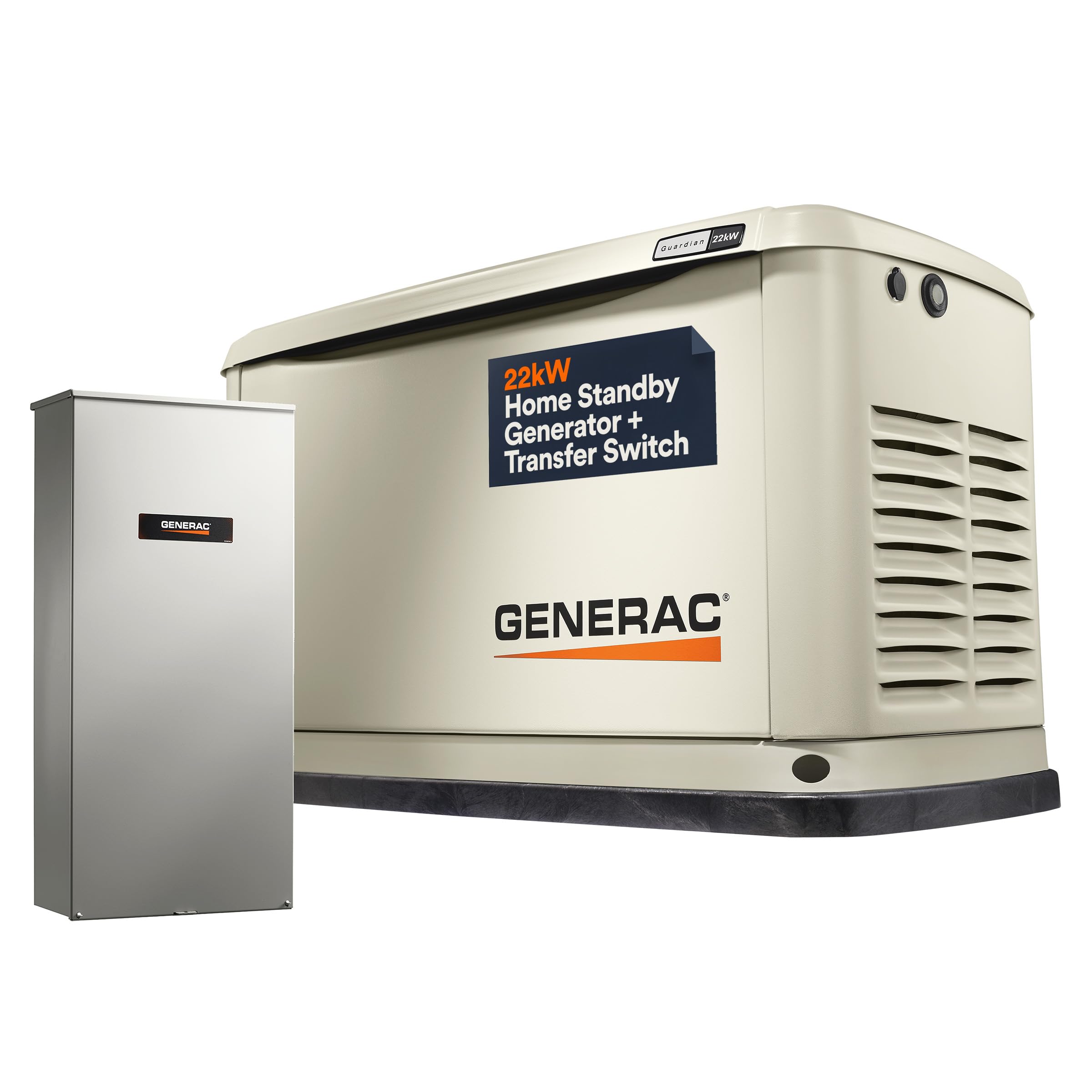
The Generac Guardian 22kW is the gold standard for automatic standby power in the residential market. It pairs a G-Force engine purpose-built for generator duty with a 200-amp NEMA 3R transfer switch that handles the entire house load automatically within seconds of a grid failure. The 22,000 watts on either natural gas or LP gas deliver enough headroom to start a 4-ton central AC, run the well pump, and power the kitchen appliances simultaneously without sagging below 240V.
True Power Technology holds total harmonic distortion under 5 percent, which keeps furnace control boards, variable-speed pool pumps, and smart home hubs running cleanly. The Mobile Link Wi-Fi module lets you monitor status, schedule weekly exercise runs, and receive maintenance alerts from anywhere — a feature that saves you from discovering a dead battery or stuck valve during an actual outage. At 466 pounds, this is a permanent installation requiring a concrete pad and licensed electrician, but the 5-year limited warranty reflects the build confidence.
Owners consistently report that the unit carries the entire house during multi-day outages, and the 200-amp smart switch integrates seamlessly with existing panels. The included aluminum enclosure is corrosion-resistant for outdoor mounting, and the sound-dampened enclosure keeps noise at neighbor-friendly levels. For buyers who want a true set-and-forget solution, this is the benchmark.
Why it’s great
- True automatic operation with integrated 200A transfer switch
- Wi-Fi remote monitoring for status and maintenance alerts
- 5-year limited warranty on the complete system
Good to know
- Must be installed by a certified electrician — not a DIY job
- Requires dedicated natural gas line or large propane tank
- Mobile Link app may require subscription for advanced features
2. GENMAX GM10500iETC Tri-Fuel

The GENMAX GM10500iETC is a rare breed — a 458cc single-cylinder inverter generator that runs on gasoline, propane, or natural gas while keeping total harmonic distortion under 3 percent. On natural gas it delivers 8,400 peak watts and 6,800 running watts, which is enough for a 3-ton central AC, well pump, and fridge if you prioritize loads. The neutral floating design makes it simple to connect to a home interlock kit or transfer switch without bonding complications.
The control panel is the most versatile in its class, featuring a 50A 14-50R outlet, a 30A L14-30R twist-lock, four 120V 20A GFCI duplexes, and an ATS automatic control port for semi-automatic standby operation. The included remote start key fob works from inside the house, and the LCD screen displays real-time wattage, voltage, and frequency so you can see exactly how close you are to the limit. The rain cover and spark plug wrench in the box show GENMAX thought about installation day.
Real-world owners highlight how quiet it runs compared to open-frame units, and the ability to tap into a natural gas line eliminates fuel storage concerns entirely. The 3-year warranty with lifetime technical support adds peace of mind, though some users note that the paperless manual requires an email request. If you want inverter-quality power with tri-fuel flexibility, this is the most complete package.
Why it’s great
- Tri-fuel capability with natural gas option for unlimited runtime
- Inverter technology with <3% THD for sensitive electronics
- Neutral floating design eases home panel bonding
Good to know
- Heavy at over 200 pounds — wheels help but not for rough terrain
- Some units reported surging under heavy mixed loads
- Manual is digital-only; request a printed copy during ordering
3. Westinghouse iGen12000DFc
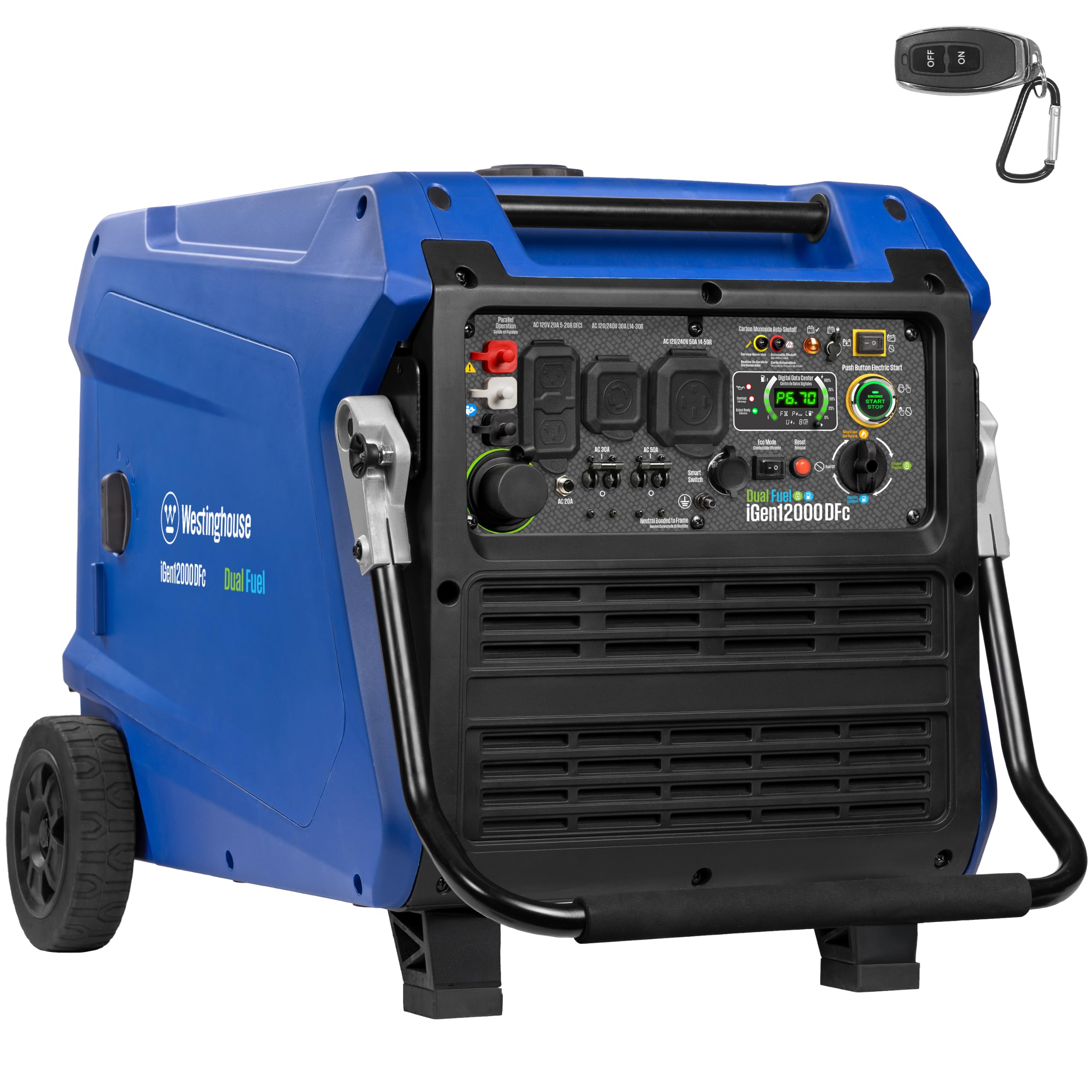
The Westinghouse iGen12000DFc packs a 457cc engine that produces 12,000 peak watts and 9,000 running watts on gasoline, with propane output at 11,000 peak and 8,100 running. The inverter architecture keeps THD at or below 3 percent, which matters when you have variable-speed mini-splits, a well pump with a soft-start controller, or a refrigerator with an electronic board. The 50A 14-50R outlet is transfer-switch ready, and the L14-30R twist-lock gives you a second 240V circuit for load splitting.
Eco Mode adjusts engine speed to match load demand, cutting fuel consumption by up to 50 percent compared to a conventional generator. On a 7.9-gallon tank at 25 percent load, that translates to 19 hours of runtime — enough to sleep through an entire overnight outage without refueling. The LED data center shows fuel level, power output, remaining runtime, and lifetime hours, so you always know the status at a glance.
Customer feedback consistently praises the remote start range of about 50 feet, the stable 242V output at 60Hz, and the fact that it can charge a Tesla at 20–25 miles per hour through the 50A outlet. The 187-pound weight with wheels makes it movable but not flimsy, and the included propane regulator kit gets you running on LP out of the box. For buyers who want inverter clean power with dual-fuel flexibility at a mid-range investment, this is the smartest pick.
Why it’s great
- Inverter architecture with ≤3% THD protects electronics
- Eco Mode cuts fuel consumption by up to 50%
- 19-hour runtime on 7.9-gallon tank at 25% load
Good to know
- Included oil unsuitable for below 23°F; needs 5W-30 synthetic
- Propane hose regulator connection may feel slightly loose
- Fuel efficiency drops noticeably under loads above 50%
4. Westinghouse WGen14500TFc Tri-Fuel
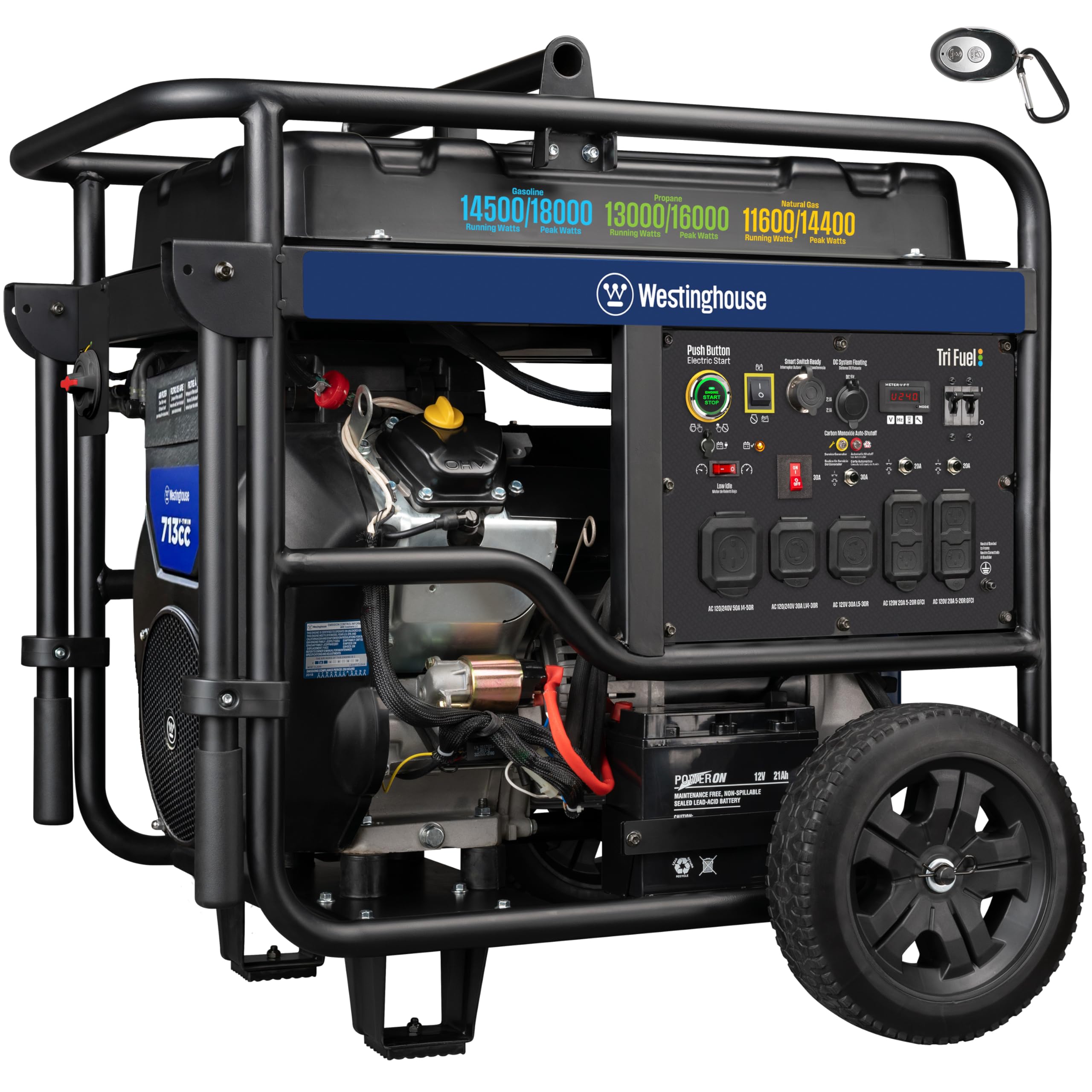
The Westinghouse WGen14500TFc is a 713cc V-Twin brute that delivers 18,000 peak watts and 14,500 running watts on gasoline, with propane at 16,000 peak and 13,000 running, and natural gas at 14,400 peak and 11,600 running. The V-Twin engine provides smoother power delivery and lower vibration than single-cylinder alternatives, and the copper windings in the alternator help the machine run cooler during extended high-load events.
The 10.5-gallon fuel tank yields up to 16 hours at 25 percent load, and the VFT data center displays voltage, frequency, and lifetime hours so you can track maintenance intervals. The control panel includes a 50A 14-50R outlet, a 30A L14-30R twist-lock, a 30A L5-30R single-phase outlet, two GFCI 20A duplexes, and two USB ports — everything you need for a full-house transfer switch connection. The push-button and remote start make starting effortless, and the CO sensor automatically shuts down the generator if harmful fumes accumulate.
Real-world owners note that 74 dBA is audible but not intrusive for a unit of this size, and the reinforced steel handles and lift bar make positioning manageable despite the 348-pound weight. Some users report that the NEMA 5-15 outlets share a single leg, which can cause unbalanced loads if you run heavy equipment on both simultaneously. For properties with electric water heaters, well pumps, and multiple AC zones, this tri-fuel machine provides the headroom you need without stepping up to a permanent standby unit.
Why it’s great
- 713cc V-Twin engine provides smooth, low-vibration power
- Tri-fuel capability with 18,000W peak on gasoline
- 10.5-gallon tank delivers up to 16 hours runtime
Good to know
- No natural gas hose included; must purchase separately
- THD measured around 5.5-5.8% — not ideal for sensitive electronics
- Battery switch must be manually turned off to prevent parasitic drain
5. Champion Power Equipment 201407

The Champion 201407 is a 459cc inverter generator that pushes 11,000 starting watts and 9,000 running watts while staying at 64 dBA from 23 feet — quiet enough to hold a conversation next to it. The remote start key fob works from up to 80 feet away and includes a stop function, so you can start or kill the generator from your porch without stepping into rain. The CO Shield carbon monoxide auto-shutoff system adds a layer of safety for installation near windows or garage doors.
The 5.5-gallon tank delivers 10 to 12 hours of runtime under moderate loads, and the parallel-ready outlets let you double output with a second Champion inverter. The control panel includes two 120V 20A GFCI duplexes, a 120/240V 30A locking outlet, a 120/240V 37.5A outlet, and a 12V automotive-style port for battery charging. Cold Start Technology primes the engine automatically in freezing temperatures, and the battery-included electric start eliminates pull-cord frustration.
Owners frequently describe this as a “whole-house monster” that powered a 3-ton AC, electric water heater, oven, fridge, and TVs for four straight days without hesitation. The 200-pound weight with the included wheel kit makes it portable enough to maneuver around the yard, and the 3-year limited warranty with free lifetime tech support sets Champion apart from most competitors. The only recurring complaint is a CO sensor that can be overly sensitive in confined outdoor spaces, triggering shutdown even with excellent ventilation.
Why it’s great
- 64 dBA noise level — one of the quietest in its power class
- Remote start key fob with 80-foot range
- Cold Start Technology for reliable winter operation
Good to know
- CO sensor may trigger false shutdowns in tight outdoor spaces
- Fuel gauge is difficult to read in low light
- Some units arrived with cracked casing; Champion sends free replacements
6. Generac Guardian 26kW with 200A Transfer Switch
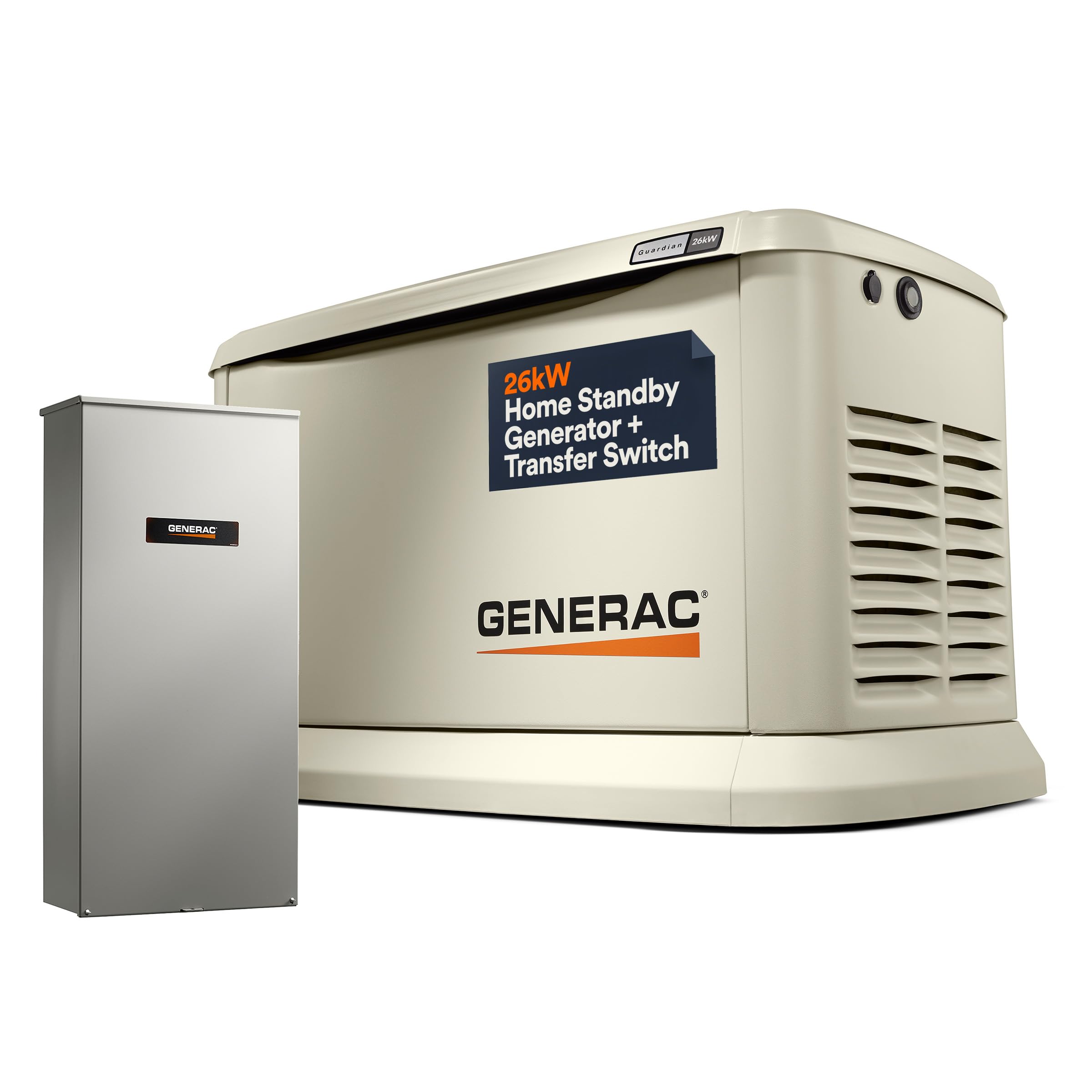
The Generac Guardian 26kW is the top-tier automatic standby solution for homes with electric heat pumps, dual water heaters, or a workshop with heavy machinery. The 999cc G-Force 1000 Series engine produces 26,000 watts on natural gas or LP gas, and the 200-amp NEMA 3R transfer switch switches the entire house load within seconds of a grid failure. True Power Technology keeps harmonic distortion under 5 percent, so the output is clean enough for smart appliances, home servers, and variable-speed HVAC systems.
Mobile Link Wi-Fi connectivity provides remote monitoring of generator status, battery voltage, and maintenance alerts, and you can schedule weekly exercise runs to keep the engine lubricated and the battery charged. The low-maintenance G-Force engine uses fewer moving parts than standard automotive engines, reducing the risk of valve sticking or oil starvation during long idle periods. The aluminum enclosure is corrosion-resistant and designed for permanent outdoor mounting on a concrete pad.
Customer feedback highlights the peace of mind that comes with the 5-year limited warranty and the ability to run the entire home without load shedding. The 518-pound weight is typical for this class, but the reinforced lift bar makes crane or hoist positioning straightforward. Some owners report the noise is “loud but tolerable” — roughly equivalent to a central AC condenser running at full speed. For buyers who want maximum power reserve and are willing to invest in professional installation, this is the definitive choice.
Why it’s great
- 26,000W output handles entire home including electric HVAC
- G-Force 1000 Series engine designed for generator duty cycles
- 5-year limited warranty on complete generator and transfer switch
Good to know
- Delivery logistics can be problematic; schedule lift gate service
- Some units arrived with used or damaged panels
- Wi-Fi module requires setup and strong home network
7. DuroMax XP15000HX
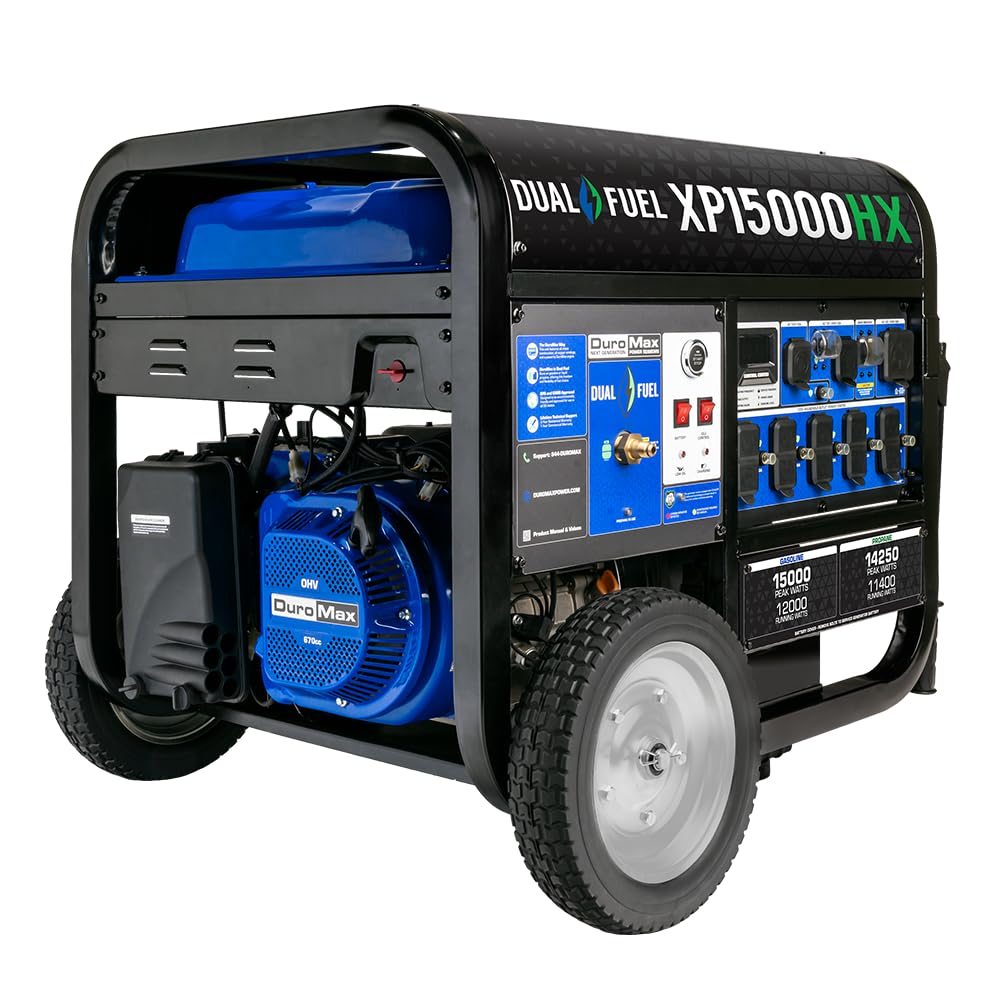
The DuroMax XP15000HX is a 670cc dual-fuel heavyweight that delivers 15,000 peak watts and 12,000 running watts on gasoline, with slightly lower ratings on propane. The all-copper windings are a meaningful differentiator — copper conducts heat better than aluminum, which extends the generator’s life under sustained high loads. The push-button electric start and front-facing fuel selector let you switch between gasoline and propane in seconds without juggling hoses or levers.
The digital multimeter displays voltage, frequency, total hours run, and time until recommended maintenance, giving you the data you need to stay on top of oil changes and valve adjustments. The CO Alert system automatically shuts down the generator if carbon monoxide levels become dangerous, which is a critical safety feature if the generator is near living spaces. The control panel includes five 120V GFCI household outlets, a 120V 30A RV outlet, a 120/240V 30A twist-lock, and a 120/240V 50A outlet ready for transfer switch connection.
Owner experiences are mixed but generally positive for the price tier — many report the unit powers their entire property “like normal” during outages, while a small number experienced defective units or even a fire in one rare case. At 345 pounds, this is a unit that stays on a wheel kit and only moves for maintenance. The 5-year warranty is solid for the category, and the included remote control adds convenience. For buyers who need high surge capacity on a tighter budget, the XP15000HX delivers the raw power without the inverter premium.
Why it’s great
- All-copper windings for better heat dissipation and longevity
- 15,000W peak provides ample headroom for large homes
- CO Alert auto-shutdown for safety during outdoor use
Good to know
- Runs loud — 74+ dBA under load may disturb neighbors
- Not an inverter; THD above 5% can stress sensitive electronics
- Some replacement oil filters are too long and require repositioning
FAQ
Can I use a portable generator as a permanent standby without a transfer switch?
How often should I exercise my standby generator?
Is natural gas or propane better for a standby generator?
Why does my inverter generator shut off when I connect a well pump?
Final Thoughts: The Verdict
For most users, the best auto standby generator winner is the Generac Guardian 22kW because it delivers true automatic standby power with a 200-amp transfer switch, Wi-Fi monitoring, and a 5-year warranty — all at a price point that undercuts dealer markup. If you want inverter-clean power with tri-fuel flexibility, grab the GENMAX GM10500iETC. And for budget-conscious buyers who need raw surge capacity, nothing beats the DuroMax XP15000HX.