
Our readers keep the lights on and my morning glass full of iced black tea. As an Amazon Associate, I earn from qualifying purchases.
Specs are compiled from manufacturer listings and verified buyer reviews and can change over time — please confirm the key details on the product page before buying.
Setting ignition timing is one of those jobs that is either dead simple or a total headache, and the tool in your hand is what makes the difference. A weak or unreliable strobe leaves you guessing at the marks, wasting time on a second set of hands, or chasing a misfire that is actually a bad connection at the clamp. The right auto timing light delivers a precise flash, reveals the advance curve, and gets you back on the road quickly.
I’m Min — the founder and writer behind Gadgets Feed. This guide is built by comparing the manufacturers’ published specifications and the patterns across verified customer reviews, so you get each pick’s real strengths and trade-offs instead of marketing spin.
Whether you are dialing in a vintage flathead or tweaking a modern street machine, finding the right auto timing light means matching the RPM range, power source, and feature set to the engines you actually work on — no more, no less.
Our Picks at a Glance


How To Choose The Best Auto Timing Light
Picking a timing light depends on three big trade-offs: where its power comes from, if you need a digital display, and how bright the flash needs to be for where you work. The best choice depends on the vehicles you work on and your typical under-hood conditions.
Power Source: Self-Powered vs. 12V Wired
Self-powered lights run on their own D-cell batteries, which means you can use them on any engine — a 6V Model A, a motorcycle with a dead battery, or a track car with the battery relocated to the trunk — without hooking up clips to the battery. The trade-off is that you carry the weight of the batteries (usually two D cells). Wired 12V lights pull power directly from the car’s battery or cigarette lighter. They are often lighter and never suffer from dimming batteries, but you are tethered to a running engine with a healthy electrical system. If you work on a mix of old and new vehicles, self-powered is the safer choice.
Dial-Back Advance vs. Simple Strobe
A simple timing light flashes only at the moment the No. 1 spark plug fires. To check mechanical or vacuum advance, you need to use a timing tape on the harmonic balancer, then manually calculate degrees. A dial-back timing light lets you set an advance value (say 10° or 32°) right on the tool. The light then retards the flash by that many degrees, so the timing mark on the balancer reads zero — you read total timing in one glance. This saves significant time on modern engines and is essential for tuning beyond base timing. Expect to pay more for accuracy; the best dial-back models maintain precision even as RPM climbs.
Xenon vs. LED Strobe Brightness
Xenon flash tubes produce a very intense, white burst of light. They cut through direct sunlight better than most LEDs, making them the default for professional shops that tune cars outdoors. However, xenon bulbs have a shorter lifespan and the flash is a strobe — it pulses, it does not stay on. LED strobes are more durable, use less power (important for rechargeable models), and some modern units are bright enough for shaded garages. But a low-brightness LED can be completely useless on a sunny driveway. If you do most of your work inside a shop, either works. If you tune in full daylight, prioritize a xenon light or a LED model proven for high brightness.
Quick Comparison
| Model | Best For | Max RPM | Power Source | Strobe Type | Amazon |
|---|---|---|---|---|---|
| ESI 130 Self-Powered★ Best Overall | Ultimate Reliability | 14,000 RPM | 2 D-Cell Batteries | LED | Amazon |
| Innova 3555Also Great | Best Overall | 9,990 RPM | 12V Wired | Xenon | Amazon |
| MSD 8992 ProPremium Flash Power | Premium Build & Flash | — | 12V Wired | Xenon | Amazon |
| KZYEE KT80 | Most Versatile Digital | — | USB-C Rechargeable | LED (Adjustable 60°) | Amazon |
| KZYEE KT60 | Budget Digital Display | — | 12V Wired | Xenon | Amazon |
| THIKPO Digital Auto | Budget Digital Display | 9,990 | 12V Wired | Xenon | Amazon |
| ESI 125 Digital Tach | Reliable Shop Tool | 9,999 RPM | 12V Wired | Xenon | Amazon |
| ANCEL LT70 | Cordless Digital Tuning | — | Rechargeable + 12V Backup | LED | Amazon |
| Performance Tool W80578 | Budget Entry-Level | — | 2 D-Cell Batteries | Xenon | Amazon |
In‑Depth Reviews
1. ESI 130 Self-Powered Timing Light
Our pick — over 4.5★ from 200+ verified ratings; the strongest balance of quality and price.
The self-powered workhorse that fires strong on 6V, 12V, and everything in between.
The ESI 130 is the gold standard for anyone who steps away from modern 12V cars. It runs on two D-cell batteries, which means no battery clips, no drawing power from a weak electrical system, and no issues with positive-ground or 6V setups. The protective heat sleeving on the lead is rated for up to 1,200°F, so you can route it near exhaust manifolds without melting it. It fires accurately up to 14,000 RPM — a 713.6x gap in range compared to the Innova 3555’s 9,990 RPM, meaning it keeps a steady flash at much higher engine speeds. At just 11.2 ounces, it is lighter than the Performance Tool W80578 (13.6 oz, a difference of about 21%), so it does not weigh down your hand during a long tuning session.
Users consistently praise its build quality and reliability. As owners put it: “Flashes reliably above 4,000 RPM, unlike cheaper lights.” It uses a rugged sheet-metal inductive clamp, not the thin plastic found on budget units. The LED flash is bright at all speeds, and the simplicity of the self-powered design means no troubleshooting a bad ground wire. It is also compatible with MSD ignition systems — a common pain point for cheaper lights. The downsides are the premium price and the need to supply your own D-cell batteries.
Perfect for the vintage fleet owner: if you regularly work on 6V cars, positive-ground vehicles, or engines without a reliable battery, this is the only choice that eliminates the wiring headache. The trade-off is its cost and the ongoing need for batteries, but the consensus is clear: it pays for itself the first time it flashes on a car that no other light can touch.
Who it suits: classic and vintage car enthusiasts, motorcycle tuners, and professional shop mechanics who need a dependable light that works on any voltage.
Who might pass: the home DIYer on a strict budget who only tunes modern 12V engines and can use a wired light with fewer upfront costs.
2. Innova 3555 Advance Timing Light
The dial-back champion that brings shop-level precision to any garage.
The Innova 3555 is the timing light that keeps popping up in conversations because it does the hard part right. A patented skip circuitry test reads engine speed up to 9,990 RPM, and the direct-reading advance scale adjusts from 0 to 60 degrees — so you can check base timing and total mechanical advance without a timing tape. The result is a tool that works with conventional, electronic, and computer-controlled ignitions on domestic and import cars.
What wins people over is the strong flash and accurate inductive pickup. Owners confirm that the dial-back feature matches the balancer marks exactly — one report describes how the TDC and pointer aligned perfectly at the 10° setting. The slim, rotating barrel makes it easier to aim at awkward timing marks tucked behind fans and pulleys. The main trade-off is brightness: it is sufficient for most situations but not as intense as the top-tier xenon guns in direct sunlight.
What Pulls Ahead
- Patented Skip Circuitry reads up to 9,990 RPM for accurate high-rpm timing checks
- Dial-back advance scale (0–60°) eliminates the need for timing tape
- Strong inductive pickup and reliable flash verified by owners at specific advance settings
The Honest Trade-Off
- Flash brightness is good but not the strongest for direct-sunlight work
- Buyers report the unit lasts about five years before needing replacement
Reach for it if: you want a proven, feature-rich dial-back light that does everything from base timing to full advance checks on most modern and classic engines.
Look elsewhere if: you need a self-powered unit for 6V systems, or if you tune exclusively in bright sunlight and need the brightest possible xenon flash.
3. MSD 8992 Timing Pro Timing Light
The simple, brutally bright MSD light that just works with aftermarket ignitions.
The MSD 8992 is a straightforward, no-dial-back timing light built for one thing: delivering a rock-solid flash with aftermarket electronic ignitions — the kind that often cause less expensive lights to skip or fade. It uses a secure pickup and a bright xenon strobe, and owners confirm it does not retard the flash as RPM increases, so your reading stays honest all the way up the rev range. This makes it a natural pairing with MSD’s own ignitions, Holley EFI systems, and other high-energy setups where other dial-back guns fail.
Brightness is its standout feature. Owners describe loving the bright strobe light, and the feedback loop on performance is consistent: it works on systems where Snap-On and Matco dial-back lights have trouble. The trade-off is the price — it carries a premium cost, and the value-for-money discussion is the most common note among buyers. It is also a simple strobe light with no advance dial, so you need a timing tape to check full advance. But if your engine has a high-output ignition, this is the light that keeps flashing when others quit.
Where It Excels
- Bright, stable xenon strobe that works with MSD and aftermarket electronic ignitions
- No flash retard as RPM increases, giving you accurate high-rpm timing
- Detachable leads for easier storage and cable replacement
The Catch
- Premium price that generates mixed value-for-money opinions among buyers
- No dial-back or digital advance display — requires a timing tape for total timing checks
Best for: serious engine builders with high-energy ignitions and aftermarket EFI who need a strobe that does not miss a beat at high RPM.
Not for: a home mechanic on a budget who wants a digital readout or dial-back convenience for general engine tuning.
4. KZYEE KT80 Digital Timing Light with Tachometer
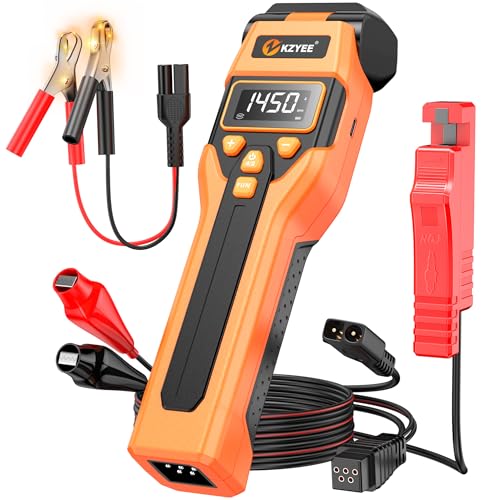
The digital Swiss Army knife that combines timing, dwell, and voltage in one rechargeable package.
The KZYEE KT80 is the most fully-featured digital timing light on this list. It packs a timing light, tachometer, dwell meter, and a 0–35V voltage tester into one housing. The 60° adjustable LED strobe head lets you aim around belts and fans without contorting your arm. It runs on a built-in rechargeable battery via USB-C for cordless quick checks, and it comes with a 12V backup lead for extended tuning sessions. It works on both 6V and 12V distributor gas engines, including classic cars, vintage motorcycles, and marine engines.
The all-in-one design removes the need for a separate tachometer and voltmeter during ignition service. The strobe itself is rated for over 1,000,000 flashes, and the adjustable head is a genuine help in tight engine bays. The downside is the inconsistency reported by some buyers: a small number of units have suffered from early failure on the second use, and the customer service response has been hit-or-miss. The brightness is decent for garage work but not the strongest on this list.
The Big Strengths
- Combines timing, tachometer, dwell, and voltage testing in one rechargeable tool
- 60° adjustable LED strobe head for aiming in tight engine bays
- USB-C rechargeable with a 12V backup for uninterrupted long sessions
The Real Talk
- Inconsistent quality control — some units fail after the first use
- LED strobe is not the brightest for outdoor use in direct sunlight
Reach for this if: you want a single cordless tool that does timing, dwell, and voltage checks, and you work mostly in a garage where the LED strobe is bright enough.
Pass on it if: you need bulletproof reliability for daily shop use, or you tune outdoors in full sun and need a more powerful flash.
5. KZYEE KT60 Digital Timing Light

A digital step up that brings real-time RPM and advance angle to the non-premium price table.
The KZYEE KT60 delivers a bright LCD screen that shows real-time RPM and an adjustable 0–90° advance angle, taking the guesswork out of ignition timing on distributor-equipped engines. The directional clamp is designed to capture consistent ignition signals from the No. 1 spark plug wire, and the xenon strobe works on 2-stroke and 4-stroke gasoline engines for cars, motorcycles, marine, and classic cars. It is not compatible with diesel, hybrid, or coil-on-plug systems.
For the price, the digital readout is a genuine feature upgrade over basic strobe lights. Owners appreciate that it provides precise ignition timing, RPM, advance angle, and skip-fire detection — all on one display. The build quality and ease of use get consistent positive marks. The trade-off is the strobe brightness: it is adequate in a darkened garage but noticeably dim in daylight. The reliability of the unit also draws mixed feedback, with a small number of owners reporting that the light fails to work on the first use. The instructions are poor, but online guides fill the gap.
Great entry point to digital tuning: if you are comfortable learning a slightly more complex tool and working indoors, the KT60 gives you digital precision without the premium price. For outdoor tuners or those who value absolute reliability over features, the trade-offs in brightness and consistency may send you toward a simpler analog model.
Good fit for: the DIY tinkerer who wants real-time RPM and advance data on a budget, and works in a garage or shaded area.
Better choices exist if: you tune exclusively in daylight or need a shop-grade tool that must work every time without troubleshooting.
6. THIKPO Digital Automotive Timing Light

The digital newcomer with a high-definition display that tracks RPM and advance angle in real time.
This THIKPO timing light brings a modern, data-rich approach to ignition tuning. Its high-definition display monitors ignition advance angle from 0 to 90° and RPM from 249 to 9,990 — both displayed in real time as you squeeze the trigger. It uses a bright linear xenon flash tube designed to be visible in daylight. The inductive clamp is polarity-protected and impact-resistant, and the housing has passed multiple drop tests. It works on 2-stroke and 4-stroke 12V gasoline engines across automotive, agricultural, and marine applications.
The digital readout is a clear advantage for solo tuners: you can set the advance number, switch to RPM mode, rev the engine to spec, and adjust the distributor until the timing mark reads zero. The adjustable advance angle range goes up to 90°, which covers virtually any engine’s total timing needs. The recurring issue is the xenon light itself — several owners mention it is weaker than their older analog lights and difficult to see in daylight. The plastic clip on the plug wire is also a weak point; one owner reported it melting after a single use when placed near the exhaust manifold.
What Stands Out
- Digital display shows RPM and advance angle in real time for precise solo tuning
- Adjustable advance angle range from 0–90° covers most engines
- Polarity-protected and drop-tested housing adds durability
The Shortcomings
- Xenon flash is weaker than many basic analog lights, especially in daylight
- Plastic clamp can melt if placed too close to the exhaust manifold
Best for: the budget-conscious tuner who wants digital RPM and advance data and works mostly indoors or in the shade.
Think twice if: you work under the sun, or you need a timing light with a heavy-duty clamp that can live near hot engine parts without damage.
7. ESI 125 Digital Tach Advance Timing Light

The simple, no-nonsense digital tach advance light that does exactly what the dial says.
The ESI 125 keeps things straightforward: a bright digital display shows RPM and advance degrees, the xenon flash has a brilliant strobe at all speeds, and the detachable cable set makes storage and replacement easy. It is accurate up to 9,000 RPM with a measurement accuracy of +/- 1%, and it handles both 2-stroke and 4-stroke engines. It comes from the same manufacturer known for the excellent ESI 130 self-powered light, so the build quality is a known quantity.
Owners appreciate the easy-to-use controls, the big readout, and the fact that it performs as well as the high-dollar lights many have used in professional shops. It is light at 8 ounces and features simple switches for all functions. The catch is a design quirk: it defaults to a 10° advance setting every time you turn it on, which means you must manually reset it to 0° for base timing. A few owners have reported inconsistent readings or failures, with one display showing incorrect data from the start. The strobe is also not the brightest in the ESI lineup for direct-sun work.
A solid shop addition with a quirk: if you can build the habit of resetting the advance dial to zero, this is a reliable, accurate digital timing light that punches above its weight. The occasional quality control issue and the 10° default are real downsides, but for many, the performance and price make it a strong choice for a second light or a daily driver in a home shop.
Reach for it if: you want a digital tach advance light from a proven brand and you are disciplined about setting the advance dial before each use.
Look elsewhere if: you need the brightest possible strobe for outdoor work, or if the idea of an automatic 10° advance default that could cause a timing error is a dealbreaker.
8. ANCEL LT70 Digital Timing Light
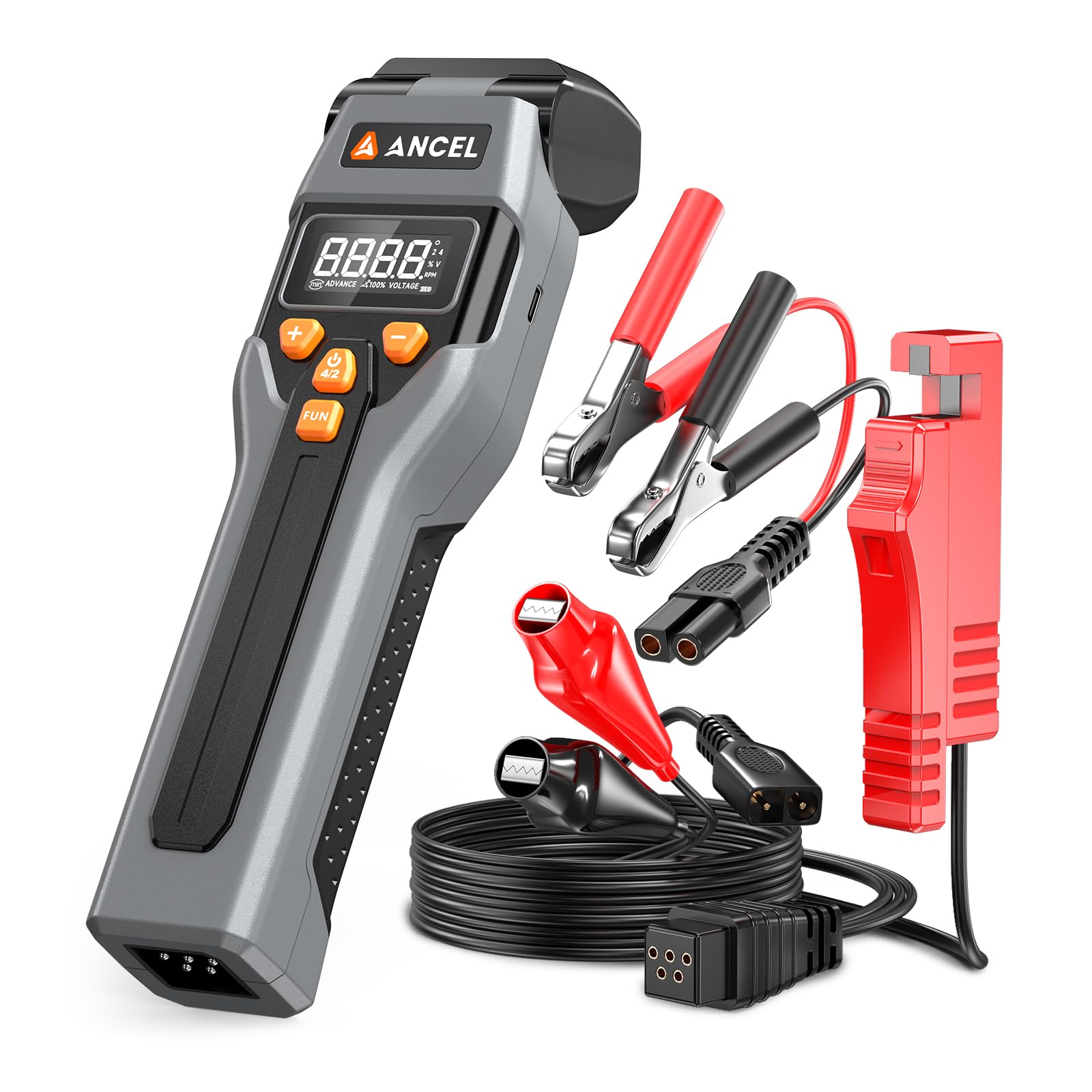
The 5-in-1 cordless light that checks timing, dwell, and voltage without the cable tangle.
The ANCEL LT70 is a digital Swiss Army knife for engine tuning. It combines timing, RPM, dwell angle, advance timing, and voltage tests in one tool. The upgraded LED strobe is designed to be clearer in tight engine bays, and the 60° adjustable light head helps you aim around obstacles without moving the whole tool. The big differentiator here is the cordless operation: a built-in rechargeable battery with Type-C charging lets you work without trailing a power cable, and the included 12V backup lead keeps you running during longer sessions when the battery runs low.
Owners appreciate the ability to adjust the advance degree directly on the light, see the dwell angle, and monitor RPMs all from one display. The build quality has survived concrete drops in some cases, and the fewer wires are a real plus over older timing lights. The brightness is the recurring frustration: the LED strobe is dim, and several owners describe it as unusable outdoors. One buyer summed it up: “LED light is not bright makes it very hard to set timing.” If you work indoors, it is functional; if you tune in the driveway, it will frustrate you.
The Cordless Advantage
- 5-in-1 functionality combines timing, tach, dwell, advance, and voltage in one tool
- Built-in rechargeable battery with Type-C charging and 12V backup for extended use
- 60° adjustable head improves access in crowded engine bays
The Big Caveat
- LED strobe is dim — difficult or impossible to use for timing in direct sunlight
- Some customers note poor build quality and unreliable performance
Best for: the DIYer who does all their timing work in a garage or shop and wants a single cordless tool for multiple ignition checks.
Avoid for: outdoor tuning or any situation where you need a bright, reliable flash you can see in daylight.
9. Performance Tool W80578 Self-Powered Timing Light

The budget-priced self-powered light that trades brightness for versatility on 6V and 12V engines.
The Performance Tool W80578 is the entry point for anyone who needs a self-powered timing light without the premium price tag. It runs on two D-cell batteries just like the ESI 130, so it works on 6V and 12V cars without battery clips. The xenon bulb is described by the maker as “super bright” for daylight conditions. It also includes a work light function that helps you see in low-light engine bays. The detachable inductive pickup works with magnetos, expanding its usefulness on small engines, motorcycles, and outdoor power equipment.
The functionality and value are the biggest positives here — it works on a wide range of engines and the price is hard to argue with. At 13.6 ounces, it is heavier than the ESI 130 by about 21%, but still manageable. The brightness is the most discussed drawback. Owners say the timing light LED is bright enough except in direct sunlight, and the included flashlight is essentially useless. The on/off switch on top feels finicky to some. A few units have arrived unable to strobe at all, behaving like a dim flashlight instead of a timing light. This is a solid light for a shade-tree mechanic working in a garage, but not for a pro who tunes outside.
The Value Points
- Self-powered design works on 6V and 12V without battery clips
- Xenon bulb is bright enough for garage use and includes a work light function
- Works with a wide range of engines: gas engines, motorcycles, mowers, and tractors
The Trade-Offs
- Brightness is marginal — not strong enough for outdoor use in direct sunlight
- On/off switch can feel finicky, and some units arrive defective or unable to strobe
Who it is for: the budget-minded home mechanic who needs a self-powered light for occasional tuning in a garage or shop environment.
Who should skip it: anyone who works outdoors, needs a bright daylight flash, or relies on a timing light for daily professional use.
Understanding the Specs
Self-Powered vs. 12V Wired Operation
The power source determines where and how you can use the timing light. Self-powered lights run on internal D-cell batteries, so they work on 6V systems, positive-ground classics, and vehicles with dead batteries or relocated batteries (like race cars). The trade-off is the added weight and the ongoing cost of replacing batteries. Wired 12V lights are lighter and pull power from the car’s own battery via clips, but they require a running engine with a healthy electrical system to power the flash. If you only work on modern 12V cars, a wired light is cleaner and cheaper. If you touch anything older, a self-powered unit is the safe bet.
Dial-Back Advance and Digital Displays
A dial-back advance feature lets you set a specific advance angle (like 15° or 30°) on the tool itself. The light then retards the flash by that amount, making the timing mark on the balancer appear at zero degrees. This lets you check total mechanical advance with one glance instead of using a timing tape and doing math. Digital displays go a step further, showing the actual RPM and advance angle in real time on an LCD screen. This is particularly useful for tuning alone, as you can watch the RPM climb and the advance change while you adjust the distributor. The accuracy of the dial-back mechanism varies by price point; the best units maintain precision even at high RPM.
FAQ
Will a self-powered timing light work on a 6V positive-ground car?
What is the difference between a xenon strobe and an LED strobe in a timing light?
Can I use a timing light on a distributor-less ignition system (COP, DIS)?
How accurate are dial-back timing lights at high RPM?
How do I know if a timing light will work with my MSD or aftermarket ignition system?
What does the RPM reading on a digital timing light actually tell me?
How long does the battery last in a self-powered timing light?
Is a timing light the same as a timing gun?
Can I use a 12V wired timing light on a lawn mower or small engine?
What is the most reliable brand of timing light?
Final Thoughts: The Verdict
Across the board, the auto timing light winner is the Innova 3555 because it combines the most-wanted features—a proven dial-back advance scale, strong flash, wide 9,990 RPM range, and compatibility with most ignition systems—at a price that still feels fair. If you work on 6V classics or want to eliminate battery clip frustration, grab the ESI 130 Self-Powered. And for high-energy aftermarket ignitions where nothing else holds a flash, the MSD 8992 is the one to reach for.
How We Picked
We do not accept paid placement. Every pick is matched to a real buyer and a real use-case; we do not hands-on test units.
Sources & Methodology
Specifications: manufacturer listings and product documentation. Review insights: verified customer reviews, as of July 2026. Pricing: not shown on this page (it changes often); check the current price via the retailer link.
As an Amazon Associate, Gadgets Feed earns from qualifying purchases. This does not affect which products we feature.