
Our readers keep the lights on and my morning glass full of iced black tea. As an Amazon Associate, I earn from qualifying purchases.
Specs are compiled from manufacturer listings and verified buyer reviews and can change over time — please confirm the key details on the product page before buying.
If you drive on roads treated with salt or brine, your frame is slowly rusting from the inside out. The right undercoating spray stops that by adding a sacrificial layer that takes the abuse instead of your metal. Your main decision is between a hard, chip-resistant shell or a self-healing wet film that seeps into every hidden cavity.
I’m Min — the founder and writer behind Gadgets Feed. This guide is built by comparing the manufacturers’ published specifications and the patterns across verified customer reviews, so you get each pick’s real strengths and trade-offs instead of marketing spin.
From frame rails to wheel wells, these sprays seal out moisture, road salt, and stone chips to keep your vehicle’s undercarriage solid for years to come.
Our Picks at a Glance


How To Choose The Best Auto Undercoating Spray
Undercoating falls into two camps, and picking the right one is the whole game. Rubberized coatings dry into a hard, flexible shell that shrugs off stone chips and road spray. Lanolin-based coatings stay wet and oily, creeping into seams and boxed frame rails where a hard shell can’t reach.
Wet film vs. hard shell
If you want to protect the inside of your frame rails — the #1 rust trap on trucks and SUVs — you need a product that flows. Lanolin and oil-based sprays creep into enclosed areas and self-heal if scraped. Rubberized coatings are better for visible surfaces like wheel wells and the outside of the chassis where you want impact protection and a clean finish.
Coverage and application method
An aerosol can with a nozzle tube is perfect for spot-treating rockers, bolt holes, and small cavities. A full underbody or a long truck frame is a gallon-and-a-gun job — you’ll need a spray gun and an air compressor, and you’ll use a lot more product than you think. Match the container size to the size of the job or you’ll run out halfway.
The prep matters more than the product
Every serious undercoating needs a clean, dry, rust-free surface to bond to. Loose rust, grease, and wax will lift any coating off in months. Expect to spend as much time with a wire brush and degreaser as you do with the spray can — that’s the difference between 2 years of protection and 10.
Quick Comparison
| Model | Best For | Type | Size | Protection Style | Amazon |
|---|---|---|---|---|---|
| Eastwood Internal Frame Coating★ Best Overall | Inside frame rails & cavities | Rust converter aerosol | 14 oz | Hard, gloss finish | Amazon |
| Woolwax 1-GallonLong-Term Seal | Whole undercarriage, salt belt | Lanolin wet film | 1 gallon | Self-healing, stays wet | Amazon |
| Rusfre RUS-1020F1Best Value | Full chassis with a spray gun | Rubberized spray | 1 gallon | Hard, smooth finish | Amazon |
| Rust-Oleum Pro Grade | Underbodies, wheel wells, DIY | Rubberized aerosol | 443.6 ml | Hard, matte finish | Amazon |
| POR-15 Rubberized | Chassis & sound deadening | Rubberized liquid | 22 fl oz | Satin, sound-dampening | Amazon |
| Barrier Bond | Matching OEM textures | Rubberized liquid | 28 oz | Coarse texture, hard | Amazon |
| Eastwood Chassis Black | Visible chassis, OEM look | Acrylic aerosol | 14 fl oz | Hard, gloss finish | Amazon |
| B’laster Surface Shield | Quick spray, no prep | Lanolin aerosol | 6-pack | Waxy, self-healing | Amazon |
| RustKote Rust Fighter | Spot-treating & salt neutralizer | Corrosion inhibitor aerosol | 15 oz | Creeping, moisture-lifting | Amazon |
In-Depth Reviews
1. Eastwood Internal Frame Coating Aerosol
Our pick — over 4.5★ from 900+ verified ratings; the strongest balance of quality and price.
The 360° wand that coats the inside of your frame — the rust you can’t see.
This is the pick for the rust that lives inside boxed frame rails, rockers, and bolt holes — the places a normal spray can simply can’t reach. The 360-degree spray wand (a flexible tube with nozzles that spray in all directions) threads into frame openings and coats the inside walls evenly, which makes it nearly perfect for frames and decent for tight cavities.
This spray both prevents rust and stops existing rust in one formula. The 14 oz can delivers a gloss black finish that dries in 24 hours, and buyers report it’s a go-to for interior frame coating — one owner used it on a 20 year old SUV and called the process easy, just messy. The downside: the tube has no support and can flail, so some owners tape a straightened clothes hanger to it for control.
Quality is the thing everyone raves about here — how well it performs in tight spaces and inside frames, adding years to a vehicle’s life. At 1.1 pounds, it’s the lighter of the two Eastwood cans here, and the 90-day warranty backs it up. If you’re restoring a classic or just want to stop rot before it starts, this is the one.
seals tight spots
- 360° wand coats inside frame rails you can’t see or touch
- Combines rust prevention and rust conversion in one pass
- Dries fast and even, with a clean gloss finish
thin film only
- Tube flails without support — add a hanger for control
- Finds any gap and tends to drip, so watch seams
- Coverage earns mixed notes; buy a can more than you think
frame coat: any owner fighting rot inside boxed rails or restoring a classic should start here — it’s the only true internal-frame tool in this lineup.
skip for thick: if you only need to coat visible surfaces, a simpler aerosol gives you the same finish without the tube management.
2. Woolwax 1-Gallon Jug
The wet-film champion that creeps into frame rails and never dries, cracks, or washes off.
Woolwax is the anti-rust strategy in a different league: it sprays on wet and stays wet, forming a self-healing film that creeps into frame rails, rockers, doors, and other sealed cavities. Because it never dries hard, it can’t crack or peel like rubberized coatings — it just keeps moving and protecting.
The formula uses more raw wool-grease (lanolin) than competitors, making it thicker and more resistant to wash-off, with undercarriage corrosion protection rated at 2 years or more. Enclosed protected areas are protected indefinitely — many years by the maker’s estimate. It’s solvent-free, made in the U.S.A., and has almost no smell, which owners appreciate.
This is a gun-and-compressor job: the maker says to apply at 70-90 psi, and owners recommend heating the jug in hot water when it’s cold. One buyer used under 3/4 of a gallon on a 2025 Outback and found it smooth and thick but not drippy — it stays where you point it and doesn’t drip on the floor. The recurring note is that it’s messy to apply, but the rust protection is worth it.
big jobs: you live in the salt belt, own a boxed-frame truck, and want protection that reaches every hidden seam for years without cracking.
not for small: you want a clean, dry, hard shell — this stays oily by design, so it’s not for show cars.
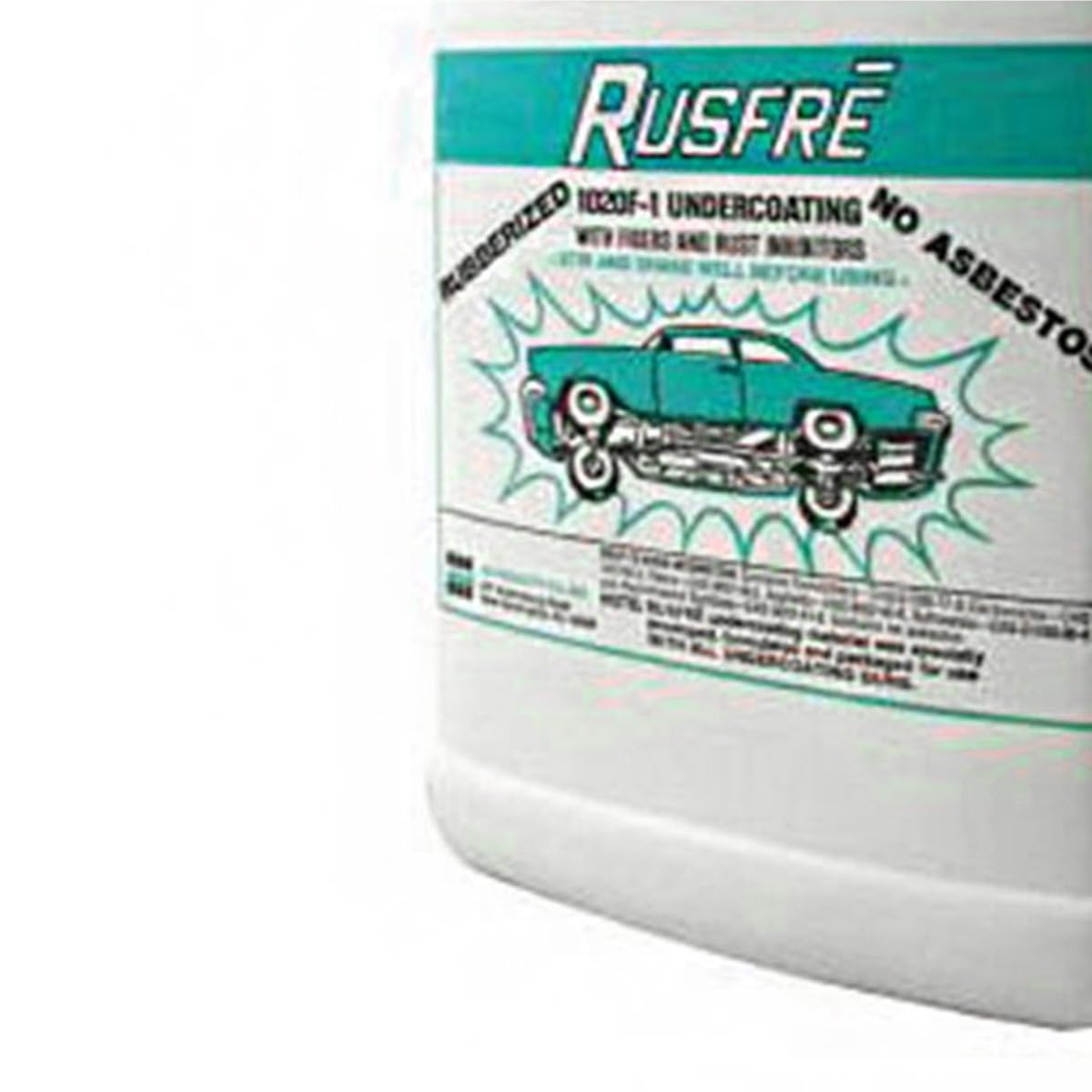
3. Rusfre Spray-On Rubberized Undercoating (1-Gallon)
A gallon of truck-grade armor for the price of three aerosols.
When you need to coat a whole chassis, a 1-gallon jug beats a shelf of aerosol cans on cost and consistency. This rubberized coating comes as smooth black liquid designed for a spray gun, and it fills small holes effectively — one owner called it the best undercoating on the market after 20 years of use.
The finish is a tough, durable black that adheres well to clean surfaces and looks very nice. That longevity is the headline: a long-time user reports that after sandblasting and coating, it survived five New England winters with zero rust, where factory paint rusted in under 6 years. It’s permanent adhesion, which is exactly what you want — until you want to remove it.
The honest trade-offs are real. The overspray is extreme, requiring full disposable protection and solvent cleanup, and it’s messy and hard to remove once cured. Drying gets mixed reviews — some find it fast, others say it takes up to 24 hours for a full cure. If you’re coating a truck, do it on a day you can leave the garage doors open.
heavy coat: serious DIYers coating trucks, trailers, or tractors get the most protection per dollar here — if you’ve got a compressor, this is your value king.
skip if hurry: you hate messy cleanup or need a quick, contained aerosol job for a single panel.
4. Rust-Oleum Stops Rust Pro Grade Rubberized Undercoating
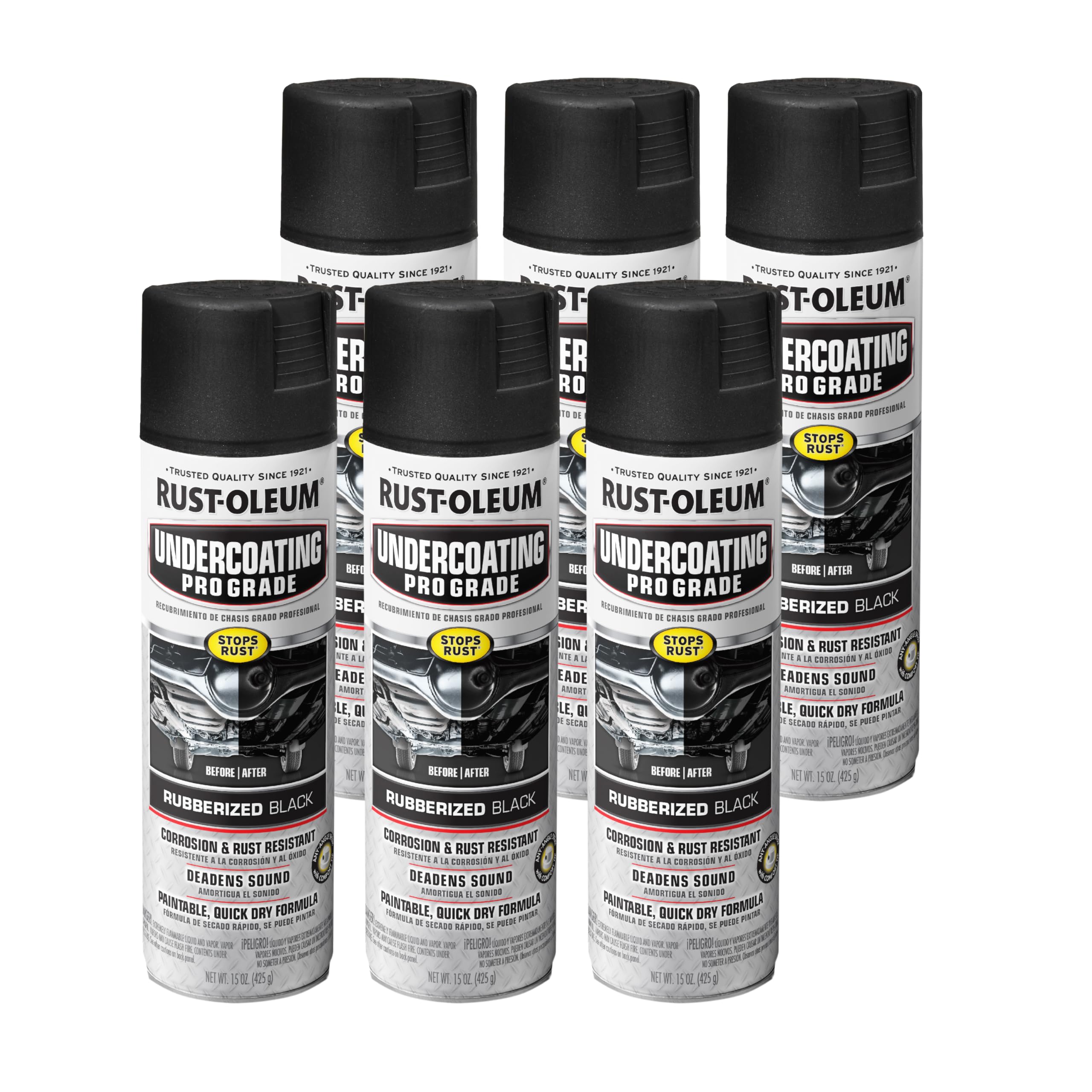
The any-angle aerosol that hits wheel wells upside down and dries in an hour.
This is the weekend-warrior pick: a professional-grade rubberized spray that works on bare or primed metal underbodies of cars, trucks, trailers, and RVs. Its any-angle spray technology (a nozzle that works even when you’re spraying upside down) makes those awkward wheel-well angles much easier, and it features a wide, comfort spray tip.
The protection is serious — it fights corrosion and damage from water, salt, and other chemicals, and it helps deaden sound and reduce damage to parts. It dries to the touch in 1 hour, which beats most of the field, and covers up to 10-15 sq. ft. per can. One owner used it on a 66 Charger and noted the spray is thick — shake it for a full 2 minutes, longer than the label suggests.
The coverage and durability draw mixed notes, though — some owners mention rust coming through if prep was skipped. The value is the catch; it’s a premium price for a single can, but the matte finish and quick dry make it worth it for patching.
easy spray: the 1-hour dry time and upside-down spray tip make this the most user-friendly rubberized option for patching wheel wells or redoing an underbody on a weekend.
budget limited: it’s the priciest per-can aerosol here, so for a full chassis you’ll either pay up or switch to a gallon — good for spot jobs, expensive for whole-corrosion coverage.
5. POR-15 Rubberized Undercoating

The satin shell that doubles as a sound barrier under wheel wells and floors.
POR-15 is famous in the rust world, and this rubberized undercoating brings that reputation to the chassis. It protects against moisture, salt, chemicals, dust, heat, and cold — and on top of that, it creates an effective sound barrier that reduces vibration and deadens sound in wheel wells, quarter panels, fenders, and undercarriages. It can even insulate against engine and muffler noise.
The 22 fl oz aerosol sprays on with a satin finish, and the maker says to shake well for at least a minute and spray from 12-16 inches. It dries in 1 hour before you can touch it or recoat. Customers note it works great for chassis protection and that a single can covers panel interiors plus two vehicle floors after rust patching. A full 8ft bed with extended cab takes 7-8 cans.
It’s a heavy, thick spray that builds up and drips easily, and it’s hard to spray upside down — a real limitation for wheel wells. The value draws mixed feedback; it’s effective, but the price per can adds up fast on a big vehicle. The durability is the thing people love, with one owner noting it “is a beast” that likely outlasts the vehicle.
rusty metal: a classic car restoration or a rusty spare-tire well where you want moisture and sound blocked together in a single coat.
skip if clean: you’re coating large areas on a budget — the per-can cost climbs quickly on a full-size truck.
6. Barrier Bond Rubberized Undercoating

The coarse-texture coat that makes a restored frame look factory-fresh.
This one is for the builder who cares how the underside looks, not just that it’s protected. Barrier Bond matches OEM textures and provides excellent abrasion and stone chip protection, sound deadening, and corrosion resistance — and it’s ideally suited where heavy or coarse texture patterns are desired. One owner said it made their frame look like a professional crew did it.
It’s a 28 oz liquid rubber designed for a texture gun — the maker recommends a Custom Coat BLG-684 gun or a 3M Schutz gun — and it dries fast. It’s 50-state VOC compliant (meets volatile organic compound limits everywhere in the US), so you can spray it with confidence. Owners find it easier to apply than expected and worth the value, with a process of removing rust, applying Ospho, then this coating.
The recurring trade-off is the container: it comes as 4 cans holding 2 quarts total, and one owner wasted about half a can per 4 because leftover product the gun couldn’t shoot set too fast to pour. Coverage and durability get mixed notes — some say it covers very well and is very durable, others say it doesn’t go very far. It hardens quickly, so work in smaller sections.
flex zones: a frame-off restoration or an off-road build where you want that heavy OEM-style chip-resistant texture on visible chassis parts.
skip for reuse: you’re covering a huge area — the 28 oz total goes fast, and the leftover waste in the gun adds up.
7. Eastwood Chassis Undercoating

The 14-ounce gloss black that restores a show-car chassis to OEM perfection.
This is the finish coat for the visible parts of a build — chassis, suspension, subframe, and wheel arches — where you want stone chip and scratch resistance and a clean OEM-style gloss. It’s built to extend the lifetime of vital components while keeping them looking great, and reviewers point out great coverage and a great look on restored classics.
Application is straightforward: spray onto clean bare metal or painted surface from 8-10 inches, and the maker recommends prepping with 320 grit for strong adhesion. Allow up to 36 hours to cure for a long-lasting, solid protection against rust and the elements. One owner used it through the construction of a dune buggy and noted it’s not ultra-high gloss — but that’s exactly what they wanted.
The paint quality is the thing everyone agrees on — it’s been trusted for years, with one owner cleaning and painting the complete underside of an 81 Buick Regal during an LS swap. At 1.1 pounds, it’s the lighter of the two Eastwood aerosols, and it comes with a 90-day limited warranty. The 14 fl oz volume means a full frame will take multiple cans, so plan coverage carefully.
top coat: resto-mod builders and dune buggy fabricators who want a clean, chip-resistant gloss on visible chassis parts should pair this with the Internal Frame Coating for the full Eastwood system.
skip for base: this protects surfaces you can see — for rust inside the frame, you’ll still want the 360° wand version.
8. B’laster Surface Shield Rust Prevention Spray (6-Pack)

The waxy aerosol that seals out salt for years with zero prep and zero drips.
This is the entry point into lanolin-based protection, and it makes a strong case. The thick lanolin coating clings to metal while not sagging or dripping, and it aggressively displaces moisture (pushes water out of the way) to prevent corrosion in automotive, marine, and outdoor environments. It’s 50-state VOC compliant and built for minimal prep.
It forms a waxy seal that doesn’t drip like most oils but spreads back out if dinged — a self-healing trait that makes it ideal for undercoating, equipment protection, and exposed metal. It easily resists high-pressure washing, and the maker rates it for up to 2 years of corrosion protection. One owner applied it to a rag and wiped it on 2-inch flat steel bar; after over a year outside, there’s still no rust.
The recurring note is that it’s messier than expected — it’s a thick oil, so expect drips and overspray. Sprayability and adhesion get mixed feedback (some cans deliver inconsistently), and the value draws mixed notes. The 6-pack is the smart buy here; one can covers about a third of a truck underbody, so the pack handles a full vehicle.
first timer: you want rust-belt protection without a compressor, a spray gun, or a weekend of prep — just shake and spray.
skip if pro: you need a thicker, longer-lasting film for a boxed truck frame — the gallon of Woolwax beats this on durability and wash-off resistance.
9. RustKote Rust Fighter Aerosol

The corrosion fighter with 40 years of Rust Belt expertise behind it.
RustKote comes from experts with over 40 years of experience battling corrosion in the Rust Belt region of the northeast USA — this is a product born of real road-salt warfare. It coats metal parts to protect against rust and stop existing rust from getting worse, and it’s strong on the rust-resistance front, earning consistent praise for it.
At 1.26 pounds for a 15 oz can, it goes on like foam and doesn’t run off easily — it creeps into crevices, lifts moisture, and seals it out. One owner has used it for years on a 20 year old snowmobile trailer, coating the frame and springs every other year, and expects it to last another 20. It’s a solid choice for winter equipment and any metal that sees salt.
The honest caveat: the formula appears to have changed between batches. The original foaming version turned rust into slick dark metal, while some report the newer thin liquid fails to coat as well. It also can’t match the sheer volume of the gallon options. But for quick, effective rust protection on spot areas, it holds its own as a lightweight, easy-to-apply aerosol.
spot fix: you need a fast, portable rust-stopper for a trailer, machinery, or equipment that lives outdoors in the salt belt.
skip for full: formula consistency across batches — check recent reviews before buying a full case.
Understanding the Specs
Lanolin vs. rubberized coating
Lanolin (a natural grease from sheep’s wool) stays wet and oily, so it creeps into seams and self-heals if scratched. Rubberized coatings dry into a hard shell that blocks stone chips but can crack and trap moisture underneath if not perfectly sealed. Lanolin wins for boxed frames and cavities; rubber wins for visible surfaces.
Coverage area and dry time
Aerosols stretch 10-15 sq. ft. or stop at 50 (in unspecified units per the maker), while a gallon genuinely covers a full chassis. Dry times range from 1 hour to 36 hours. A faster dry lets you recoat sooner, while a longer cure often means a tougher final film — match the spec to your patience and the job’s size.
FAQ
What is the difference between lanolin and rubberized undercoating?
How long does undercoating spray actually last?
Can I spray undercoating without a compressor?
Do I need to remove existing rust before applying undercoating?
Can undercoating spray be applied over painted surfaces?
Will undercoating stop existing rust from spreading?
How many cans do I need for a full truck?
Is undercoating spray safe for the environment?
What prep work is required before spraying undercoating?
Final Thoughts: The Verdict
For most buyers, the best auto undercoating spray is the Eastwood Internal Frame Coating because it’s the only aerosol that truly reaches rust you can’t see, using a 360° wand to coat inside frame rails and a formula that both prevents and destroys rust. If you want whole-chassis, set-it-for-years protection in the salt belt, choose the Woolwax 1-Gallon. And for a budget-friendly way to get lanolin protection with zero prep, the B’laster Surface Shield 6-pack is the one to grab.
How We Picked
We do not accept paid placement. Every pick is matched to a real buyer and a real use-case; we do not hands-on test units.
Sources & Methodology
Specifications: manufacturer listings and product documentation. Review insights: verified customer reviews, as of August 2026. Pricing: not shown on this page (it changes often); check the current price via the retailer link.
As an Amazon Associate, Gadgets Feed earns from qualifying purchases. This does not affect which products we feature.