
Our readers keep the lights on and my morning glass full of iced black tea. As an Amazon Associate, I earn from qualifying purchases.
Specs are compiled from manufacturer listings and verified buyer reviews and can change over time — please confirm the key details on the product page before buying.
You hit a pothole in the rain, and the other driver swears you crossed the line. Without a clear, always-running video record, it is your word against theirs — and insurance adjusters love video. This guide walks you through six dash cams that capture crisp 4K front and clear rear footage, plus the extras (built-in GPS, parking monitoring, app control) that turn a simple camera into your car’s best witness.
I’m Min — the founder and writer behind Gadgets Feed. This guide is built by comparing the manufacturers’ published specifications and the patterns across verified customer reviews, so you get each pick’s real strengths and trade-offs instead of marketing spin.
Whether you drive a sedan, an SUV, or a rideshare rig, the right best auto video camera gives you clear evidence day and night, saves you from he-said-she-said disputes, and watches your parked car when you are not there.
Our Picks at a Glance

How To Choose The Best Auto Video Camera
Picking your first dash cam can feel like a loop of confusing specs — 4K, 1080p, HDR, G‑sensor, parking mode. Here is what those words actually mean for your daily drive so you spend money only on what helps you.
Resolution — Front vs. Rear Matters
4K front recording (3840×2160P) is the gold standard for reading plates and road signs, especially at night. A 1080P rear camera is fine for catching tailgaters and rear-end collisions, but some premium pairs now offer 2.5K or 2K rear. If you often park in tight spaces or drive in heavy traffic, the extra rear clarity helps if someone hits you from behind.
Night Vision and Aperture
A bright lens aperture — F1.5 or F1.55 — lets in more light, so you see plates in dim parking lots and on unlit roads. HDR or WDR (High Dynamic Range / Wide Dynamic Range) balances bright headlights against dark shadows, so you are not blinded by oncoming beams while the road stays visible.
Parking Mode — The Invisible Guard
Most dash cams offer 24-hour parking surveillance, but they need a hardwire kit (sold separately) to run off your car’s battery. You can choose time-lapse (records one frame per second), motion detection (starts on movement), or collision detection (locks a clip on impact). If you park on the street, time-lapse or collision mode is your best bet for catching hit-and-runs.
GPS and Wi-Fi — Convenience vs. Privacy
A built-in GPS stamps your speed, location, and route onto each video. This helps you prove your speed and location in an accident. Wi-Fi (especially 5GHz or Wi-Fi 6) lets you download clips to your phone at speeds up to 25MB/s without pulling the memory card. If you do not want your speed tracked, look for a model that lets you turn off GPS recording in the app.
Quick Comparison
| Model | Best For | Channels | Front Res | Max SD Card | Amazon |
|---|---|---|---|---|---|
| ROVE R2-4K DUAL★ Best Overall | Night clarity + included 128GB | Front & Rear | 4K 2160P @30fps | 1TB | Amazon |
| VIRROW X5Best Angle | Widest angle + 2.5K rear | Front & Rear | 4K + 2.5K | 256GB | Amazon |
| FAIMEE F6 | GPS logging + dual-band Wi-Fi | Front & Rear | 4K UHD + 2K | 256GB | Amazon |
| 70mai A810 Lite | 4G LTE remote access | Front & Rear | 4K 3840×2160P | 512GB | Amazon |
| TERUNSOUl 3CH | Triple camera (cabin included) | Front, Rear & Cabin | 4K + 1080P + 1080P | 512GB | Amazon |
| 70mai T800E | 3‑channel + switchable IR interior | Front, Rear & Interior | 4K + 1080P + 1080P | 512GB | Amazon |
In‑Depth Reviews
1. ROVE R2-4K DUAL Dash Cam Front and Rear
Our pick — 4.5★ from 12,500+ verified ratings; the strongest balance of quality and price.
The dash cam that sees in the dark and hands you a 128GB card in the box.
This ROVE dash cam uses a Sony IMX675 STARVIS 2 sensor (a top-tier imaging chip that captures vivid colors and sharp details even in dim parking lots) on the front camera. The front F1.5 aperture pulls in extra light — so number plates stay readable at night — while the rear camera’s F1.8 aperture keeps a 140-degree field of view (18% wider than some rear cams) for clear coverage behind you. The front lens covers 150 degrees, which is a 13% narrower view than the VIRROW X5, but the Sony sensor compensates with noticeably richer low-light detail.
Buyers report that the 5GHz Wi-Fi downloads clips at up to 20MB/s, making it easy to grab a video and share it right after a fender-bender. The 3.39-inch IPS display (a 13% larger screen than the ROVE R2-4K’s own 3-inch screen) makes menu navigation straightforward. The built-in supercapacitor handles extreme heat better than a lithium battery, so this camera should last in a hot windshield. The free 128GB card means zero extra cost at setup, and the camera supports cards up to 1TB — the most storage headroom in this lineup.
The catch is the 24-hour parking mode: it works well (1fps time-lapse, motion detection, or collision detection), but you must buy a hardwire kit separately. That small extra step is common across most dash cams — once installed, the camera gives you a voice alert the next time you start the car if an event happened while parked.
Why it stands out
- Sony STARVIS 2 sensor delivers the best low-light front footage in this roundup
- Free 128GB card included — ready to record from the start
- Supercapacitor (versus battery) means better durability in hot cars
One trade-off
- Parking mode requires a separately purchased hardwire kit
- Front field of view (150°) is slightly narrower than some competitors at 170°
Who it serves best: Drivers who want the best night-vision in the category and appreciate getting a high-capacity card included, especially those who park in dim areas.
Not your pick if: You want the absolute widest front angle (the VIRROW X5 at 170° has a broader sweep) or need a cabin-facing camera for rideshare.
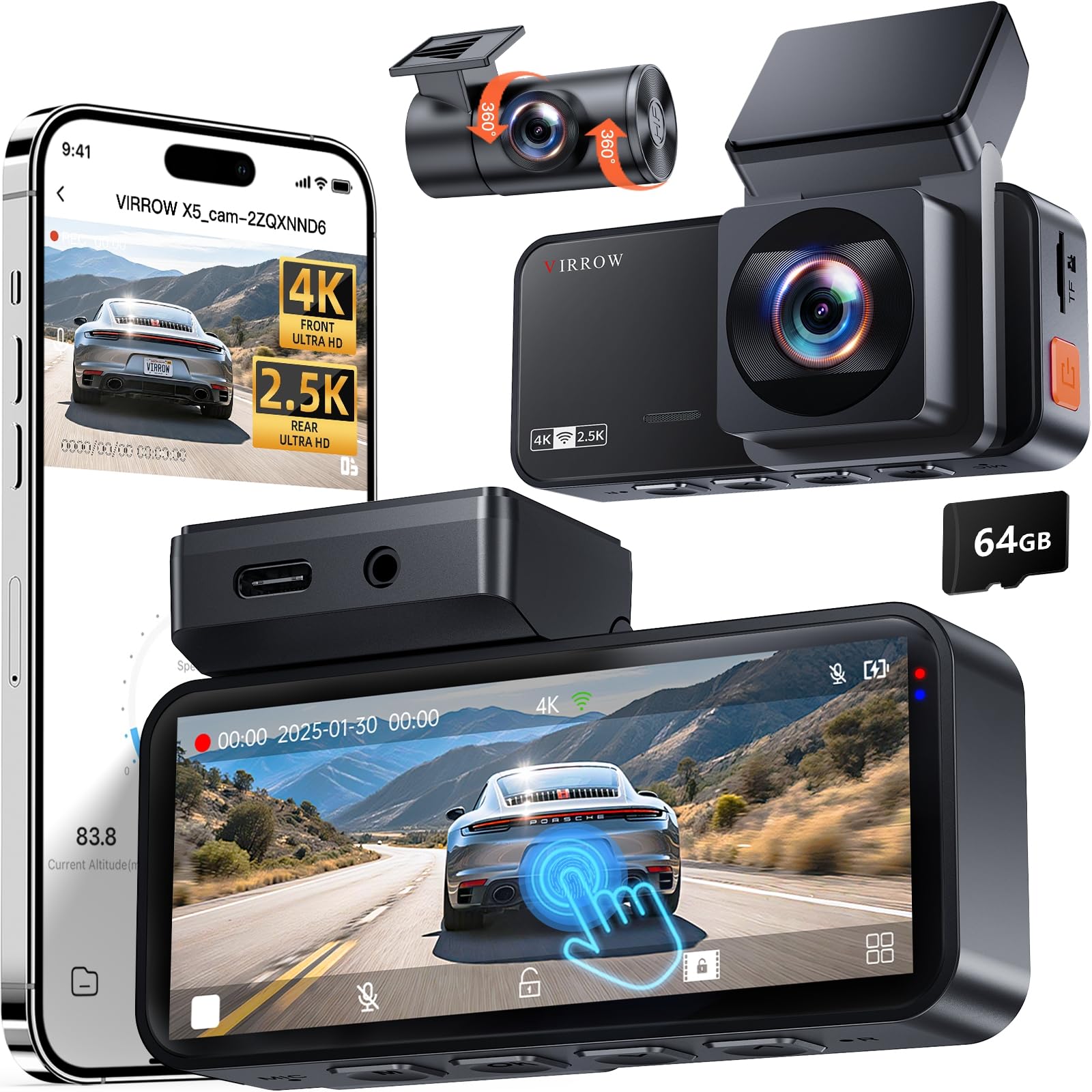
2. VIRROW X5 Dash Cam Front and Rear (4K+2.5K)
The widest lens in the group, plus a rear camera that records sharper-than-usual 2.5K HD.
If you want to see every lane beside you, the VIRROW X5 leads the pack with a 170-degree front lens and a 165-degree rear lens (an 18% wider rear view than the ROVE’s 140-degree rear). That means fewer blind spots when you check side views, and more coverage if a car sideswipes you in a narrow lane. For rideshare drivers, the extra 2.5K rear resolution (2,560×1,440P roughly) captures more detail on tailgaters than a standard 1080P rear cam.
The 3.39-inch touchscreen is the largest display in this list — you can tap through video playback or change settings without fumbling for physical buttons. The built-in SC2336 sensor plus WDR (Wide Dynamic Range — a feature that balances bright headlights and dark shadows in the same frame) keeps footage clear in tunnels and at dusk. Like the ROVE, the X5 supports 24/7 parking guard with time-lapse and motion monitoring. Owners mention that the included 64GB card gives you about 4–6 hours of 4K+2.5K looped recording before it overwrites the oldest clips.
On the flip side, the max SD card size is 256GB — half the storage ceiling of the ROVE or the 70mai models. If you take long road trips and want days of recording before overwriting, you might prefer the ROVE’s 1TB limit. The hardwire kit for parking mode is also separate.
Strengths
- 170° front lens is the widest in this roundup
- Rear camera records 2.5K, sharper than the typical 1080P rear cam
- Large 3.39″ touchscreen makes playback and setup easy
Limitations
- Max memory card support is 256GB (less headroom than the 1TB ROVE)
- Parking mode hardwire kit sold separately
Best suited for: Drivers who prioritize the widest possible coverage, especially on busy multi-lane roads, and want a touchscreen for easy control.
Look elsewhere if: You need more than 256GB of storage or require a cabin-facing camera for rideshare passengers.
3. 70mai 4K Dash Cam T800E (3 Channel)

A triple-lens system with an interior camera that sees in infrared — built for rideshare and family drivers.
This 70mai T800E captures three views at once: 4K front, 1080P interior, and 1080P rear. The interior camera has switchable infrared recording (IR) — you can turn it on to see clearly inside the cabin at night (for monitoring passengers) or off during the day to reduce unwanted reflections. The front F1.55 aperture, combined with HDR and 3D noise reduction, keeps license plates and road signs readable even on dark rainy nights.
The built-in 5-mode GPS (GPS + GLONASS + BDS + Galileo + QZSS) tracks your speed, route, and location with high accuracy — useful for fleet or rideshare loggers. The supercapacitor handles temperatures from 14°F to 140°F, a broader range than many lithium-battery cams. A 64GB SD card is included, and the camera accepts cards up to 512GB.
Unlike the 70mai A810 Lite below, this model does not support 4G connectivity, so you cannot summon a live view from your phone while parked far away. For around-the-clock parking protection, you again need a separate hardwire kit (UP06 or UP03, sold separately).
What you gain
- Three-channel recording includes interior cabin view — ideal for rideshare or family car
- Switchable IR on the interior camera for clear night cabin footage
- Wi-Fi 6 and supercapacitor for fast transfer and heat tolerance
What you give up
- No 4G LTE remote access (the A810 Lite has that option)
- Hardwire kit needed for parking mode, sold separately
Grab it if: You drive for Uber or Lyft and want to monitor passengers while retaining clear front and rear road coverage for safety.
skip it if: You need to check your parked car’s live feed from afar — the A810 Lite supports 4G LTE, the T800E does not.
4. FAIMEE F6 Dash Cam Front and Rear (4K+2K)
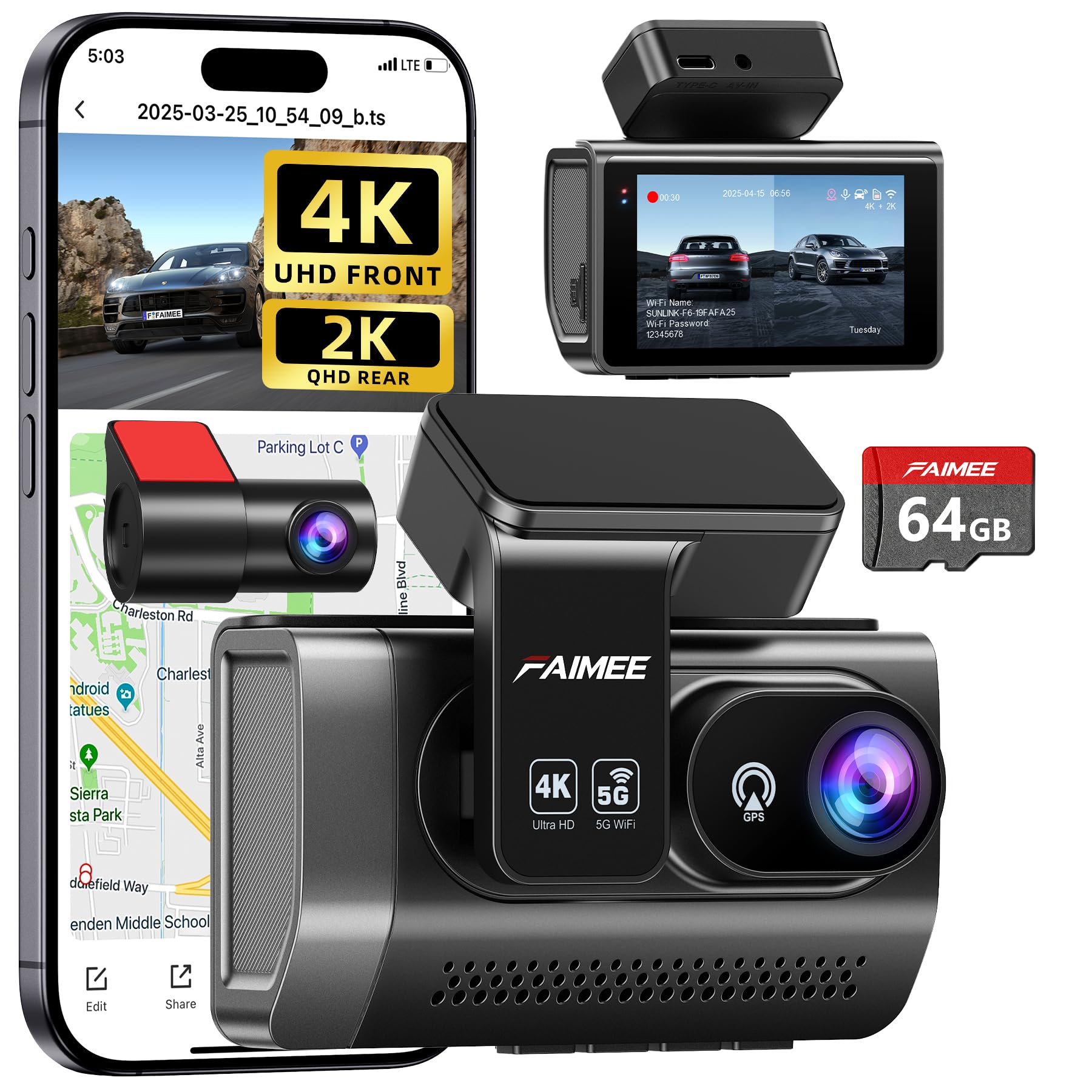
A dual-recording system with accurate GPS tracking and a stable dual-band Wi-Fi connection.
The FAIMEE F6 records the front in 4K (3840×2160P) and the rear in 2K (2304×1296P) — a step up in rear detail from many entry-level pairs. The 170-degree front lens matches the VIRROW X5 for width, and the F1.8 aperture with WDR (Wide Dynamic Range) keeps footage balanced between bright headlights and shadowy curbs. The built-in GPS tracker embeds real-time speed, route history, and location coordinates directly into each video — handy if you need to prove your speed or whereabouts in a dispute.
The upgraded dual-band Wi-Fi (5.8GHz/2.4GHz) gives you a stable connection to the FAIMEE app for live-view and downloads. Customers note that the 3-inch IPS screen is compact enough to hide behind the rearview mirror without blocking the windshield. The 64GB memory card included is risk-free for daily commuting, and the camera accepts cards up to 256GB. If there is a sudden collision, the G-sensor (a small motion sensor that detects a bump) locks the current video so it is not overwritten.
The main trade-off is the max storage limit of 256GB — the same cap as the VIRROW X5. Power users who want weeks of footage before overwriting will need a model that supports 512GB or more (like the 70mai options). Parking mode requires a separate hardwire kit, as with most picks here.
Strong points
- Rear camera records at 2K, sharper than standard 1080P
- Built-in GPS stamps speed and route data for evidence
- Dual-band 5.8GHz/2.4GHz Wi-Fi gives reliable app connection
Room for improvement
- Max SD card support 256GB is half the ceiling of high-end models
- Parking mode hardwire kit is an extra purchase
Ideal for: Drivers who want accurate GPS logging and a bright rear camera, but do not need a cabin view or 4G connectivity.
Not the best fit: If you prefer a touchscreen or need gobs of removable storage — the VIRROW X5 has a touchscreen; the ROVE accepts 1TB.
5. 70mai A810 Lite Dash Cam Front and Rear
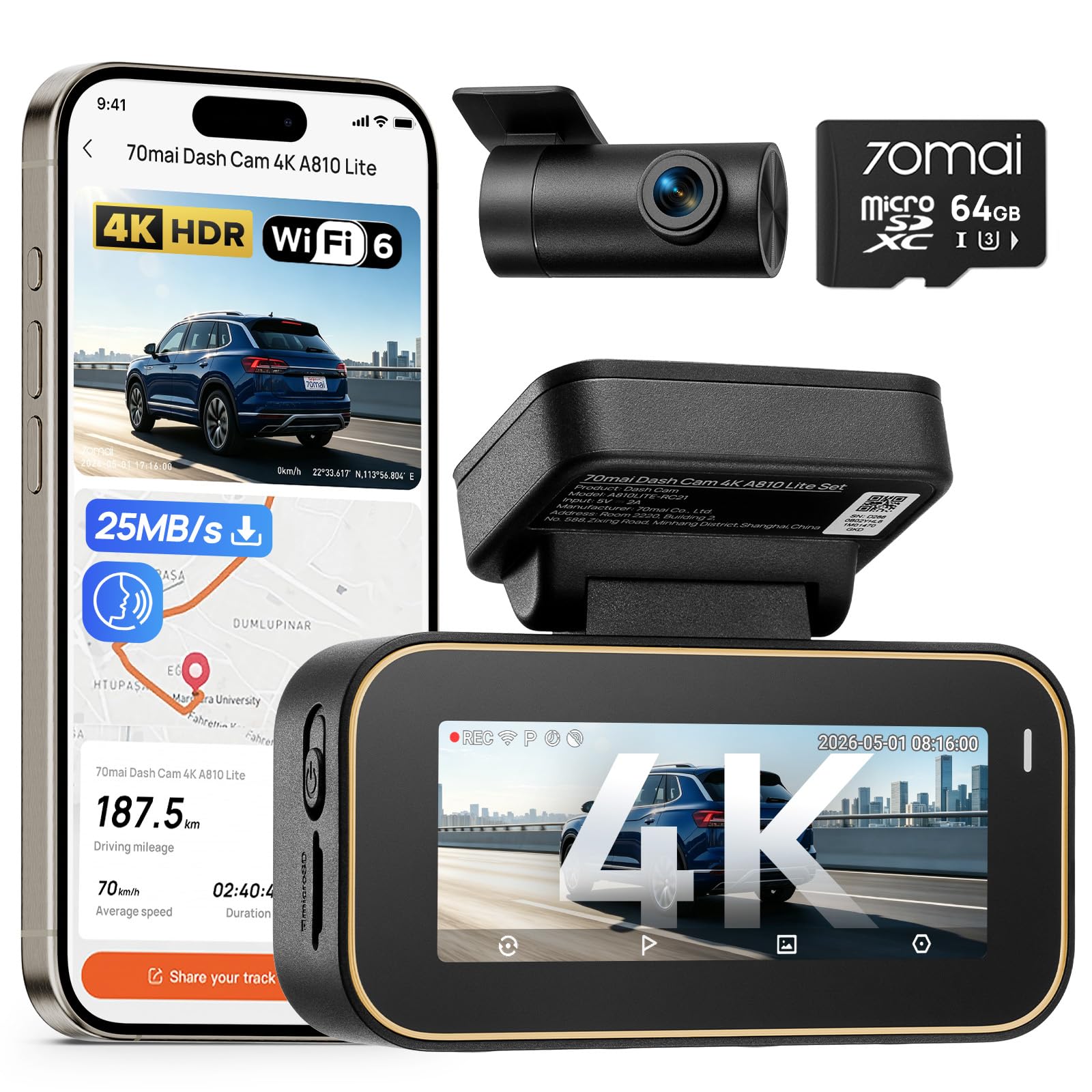
The only dash cam here that connects to 4G LTE so you can peek at your parked car from anywhere.
Most dash cams only let you view footage after you get back to the car. The 70mai A810 Lite is different — with a separate 4G hardwire kit (UP05, ASIN: B0GD7FXMVT), you can remotely stream live video, track your vehicle’s location, and receive real-time alerts through the app. This 4G LTE remote access is a standout for overnight street parking in busy cities. The front camera records 4K (3840×2160P) and the rear captures 1080P, both with an F1.55 large aperture and HDR for night clarity.
Built-in 5GHz Wi-Fi 6 pushes download speeds up to 25MB/s — the fastest in this roundup — so pulling a 2-minute 4K clip takes seconds. The three-mode GPS (GPS + GLONASS + BDS — three satellite systems working together for faster lock and higher accuracy) logs speed, route, and location for playback. An included 64GB card gets you started, and the camera supports up to 512GB. The supercapacitor helps it withstand hot parked-car temps better than a battery.
The trade-off is that the rear camera records only 1080P, not 2K or 2.5K like the VIRROW X5 or FAIMEE F6. Also, the 4G remote access requires the UP05 kit plus a data plan — that is an extra expense and monthly cost you might not want if you only drive locally.
What makes it special
- 4G LTE optional remote live view — unique in this list
- Wi-Fi 6 transfer speeds up to 25MB/s — fastest download rate here
- Supercapacitor and 18-month warranty for confidence
Consider this
- Rear camera is 1080P only (others offer 2K or 2.5K rear)
- 4G remote access needs an additional hardwire kit and probably a data plan
Your pick if: You park on the street long-term and want the ability to check your car’s surroundings from miles away for extra confidence.
Not if: You mostly drive and park at home — the monthly data cost for 4G remote access is unlikely to be worth it.
6. TERUNSOUl 3 Channel 4K Dash Cam
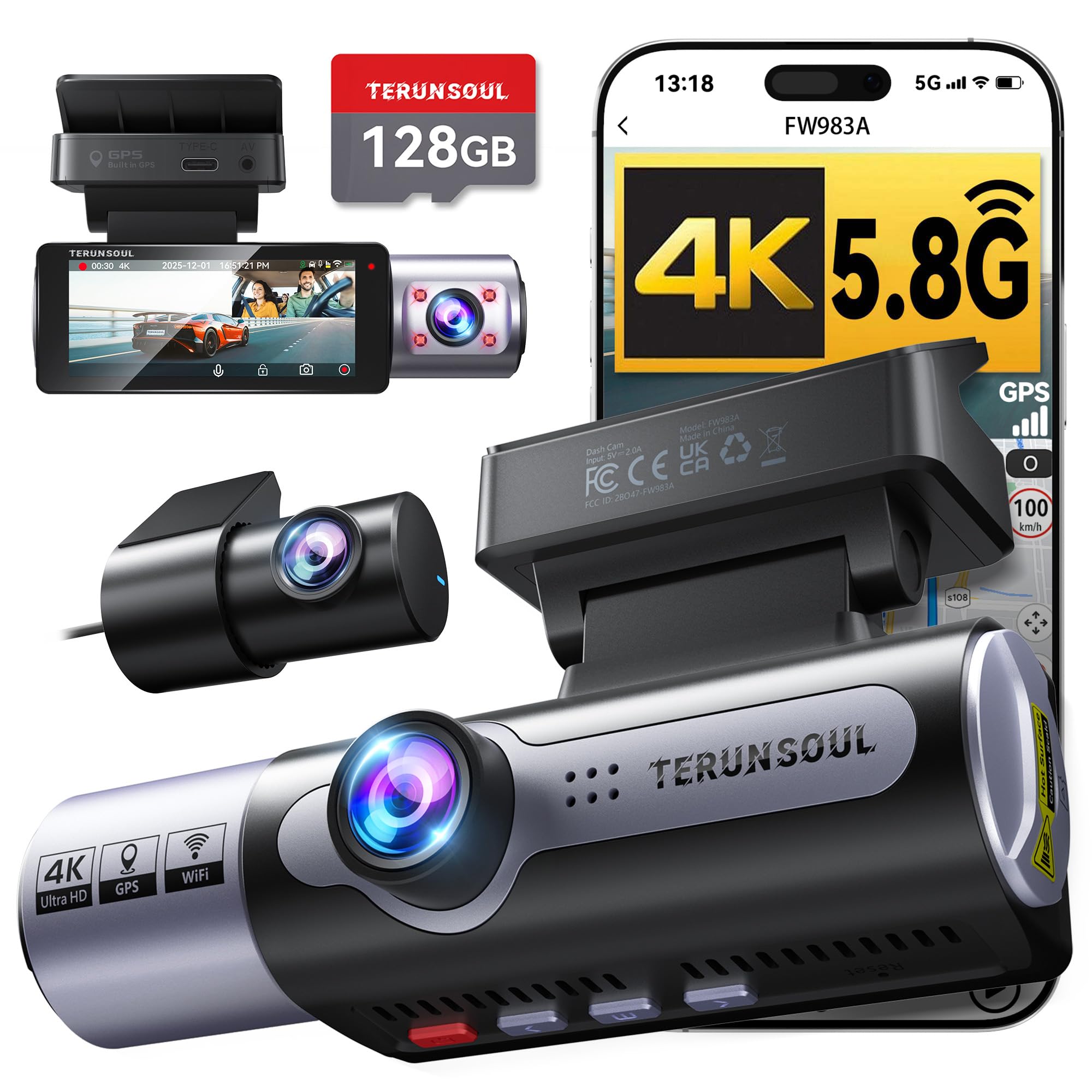
A three-way system (front, rear, and cabin) that includes a free 128GB card.
This TERUNSOUl dash cam records in three channels simultaneously: 4K front, 1080P rear, and 1080P cabin. The front lens covers 170 degrees, the same width as the VIRROW X5 and FAIMEE F6, while the rear and cabin both cover 165 degrees — near-360-degree panoramic coverage for both the road and the inside of your car. The starlight-grade F1.6 aperture with HDR (High Dynamic Range) picks up plate numbers and face details in dim parking garages and at dusk.
A free 128GB memory card is pre-installed in the box, giving you more starting capacity than any other pick except the ROVE (also 128GB) and matching the ROVE on value. The camera supports cards up to 512GB for extended recording needs. Built-in 5.8GHz Wi-Fi allows app downloads at up to 20MB/s — similar to the ROVE’s speed — and the built-in high-precision GPS embeds driving routes, speed, location, and a timestamp into each video. You can review GPS-tagged footage on a free desktop GPS player if you ever need strong evidence in a claim.
This is a strong value pick, especially given the 128GB card and the triple-channel recording at the mid-range price. However, the hardwire kit for full-time parking mode (ASIN: B0G4LLMKG8) is separate. Also, the cabin camera is fixed (no switchable IR like the 70mai T800E), so interior night footage may be less detailed if you do not have interior dome lights on.
Why it is a value
- Three channels (front, rear, cabin) with 170° front and 165° rear/cabin coverage
- Free 128GB card included — ready for long drives from day one
- 5.8GHz Wi-Fi for up to 20MB/s app downloads
Trade-offs
- No switchable IR for interior camera — night cabin footage is less effective
- Parking mode hardwire kit sold separately
Reach for this if: You want the full coverage of a triple-camera system for a mid-range budget, especially if you have new drivers in the family and want to monitor both the road and the cabin.
Pass if: You need infrared interior recording for dark rideshare shifts — the 70mai T800E offers switchable IR, the TERUNSOUl does not.
Understanding the Specs
Aperture (F1.4, F1.5, F1.55)
This is the opening that lets light into the camera lens. A smaller F-number (like F1.5) means a wider opening that collects more light. On a dash cam, a wider aperture makes your nighttime footage brighter and helps you read license plates in low-light parking lots. Most good dash cams have an F1.55 or F1.6 aperture — you will see the low-number version in models with “night vision” or “STARVIS” labels.
G‑Sensor
This is a small motion sensor that detects a bump, a sudden stop, or a collision. When it feels a strong impact, it instantly locks the current video file so it does not get overwritten by the loop recording. Think of it as a “save this clip” button that fires automatically. If you bump a curb or get rear-ended, a G-sensor preserves that crucial moment for your insurance claim.
FAQ
How long will a 64GB card record on a 4K dash cam?
Do I really need a rear camera, or is front only enough?
Will parking mode drain my car battery overnight?
What is the difference between 4K+2K and 4K+1080P rear?
Can I use any microSD card in a dash cam?
What is a supercapacitor, and why does it matter?
Do I need a hardwire kit for parking mode?
Will a dash cam record while the car is off?
How do I install a rear camera cable in my car?
What does “loop recording” mean?
Final Thoughts: The Verdict
For the majority of shoppers, the best auto video camera winner is the ROVE R2-4K DUAL because it combines the Sony STARVIS 2 sensor for outstanding night vision, a free 128GB card, and 1TB expandable storage — all in a tested, highly-rated package. If you want 4G remote access to live-view your parked car from your phone, grab the 70mai A810 Lite. And for triple-channel coverage (front, rear, cabin) with a big included card and starlight night vision at a mid-range price, the standout is the TERUNSOUl 3 Channel 4K Dash Cam.
How We Picked
We do not accept paid placement. Every pick is matched to a real buyer and a real use-case; we do not hands-on test units.
Sources & Methodology
Specifications: manufacturer listings and product documentation. Review insights: verified customer reviews, as of July 2026. Pricing: not shown on this page (it changes often); check the current price via the retailer link.
As an Amazon Associate, Gadgets Feed earns from qualifying purchases. This does not affect which products we feature.