
Our readers keep the lights on and my morning glass full of iced black tea. As an Amazon Associate, I earn from qualifying purchases.
Specs are compiled from manufacturer listings and verified buyer reviews and can change over time — please confirm the key details on the product page before buying.
You want your plants watered while you are away, and you want it done without dragging a hose through the house or hauling a watering can every morning. The short answer for most people is a solar or battery drip kit that pulls water straight from a bucket you fill once a week. Here is what actually matters: the number of plants the kit feeds, the size of the water container it can pull from, and how easy the timer is to program. Get those three right and you can leave for a month and come home to healthy plants.
I’m Min — the founder and writer behind Gadgets Feed. This guide is built by comparing the manufacturers’ published specifications and the patterns across verified customer reviews, so you get each pick’s real strengths and trade-offs instead of marketing spin.
Most of these systems sit on a shelf or balcony, sip from a jug or a bucket, and run on a timer you set once. This guide ranks seven of them by what they genuinely do well, including the honest trade-offs on flow control and reliability that show up again and again in owner feedback. If you want a set-and-remember system that keeps potted plants alive without a tap, this breakdown of the best auto water pump for plants is the place to start.
Our Picks at a Glance


How To Choose The Best Auto Water Pump For Plants
The biggest mistake new buyers make is buying a kit that holds too few plants for their setup, then discovering halfway through a holiday that the last three pots never got a line. The second mistake is expecting a small pump to push water up a long slope or through a second length of tubing. Both problems come down to the same thing: the pump’s rated flow and the size of the container feeding it.
Power source: solar versus battery versus plug-in
A solar panel that trickles charge into a built-in battery (usually a 2200mAh cell) keeps working through cloudy spells, but it needs a spot with decent light or a detached cord so the panel can be moved into the sun. Battery-only units run on AA cells or a USB-C cable, which is simpler indoors but leaves you swapping batteries or finding a socket. A plug-in pressure pump is the third option and the most powerful, but it needs mains power near the water source.
Flow rate and how many pots you can feed
Flow rate tells you how much water moves per minute, and it is the number that decides whether ten drippers all get fed or the far ones starve. Small solar kits measure output in liters per hour or a weak liters-per-minute figure. A high-output pressure pump rates its flow in gallons per minute (GPM) and moves water fast enough to feed a whole row of hanging baskets from one barrel. Match the flow to the number of lines you actually plan to run.
Timer programming and watering intervals
Basic kits offer a handful of watering modes with fixed durations. Better ones let you pick a duration in minutes and then an interval measured in hours or days, so you can water briefly twice a day or deeply once a week. If you grow thirstier plants like tomatoes, look for the ability to set long durations. If you grow succulents, look for short durations paired with long intervals.
Self-priming and dry-run protection
A self-priming pump can lift water from a bucket on the floor without you filling the line by hand first. That matters when your reservoir sits below the pots. Dry-run protection, also called run-dry protection, shuts the pump off when the water level drops so the motor does not burn out — a genuinely useful safety feature if you travel and forget to top up the jug.
Quick Comparison
| Model | Best For | Plants Supported | Power Source | Timer Type | Amazon |
|---|---|---|---|---|---|
| Lewisia 2W Solar Kit★ Best Overall | Container gardens and grow bags | Up to 15 plants | Solar powered | 12 watering modes | Amazon |
| Srygery LCD Solar KitBest Timer Range | Balcony pots with no outdoor tap | Up to 15 pots | Solar powered | 30 modes, 10 intervals | Amazon |
| VIVOSUN Automatic Kit | Indoor grow setups | Up to 8 pots | 15W plug-in pump | Up to 20 sets of times | Amazon |
| RUNWUSHENG Drip System | Short trips and terrariums | Not stated | 4 AA batteries or USB-C | Programmable | Amazon |
| DAOTAILI Dual-Pump Kit | Two zones with different plants | Up to 20 plants | USB-C or 4 AA batteries | Programmable timer | Amazon |
| Kohree 110V Pressure Pump | Rain barrels and long hose runs | Multiple lines | 110V AC power | Pressure switch | Amazon |
| LetPot Wi-Fi System | App control from anywhere | 10-20 pots | Battery powered | App-controlled schedules | Amazon |
In‑Depth Reviews
1. Lewisia 2W Solar Automatic Drip Irrigation Kit with Timer Auto Watering System
Our pick — over 4★ from 60+ verified ratings; the strongest balance of quality and price.
The solar kit that keeps a container garden alive through an overcast week.
The Lewisia earns the top spot because its control panel is separate from the solar panel, connected by a 10-foot solar cord. That means you can bolt the panel wherever the sun actually hits while leaving the controller within easy reach. You also get a 1-watt DC impeller pump inside, plus 15 meters (roughly 49 feet) of water pipe for up to 15 plants, and a built-in 2200mAh battery that carries it through cloudy stretches. The kit arrives as 40 pieces total, and the run-dry protection shuts the pump down the moment the water level in your container drops too low.
What owners keep coming back to is that it just quietly works over a long stretch. The sub-surface watering delivers water right at the roots instead of across the leaves, and one owner’s experience after months of use sums it up well: “After 3 months, the pumps work reliably and solar is solid.” Several also mention the two-way mounting, which lets you spike the panel into the ground or fasten it to a wall or fence instead of buying extra mounting hardware.
Here is the honest catch. The timer works in blocks, not fine increments, so if 5 minutes daily is too much and 5 minutes every second day is too little, you cannot split the difference — that exact gap shows up in the feedback. The drip stakes can also be stiff to push into the tubing on the first setup, so warming the tube ends helps. The system is also expandable to 21 stakes, so it covers a slice of extra room beyond the standard 15.
What Makes It the Winner
- Separate solar panel with a 10-foot cord lets you chase the sun
- Run-dry protection with a water level sensor
- 40 pieces, covers up to 15 plants with 15m of pipe
- 2200mAh battery handles overcast days
Where You’ll Notice the Limit
- Watering times come in fixed blocks you cannot fine-tune
- Drip stakes are stiff to press into the tubing at first
- Output maximum is well above what container plants need, so you run it low
Reach for this if: you have a container garden, grow bags, or a porch row that could use sun-powered watering with no outdoor socket.
Look elsewhere if: your plants need a precise millilitre-per-day schedule — the block timing will frustrate you.
2. LCD Display Solar Drip Irrigation System Kit, 30 Working Modes & 10 Watering Interval
Aiming a screen, a panel, and a timer at anyone who has killed a plant on holiday.
Where the Lewisia gives you 12 watering modes, this kit from Srygery opens that out to 30 working modes with durations in single minutes, then adds 10 intervals you can stretch from 3 hours all the way to 7 days. The 180° rotatable solar panel lets you angle the cell toward the light, and the 2200mAh battery holds enough charge for up to 30 days of continuous use on a full charge, which is the number to quote if you live somewhere with grey skies. The 49.21 feet of tubing, plus 15 stakes, 15 T-joints and a filter, lets you reach the far corner of a balcony.
Owners are clear about what they love — the setup itself is a breeze, and the kit has been used on rain barrels and window planters alike. One buyer reports that it “Runs 15 pots (8-12″) plus 3 railing containers daily for 20 min,” and delivers roughly 2 oz per minute per container, about two cups per pot. That kind of detail is worth knowing before you buy, because it tells you the small pump is doing honest work rather than spraying wildly. It also fits a bucket, so you are not tied to a garden tap.
The parts that are less tidy are the screen and the reliability. The display has a habit of going nearly unreadable, and the pump has a reputation for giving up on some units within the first few days — which is the single biggest thing to watch. The included blue spikes double as end caps, so if you lose them, the last line leaks. This is a budget-friendly kit built for lightweight use rather than heavy outdoor duty.
Timer reach is the win here: the spread from one-minute bursts up to a seven-day gap covers herbs and hardy plants alike, so you can leave the schedule alone once you like it.
The real risk to know: this is a small self-contained pump that some owners have found fails early, so if you plan to run it reliably through a season, keep an eye on it for the first few weeks.
Best matched to: a beginner with a balcony, a bucket, and no tap — someone who will accept a little screening trouble for the biggest range of timer options in the line-up.
Think twice about: mounting it fully outdoors for a hard winter, since the electronics are not built for that.
3. VIVOSUN Professional Automatic Drip Irrigation Kits, 15W Output, All in One Grow Kit

The high-flow workhorse for anyone growing tomato plants indoors.
This is the pick for a grower running a real indoor setup, because the pump is a plug-in 15W submersible unit that moves a maximum of 1000L per hour, far beyond anything a solar kit can manage. The noise it makes while watering sits in the 30-40dB range, which is roughly what a quiet fridge produces. You get eight drip emitters in the box and an auto cycle watering timer with up to 20 sets of irrigation times, all switchable between auto and manual. The kit is a complete set of 17 pieces and takes around 10 minutes to put together, according to the maker.
The water flows evenly when it is set up right, and one thing owners like is the drip arrows with flow stabilizers, which keep the delivery steady across the lines. You can also blend fertilizer straight into the reservoir instead of feeding plants by hand. There is a real difference, though, between this plug-in pump and the solar units above: the Lewisia’s 1-watt pump tops out at 576L per day, while the VIVOSUN runs at a maximum of 1000L per hour, which is why one runs continuously and the other is meant for short timed bursts.
Now for the caveat. This is a kit where the setup and the hardware are mostly reliable, but the timer is fiddly to program, and a few buyers report that lines can fail in the first month. Give the drip emitters a flush before you commit to a schedule, trim the tip if you see flow blocked, and the emitters behave. It is a mid-range kit built for hands-on growers rather than the set-and-forget crowd.
Standouts for Indoor Growers
- 15W pump moves up to 1000L per hour for full coverage
- 30-40dB operation keeps the grow space quiet
- Up to 20 sets of irrigation times
- Fertilizer can be mixed directly in the reservoir
Where It Asks for Patience
- Timer programming takes a genuine sit-down session
- Lines and emitters can clog, so a pre-season flush is worth it
- Only eight pots covered in the boxed kit
The pick for: indoor growers running soil, rockwool or clay pebbles who want one pump strong enough to feed the whole row.
Not for: anyone who wants to program a timer by feel and then forget it exists.
4. Automatic Drip Irrigation System, DIY Indoor Plant Watering System with Self-Priming Pump

A self-priming indoor kit for the plant parent who checks in on the balcony every day anyway.
What sets this unit apart is its self-priming pump — a pump that pulls water up from a bucket on its own, without you filling the line first. Connect the intake hose to any container, and it starts watering from a plastic tote on the floor or a covered reservoir out on the balcony. The main unit uses locking pneumatic connectors at the inlet, outlet, and T-joint, so the tubing is harder to accidentally pull loose under pressure, and each probe has its own adjustable drip arrow for per-plant flow. The 10 meters of tubing is plenty for a shelf or two of pots.
Owners lean on this one for travel. It has run cleanly through a seven-day absence, and one person used it for an aquarium top-off while away for weeks, setting it for one cup a day from a five-gallon bucket that lasted about a month. The settings persist after a power cut and the unit resumes on its own — that memory feature is worth its weight when the trip runs long. Adding a bucket of diluted fertilizer to the source is a common move and it handles that without complaint.
The things to know before you buy are the display and the pump logic. The screen dims out in a few seconds, which slows you down while you are programming, and once programmed there is no on/off indicator light to reassure you. More importantly, one buyer returned it because there is no shut-off mechanism — the design relies on the pump simply not running, so if you want a hard cut-off valve, look elsewhere. Its 17 pieces and lightweight frame suit terrariums and short trips better than heavy daily watering.
Why it travels well: the settings survive a power failure and the AA-battery or USB-C dual supply means you can leave it running while the house is dark.
Where it falls short: without a physical shut-off valve, a stuck timer can overwater — and the sleeping display makes programming a two-hand job.
The right fit for: a trip-taker with a dozen indoor pots who wants a self-priming pump and doesn’t mind checking the schedule before leaving.
Look at another pick if: you need a hard valve to stop the flow, because this one relies on the timer alone.
5. Automatic Watering System for Potted Plants with Dual Self-Priming Pumps

Two pumps, two schedules, one kit for the plants that never agree on water.
A pair of independent pumps is the reason to consider this one. You can run succulents on a light schedule through one line while herbs and larger indoor plants drink more deeply through the second, without forcing both onto the same timetable. It supports up to 20 plants across 20 pieces of kit, runs on USB-C or four AA batteries, and the battery backup keeps the schedule alive if a plug is pulled. You drop the intake hose into a bucket, bottle or jug — no tap needed — and the emitter flow adjusts from low to high to suit each pot.
Setup is the easy part here; this is the kind of kit that goes together on a kitchen counter in an evening, and it has handled balcony flower boxes and tomatoes with four or five spikes per planter. Owners mention running a five-gallon bucket or even a seven-gallon reservoir, testing the flow weeks before the trip, and it repays that patience with even watering across both zones. The locking T-connectors do their job, and a filtered-water habit stretches the pump’s life considerably — one buyer writes that it “Lasted a good 7 months pumping nutrient mixed water.”
The honest caveat is a mixed bag on adjustability and leakage. Some units arrive perfectly dry; a few leak at a joint or are hard to program, and one shorted the buyer on drippers so five of the 20 plants had nothing. Push the T-connectors fully home, keep the reservoir below the pots as the instructions advise, and those risks shrink. This kit earns its place for anyone with genuinely different watering needs in one room.
What Wins People Over
- Two independent pumps run separate watering schedules
- USB-C or AA battery with backup power
- Adjustable emitters tune flow per pot
- Supports up to 20 plants in 20 pieces
The Trade-offs to Weigh
- Fit and finish can be inconsistent unit to unit
- Program prompts can confuse a first-timer
- Occasional reports of a missing dripper in the box
The one to reach for when: your collection mixes water-hungry and drought-tolerant plants and you want each zone on its own clock.
Sharper fit elsewhere if: you want a no-fuss single-schedule kit and don’t need the second pump.
6. Kohree 110V AC Water Pressure Pump, 4 GPM 50 PSI Self-Priming Pressure Pump
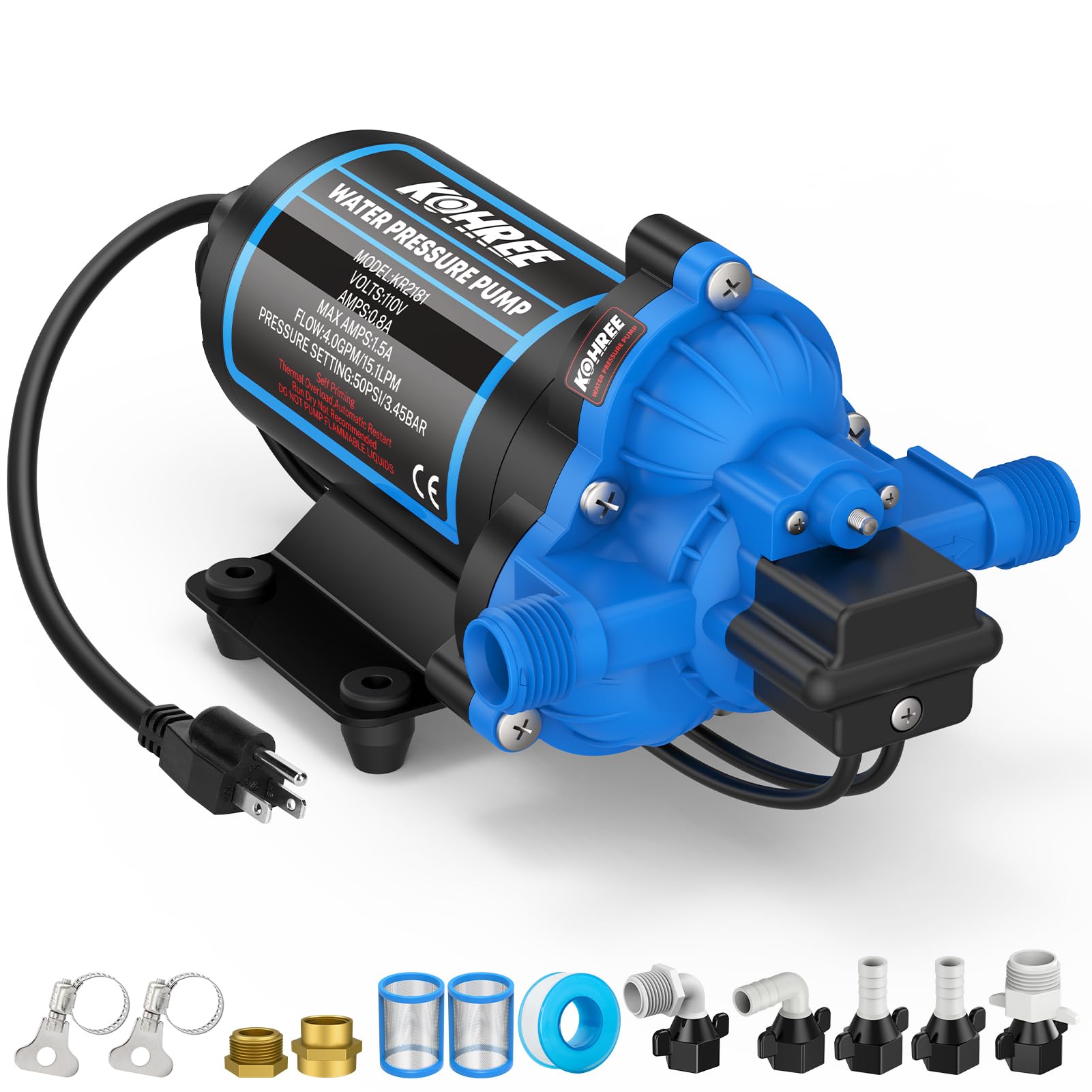
When you want to run a proper hose from a rain barrel instead of dripping pot by pot.
This is a different animal from the kits above: a 110-volt pressure pump, not a battery dripper. It pushes 4.0 gallons per minute at 50 PSI, self-primes up to 9.8 vertical feet, lifts water as high as 148 feet, and its adjustable pressure switch (40-70 PSI) ramps it down when the nozzle closes and back up when you open a valve. That means you connect it to a rain barrel or a 35-gallon trash can and then run a full garden hose or a sprinkler line right off it. Compared with the VIVOSUN’s 1000L-per-hour ceiling, this unit is built for volume, not dripper counts.
The reviews point to exactly the scenarios this pump was made for. It powers a rain barrel that keeps hanging plants fed across a long hose, and one owner uses a 35-gallon trash can of RO water as a tank that refills aquariums through a garden hose. It runs at ≤50dB thanks to the rubber mounting base — a soft background hum rather than a whine. Owners also note the on-demand pressure switch means you rarely have to think about it once the barrel is full. A complete kit of hose adapters, a 50-mesh inlet strainer, and Teflon tape means the plumbing work is covered.
The trade-offs are the ones you would expect from any mains-powered pump: it needs a 110V outlet near the water, and one buyer found their unit failed. Its thermal overload protection keeps it from dry-running itself to death, which is a real safeguard on a barrel. If your plants are a dozen pots on a balcony shelf, a solar or battery kit will suit you better than this unit; if your plants are a garden or full porch row, this is the pick that will not tire.
What the extra output buys you: enough flow to water hanging baskets through a long hose, refill a tank, or drive a sprinkler, all while keeping everything self-contained from a barrel.
The trade-off you sign up for: mains power ties it to an outlet, and it’s still one unit that has failed on a small number of buyers — so keep the strainer clean and don’t run it dry.
The right pick when: your water source is a rain barrel and your plants need a hose or sprinkler, not a drip line.
Wrong match if: you have no outdoor power and only a handful of pots to feed.
7. LetPot Automatic Watering System for Potted Plants, Wi-Fi & App Control

The only pick you can re-schedule from the airport lounge.
If you travel often and want to check in on your plants from your phone, this is the one. The LetPot system runs on Wi-Fi with app control, so you set the schedule, change it, and watch the low-water alert from anywhere with a signal — and the app holds up to five simultaneous watering tasks. The kit includes 10 meters of pipe, 10 adjustable drippers, 10 connectors, 10 brackets, and a filter, and supports 10-20 pots. The upgraded 2.0 chip is behind the faster, more stable connection, and the anti-backflow valve stops the siphon effect so water does not keep trickling after the pump stops.
Flexibility is the point here. The adjustable drippers and the app let you choose between intermittent and continuous watering, and you can dial in frequency and duration to suit each plant — the app also includes a plant info library and a diary feature. It carries an IP66 waterproof rating, which means it is sealed against rain and hose spray, so it can stay on the balcony through changing weather. The pump itself is quiet enough for a bedroom or living space, and owners running nutrients through it on a 24-hour continuous drip say the pump stays quiet but powerful.
The honest catch is that the drip emitters need a little tuning before you rely on them; the nozzles lack clear flow-rate graphics, and one owner caused an overflow by misjudging them. The stiff PE tubing can also hold its coil shape, which makes placing drippers awkward at first — soaking the ends in warm water, as the maker suggests, softens it. Test the flow before you travel, and this becomes the most controllable kit on the list. It is the premium pick, priced above the solar and pressure units here, but it is the one that stays truly hands-off.
The real selling point: a phone-linked schedule means you can add a minute of watering from the road rather than guess and hope.
Before you trust it away: tune each drip emitter and test overnight — the flow graphics on the nozzles are hard to read, so a dry run saves a soaked floor.
Perfect for: the frequent traveler with 10-20 pots who wants to run nutrients and change schedules from a phone.
Not for: someone with no Wi-Fi on the balcony or a preference for a purely button-and-timer setup.
Understanding the Specs
Flow Rate and How It Is Measured
Flow rate describes how much water a pump moves in a set time, and different kits quote it in different units — some in liters per hour, some in gallons per minute, some simply as an output ceiling. The Lewisia’s 1-watt DC impeller pump is rated up to 576L per day, which works out to 24L per hour. The VIVOSUN’s 15W pump quotes a maximum of 1000L per hour. The Kohree pressure pump quotes 4 GPM at 50 PSI. When comparing, match the flow to the number of drippers and the height the water must climb; a low-flow pump feeding eight lines loses pressure fast.
Battery Capacity, Solar Panels, and Self-Priming
A 2200mAh battery is the standard cell behind the Lewisia and the Srygery solar kits, and it is what lets a solar unit keep running through a cloudy week — the Srygery holds up to 30 days of continuous use on a full charge. Self-priming matters when your reservoir sits below the pots, because the pump can lift water up on its own instead of needing you to fill the line by hand. The Kohree self-primes up to 9.8 vertical feet. Dry-run protection, found on the Lewisia and the Kohree, senses a dry intake and shuts the motor down to protect it.
FAQ
Do I need a tap for these plant pumps to work?
How long can a solar plant watering kit run without sun?
What is the difference between self-priming and standard pumps?
How many plants can each kit actually water?
Can I run fertilizer through a drip irrigation pump?
Will an auto plant waterer survive being left outdoors?
Can a small solar pump feed a whole garden bed?
What happens if the water container runs dry while I am away?
How long does it take to set up a plant watering kit?
Do these pumps need a valve to stop the water when the timer is off?
Final Thoughts: The Verdict
For most balconies and container gardens, the auto water pump for plants winner is the Lewisia 2W Solar Kit, because its separate solar panel, run-dry protection, and 2200mAh battery let it water up to 15 plants with no tap and no outdoor socket. If you want the biggest spread of timer options, grab the Srygery LCD Solar Kit with its 30 modes and 10 intervals. And for a rain barrel feeding a full garden row, the Kohree 110V Pressure Pump is the one to reach for.
How We Picked
We do not accept paid placement. Every pick is matched to a real buyer and a real use-case; we do not hands-on test units.
Sources & Methodology
Specifications: manufacturer listings and product documentation. Review insights: verified customer reviews, as of September 2026. Pricing: not shown on this page (it changes often); check the current price via the retailer link.
As an Amazon Associate, Gadgets Feed earns from qualifying purchases. This does not affect which products we feature.