
Buffering during a video call or a gaming session isn’t just frustrating — it’s a sign your network hardware can’t keep up with the demands of modern streaming, smart home devices, and remote work. The right router is the single most impactful upgrade you can make to your home network, delivering lower latency, wider coverage, and the capacity to handle dozens of devices without breaking a sweat.
I’m Min — the co-founder and writer behind Gadgets Feed. I’ve spent hundreds of hours analyzing the latest WiFi standards, comparing throughput benchmarks, and dissecting real-world signal performance across dozens of models to understand what separates a reliable workhorse from a frustrating bottleneck.
Whether you’re upgrading from an ISP-issued rental or jumping to WiFi 6 or 7, this guide cuts through the marketing noise to help you find the best auto wifi router for your specific home and budget.
How To Choose The Best Auto WiFi Router
The right router balances speed, coverage, device capacity, and future-proofing against your actual home network demands. Focusing on the wrong spec — like a high data rate without considering the number of devices — can leave you with a paper tiger. Here are the critical factors to evaluate.
WiFi Standard: Wi-Fi 5 vs. Wi-Fi 6 vs. Wi-Fi 7
The generation of WiFi technology built into the router dictates its base performance ceiling. Wi-Fi 6 (802.11ax) brought OFDMA and MU-MIMO for handling many devices efficiently, while Wi-Fi 7 (802.11be) introduces 320 MHz channels, Multi-Link Operation (MLO), and 4K-QAM for massive throughput and lower latency. If you have gigabit or multi-gig internet and a flock of modern devices, skipping straight to Wi-Fi 7 offers the best future-proofing. For most homes on sub-gigabit plans, a quality Wi-Fi 6 router delivers excellent performance today.
Band Support: Dual-Band, Tri-Band, or Quad-Band
A dual-band router (2.4 GHz + 5 GHz) is sufficient for homes with under 30 devices. Tri-band adds a second 5 GHz or a 6 GHz band, dedicating a wireless channel for backhaul communication between mesh nodes or high-bandwidth gaming traffic. Quad-band routers, like the ASUS ROG Rapture GT-BE98 PRO, offer maximum flexibility for interference-free channels and top-tier mesh backhaul but are overkill unless you are a hardcore gamer or running a home office with multi-gig wired infrastructure.
Port Configuration: The Forgotten Bottleneck
Many buyers focus entirely on wireless speeds but overlook the ethernet ports. If your internet plan exceeds 1 Gbps, a router with only gigabit WAN/LAN ports will cap your wired performance. Look for at least one 2.5 Gbps port on the WAN side, and ideally 2.5 Gbps LAN ports for connecting a gaming PC or NAS. The GL.iNet Flint 3 and TP-Link Deco 7 BE23 provide multi-gig ports at a reasonable mid-range premium.
Coverage Area and Antenna Design
Manufacturer coverage claims are based on open-plan, interference-free environments. For real-world homes with walls, floors, and appliances, expect roughly 60-70% of the stated range. Routers with external high-gain antennas, like the TP-Link Archer AX21, typically deliver stronger signal penetration than internal antenna designs. For homes over 2,000 sq. ft., a single powerful router may still leave dead zones, making a mesh-capable system like the TP-Link Deco 7 a smarter choice.
Quick Comparison
On smaller screens, swipe sideways to see the full table.
| Model | Category | Best For | Key Spec | Amazon |
|---|---|---|---|---|
| ASUS ROG Rapture GT-BE98 PRO | Premium Gaming | Enthusiast Gaming & Multi-Gig | Quad-Band, Dual 10G Ports | Amazon |
| GL.iNet GL-BE9300 (Flint 3) | High-End VPN | VPN & Open-Source Control | Tri-Band, 5x 2.5G Ports | Amazon |
| TP-Link Deco 7 BE23 | Premium Mesh | Whole-Home Mesh & Future-Proof | Wi-Fi 7, 2x 2.5G Ports | Amazon |
| Linksys MR7350 | Mid-Range Mesh | Reliable Mesh Starter | Wi-Fi 6, 1.8 Gbps Speed | Amazon |
| NETGEAR Nighthawk RAX30 | Mid-Range Value | Coverage & Speed Balance | 5-Stream, 2,000 sq. ft. | Amazon |
| NETGEAR R6700AX | Budget WiFi 6 | Entry-Level WiFi 6 Upgrade | 4-Stream, 1,500 sq. ft. | Amazon |
| TP-Link Archer AX21 | Budget Champion | Best Bang-for-Buck | AX1800, 4 High-Gain Antennas | Amazon |
In‑Depth Reviews
1. ASUS ROG Rapture GT-BE98 PRO

The ASUS ROG Rapture GT-BE98 PRO is the pinnacle of consumer routing, packing a quad-band Wi-Fi 7 system with 320 MHz channel support on the 6 GHz band and a staggering aggregate speed of up to 30 Gbps. Its external dual-feeding antennas and four adjustable antenna elements deliver exceptional signal efficiency, with real-world Wi-Fi 7 throughput measured at roughly 2 Gbps at close range on matching clients. The inclusion of dual 10G ports (one WAN, one LAN) plus four 2.5G ports removes every conceivable wired bottleneck for multi-gig internet plans and NAS connections.
This router’s Triple-Level Game Acceleration pipelines PC traffic from the gaming port all the way to the game server, drastically reducing in-game ping during peak household use. The hardware revision cycle has matured significantly — current units (HW v3.0) run cool at around 42°C and offer rock-solid stability across all bands. The Guestnet Pro feature provides per-SSID IoT subnet isolation, a critical security layer for smart home devices. The ASUS app facilitates initial setup, though the full web GUI is where networking enthusiasts will want to fine-tune QoS and VLAN settings.
That said, this is a massive device — both physically and in terms of feature depth — and may overwhelm less technical users. Some early firmware versions had 2.4 GHz IoT disconnection issues, now largely resolved by firmware v3.0.0.6.102_39262, though certain Eufy Homebase 3 units still show interference quirks. At the top of the price stack, it is justified only if you have multi-gig fiber, a fleet of Wi-Fi 7 clients, and a desire for the absolute lowest latency available.
Why it’s great
- Unmatched quad-band Wi-Fi 7 with 320 MHz channels
- Dual 10G and quad 2.5G ports eliminate all wired bottlenecks
- Subscription-free security and robust gaming QoS
Good to know
- High price point requires multi-gig plans to justify
- Setup complexity is steep for non-enthusiasts
- Older firmware had 2.4 GHz IoT compatibility quirks
2. GL.iNet GL-BE9300 (Flint 3)

The Flint 3 distinguishes itself with a rare combination: fully open-source capable firmware with a polished UI, plus Wi-Fi 7 tri-band speeds up to 9 Gbps aggregate, all wrapped in a chassis with five 2.5 Gbps ethernet ports. For users who demand VPN performance, its hardware-accelerated WireGuard and OpenVPN throughput reaches up to 680 Mbps, meaning your entire home can run through a VPN tunnel without bottlenecking on a 500 Mbps fiber plan. The built-in AdGuard Home integration allows DNS-level ad and tracker blocking directly on the router, improving privacy across every connected device without client-side software.
Tri-band operation with Multi-Link Operation (MLO) and 4K QAM delivers real-world speeds of 950 Mbps on the 6 GHz band from a 1 Gbps fiber connection, as reported by users in typical wood-frame homes. The router includes a USB 3.0 port that supports up to a 6 TB external drive for basic network-attached storage, though the USB throughput caps around 30 MB/s, so it is not a replacement for a dedicated NAS. Its compact black chassis with retractable antennas is surprisingly understated for such a feature-packed unit.
Coverage is rated at 2,000 sq. ft., and user feedback suggests it handles that target adequately but may leave fringe areas weaker than some competitors with larger antenna arrays. The rubber-footed base lacks wall-mounting options, which may be a consideration for permanent installations. While the web admin panel is highly responsive and does not require an app for setup, less technical users may find the advanced network settings intimidating. Still, for the price, it delivers an exceptional feature-per-dollar ratio for networking enthusiasts.
Why it’s great
- Superb WireGuard/OpenVPN performance (680 Mbps)
- Five 2.5 Gbps ports for full multi-gig wired setup
- Built-in AdGuard Home for network-wide ad blocking
Good to know
- WiFi range is adequate but not class-leading
- USB 3.0 NAS speeds are limited (~30 MB/s)
- No wall-mounting holes in the base
3. TP-Link Deco 7 BE23

TP-Link’s Deco 7 BE23 brings Wi-Fi 7 to the mesh form factor at a price that undercuts most standalone Wi-Fi 7 routers. Each node is a dual-band BE3600 unit with two 2.5 Gbps WAN/LAN ports, supporting wired backhaul for maximum throughput between units. The system covers up to 2,500 sq. ft. per node and handles 150 devices with AI-driven roaming that dynamically switches client connections as you move through the house. MLO (Multi-Link Operation) aggregates bands for lower latency and more stable connections, which is especially beneficial for video calls and cloud gaming.
Setup is handled through the TP-Link Deco app, which is among the most streamlined in the mesh space — users commonly report a 3-node system fully operational within 10 minutes. The HomeShield suite provides real-time IoT security, parental controls, and network scans without a subscription fee for the basic tier. The white, pill-shaped design is unobtrusive and blends into living spaces far better than traditional antenna-riddled routers. Users upgrading from ISP gear frequently report a 2-3x speed improvement at previously dead zones in homes around 2,600 sq. ft.
A key limitation is that the BE23 is dual-band, not tri-band, so the 5 GHz band handles both client traffic and wireless backhaul unless you run ethernet between nodes. In wireless backhaul mode, throughput between nodes drops noticeably compared to a tri-band or quad-band mesh system. Also, some older IoT devices on 2.4 GHz may struggle to connect if the mesh’s band-steering algorithms are too aggressive. Despite these points, it is the most affordable entry point to Wi-Fi 7 mesh with multi-gig wired ports.
Why it’s great
- Most affordable Wi-Fi 7 mesh system available
- Excellent range per node with AI-driven roaming
- Two 2.5 Gbps ports per node for wired backhaul
Good to know
- Dual-band limits wireless backhaul performance
- Band-steering can occasionally drop older 2.4 GHz IoT gear
- Basic HomeShield features are limited behind subscription
4. Linksys MR7350

The Linksys MR7350 is a dual-band AX1800 Wi-Fi 6 router that leverages Intelligent Mesh Technology to eliminate dead zones in homes up to 1,700 sq. ft. while supporting over 25 simultaneous devices. It is powered by a Qualcomm chipset that delivers wire-like low latency and stable streaming, making it an excellent entry-level mesh expander or standalone router for smaller homes. The retractable antenna design and white chassis give it a clean, living-room-friendly appearance that avoids the aggressive gamer aesthetic.
Setup is guided entirely through the Linksys App, which, despite some user complaints about fake apps in app stores, is straightforward once the correct version is installed. The router’s mesh capability means you can wirelessly add additional nodes later without replacing the entire system — a cost-effective path to broader coverage. Users replacing ISP gateways commonly report immediate improvements in streaming stability on smart TVs and a measurable reduction in dropouts during peak family usage. The MR7350 does not support 160 MHz channels, so peak single-device speed on Wi-Fi 6 is capped compared to competitors.
A notable drawback is that the MR7350 has been discontinued by Linksys, which may affect long-term firmware support and warranty replacement availability. Additionally, the management interface forces app-based setup with limited local web access — disabling remote management via the app also blocks local web GUI login, a frustrating design choice for advanced users. For the price, it remains a solid mesh-starter router for those who prioritize a simple, app-driven experience over raw peak performance or advanced feature tweaking.
Why it’s great
- Intelligent Mesh technology expands coverage easily
- Qualcomm chipset delivers stable, low-latency connections
- Clean white design suitable for any room
Good to know
- Model is discontinued; future firmware support uncertain
- No 160 MHz channel support on 5 GHz band
- App-dependent management with limited local web access
5. NETGEAR Nighthawk RAX30 (Renewed)

The Nighthawk RAX30 is a 5-stream AX2400 dual-band Wi-Fi 6 router designed to cover up to 2,000 sq. ft. and handle up to 20 connected devices. Its 5-stream architecture — three on 5 GHz and two on 2.4 GHz — provides an extra data pipe over the more common 4-stream routers, which translates to better multi-device throughput in households with a mix of streaming, gaming, and web conferencing. The renewed version is often indistinguishable from new stock, with many buyers reporting a like-new unit in a generic box with a QR code for quick app-based setup.
At roughly 2,000 sq. ft., real-world coverage in a typical two-story home with wood-frame construction is solid, with users commonly achieving 200+ Mbps on 5 GHz throughout the living areas and bedrooms. The four 1G ethernet LAN ports provide ample wired connections for consoles and PCs, though the lack of a 2.5G port means it will bottleneck gigabit+ internet plans. NETGEAR’s automatic firmware updates and WPA3 security come standard, and the Nighthawk app provides a clean interface for network monitoring and guest access.
A key consideration is the renewed status — while most units function flawlessly, warranty support follows NETGEAR’s renewed electronics policy, which is shorter than the standard new-product warranty. The RAX30 also lacks USB ports, so there is no option for network-attached storage or a printer server. It is also worth noting that some users found the 5 GHz range slightly behind the previous-gen R7000 in specific layouts. For the price, however, it remains a compelling entry point into AX2400 performance.
Why it’s great
- 5-stream architecture improves multi-device throughput
- Wide coverage for homes up to 2,000 sq. ft.
- Renewed units offer strong performance at lower cost
Good to know
- No 2.5G or multi-gig WAN port
- Lacks USB ports for storage or printer sharing
- Renewed warranty period is shorter than new units
6. NETGEAR R6700AX
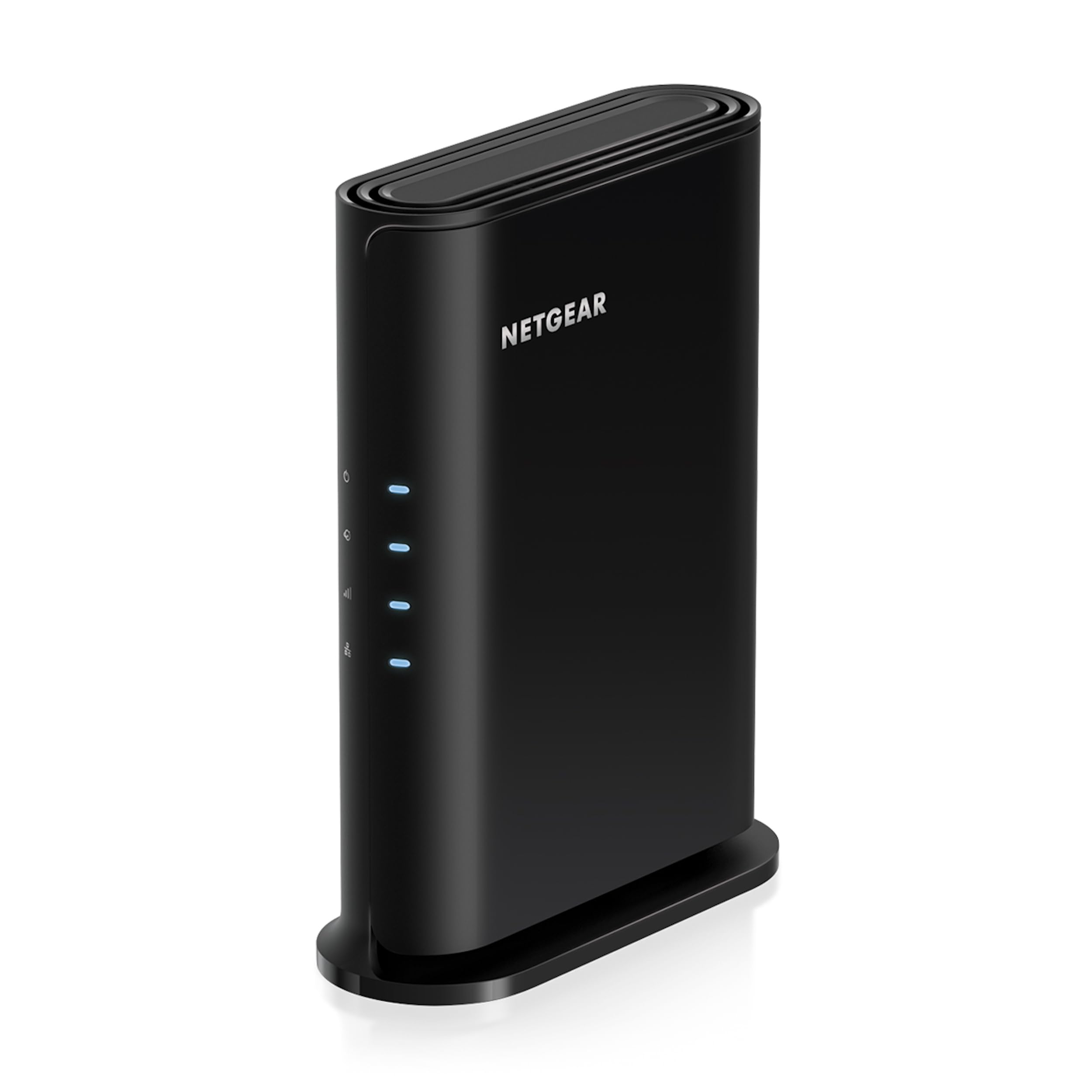
The NETGEAR R6700AX is a 4-stream AX1800 dual-band Wi-Fi 6 router that delivers the core benefits of Wi-Fi 6 — OFDMA, MU-MIMO, and WPA3 — in a compact, unassuming chassis. It is designed for small to medium homes up to 1,500 sq. ft., and user reports confirm strong signal coverage in open-plan condos and apartments where it easily outperforms ISP-provided gateways. Setup through the Nighthawk app is consistently praised as intuitive, with most users getting online in under 10 minutes without needing to touch a web browser.
The router includes four gigabit LAN ports and a separate WAN port, but like its price-adjacent siblings, it lacks a 2.5G port, capping wired throughput at 1 Gbps. Real-world throughput for mixed-use scenarios is impressive — one user reported 113 Mbps down on a 100 Mbps Spectrum plan with a 15 ms ping, indicating efficient packet processing. The internal antenna design keeps the unit small enough to place on a dresser or entertainment center without dominating the space, though coverage may fall short in larger homes with multiple floors or dense interior walls.
A critical caveat is that NETGEAR’s support model requires a paid subscription for ongoing phone support after the initial period, and some users have reported difficulties canceling these subscriptions. Additionally, the R6700AX does not support forming a mesh network with other NETGEAR units, so coverage expansion requires a separate network extender rather than a seamless mesh node. For the budget-minded buyer who simply wants to stop renting from their ISP and enjoy stable Wi-Fi 6, it is a functional, low-hassle choice.
Why it’s great
- Simple app-based setup in under 10 minutes
- Strong enough signal for apartments and small homes
- Low-cost way to stop ISP rental fees
Good to know
- No 2.5G port — wired speeds capped at 1 Gbps
- Cannot form a mesh with other NETGEAR routers
- Phone support requires a paid subscription after trial
7. TP-Link Archer AX21 (V5)

The TP-Link Archer AX21 is the quintessential budget-friendly Wi-Fi 6 router, consistently delivering strong performance at a value that frequently undercuts the competition. Its four fixed high-gain antennas, combined with beamforming technology and an advanced front-end module (FEM) chipset, produce surprisingly robust coverage for a sub- router — users in 2,000 sq. ft. homes regularly report full signal strength in previously dead zones. The dual-band AX1800 architecture (up to 1200 Mbps on 5 GHz, 574 Mbps on 2.4 GHz) is well-matched to sub-gigabit internet plans.
A significant advantage of the Archer AX21 is its web-based admin interface, which many users find cleaner and more reliable than the Tether phone app. The router supports OpenVPN and PPTP VPN servers directly, a feature rarely seen at this tier, allowing users to securely access their home network remotely. It also supports TP-Link OneMesh, giving a path to expand coverage with compatible range extenders, though the implementation is not as seamless as a dedicated mesh system. The Archer AX21 is a Certified for Humans device, meaning voice control via Alexa is supported out of the box.
The most common user complaint involves the Tether mobile app, which has been reported to cause login and password issues during initial setup — the fix is simply to use the web browser interface instead. The router’s dark gray chassis with three external antennas is functional but visually uninspiring, and the LEDs on the front are bright enough to be distracting in a bedroom. For anyone seeking the absolute best performance-to-dollar ratio in a standalone router, the Archer AX21 remains the benchmark to beat.
Why it’s great
- Best-in-class value for Wi-Fi 6 performance
- Excellent coverage from 4 high-gain antennas with FEM
- Built-in OpenVPN/PPTP VPN server support
Good to know
- Tether mobile app has known setup issues — use web GUI
- External antennas and bright LEDs are not bedroom-friendly
- No 2.5G port; wired speed capped at 1 Gbps
FAQ
What does the “AX” number on a Wi-Fi 6 router mean?
Can I use a Wi-Fi 6 router with my older laptop or phone?
When would I need a 2.5 Gbps or 10 Gbps ethernet port on my router?
Final Thoughts: The Verdict
For most users, the best auto wifi router is the TP-Link Archer AX21 because it delivers reliable Wi-Fi 6 performance, excellent coverage from its high-gain antennas, and built-in VPN server support at a price that makes ISP rental fees look absurd. If you want multi-gig wired performance and open-source flexibility, grab the GL.iNet Flint 3. And for the ultimate future-proofed gaming setup with no compromises, the ASUS ROG Rapture GT-BE98 PRO stands alone.