
Fermentation is a controlled microbial dance, and the only way to start with a clean slate is to absolutely obliterate every wild yeast, bacterial spore, and mold cell from your equipment. An autoclave that reaches the correct temperature and pressure is the difference between a crisp, predictable ferment and a sour, contaminated batch that goes straight down the drain.
I’m Min — the co-founder and writer behind Gadgets Feed. My research digs deep into the pressure ratings, chamber materials, and cycle consistency that actually matter when you need repeatable sterilization for jars, media, and tools.
Whether you’re a home brewer, a mushroom cultivator, or a small-batch fermenter, finding the right equipment means understanding capacity, safety, and heat source compatibility. This guide to the best autoclaves for fermentation will help you select a unit that reliably hits sterilization parameters without breaking your workflow.
How To Choose The Best Autoclaves For Fermentation
Selecting an autoclave for fermentation work is different from buying one for a clinical lab. You need sustained, reliable heat and pressure to penetrate dense grain bags or thick glass jars, often for long cycles. The wrong choice can mean failed sterility or a frustrating user experience.
Pressure and Temperature Capability
The gold standard for sterilization is 121°C (250°F) at 15 PSI. Any autoclave you consider must hold this minimum without struggling. Units that peak lower than 15 PSI will not reliably kill thermophilic spores common in soil-based ferments. Look for a gauge that clearly reads PSI and temperature, and check that the safety valve is rated above your target operating pressure.
Chamber Volume and Configuration
Consider your batch size. A 12-liter autoclave fits roughly four to six quart-sized jars, perfect for a small home lab or brewery. Larger 25-quart models can handle more media or grain simultaneously but take longer to heat up. Also note whether the chamber is vertical or horizontal — vertical chambers often stack jars more efficiently, while horizontal units are better for long tools or pouches.
Electric vs. Non-Electric Heat Source
Electric autoclaves offer consistent, hands-off heating with digital controls, but they are often more expensive and draw significant wattage. Non-electric models like the All American series work on any stovetop, giving you flexibility and durability, but require careful manual monitoring. A non-electric model is also easier to repair because there are fewer electronic components to fail.
Quick Comparison
On smaller screens, swipe sideways to see the full table.
| Model | Category | Best For | Key Spec | Amazon |
|---|---|---|---|---|
| All American 1930 1925X | Non-Electric | High-volume grain jar sterilization | 25 qt / 17 PSI max | Amazon |
| Tuttnauer 1730 Valueklave | Electric Tabletop | Small medical/food lab | 2 Gal / 11 min hot cycle | Amazon |
| VEVOR 16 Gal Fermenter | Pressure Fermenter | Pressurized beer and wine fermentation | 60 L / 15 PSI | Amazon |
| Mxmoonfree 12L Lab Autoclave | Electric Portable | Entry-level media and tool sterilization | 12 L / 15-20 PSI | Amazon |
| BAOSHISHAN 12L Steam Autoclave | Electric/Stovetop | Versatile dual-heat-source sterilization | 12 L / 304 SS | Amazon |
| Prestige Autoclave Classic 2100 | Small Electric | Small salon or single-instrument sterilization | 1.5 Gal / Compact | Amazon |
| GOYOJO 18L Autoclave Sterilizer | Electric Class N | Digital control for unwrapped tools | 18 L / Digital LED | Amazon |
In‑Depth Reviews
1. All American 1930 1925X Sterilizer – 25 qt
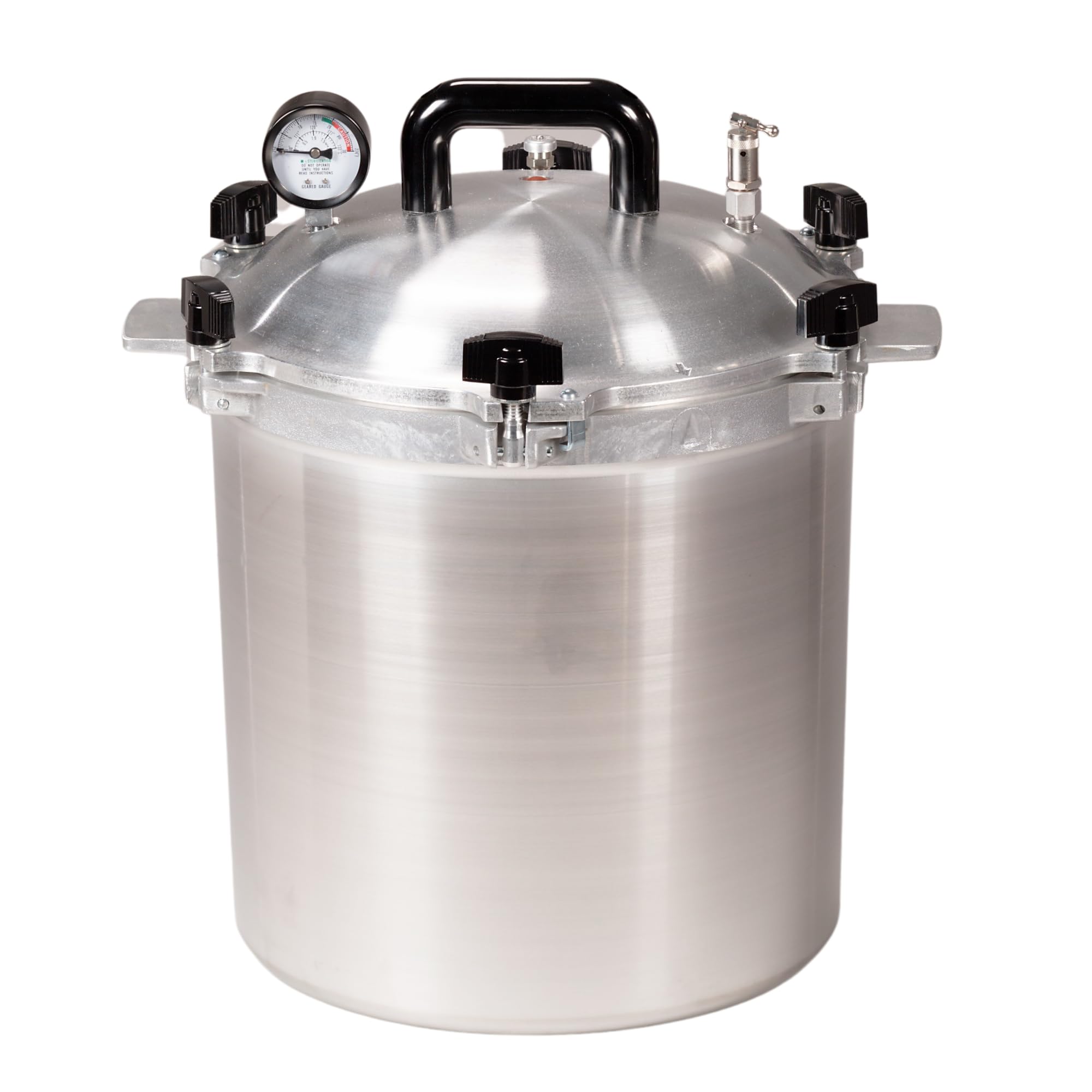
The All American 1925X is the gold standard for fermentation-related sterilization. Its massive 25-quart chamber holds multiple quart jars or grain bags per cycle, and the metal-to-metal seal eliminates gaskets that wear out. Running on any heat source, this unit reaches 17 PSI and 250°F dry steam, which is more than enough to kill endospores in dense substrates.
Made from high-grade cast aluminum, the unit feels extremely solid. The dial gauge is easy to read, and the overpressure plug adds a redundant safety layer. Users report that holding pressure overnight after a cycle is possible, indicating excellent sealing. The lack of electrical components means fewer failure points and easier long-term maintenance.
This model is non-electric, so you need to monitor the pressure manually to avoid overshooting. Some users modify it with a PID controller for precise high-altitude operation. The initial release valve can arrive damaged in shipping, but Amazon replacements are straightforward. For serious home mycology and fermentation prep, this is the workhorse.
Why it’s great
- 25-quart capacity handles large batches of grain jars.
- Metal-to-metal seal — no gasket to replace or degrade.
- Non-electric design works on any stovetop or burner.
Good to know
- Requires manual pressure monitoring — not set-and-forget.
- Heavy at 29 pounds, and the lid can be cumbersome.
- Some units arrive with a damaged release valve.
2. Tuttnauer 1730 Valueklave

The Tuttnauer 1730 is a clinical-grade electric autoclave designed for small offices, and it translates perfectly to a fermentation lab needing fast, reliable cycles. Its chamber is compact at 7×13 inches (2 gallons), but it offers an 11-minute sterilization cycle from a hot start — the fastest in this lineup. It automatically shuts off after both the sterilization and dry cycles.
Users report passing spore tests on the first try when following the manual. The unit requires somewhat careful manual operation, but this simplicity reduces electronic failure points. A Tuttnauer is built to last: one reviewer noted their prior unit served them for 17 years. The autoclave comes with three trays and uses standard 7.5×13-inch pouches.
The main limitation is size. You can only fit about three tools laid flat per cycle, and the chamber cannot accommodate a vertical rack for pouches. If your fermentation work involves small media bottles or wrapped instruments, this is excellent. For massive grain runs, you’ll want a larger companion unit.
Why it’s great
- Fast 11-minute sterilization cycle saves time on small batches.
- Automatic shut-off at end of sterilization and dry cycles.
- Proven longevity — many units last over a decade.
Good to know
- Very small chamber — only fits 2-3 tools or one medium pack.
- Fully manual operation requires reading the instructions carefully.
- Poorly organized manual for this specific model.
3. VEVOR Pressure Fermenter 15 PSI, 16 Gal/60L
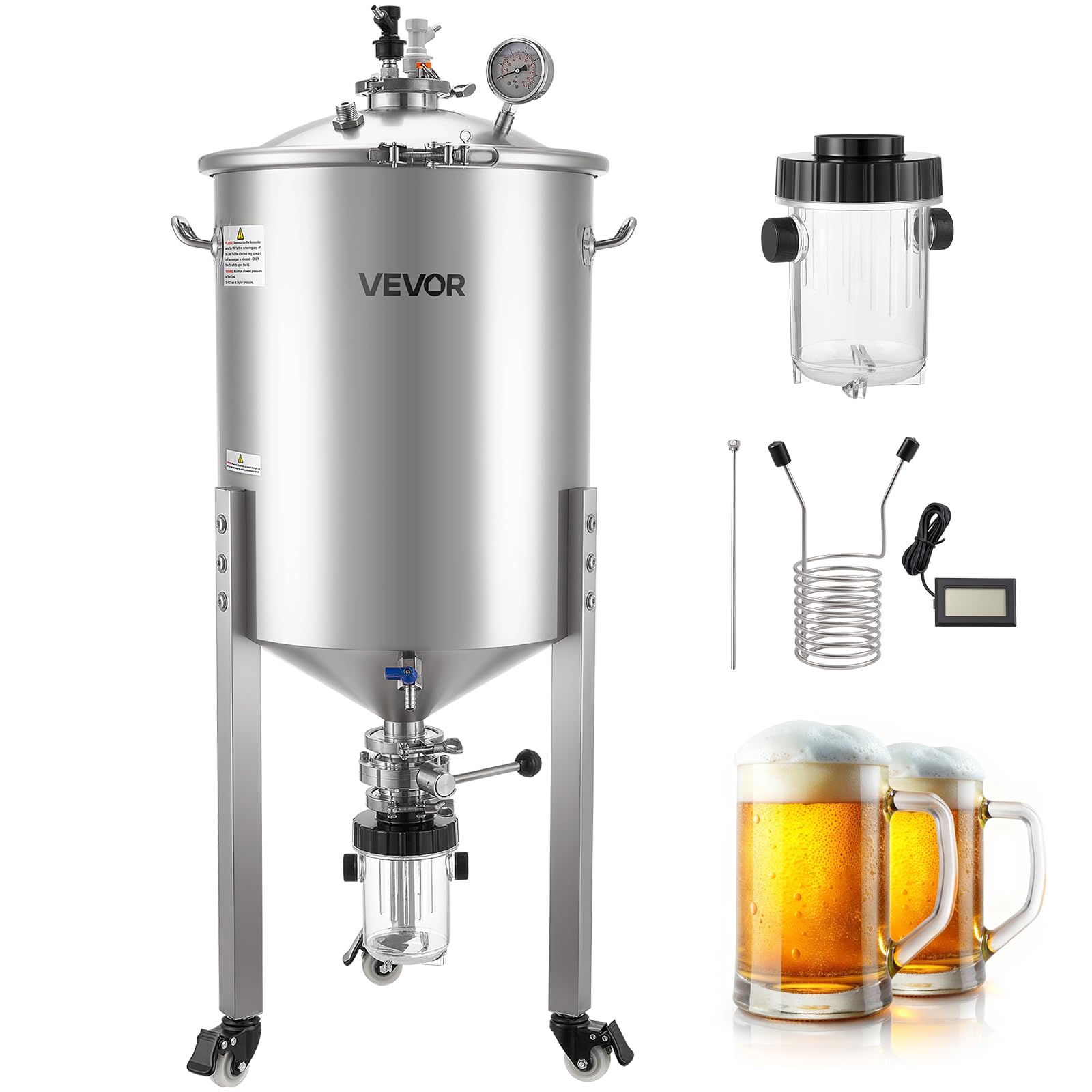
This VEVOR unit is not a traditional autoclave, but it deserves a place here because it functions as a pressure-rated fermentation vessel that also accepts sterilization temperatures. The 60-liter conical has a pressure rating of 15 PSI, which is the same threshold used for autoclaving. It includes a cooling coil for temperature control and a yeast collection bottle for consistent pitch rates.
Constructed from 304 stainless steel at 0.5 mm thickness, the tank is food-grade and easy to clean. The dual spigot system — one for trub at the bottom, one for clear beer above — is a massive upgrade from carboys or buckets. Users report that after eight brews, the unit shows no leaks and yields better fermentation efficiency than plastic buckets.
This is not a device you use to sterilize jars — it is the vessel in which fermentation occurs under pressure. It works best for brewers who want to ferment under pressure to reduce esters and speed up carbonation. The included casters make it mobile, and the pressure gauge lets you monitor real-time conditions.
Why it’s great
- 60-liter conical design allows pressurized fermentation for cleaner profiles.
- Cooling coil enables precise temperature control during active fermentation.
- Dual spigot system separates trub from finished product effortlessly.
Good to know
- Not an autoclave — it is a fermentation vessel, not for sterilizing external equipment.
- Lid seal may require some adjustment to close perfectly.
- Glass yeast collection bottle can break if handled carelessly during cleaning.
4. GOYOJO 18L Autoclave Sterilizer, Digital Control
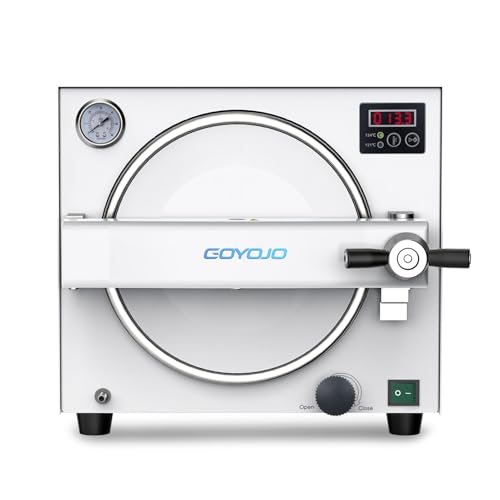
The GOYOJO 18L is a Class N electric autoclave with a digital LED control panel and two preset sterilization programs: 121°C for 30 minutes and 134°C for 10 minutes. This makes it incredibly simple — just select the program and press start. The chamber is stainless steel and holds three removable trays, suitable for sterilizing solid, unwrapped tools and glassware.
Safety is well-covered with a pressure gauge, safety door lock, and overheat protection. The unit is heavy at 66 pounds but fits on a standard countertop. Users note that the total cycle time including warm-up and cool-down is about 35 minutes on the highest setting. The exterior stays cool during operation, which is reassuring for a kitchen or small lab environment.
This autoclave is not designed for liquid loads or porous materials — it is strictly for solid, unwrapped instruments. The lack of a drying cycle means you must manually open the drain valve and wait for steam to escape. Some users report it is loud, and the door may leak a small amount of steam when opened.
Why it’s great
- Digital one-button operation with two preset sterilization cycles.
- Stainless steel 18-liter chamber holds three trays.
- Multiple safety features: door lock, overheat protection, pressure gauge.
Good to know
- Class N — only for solid, unwrapped instruments, not porous loads.
- No drying or active cooling cycle — requires manual venting and waiting.
- Some units are loud during operation and may leak steam at the door.
5. Mxmoonfree 12L Lab Autoclave, Portable Steam Autoclave

The Mxmoonfree 12L is an entry-level electric autoclave that covers the basics at a budget-friendly price point. It is rated for 0.10-0.14 MPa (15-20 PSI) and reaches 121-126°C, meeting the standard sterilization parameters. The unit is made of stainless steel and weighs 26.7 pounds, making it portable enough to move between workstations.
Safety features include two valves: a working valve and a safety release that automatically deflates if pressure exceeds limits. The upgraded pressure gauge shows both PSI and Fahrenheit, which is convenient for users in North America. Some reviewers successfully modified the unit for low-temperature applications like desalination, showing the basic construction is solid.
The downsides are significant. Multiple users report the heating element failing after about a year of use, and the screw-on lid is cumbersome and time-consuming. The unit lacks a built-in timer, so you must manually track cycle duration. Customer service is reportedly slow when addressing warranty claims for heating elements.
Why it’s great
- Achieves 15-20 PSI and 121-126°C for proper sterilization.
- Two-valve safety system with automatic overpressure release.
- Upgraded pressure gauge with easy-to-read PSI and Fahrenheit scales.
Good to know
- Heating element is a known weak point — may fail within a year.
- No built-in timer — requires manual monitoring to prevent overheating.
- Screw-on lid is tedious and time-consuming to seal and unseal.
6. BAOSHISHAN 12L Steam Autoclave Stainless Steel
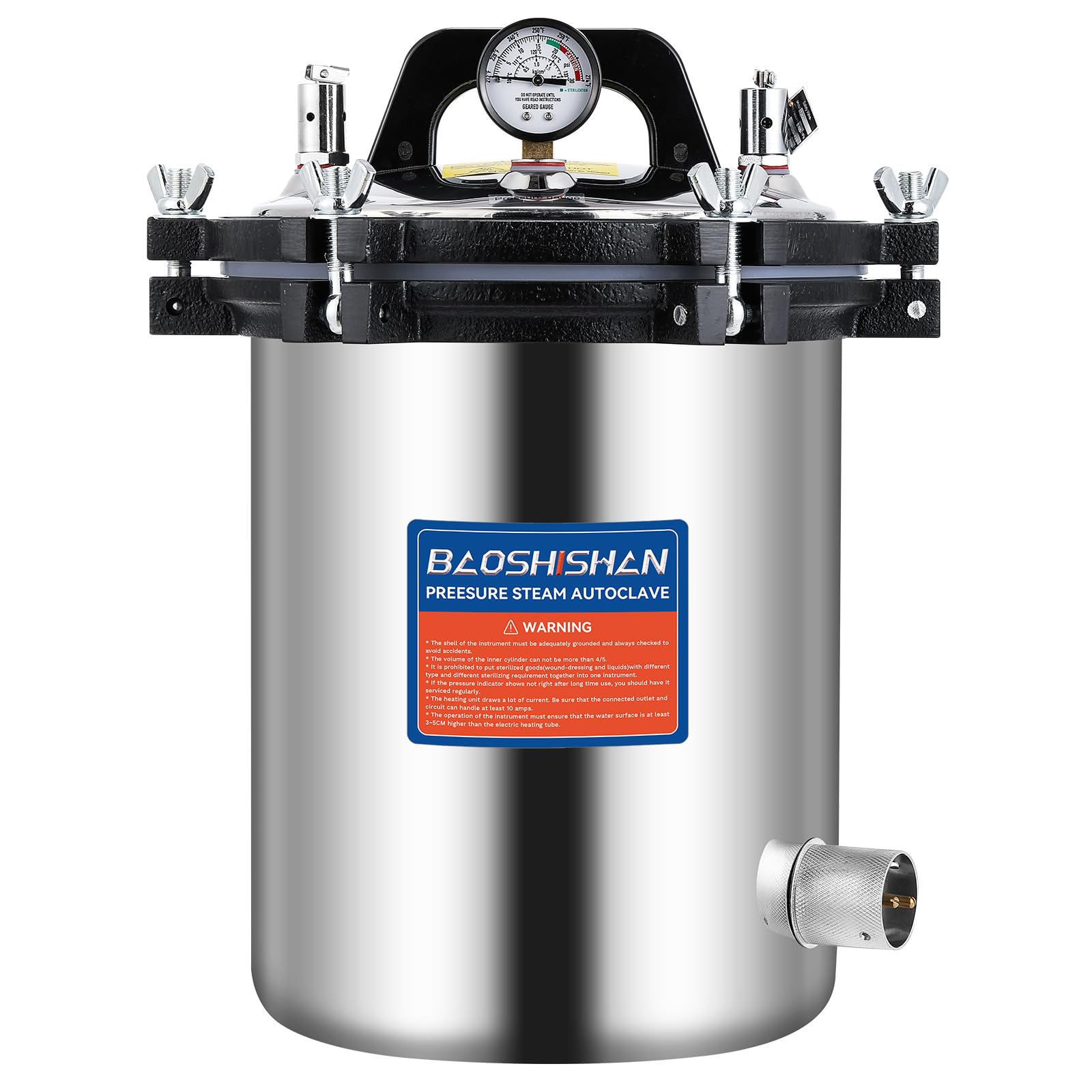
The BAOSHISHAN 12L autoclave is built from 2-millimeter-thick 304 stainless steel, which is thicker than many competitors and gives it a solid, durable feel. Its key differentiator is the ability to run on either electric power (1000W, 110V) or an open flame, making it useful in situations where electricity is unreliable or you want faster heat-up on a gas stove.
Safety is handled by two automatic pressure release valves, and the unit includes an updated user manual with clearer instructions than older versions. Users report that sterilization indicators turn dark after a 20-minute cycle at 127°C, confirming effective sterilization. The seal must be installed correctly to prevent leaks, and the unit needs good ventilation during use to avoid steam buildup.
The downsides include a lack of bottom insulation — one user reported the unit getting hot enough to burn a floor surface when plugged in. The maximum pressure seems to top out around 1.15 ATM (approximately 16.9 PSI), which is just below the 1.4-1.7 ATM claimed in the specs. The electrical plug may break within a few months, but the unit can still be used on a stovetop as a backup.
Why it’s great
- Thick 2mm 304 stainless steel construction for long life.
- Dual heat source: electric or open flame for flexibility.
- Two automatic safety release valves.
Good to know
- No bottom insulation — can damage floors or surfaces during use.
- Max pressure may be slightly below advertised rating.
- Electrical plug is fragile and may break within a few months.
7. Prestige Autoclave Classic Medical 2100

The Prestige Autoclave Classic 2100 is a compact, lightweight unit (15.42 pounds) designed for small salons and medical offices. At 1.5 gallons, it is the smallest autoclave in this roundup, suitable for sterilizing a handful of small tools like tattoo needles, manicure implements, or laboratory tweezers. It is sturdy and easy to carry between rooms.
Users in nail salons and small clinics appreciate its portability and effectiveness for wrapped instruments. However, the chamber is noticeably smaller than previous Prestige models — it can only fit one medium wrapped pack or three to four sterile envelopes. Items emerge very wet from the cycle, requiring hours of drying time, which can compromise sterility if the packaging is opened too early.
The main complaint is the lid mechanism. Multiple users report it is extremely hard to turn and close, with rough edges that may need filing out of the box. There are also reports of visible gaps in the lid seal, raising concerns about pressure retention. For the price, the Prestige offers basic functionality but lacks the refinement and capacity of other options.
Why it’s great
- Lightweight and portable at just over 15 pounds.
- Effective sterilization for small wrapped instrument packs.
- Simple operation suitable for nail salons and individual practitioners.
Good to know
- Very small chamber — only fits 1-2 medium packs or 3-4 envelopes.
- Items come out very wet, requiring hours of drying.
- Lid is notoriously hard to turn and close; rough edges may need filing.
FAQ
Can I use a regular pressure cooker for fermentation sterilization?
Why do my sterilized jars keep getting contaminated?
How do I choose between an electric and non-electric autoclave?
Final Thoughts: The Verdict
For most users, the best autoclaves for fermentation winner is the All American 1930 1925X because its 25-quart capacity, metal-to-metal seal, and ability to hold 17 PSI on any heat source make it the most reliable and long-lasting choice for serious grain jar and media sterilization. If you want a fast, automated electric unit for small batches, grab the Tuttnauer 1730 Valueklave. And for a pressure-rated fermentation vessel that doubles as a sterilizable fermenter, nothing beats the VEVOR 16 Gal Pressure Fermenter.