
Our readers keep the lights on and my morning glass full of iced black tea. As an Amazon Associate, I earn from qualifying purchases.
Specs are compiled from manufacturer listings and verified buyer reviews and can change over time — please confirm the key details on the product page before buying.
An automated camera mount turns your static tripod or slider into a remote-controlled cinematographer, handling the slow push-in, the sweeping panorama, or the time-lapse glide while you focus on the subject. The catch is matching the mount’s load limit and control style to the camera you actually own.
I’m Min — the founder and writer behind Gadgets Feed. This guide is built by comparing the manufacturers’ published specifications and the patterns across verified customer reviews, so you get each pick’s real strengths and trade-offs instead of marketing spin.
Whether you shoot with a phone, a mirrorless camera, or a full cinema rig, the right automated camera mount delivers repeatable, silent motion that makes your footage look professionally produced without the crew.
Our Picks at a Glance

How To Choose The Best Automated Camera Mount
Before you look at any features, check the maximum weight recommendation. If your camera body plus lens exceeds the number, the mount will struggle, stall, or eventually break under the load — this is the single most common cause of failed purchases in this category.
Match the Mount Type to Your Shot
A motorized pan-tilt head sits on top of your tripod and rotates the camera to follow action or sweep a scene. A motorized slider moves the entire camera along a rail for lateral tracking shots. If you shoot interviews and events, a pan-tilt head keeps a speaker in frame; if you film products or cinematic B-roll, a slider gives you that dolly-like glide.
Decide How You Want to Control It
Some mounts rely entirely on a smartphone app over Bluetooth or 2.4G, while others have a physical remote or a full button panel right on the device. An app gives you the most programmability for complex moves, but a physical remote is far faster on set when you are mid-shot and need a speed change without touching your phone.
Check Power and Battery Realities
Look for a battery you can replace or recharge without special gear. Many pro-level sliders use NP-F series batteries, which are commonly shared across camera accessories. If you work long outdoor days, a mount that can also run off a USB-C or DC power source gives you backup when the juice runs low.
Quick Comparison
| Model | Best For | Type | Max Load | Control | Amazon |
|---|---|---|---|---|---|
| IFOOTAGE Shark Nano II 660★ Best Overall | Pro multi-axis sliders | Motorized Slider | 15.4 lbs | Touchscreen + App | Amazon |
| NEEWER DL400 DollyCompact Dolly | Compact tabletop moves | Motorized Dolly | 6.6 lb | App Control | Amazon |
| NEEWER ER1-80 Slider | Long carbon-fiber travel | Motorized Slider | 11 lb | App + 2.4G Remote | Amazon |
| GVM GP-80D Slider | Budget-friendly tracking | Motorized Slider | 11 pounds | Controller Wired | Amazon |
| ZTFON YT-2000 Head | Face-tracking self-shoots | Pan-Tilt Head | 2 kg | Remote + Gesture | Amazon |
| Soonpho M4 Head | Budget pan-tilt control | Pan-Tilt Head | 1 kg | Remote Control | Amazon |
| Accsoon Toprig S60 | Silent compact travel | Motorized Slider | 4.3 pounds | Button + App | Amazon |
In-Depth Reviews
1. IFOOTAGE Shark Nano II 660
Our pick — over 4★ from 50+ verified ratings; the strongest balance of quality and price.
The slider that lifts a full cinema rig while so quiet it records ASMR takes.
This is the mount for shooters who bring heavy glass. It carries a 15.4 lb maximum load, and buyers report it lifts an FX3 with a 70-200mm lens straight up on the vertical axis — 3.5kg vertical, 7.5kg horizontal — with no micro-jitter. The 17-inch sliding range plus 360° unlimited pan means you can combine travel and rotation in one take.
Control is split between an IPS touchscreen on the device and the iFootage Moco app for iOS and Android. You can set 8 customizable waypoints, dial slide speed between 0.1°/s and 180°/s, and program time-lapse intervals. The AI dynamic tracking locks onto faces or moving objects automatically via the app — ideal for solo vlogging or live interviews. You can even run it in Multi-Target Mode with up to 4 preset points to switch between during a recording.
Power comes through a single USB-C PD 60W cable that can charge the slider, a connected DJI gimbal, and the camera at once, or you can run it on F970 batteries. Owners say the included carrying bag secures the slider well for transport, and while the build feels solid, the magnetic cable and shutter cables are thoughtful extras. The brushed aluminium and carbon fiber frame runs at under 20dB, which is why ASMR and wedding film crews reach for it.
Editor’s take: Buyers consistently call it cheaper than the Edelkrone alternative while delivering equal or better stability. It supports DJI RS2/RS3 Pro/RS4/RS4 Pro gimbals through the included adapter, which is a major plus if you already own one.
One caution: The 6.8 lb body means you are not carrying this on long hikes; it is a studio-and-car-rig tool for serious shoots.
Who it serves: Filmmakers and content teams running mirrorless bodies with heavy zoom lenses need real stability and repeatable multi-axis moves.
Think twice if: You shoot only with a phone or action camera — the load capacity and price point outclass that workflow.
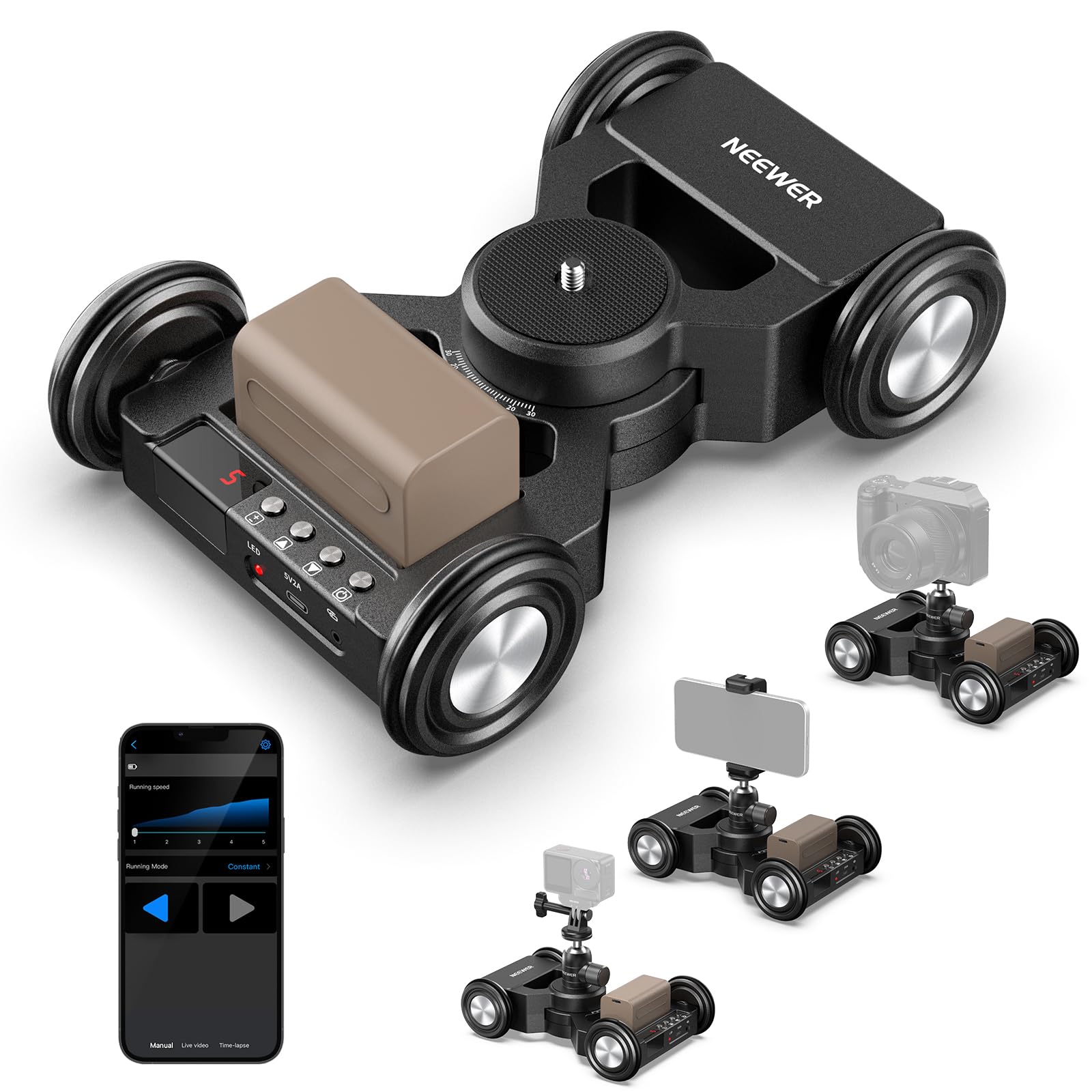
2. NEEWER DL400 Motorized Camera Dolly
A wheeled dolly that slips into a gear bag for smooth tabletop push-ins.
This is the one for product and food videographers who want dolly-style motion without laying down tracks. It rolls on non-slip wheels that grip tile seams and low-pile carpet, and the dual-motor drive runs below 30dB — quiet enough for a close-up shoot in a small room. The load cap is 6.6 lb, which comfortably handles mirrorless bodies, phones, and action cams but not heavy cinema rigs.
You drive everything from the NEEWER app, choosing between Manual, Live Video, or Time Lapse modes. It supports ±30° manual left/right movement and offers 5 speeds from 15s/m up to 60s/m, plus a ball head for 360° rotation and 90° tilt. Owners note the app has a slight learning curve, but the non-slip wheels and stable, heavy body win them over quickly.
Power comes from the included NP-F750 battery, which gives up to 5 hours of runtime, and you recharge via USB-C. The package even includes a ball head, phone mount, and action camera mounts, so it works across all your small cameras. The recurring note is that it prefers gentle grades and flat surfaces — starting at the fastest speed uphill is a recipe for shake.
What impresses owners
- Grippy wheels handle smooth indoor floors well
- Quiet motors keep takes clean
- Compact enough to fit a regular gear bag
The honest limits
- App programming lacks ramping and keyframes
- Pre-set speeds run fast for most time-lapses
- Sensitive to uneven outdoor surfaces
Reach for it if: You want quick, repeatable slider-style motion for small products, food, or social content and value portability above payload.
Look elsewhere if: You need long horizontal travel — this is a dolly, not a 31-inch rail slider.
3. NEEWER ER1-80 Motorized Camera Slider

A long carbon-fiber rail that repeats the same glide frame-perfect, take after take.
If your work depends on nailing the exact same move twice — think before-and-after shots or product comparisons — this 31.5″/80cm slider is built for it. The carbon fiber build keeps the 8.7 lb body rugged yet light enough for outdoor shoots, and 4 roller bearings add balance and anti-shake. It carries 11 lb flat and still handles 5.5 lb when tilted up at 45°.
Control comes through the NEEWER app or an optional 2.4G remote, with manual, video, and time-lapse modes. The app lets you set start and end points plus duration so the move is repeatable frame-perfect. Owners highlight the silent stepper motor and how smooth slow moves look, though they note the start and stop at each end can feel abrupt.
Power ships with a 4400mAh NP-F750 battery that lasts for hours, and you can also run it from a 5V 2A Type-C portable charger — handy if you burn through a long session. The side knobs let you set opposite angles for tracking or 120° panoramas, or keep them centered for horizontal shots. One thing to know: the charger is not included, so you will need your own NP-F750 charger or a USB-C source.
Best suited to: Videographers who want long travel and repeatable A-B moves without paying for a pro-brand slider.
The trade-off: Macro shooters may see minor shake, and the app takes time to learn before it feels intuitive.
4. GVM GP-80D Motorized Camera Slider

The entry-point slider that quietly adds production value on a strict budget.
For a filmmaker watching every dollar, this GVM slider delivers a surprising amount: it is a 6-in-1 unit handling tracking shots, panoramic sweeps, time-lapse, and video capture in one 31″ 80cm rail. It supports 11 pounds of gear, and here is the budget kicker — owners say it saves them over versus a professional slider while still being lightweight, quiet, and smooth with ramp in and ramp out.
The side and middle 1/4″ and 3/8″ screw holes let you mount it on standard tripods, and the red knobs adjust shooting angles for 120-degree panoramas. It runs on Sony NPF batteries, so if you already own those for your camera, you are set. The controller is wired and functional but takes time to learn, and you have to manually set start and end points each time you power on.
The trade-offs are real but fair for the price: it needs two tripods or light stands to hold the motor weight, it can wobble when mounted high, and there is a slight mid-rail sticking point on some units. The controls get mixed feedback since they are modifiable but not the most intuitive, and the conveyor can cause jitter via resonance — mitigable with tension and a decent mounting plate.
The verdict: 63 owners single out the value. 38 praise the aluminium and carbon fiber build, and the quiet operation keeps mechanical noise out of your audio.
The catch: You are trading setup convenience for cost; expect a learning curve on the controller and time-lapse modes.
Who it fits: Solo creators and interview shooters on a budget who want smooth B-roll motion without studio-level spend.
Who it does not fit: Narrative filmmakers needing infinite loop mode — you must specify travel count each run.
5. ZTFON YT-2000 Auto Motorized Rotating Head

A pan-tilt head that follows your face with a simple hand gesture.
This is the self-shooter’s tool. Flip the power switch down and the green light comes on, and the built-in AI chip recognizes your face to track you as you move. You start the follow with an “oK” gesture and pause it with a palm — no app in sight. For vloggers, live streamers, or presenters working alone, that hands-free control is the whole point.
It holds up to 2 kg (70.5 ounces) of gear, which covers most mirrorless bodies and phones, and the 1/4-inch universal base fits standard tripods. The 2.4G wireless remote adjusts rotation direction and speed, and the built-in lithium battery lasts over 10 hours — more than enough for a full day of outdoor live streaming. The AB point double anchor position lets you set two points and sweep between them.
The honest limits: motion gets jerky below speed 3, A-B mode takes the shortest path (which is under 180°), and there are pauses during direction changes. The tilt range is also not as accurately indicated as advertised, with some units showing calibration off by roughly 27°. It is heavy for its size at 855g, and the instructions are thin — you will want to go online for setup detail.
Reach for it if: You solo-record talking-head content and want automatic face-tracking without touching your phone mid-take.
Look elsewhere if: You need precise, smooth tilt calibration for technical work like telescope alignment — this is a content tool, not an instrument.
6. Soonpho M4 Motorized Rotating Tripod Head

The featherweight 1.4 lb head that adds smooth remote pan to any tripod.
For a light, affordable way to motorize your existing tripod, this compact head is a strong entry point. It drives 360° horizontal rotation and 35° vertical tilt, with 8 speed options, and the 2.4G remote reaches beyond 20m (owners mention over 60 ft of range even through walls). It is tiny — about 1.4 pounds — and fits most tripods with a standard 1/4-inch thread.
Setup is genuine: owners say it is easy to mount, the instructions are clear, and there is no gear noise when it operates. The built-in rechargeable lithium battery has a display button so you can check remaining power at a glance. Two memory positions let you store and recall pan/tilt spots, which is handy for interview setups.
The catch is weight discipline. The listed maximum is 1 kg, and this is the most critical number here — overload it with heavy gear and it can break. Customers note staying under the limit keeps it working happily; ignoring it invites failure. The reliability feedback is mixed, with some units failing after under two months, and a few remotes arrive dead. Treat it as a capable budget tool for light mirrorless or phone setups, not an every-day professional workhorse.
What wins people over: The value for money and easy setup stand out. The smooth 360° pan at adjustable speed makes it ideal for cover shots and pans.
The honest trade-off: Speed tops out too low for fast sports action, and the remote is bulky — this is for steady, controlled moves.
Who it serves: Phone and light-mirrorless shooters wanting affordable remote pan and tilt on a tripod they already own.
Think twice if: You run a heavy DSLR rig — the 1 kg limit is tight, and the durability record is mixed under abuse.
7. Accsoon Toprig Motorized Camera Slider
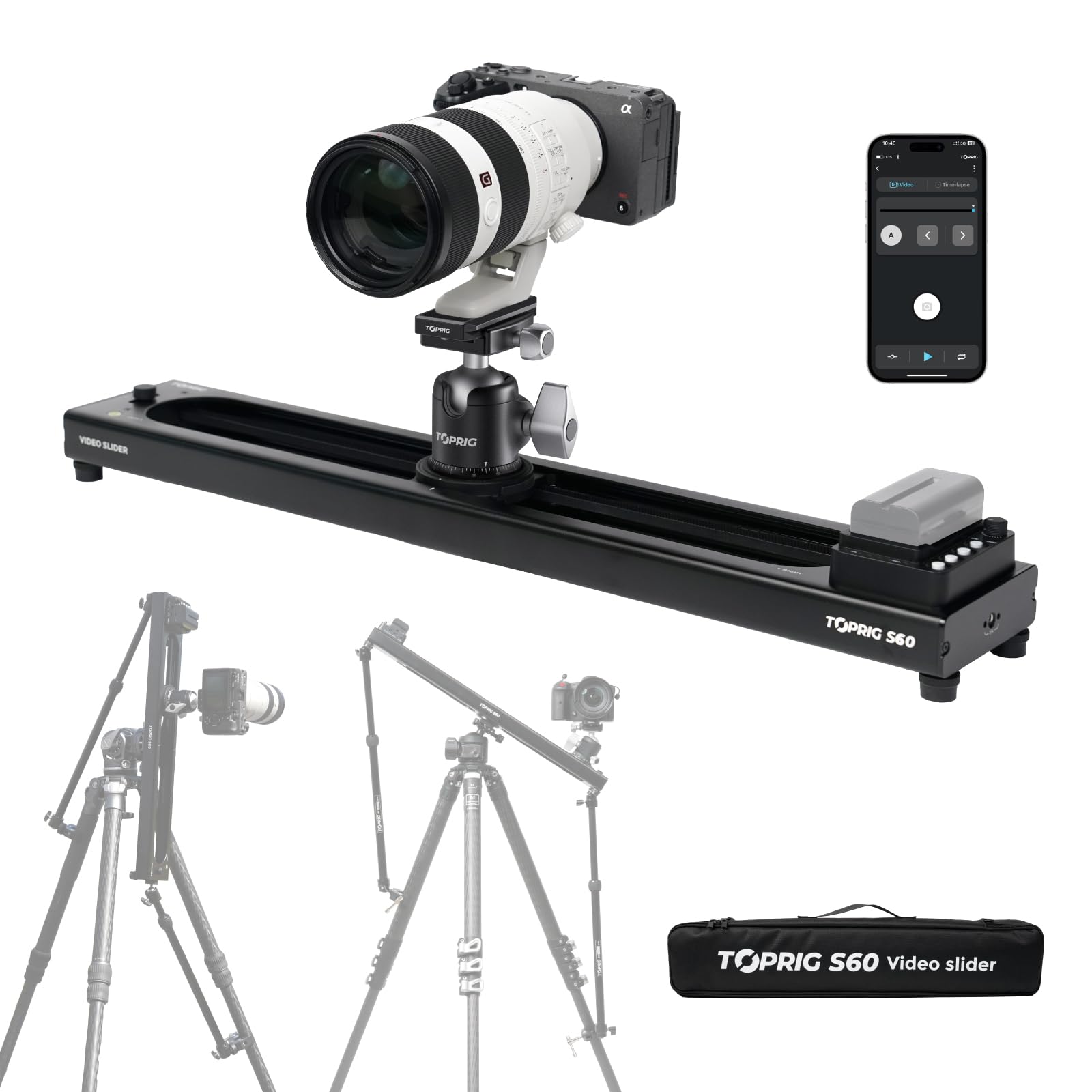
An all-metal 3.3 lb slider built for quiet location shoots and long battery days.
Travel shooters will feel the difference the moment they lift this: the aluminium alloy body weighs just 3.3 lb (about 1.5kg) yet supports a 200mm focal length lens or a 24mm macro for precise work. The ultra-quiet brushless stepper motor runs below 30dB, so background buzz is not a concern during interviews or film production. On a single NP-F550 battery, it supports up to 60 hours of continuous use.
It handles 4 kg horizontally and 2.5 kg vertically at 90° tilt, and the dual-power design accepts NP-F series batteries or a 7.4~16.8V DC source. You control it via Bluetooth through the Toprig app or the full-button panel, with Video, Time-Lapse, and Loop modes, plus a speed knob for ramping between 0.1-5 cm/s. Powering on and completing auto-calibration takes just 12 seconds, so it is ready fast on a busy set.
The catch is that payload is lower than the pro sliders — the 4.3 lb maximum recommendation means a heavy body and lens combo will push it to its limits. Reviewers point out jitter when you get near the ceiling of that capacity. It also lacks battery and DC cable in the box (you supply those), and the app is only needed for time-lapse since the on-device controls handle most work.
Why owners stick with it
- All-metal build feels solid and light
- On-device controls mean no phone required
- Compact 18-inch travel size fits a carry bag
Know before you buy
- Low payload cap — jitters near the limit
- Battery and DC cable are extra
- Battery mount on top can block your camera view
Best for: Solo videographers wanting a lightweight, quiet slider for interviews and location B-roll without app dependency.
Not for: Heavy cinema rigs — the 4.3 lb cap is the firm ceiling, and pushing past it brings jitter.
Understanding the Specs
Payload and Load Capacity
This is the number that decides everything. It tells you the maximum weight the motor can move smoothly without stalling or shaking. Weight your actual camera body plus the heaviest lens you plan to use, then make sure you stay well under the listed limit. A mount rated for 6.6 lb will struggle with a 10 lb rig, so check this before any feature list.
Control Systems
Most automated mounts offer one of three ways to drive them: a smartphone app over Bluetooth or 2.4G, a physical remote control, or buttons built directly into the device. Apps give you the most programmability for repeatable A-B moves and time-lapse, while physical remotes and on-device buttons are faster on set. Some pro sliders offer both app and on-device control, which is the most flexible setup.
Battery and Power
Look for a mount that uses a common rechargeable battery standard like NP-F series, because you can share spares with your camera accessories. Runtime matters: a head that lasts over 10 hours covers a full outdoor shoot, while a slider with a 5-hour battery needs a charge plan for long days. Some mounts also accept USB-C or DC power, giving you a backup when batteries run dry.
Pan and Tilt Range
Pan is horizontal rotation and tilt is vertical movement. A pan-tilt head with 360° pan and decent tilt lets you follow a subject in any direction. Sliders instead move the whole camera along a rail for lateral tracking. Check whether the mount supports simultaneous pan and tilt — some budget heads only do one axis at a time, which limits complex moves.
FAQ
What is the difference between a motorized head and a motorized slider?
How much weight can an automated camera mount handle safely?
Can I control an automated mount with my smartphone?
Will a motorized slider work with a DSLR and a mirrorless camera?
How long does the battery last on these mounts?
What causes jitter or shaky footage on a motorized slider?
Can I use an automated mount with a GoPro or smartphone?
What is the time-lapse mode on a camera slider for?
Do these mounts work with DJI gimbals?
How do I know which mount fits my tripod?
Final Thoughts: The Verdict
If you want one dependable pick, the automated camera mount winner is the IFOOTAGE Shark Nano II 660 because it pairs a 15.4 lb payload with 360° pan, AI tracking, and whisper-quiet brushless motors — the complete package for serious shooters. If you want compact tabletop motion with a 5-hour runtime, grab the NEEWER DL400. And for the budget-conscious starting out, the GVM GP-80D delivers quiet, smooth tracking on a rail that costs a fraction of the pro gear. If a pan-tilt head and face tracking is your focus, the ZTFON YT-2000 is the hands-free pick; for a light travel slider with button control, the Accsoon Toprig is the one to reach for. With 7 strong options here, the crowd favorite tops the ratings — so match your payload first, then pick your control style, and you will land on the right mount.
How We Picked
We do not accept paid placement. Every pick is matched to a real buyer and a real use-case; we do not hands-on test units.
Sources & Methodology
Specifications: manufacturer listings and product documentation. Review insights: verified customer reviews, as of August 2026. Pricing: not shown on this page (it changes often); check the current price via the retailer link.
As an Amazon Associate, Gadgets Feed earns from qualifying purchases. This does not affect which products we feature.