
Our readers keep the lights on and my morning glass full of iced black tea. As an Amazon Associate, I earn from qualifying purchases.
Specs are compiled from manufacturer listings and verified buyer reviews and can change over time — please confirm the key details on the product page before buying.
The single best upgrade for filming a youth soccer match, skate session, or live-streamed sermon is a camera that follows the action by itself. The best automated sports camera takes the job of panning, tilting, and re-framing off your hands, so you can actually watch the game or participate in the moment.
I’m Min — the founder and writer behind Gadgets Feed. This guide is built by comparing the manufacturers’ published specifications and the patterns across verified customer reviews, so you get each pick’s real strengths and trade-offs instead of marketing spin.
From a pocket-sized action cam with subject tracking to a full studio PTZ rig that locks onto a moving pastor, the right automated sports camera depends on where you record and how much hands‑free time you need between charges.
Our Picks at a Glance

How To Choose The Best Automated Sports Camera
The market spans everything from tiny waterproof action cams that keep a skater centered in the frame to motorized PTZ (pan-tilt-zoom) cameras that swivel on a tripod to follow a speaker across a stage. The decision starts with one question: do you need a camera that physically moves, or one that crops the image digitally to keep the subject centered?
Tracking Method: Digital vs. Motorized
Digital tracking lives inside the camera or an app — the sensor captures a wide field of view and the software crops the frame to follow a person, a ball, or an animal. It is silent and has no moving parts, which makes it ideal for waterproof action cams and phone-based systems. Motorized tracking uses a physical gimbal or PTZ mechanism. It keeps the full resolution of the sensor (no crop), but it adds noise, weight, and the risk of mechanical failure over time.
Connectivity and Workflow
Think about where your footage ends up. A phone-based system like the BallerCam streams directly to an app and stores clips on your camera roll. A PTZ camera with NDI, HDMI, and SDI outputs connects to a production switcher, a computer running OBS, or a streaming platform like YouTube. An action camera with Wi-Fi and Bluetooth is best for quick transfers to a phone for social sharing. If you plan to live-stream, ensure the camera supports RTMP or has a native streaming app.
Battery Runtime vs. Continuous Power
Action cameras typically run 2 to 4 hours on a single battery; the DJI Osmo Action 5 Pro hits 4 hours with its 1950mAh pack. Phone-based AI trackers like the XbotGo Chameleon claim up to 8 hours of recording because the phone itself runs on its own battery or an external pack. PTZ cameras often require a constant power source — many use Power over Ethernet (PoE), meaning you plug one Ethernet cable for data and power. If you are recording a full tournament day, a hot-swappable battery system or PoE matters far more than raw video quality.
Quick Comparison
| Model | Best For | Battery Life | Max Video | Tracking Type | Amazon |
|---|---|---|---|---|---|
| DJI Osmo Action 5 Pro★ Best Overall | Adventure & Vlog | 4 Hours | 4K 120fps | Digital Subject | Amazon |
| AKASO 360Top Performer | 360° Immersion | 2 Hours | 5.7K 360° | Digital AI | Amazon |
| BallerCam BC-Series | Team Sports | ~2-3 Games | iPhone Dependent | Digital Ball/Player | Amazon |
| XbotGo Chameleon | Multi-Sport Parents | 8 Hours | 4K 60fps (phone) | Motorized Gimbal | Amazon |
| OBSBOT Tail Air | Streaming Creator | ~6 months batt | 4K | Motorized PTZ | Amazon |
| AVKANS AV4KN-20 | Church / Stage | Wired | 4K 30fps | Motorized PTZ | Amazon |
| FoMaKo K600N | Broadcast Studio | Wired | 4K 60fps | Motorized PTZ | Amazon |
In‑Depth Reviews
1. DJI Osmo Action 5 Pro Adventure Combo
Our pick — over 4.5★ from 900+ verified ratings; the strongest balance of quality and price.
The rugged action cam that keeps fast subjects perfectly centered without a gimbal.
Your most portable option with automated tracking depends on the DJI Osmo Action 5 Pro. Its 4nm chip runs the subject-tracking algorithm that locks onto a cyclist, a skater, or a pet and keeps them framed in either 16:9 or 9:16 — no mechanical panning, no extra gear. The 1/1.3” sensor with 2.4 µm pixels and 13.5-stop dynamic range means you get clean, low-light footage even when the sun dips. This Adventure Combo includes three of the 1950mAh Extreme Batteries plus a multifunctional battery case, so you can record for a full 4 hours on a single charge and swap in a fresh pack in seconds.
Owners are consistently impressed by the crisp 4K footage and the cinematic color science, with one buyer calling it their “favorite action camera ever used” after two years of reliability. The IP68 rating lets you dunk it 20 meters underwater without a housing — a huge plus for snorkeling or a rainy bike commute. The dual OLED touchscreens make framing yourself easy, and the camera connects wirelessly to DJI’s Mic 2 or Mic Mini transmitter for pro-level audio without a receiver. At roughly 930 ratings and a 4.7-star average, it is the crowd favorite by a wide margin.
The catch is that this digital tracking works best when the subject stays within the wide lens — it crops the frame rather than physically following a runner across a field. For a fixed-tripod scenario like a full-court basketball game, a motorized system would serve you better. But for action-sports vlogging, motorcycle dash-cam duty, or just keeping a kid centered in a pool, this is the one.
Why It Wins
- 4-hour battery life — the DJI lasts 4 hours per battery, while the AKASO 360 lasts 2 hours for long shoots.
- Advanced subject tracking works in 16:9 or vertical 9:16 for social clips.
- Waterproof to 20 meters without a housing; excellent low-light performance.
Keep In Mind
- Digital tracking means a slight crop — not ideal for distant field sports.
- Generates some heat after several minutes of continuous recording.
Reach for this if: you want one camera that survives a tumble, goes underwater, and keeps a moving subject in the frame without extra gear.
Look elsewhere if: you need to cover a full soccer pitch and want optical panning to keep every player in full resolution.
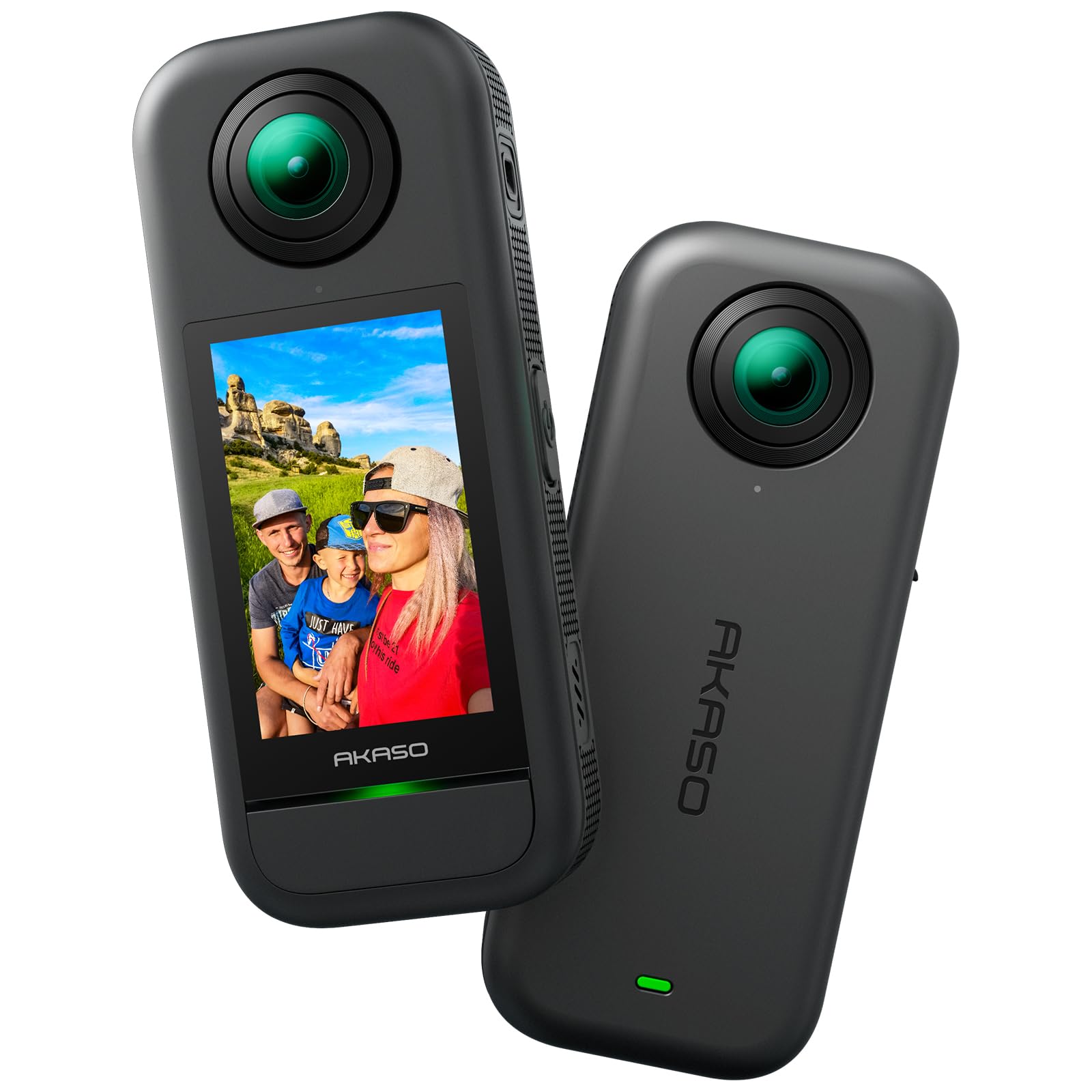
2. AKASO 360 Action Camera
A 360-degree camera that records everything around you so you can pick the best angle later.
For the buyer who hates missing a single moment of a motorcycle ride or a skate session, the AKASO 360 is built differently. Instead of following one subject by cropping, it captures a full 5.7K 360-degree sphere. You mount it, hit record, and later choose your frame in editing — the invisible selfie-stick effect makes it look like a third-person shot. The dual 1/2-inch 48MP sensors produce a 72MP 360 photo, and the in-app stabilization, called 360-SuperSmooth, keeps footage steady without a gimbal. AI subject tracking is also present, letting the software keep a person or object centered when you choose a flat frame.
Buyers call it an “excellent entry-level 360-degree camera” and praise the ease of use and the value relative to the market-leading brand. The AKASO app handles editing and sharing, and the 360 Horizon Lock keeps the level flat no matter how much you spin or flip the camera. That said, the battery lasts about 2 hours, while the DJI lasts 4 hours — and low-light performance is mixed, with some users finding it “pointless in low-light conditions.” The unit is rainproof but not fully waterproof, so you cannot submerge it like the Osmo. For action montages and social reels where you want to reframe your shot later, this is a creative powerhouse at a budget-friendly price.
It sits several hundred dollars below most PTZ systems, and the 5.7K 360 capture lets you “shoot first, frame later” — a genuine time-saver when you are in the middle of the action.
The creative twist: the invisible selfie-stick effect makes solo POV footage look like a friend filmed you — no second person needed.
The honest limit: 2-hour battery and no HDR means it struggles once the light drops; keep a spare battery or USB-C power bank on hand.
Best for: bikers, skaters, and travel vloggers who want to reframe their footage in post and skip manual aiming.
Think twice if: you plan to record a full soccer match — the 2-hour runtime and mixed low-light performance will leave gaps.
3. BallerCam BC-Series Auto-Tracking System
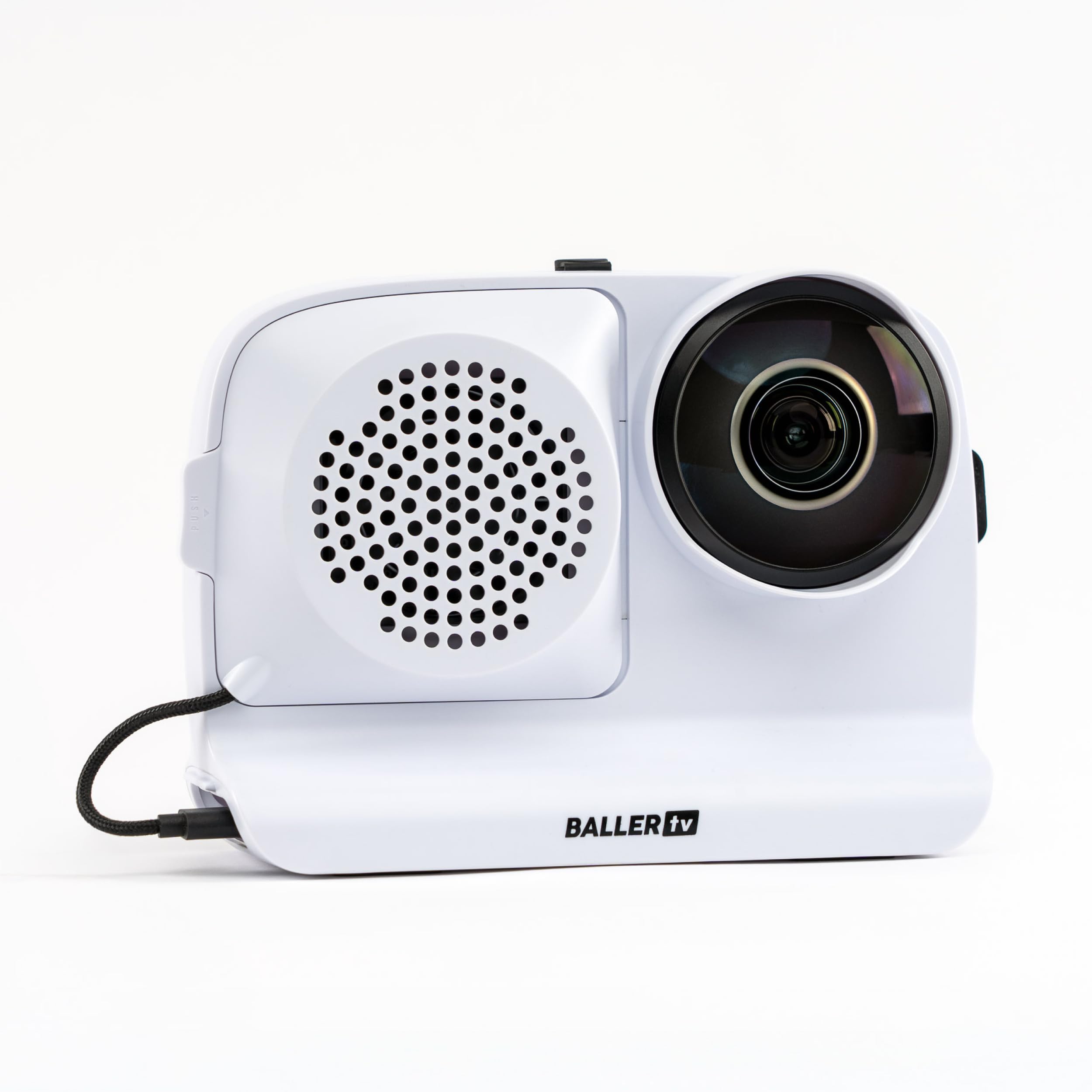
A dedicated sports rig that tracks the ball, not just a single player, on a full field.
The BallerCam takes a different approach: a 180-degree ultra-wide lens mounted on your iPhone, powered by AI trained on over 2 million games. Instead of following one person, it recognizes the field or court and follows the play — the ball, the key action — by cropping digitally within that expansive view. It supports basketball, soccer, futsal, flag football, and volleyball. Setup is simple: mount your iPhone in the included back cover, place it on a tripod, and the BallerCam app handles tracking, clipping, and live streaming with a shareable link that requires no login for viewers.
Buyers report that the tracking is “pretty good” and the live streaming quality is strong enough that “family and friends got to watch our tournament live with little to no hiccups.” The battery is a 10,000 mAh pack that lasts roughly 2-3 games, and the system includes 20 hours of free cloud storage with no subscription. The mixed feedback focuses on tracking accuracy — one owner calls it “95% accurate,” which means a fast break or sudden change of direction can lose the frame for a moment. A second phone is needed for manual scorekeeping if you want that overlay.
It is more affordable than a full PTZ system and lighter than a motorized gimbal, making it the best option for a parent who wants to capture the whole game without babysitting a camera.
The standout feature: AI that follows the ball rather than locking onto a single jersey — you get the whole play, not just one player’s back.
The trade-off: the 180-degree view means a very wide fisheye perspective; distant players look small, and you lose some detail compared to a zoomed PTZ.
Reach for this if: you are a basketball or soccer parent who wants to live-stream every game without holding a phone.
Consider alternatives if: your field is very large (regulation football) and you need optical zoom to see the action close-up.
4. XbotGo Chameleon AI Auto Sports Action Camera
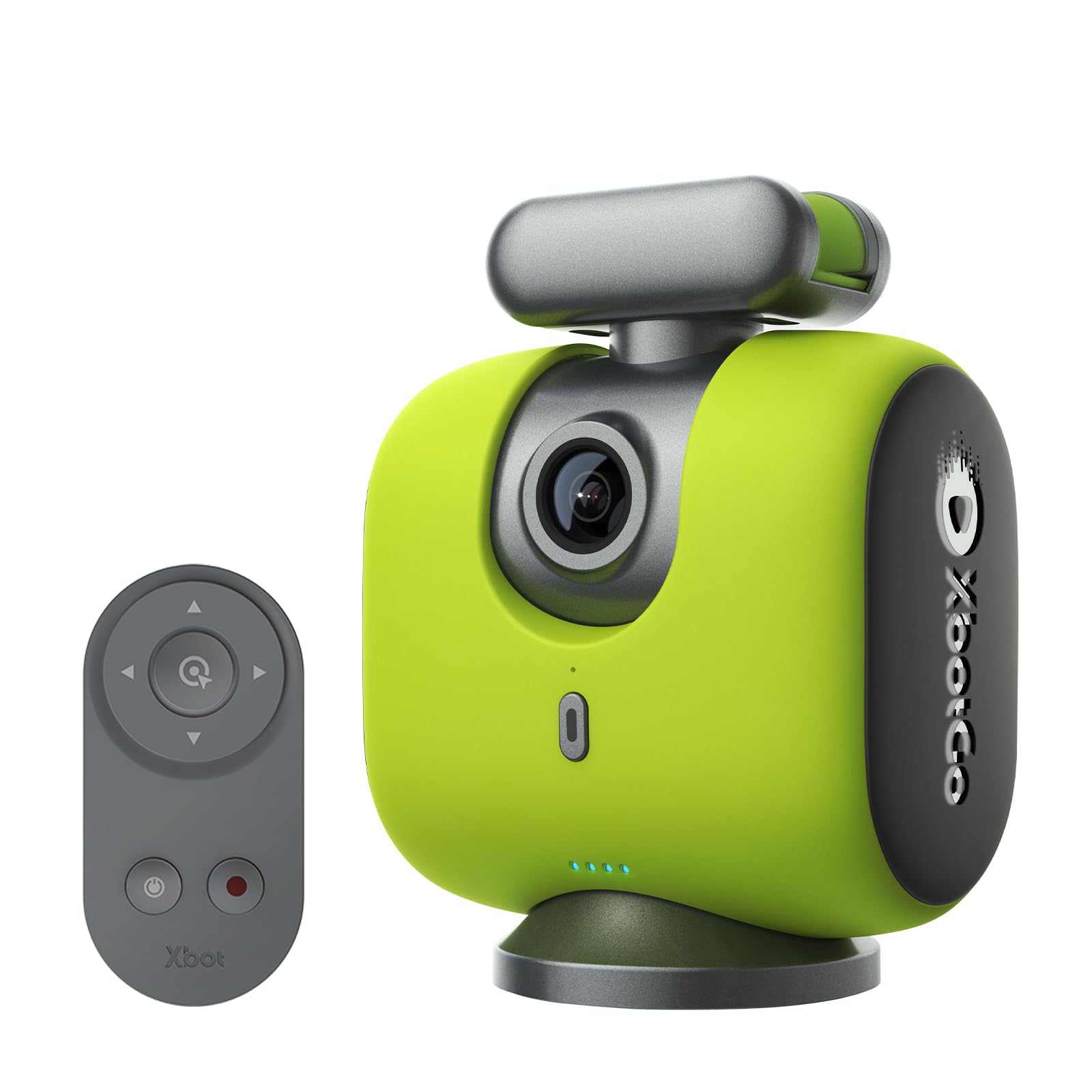
A motorized phone mount that physically pans and tilts to keep the action in full resolution.
Of all the options here, the XbotGo Chameleon is the only one that uses a physical gimbal to rotate and tilt your smartphone. Your phone does the video capture and processing, and the motorized mount follows the play in real time. That means you keep the full native resolution of your phone’s camera — no digital crop, no quality loss. The Chameleon captures in 4K at 60fps with a 120-degree field of view, and the app supports sport-specific ball tracking for basketball, soccer, football, and tennis.
Buyers praise the “smooth, real-time tracking” and the ability to set up a live stream to YouTube or Facebook with a single tap. The Bluetooth remote lets you start and stop recording from the sideline, and the integrated scoreboard overlay is a crowd-pleaser for team parents. The battery lasts up to 8 hours, which covers a full day of tournament play. The mixed feedback centers on the AI tracking — some owners mention that it “gets stuck frequently” or that the panning can feel jerky during fast transitions. There is also a steep learning curve: the manual is light on operation steps, and you will need to watch tutorial videos to open up features like FollowMe mode.
For a coach or parent who wants a full-resolution, motorized track of their athlete across an entire field, this is the best value. Your phone does the heavy lifting, so upgrading your phone later automatically upgrades your video quality.
What Stands Out
- Physical pan/tilt keeps full 4K resolution with no crop — beats the digital systems on detail.
- 8-hour battery covers a whole tournament without recharging.
- Scoreboard overlay and Bluetooth remote add polish for team events.
Watch For
- Tracking can be jerky on fast cross-court movements; some owners found it “gets stuck.”
- Setup is not plug-and-play — expect a learning curve and reliance on video tutorials.
Best suited for: soccer and basketball parents who want full-resolution 4K footage and are comfortable learning the app.
Who should skip it: anyone who needs a completely hands-off, low-maintenance system for a high-speed sport.
5. OBSBOT Tail Air 4K PTZ Camera

A tiny motorized streaming camera you can control with a hand wave from across the room.
The OBSBOT Tail Air is smaller than a soda can but packs a 320-degree horizontal and 180-degree vertical rotation range. It tracks humans, animals, and objects using the updated AI tracking, and you can direct it with hand gestures — no remote needed. The 4K resolution comes from an f/1.8 23mm lens with a 4x digital zoom, and it connects via Micro HDMI, USB-C, Ethernet, or Wi-Fi, so you can place it almost anywhere in a studio or church setting.
Owners highlight the “crisp broadcast quality video” and the ability to integrate with Stream Deck and OBS. The NDI functionality (license sold separately) lets you send video over a local network without long HDMI runs. The battery is built in, which makes it genuinely portable, but one long-term reviewer flagged a critical flaw: the non-replaceable battery degraded after about 6 months and died completely at 13 months, rendering the camera unusable without constant USB-C power. That makes this less reliable for continuous daily use than a purely wired PTZ. It is great for a content creator who moves between locations, but think carefully if you need a permanent, always-on installation.
At a price below most professional PTZs, the Tail Air offers an impressive set of features for streamers and educators. The gesture control is genuinely useful when you are mid-presentation and cannot reach a remote.
The trick you will use most: gesture control — raise your hand to start tracking, and the camera follows you without anyone at the controls.
The one worry: the internal battery is not user-replaceable; if you plan to use it as a wired studio camera 8 hours a day, look at a fully wired PTZ.
Grab this for: YouTube creators, church tech teams on a budget, and teachers who want a self-tracking camera they can pack in a backpack.
Choose a wired option if: you need the camera to run reliably for years in a fixed installation with no battery degradation risk.
6. AVKANS AV4KN-20 4K PTZ Camera
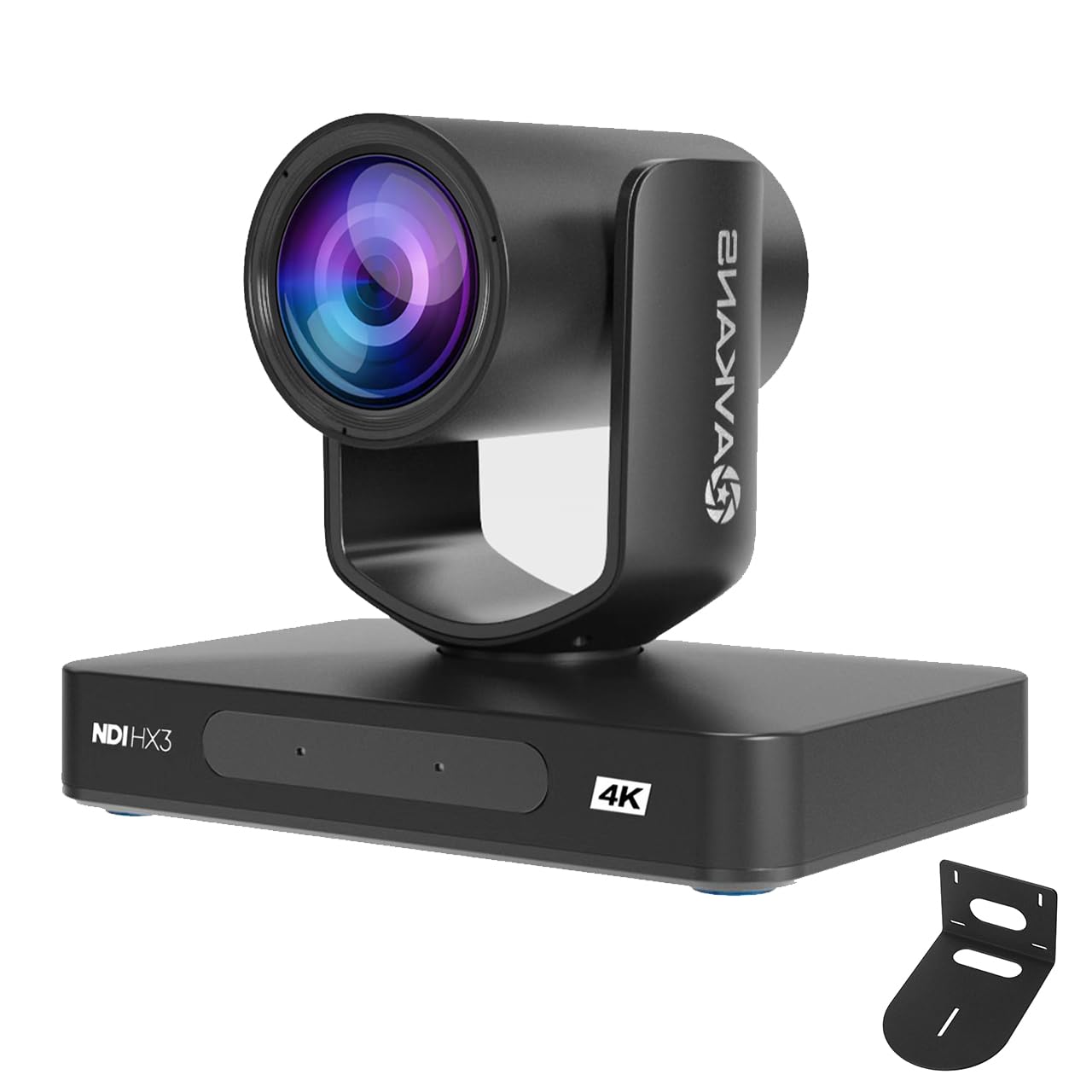
An affordable, fully wired PTZ that brings professional NDI tracking to houses of worship and lecture halls.
For permanent installations where you need reliable auto tracking day after day, the AVKANS AV4KN-20 is the standout value. It delivers UHD 4K at 30fps and Full HD 1080p at 60fps through HDMI 2.0, 3G-SDI, and NDI HX3 outputs — all over a single PoE Ethernet cable if you prefer. The 20x optical zoom lets you fill the frame with a speaker at the back of a large room, and you can fine-tune the AI tracking with parameters like tracking area, sensitivity, speed, and three modes: Presenter, Zone, and Hybrid.
Owners consistently call the image quality “clear and vibrant” and praise the “flawless” performance in church settings, with one reviewer noting the auto tracking works well “over 50 ft.” The free CMS software lets you manage multiple cameras from one computer, and the manufacturer provides 24/7 support with response times under 12 hours. The negative points are modest: the included IR remote has a narrow angle, and the manual is sparse — most users rely on YouTube videos and manufacturer support to get the tracking dialed in. At roughly 239 ratings and a 4.6-star average, it rivals the reliability of far more expensive PTZ cameras.
If you do not need 4K 60fps and just want a rock-solid auto-tracking camera for a worship service, classroom, or meeting room, this is the best per-dollar buy in the PTZ category.
What It Does Best
- 20x optical zoom captures clear close-ups of speakers from across a large room.
- NDI HX3 with included license — no extra dongle cost — plus HDMI and SDI outputs.
- PoE support: one Ethernet cable carries power, control, and video.
Minor Drawbacks
- Manual is thin; plan to watch setup videos to configure the AI tracking properly.
- IR remote beam is narrow — you must be directly in front of the camera to use it.
Ideal for: churches, schools, and conference rooms that need a dependable PTZ camera without a five-figure budget.
Consider a faster model if: you need 4K at 60fps for fast-moving sports with a lot of panning.
7. FoMaKo K600N 4K 60fps NDI PTZ Camera
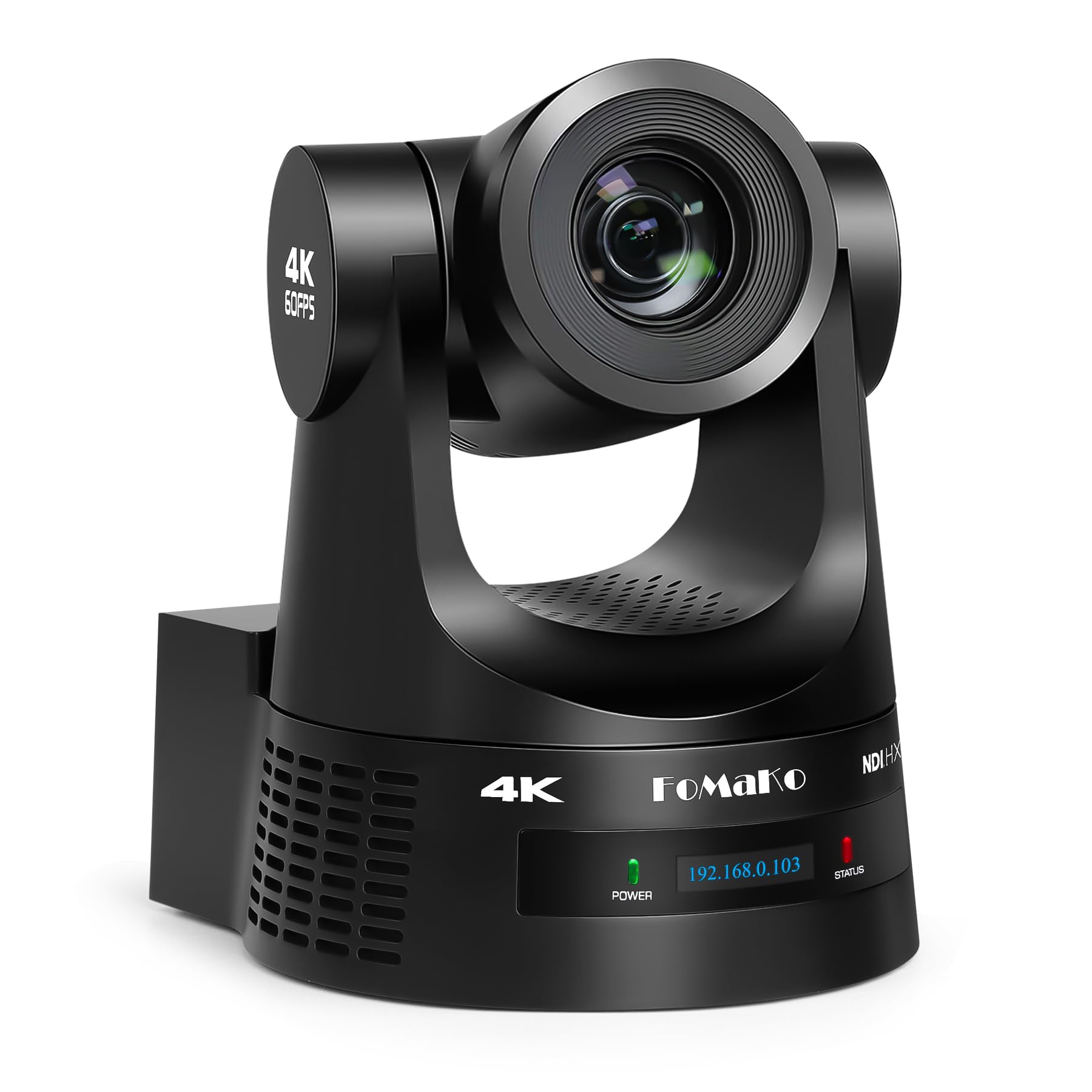
The high‑frame‑rate PTZ that delivers silky 60fps tracking for live sports and worship broadcasts.
When you need 4K at the faster 60fps rate — which makes motion look fluid instead of choppy — the FoMaKo K600N is the right tool. It supports NDI HX3 4K 60fps output over LAN, plus HDMI 2.0 at 4K 60fps and a 3G-SDI port for 1080p 60fps. The 20x optical zoom gives you real optical reach, and the Gen 3 AI auto-tracking lets you customize tracking modes, sensitivity, figure size, and lost-target behavior. You press F2 on the remote to start auto tracking and F4 to switch the tracked target, which is intuitive once the camera is mounted.
Buyers in worship and studio environments describe it as a “great camera for our worship service center shots” and appreciate the “nearly plug-and-play” setup. The auto-tracking works reliably in a dimly lit church, and the camera auto-detects an upside-down ceiling mount, flipping the controls correctly. The network setup can be a bit tricky — you will need to use the HDMI output initially to get a DHCP address — and the documentation has minor translation issues. A few owners mention “minor jerks during pan/tilt” at certain speeds, though the vast majority find the motion smooth enough for broadcast.
The FoMaKo sits at a premium price, but it includes the NDI license, a wall mount, and a 1-year warranty with optional 3-year trade-in. If you are building a multi-camera production for a gymnasium, a large auditorium, or a live-streamed sport, the 60fps output and customizable Gen 3 tracking justify the investment.
The edge over the AVKANS: 4K 60fps vs 4K 30fps — real motion smoothness when the action is fast.
The gotcha: initial network configuration is not plug-and-play; budget 30 minutes for DHCP assignment before the camera appears on your network.
Best for: churches and studios that stream in 4K at 60fps and need reliable, customizable AI tracking for a moving presenter.
Pick a simpler model if: you need only 1080p 60fps or 4K 30fps — the AVKANS offers many of the same features at a lower cost.
Understanding the Specs
AI Tracking: Digital vs. Motorized (PTZ)
Digital tracking captures a wide field of view and crops the image to follow a subject. It is silent and has no moving parts — great for action cams and phone-based systems — but it reduces resolution. Motorized PTZ (pan-tilt-zoom) physically moves the camera lens. It keeps the full sensor resolution, but it adds weight, noise, and a more complex setup. For a stationary sport like basketball, motorized is often better. For a mobile POV like cycling, digital is simpler and more rugged.
NDI, HDMI, and SDI Connectivity
NDI (Network Device Interface) sends high-quality video over a standard Ethernet cable, so you do not need a separate video cable run — useful for multi-camera setups in a church or studio. HDMI is the common consumer plug for TV monitors and switchers. SDI (Serial Digital Interface) uses a locking connector that stays secure during long cable runs (up to 300 feet without extra gear). If you plan to stream live to YouTube or Facebook, look for a camera that supports RTMP (Real-Time Messaging Protocol) or has a built-in streaming app. The more outputs a camera has, the more flexible your production workflow.
Battery Life vs. Continuous Power
Action cameras and phone-based trackers run on rechargeable batteries, which limit your recording time. The DJI Osmo Action 5 Pro manages 4 hours, while the XbotGo Chameleon can run your phone for 8 hours on a charge. For all-day tournaments, you want a system with hot-swappable batteries or USB-C pass-through charging. PTZ cameras like the AVKANS and FoMaKo use Power over Ethernet (PoE) — a single Ethernet cable provides both power and data — so they can run indefinitely. If you plan to record a 2-hour basketball game, any battery-powered option will work. For a 10-hour livestream, choose a wired PTZ.
Optical Zoom vs. Digital Zoom
Optical zoom uses the lens to physically magnify the image — it maintains the full resolution and sharpness. The AVKANS and FoMaKo each offer 20x optical zoom, which is critical for filling the frame with a speaker on a large stage or a player on a distant field. Digital zoom simply crops and enlarges the image, which reduces quality and introduces noise. Most action cameras (like the DJI and AKASO) rely on digital zoom — acceptable for close-to-medium shots, but not for pulling in a subject across a gymnasium.
FAQ
Will an automated sports camera work for indoor basketball games with fast movement?
How long does the battery last on the DJI Osmo Action 5 Pro when tracking is active?
Can I use the AKASO 360 camera for live streaming a soccer game?
What is the difference between NDI HX3 and full NDI?
Does the BallerCam work with any iPhone model?
Are there any subscription fees for the XbotGo Chameleon or the BallerCam?
What is the maximum zoom range of the AVKANS and FoMaKo PTZ cameras?
Can I use the OBSBOT Tail Air as a standard webcam for Zoom meetings?
Is the AKASO 360 waterproof?
Which automated sports camera is best for recording hockey games?
Final Thoughts: The Verdict
If you want one dependable pick, the automated sports camera winner is the DJI Osmo Action 5 Pro Adventure Combo because it combines rugged waterproof build, the longest action-cam battery life at 4 hours, and reliable subject tracking in one pocket-sized package. If you want the full-resolution physical tracking of a motorized gimbal, grab the XbotGo Chameleon — its 8-hour runtime and sport-specific ball tracking make it the best pick for a full tournament day. And for a permanent live-streaming setup in a church or studio, the FoMaKo K600N delivers 4K 60fps NDI output with customizable Gen 3 AI tracking that handles fast-moving speakers without breaking a sweat.
How We Picked
We do not accept paid placement. Every pick is matched to a real buyer and a real use-case; we do not hands-on test units.
Sources & Methodology
Specifications: manufacturer listings and product documentation. Review insights: verified customer reviews, as of July 2026. Pricing: not shown on this page (it changes often); check the current price via the retailer link.
As an Amazon Associate, Gadgets Feed earns from qualifying purchases. This does not affect which products we feature.