
Our readers keep the lights on and my morning glass full of iced black tea. As an Amazon Associate, I earn from qualifying purchases.
Specs are compiled from manufacturer listings and verified buyer reviews and can change over time — please confirm the key details on the product page before buying.
An automatic arm blood pressure monitor is only as good as the match between the cuff and your arm — get the wrong size and the numbers are meaningless. The best ones combine a fast, comfortable reading with enough memory to track trends over time, so you show up to your doctor’s appointment with real data, not a guess.
I’m Min — the founder and writer behind Gadgets Feed. This guide is built by comparing the manufacturers’ published specifications and the patterns across verified customer reviews, so you get each pick’s real strengths and trade-offs instead of marketing spin.
Whether you are monitoring for yourself or the whole family, the right automatic arm blood pressure monitor pairs a snug cuff fit with clear feedback and keeps your history organized without fuss.
Quick Picks
- OMRON Gold Blood Pressure Monitor (BP5360) — Best Overall
- AQESO Blood Pressure Machine (U80AH) 3-Cuff — Best Storage
- URION U83X LED Blood Pressure Monitor — Bright Display
- Microlife Series 500 Automatic Upper Arm Blood Pressure Monitor — Value Pick
- Acenis AOJ-30F Blood Pressure Monitor — Entry Level
- VOLUETH DBP-62A1B Pediatric Blood Pressure Monitor — Family Fit
- A&D Medical UA-767 Plus Blood Pressure Monitor — Petite Fit
How To Choose The Best Automatic Arm Blood Pressure Monitor
The two make-or-break factors are cuff fit and how the monitor stores your data.
Cuff Size Is The First Filter
A cuff that is too loose or too tight throws off the reading every time. Measure the circumference of your upper arm between your shoulder and elbow, then match it to the cuff range listed on the product. Some monitors ship with a single wide-range cuff, while others include three separate cuffs to cover the whole family — the right fit is non-negotiable for accurate results.
Memory and Multi-User Support
If you track blood pressure daily, you want a monitor that stores past readings with a date and time stamp so you can spot trends. Some models keep 60 to 99 readings per person, while others push past 500 per user. For households with two or three people monitoring separately, a unit with distinct user profiles saves you the headache of mixing up who’s who.
Display and Ease of Use
A large, backlit screen helps if you read in dim light or have less-than-perfect eyesight. One-button operation is standard; some monitors add a WHO color-scale bar for an instant visual check before you read the numbers.
Quick Comparison
On smaller screens, swipe sideways to see the full table.
| Model | Best For | Weight | Memory (Per User) | User Profiles | Amazon |
|---|---|---|---|---|---|
| OMRON Gold BP5360 | AFib detection & app sync | 1.37 lbs | Unlimited via App | 2 | $84.24Amazon |
| AQESO U80AH 3-Cuff | Large storage & 3 users | 1.72 lbs | 500 | 3 | $59.99Amazon |
| URION U83X LED | Large 4.5-in LED screen | 1.28 lbs | 199 (shared across 2) | 2 | Amazon |
| Microlife Series 500 | PC software & trends | 1.54 lbs | 99 | 2 | $50.99Amazon |
| Acenis AOJ-30F | Entry-level simplicity | 1.1 lbs | 2 | 3 | $49.97Amazon |
| VOLUETH DBP-62A1B | Family with kids | 15.87 oz | 300 (shared across 2) | 2 | $49.99Amazon |
| A&D Medical UA-767 Plus | Small arm / petite fit | 1.19 lbs | 60 | 1 | $66.09Amazon |
In‑Depth Reviews
7. OMRON Gold Blood Pressure Monitor (BP5360)
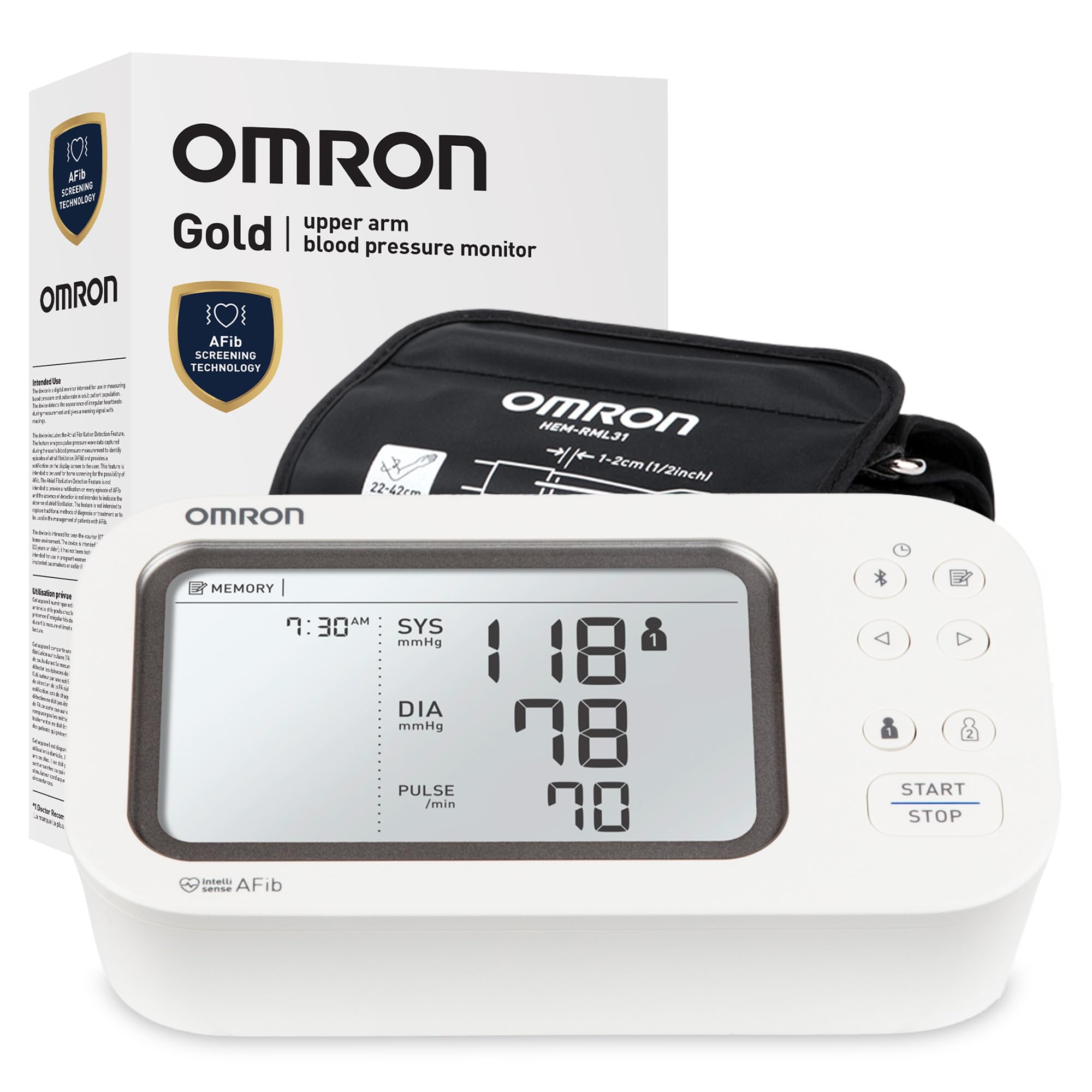
The OMRON Gold that flags atrial fibrillation mid-reading and syncs everything to your phone.
You get two features here that no other pick on this list offers: AFib detection (a built-in alert that spots an irregular heart rhythm during each reading) and a High Morning Average Indicator that flags morning blood pressure spikes tied to higher cardiovascular risk. The free OMRON connect app stores unlimited readings, and the sync happens over Bluetooth so you never worry about filling up onboard memory. Buyers report readings staying within 1-2 units of the doctor’s office unit — one reviewer even tested it side by side with a clinical reading and got nearly identical numbers.
The wide-range D-ring cuff fits arms 9″ to 17″, and the unit supports two separate user profiles so a partner can track their own trends. One important caveat raised by several buyers: if you have atrial fibrillation, the monitor will not display a blood pressure reading — it only shows “Possible A-Fib” and the detection feature cannot be disabled, which made the unit unusable for those reviewers. For everyone else, this is the most complete home monitoring experience available.
Why It Leads
- AFib detection built into every reading
- Unlimited data storage via app syncs with Apple Health and Google Fit
- High Morning Average Indicator catches dangerous morning spikes
The Real Catch
- Useless for anyone with confirmed A-fib — blocks BP reading
- Requires a smartphone for the full memory experience
Reach for this if: you want clinical-grade extras like AFib screening and easy trend-sharing with your doctor via an app.
Look elsewhere if: you or someone in your household has diagnosed atrial fibrillation — the safety lockout will prevent readings.
4. AQESO Blood Pressure Machine (U80AH) 3-Cuff

The AQESO that stores 1,500 readings across three users with three cuff sizes from small to extra-large.
With 500 readings per person for up to three users, this monitor holds more history than any other pick here — and the three included cuffs cover arm sizes from 7″ to 21″, so a small-armed adult and a larger family member both get a proper fit. The WHO classification bar (a color scale on the large backlit LCD) gives an instant visual check of where your reading lands before you even process the numbers. Buyers mention the automatic cuffs work well even for people whose arms are a tough fit for standard cuffs, and the device runs on either 4 AAA batteries or via USB Type-C cable (though it is not rechargeable — it needs continuous USB power to operate without batteries).
One-touch operation and the backlit screen make late-night readings easy on the eyes. Compared with the lighter 1.1-lb Acenis monitor below, the 1.72-lb AQESO is noticeably heavier but packs far more storage capacity and cuff flexibility. A buyer wrote that after weeks of use the readings stayed consistent, and that the history values held even when unplugged — matching ER findings.
Standout Features
- Three cuff sizes (S, M/L, XL) fit 7″ to 21″ arms
- 1,500 total readings — 500 per user for three users
- Large backlit LCD with WHO classification bar
Trade-offs
- Heavier than many competitors at 1.72 lbs
- USB power requires constant cord connection — no internal rechargeable battery
Grab this for: a family of three who all need their own cuff size and long-term trend tracking.
skip it if: you travel light and want the smallest possible unit in your bag.
6. URION U83X LED Blood Pressure Monitor
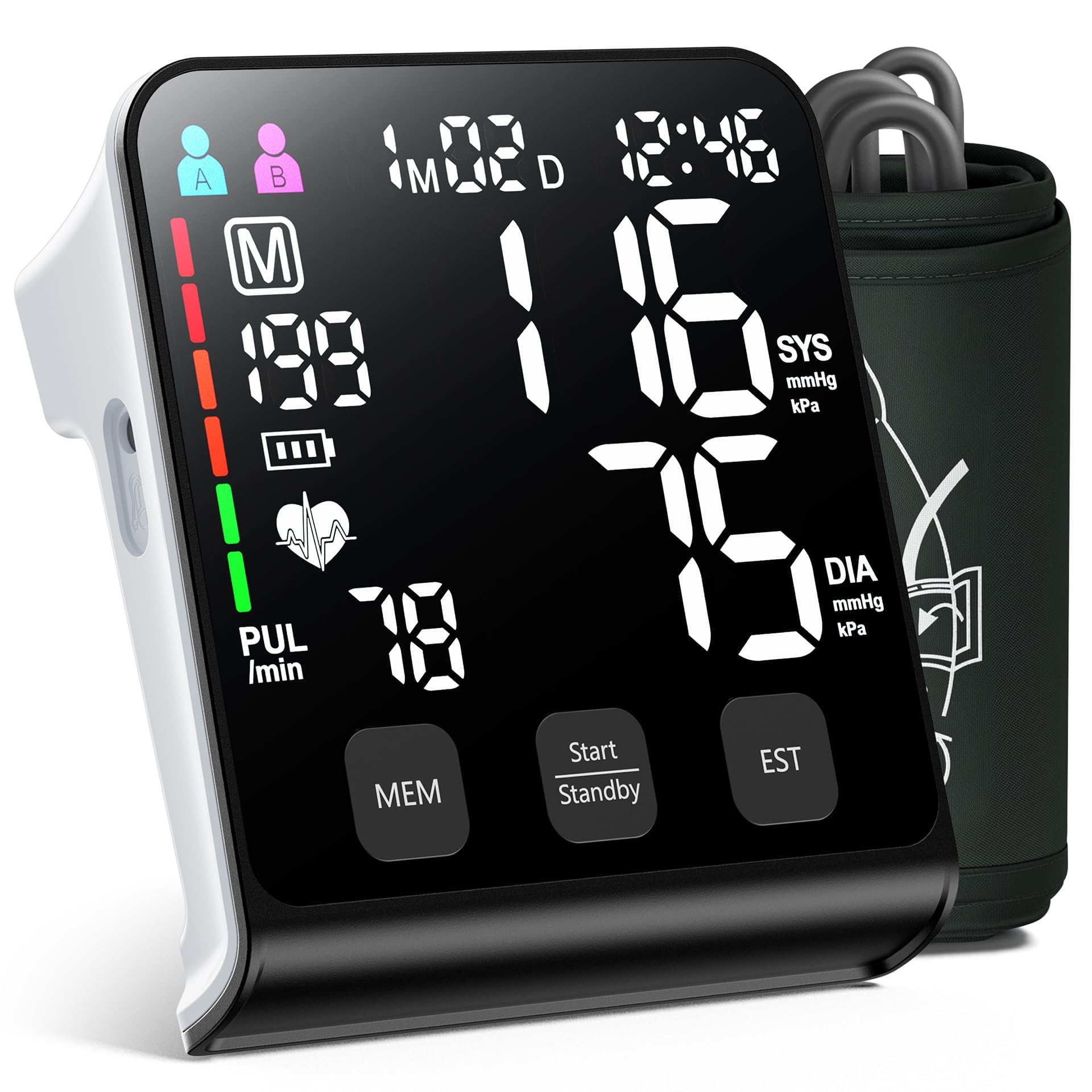
The URION with a 4.5-inch LED screen that seniors can read across the room.
The defining spec here is the 4.5-inch LED display with oversized digits — it is the largest screen among the seven picks, and buyers consistently note they can read it comfortably in low light without squinting. An intelligent pressure algorithm keeps the error margin to ≤±3mmHg, and the monitor alerts you to an irregular heartbeat during the reading. It stores 199 readings for two users, and the adjustable wide-range cuff fits most adult arm sizes.
The unit runs on either batteries or USB power, and it is FSA and HSA eligible, meaning you can buy it with pre-tax health funds. One reviewer called it quiet, durable, and accurate for daily home use, and the scratch-resistant acrylic panel helps it survive regular handling. At 1.28 lbs, it sits between the heavier AQESO and the lighter Acenis in portability. The memory count of 199 shared across two users is lower than the AQESO’s 500 per person, so if you take multiple daily readings you will fill it faster.
Why It Works
- 4.5-inch LED screen with bold digits — excellent for low-light visibility
- FSA and HSA eligible for tax-advantaged purchase
- Error margin of ≤±3mmHg with irregular heartbeat alerts
Limitations
- 199 reading memory is shared between two users, not allocated per person
- No app or Bluetooth for off-device data backup
Perfect for: an older adult with poorer eyesight who needs a giant, bright screen and simple operation.
Not for: families wanting dedicated user compartments or unlimited app-based history.
3. Microlife Series 500 Automatic Upper Arm Blood Pressure Monitor
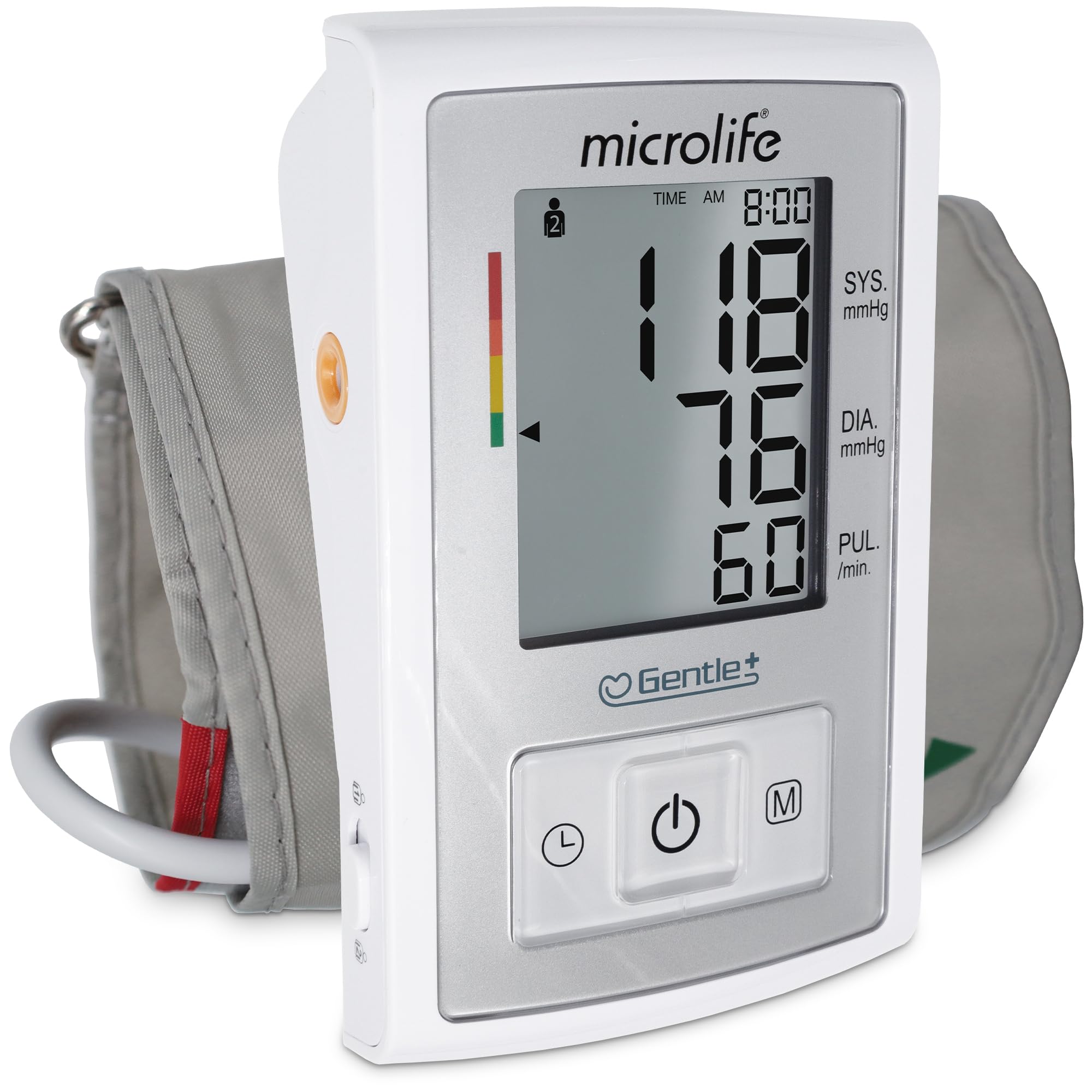
The Microlife that earned an AA rating from the British & Irish Hypertension Society and talks to your computer.
Accuracy is the whole story here — this monitor received the highest possible rating for blood pressure measurement from the British & Irish Hypertension Society (AA rating), which is about as authoritative as consumer-grade validation gets. It reads systolic, diastolic, and pulse in one sitting, and adds an irregular heartbeat detector and a hypertension risk indicator. The MAM (Microlife Averaging Mode) takes three consecutive readings and averages them automatically, which is the method many doctors recommend for a truer picture.
It stores 99 results per user for two users, and the included Microlife Blood Pressure Analyzer Software lets you transfer results via USB to your computer (Windows and Mac compatible) to view graphs. Owners mention it was ready to read in 2 minutes without touching the manual — the large display and simple controls make setup brainless. The wide-range cuff fits arms 8.7″ to 16.5″ and uses Gentle+ Technology, which buyers describe as a gentler squeeze than other monitors. One limitation noted by a reviewer: the carrying case lacks a compartment for the USB cord, and the pediatric cuff is not compatible.
what separates it
- AA-rated by the British & Irish Hypertension Society for accuracy
- MAM averaging mode gives you a doctor-recommended triplicate reading
- PC software lets you graph and share trends without an app
Downsides
- No Bluetooth or smartphone app — data transfer is USB-only
- Will not work with a pediatric / smaller cuff
Choose this if: you want the highest clinical accuracy rating and prefer to track numbers on your computer rather than a phone.
Pass on it if: your arm circumference is under 8.7″ or you need a pediatric-sized cuff.
1. Acenis AOJ-30F Blood Pressure Monitor
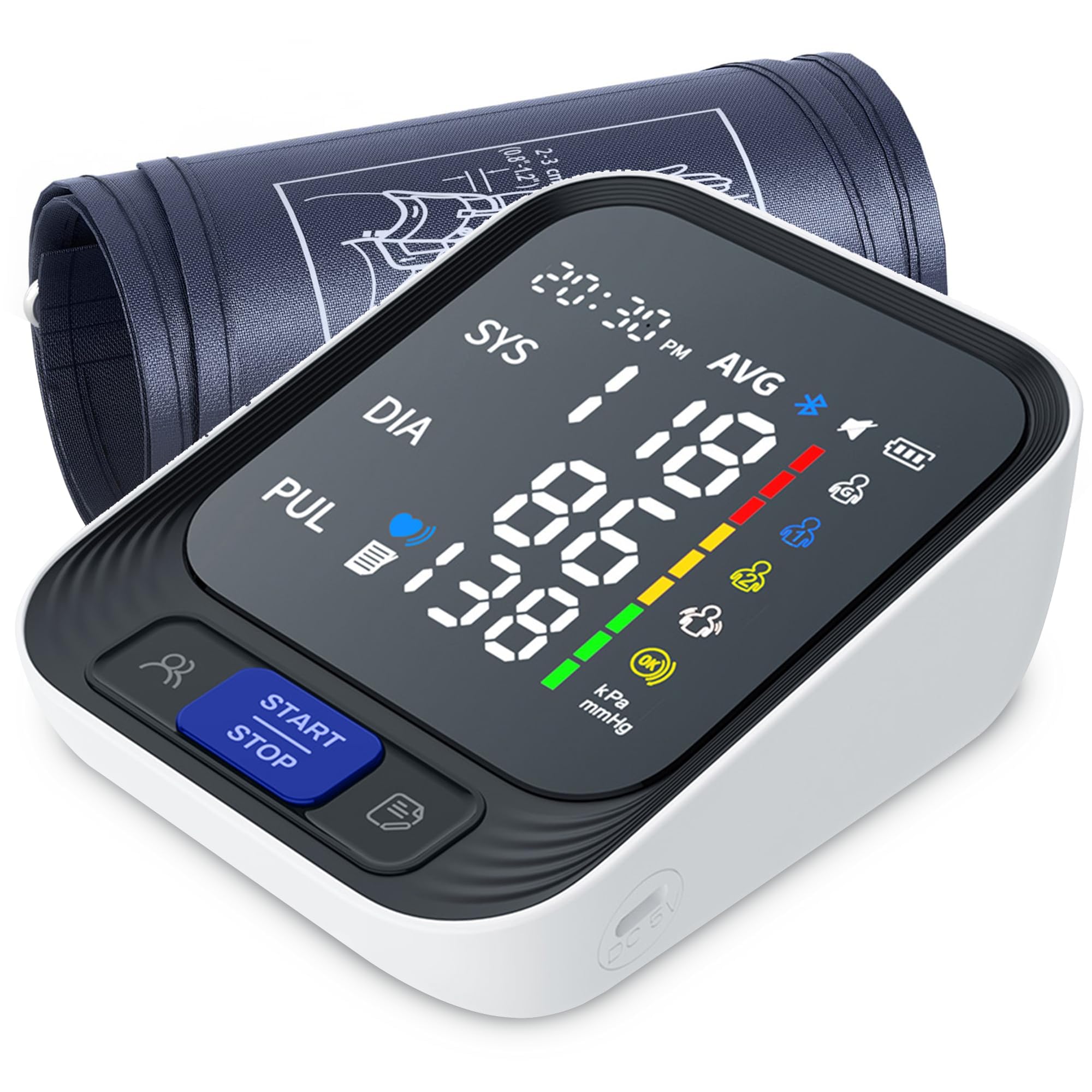
The Acenis that keeps it basic — one-button operation, a large color screen, and three user slots.
This is the lightest monitor in the lineup at 1.1 lbs, and the most straightforward: press the single button and get results in 40 seconds on a large color screen designed for seniors who need clear digits. It tracks three users — one more than most competitors — though it stores only 2 readings per person, so its memory is less a trend tool and more a quick-check confirmation. The large adjustable cuff aims to fit “all shapes and sizes,” and 4 AAA batteries are included in the box so you can start immediately.
Buyers consistently call the display legible and the setup easy, with one noting the unit is “accurate compared to prior monitor” for twice-daily tracking. The reviewer who takes BP twice daily manually records results for privacy, choosing not to use the onboard storage. If you want app connectivity, zero cloud sync, or deep history — this is not it. But for a spare room, an older relative who just needs a readable readout, or someone replacing a dead unit on a budget, the Acenis delivers exactly what it promises without complications.
Why It Is Simple
- Lightest pick at 1.1 lbs — easy to store or move
- Large color screen with one-button operation
- Supports 3 users (more user slots than most)
Where It Falls Short
- Only stores 2 readings per user — no long-term history
- No app, Bluetooth, or USB data export
Get this for: a no-fuss monitor for the guest room, a senior who just wants to see the number, or your first monitor on a tight entry-level budget.
Skip it for: trend tracking, multi-user history, or any kind of data sharing with a doctor.
2. VOLUETH DBP-62A1B Pediatric Blood Pressure Monitor

The VOLUETH with three cuffs that reach from a child’s arm (4″) to an adult XL (17″).
This is the only monitor in the lineup that includes a dedicated small cuff for kids (4″–8″), plus a medium/large cuff (6″–10″) and an XL cuff (7″–17″) — so one unit covers a 4-year-old’s arm and a large adult’s bicep. The ASP (Accurate Signal Processing) technology delivers results in about 30 seconds, and the WHO classification bar on the LCD backlight display gives a quick visual health status. It stores up to 300 readings for two users with date and time stamps, plus a last-3-groups average function for tracking weekly trends.
At just 15.87 ounces, it is the lightest pick — less than half the weight of the 1.72-lb AQESO — making it the most portable option for travel. The kit comes with a cloth storage bag and USB Type-C power (you supply your own 5V 1A adapter). Customers note the three cuff sizes are comfortable and easy to switch, and the one-button operation with a large clear screen makes it user-friendly for all ages. One reviewer noted the included batteries were dead on arrival but the unit works fine plugged into USB.
Family-First Features
- Three cuff sizes include a 4″–8″ pediatric cuff — only pick with a true child size
- Lightest unit at 15.87 oz — packable in a cloth bag
- 300 reading memory with date/time stamps and 3-reading average
Watch Out For
- Batteries may arrive dead — plan to use USB power
- Only 2 user profiles despite having 3 cuff sizes
Best for: a household with both kids and adults who need one device that fits every arm in the house.
Not for: a single user who only needs one cuff and wants maximum memory per person.
5. A&D Medical UA-767 Plus Blood Pressure Monitor

The A&D Medical that ships with a small cuff (6.3-9.4″) for skinny arms and an AC adapter in the box.
If you or someone you care for has a petite arm — one buyer described a 4’10”, 84-lb person — most standard cuffs are too loose and give inaccurate readings. This unit solves that with a dedicated small cuff sized for 6.3 to 9.4 inches of arm circumference. The monitor is clinically validated for accuracy, uses one-button operation, and stores 60 readings in memory. It runs on 4 AA batteries or the included AC adapter, so you never worry about battery drain during daily monitoring.
An irregular heartbeat indicator and blood pressure rating display add a layer of clinical insight without complicating the interface. Buyers praise its quiet operation and battery efficiency — one buyer owned two units (one 10 years old, one over a year) and reported both remained reliable and accurate against clinical cuffs. The small cuff is a defining advantage that the wider-range picks (like the Microlife, which starts at 8.7″) simply cannot match. The trade-off is that the memory count of 60 readings is lower than most competitors, and it supports only a single user profile.
Why It Stands Out
- Smallest available cuff (6.3-9.4″) for petite arms — genuinely different from the competition
- AC adapter included, so no battery hunting
- Clinically validated with irregular heartbeat detection
Limitations
- Only 60-reading memory — less history than most
- Single user profile — no separate slots for a partner
Reach for it if: you have a smaller upper arm (under 8.7″) and every other cuff feels baggy — this is the dedicated solution.
Pass if: you need multi-user support or deep trend storage.
Understanding the Specs
Cuff Size and Fit
The single biggest source of error in home blood pressure monitoring is a cuff that does not fit. Measure the circumference of your bare upper arm halfway between your shoulder and elbow. A too-small cuff reads artificially high; a too-large cuff reads low. Single-cuff monitors typically cover 8.7″ to 16.5″, while multi-cuff kits extend from 4″ pediatric arms to 21″ extra-large. Always match the cuff range to your arm before comparing any other feature.
Memory and User Profiles
Memory capacity determines how far back you can spot a trend. Basic units store 2 to 60 readings; high-capacity models hold 500 per user. User profiles let two or three people keep separate histories on one device, which matters if multiple household members need daily tracking. Some monitors sync to apps (OMRON Gold, Microlife PC software) for unlimited off-device storage, while others rely entirely on onboard memory — check whether that onboard number fits how often you measure.
FAQ
How tight should the arm cuff feel during a reading?
Can I use an upper arm monitor if I have an irregular heartbeat?
How do I know which cuff size I need?
How many readings should I store to track trends?
Can multiple people use the same monitor?
Do I need a monitor with Bluetooth or app connectivity?
How often should I replace my blood pressure monitor?
Can children use an automatic arm blood pressure monitor?
Is it normal for the cuff to squeeze very hard?
What does the WHO classification bar mean?
Final Thoughts: The Verdict
Across the board, the automatic arm blood pressure monitor winner is the OMRON Gold BP5360 because it combines AFib detection, unlimited app storage, and the most doctor-friendly data sharing. If you want the deepest onboard memory and three cuff sizes for the whole family, grab the AQESO U80AH. And for a household with kids and adults who need different arm fits from one device, the VOLUETH DBP-62A1B and its three-cuff kit including a pediatric size is the only choice that truly covers everyone.
How We Picked
We do not accept paid placement, and we did not hands-on test every unit. Instead, we match each pick to a real buyer and use-case by comparing the manufacturers’ published specifications against the patterns in verified customer reviews — so you get each pick’s real strengths and trade-offs instead of marketing copy.
Sources & Methodology
Specifications: manufacturer listings and product documentation. Review insights: verified customer reviews, as of July 2026. Pricing: not shown on this page (it changes often); check the current price via the retailer link.
As an Amazon Associate, Gadgets Feed earns from qualifying purchases. This does not affect which products we feature.
Product prices and availability are accurate as of the date/time indicated and are subject to change. Any price and availability information displayed on Amazon at the time of purchase will apply to the purchase of this product. As an Amazon Associate I earn from qualifying purchases.
CERTAIN CONTENT THAT APPEARS ON THIS SITE COMES FROM AMAZON. THIS CONTENT IS PROVIDED "AS IS" AND IS SUBJECT TO CHANGE OR REMOVAL AT ANY TIME.
Amazon and the Amazon logo are trademarks of Amazon.com, Inc. or its affiliates.