
Our readers keep the lights on and my morning glass full of iced black tea. As an Amazon Associate, I earn from qualifying purchases.
Specs are compiled from manufacturer listings and verified buyer reviews and can change over time — please confirm the key details on the product page before buying.
Here is the short answer: a home cuff is only worth owning if the arm cuff actually fits you, because a loose or pinching cuff is the number one cause of readings you cannot trust. Pick the wrong one and you will chase numbers for weeks without ever knowing whether your pressure is really up or the cuff just misfired. That single fit detail decides more than every app and backlight combined, so it leads this whole list.
I’m Min — the founder and writer behind Gadgets Feed. This guide is built by comparing the manufacturers’ published specifications and the patterns across verified customer reviews, so you get each pick’s real strengths and trade-offs instead of marketing spin.
Your arm size and how many readings you want to store decide which monitor fits your home. The picks below fall into three groups: monitors with wide, adjustable cuffs for bigger arms, compact units for travel, and app-connected models for people who want a tidy history. This guide to automatic blood pressure cuffs matches each one to a real household.
Our Picks at a Glance
How To Choose The Best Automatic Blood Pressure Cuffs
An automatic cuff (a monitor that inflates itself at the push of a button, with no hand pump or stethoscope) removes the guesswork from home readings. You wrap it on, press start, and the machine does the squeezing. The hard part is not the button — it is matching the cuff band to your arm and picking a memory setup you will actually keep up with.
Start with your arm circumference, not the screen
Measure around the middle of your upper arm with a soft tape before you buy anything. Most cuffs here cover a range like 8.5 to 16.5 inches or 9 to 21 inches, and the printed range is the spec that decides whether the reading is usable. An undersized cuff squeezes hard and can push readings up; an oversized one reads low. If your arm sits near the top of a range, choose a model that ships a second, larger cuff.
Decide how much history you want stored
Memory ranges from 30 stored readings to 1,000 split across two users. A single user who checks twice a week is fine with 30 to 60 slots. A couple sharing one device, or anyone building a log to show a doctor, wants the bigger banks and a two-user mode that keeps the records separate.
Know what the extras really add
A color-coded risk indicator (a green, yellow, or red bar next to your result) saves you looking up whether a number is in range. An irregular heartbeat detector flags an uneven rhythm during the reading — it is an alert to mention to your clinician, never a diagnosis on its own. App syncing over Bluetooth or Wi-Fi is handy for long-term charts, but only if you will actually open the app.
Quick Comparison
| Model | Best For | Cuff Range | Memory | Power | Amazon |
|---|---|---|---|---|---|
| Konquest KBP-2704A★ Best Overall | Everyday one-touch checks | 8.5–16.5 in | Multiple readings | 4 AA (included) | Amazon |
| Beurer BM25Best for Travel | Compact app tracking | — | App (HealthManager Pro) | 4 AAA or USB-C | Amazon |
| Braun ExactFit 2Simple Pick | Simple color-coded readings | — | 30 readings | 4 AA (included) | Amazon |
| iHealth Track | Phone-synced logging | 8.7–16.5 in | 99 + unlimited app | 4 AAA (included) | Amazon |
| Homedics 300 Series | Fast single-user checks | Upper arm | 60 readings | 4 AA (included) | Amazon |
| Microlife BPM2 | Routine checks with averages | Upper arm | 60 readings | 4 AA (included) | Amazon |
| Medline Advanced | Multi-user households | 8.6–16.5 in | 90 (3 users) | 4 AA (included) | Amazon |
| AQESO Upper Arm | Large and extra-large arms | 9–21 in (2 cuffs) | 1,000 (2 users) | 4 AAA or USB-C | Amazon |
| Withings BPM Vision | Automatic app syncing | 8.7–16.5 in | Unlimited app storage | 1-year battery | Amazon |
In‑Depth Reviews
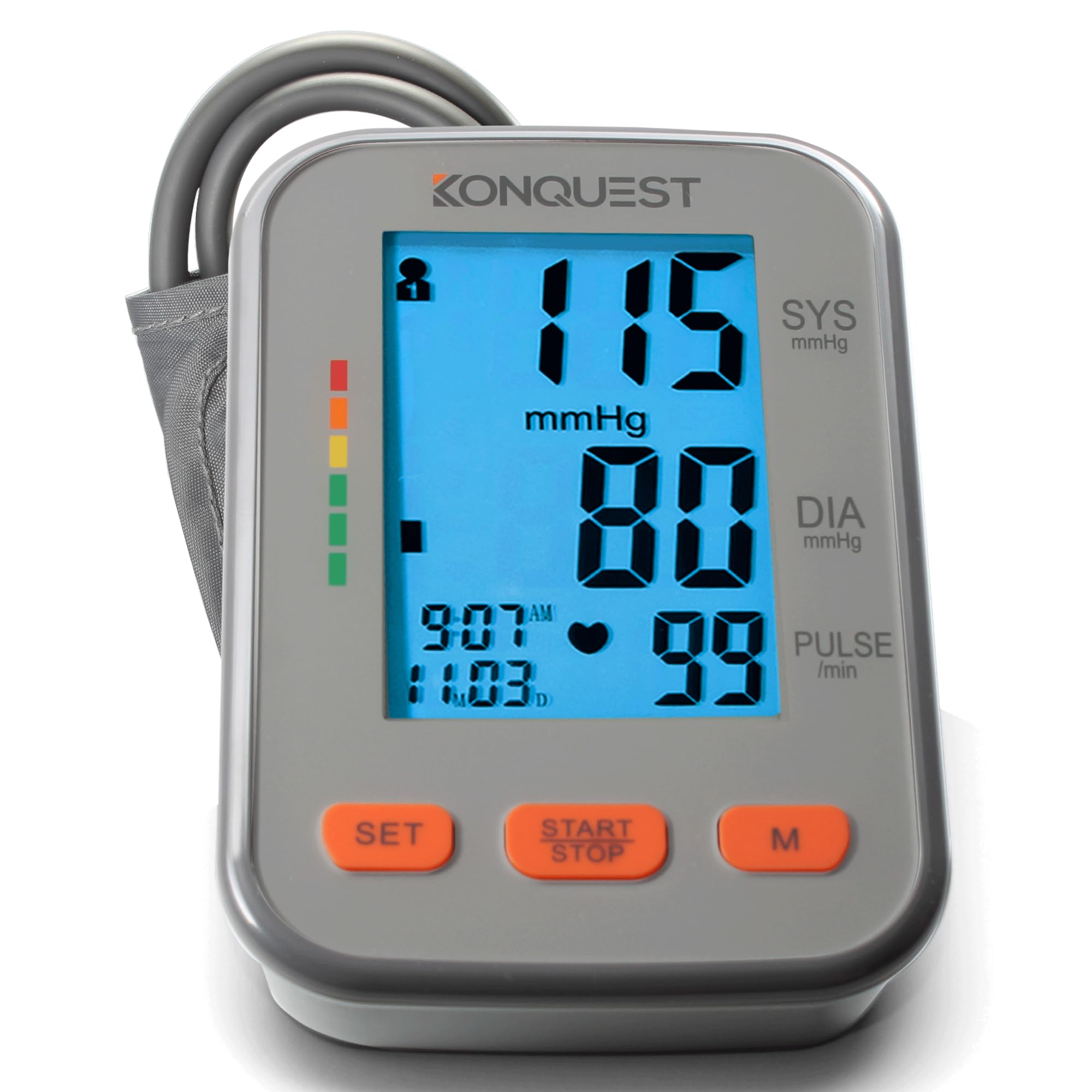
1. Konquest KBP-2704A Automatic Upper Arm Digital Blood Pressure Monitor
Our pick — 4.5+★ from 34,500+ verified ratings; the strongest balance of quality and price.
A bold backlit screen and a cuff that reaches most adult arms make this the one to start with.
The thing that wins people over is readability. That bright backlit LCD (a screen that lights itself so you can read it in a dim bedroom) puts systolic, diastolic, pulse, date, time, and the user profile all on one display. Even a reader without reading glasses can glance down and see the numbers. This is the crowd favorite of the list — 4.5+ stars across 34,000+ owners — and that big, clear screen is why so many households keep it on the nightstand.
The cuff band is the real seller here. It fits upper arms from 8.5 to 16.5 inches (22 to 42 cm), so most adults can use it without ordering a separate cuff. One press and it inflates and deflates on its own, so there is no hand pump to squeeze. A WHO blood pressure indicator (a bar based on World Health Organization guidelines) tells you at a glance whether your reading sits in range. It also stores multiple readings over time, so you can build a log for your doctor.
Here is the honest catch you should weigh. The recurring gripe is the squeeze — the cuff tightens firmly during inflation, and people with larger arms feel it most. Accuracy also draws mixed notes, so treat any single odd reading as a reason to re-test rather than a verdict. Sit still, cuff at heart height, and take two readings a minute apart for a cleaner picture. Unlike the compact Beurer below, this one is a desk-side unit at 1.3 pounds and 5.8 x 4 x 2.2 inches, so it stays home rather than riding in a bag.
What earns it the top spot
- Backlit LCD shows pressure, pulse, date, time, and profile together
- Wide 8.5–16.5 inch cuff covers most adult arms from the start
- One-touch automatic inflation and a WHO range indicator
- Stores multiple readings for a shareable history
Where it asks for patience
- The cuff squeezes firmly on larger arms during inflation
- Reading consistency draws mixed notes — re-test before trusting one number
- Runs on 4 AA batteries and stays put at home rather than traveling light
Worth it for: anyone who wants a clear, bright, one-button check and has an arm within the 8.5–16.5 inch range.
Look elsewhere if: you have a very large arm or want a cuff that barely squeezes — the AQESO ships an extra-large cuff instead.
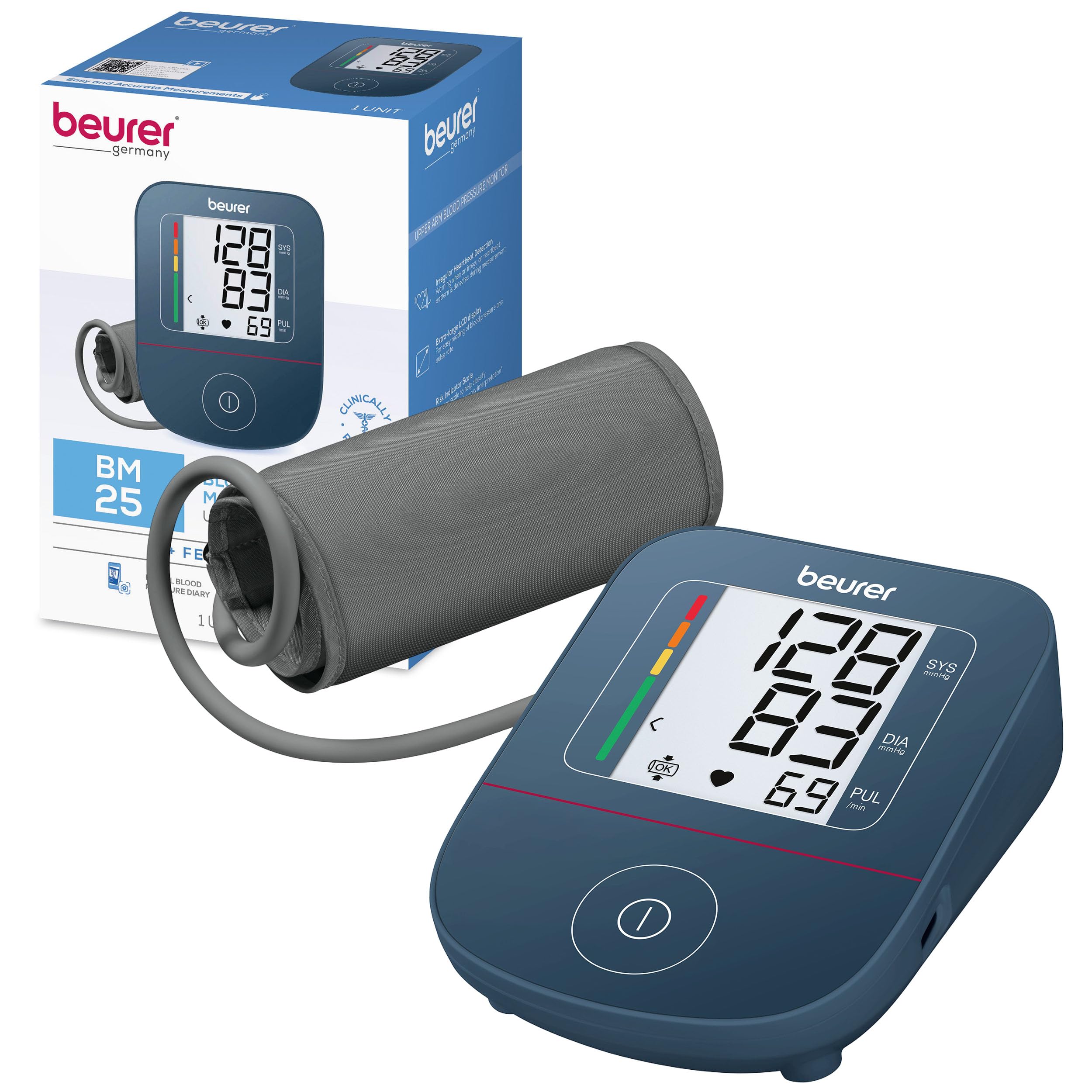
2. Beurer BM25 Upper Arm Blood Pressure Monitor
Pocket-sized comfort with a choice of battery or USB-C power for travel.
Portability is where the BM25 makes its case. It measures 4.7 x 3.5 x 1.5 inches and weighs 12.77 ounces, which is lighter than the 15.45-ounce iHealth Track below. That difference means it slips into a carry-on or a desk drawer without a fuss. If you monitor on the road or split your time between two homes, this is the shape you want.
A cuff-position control confirms the band sits correctly before measuring, so you get a usable reading on the first try. An arrhythmia detector (a check for an uneven heartbeat rhythm during the measurement) flags anything odd for you to mention to your clinician. A color-coded risk indicator (green, yellow, red) reads the result for you, and the Scan & Save function stores measurements in the Beurer HealthManager Pro app. Reliability and quality are the traits owners single out most, and the freedom to run it on the included 4 AAA batteries or a USB-C cable (sold separately) removes the dead-battery stall.
What you trade for the compact frame is long-term durability — some units have quit early, so it is best treated as a good portable companion rather than a decade-long anchor. The app is a tidy extra only if you will open it; the built-in display does the job on its own. For a traveler who wants a light cuff and the flexibility of USB-C, the small footprint is the whole point.
Compact that carries its weight: battery or USB-C power plus cuff-position checking makes first-try readings easier away from home.
The honest trade-off: durability has come up short on some units, so this suits the traveler or light daily user more than the household wanting one device for years.
Reach for it if: you want a light, USB-C-or-battery cuff that packs into a bag.
Pass if: you need a heavy-duty daily unit you will never move.
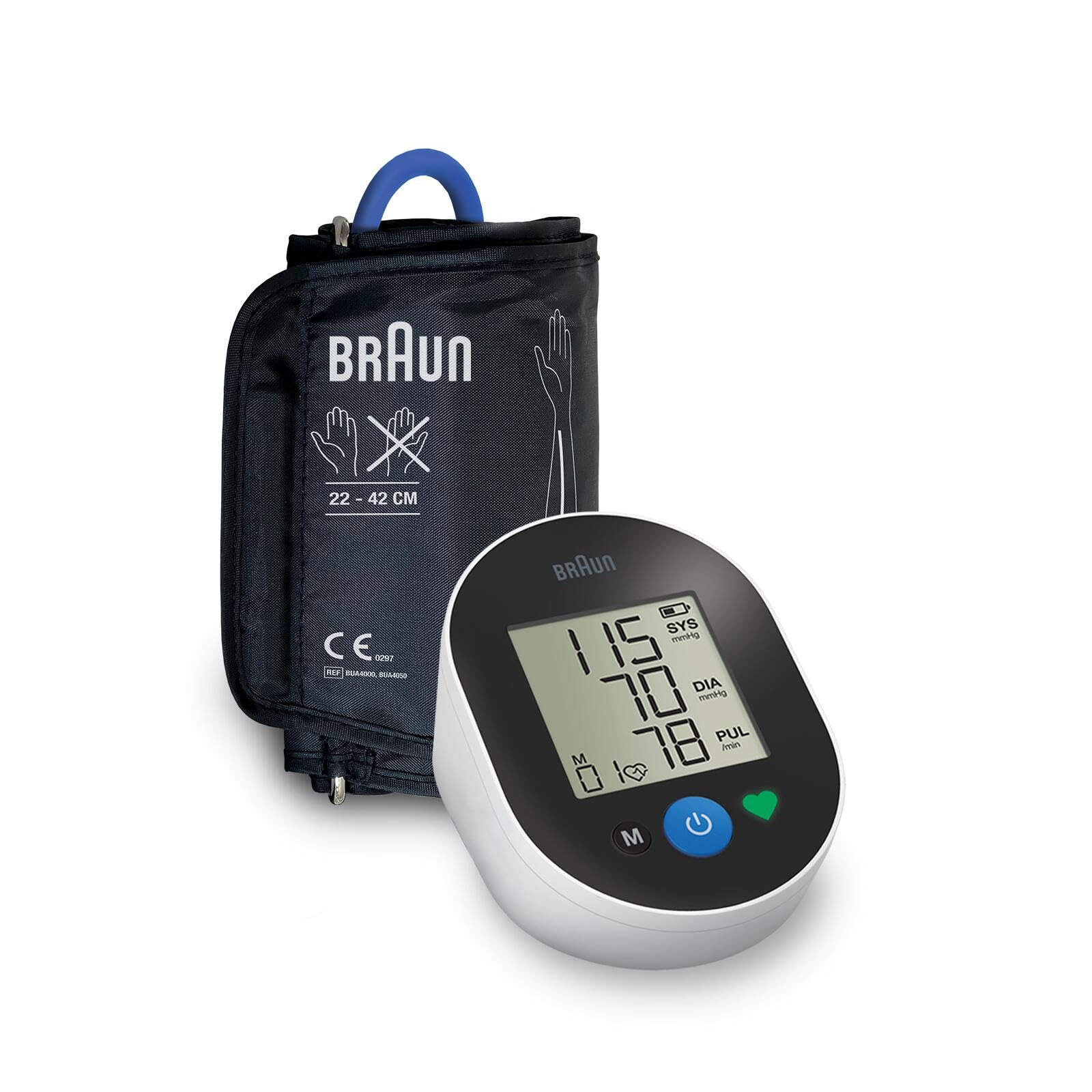
3. Braun ExactFit 2 Upper Arm Blood Pressure Monitor BUA4050US
An accurate, no-fuss cuff that color-codes your result so you do not have to interpret it yourself.
The Braun leads on the one thing that matters most — accuracy. That is the aspect owners praise most, and the color-coded indicator (a colored bar that simplifies what the numbers mean) makes a reading readable in a second. An irregular heartbeat detector adds a second layer of insight during the check. For someone who just wants a dependable daily numeral without learning a manual, this is a clean, unfussy fit.
It stores up to 30 readings for reviewing your history, and the inflation measurement system keeps routine checks simple. It weighs 1.2 pounds in a 5 x 3.5 x 3.75-inch body, a touch lighter than the 1.3-pound Konquest above. The memory is modest next to the iHealth Track’s 99 slots — 30 readings against 99 — so if you log daily and want a long paper trail, the Braun will cycle sooner.
The battery is the small caveat here. A few users find it goes through batteries quickly, so keep a set of 4 AA on hand. Beyond that it is a straightforward, trustworthy daily reader that does not overcomplicate the job.
What it gets right: accurate readings and a color-coded result that skips the guesswork.
Keep in mind: 30-reading memory is lean for heavy loggers, and batteries drain fast on some units.
Good match for: the occasional checker who wants confidence and simplicity in one cuff.
Better served elsewhere: daily data-loggers who need a deep memory bank.
4. iHealth Track Smart Upper Arm Blood Pressure Monitor
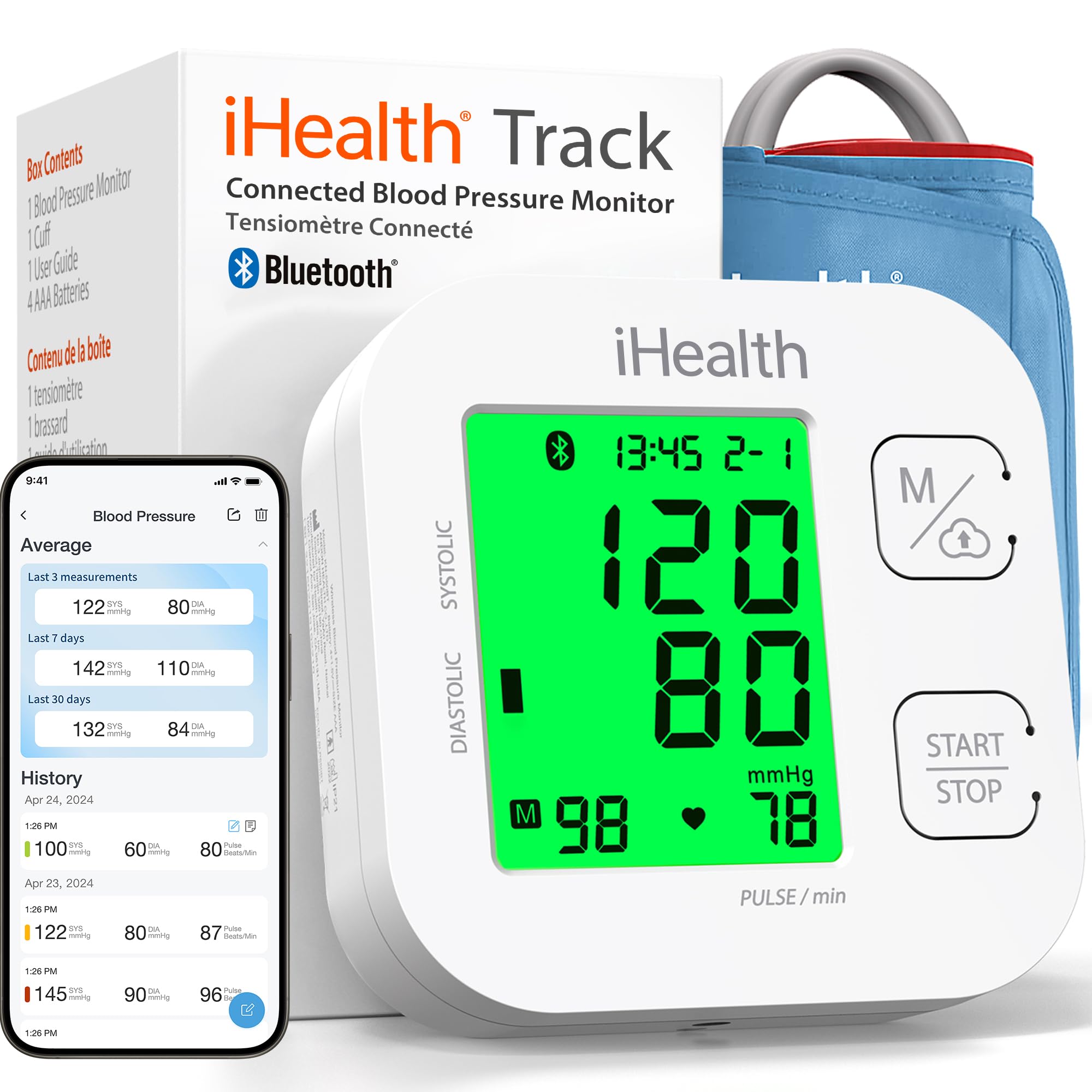
Built for the phone-first household that wants every reading charted automatically.
If you keep your health data on your phone, the iHealth Track is the natural pick. It stores up to 99 readings on the device itself, then unlimited readings in the free iOS and Android app over Bluetooth 4.0. That is a deep memory compared to the Braun’s 30 readings, and it pairs easily with phones and syncs with Apple HealthKit — the connectivity is what people rave about. The large multi-color backlit display with oversized numbers codes the result green, yellow, or red so you know where you stand at a glance.
Operation is two buttons, no calibration, and it ships with a wide-range cuff fitting 8.7 to 16.5 inches (22 to 42 cm). It also automatically flags heart rhythm disturbances with a warning symbol after the measurement. The unit carries an ESH 2010 performance standard and a 12-month warranty, with California-based customer service. In a 3.9 x 3.9 x 1.6-inch body it sits neatly on a shelf, though at 15.45 ounces it is heavier than the 12.77-ounce Beurer above.
The caveat worth knowing is accuracy consistency — readings can run high for some users, so pair it with a second check now and then rather than trusting one number alone. It is also note the device and the app are the system; if you never open the app, you waste what makes it special.
Why the phone crowd likes it
- 99 on-device readings plus unlimited in the free app
- Bluetooth sync to iPhone and Apple HealthKit
- Wide-range 8.7–16.5 inch cuff included
- Color-coded display and two-button operation
What to plan around
- Readings can run high on some units — cross-check occasionally
- Heavier than the travel-focused Beurer
- The app is the point; skip it and you lose the main benefit
Make it yours if: you want a scrolling history on your phone without typing anything in.
Think twice if: you would rather keep a paper log than open an app.
5. Homedics Upper Arm 300 Series Blood Pressure Monitor

A one-button cuff that measures on the way up and cuts the sit-still time short.
Speed is the headline here. For a daily checker who wants in and out, that short sit is the draw. The excessive body motion detector watches for fidgeting and alerts you, helping keep a clean result.
Functionality is what owners praise most, and the practical envelope supports that: it stores 60 readings for a single user and averages your last 3 so a single blip does not skew the picture. A risk category index compares your result against American Heart Association (AHA 2017) levels, an irregular heartbeat detector flags uneven rhythms, and the large easy-to-read numbers keep it legible. At 1.28 pounds in a 5.31 x 2.91 x 4.33-inch frame it is compact enough for a small shelf.
The honest limit is the single user — there is no second profile, so a couple sharing it would blend their readings together. It runs on 4 AA batteries with no rechargeable option. If it is just you checking, that simplicity is a plus, not a problem.
Fast and focused: measuring on inflation keeps the check under a minute, and the motion detector keeps it accurate.
Built for one: a single-user 60-reading memory means no sharing across a couple.
Suits you when: you are the sole user and want the quickest routine check on the list.
Not for you if: two people plan to share one device and keep separate records.
6. Microlife BPM2 Automatic Digital Upper Arm Blood Pressure Monitor

In a single sitting you get pulse, systolic, and diastolic pressure, a hypertension risk indicator, and an irregular heartbeat detector. The kit is complete: monitor, upper arm cuff, storage bag, 4 AA batteries, and an English/Spanish manual, with an optional Microlife AC adapter sold separately. At 12.2 ounces it is lighter than the 15.45-ounce iHealth Track above, easy to stow in its bag.
The catch to size honestly is reading consistency. Accuracy draws mixed notes — some units read spot-on, others off — so this is a monitor to sanity-check against your doctor’s office rather than trust blind. Reliability over the long haul is a genuine strength: quality and durability both come up positively, with users reporting it lasting for years. Just confirm a fresh set of batteries and a correctly seated cuff before you lean on a number.
Accuracy with a badge: the AA BIHS rating plus 60-reading averaging gives you a trend, not a single guess.
The caveat to weigh: consistency varies unit to unit, so cross-check against a clinical reading when you can.
Worth grabbing if: you value a clinically rated device and want your averages calculated for you.
Look past it if: you want zero doubt on each reading without a comparison check.
7. Medline Advanced Automatic Blood Pressure Monitor

One cuff, three separate memory banks — built for a household that shares a single monitor.
If more than one person in the house checks their pressure, the Medline solves the mess of blended records. It stores up to 90 measurements with memory for up to 3 users, and shows the average of your last 3 readings. The large digital display puts systolic, diastolic, and pulse rate together with a colored scale beside it to help you interpret the result. Readability is the clear strength — large digital readings are the point.
The cuff inflates at the push of a button with customized inflation for each person, plus advanced error detection to keep results reliable. A universal cuff fits 22 to 42 cm (8.6 to 16.5 inches), and the kit includes a carrying case, the monitor, the cuff, and 4 replaceable AA batteries, backed by a 2-year warranty. That carry case makes it easy to move between rooms or take along.
The trade-off is reading consistency. Accuracy, quality, and value all draw mixed notes — some households love it and find it fine for the price, others report readings running consistently too high. That is not a reason to skip it, but it is a reason to verify against your clinician’s cuff before you build a routine around it. For a three-person household wanting separate logs, the organization is the win.
Family-friendly setup: separate memory for up to 3 users keeps everyone’s readings apart.
Worth a cross-check: accuracy varies, so confirm against a clinical reading before trusting the trend.
Ideal for: a shared household that wants everyone’s readings kept in their own lane.
Skip if: you are one user who wants a single clean record and zero sharing.
8. AQESO Upper Arm Blood Pressure Machine with 2 Size Cuffs

Two cuffs in the box — including an XL band up to 21 inches — for arms that outgrow standard sizes.
This is the one for anyone whose arm sits near or past the top of a normal cuff. It ships a Medium/Large cuff for 9 to 17 inches and an extra-large XL cuff for 13 to 21 inches, so you pick the band that fits and get a clean, comfortable reading instead of a squeeze. For larger arms that fight a standard cuff, that extra range is the entire reason to choose it.
Beyond the fit, it uses advanced oscillometric technology (a standard method that senses pressure changes in the cuff) for fast, consistent readings, plus a WHO classification bar to grade the result. The large backlit LCD keeps oversized numbers readable in low light, which helps early-morning checks. It supports 2 users with 500 sets of readings each, and can run on 4 AAA batteries or a USB Type-C cable for dual power.
The honest note is reliability and accuracy — both draw mixed feedback, so a reading here is worth a second look before you act on it. The device is not rechargeable, so USB power needs a continuous connection. But for a large-arm household that also wants deep two-user memory, nothing else on this list packs an XL cuff with 1,000 total slots.
Where the extra cuff pays off
- Two cuffs cover 9–21 inches, including an XL band
- 2 users with 500 readings each for family logs
- Large backlit LCD readable in low light
- Battery or USB Type-C power
The fine print
- Accuracy and reliability vary — cross-check before trusting a reading
- Not rechargeable; USB needs a constant connection
Made for: bigger arms and two-person households that need the widest fit and deepest memory here.
Not the one if: you have a standard arm and want the simplest single-cuff setup.
9. WITHINGS BPM Vision Blood Pressure Monitor
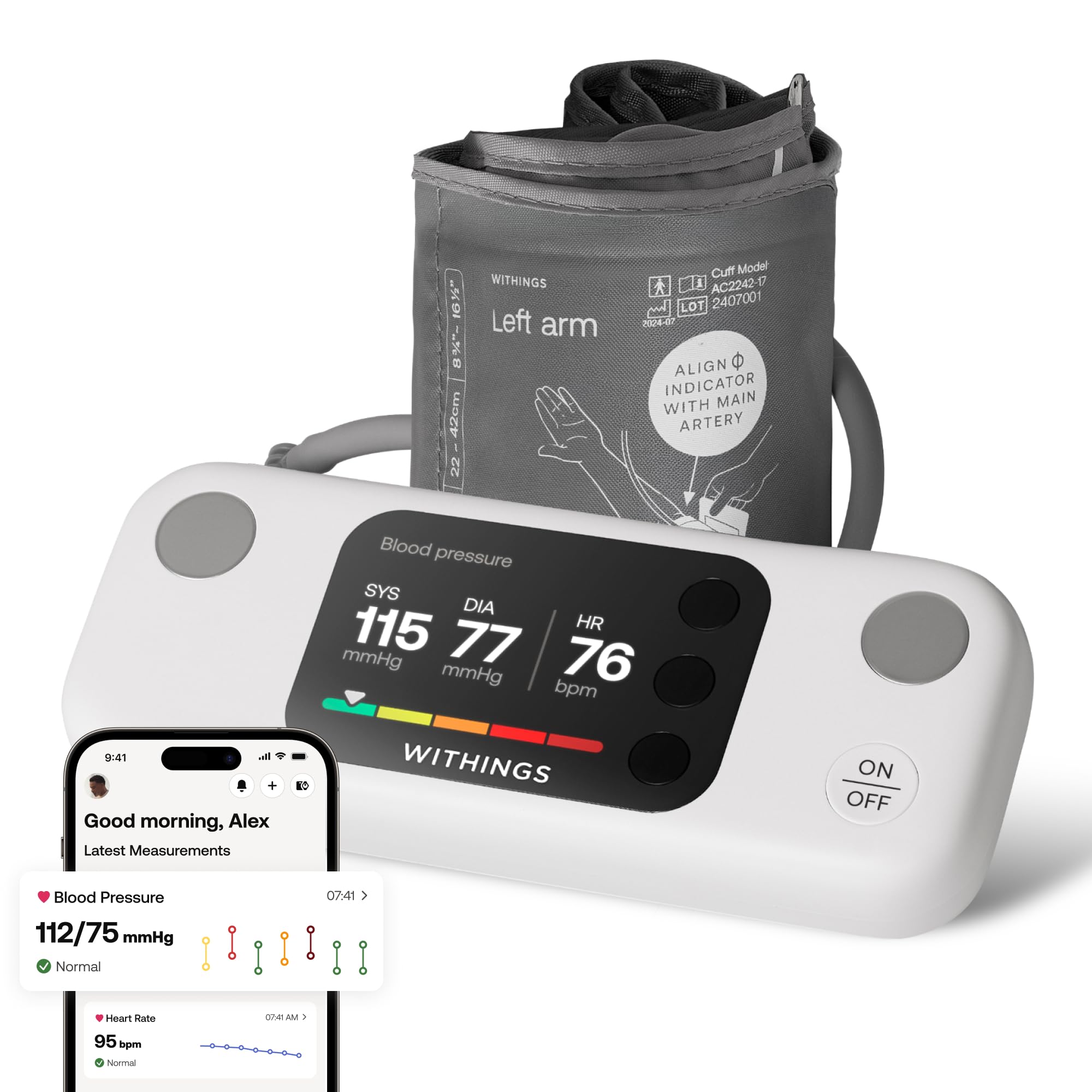
The premium sync-first cuff whose readings land in the app without you touching a thing.
At the top of the range, the BPM Vision is for the buyer who wants the data to handle itself. It syncs automatically over Wi-Fi or Bluetooth to the Withings app for unlimited storage, and the 2.8-inch LCD shows ultra-clear results in a big, bright frame. Color-coded feedback compares your reading to official US hypertension levels defined by the American Heart Association, so interpretation is instant. A one-year battery life means you are not recharging a cuff every week.
Quality and ease of use are what owners praise most, and the setup extras support that. Built-in step-by-step tutorials walk you through taking a reading in the ideal conditions, and the included standard cuff fits 8.7 to 16.5 inches (22 to 42 cm). A protective case doubles as a stand for steady readability, and it weighs 2.3 pounds in an 8.2 x 3.2 x 1.5-inch body. One important note: it is incompatible with pacemakers, so check that first.
The catch is the connected part you are paying for. Setup draws frustration for many, and syncing is not always smooth, plus two household users cannot share one phone. Reliability and accuracy also draw mixed notes. When the sync works, the hands-off log is excellent; when it fights you, the app becomes the chore. This is the model to choose for convenience, not for the lowest-effort first day.
The hands-off angle: automatic Wi-Fi and Bluetooth syncing with a big 2.8-inch screen and a year of battery.
The catch: setup and syncing frustrate some, and two people cannot share one phone — plus it is not for pacemaker users.
Choose it if: you want readings to file themselves into a clean, connected chart.
Leave it if: you want plug-and-play simplicity with no app at all.
Understanding the Specs
Cuff Circumference Range
This is the arm size the band is built to fit, printed as a range like 8.5 to 16.5 inches. It is the most important spec on the box, because a band that is too tight squeezes hard and can read high, while a loose one reads low. Match the middle of your upper arm to the range, and if you sit near the top, look for a model that ships a second, larger cuff.
Memory and Averages
Memory (the number of past readings the monitor keeps) ranges from 30 slots to 1,000 across two users. Averages of your last few readings smooth out a single blip. If you log daily or share with a doctor, a deep bank or app storage keeps the history long; an occasional checker is fine with a smaller number.
Irregular Heartbeat Detection
This feature watches for an uneven pulse rhythm during the measurement and shows a warning symbol or alert if it spots one. It is a flag to mention to your clinician, and it is not a diagnosis on its own. Several models here include it.
Power Options
Most cuffs run on AA or AAA batteries included in the box. A few add a USB-C or USB cable option for travel or a dead-battery backup, and some note the USB path needs a continuous connection rather than charging. Match the power to how you use it — battery for a shelf, USB for a fixed spot.
FAQ
How do I know which cuff size will fit my arm?
Are automatic cuffs as accurate as the one at my doctor’s office?
What do systolic and diastolic numbers mean?
Do I need an irregular heartbeat detector?
How much memory do I actually need?
Can two people share one blood pressure monitor?
Why does the cuff squeeze so hard during inflation?
Is a Wi-Fi or Bluetooth monitor better than a basic one?
What is the difference between measuring during inflation and waiting?
Final Thoughts: The Verdict
The overall pick for most households is the Konquest KBP-2704A, because its backlit display, wide 8.5 to 16.5 inch cuff, and one-touch operation make daily checking genuinely easy. If your phone is your health log, the iHealth Track keeps 99 readings on-device and unlimited in the app. For larger arms, the AQESO ships an XL cuff up to 21 inches. And if you want readings to file themselves, the Withings BPM Vision syncs over Wi-Fi and Bluetooth on its own. Measure your arm first, match the cuff range, and you will pick right the first time.
How We Picked
We do not accept paid placement. Every pick is matched to a real buyer and a real use-case; we do not hands-on test units.
Sources & Methodology
Specifications: manufacturer listings and product documentation. Review insights: verified customer reviews, as of November 2026. Pricing: not shown on this page (it changes often); check the current price via the retailer link.
As an Amazon Associate, Gadgets Feed earns from qualifying purchases. This does not affect which products we feature.