
Consistent chlorine levels without the daily hassle of dumping tablets into a skimmer or chasing a floating plastic duck around the deep end. An automatic chlorine dispenser takes the manual labor out of pool sanitation, turning a tedious chore into a set-it-and-forget-it process that keeps your water balanced week after week.
I’m Min — the co-founder and writer behind Gadgets Feed. I’ve spent years analyzing pool equipment specifications, comparing flow rates, gallon capacities, and material corrosion resistance so you can match the right feeder to your circulation system without costly mistakes..
Whether you own a small above-ground spa or a large in-ground pool with dedicated plumbing, the right feeder transforms your maintenance routine. This guide breaks down the top contenders to help you find the best automatic chlorine dispenser for your specific setup and budget.
How To Choose The Best Automatic Chlorine Dispenser
Selecting the right dispenser starts with understanding your pool’s plumbing setup and your tolerance for maintenance. Floating units are inexpensive but drift into skimmers, while inline feeders tie directly into the return line for precise, automated dosing.
Inline vs. Floating Dispensers
Inline chlorinators connect to your PVC return line and use the pump’s flow to dissolve tablets gradually. They keep chemical levels steady, never block the skimmer, and last for weeks on a single fill. Floating dispensers are cheaper and require no plumbing, but they can tip over, release chlorine unevenly, and get stuck against the pool wall.
Gallon Capacity and Flow Rate
Every feeder has a max water-handling rating, typically between 15,000 and 70,000 gallons. Oversizing is fine — you just dial the valve down. Undersizing forces you to refill tablets constantly. Flow rate matters for inline models: 50 gallons per minute is standard, but larger pools benefit from units rated at 90 GPM to maintain circulation without restriction.
Material and O-Ring Quality
ABS bodies resist chemical corrosion, but the real weak point is the gasket. Thick, fluorocarbon (FKM) O-rings seal better and last longer than standard rubber. Lubricating them every two weeks prevents dry rot and leaks. Models with vent plugs also release built-up gas safely, reducing pressure on the lid seal.
Quick Comparison
On smaller screens, swipe sideways to see the full table.
| Model | Category | Best For | Key Spec | Amazon |
|---|---|---|---|---|
| Hayward CL2002S | Inline | Large In-Ground Pools | 90 GPM flow rate | Amazon |
| Pentair Rainbow 320 (R171096) | Inline | Clear Tablet Monitoring | 70,000 gal top feed | Amazon |
| Pentair 300 (R171016) | Inline | Mid-Sized Pools | Completely enclosed system | Amazon |
| Hayward CL100 | Inline | Above-Ground Pools | 50 GPM max flow rate | Amazon |
| LONGADS CL200 | Inline | Budget Inline Feeder | 40,000 gallon capacity | Amazon |
| Vikua Upgraded 320 | Inline | Large Capacity Fill | Holds 98 small tablets | Amazon |
| Poolmaster Duck Dispenser | Floating | Fun, Small Spas/Pools | Holds 3-inch tablets | Amazon |
In‑Depth Reviews
1. Hayward CL2002S In-line Automatic Chemical Feeder

The Hayward CL2002S is the heavyweight champion of inline chlorinators, handling flow rates up to 90 gallons per minute — enough for large in-ground pools with high-circulation pumps. Its 2-inch inlet and outlet ports minimize backpressure, and the Easy-Lok threaded cover lets you refill slow-dissolving Trichlor or Bromine tablets without tools.
This unit comes with a finger-release safety catch that prevents the lid from popping off under pressure, a real safety concern with pressurized chemical feeders. Users report a single charge lasting 30 days or more during peak summer heat, which dramatically cuts down manual intervention. The snap-lock design requires only a quarter-turn to seal, and the low torque needed means you won’t crack the housing over-tightening.
The only catch is the unthreaded 2-inch connections — you’ll need to glue PVC or buy a separate adapter if your system uses 1.25-inch hose. Adding a shutoff valve on the output line prevents backflush during pump-off periods. It’s a premium committment upfront, but the month-long runtime and elimination of floating skimmer blockers justify the spend for serious pool owners.
Why it’s great
- High 90 GPM flow capacity handles large circulation systems
- Month-long tablet life during summer conditions
Good to know
- Requires glued PVC connections and optional adapters for smaller hoses
- Snap-lock lid can be knocked open if latch is not fully engaged
2. Pentair Rainbow 320 In-Line Feeder (R171096)
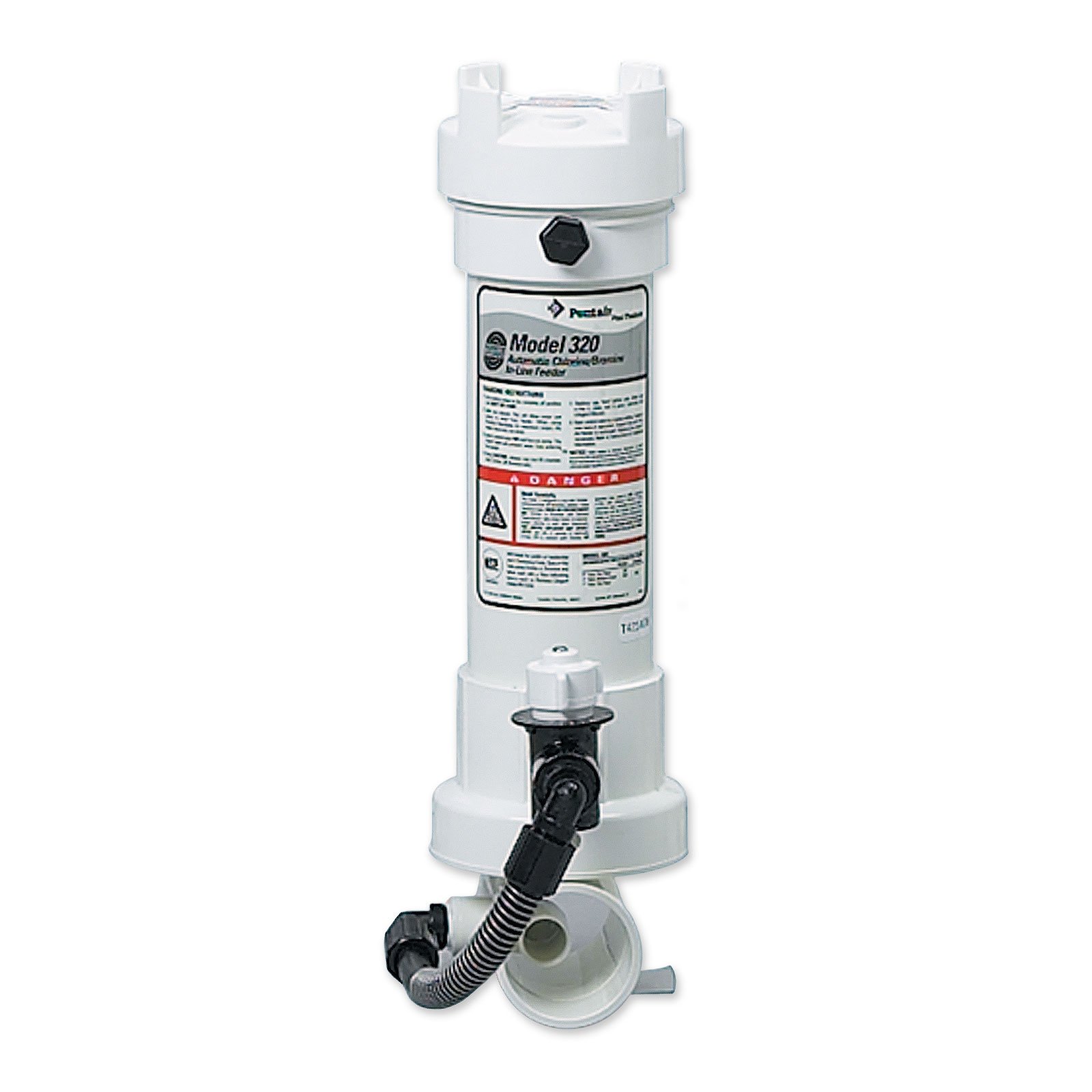
The Pentair Rainbow 320 stands out with its amber-tinted body that lets you see the tablet level without opening the lid — a small convenience that saves you from inhaling concentrated chlorine gas. It’s a completely enclosed system that requires no special venting, and its design circulates water more efficiently than many competitors, reducing the load on your pump.
With a top-feed capacity handling up to 70,000 gallons, this unit can hold 11 large Trichlor tablets or 98 small bromine sticks, making it ideal for large pools and spas. The control valve is straightforward to adjust, and the bottom drain simplifies cleaning when you switch between chlorine and bromine. Many users replace 15- to 25-year-old units with this exact model, noting the screws and hoses fit perfectly.
At 50 PSI maximum operating pressure, it’s rated well within typical residential systems, but high-pressure commercial pumps may exceed its limit. Some users note the initial instruction manual is sparse, but the design is simple enough for any competent DIYer. For a premium OEM part that offers durable ABS construction and a crystal-clear tablet window, the 320 is a solid investment.
Why it’s great
- Clear body allows visual tablet-level check without gas exposure
- Holds up to 98 small tablets for infrequent refills
Good to know
- 50 PSI max may not suit high-pressure commercial pumps
- Instructions are minimal; requires basic DIY plumbing knowledge
3. Pentair Rainbow 300 Automatic Pool and Spa Feeder (R171016)

The Pentair Rainbow 300 is a workhorse that many pool owners have trusted for well over a decade. Its completely enclosed system means no escaping gases, which keeps the area around the equipment pad safer and reduces the telltale “pool smell.” The adjustable flow dial gives you precise control over chlorine output; a setting of 3 or 4 typically dissolves one puck per day in a 55,000-liter pool.
Plumbing this unit into the return line eliminates the need for floating dispensers, which can get caught in skimmers and cause uneven chemical distribution. Users report excellent build quality and simple installation, though the plastic ball valve (part number 20) can snap if overtightened. A gentle hand during assembly prevents this issue.
The supplied metal strap does double duty as a mounting bracket and secures the feeder to a stable surface. Some users wish for a built-in chlorine level indicator, but the adjustable dial is sufficient once you learn your pool’s demand. For the price, this is a well-engineered solution that dissolves pucks evenly and keeps your water balanced with minimal fuss.
Why it’s great
- Enclosed system prevents gas leaks and strong chlorine odor
- Dial control provides consistent, adjustable feed rate
Good to know
- Plastic ball valve is brittle and requires careful tightening
- No built-in indicator for remaining tablet level
4. Hayward CL100 Automatic Chlorine Feeder
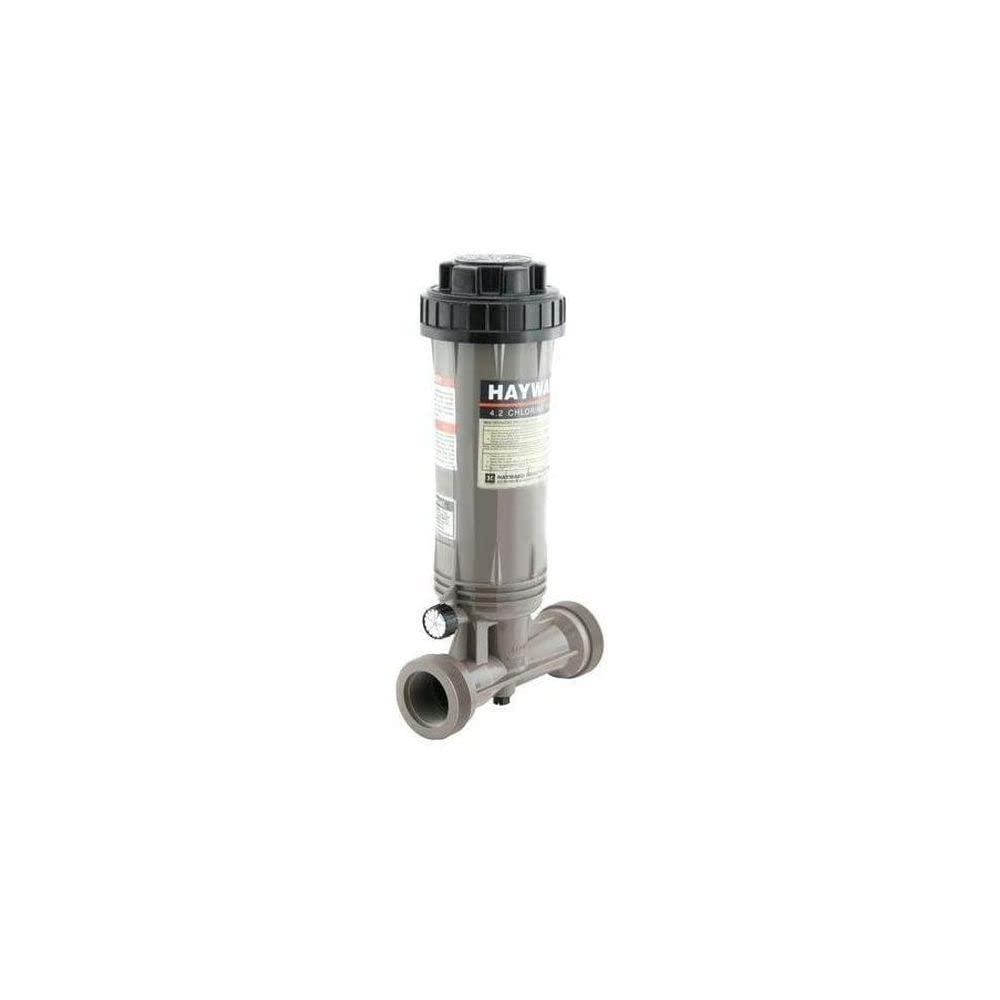
The Hayward CL100 is purpose-built for above-ground pools, using 3-inch diameter Trichlor tablets with a simple dial control valve that lets you adjust the feed rate without disassembly. Its compact size — 16 x 8 x 8 inches — tucks neatly next to above-ground filter systems, and the Easy-Lok threaded cover allows single-handed refills.
Users consistently report a full load lasting up to three weeks, depending on water temperature and bather load. The finger-release catch adds an extra layer of security, preventing the lid from accidentally unscrewing under line pressure. Installation is straightforward for any DIYer, and the PVC connections hold up well when assembled with proper Teflon tape.
Safety is the single most important consideration here: opening this unit without proper protection releases potent toxic gas. A welding-grade mask and goggles are strongly recommended during refills. The black seal ring inside the lid can also fall out if you tilt the cover carelessly. For above-ground pool owners who want reliable inline chlorination without overspending, this is a proven choice.
Why it’s great
- Compact design fits easily in above-ground filter setups
- Simple dial control for precise chlorine feed adjustment
Good to know
- Lid seal ring can dislodge easily during removal
- Always use proper gas-mask protection when refilling
5. LONGADS CL200 Inline Chlorinator Replacement

If you own a Hayward CL200 or CL200EF, the LONGADS CL200 is a near-identical replacement at roughly half the OEM price. It’s built with a blend of ABS and PC material that improves corrosion resistance over standard ABS, and the dual-threaded inlet/outlet ports (2-inch outer thread, 1.5-inch inner thread) make it compatible with most existing PVC plumbing without adapters.
This feeder handles pools up to 40,000 gallons, making it suitable for mid-sized in-ground setups. The Easy-Lok nut on top simplifies tablet refills, and the +/- adjustment ring lets you fine-tune dissolution speed. Included fluorocarbon O-rings seal well initially, but regular lubrication every two weeks is required to prevent dry rot and cracking under pressure.
Quality control is a mixed bag — some users report leak-free operation for years, while others receive units that weep at the seam from day one. The warranty is good, but a faulty seal can turn a cheap buy into a frustrating hassle. For budget-conscious shoppers who understand the maintenance commitment, this is a viable alternative. Just inspect the O-rings immediately and consider buying a spare set upfront.
Why it’s great
- Direct CL200/CL200EF replacement at a cost-effective price
- ABS/PC blend resists chemical corrosion better than plain ABS
Good to know
- O-rings must be lubricated every two weeks to prevent failure
- Inconsistent quality control; some units leak immediately
6. Vikua Upgraded 320 Pool Chlorinator

The Vikua Upgraded 320 is designed to rival the Pentair Rainbow 320 with an even bigger tablet capacity — 11 large or 98 small chlorine or bromine tablets per fill. That translates to fewer refill trips for large pools and hot tubs, and the bottom drain is a thoughtful upgrade that makes seasonal cleaning faster than models requiring full disassembly.
This unit uses a 1/4-inch feed hose to deliver chlorinated water, and the top vent plug releases built-up gas safely to keep lid pressure manageable. The inner walls are thickened ABS, which resists the oxidizing effects of chlorine better than thinner plastics. Included lubricating grease helps maintain the cover and control valve seals.
The biggest downside is parts consistency. The control valve on some units has mismatched thread sizes between the top and feeder side, making a perfect seal difficult. Users have reported leaks that require sourcing a separate valve. For those willing to troubleshoot a bit, the overall value is high; for a plugs-free setup, stick with the Pentair OEM.
Why it’s great
- Massive tablet capacity minimizes refill frequency
- Thickened ABS walls improve longevity against chlorine corrosion
Good to know
- Some units have mismatched control valve threads causing leaks
- Requires regular lubrication of the cover and valve seals
7. Poolmaster Duck Adjustable Chlorine Dispenser

Not every pool owner wants to cut into PVC lines, and that’s where the Poolmaster Duck comes in. This floating dispenser holds standard 3-inch chlorine tablets and adds a decorative touch to your spa or small pool. The adjustable dispensing ring controls how fast the tablets dissolve, giving you some control over chlorine output without any plumbing.
The duck is molded from all-weather plastic and floats upright reliably. Many owners note that it looks surprisingly lifelike from a distance, blending into fountain or pond-style settings. Users with multi-tiered fountains especially appreciate that it stays visible and doesn’t sink under the water flow. It’s also inexpensive enough to buy two for larger pools.
Being a floating unit, it has inherent limitations: it can get pushed into a skimmer by the current, the orange beak may scuff against pool walls, and it tilts as the tablets dissolve. It’s not a solution for those seeking precision chemical management. But for small above-ground pools, hot tubs, or anyone who prioritizes low cost and fun aesthetics, it’s a perfectly functional little dispenser.
Why it’s great
- No plumbing required; just drop it in the water
- Lifelike duck design adds poolside character
Good to know
- Can drift into skimmers and block water flow
- Orange beak may scuff vinyl or fiberglass walls
FAQ
Do I need an inline chlorinator or will a floating dispenser work?
How do I safely refill an automatic chlorine feeder?
Final Thoughts: The Verdict
For most users, the best automatic chlorine dispenser winner is the Hayward CL2002S because it combines the highest 90 GPM flow capacity with a month-long tablet life and robust safety latch. If you want a clear body for easy tablet monitoring, grab the Pentair Rainbow 320 (R171096). And for a budget-friendly inline option that fits standard CL200 plumbing, nothing beats the value of the LONGADS CL200.