
Our readers keep the lights on and my morning glass full of iced black tea. As an Amazon Associate, I earn from qualifying purchases.
Specs are compiled from manufacturer listings and verified buyer reviews and can change over time — please confirm the key details on the product page before buying.
Keeping fish fed while you are away used to mean begging a neighbor to follow a strict schedule or trusting a simple timer that dumps all the food at once. Now an automatic feeder handles the daily routine for you, but picking the right one matters — too much food fouls the water, too little leaves your fish hungry, and a poor mechanism can jam or clog. This guide breaks down the features that actually affect your fish’s health and your confidence.
I’m Min — the founder and writer behind Gadgets Feed. This guide is built by comparing the manufacturers’ published specifications and the patterns across verified customer reviews, so you get each pick’s real strengths and trade-offs instead of marketing spin.
If you take weekend trips or want a hands-off daily feeding routine, this look at the best automatic feeder for fish covers capacity, battery life, feeding schedules, and moisture resistance — the specs that separate a reliable feeder from one that could spoil a tank while you are gone.
Quick Picks
- fishkeeper Automatic Fish Feeder (320ML) — Best Overall
- Papettly Automatic Fish Feeder (LCD Display) — Precision Pick
- FISHNOSH Automatic Fish Feeder — Extra Feature
- JuzPetz Automatic Fish Feeder (200ml) — Best Value
- Petbank Rechargeable Automatic Fish Feeder — Simple Operator
- FISHNOSH Automatic Fish Feeder (Model ML) — Compact Option
- TOPBRY Automatic Fish Feeder (Digital) — USB Daily Driver
How To Choose The Best Automatic Feeder For Fish
Picking an automatic fish feeder depends on three pillars: how much food it holds, how you want to set the schedule, and whether it keeps the food dry. Get these right, and you get a feeder that works for days or weeks without a problem.
Capacity and Food Hopper Size
This is the single biggest factor for vacation use. A feeder with a 200ml hopper will last a few days for a small community tank, while a 320ml hopper can feed the same tank for weeks. Bigger capacity also means fewer top-ups in daily use. Check that the opening is wide enough to pour food in without spilling.
Feeding Schedule and Portion Control
The best feeders let you set multiple feedings per day — anywhere from 1 to 4 — and adjust the portion size per drop. Look for a model that offers an interval timer (12-hour or 24-hour cycles) or a programmable clock (a clock you set to exact times like 8:00 AM). This matters because different fish have different metabolisms. Some feeders let you set up to 3 rotations per feeding, which is useful if you have multiple tanks or very hungry fish.
Power Source: Rechargeable vs. Battery
Rechargeable feeders save you from buying batteries, but you need to remember to charge them. Battery-powered models (often 2 x AA or D-cell) can last months on one set, but they add recurring cost. A USB-rechargeable feeder with a large capacity battery can run for 3-6 months on a single charge, which is ideal for long vacations.
Moisture Protection and Food Freshness
Humidity is the enemy of fish food. A feeder that leaves the dispensing port open will let moisture in, causing flakes or pellets to clump and jam the mechanism. Look for designs that have a spring-loaded door or a rubber curtain that closes after each feed. A separate, ventilated food compartment that slides back tightly against the feeder body also helps keep food dry.
Quick Comparison
| Model | Best For | Capacity | Feeding Schedules | Power | Amazon |
|---|---|---|---|---|---|
| fishkeeper 320ML | Large tanks / Long trips | 320 ml | 8H / 12H / 24H | Batteries Included | $23.74$24.99PrimeAmazon |
| Papettly Display | Precise portion control | 1.06 oz / 15 chambers | Up to 3x daily | Batteries Included | $29.99$35.99Amazon |
| FISHNOSH Digital Thermometer | Temperature monitoring + feeding | 200 ml | Up to 9 portions daily | Batteries Not Included | $35.97Amazon |
| JuzPetz 200ml | Budget-friendly / Value | 200 ml | 4 times / day | Batteries Not Included | $17.98Amazon |
| Petbank Rechargeable | Simple interval timers | 200 ml | 12H / 24H / 48H | USB Rechargeable | $20.99Amazon |
| FISHNOSH ML | Compact / Small tanks | 200 ml | Up to 3x daily | Batteries Not Included | $22.97Amazon |
| TOPBRY (B07NV6GLXH) | USB rechargeable / Daily use | 200 ml | 4 exact times / day | USB Rechargeable | $23.99Amazon |
In‑Depth Reviews
1. fishkeeper Automatic Fish Feeder (320ML)
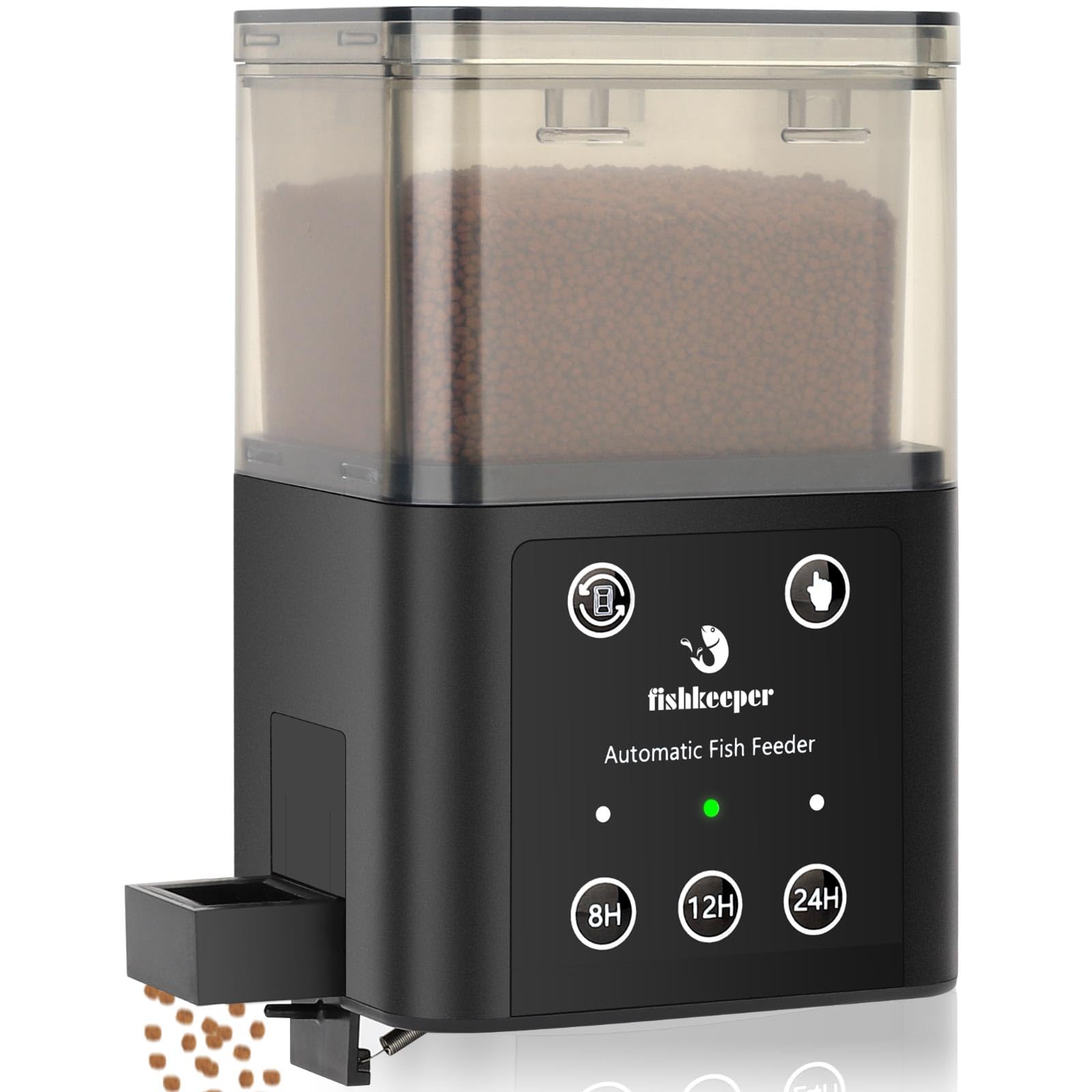
The 320-milliliter tank that keeps the food fresh while you are gone for weeks.
You can fill this feeder once and walk away for a two-week trip without worrying about running out, because its hopper holds 320ml — holding 320ml compared to the JuzPetz 200ml. The transparent tank lets you see the food level at a glance.
Moisture is the main cause of jammed feeders, and this one fights it with a spring-loaded drawer system. After each feeding cycle, the bin slides back tight against the body, and a rubber curtain wipes any food debris off the exit port. The result is a feeder that handles pellets reliably. Buyers report that “pellets work great” and that it is “a vacation must have” for fish owners. It runs on batteries (included), and the feeding mechanism measures under 5dB (quieter than a whisper), so it won’t disturb your tank’s peace.
There is a catch: this feeder is not recommended for flake food. The same moisture-proof drawer that works so well with pellets can cause flakes to cake. It also measures quite large at 6.13″L x 2.8″W x 4.4″H, compared to the JuzPetz (4.7″ x 3.4″ x 6.5″), so it may look bulky on a small desktop tank.
Why It Wins for Long Trips
- 320ml capacity — largest in this test, lasts 3-6 months per fill
- Anti-blocking rubber curtain and spring-loaded door keep food dry
- Three fixing methods (clamp, stand, sticker) suit lid or rim mounting
One Real Limitation
- Not reliable with flake food — jamming risk is high
- No LCD display; schedule is set via button press
- Too bulky for nano tanks under 5 gallons
Best for: Anyone going on a long trip with a medium-to-large tank who feeds pellets — set it once and forget it.
Skip if: You feed flake food exclusively or have a very small tank where the feeder’s size looks out of place.
2. Papettly Automatic Fish Feeder (LCD Display)

A precision feeder that dishes out exactly 2 grams per go to prevent overfeeding.
Where most feeders rely on a sliding door that drops an inconsistent amount, the Papettly takes a different approach. It uses 15 separate compartments that rotate into position, each holding a pre-measured portion, so you know exactly what goes into the tank every time. You can set up to 3 feedings per day with up to 3 portions per feeding. Owners mention that “it gives out the proportioned amounts each set time so your fish doesn’t starve or get over fed.”
The LCD display (liquid-crystal display, a small screen that shows numbers and settings) makes programming straightforward — you scroll through hours and minutes rather than counting button presses. The feeder runs quietly under 30dB and uses an auto-closing feeding port that keeps moisture from spoiling the food in the hopper. It also comes with a spoon for measuring food. That compartment-based design holds about 2.5 days of food at the maximum setting (6 chambers per day), so it is best suited for short trips.
The trade-off is that this feeder is not suitable for flake or shrimp food — the compartments are shaped for pellets. Its suction-cup mount works well on thick glass tanks, but it may not stay secure on rimmed tanks.
Portion Control Champ
- 15 separate compartments eliminate dispensing variability
- LCD screen for easy programming
- Auto-closing door and water-resistant design
Capacity Cramp
- Only holds 1.06 oz — need to refill for trips over a few days
- Not usable with flake or shrimp food
- Suction cup may loosen on textured or rimmed tank edges
Reach for this if: You want dead-accurate portion control for pellets and do not mind refilling every 2-3 days.
Look elsewhere if: You feed flakes or need a set-and-forget solution for multi-week trips.
3. FISHNOSH Automatic Fish Feeder with Digital Thermometer

A feeder that also watches your tank temperature and sounds an alarm if things get too warm.
What if you could check the water temperature without buying a separate thermometer? This FISHNOSH model embeds a digital temperature sensor (an electronic device that reads water temperature) with an audible alert — set a maximum, and the feeder beeps if the tank water exceeds it. That is a genuine safety net for fish that are sensitive to heat spikes. The programmable timer allows up to 9 portions per day across 3 feeding windows, so you can match the feeding rhythm of fish that naturally eat small amounts throughout the day.
The unit holds a 200ml capacity in the same compact footprint as previous FISHNOSH designs (6.14″L x 2.8″W x 4.4″H). It comes with a clip and a stand, and customers note that it is “lightweight yet sturdy.” Buyers also mention that it survived a classroom holiday break and a week of snow days without issue. The dual feeding windows let you swap between a small and large opening to handle different pellet sizes.
Here is the catch: the temperature sensor has a known accuracy issue. One reviewer noted that after setting the max temperature, the display recalculated the reading incorrectly. The feeder’s slot also stays open after dispensing, which lets moisture in — you will need to clean the mechanism more often than a fully sealed unit like the fishkeeper 320ML.
Double-Duty Device
- Built-in digital thermometer with audible high-temp alert
- Up to 9 portions daily across 3 feeding times
- Lightweight at 10.68 oz — easy to mount on rim or lid
Accuracy Caveat
- Temperature sensor may drift or recalculate incorrectly
- Open slot allows moisture into the food hopper
- Batteries not included
Best for: Fishkeepers who want a feeding solution plus basic temperature monitoring in one device.
Consider alternatives if: You need precise temperature readings or live in a humid climate where an open slot leads to frequent cleaning.
4. JuzPetz Automatic Fish Feeder (200ml)

The entry-level feeder that still gives you four daily feedings and a solid 200ml hopper.
You do not have to spend a lot to get a programmable feeder that works. The JuzPetz lets you set up to 4 feeding times per day with 1 to 3 rotations per session. That is more daily feedings than most budget models offer, and it helps mimic the natural grazing pattern of fish. The 200ml container is standard for this price tier. One buyer summed up the experience by saying, “I got this feeder a couple days ago! Setting it up was so easy.”
The adjustable slider lets you control portion size, which helps prevent overfeeding. It mounts on the tank glass or the cover, and at 4.7″L x 3.4″W x 6.5″H it is more compact than the fishkeeper 320ML, so it fits on rimmed tanks more easily. It also offers a manual feeding button for those days when you want to give your fish an extra snack by hand.
The main complaints from buyers center on feeding consistency. One buyer mentioned that the feeder “spills too much food” with round pellets and can’t be adjusted enough. Another noted that it works best with flake food, but then tends to overfeed. This is a solid budget pick, but it is not the most precise option if you are feeding large pellets.
Budget-Friendly Specs
- 4 feeding times per day with adjustable rotations
- 200ml capacity helps reduce refill frequency
- Simple manual feeding option for spontaneous feeding
Feed Consistency on Pellets
- Round pellets may spill or dispense unevenly
- Some reviewers point out overfeeding with flake food
- Batteries not included
Best for: Value-conscious owners with small to medium tanks who feed flake or small pellet food and want a simple setup.
Look elsewhere if: You rely on large round pellets or need very consistent portion sizes every time.
5. Petbank Rechargeable Automatic Fish Feeder
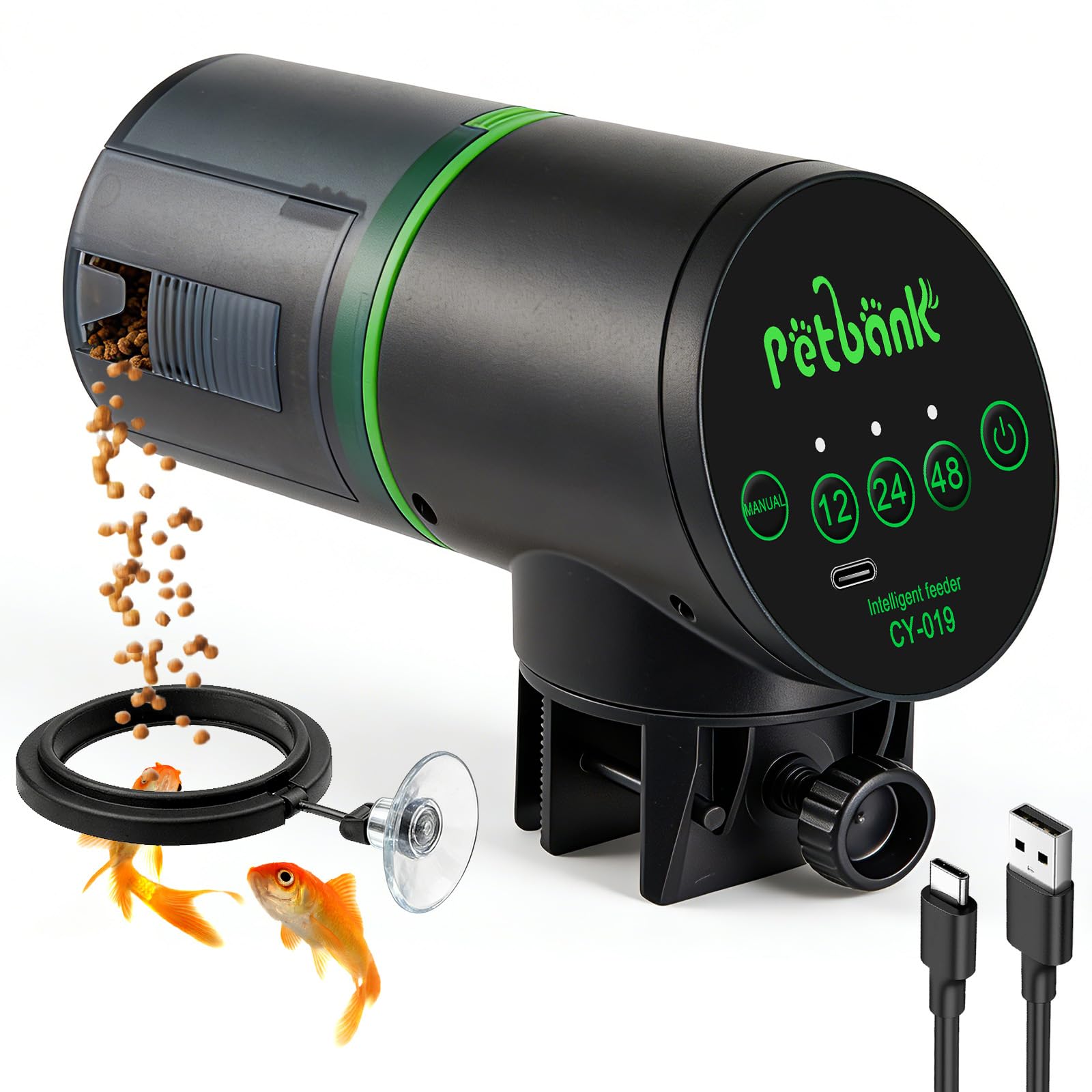
A rechargeable feeder with three simple interval timers and no screen to fuss with.
If you just want a feeder that operates on a fixed repeating schedule without daily programming, this Petbank model is as simple as it gets. It offers three interval modes — 12 hours, 24 hours, or 48 hours — and a manual button for on-demand feeding. That means you do not have to set a clock; just pick the interval and it rotates once per cycle. The USB rechargeable battery is a big convenience: shoppers say it lasting for years, and the manufacturer claims 3-6 months on a single charge.
The 200ml hopper is standard, and the adjustable slider lets you control how much food drops per rotation. It comes with a clip for the tank rim and a sticker for the lid. A reviewer who kept 40+ fish, shrimp, and snails found that the feeder worked well for a large tank but noted that the medium port dumps roughly 25 pieces at a time. That is fine for a community tank but may be too much for a small betta setup.
There is a notable risk: one owner reported that the feeder malfunctioned and dumped all the food at once, killing their fish. The feeder’s port also has a small opening that can jam on 5mm pellets. If you use large pellets, you may need to use tape to modify the opening, as some reviewers did.
Set-and-Nearly-Forget
- USB rechargeable — no battery cost or disposal
- Three interval modes (12/24/48h) are dead simple
- Large capacity battery lasts 3-6 months
Reliability Concern
- One documented case of food dumping all at once
- Small port jams with 5mm pellets
- No LCD or programmable clock — only interval-based
Best for: Owners who want a no-screen, rechargeable feeder for a mixed community tank on a simple schedule.
Think twice if: You have large pellets, a small tank, or need precise 24-hour cycle control — the risk of over-dispensing is real.
6. FISHNOSH Automatic Fish Feeder (Model ML)

A no-screen timer feeder that fits tight tank lids and only needs three buttons to program.
This FISHNOSH (Model ML) keeps things deliberately simple. There is no LCD screen, no complex menu — just a mechanical timer you set by pressing a button to choose between 8, 12, or 24-hour intervals. It holds a 200ml capacity and offers up to 3 feedings per day, with 1 rotation per feeding. The dimensions are compact at 6.13″L x 2.8″W x 4.4″H, and it weighs just 7.23 oz, making it one of the lightest options here.
Mounting is straightforward: clip it to the rim or use the included sticky pad for the lid. One buyer with a 120-gallon tank found that the food capacity was great and the setup was easy. The feeder works with both flakes and pellets, though the manufacturer notes there is no display screen, so you have to track the schedule yourself.
The obvious shortcoming is that humidity gets into the food after a few days. One reviewer who tested it on a longer trip reported: “This works great for a weekend, but longer than that, and the humidity gets to the food.” That means the feeder is ideal for short breaks (2-3 days) but not for long vacations unless you live in a very dry climate. The clip may also have trouble with thick tank rims.
Small and Light
- Compact footprint fits small tanks and tight lids
- Very simple 3-button programming
- Supports multiple food types (flakes, pellets)
Short-Break Only
- Moisture gets into the food after 2-3 days
- No display — you have to remember the schedule
- Clip may not fit thick tank rims snugly
Best for: Weekend trips or daily use in a small tank where simplicity beats feature depth.
skip it if: You need a feeder for a full week away — the humidity problem makes it unreliable for longer absences.
7. TOPBRY Automatic Fish Feeder (Digital)

A digital feeder that lets you dial in four exact feeding times — and charges via USB.
Unlike the interval-based Petbank Rechargeable, this TOPBRY feeder gives you a digital timer where you set the exact time (e.g., 8:00 AM, 12:00 PM, 4:00 PM, 8:00 PM) for up to 4 feedings per day. You can also set 1 to 3 rotations per feeding. The 200ml hopper is top-loaded, which means you add food through the lid without taking the entire bucket off. The 360-degree rotating base lets you angle the feeder exactly where you want over the water.
The USB rechargeable battery is a strong point. One customer observed that after over 4 months of use, the feeder still had plenty of charge left. They solved it by spacing two single-rotation feedings 3 minutes apart. The feeder is also noted as being great for turtle tanks with multiple feedings per day.
The biggest issue is portion consistency. Because the feeder relies on a rotating auger (a screw-like mechanism that pushes food out), the amount dispensed per cycle varies — especially when the hopper is full versus nearly empty. Taping the slider in place after calibration, as some buyers do, helps, but it is not a precision tool. The unit dimensions are not listed, but the weight is 9.6 oz, which is middle-of-the-pack.
Accurate Schedule
- 4 exact feeding times per day — not just intervals
- USB rechargeable battery lasts 3-6 months
- Top-loading hopper makes refilling simple
Portion Variance
- Dispensing amounts vary between rotations
- May need tape or modifications for consistent portions
- No moisture seal — flakes can cake in humid conditions
Best for: Daily use with a rechargeable battery and precise timing — ideal for busy fishkeepers who feed at set hours.
Consider an alternative: If you need very consistent, repeatable portion sizes for a delicate tank or fish species prone to overfeeding.
Understanding the Specs
Capacity (ml or oz)
This tells you how much food the hopper holds. A 200ml feeder is standard and will last a few days for a small tank. A 320ml feeder holds 320ml, while a 200ml feeder holds 200ml. If the feeder uses compartments, count how many — 15 compartments at 2g each means you get about 30g total, which lasts 2-3 days at maximum feeding.
Feeding Schedule Type
There are two main types: interval timers (feed every 12/24/48 hours) and real-time clocks (feed at 8:00 AM, etc.). Interval timers are simpler and cheaper. Real-time clocks offer more precision and help you match the fish’s natural feeding rhythm. Look for models that allow at least 3 feedings per day so you can mimic a natural grazing schedule.
FAQ
Will an automatic fish feeder work for vacation?
Can I use an automatic feeder with flake food?
How long do the batteries last?
What pellet size fits in the feeder?
What does the moisture-proof design actually do?
How do I prevent overfeediing with an automatic feeder?
Will the feeder fit on a rimmed tank?
What is the difference between an interval feeder and a real-time clock feeder?
Can I use an automatic feeder for turtles?
Final Thoughts: The Verdict
If you want one dependable pick, the best automatic feeder for fish is the fishkeeper 320ML because its huge 320ml capacity and effective moisture-proof design tackle the two biggest pain points: running out of food and jamming. If you want dead-accurate portion control for pellets and do not mind refilling more often, the Papettly is a precision pick. And for the best value that still offers four daily feedings, the JuzPetz 200ml delivers a strong balance of features and price.
How We Picked
We do not accept paid placement. Every pick is matched to a real buyer and a real use-case; we do not hands-on test units.
Sources & Methodology
Specifications: manufacturer listings and product documentation. Review insights: verified customer reviews, as of July 2026. Pricing: not shown on this page (it changes often); check the current price via the retailer link.
As an Amazon Associate, Gadgets Feed earns from qualifying purchases. This does not affect which products we feature.
Related Guides
Product prices and availability are accurate as of the date/time indicated and are subject to change. Any price and availability information displayed on Amazon at the time of purchase will apply to the purchase of this product. As an Amazon Associate I earn from qualifying purchases.
CERTAIN CONTENT THAT APPEARS ON THIS SITE COMES FROM AMAZON. THIS CONTENT IS PROVIDED "AS IS" AND IS SUBJECT TO CHANGE OR REMOVAL AT ANY TIME.
Amazon and the Amazon logo are trademarks of Amazon.com, Inc. or its affiliates.