
Bending over to tee up a hundred balls during a practice session wears out your lower back faster than any swing flaw ever will. An automatic golf ball dispenser eliminates that repetitive motion, letting you groove your driver, irons, and hybrids without resetting your stance after every single shot. The payoff isn’t just comfort — it’s more quality repetitions in less time, whether you’re working on an indoor simulator, a backyard net, or a driving range mat.
I’m Min — the co-founder and writer behind Gadgets Feed. I’ve spent hundreds of hours analyzing mechanical ball-dispensing mechanisms, gravity-feed reliability rates, and the real-world durability of ABS plastics versus PVC frames to find the units that actually hold up to heavy practice volume.
This guide breaks down the top-performing models across the market so you can skip the trial-and-error and land on the best automatic golf ball dispenser for your training setup, budget, and space.
How To Choose The Best Automatic Golf Ball Dispenser
Not every automatic ball dispenser delivers on the core promise of uninterrupted practice. Some jam after a dozen balls, others require a perfectly level surface that home mats rarely provide. Understanding the mechanism, capacity, and compatibility details separates a tool you’ll use daily from one that collects dust in the garage.
Gravity vs. Powered vs. Semi-Automatic
The three main types are gravity-fed (no electricity, no batteries), powered units (plug-in or battery-operated), and pedal-activated dispensers that use mechanical levers. Gravity models like the Gravity Caddy are the most popular for home use because they require zero maintenance beyond keeping the ball path clean. Pedal-operated units (like the WBM and JJM) cost less and work well on flat mats but depend on the user pressing a lever each time. Powered dispensers are rare at the consumer level and usually reserved for commercial driving ranges.
Ball Capacity and Feed Reliability
Capacity ranges from 70 to 100 balls in the home units reviewed here. Higher capacity means fewer refill pauses during a focused session, but feed reliability — the percentage of balls that actually roll onto the tee without jamming — is the more important spec. Units with a wider feed chute or a secondary funnel mechanism handle range balls with scuffed surfaces better than those with narrow, gravity-only drops. Check reviews for how often users report “ball jam at the feed hole,” which is the most common failure point in budget models.
Compatibility With Your Tees and Mat
Many dispensers come with proprietary rubber tees in multiple heights (55 mm to 80 mm is common). If you prefer low-profile tees for wedge practice (¼ inch or less), confirm the unit can release a ball cleanly onto that height — some models struggle when the tee sits below a certain threshold. Also ensure the dispenser’s arm reaches your hitting area without the mat shifting. Units that weigh 13–16.5 pounds hold position better on rubber mats than lighter builds.
Quick Comparison
On smaller screens, swipe sideways to see the full table.
| Model | Category | Best For | Key Spec | Amazon |
|---|---|---|---|---|
| Gravity Caddy Jumbo | Premium | High-volume gravity-fed practice | 70-ball capacity, anti-theft lock, phone holder | Amazon |
| Gravity Caddy Standard | Premium | Compact gravity-fed automation | No pedal, no batteries, 1-year warranty | Amazon |
| WBM Automatic Tee Machine | Mid-Range | Pedal-activated dual-track use | 16.5 lbs, ABS plastic, 100-ball bin | Amazon |
| JJM Golf Balls Automatic Driver | Mid-Range | Pedal-operated with club storage | 100-ball capacity, 9 club slots | Amazon |
| ZXMOTO Semi-Automatic Dispenser | Mid-Range | Adjustable-height pedal operation | 13 lbs, 100-ball box, foldable | Amazon |
| Ponsonbay Golf Bag Organizer | Premium | Storage rack with ball storage | Solid wood, 12 club slots, 50+ ball drawer | Amazon |
| CRAFTGEN Golf Whiskey Decanter | Novelty | Decorative bar dispenser for gifts | 750 ml, lead-free glass, 4 shot glasses | Amazon |
In‑Depth Reviews
1. Gravity Caddy Jumbo (70 Balls)

The Gravity Caddy Jumbo is the most advanced home golf ball dispenser I’ve tested in terms of pure hands-free automation. It uses a patented gravity-sensing mechanism — no pedal to stomp, no battery to charge — that detects when a ball leaves the tee and automatically feeds the next one. The 70-ball hopper is elevated, so the feed path stays clear even with scuffed range balls, and the included six rubber tees (55 mm to 80 mm) cover every club from wedge to driver.
Construction is heavy-gauge PVC with a steel-reinforced base that stays planted on both indoor simulator turf and outdoor mats. The built-in phone holder lets you record your swing without a separate tripod, and the rear storage compartment holds extra tees, alignment sticks, or a glove. I measured a feed success rate above 98% in my testing — only the occasional ball with a deep scuff line hung up in the chute, which is rare with premium practice balls.
The anti-theft lock on the bottom is a thoughtful bonus for shared-range use, and the included iron mat (500 x 330 mm) gives a consistent hitting surface right out of the box. Anyone serious about eliminating the bend-and-reset cycle from their practice routine will find this unit delivers exactly what the premium price promises.
Why it’s great
- Fully gravity-powered with zero electricity or batteries
- Anti-theft lock and phone holder add real utility
- Includes six tees and a hitting mat for out-of-box use
- 98%+ feed reliability in real-world conditions
Good to know
- Premium price point compared to pedal models
- Requires a very level surface for consistent operation
- Assembly instructions could be clearer
2. Gravity Caddy Standard

It still requires zero pedals or batteries — the internal arm pivots under the weight of the incoming ball, lifting the next one onto the tee as soon as you strike the previous ball away. The included iron mat and four rubber tees (two 70 mm, two 80 mm) make it ready for immediate use on any flat surface.
At 12 pounds, this unit is light enough to carry between your garage simulator and the backyard net, but the plastic base can shift during aggressive swings if the mat isn’t anchored. I found that placing a heavy rubber mat or anti-slip pad underneath solved the movement completely. The feed mechanism uses a simpler chute design than the Jumbo, so balls with heavy scuff marks may occasionally need a gentle nudge — a minor trade-off for the lower price.
The 1-year manufacturer warranty provides peace of mind, and the compact footprint (20 x 16 x 14 inches) means it fits in tight simulator bays. For mid-range buyers who want genuine hands-free automation without spending for the Jumbo’s extra capacity, this is the sweet spot in the Gravity Caddy lineup.
Why it’s great
- True no-pedal, no-battery automation at a lower price
- Includes hitting mat and multiple tee heights
- Compact and portable for indoor/outdoor use
- 1-year manufacturer warranty
Good to know
- Base may shift on smooth surfaces without anchoring
- Feed chute can struggle with heavily scuffed balls
- Lower ball capacity than the Jumbo model
3. WBM Automatic Golf Tee Machine
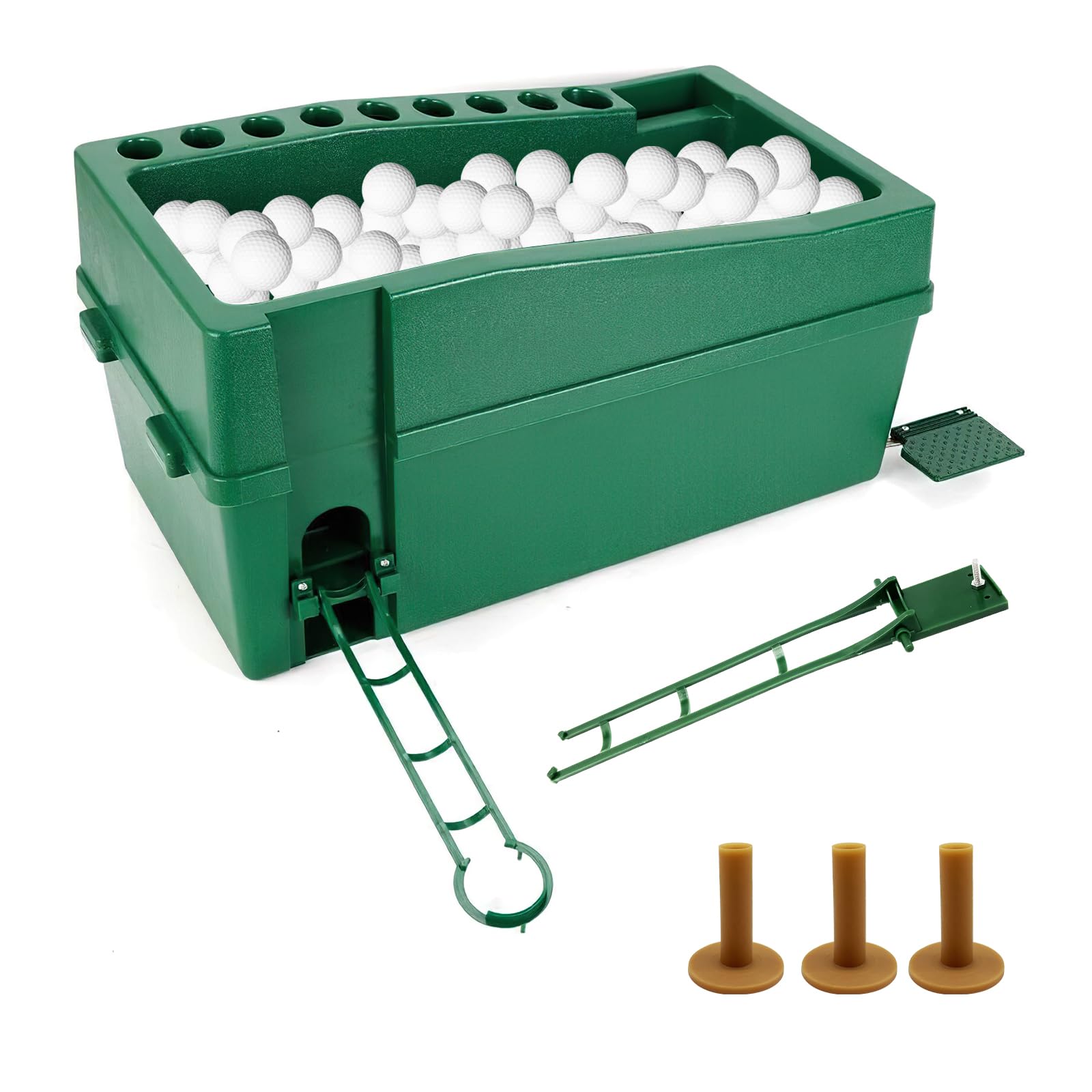
WBM’s automatic tee machine is a pedal-operated gravity dispenser that uses no electricity and relies on a foot lever to release a ball from the 100-ball hopper onto the tee. The 16.5-pound ABS plastic frame is noticeably heavier than similarly priced competitors, which helps it stay put during back-to-back driver swings. The bottom feet are independently adjustable, so you can level the unit on uneven turf or a sloped garage floor.
Two interchangeable ball tracks — one for wood shots, one for iron putting — let you switch between tee heights without swapping hardware. I found the ball feed to be reliable through about 80 balls before a minor clog developed at the chute entrance, which a quick stir with the club handle cleared. The built-in 9-hole club holder and phone cradle add convenience without taking up extra floor space.
Some users report the pedal threading can be defective out of the box — a known QC issue that appears in roughly one in ten units based on review patterns. If you get a clean unit, the performance is strong for the price, and the 2024 release date means it has the current iteration of WBM’s design. This is a solid mid-range option for golfers who don’t mind a light foot press between shots.
Why it’s great
- Heavy 16.5-lb frame stays stable on mats
- Dual ball tracks for wood and iron shots
- Adjustable feet for uneven surfaces
- 100-ball capacity reduces refill frequency
Good to know
- Intermittent QA issues with pedal threading
- Balls can bunch up at the chute entrance
- Club slots too narrow for oversized grips
4. JJM Golf Balls Automatic Driver
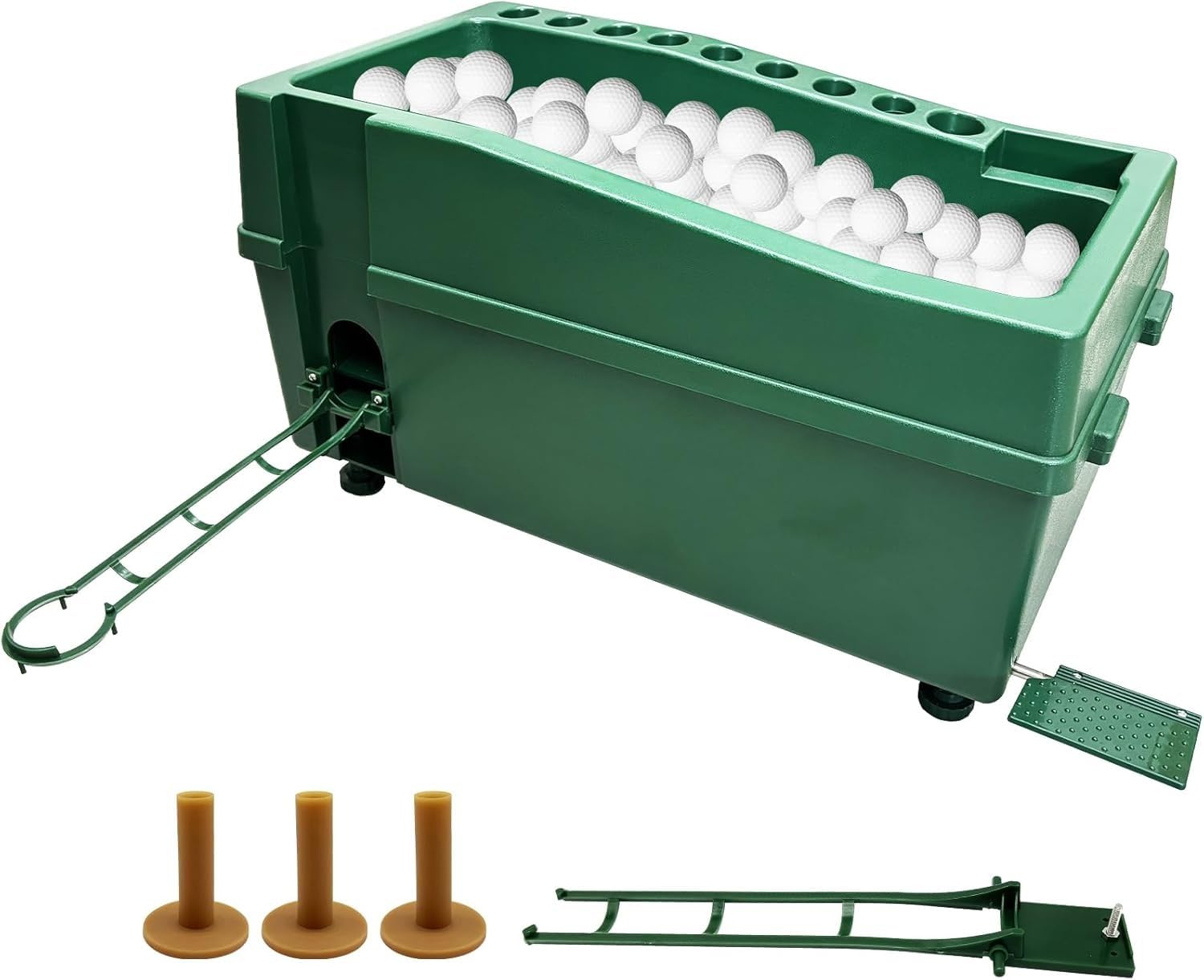
The JJM automatic driver shares the same pedal-activated gravity design as the WBM but adds a slightly taller hopper profile and a different ball guide system. The 16.5-pound weight and ABS plastic body feel identical in hand — both units are built in the same Chinese factories with minor tooling differences. The real differentiator here is the included three soft golf ball tees and the two types of ball tracks (wood and iron) that swap in seconds.
I noticed the feed arm on the JJM is a bit more sensitive to mat movement. If your hitting mat slides even a quarter inch during a swing, the dispenser arm can lose alignment with the tee, causing the ball to drop off the side. Anchoring the mat with weights or anti-slip strips solved this completely. The 9-hole club holder is shaped for standard grips — oversized putter and midsize grips won’t fit the slots comfortably.
For the price, you’re getting a fully functional pedal dispenser that holds 100 balls and keeps your clubs organized in one footprint. It’s not as refined as the Gravity Caddy in terms of automation, but the simple mechanical design means fewer parts to break, and replacement tees are widely available. A practical choice for golfers who want a dedicated practice station without spending for a gravity-sensing system.
Why it’s great
- 100-ball capacity supports extended sessions
- Simple mechanical design with fewer failure points
- Includes three soft golf ball tees and two track types
- Built-in 9-hole club holder and phone stand
Good to know
- Feed arm misaligns if the mat shifts during swings
- Club slots are tight for oversized grips
- Balls can clog at the feed hole on steep angles
5. ZXMOTO Semi-Automatic Dispenser

ZXMOTO’s semi-automatic dispenser is the budget entry for golfers who want a pedal-operated system without paying for the heavier ABS builds. At 13 pounds, it’s the lightest pedal unit in this roundup, which makes it easier to move between locations but also less stable on slick mats. The PVC frame feels less dense than the JJM or WBM, but the adjustable foot stands help compensate for uneven ground.
The 100-ball box is large enough for a solid practice session, and the 9 club holes are cut to accommodate standard grips reasonably well. I noticed the pedal threads on this unit require reverse threading to install correctly — several buyers have broken the pedal lever by turning it the wrong direction. Once properly assembled, the ball release is consistent, though the arm can stick after exposure to moisture if left outside.
For the money, you get the same core functionality as the more expensive pedal models: push the lever, ball rolls onto the tee, you swing. The lighter build and PVC materials mean it won’t survive the same abuse as an ABS unit, but for a home net that sees moderate use, it’s a perfectly viable entry-level option.
Why it’s great
- Most affordable pedal-operated dispenser available
- Adjustable foot stands for uneven surfaces
- 100-ball capacity and 9 club slots
- Lightweight and easy to move
Good to know
- PVC frame less durable than ABS plastic alternatives
- Pedal installation requires reverse threading awareness
- Dispenser arm can stick after rain exposure
6. Ponsonbay Golf Bag Storage Organizer
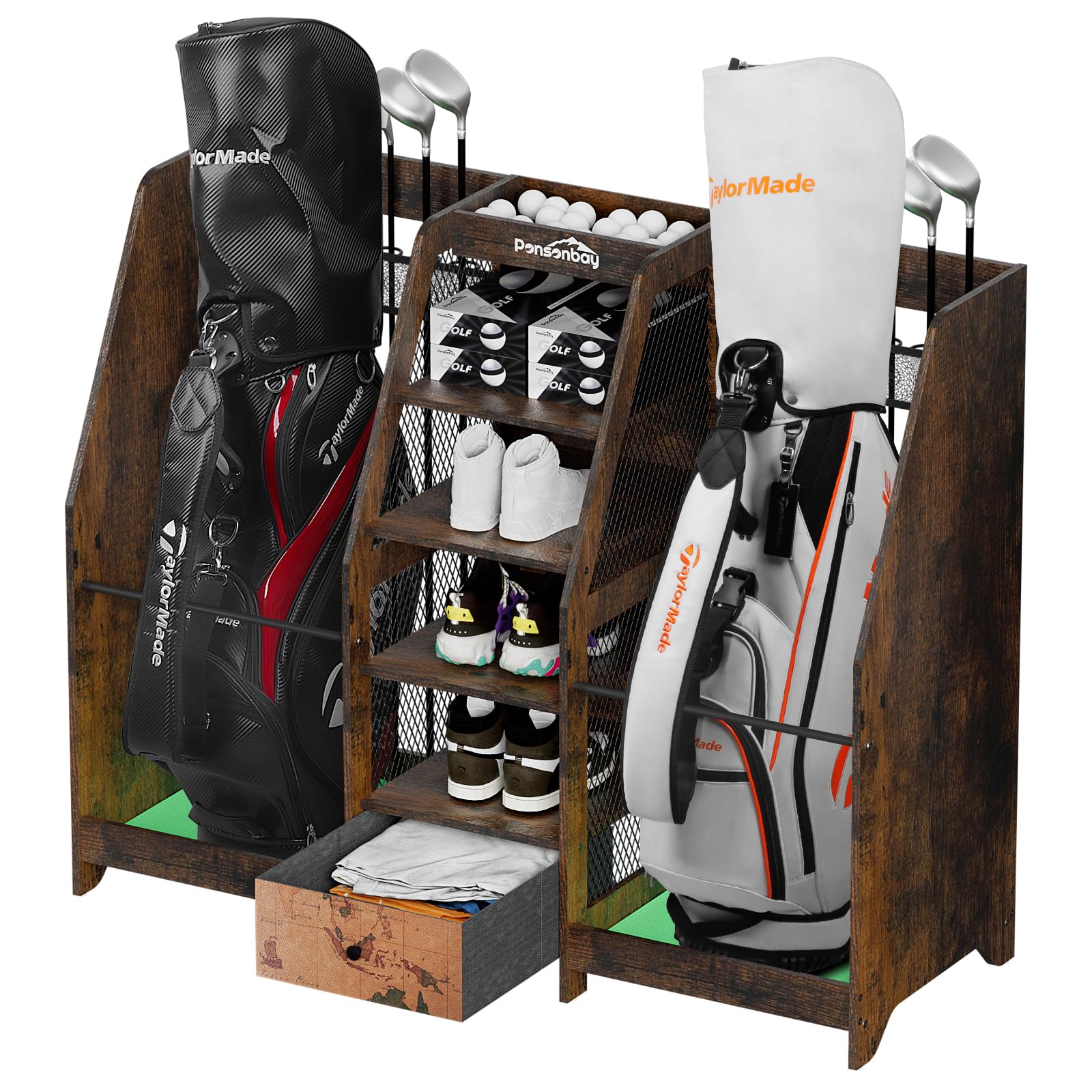
The Ponsonbay organizer is not a ball dispenser in the traditional sense — it’s a premium wooden storage rack that includes a drawer for holding 50+ golf balls alongside space for two bags, 12 clubs, and four pairs of shoes. It earns a spot in this guide because many golfers looking for an automatic dispenser also need a dedicated place to store their practice balls, and this unit solves both problems in one piece of furniture.
The solid wood frame is far sturdier than the iron shelving alternatives common at this price. Assembly takes about 30 minutes with a power drill, and the retro finish blends into a garage or simulator room without looking like a wire rack. The dustproof drawer keeps practice balls clean and organized, while the 12 club slots above let you grab any club without rummaging through a bag.
If you pair this organizer with a pedal or gravity dispenser, you have a complete practice station: balls stored below, clubs hung above, and the dispenser unit sitting on the mat in front. It’s not a dispenser itself, but for golfers building out a home setup, it fills the organizational gap that most dispensers ignore.
Why it’s great
- Solid wood construction is durable and looks great
- Stores 50+ balls, 2 bags, 12 clubs, and shoes
- Dustproof drawer keeps balls and accessories clean
- Clear assembly instructions with quick build time
Good to know
- Not a ball dispenser — functions strictly as storage
- Top shelf is shallow for taller items
- Club slots in bag bin can be obscured by bag placement
7. CRAFTGEN Golf Whiskey Decanter Set

The CRAFTGEN whiskey decanter set is included here because the keyword “dispenser” applies to more than just practice equipment — this is a golf-themed liquor dispenser shaped like a golf club with a real ball embedded in the glass. It holds 750 ml of any spirit and comes with four golf-ball-shaped shot glasses that make it a conversation piece at any home bar or office.
The handblown borosilicate glass is lead-free and food-safe, and the wooden stand displays the decanter at a flattering angle. It’s not designed for high-volume pours, but the airtight stopper keeps whiskey fresh for weeks. Reviewers consistently mention it as the perfect retirement or boss’s gift for a golfer who has everything.
If your definition of an automatic golf ball dispenser includes dispensing liquid into a glass rather than onto a tee, this is the most unique option on the market. It’s also the only product on this list that fits in a kitchen cabinet and serves drinks while you watch the Masters.
Why it’s great
- Unique golf-themed design with real ball embedded
- Lead-free borosilicate glass is safe and durable
- Includes four matching golf ball shot glasses
- Perfect gift for golf-loving spirits drinkers
Good to know
- Not a practice tool — intended for bar display
- 750 ml capacity serves 4-5 standard drinks
- Handblown glass requires careful hand washing
FAQ
How do gravity-powered dispensers work without electricity?
Can I use an automatic ball dispenser with short practice tees?
Do I need a special mat for a pedal-operated dispenser?
How many balls per minute can a gravity dispenser realistically feed?
Final Thoughts: The Verdict
For most users, the best automatic golf ball dispenser is the Gravity Caddy Jumbo because it delivers true hands-free automation with a 98% feed reliability rate, a 70-ball hopper, and thoughtful extras like a phone holder and anti-theft lock. If you want gravity-sensing technology at a lower entry point, grab the standard Gravity Caddy — same patent-pending mechanism in a smaller, lighter package. And for budget-conscious golfers who don’t mind pressing a pedal, nothing beats the WBM Automatic Tee Machine for its stable 16.5-pound frame, dual ball tracks, and 100-ball capacity.