
Our readers keep the lights on and my morning glass full of iced black tea. As an Amazon Associate, I earn from qualifying purchases.
Specs are compiled from manufacturer listings and verified buyer reviews and can change over time — please confirm the key details on the product page before buying.
You want a lamp timer that saves you from walking into a dark house or leaving Christmas lights on all night. But a noisy dial that clicks every 30 minutes or a digital screen that needs a manual to decode can make a simple task feel like a chore. These five automatic lamp timers each solve that problem differently, so you can pick the one that fits your daily routine without the guesswork.
I’m Min — the founder and writer behind Gadgets Feed. This guide is built by comparing the manufacturers’ published specifications and the patterns across verified customer reviews, so you get each pick’s real strengths and trade-offs instead of marketing spin.
Below you will find straightforward reviews of five automatic lamp timers that handle everything from basic 24-hour cycles to complex 7-day programs, all chosen to match real home needs without the hype. This is your no-nonsense look at the best automatic lamp timer options available today.
Quick Picks
- Intermatic DT620 Heavy Duty Indoor Digital Plug-in Timer — Best Overall
- GE 7-Day Programmable Indoor Digital Timer (15150) — Weekly Pro
- DEWENWILS 24 Hour Programmable Digital Timer Outlet, 2 Pack — Compact Duo
- HBN 7 Day Heavy Duty Digital Timer, Dual Outlet — Budget Champion
- GE 24‑Hour Mechanical Outlet Timer Switch, Dual Grounded Plug‑in Control (4 Pack) — Simple & Reliable
How To Choose The Best Automatic Lamp Timer
The right timer depends on how often your schedule changes and whether you mind a mechanical hum in a quiet room. The simplest models run on a 24-hour cycle with pushpins, while digital options let you set different times for each day of the week.
Mechanical vs. Digital
A mechanical timer uses a small motor that turns a dial. You push pins in or out to set 30-minute intervals when you want the lamp on. No batteries, no menus, just a steady hum. Digital timers use a microprocessor and a screen, letting you set multiple on/off events per day. Digital models are quieter but require some button-pressing to program.
Number of Programs (Settings)
Every on/off pair counts as one “setting.” A basic lamp on a fixed bedtime schedule only needs 1 or 2 settings per day. Weekly timers can store 8, 16, or even 28 settings, which lets you program a different schedule for Monday morning and Saturday night without starting over.
Battery Backup
If the power flickers for a split second, a timer without battery backup resets to 12:00 and stops working until you reprogram it. Look for a built-in battery if you rely on the timer while traveling or if your area has frequent storms.
Quick Comparison
On smaller screens, swipe sideways to see the full table.
| Model | Best For | Number of Settings | Unit Count | Dimensions (D x W x H) | Amazon |
|---|---|---|---|---|---|
| Intermatic DT620 | Most Scheduling Flexibility | 28 | 1 | 4″ x 4″ x 3″ | $55.52Amazon |
| GE 7-Day Programmable | Weekly Variety | 16 | 1 | 3″ x 5″ x 6″ | $22.31Amazon |
| DEWENWILS 2-Pack | Two Outlets, One Box | 8 | 2 | 3.5″ x 1″ x 3.5″ | $21.99$24.22Amazon |
| HBN Digital Timer | Budget Dual Outlet | 8 | 1 | 3.3″ x 3.3″ x 1.7″ | Amazon |
| GE Mechanical 4-Pack | Simple Daily Schedule | 1 | 4 | 3.26″ x 6.88″ x 3.81″ | $27.99Amazon |
In‑Depth Reviews
1. Intermatic DT620 Heavy Duty Indoor Digital Plug-in Timer

The timer that keeps your schedule saved even when the power goes out — and gives you 28 settings to tweak every day of the week.
You get up to 28 on/off settings, which is 28.0x more than a basic mechanical unit that only manages one cycle. That means you can program the lamp to turn on at 6 PM Monday, 8 PM Saturday, and again at 7 AM for a morning routine — all on the same device. The dual grounded outlets let you control two lamps or appliances at once. The built-in battery backup (a replaceable hearing-aid battery, buyers report) keeps everything saved if the power blinks. Owners mention that the “battery backup retains settings for 3 months,” so you do not need to reprogram after a short blackout.
A few owners note the lack of a backlight on the screen, so you need a nearby lamp to read the display at night. The programming requires a careful read of the manual, but reviewers who stuck with it describe the timer as still “functional after 11+ years,” which suggests real longevity. This is a better choice than the GE 7-Day below if you need more than 16 settings or want two outlets.
what separates it
- 28 settings allow dusk-to-dawn and sunrise/sunset triggers
- Two grounded outlets for lamps, fans, or small appliances
- Internal battery holds settings during power outages
- Handles 15A resistive loads and 1/2 HP motors
The Trade-Offs
- Screen has no backlight for dark rooms
- Programming is complex and rewards patience
- Requires hearing-aid batteries for the backup (3-month life)
Reach for this if: you want the most scheduling flexibility available in a plug-in timer, including sunrise/sunset and weekly variety.
Look elsewhere if: you prefer a fast, no-manual setup and do not need more than a simple daily repeat.
2. GE 7-Day Programmable Indoor Digital Timer (15150)

A weekly timer that gives you 16 on/off settings per day — enough for weekday mornings that differ from lazy weekends — without the programming headache of the Intermatic above.
This GE timer stores up to 16 on/off settings per day, giving you more flexibility than most basic digital timers while staying simpler to operate than the Intermatic DT620. It cycles on a full 7-day pattern, so you can program a 7:00 AM lamp for workdays and a 9:00 AM schedule for Saturdays without resetting anything. Customers note that it is “easy to program with 20 on/off weekly schedules, accurate, DST button works well,” meaning daylight saving time adjustments happen at the push of a button rather than a full reprogram. The timer is also rated for 15A general purpose and 10A tungsten, covering most household lamps and small fans.
Reviewers point out that the instructions are incomplete — the manual skips details on the DST and Random buttons — but once set, the timer runs quietly and accurately. One owner mentioned replacing old analog timers “with the noisy dial” and found this GE model a welcome upgrade. The single outlet limits you to one device, so if you need dual control, the Intermatic or HBN options offer more ports.
Bottom Line: A solid weekly digital timer with enough settings for real daily variety, held back only by its single outlet and sparse instructions.
Best for you if: you need different schedules for different days and prefer a proven brand that shoppers say lasts many years.
skip it if: you want to control two devices at once or need a timer with a well-written manual included.
3. DEWENWILS 24 Hour Programmable Digital Timer Outlet, 2 Pack
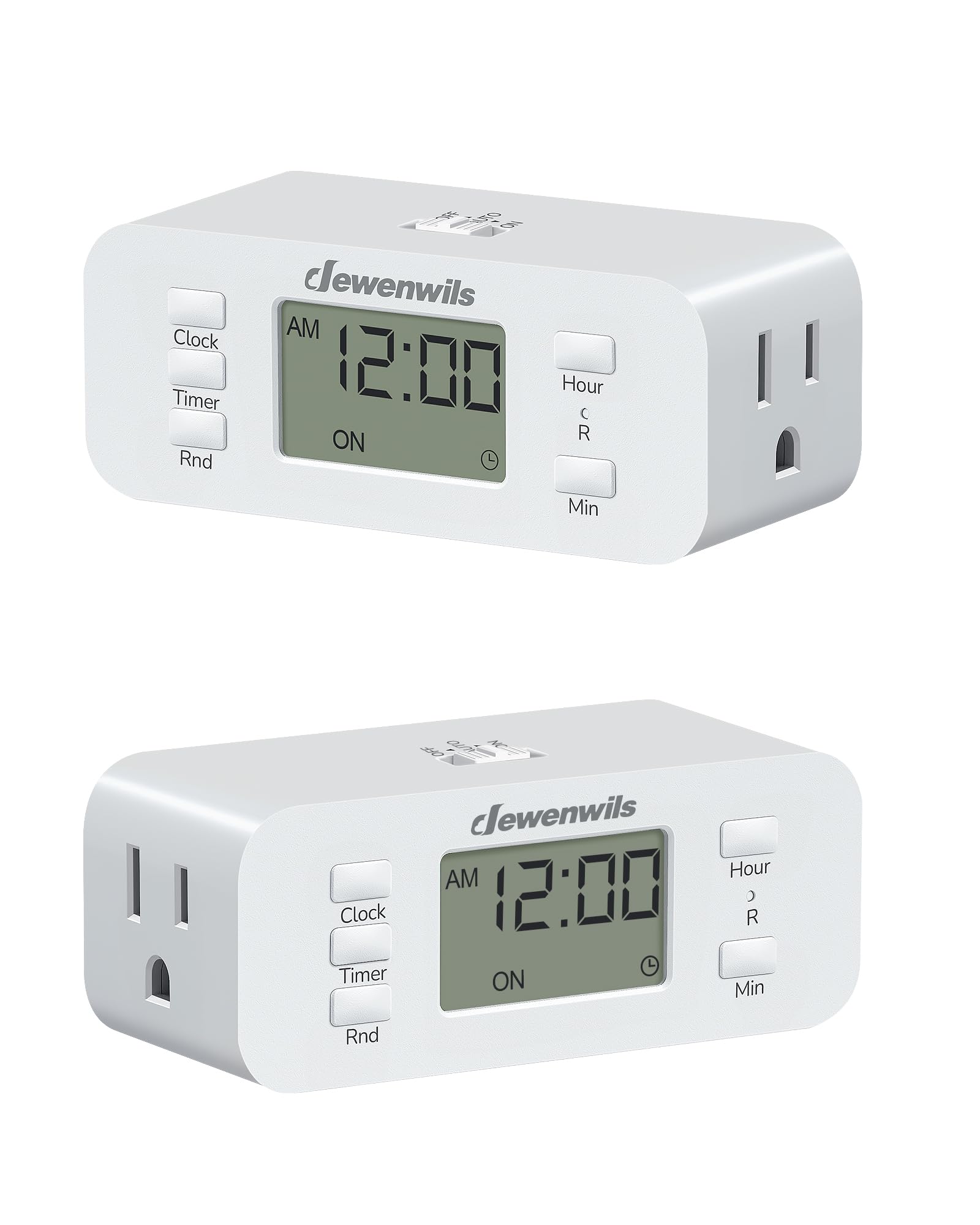
Two silent timers that each leave your second wall outlet free — and keep their settings for up to six months after a blackout.
You get two timers in the box, so you can automate a lamp in the living room and a fan in the bedroom at once. Each timer measures just 3.5″D x 1″W x 3.5″H, a slim profile that buyers report is “compact, leaves one outlet open,” so you can still plug in a phone charger next to it. The built-in Ni-MH battery stores your settings for up to 6 months during a power outage, which beats the 3-month battery backup on the Intermatic above and the no-backup on the GE Mechanical below.
Owners mention these timers are “very easy, very reliable, very accurate” and that they operate “more quietly than traditional mechanical timers,” making them a good fit for a bedroom where a humming dial would be distracting. The trade-off is the 3-program limit per day — several reviewers wished for 6 settings instead of 3. For most lamp schedules (on at dusk, off at bedtime), three settings are plenty, but a complex aquarium or grow-light cycle might require more events. The 8 total settings in memory are spread across the two outlets per unit, so plan your daily events accordingly.
Why It Stands Out
- Two timers in one box cover multiple rooms at once
- Ultra-slim body does not block the second wall outlet
- Battery backup preserves settings for up to 6 months
- Silent operation suits bedrooms and offices
One Limitation
- Only 3 programmable on/off events per day
- Daily repeat pattern, not customizable per weekday
Reach for this if: you need two reliable, nearly silent timers that keep their memory for months and fit into tight outlet spaces.
Look elsewhere if: you need more than 3 schedule changes per day or want different weekend vs. weekday timing without manual adjustment.
4. HBN 7 Day Heavy Duty Digital Timer, Dual Outlet

A dual-outlet digital timer with a random vacation mode for security — without the steep learning curve of the Intermatic or the single-outlet limit of the GE 7-Day.
For the price of a single-outlet timer from some brands, this HBN unit gives you two grounded outlets and a full 7-day programming capability with 8 on/off settings. That 8-setting count matches the DEWENWILS, but the HBN lets you assign different days to each program, so you can set the lamp to come on weekdays at 6:30 PM and weekends at 8:00 PM. It also has a Random Vacation Mode that varies your programmed lights to make the home look lived-in while you are away.
Customers note that “programming less confusing than most Chinese electronics” and that the “battery backup works for 4+ hour power failures,” which is enough coverage for most short outages. Some reviewers found the manual override logic a bit puzzling at first — the unit has a small learning curve around the Auto/On toggle — but once set, it runs reliably. One long-term owner noted that one of the two outlets stopped working after about a year, but still chose to repurchase the same model due to its overall dependability. With a 15A/1875W resistive rating, it handles most lamps, fans, and small kitchen appliances.
The Real Value: The HBN delivers weekly programming and dual outlets at a budget-friendly price, making it a strong candidate for first-time timer buyers who want features without the premium markup.
Reach for this if: you want 7-day scheduling and dual outlets on a budget, and you are comfortable with a short setup learning curve.
pass on it if: you need more than 8 total programs across the week or want a timer with zero programming confusion from the start.
5. GE 24‑Hour Mechanical Outlet Timer Switch, Dual Grounded Plug‑in Control (4 Pack)

Four timers that take under two minutes to set — just push pins in or out — and run for years on zero batteries.
Sometimes the simplest tool is the right one. This GE mechanical timer uses pushpins spaced at 30-minute intervals around a rotating dial. You pull up the pins for the hours you want the lamp off and push them down for the hours you want it on. No apps, no menus, no battery to replace. The 4-pack covers multiple rooms at once, and each unit includes two grounded outlets, so you could plug a lamp and a small fan into the same timer. Reviewers point out that the “GE mechanical timer 4-pack: reliable, no batteries, <2 min setup,” and one owner mentioned their previous model lasted 20 years before being replaced.
There is a clear trade-off here. The timer has only 1 setting — the same on/off pattern repeats every 24 hours. If your schedule changes between weekday and weekend, you will need to adjust the pins manually. The unit count is 4.0 Count, a 4.0x gap compared to a single-unit timer like the HBN, so you have enough for every lamp in the house. A few shoppers say the mechanical hum is noticeable in a quiet bedroom, so this pick works best in living rooms, basements, or garages where the gentle clicking blends into background noise.
What Makes It a Classic
- 4 timers in one box for whole-house coverage
- 30-minute pushpin scheduling with zero programming
- No batteries needed — runs on a small motor
- Dual outlets per timer control two devices each
What It Lacks
- Single 24-hour cycle repeats every day the same way
- Audible hum that some find distracting at night
- No battery backup if the power goes out
Reach for this if: you need a low-cost, no-fuss way to control multiple lamps on a fixed daily schedule, like Christmas lights or a morning routine.
it’s not for you if: you need different weekend and weekday timing, or you want a silent timer for a bedside or office lamp.
Understanding the Specs
Number of Settings (Programs)
Each “setting” refers to one on/off action. A timer with 1 setting runs the same schedule every 24 hours. Models with 8, 16, or 28 settings let you stack multiple schedules — for example, turning a lamp on at 6 PM, off at 11 PM, then on again at 7 AM. Weekly timers use these settings to assign different schedules to different days, so you are not stuck with the same pattern for every day of the week.
Battery Backup
A battery inside the timer keeps your program saved when the power cuts out. Without it, the timer resets to 12:00 and stops working until you reprogram it. Some models use a rechargeable Ni-MH cell that lasts through short outages, while others use replaceable button-cell batteries that may need changing every few months. If you travel or live in an area with storms, battery backup prevents a dark house when you return.
FAQ
Will a lamp timer work with LED bulbs?
Can I use these timers outdoors?
How long does the battery backup last during a power outage?
What is the difference between a 24-hour timer and a 7-day timer?
Can I control two different lamps with one timer?
Are mechanical timers loud?
How hard is it to program a digital lamp timer?
Can I use a lamp timer for a space heater or air conditioner?
Do I need Wi-Fi or Bluetooth to use these timers?
Final Thoughts: The Verdict
For the majority of shoppers, the best automatic lamp timer winner is the Intermatic DT620 because its 28 settings, dual outlets, and reliable battery backup cover the widest range of real-world schedules. If you want a straightforward weekly timer that is easier to program than the Intermatic, grab the GE 7-Day Programmable. And for a simple, no-battery approach that can automate multiple rooms in minutes, the GE Mechanical 4-Pack is the pick for a fixed daily schedule.
How We Picked
We do not accept paid placement, and we did not hands-on test every unit. Instead, we match each pick to a real buyer and use-case by comparing the manufacturers’ published specifications against the patterns in verified customer reviews — so you get each pick’s real strengths and trade-offs instead of marketing copy.
Sources & Methodology
Specifications: manufacturer listings and product documentation. Review insights: verified customer reviews, as of July 2026. Pricing: not shown on this page (it changes often); check the current price via the retailer link.
As an Amazon Associate, Gadgets Feed earns from qualifying purchases. This does not affect which products we feature.
Product prices and availability are accurate as of the date/time indicated and are subject to change. Any price and availability information displayed on Amazon at the time of purchase will apply to the purchase of this product. As an Amazon Associate I earn from qualifying purchases.
CERTAIN CONTENT THAT APPEARS ON THIS SITE COMES FROM AMAZON. THIS CONTENT IS PROVIDED "AS IS" AND IS SUBJECT TO CHANGE OR REMOVAL AT ANY TIME.
Amazon and the Amazon logo are trademarks of Amazon.com, Inc. or its affiliates.