
Our readers keep the lights on and my morning glass full of iced black tea. As an Amazon Associate, I earn from qualifying purchases.
Specs are compiled from manufacturer listings and verified buyer reviews and can change over time — please confirm the key details on the product page before buying.
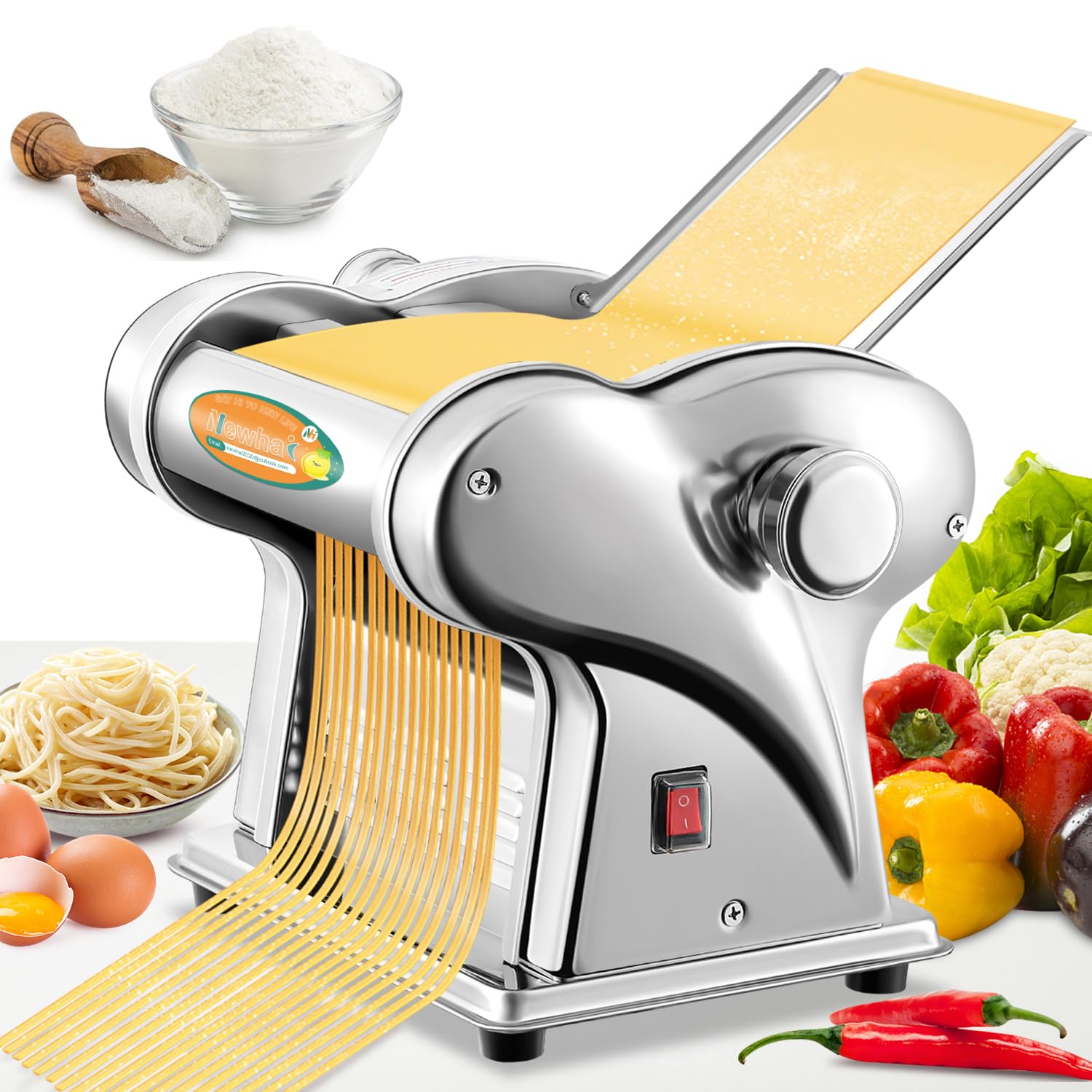
If you want fresh noodles at home without kneading by hand for an hour, the machine that earns its countertop space is the Newhai Electric Pasta Maker — a 135W steel roller that presses dough and cuts noodles in one pass. The real question most buyers get wrong is blades versus discs. Roller-and-cutter machines press a flat sheet and slice it, so noodles come out firm and hold their shape. Extruders push dough through shaped dies, which gives you more shapes but softer texture. Knowing which one you actually want settles almost every decision here.
I’m Min — the founder and writer behind Gadgets Feed. This guide is built by comparing the manufacturers’ published specifications and the patterns across verified customer reviews, so you get each pick’s real strengths and trade-offs instead of marketing spin.
Water ratio and dough feel decide your results long before the motor does, and every machine here has its own rhythm to learn. This guide breaks down the nine strongest contenders, from compact countertop rollers to commercial-grade sheeters, so you can find the right best automatic noodle machine for the way your kitchen actually works.
Our Picks at a Glance

How To Choose The Best Automatic Noodle Machine
An automatic noodle machine takes over the two jobs your arms hate most — working the dough and cutting it into strands. There are two distinct types, and picking the wrong one is the most common complaint in the category. Here’s how to sort it out.
Roller-and-Cutter vs Extruder: Pick Your Texture First
A roller-and-cutter machine presses dough into a flat sheet between steel rollers, then slices the sheet into noodles with a blade. Aluminum or steel rollers, adjustable thickness dials, and replaceable cutters are the hallmark of this design. Extruder machines push dough through shaped discs (dies), which lets you make hollow shapes like rigatoni and macaroni but produces a softer, chewier bite. Roller-style noodles hold their texture better in sauce; extruded noodles absorb more. Neither is wrong — just know which eating experience you’re aiming for.
Motor Wattage: What Actually Matters
A 135W motor handles a typical family batch of noodles without strain. The 550W to 700W motors in this list handle stiffer, lower-hydration dough and bigger batches without slowing down. Wattage is a ceiling, not a promise — the machine’s gearing and cooling design determine how long it can run before it needs rest. A 15-minute batch with a 5-minute cool-down is the habit that keeps smaller motors alive.
Water-to-Flour Ratio: The Real Variable
Every “it doesn’t work” review in this category traces back to dough that’s too wet or too dry. Wet dough gums up the rollers and sticks to the fins; dry dough crumbles and won’t extrude. The right target for most of these machines is 500 grams of flour to about 6.1 oz of liquid, giving you a crumbly, pebbly texture that presses into a smooth sheet. Weigh your flour on a scale — the scoops and cups included with these machines vary widely.
Quick Comparison
| Model | Best For | Power | Pasta Shapes | Weight | Amazon |
|---|---|---|---|---|---|
| Newhai Electric Pasta Maker★ Best Overall | Everyday stainless countertop rolling | 135W | 2 (1.5mm, 4mm) | 16 lb | Amazon |
| VEVOR Electric Pasta MakerBest Beginner Pick | Beginners who want one-button simplicity | 150W | 8 (extruder dies) | 11 lb | Amazon |
| GVODE Electric Pasta MakerBest for Small Kitchens | Small kitchens and quick single batches | 700W | 3-in-1 roller set | 5.2 lb | Amazon |
| Zuguachi 260W Automatic Pasta Maker | Cordless portability and sausage making | 260W | 13 (extruder dies) | 2 lb | Amazon |
| WICHEMI Electric Pasta Maker | Family batches with three noodle widths | 135W | 3 (2.5mm, 4mm, 9mm) | 17.6 lb | Amazon |
| Luzrise Electric Pasta Maker | Long sessions and thicker dough sheets | 135W | 4 (1.5mm, 2.5mm, 4mm, 9mm) | — | Amazon |
| LEONEBEBE Commercial Noodle Machine | High-volume home and small restaurant use | 550W | 2 widths (3mm, 9mm) | 44 lb | Amazon |
| XINGYUEXUAN Electric Pasta Machine | Continuous operation in restaurant kitchens | 550W | 2 widths (2mm, 6mm) | 42.3 lb | Amazon |
| Philips 7000 Series Pasta Maker | Hands-off pasta with app-guided recipes | 150W | 8 (extruder dies) | 20 lb | Amazon |
In‑Depth Reviews
1. Newhai Electric Pasta Maker, Stainless Steel 135W
Our pick — over 4★ from 100+ verified ratings; the strongest balance of quality and price.
A 135W stainless roller that presses and cuts 11lb of noodles an hour
The Newhai does exactly one thing extremely well: press dough into a flat sheet and run it through two cutters — a 1.5mm thin round noodle and a 4mm flat noodle. It’s a family machine built for daily countertop use, not a commercial kitchen. At just 135W, it chugs along without straining. The 17.6lb weight and low noise mean it stays put on the counter and won’t wake the house during an early batch.
The dough thickness dial runs from gear 1 through 8, covering 0.5mm to 3mm. Newhai’s manual recommends you stay below gear 5 for cutting noodles, because above gear 6 the sheet gets too thin and won’t slice cleanly — that upper range is for dumpling and wonton wrappers instead. Sticking to gear 3 or 4 for fettuccine is the move. The whole process switches from pressing to cutting with one key turn.
Its 135W motor is modest next to the GVODE’s 700W, but it still turns out 11lb/h. It weighs 16 pounds against the VEVOR’s 11 — noticeably heavier on the counter, but the mass is exactly why it stays steady under a full batch. The stainless body, roller, and blade mean nothing is going to rust on you. Buyers report making 50 pounds of noodles in two days without a mechanical hiccup, and the recurring praise in the review pages is performance — the machine simply keeps producing consistent, cuttable sheets.
Where it earns its keep
- 430 stainless steel body, roller, and blade — food-grade and rust-resistant
- 11lb/h throughput from a quiet 135W motor
- 8 thickness gears for dough sheets from 0.5mm to 3mm
- One-key switch between dough pressing and noodle cutting
- Rounded corners won’t scratch your fingertips
Worth knowing before you buy
- Cleanup demands dedication — flour residue needs a brush or air to clear, and water is off-limits because of the gearbox
- Two noodle sizes only — 1.5mm and 4mm. No fettuccine-wide or lasagna-width cutter in the box
- Hand-rolling the dough first takes practice before the machine takes over
Buy this if: Anyone making noodles two or three times a week for a family who wants a firm, roller-cut bite rather than a soft extruded one.
Steer clear if: You want a dozen pasta shapes from one machine — the two blades here keep things deliberately simple.
2. VEVOR Electric Pasta Maker, 150W, 8 Pasta Shapes
One click, four modes, eight shapes — the easiest on-ramp in the group
If your experience with dough begins and ends with “add liquid and hope,” the VEVOR is where you start. It runs on four automatic modes that handle the mixing and extrusion for you, and it includes recipe cards with the flour and water ratios spelled out. The 500g flour hopper makes enough noodles for about four people in 14 minutes, and the eight interchangeable discs cover everything from thin spaghetti through wider shapes. A two-way kneading rod and four-dimensional mixing give the dough a texture closer to hand-kneaded than you’d expect from a one-button machine.
The 8-disc count is four times what the Newhai above offers, though it’s worth being clear about what that number means: these are extruder dies, so the noodles come out softer and chewier than roller-cut strands. For most weeknight pasta, that’s a fair trade. The machine weighs 11 pounds — noticeably lighter than the Newhai’s 16, so it’s easier to move between pantry and counter. Cleaning is genuinely simple: let the flour dry, tap it off, and the parts go into the dishwasher.
What wins people over is ease of use, and it’s not close — nothing else matters as much to owners. The recurring gripe is dough feed: skip the ratio guide and wet dough either won’t pass through or sticks to the machine. Follow the included water chart and the recipes, and the VEVOR delivers batch after batch. As buyers put it: “30 minutes from beginning to all clean.” Durability gets some mixed notes in longer-term reviews, so treat it as a steady weekly machine rather than a daily production tool.
Plainest path in: Four auto modes, eight discs, and recipe cards with the ratios worked out for you. First batch is genuinely low-stress compared with machines that assume you already know what dough should feel like.
The honest catch: Extruder dies create softer noodles than a roller will, and the feed system is unforgiving of wet dough. Follow the water chart, not your instinct.
Reach for this if: You’re making your first fresh pasta at home and want a machine that walks you through the process rather than assumes you know it.
Look elsewhere if: You want firm fettuccine-style noodles — a roller-and-cutter machine will get you there faster.
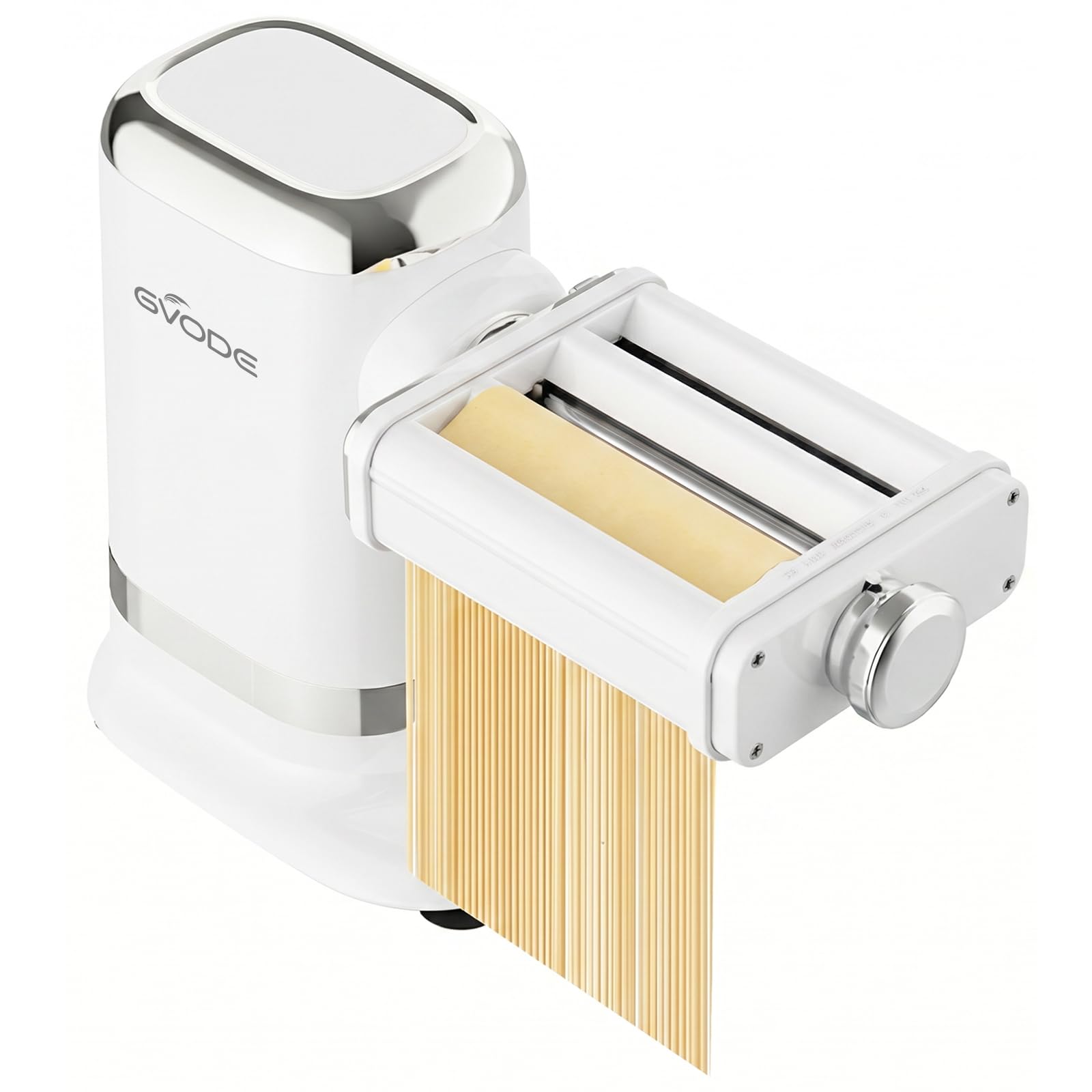
3. GVODE Electric Pasta Maker Machine, 3-in-1 Roller & Cutter
The featherweight that punches in at 700W and still fits in a cupboard corner
The GVODE makes a very specific trade: plastic housing, metal drive gears. That combination keeps the whole unit around 5.2 pounds — light enough to lift onto the counter with one hand and push back into a cupboard without rearranging the shelf. The metal gears where it counts are what let the rollers hold alignment batch after batch, and that’s the difference between a machine that lasts a year and one that lasts one season.
The 700W motor and eight thickness settings (0.4mm to 2mm) push through stiff dough that lighter motors would just stall on. Two speeds plus a reverse function let you back dough out if it bunches up around the roller — a small feature that solves a real problem. The three-in-one attachment set rolls sheets and cuts fettuccine, spaghetti, or wide lasagna noodles.
Owners consistently flag performance as the standout — the machine rolls and cuts six batches of fettuccine in under 20 minutes, which is a serious throughput for the weight. Where it stumbles is long sessions: it wants 15-minute batches with a 5-minute cool-down between, and skipping that step is the single most-cited reason these motors quit early. Some owners mention the fettuccine setting produces wide strands with a center seam that requires hand separation. Value-for-money notes are mixed, so judge the price against how often you’ll actually use it.
Compact power: 700W in a 5.2lb frame. That ratio is the best in the group by a wide margin, and it’s why this one wins small-kitchen space.
Use it in rhythm: Run 15 minutes, rest 5. Skip the rest and you’re gambling with the motor.
Pick it for: Cooks working in tight kitchens who want real motor power without a machine that lives on the counter permanently.
Skip if: You need to run marathon pasta sessions — this one is built for single fast batches.
4. Zuguachi 260W Automatic Pasta Maker, 13 Shapes, Cordless

A two-pound handheld that goes anywhere and squeezes out thirteen different shapes
Two pounds. Thirteen pasta dies. A 1500mAh battery and Type-C charging. The Zuguachi is the only cordless option here, which changes what the machine is for — it’s a portable extruder, not a countertop roller. The 260W motor pushes dough through a molding disc while you hold the unit over a pot or bowl. Select the mold, load the dough, press the button. That’s the whole process. The included sausage stuffer attachment is a bonus most machines in this list don’t offer.
The 13 discs cover thick noodles, thin noodles, and wide noodles, plus wrapper-style dough sheets — an unusual range for a machine that fits in a drawer. The 500g flour capacity is generous for a handheld, and one charge is rated to make up to 100 bowls of noodles. Type-C charging takes about 4 hours for a full tank, and the food-grade 304 stainless steel contact parts are dishwasher-safe after disassembly.
Dough consistency is what breaks or makes this one. Dry, crumbly dough extrudes cleanly; wet dough jams and the motor stalls. Customers note the included recipe runs wet, and swapping in a drier ratio from a different machine fixed the results immediately. The mixer lid on some units lifts during operation and triggers the auto-shutdown, so a weigh-down helps if yours does it. Occasionally a batch won’t extrude and the machine reports an error. In short: this rewards precision more than any roller here, and it’s the pick if portability matters more than hands-off automation.
For grab-and-go cooks: Two pounds and a battery — pack it to a rental kitchen, a friend’s house, or a camp site and make noodles on the spot.
Precision matters more here: Wet dough jams the extruder. Follow a drier ratio than the included card suggests, and weigh your flour.
Buy this if: Anyone who wants noodle-shape variety in a tool that travels.
Not for you if: You’d rather dump ingredients and walk away — this one wants your hands on it the whole time.
5. WICHEMI Electric Pasta Maker Machine 3-in-1

A 22lb/h stainless tank built for weekend pasta marathons
The WICHEMI’s standout number is 22lb/h — double the Newhai’s 11lb/h, and the highest throughput in the whole group short of the commercial-grade machines further down. That number matters when you’re feeding extended family or running a weekend prep session where you want to stock the freezer. The 304 food-grade stainless body and blades are built to resist rust and aging, and the one-button function switch handles dough pressing and noodle cutting without hitching.
Three built-in blade options cover 2.5mm round noodles, 4mm flat noodles, and a wider 9mm flat cut. Dough sheets run 1.5mm to 4mm — the top end handles dumpling and wonton wrappers. The 17.6lb weight and 8.66-inch-square footprint keep it stable without hogging the counter, and at just 135W the motor is quiet enough that house noise isn’t an issue. The stainless body also means cleanup is a wipe-down once the dough is dry.
Where this one splits from the cheaper electrics is the motor feel — owners describe smooth, fast performance, and there’s a recurring note that the motor warms up under use. The silicone-black-stain leaks a couple of reviewers point out even after multiple runs are a real quality-control flag worth knowing about before you buy. This isn’t a “dangerous machine” verdict — it’s a machine where you should inspect the blades and break them in before your first serious batch. Long-term durability reports are a mixed bag, so this is the pick for someone who wants the throughput and will treat it as a semi-disposable tray of stainless steel rather than a heritage appliance.
Why the throughput pick
- 22lb/h output — double the Newhai’s 11lb/h
- 304 food-grade stainless body, roller, and blades
- Three blade options: 2.5mm round, 4mm flat, 9mm flat
- Dough sheets from 1.5mm to 4mm — wontons and dumplings included
- One-button mode switch for press-and-cut operation
What to watch for
- Motor warms under extended use — pace your batches
- Some units ship with residual oil that shows on noodles for the first few runs — clean thoroughly before you begin
- Mixed durability reports at the one-year mark
Buy this if: Feeds a crowd and wants restaurant-type output from a countertop appliance without stepping into the commercial-grade weight class.
Think twice if: You need a machine to run for years without maintenance — this is throughput-first design.
6. Luzrise Electric Pasta Maker, 4 Blades, 9 Thickness Settings

Nine thickness dials, four cutters, and a built-in 135W motor rated for continuous use
Most compact rollers ask you to pause every fifteen minutes. The Luzrise doesn’t. Its 135W motor is rated to run continuously for up to an hour without needing a cool-down — and it sits right next to a heat dissipation system that actively prevents overheating. That combo is what separates it from the entry-level machines in this list. Add anti-slip pads under the base and the vibration is minimal even during a long session.
The 14cm roller is deliberately wider than the Newhai’s and the GVODE’s, and it’s rounded to mimic hand-rolling more closely. Nine thickness settings from 0.5mm to 5mm open up a wider range than most household machines, and the 4 blades (1.5mm, 2.5mm, 4mm, and 9mm) cover everything from angel-hair fine up to wide tagliatelle. The body is 304 stainless steel with a polished surface and an ABS shield to protect against scratches. The default setting handles gluten-free and spelt flour as easily as standard wheat.
A plastic-shield note first: the ABS cover isn’t cosmetic — leave it on and the machine stays scratch-free for years longer. The Luzrise ships with a two-year warranty and a 30-day refund window, which is the longest protection window of any pick here. Some buyers use it for polymer clay instead of pasta, which isn’t what it was designed for but does show how durable the roller assembly is. The one honest caveat: the wider noodle cutters aren’t in the included set — the widest here is 9mm, so if you specifically want lasagna sheets cut in the machine you’ll need to slice those by hand.
Built for the marathon: An hour of continuous running without rest is a real feature. If you’re feeding a crowd or prepping big batches for the freezer, this is the machine that won’t tap out early.
Refined range: Nine settings and four blades cover more ground than competitors at this level — but lasagna-wide sheets still need hand-cutting after rolling.
Worth it for: Anyone running long or repeated batches who needs a machine that survives a full hour without an intermission.
Not the one if: Wide lasagna sheets in the machine are non-negotiable for you.
7. LEONEBEBE Commercial Noodle Machine, 550W
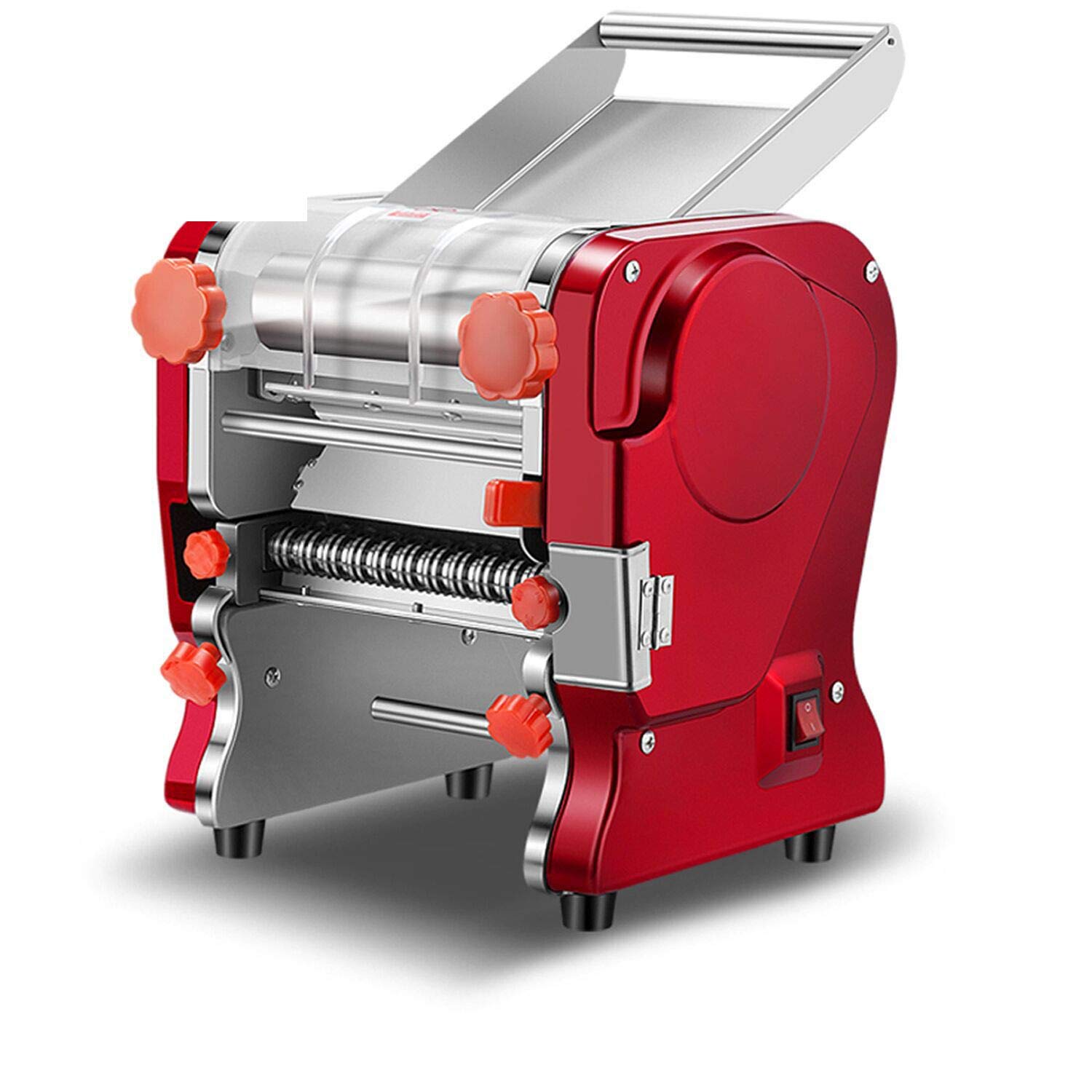
A 550W stainless beast that knocks out 55lb of noodles an hour without breathing hard
A LEONEBEBE isn’t a kitchen gadget. It’s a small commercial dough sheeter — 550W, all-stainless body, 44 pounds of steel, and a workload rated at 45 to 55 pounds of fresh noodles per hour. It’s built to handle stiff, low-hydration dough that would stall a household motor in seconds. The dual-knife cutter puts out both 3mm and 9mm flat noodles simultaneously, and the dough roller adjusts from 0.1mm to 5mm so you can run dumpling wrappers, wonton skins, mantou, and even pancakes through it.
The 13-by-10-by-18-inch body runs on a US-regulated triangle plug at 110V. There are two thickness dials that need to be turned in equal amounts — miss that and one side of the sheet will be thicker than the other. Cutter changes are quick, and pasta doesn’t stick to the rollers during normal operation. The one-year warranty and 24/7 manufacturer support are genuine; this is a company that’s been building dough sheeters for a long time.
Owners praise two things: solid construction and serious speed. The machine doesn’t strain on stiff dough, and restaurant-minded shoppers say they’ve used it six months at twice-a-week frequency for a family of four without a hiccup. Its repeated kneading-and-pressing process yields a notably chewier noodle than a Philips direct-extrusion machine — a texture difference you can feel. The 44-pound weight is the honest downside: this machine finds a permanent spot on your counter and doesn’t move.
Commercial heart, home body: 550W, 55lb/h, dual cutter, 0.1mm to 5mm thickness range. It eats low-hydration dough that chokes lesser machines.
Space and speed: It also needs a fixed spot — 44 pounds isn’t getting moved for dinner prep on a whim.
Buy this if: Serious home cooks and small operators who want commercial-tier output and a wider thickness range than any household machine here can match.
The skip signal: You don’t have a permanent counter slot for a 44-pound machine.
8. XINGYUEXUAN Electric Pasta Making Machine, 550W
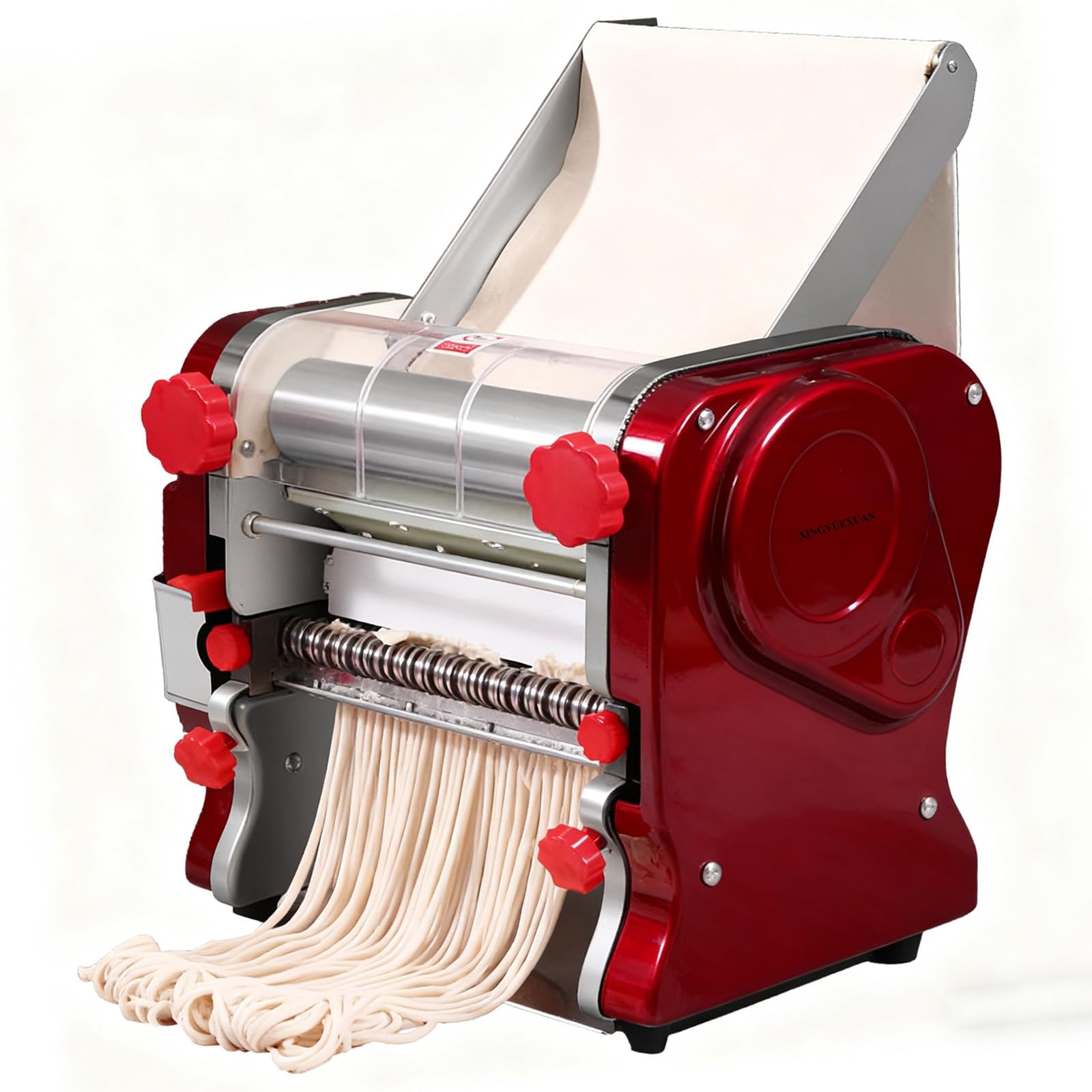
Full stainless steel, 5kg per hour, and a one-year warranty in a restaurant-ready frame
XINGYUEXUAN built this one for continuous use — the 550W motor is the same wattage as the LEONEBEBE’s above, and the 5kg/h capacity (11lb/h) sits below the LEONEBEBE’s commercial 45-55lb/h figure, so this is best read as a light-commercial or serious home machine rather than a full restaurant workhorse. The 0.1mm to 5mm thickness range is the same span as the LEONEBEBE, and the 2mm and 6mm cutter switch happens with a red knob rotation — clockwise for the thin spaghetti, counterclockwise for the wider 6mm.
The dual adjustment knobs on the thickness control keep the sheet even across the whole dough. The 3-in-1 automatic operation kneads, presses, and cuts in one continuous flow, and the body is entirely food-grade stainless — cleanup is a damp-cloth wipe and nothing more. Low-noise operation is part of the spec, and there’s built-in overheating protection that cuts power if the motor gets hot during extended operation. The 42.3-pound weight and 11-by-27-by-17.3-inch footprint make it a fixed-position machine.
The recurring friction on this one is the cutter setup — some owners find the noodle cutters jam and need constant reloading, and a couple of units ship with a handle that won’t lock into place. The straight roller itself earns steady praise for build quality and for producing good pasta and egg noodles in a few runs. For most home cooks, it’s more machine than they need; for someone running weekend batches or a small kitchen operation, the 5kg/hour flow and stainless construction are the reason to pick it.
What it delivers
- Full stainless steel body with overheat protection built in
- 0.1mm to 5mm thickness range with dual adjustment knobs
- 2mm and 6mm cutters switch with a single red knob rotation
- 5kg/h throughput from a 550W motor
- Wipe-clean surfaces with no crevices to dig into
Where it asks for patience
- Cutter assembly can jam on some units and needs frequent clearing during a batch
- Occasional handle-latch issues from the start
- 42.3 pounds means it stays put — this isn’t a pantry-cabinet machine
Buy this if: You run regular noodle sessions at scale and want stainless construction and overheat protection without stepping up to full commercial pricing.
Not the pick for: Someone making small weekly batches — the cutter quirks get tiring fast when the machine has to work every time.
9. Philips 7000 Series Pasta Maker, ProExtrude 150W

Dump, press, wait — the closest thing in this list to zero-effort fresh pasta
The Philips 7000 does one thing no other machine here does: walk you through the recipe step by step. Download the HomeID app, and you get guided instructions including vegan and gluten-free options, plus an integrated mixing function that handles the dough for you. Push a button, walk away, come back to fresh pasta in under 10 minutes. That’s the entire pitch, and it’s what makes this the pick for anyone who wants results without learning dough feel. The crowd-favorite rating reflects that — this is among the most trusted machines in the category.
The 150W ProExtrude system kneads and pushes dough through the die in one motion, and the eight discs cover spaghetti, fettuccine, rigatoni, pappardelle, tagliatelle, paccheri, angel hair, and more. Capacity is up to 8 portions in a single batch — enough for a family dinner without a second run. The mixing function is also usable for cookies and for starting pizza and bread dough, so the machine isn’t a one-trick appliance. Weight is 20 pounds, dishwasher-safe parts, and a non-stick finish that wipes down in a couple of minutes.
The trick is entirely in the liquid ratio. Correct ratio is roughly 6.1 oz of liquid per 500 grams of flour, and the dough should feel dry and pebbly, not soft and smooth like bread dough. One buyer’s own note captures the go-to method: “Follow instructions. Use about 6.1 oz liquid to 500 grams flour.” Use a kitchen scale, not the cup — scoops vary wildly and that’s the source of most “it doesn’t work” reports. Extrusion can be slower with the smaller dies and the “Extrusion Only” button is occasionally finicky on individual units, so a full-cycle re-run usually sorts it out.
The hands-off option: Guided recipes, auto-mixing, and eight pasta dies — the machine does the parts of pasta-making most people find tedious.
Where it insists on discipline: It rewards precision on liquid ratio. Follow the app’s numbers, weigh the flour, and the fussiness disappears.
Buy this if: You want fresh pasta on the table with minimal hands-on work and a documented recipe path you can trust to repeat batch after batch.
skip it if: You’d rather chase your own ratios and dough feel and don’t want an app steering the process.
Understanding the Specs
Motor Wattage
The number on the box tells you how much torque the motor can deliver before it stalls. A 135W motor handles a family batch of typical pasta dough without straining. A 550W or 700W motor pushes through stiffer, lower-hydration dough that chokes smaller motors — the kind you make for dumpling wrappers or long-extrusion shapes. Wattage is not the same as unlimited runtime: a powerful motor can still overheat if it runs continuously without a break, which is why cooling design and duty cycle matter as much as the spec. Match the wattage to the dough you’ll actually make.
Noodle Cutter Widths
Roller machines cut the dough sheet with fixed-width blades. A 1.5mm or 2mm cut gives you thin round spaghetti or angel hair; 4mm gives you a classic flat noodle; 9mm gives you wide tagliatelle or pappardelle. Extruder machines use interchangeable discs — some offer eight or more, covering everything from narrow spaghetti up to wide rigatoni. The trade-off is texture: rollers cut through a pressed sheet, extruders push dough through a shaped die. Rolled noodles hold their bite better in sauce; extruded noodles are softer and absorb more. Know which one you eat more often before you buy.
Dough Thickness Range
The thickness dial controls how thin the dough sheet gets. Below 1mm you’re into wrapper territory — dumpling and wonton skins live between 0.1mm and 1mm. Between 1mm and 3mm you’re in noodle-sheet range for spaghetti and fettuccine. Above 3mm, you’re building lasagna sheets or heavy wide-cut noodles. Machine dials typically run 0.4mm up to 5mm depending on the model. Stay near the middle of the range for cutting noodles — too thin and the sheet won’t hold up against the blade; too thick and the cutter tears instead of slices.
Weight and Footprint
Weight is a proxy for stability. A 44 or 42.3-pound machine sits still under stiff dough and doesn’t walk across the counter. A 5.2 or 11-pound machine needs anti-slip pads and a bit of care, and you’ll want to move it off the counter between uses. The compact machines fit in a cupboard; the commercial-grade ones want a permanent counter slot. Match the footprint to your kitchen before you match the motor to your dough.
FAQ
Is an extruder or a roller better for noodles?
What water-to-flour ratio should I use in an automatic pasta maker?
Can these machines make gluten-free pasta?
How often should I clean the machine between uses?
Can I use an automatic noodle machine for dumpling wrappers?
Do I need a commercial machine for home use?
How long can these machines run without overheating?
What do I do if the dough won’t extrude through the machine?
Is it worth buying an automatic pasta maker over a manual hand-crank model?
Can I use the same machine for noodles and for other doughs like bread or cookies?
Final Thoughts: The Verdict
For most kitchens, the best automatic noodle machine is the Newhai Electric Pasta Maker. It’s a 135W stainless roller that presses and cuts in one pass at an 11lb/h pace, and the 4.4-star showing across much of its catalog backs up the “keeps working” reputation owners have built around it. It’s not the flashiest machine here, but it does the core job — consistent sheets and clean cuts — without asking you to babysit the motor.
If you want the most hands-off experience, the Philips 7000 Series is hard to argue with. Its ProExtrude system, eight discs, and HomeID app make fresh pasta a single-button operation, and the eight-portion capacity handles a full family dinner without a second run. For small kitchens, the GVODE packs 700W into a 5.2-pound frame, so you get serious rolling power without permanently surrendering counter space. And if volume matters more than anything, the LEONEBEBE covers 45 to 55 pounds of noodles an hour from a fully stainless body — the pick for anyone running an operation, not just a dinner.
Whichever one you choose, the machine is only as good as your dough. Weigh your flour, aim for a crumbly texture, and the rest of the process takes care of itself.
How We Picked
We do not accept paid placement. Every pick is matched to a real buyer and a real use-case; we do not hands-on test units.
Sources & Methodology
Specifications: manufacturer listings and product documentation. Review insights: verified customer reviews, as of September 2026. Pricing: not shown on this page (it changes often); check the current price via the retailer link.
As an Amazon Associate, Gadgets Feed earns from qualifying purchases. This does not affect which products we feature.