
Our readers keep the lights on and my morning glass full of iced black tea. As an Amazon Associate, I earn from qualifying purchases.
Specs are compiled from manufacturer listings and verified buyer reviews and can change over time — please confirm the key details on the product page before buying.
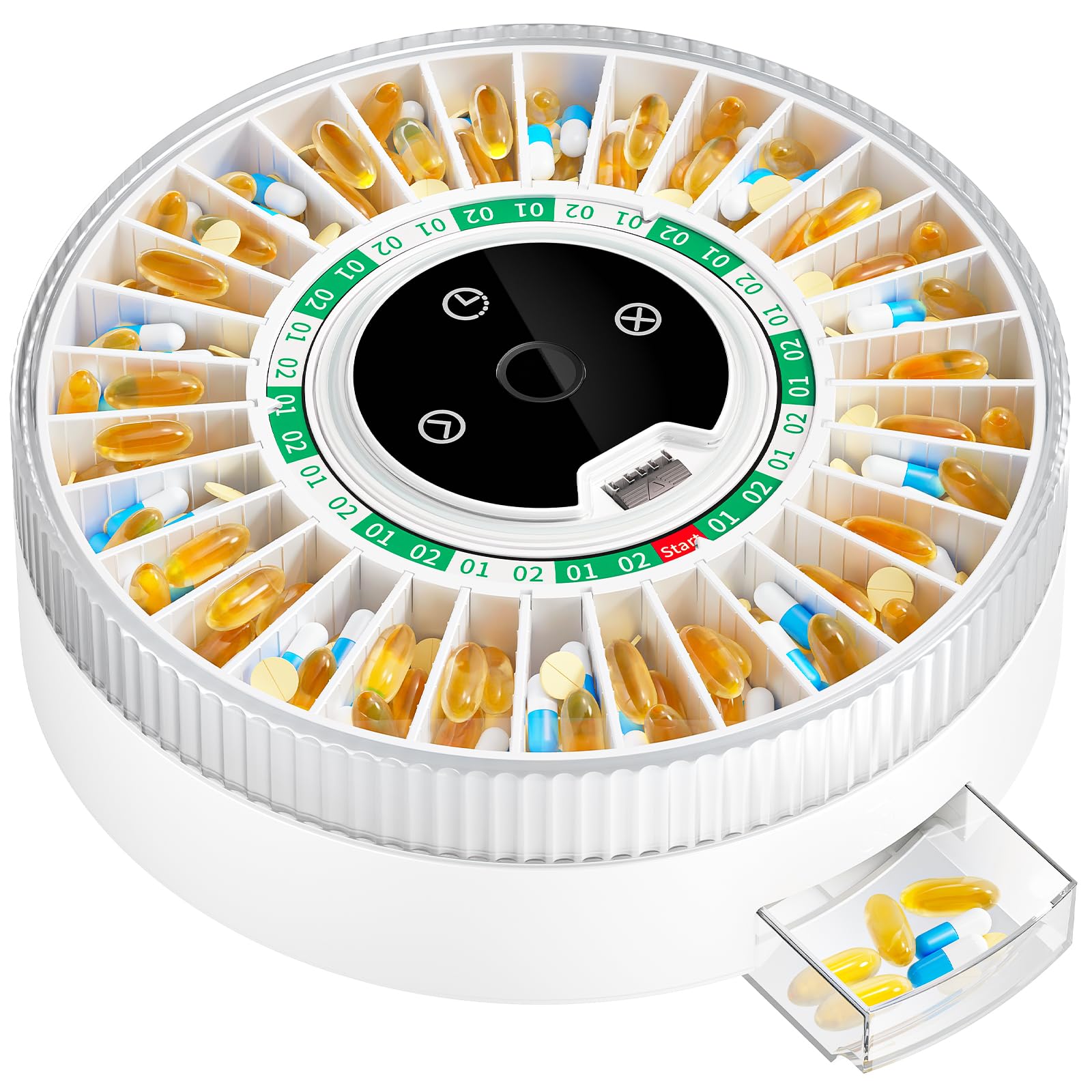
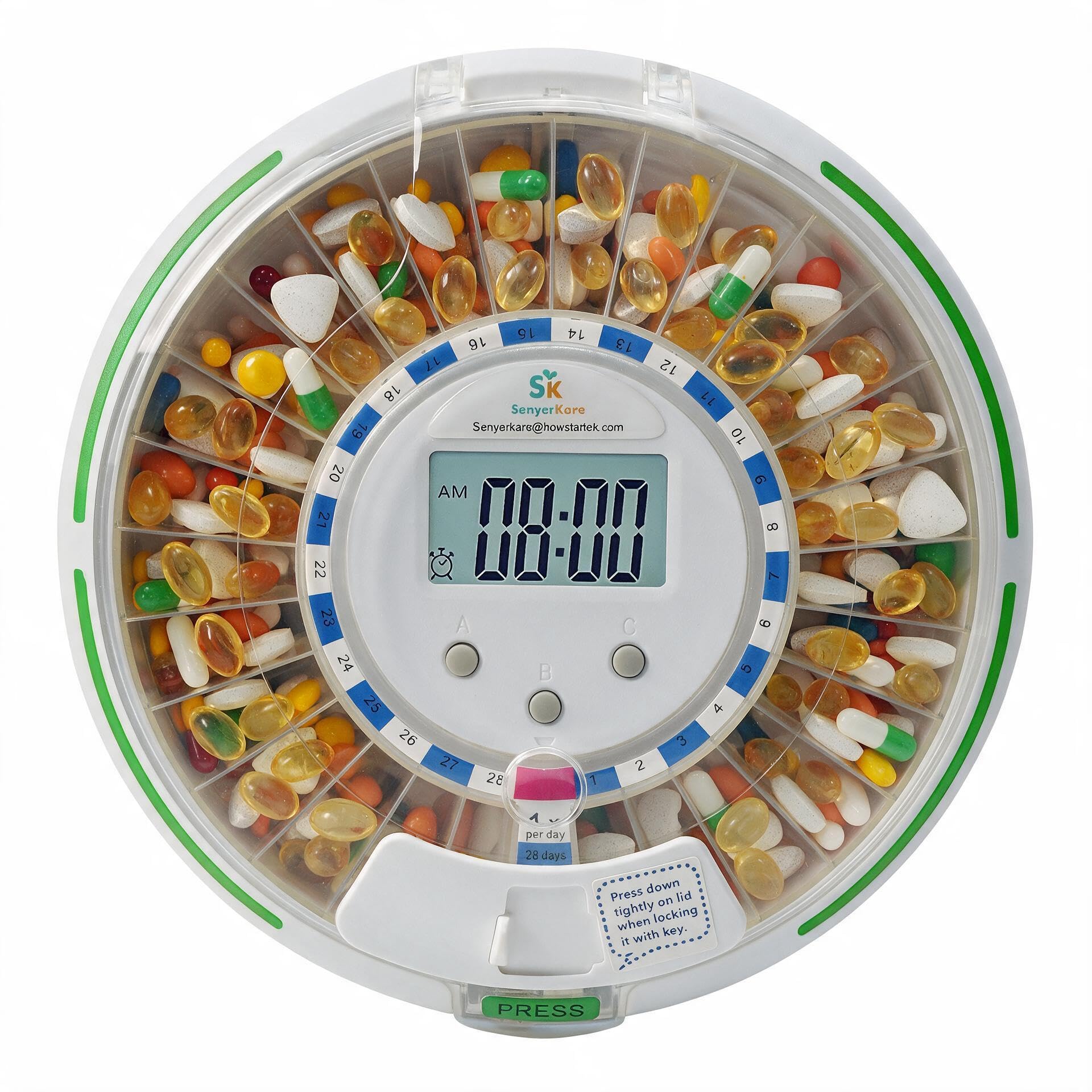
If your parent forgets a dose, doubles up, or takes the night pills at noon, the fix is a dispenser that holds the medication locked and only lets one dose out at the right time. That single feature — timed, locked release — separates a real automatic dispenser from a plastic weekly box.
I’m Min — the founder and writer behind Gadgets Feed. This guide is built by comparing the manufacturers’ published specifications and the patterns across verified customer reviews, so you get each pick’s real strengths and trade-offs instead of marketing spin.
A good unit also has to be easy to refill and loud enough to hear from the next room, because a dispenser that frustrates you gets abandoned fast. The picks below cover every setup from a simple one-button machine to an app-connected automatic pill dispenser for elderly.
Our Picks at a Glance

How To Choose The Best Automatic Pill Dispenser For Elderly
Every machine here does the same core job: it holds the pills, and it opens one dose at the programmed time. What changes between models is how you load it, how loud it shouts, and how many times a day it can run.
Locking, keys, and who gets access
The lock is the safety feature you are paying for. A tamper-proof lid means only the caregiver can load the tray, and your parent can only reach the single dose that is due. Some models add a fingerprint reader that stops impulsive access, plus a mechanical key as a backup. Others ship with two physical keys. Whichever you pick, test the lock in your own kitchen before you rely on it, because a stiff lock you fight every week is a lock you stop using.
Alarm type versus who is taking the pills
A loud beeper suits someone hard of hearing. A bright flashing light suits someone who cannot hear high tones but sees well. The cleverest units do both at once, and several keep beeping for up to 30 minutes until the tray is flipped to take the dose. That persistence is the whole point for dementia care: a reminder you can ignore is not a reminder.
How many doses per day, and how often you refill
Count your parent’s daily doses before you buy. A 28-slot carousel holding a single dose per day runs a full month between refills. The same tray set for two doses a day runs about two weeks, and three doses a day runs closer to ten days. Some units solve this with interchangeable rings that reshape the tray for a 1x to 6x daily plan, so the machine matches the prescription rather than the other way round.
Quick Comparison
| Model | Best For | Daily Alarms | Capacity | Power | Amazon |
|---|---|---|---|---|---|
| Colorwing® 2025 Smart Pill Dispenser for Seniors★ Best Overall | Hands-free daily dispensing | Custom with 3 tones | 31 slots, 7 rings | 1200mAh, 30+ days | Amazon |
| Automatic Pill Dispenser with Safety LockBudget Champion | Budget multi-dose reminders | Up to 6 | 28-day, 6 rings | 4 AA | Amazon |
| EziMedPil Automatic Pill DispenserBest Display | Low-vision seniors | Up to 6 | 28 slots, 6 rings | 4 AA | Amazon |
| Automatic Pill Dispenser for Elderly with Alarm | Simple four-times-daily plans | 1X to 6X daily | 28-day | — | Amazon |
| LiveFine Automatic Pill Dispenser | Long, repeat alarms | 6 | 28 compartments, 6 rings | 4 AA | Amazon |
| LiveFine 28-Day Locking Dispenser | High-dose schedules | Up to 9 | 28-day, 9 rings | 4 AAA | Amazon |
| Betife Automatic Pill Dispenser | Family voice reminders | App-scheduled | 31 slots, 7 rings | Plug-in + 1200mAh backup | Amazon |
| 28-Day (1X) Automatic Pill Dispenser | One-press simple use | Up to 4x daily | 28 compartments | 5V USB-A 4 AA | Amazon |
| 42-Day(1X) Automatic Pill Dispenser | Remote caregiving from a distance | App-scheduled | 42 doses, 3 trays | 4 AA | Amazon |
In‑Depth Reviews
1. Colorwing® 2025 Smart Pill Dispenser for Seniors – 31-Slot Automatic Medication Organizer
Our pick — 4.5★ from 650+ verified ratings; the strongest balance of quality and price.
The dispenser that opens on a press instead of a flip, so stiff fingers never wrestle a tray.
This is the pick for a senior with arthritis who still wants to manage their own pills. Instead of lifting and tipping a heavy carousel, the whole dose box pops open with one palm press — the box does the work, not the hand. It holds 31 slots and ships with 7 reversible dose rings, so you can shape it into a monthly plan or a weekly one without buying extra parts.
The security is the serious part. A fingerprint scanner (a reader that only open up for a saved finger) blocks impulsive access, and a physical backup key covers the day the sensor or a memory lapse gets in the way. Choose a custom voice reminder — you can record “Mom, time for medicine” yourself — or pick from 3 soothing alert tones. On power, it runs a 1200mAh battery (about a phone-sized cell) that charges fully in 2 hours and lasts 30+ days in energy-smart mode, with Bluetooth 5.0 (the short-range wireless standard) syncing doses and intake to a free companion app with no subscription.
What wins owners over is that it just works as a daily routine, and the loading ritual stays simple. It is a bulkier machine than most on this list, though — at 3.06 pounds it is noticeably heavier than the 2.01-pound safety-lock unit below, and its 10.35 x 5.43 x 10.35-inch body wants its own counter space. Buyers report the flexing plastic caps on the daily cases may eventually split, though the one-year mark shows no sign yet. The honest trade-off is the fingerprint lock: brilliant for stopping double doses, but a caregiver now needs the saved finger or the key every refill.
The daily reality: Once it is loaded, your parent presses once and takes the dose — no flipping, no counting, no missing a slot.
Where it strains: That same locking design means refills are a caregiver job, and the app setup is a one-time task someone younger should handle.
Made for: A senior with arthritis or limited hand strength who manages their own medication and needs impulsive access blocked.
Think twice if: Nobody nearby can load a 31-slot tray or manage a Bluetooth app setup.
2. Automatic Pill Dispenser with Safety Lock for Seniors, Dementia
A budget locking dispenser that shouts at 80dB and flashes a light until the dose is taken.
Six programmable daily alarms, an 80dB audible alert (about the loudness of a busy restaurant), and a bright flashing light cover the two most common ways a dose gets missed — you cannot hear it, or you cannot see it. It holds a full 28-day supply at one dose a day, or shorter runs for multi-dose plans, and the clear lid lets you check upcoming doses without opening it.
Setup is deliberately simple: 3 clearly labeled buttons, settings that survive a battery change, and a quick-fill carousel you load once a month. Access is a slide-open window; you flip the unit over and pour the pills out. Two backup keys ship in the box, so a lost key is not a crisis. It weighs 2.01 pounds and measures 10 x 9.8 x 2.76 inches — light enough to lift one-handed and slim enough to sit on a nightstand, unlike the 3.06-pound Colorwing above.
The recurring gripe is the lock. The plastic catch has been known to give out over time, with buyers reporting a unit that would no longer latch after several months, and a few note the housing feels inexpensive in the hand. Programming also reads as fiddly if your parent tries it alone — this is a setup you do once for them, not with them.
What works in the real routine
- Six alarms plus an 80dB alert and flashing light suit both hearing and vision limits.
- 28-day capacity at one dose a day means one refill trip a month.
- Two backup keys and memory-saving settings reduce caregiver firefighting.
What to handle gently
- The locking catch is the weak point — treat the latch like the delicate part it is.
- Initial programming frustrates seniors; plan to set it up yourself.
- Flipping the unit to pour a dose works best over a cup or plate.
Reach for this if: You want locked, timed dispensing on a tight budget and you will do the monthly setup.
Look elsewhere if: You need a lock that survives years of heavy daily opening and closing.
3. EziMedPil Automatic Pill Dispenser with Alarm for the Elderly
Built for eyes and hands that need help — a magnifier over the pills and a large-font screen.
This one is loaded with small kindnesses for the elderly. The transparent lid carries a built-in mini magnifying glass so your parent can read the pills in the tray, and the large-font LCD screen keeps the time legible without glasses. Two anti-slip grips on the rear give a firm hold for flipping the device over when a dose is due.
Inside, 28 independent slots each hold up to 24 aspirin-sized tablets, a total capacity of 672 pills — 30% more than ordinary automatic dispensers, per the maker. Six interchangeable dosage rings reshape the tray for different schedules. All programming runs on 3 buttons that set time, up to 6 daily alarms, volume, ringtone, and 12/24-hour format. Power comes from 4 AA batteries that ship in the box, and a low-power icon appears on the screen when they run down.
The honest catch is battery appetite. Owners mention the unit goes through batteries quickly, and the lock has a reputation for feeling finicky — being gentle with it pays off. The alarm volume splits opinions: fine for many, quiet for anyone hard of hearing. On the plus side, the alerts keep sounding until the unit is flipped, so a dose is not walked away from.
What stands out: The magnifier and large-font screen solve the reading problem that stops many seniors from using a dispenser alone.
What to plan around: Frequent battery changes are part of owning this one — keep a supply on hand.
Best match: A senior with poor eyesight or limited hand strength who reads the tray before taking a dose.
Consider another: If your parent needs a very loud alarm or a lock that stays crisp for years.
4. Automatic Pill Dispenser for Elderly with Alarm, Lock 28-Day Medication Dispenser
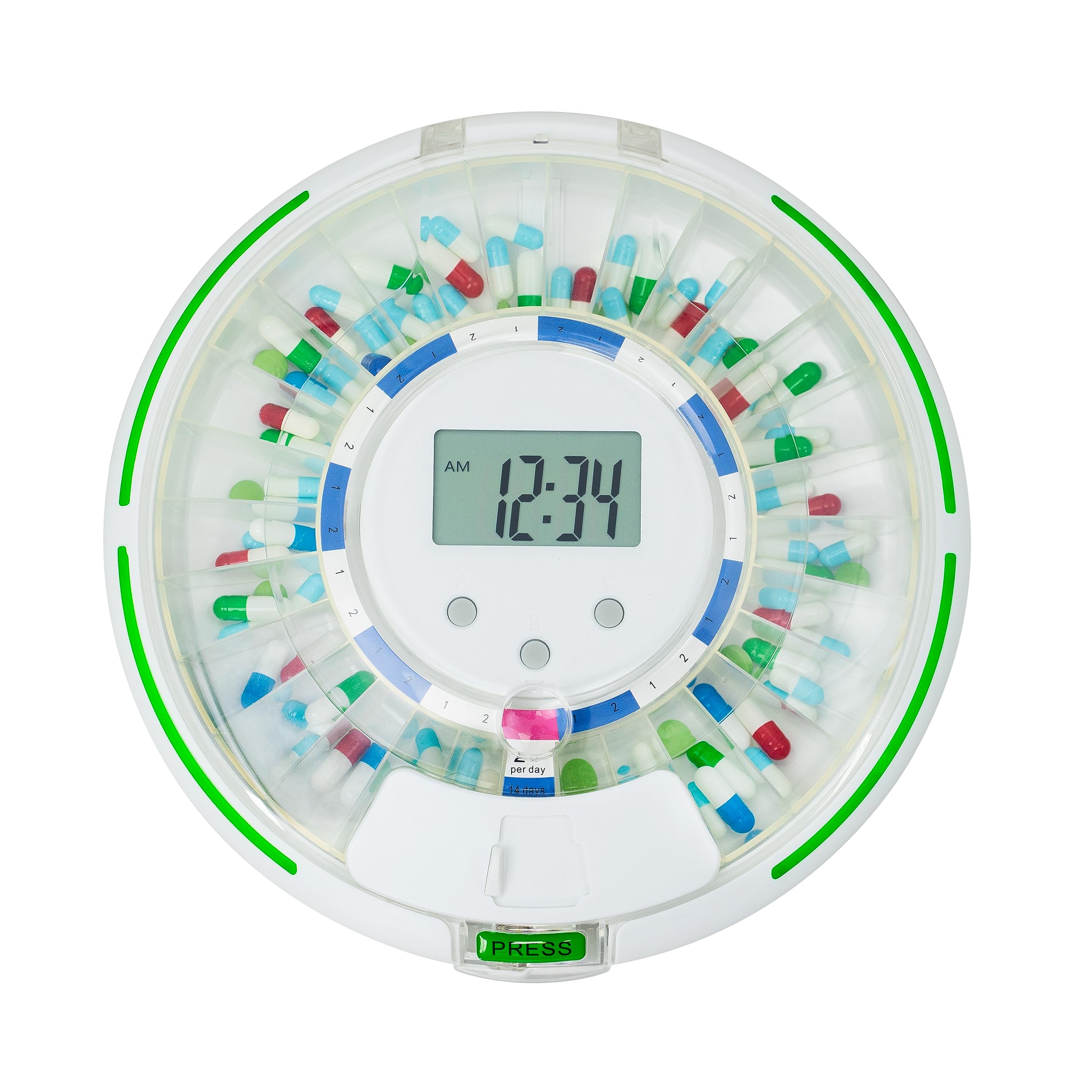
A straightforward locked dispenser that does one job — controlled dosing, 1X to 6X a day.
No app, no fingerprint reader, no learning curve to speak of. This dispenser organizes, tracks, and releases medications, vitamins, and supplements for up to 28 straight days, with audio and visual alerts running 1X to 6X daily across six dosage templates. The locked lid keeps a confused hand out of the tray, and the clear cover lets you eyeball what is loaded before you leave the room.
Owners describe the routine in the exact terms a caregiver wants: fill it, set the dose times, and it runs by itself from there. One family set the machine to dose at 10AM and 8PM and stopped worrying about the night pills going missing early — the unit simply would not open the wrong compartment. Another uses it four times a day for a 79-year-old and treats it as both the reminder and the access control, which is the whole point of a lockable unit.
The trade-off is bare-bones reach. There is no Bluetooth, no companion app, and no remote monitoring, so if your parent lives far away you get no alert that a dose was skipped. It also weighs 1.87 pounds, the lightest machine on this list, and measures 8.86 x 8.86 x 2.68 inches — easy to move but also easy to walk off with. Simple by design also means limited by design.
The right buyer: A nearby caregiver who wants locked, timed dosing with zero tech setup and no app to babysit.
Not for: Long-distance monitoring, where an alert you can check remotely matters more than simplicity.
5. LiveFine Automatic Pill Dispenser with 28-Day Electronic Medication Organizer
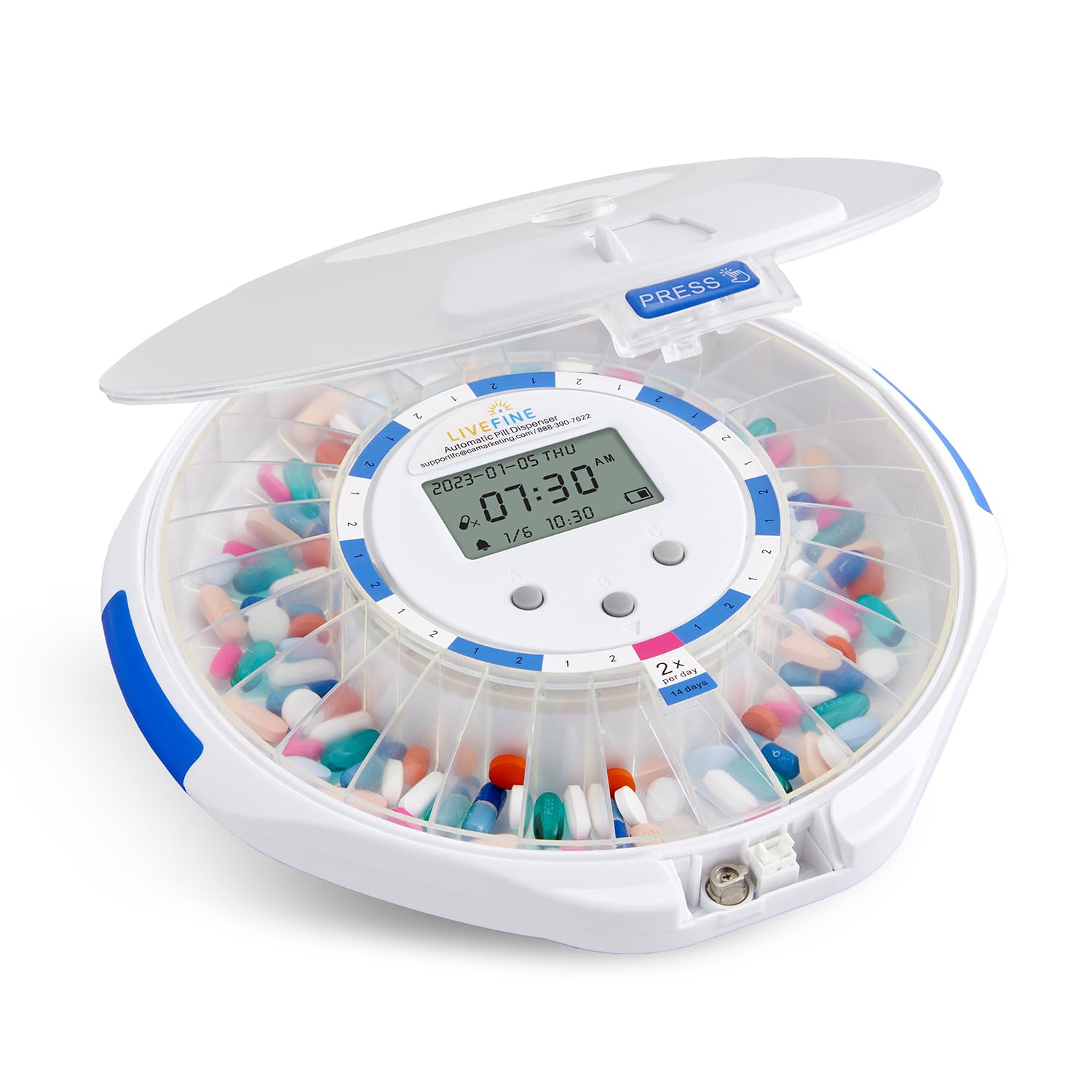
The machine that keeps nagging — audible alarms every 7 seconds for up to 30 minutes.
Persistence is the feature here. Once the carousel rotates to a dose, a repeating visual light ring and an audible alarm sound every 7 seconds for up to 30 minutes, or until the medication is actually dispensed. If a dose is missed entirely, the unit auto-rotates after 30 minutes, so the schedule does not stall. That is the difference between a gentle reminder and a machine you cannot ignore.
Inside, 28 spacious compartments work with 6 interchangeable dosage rings for 1 to 6 doses a day, holding up to 28 days of multiple medications, vitamins, and supplements. A built-in magnifying glass sits above the dosage window for reading pills, and the LCD shows 12/24-hour time across 6 programmable alarms and 3 volume levels, including mute. A low-battery indicator warns before you lose the schedule. It runs on 4 AA alkaline batteries, no charging, and the pill carousel lifts out for refilling.
The lock is the friction point — owners find it stiff to open and close, and the printed numbers on the tray lack color separation, so reading which day is due takes a squint. Those with dementia do best when a caregiver handles loading. Everyone else settles in fast: the alarm repeats until the unit is tipped over, the dose window is gentle on fingers, and one long-time owner noticed the current version arrives with improvements over the unit bought six years earlier.
What earns its keep
- 30 minutes of repeating alarms across sound and light, with a 30-minute auto-rotate on missed doses.
- 6 dosage rings cover 1X to 6X daily plans without extra purchases.
- Runs on 4 AA alkaline batteries — no charging cord, no power outlet needed.
Where it asks patience
- The lock is stiff and the numbers are not color-coded — both add refill-time fiddling.
- Not a self-management tool for cognitive impairment; a caregiver should load it.
- The alarm needs the unit tipped over to silence, so place it within arm’s reach.
Pick it when: Loud, repeating alerts matter more than a slick lock, and a caregiver handles refills.
Skip it when: Your parent has dementia and tries to manage the tray without help.
6. LiveFine 28-Day Locking Automatic Pill Dispenser with Alarm, Clear Lid
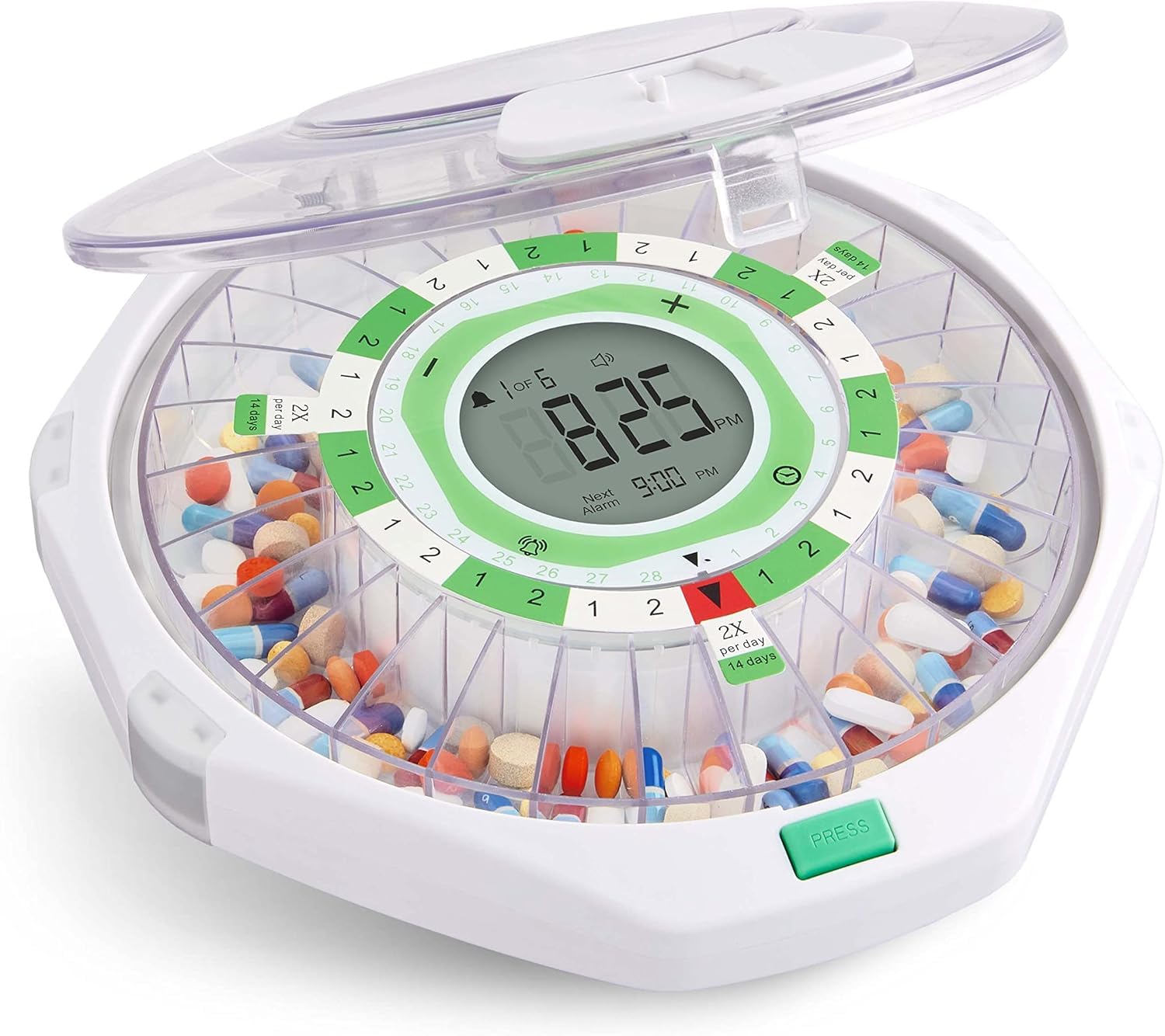
For a packed daily schedule — nine dosage rings handle plans other dispensers cannot fit.
Nine interchangeable dosage rings set this apart. If your parent takes medication five or six times a day, most 28-slot dispensers run out of program slots; this one does not. It holds a 28-day capacity with a jumbo LCD that shows the current time, upcoming alarms, and battery status at a glance, and three beeping patterns with adjustable volume let you tune the alarm to the household.
The lockable cover with a manual key keeps medication secure, and the sliding retrieval window is shaped to be reachable even with arthritis. It is the lightest unit here at 1 pound, and its 9.25 x 7.87 x 2.15-inch body travels well. Owners who tried other dispensers landed on this one specifically because it met a five-doses-per-24-hour need that nothing else managed.
Two quirks come up again and again. The face opening takes practice — there is a press-and-lift motion that some caregivers need a few tries to master. And smaller pills can stick in the angular compartments; flipping the unit over a bed or a small cup shakes them loose. Alarm setup is also reported as fiddlier than it should be, so budget a patient half hour for the first configuration.
The standout: Nine rings make this the machine for complex, high-frequency prescriptions nobody else accommodates.
The catch: Small pills occasionally cling, and the alarm menu takes practice to program.
Suits: A senior on five or more daily doses whose caregiver needs a program-capable, lockable dispenser.
Less ideal: Someone on simple twice-a-day medication, for whom the extra rings are overkill.
7. Betife Automatic Pill Dispenser for Elderly with Alarm – 31-Slots
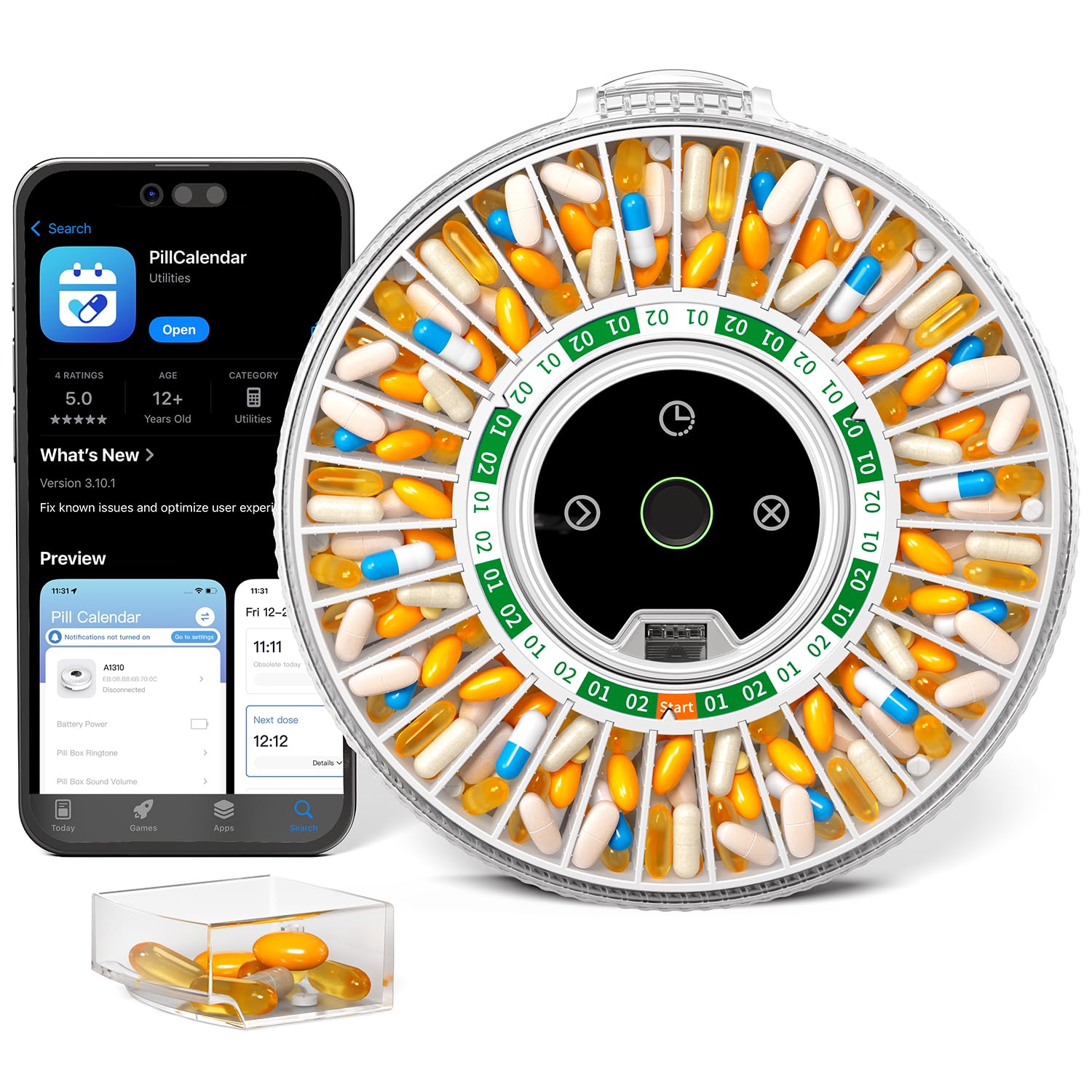
A plug-in dispenser that swaps the beep for your own recorded voice.
The personalization is the point. Beyond 3 standard alarm tones, you can record custom reminders in a family member’s voice — “time for your pills, Dad” instead of a beep. That familiarity helps a lot when the person taking the medication resists a cold machine tone. It also offers a press-to-open design that does not require lifting the whole unit, and a fingerprint open up backed by a mechanical lock to keep children and impulsive hands out.
Capacity is generous: 31 compartments with 7 double-sided dose rings cover monthly and weekly regimens. Power is dual — plug it in for everyday use with no battery worry, and if the power cuts out, a built-in 1200 mAh backup keeps doses opening on time. The free app sets up in minutes, logs every pill, and drives the reminders.
Keep your expectations calibrated. It is the heaviest unit on this list at 3.06 pounds, so it lives on a counter rather than a nightstand. The app is the weak link — some customers note it refusing to open or refusing to cooperate with older phones, and multi-dose schedules beyond two times a day take real effort to program. This is a machine for a caregiver who is comfortable with an app, not for solo self-setup.
Get this if: You want warm voice reminders and app logging, and you are comfortable setting up a phone app for your parent.
Pass if: Nobody in the household will troubleshoot an app or the medication plan runs three-plus times a day.
8. 28-Day (1X) Automatic Pill Dispenser, No APP with Alarm & Desiccant

One button, one dose, no tray to flip — the simplest daily routine on this list.
Most dispensers ask your parent to lift and tip the whole machine. This one asks for a single press. There is no tray to rotate and no carousel to flip — press the button and today’s dose drops into a cup below via a slide-door. For weak grip strength or shaky hands, that is a meaningful difference. The timing window is generous too: a dose can be taken up to 15 minutes early or 30 minutes late before the machine moves on, so a slightly early or late morning does not throw the schedule.
Reminders adapt to the person: choose sound-only, light-only, or sound plus light, with a bright LED ring and clear beeps that still land in a noisy or dim room. Moisture gets real attention with a water-resistant lid, a sealing silicone structure, and dual desiccant chambers (the drying packs that keep pills from clumping in humid air) that the maker says keep pills stable for 7+ days in high humidity. Each of the 28 large compartments takes everyday pills, and no app is required.
Two things to know before buying. Small pills have been known to stick, and gummy-style capsules are not recommended because they cling. Also, the tray is bottomless once pills are loaded — take it out and the contents scatter — so open it over a surface. Some owners found the tray tab stiff to pull. Most, though, describe a sturdy, well-made machine that a 94-year-old can run without help.
Why it is the easy one
- One-press dispense drops the dose into a cup — no lifting, tilting, or flipping.
- 15 minutes early or 30 minutes late gives real-world flexibility on dose timing.
- Dual desiccant chambers plus a sealed lid protect pills in humid bathrooms.
Where it bites
- Small or gummy-style pills can stick — steer clear of gummy capsules.
- The tray is bottomless once loaded; do not lift it out mid-cycle.
- Setup is straightforward but may still need a caregiver’s first pass.
Ideal for: A senior with weak hands or shaky grip who needs the least physical effort per dose.
Choose another: If the medication includes small or gummy pills, which this tray handles poorly.
9. 42-Day(1X) Automatic Pill Dispenser (Expandable Tray)
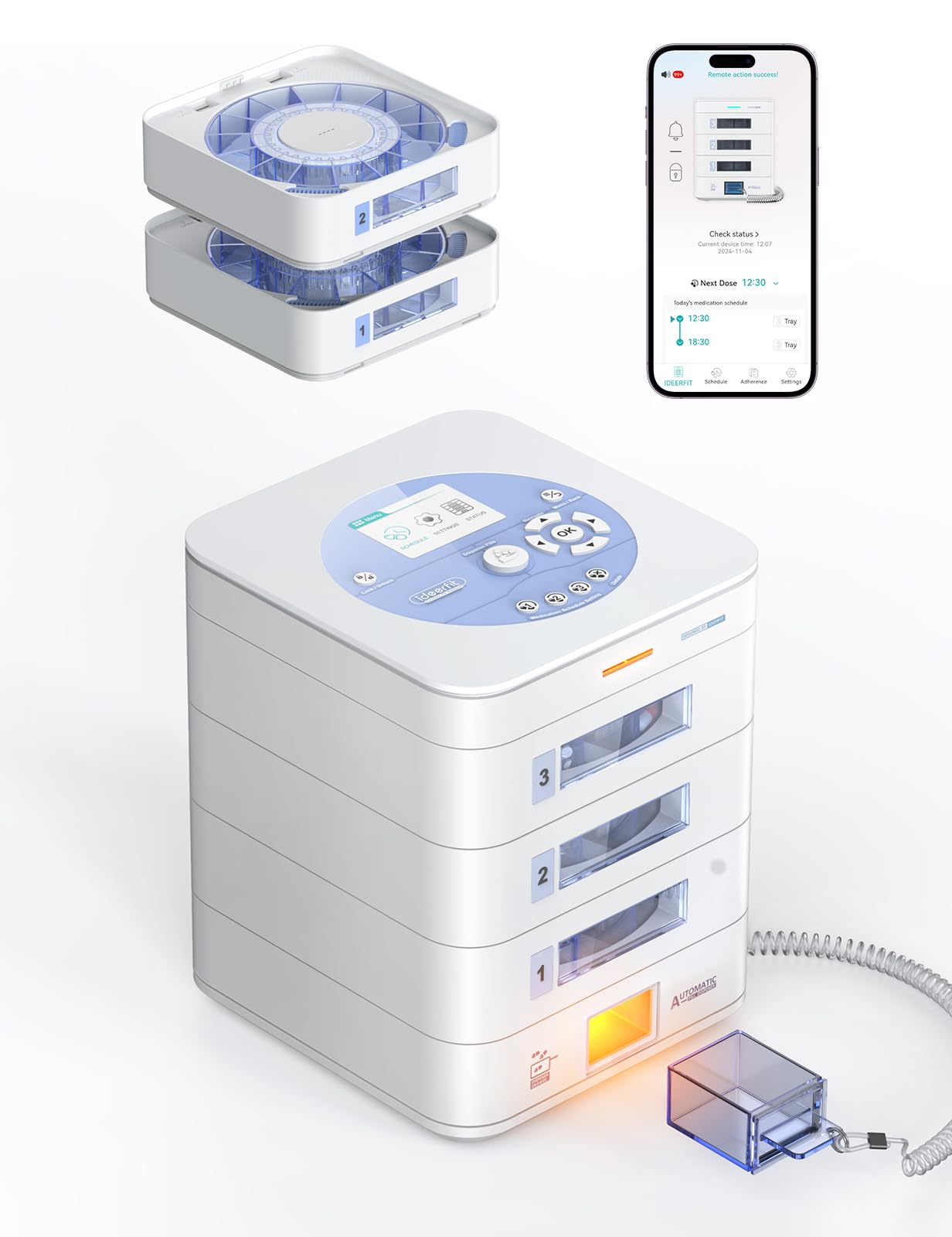
For the caregiver three states away — set doses and confirm they were taken from your phone.
This is the pick for families who cannot be in the room. Set dosing times remotely through the app, check whether pills were actually taken, get alerts for missed doses, and trigger an emergency dispense if needed. The digital lock keeps accidental access out, and the app logs dosage history and adherence over time. No subscription is required, and software updates arrive automatically.
Setup flexes to whoever is comfortable. A senior can program it on the device with voice prompts guiding each step, or family configures everything through the app. The three-tray design works differently from a carousel — each tray holds 14 pill slots, one slot equals one dose, and each tray stands for a time of day. Loaded for a once-a-day plan, the three trays cover 42 days; twice or three times a day shortens that window. There is no manual rotation and no rings to swap.
The honest limits are real. It runs on 4 AA batteries, not rechargeable ones, and the battery indicator is not always accurate. Wi-Fi setup and programming frustrate non-technical caregivers, and the lock is genuinely stiff — described as bank-vault-like by one frustrated user. You also cannot add a fourth tray later without significant extra cost, so plan your tray count up front. Support, though, is repeatedly called excellent, and it holds its settings through a power loss.
Where it leads
- Remote monitoring of whether doses were taken, with missed-dose alerts and remote dispensing.
- Three-tray design gives 42 days at once-daily dosing with no carousel to rotate.
- Dual setup — on-device voice prompts for seniors, app control for family.
What to weigh
- Wi-Fi setup and programming challenge non-technical caregivers.
- Runs on 4 AA non-rechargeable batteries with a battery indicator that can misread.
- You cannot add trays after purchase without extra cost, so decide the count up front.
Built for: A caregiver who lives far from a parent and needs to confirm every dose was taken without calling.
Not the fit: Households with no one comfortable managing Wi-Fi and an app.
Understanding the Specs
Daily alarms and dosage rings
An alarm is the reminder; a dosage ring is the shaped tray that sets how many doses the machine can release in a day. A 28-slot carousel with a once-a-day ring runs a full month between refills. Swap in a ring set for four doses a day and the same tray runs about a week. Match both to the prescription before you buy — a six-alarm machine on a twice-daily plan is fine, but a three-alarm machine on a five-dose plan will fall short.
Locking, keys, and fingerprint access
A physical key lock keeps the tray closed between doses, so the only pills reachable are the ones currently due. A fingerprint reader adds a second layer by restricting even that access to a saved finger, which stops impulsive double-dosing. Both systems usually ship with a manual backup so a lost key or a dry fingertip does not lock the family out. Whatever you choose, test the lock at home — stiff latches get bypassed in frustration.
Alert type — sound, light, or both
Match the alert to the person, not to the spec sheet. A loud beeper suits someone hard of hearing; a flashing light suits someone who cannot hear high tones but sees well. The strongest units run both at once and keep repeating for up to 30 minutes until the dose is taken, which matters most in dementia care where a single chime is easy to sleep through or ignore.
Capacity and refill frequency
Capacity numbers are meaningless without a dose count. A 28-slot tray at one dose a day is a month of independence; at two doses a day it is roughly two weeks; at three doses a day it is about ten days. If you would rather not make refill trips that often, look for a larger slot count or a model that expands with extra trays. Then decide who does the refilling, because that person needs to be local.
FAQ
What is the difference between an automatic pill dispenser and a weekly pill box?
How many daily alarms do I need for twice-a-day medication?
Will a locking dispenser work for someone with dementia?
Are the batteries included, and how often do they need replacing?
Can a caregiver set up the dispenser remotely?
What happens if a dose is missed?
Do I need a smartphone to use these dispensers?
How do I keep pills from sticking in the compartments?
Is a bigger unit always better for an elderly parent?
Can these dispensers be used while traveling?
Final Thoughts: The Verdict
For most families, the automatic pill dispenser for elderly winner is the Colorwing® 2025 Smart Pill Dispenser for Seniors — a 4.5-star, 600-plus-rating favorite that pairs a fingerprint-and-key lock with a press-release box for arthritic hands, so a senior can manage their own doses. If stiff fingers are the main obstacle, grab the 28-Day (1X) one-press dispenser and skip the flipping. And if you live far away from your parent, the 42-Day dispenser is the one to reach for — it is the only model here that lets you confirm a dose was taken without picking up the phone.
How We Picked
We do not accept paid placement. Every pick is matched to a real buyer and a real use-case; we do not hands-on test units.
Sources & Methodology
Specifications: manufacturer listings and product documentation. Review insights: verified customer reviews, as of September 2026. Pricing: not shown on this page (it changes often); check the current price via the retailer link.
As an Amazon Associate, Gadgets Feed earns from qualifying purchases. This does not affect which products we feature.