
Our readers keep the lights on and my morning glass full of iced black tea. As an Amazon Associate, I earn from qualifying purchases.
Specs are compiled from manufacturer listings and verified buyer reviews and can change over time — please confirm the key details on the product page before buying.
Going away for a week shouldn’t mean coming home to brown, crispy leaves. An automatic plant watering system fixes that by delivering water on a schedule you set, so your pots stay hydrated whether you’re on a three-day work trip or a three-week vacation. The catch is that these systems come in three very different shapes — pump-and-timer drip kits, solar-powered drip kits, and no-power gravity wick systems — and picking the wrong one for your setup is the fastest way to drown a cactus or dry out a fern. This guide breaks down nine real options so you can match the system to your plants and your space.
I’m Min — the founder and writer behind Gadgets Feed. This guide is built by comparing the manufacturers’ published specifications and the patterns across verified customer reviews, so you get each pick’s real strengths and trade-offs instead of marketing spin.
Most people only need one of these once they understand watering frequency, reservoir size, and whether a faucet is even available. If you want the short answer, the pump-and-timer drip kits are the most flexible for indoor collections, while gravity wick systems win for a silent, no-electricity setup. Here’s what to know before buying an automatic plant watering system.
Our Picks at a Glance

How To Choose The Best Automatic Plant Watering System
Three things decide whether an automatic watering system works for you or becomes a plastic paperweight: how it moves water, how often you can schedule it, and where it pulls water from. Get those right and everything else — tubing length, number of drippers, app control — is just detail. Here’s what actually matters when you’re standing in front of a listing.
Water delivery: pumps, gravity, or wicks
A pump system uses a small electric motor to push water through tubing to each pot. It gives you the most control and the longest reach, which is why it suits collections spread across a room or a balcony. A gravity system skips electricity entirely — water flows downhill from a reservoir through wick lines that the soil pulls from as it dries. No noise, no timer, no battery to charge, but you do need to get the reservoir height right. Old-school terracotta spikes are the simplest version: you bury a porous clay bulb and refill it from the top.
Frequency and duration range
This is the spec serious buyers check first, because it decides which plants the system can actually support. A kit that only waters every few days is useless for thirsty ferns in summer, while one that can run every hour is overkill for a snake plant. Look for a stated frequency range (for example, every 8 hours up to every 30 days) and a duration range (seconds up to minutes) rather than a vague promise of “customizable schedules.”
Water source and reservoir
Most drip kits don’t connect to a faucet — they drop an intake hose into a bucket, jug, or barrel. That’s a feature, not a limitation, because it means you can run them in an apartment or on a patio with no plumbing. A bigger container simply means fewer refills, so size your reservoir to how long you’ll be gone.
Quick Comparison
| Model | Best For | Power | Plants Covered | Tubing Length | Amazon |
|---|---|---|---|---|---|
| Moistenland Automatic Plant Waterer★ Best Overall | Simple indoor drip on a budget | Battery or USB-C | — | 33 feet | Amazon |
| RAINPOINT Large Display WatererBest Display | Reading your next watering time | Rechargeable battery | 10–15 plants | Main + branch line | Amazon |
| Beday Solar Drip Irrigation SystemBest for Outdoors | Balcony and patio without an outlet | Solar + USB | 15 potted plants | 50 feet | Amazon |
| SmartiLiving Drip Irrigation Stakes | No-power watering for outdoor pots | Manual (gravity) | 4 pots (4 jars) | — | Amazon |
| DAOTAILI Dual-Pump Watering System | Two separate watering zones | USB-C or 4 AA | Up to 20 plants | — | Amazon |
| Beday 206S Two-Pack Waterer | Two-room coverage in one buy | Battery powered | 15 pots per set | 33 feet (x2) | Amazon |
| LetPot Wi-Fi Watering System | Remote app control and alerts | App-controlled | 10–20 pots | 10 meters | Amazon |
| ZEEGO Automatic Plant Waterer | No-faucet setups in apartments | Battery or AC | Up to 10 plants | 33 feet | Amazon |
| Spider Farmer Gravity Self-Watering System | Silent no-power growing | No power needed | 4 plants | — | Amazon |
In‑Depth Reviews
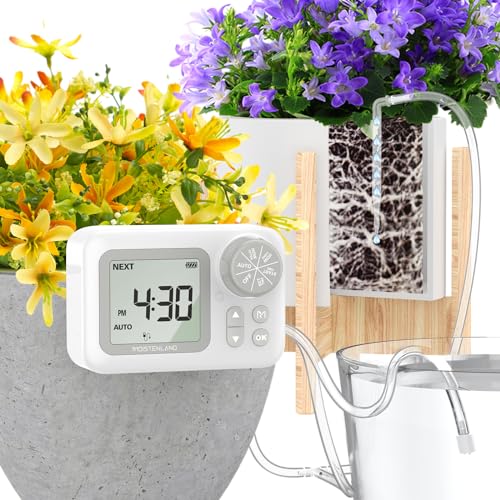
1. Moistenland Automatic Plant Waterer, Indoor Plant Watering System
Our pick — over 4★ from 250+ verified ratings; the strongest balance of quality and price.
The drip kit that quietly keeps a room full of plants alive for three weeks straight.
If your plants live indoors and you want a programmable drip setup that’s ready to run the day it arrives, this is the pick to beat. The kit ships as 15 pieces with 33 feet of hose, so you can route drip lines to pots across a room without running short. It runs on batteries or USB-C, and the schedule is set through a straightforward button control with an internal clock — you decide the day and time watering starts, then leave it.
What wins people over is the sheer reliability of the thing. The functionality is what the vast majority of owners talk about, and the pattern is consistent: it keeps plants thriving through vacations rather than merely surviving. Buyers report three-week trips ending with all seven plants healthy and no dry or waterlogged soil. The manufacturer claims up to 70% water savings versus hand watering, since drip delivers to the root zone instead of the surface.
The one thing you must get right is the siphon effect. The inner pump has no anti-siphon built in, so if your water source sits above the pots, water keeps leaking from the drippers even after the timer stops. Keep the reservoir below all your potted plants, or make sure the first dripper in the line sits higher than the water level. A few owners have also hit algae in the tubing over the long term, and the tubing isn’t replaceable, so clean water matters.
Where it earns its keep
- 15-piece kit with 33 feet of hose so you can reach every pot in a room
- Runs on batteries or USB-C, giving you a backup if one power source drops out
- Up to 70% water saving versus traditional watering, per the manufacturer
- Internal clock lets you set both the start day and the start time
The fine print to know first
- No built-in anti-siphon, so the reservoir must sit below your plants or drippers keep leaking
- Tubing isn’t replaceable once it’s fitted to the timer ports
- Instructions split owners — some find them great, others tricky
Reach for this if: you want a flexible indoor drip kit with the widest mix of power options and enough hose for a full room of pots.
Think twice if: your water source has to sit higher than your plants — this exact kit needs the reservoir below them to avoid constant dripping.
2. RAINPOINT Large Display Automatic Plant Waterer
A big LCD that tells you the next watering time, and a soak cycle that spares your soil.
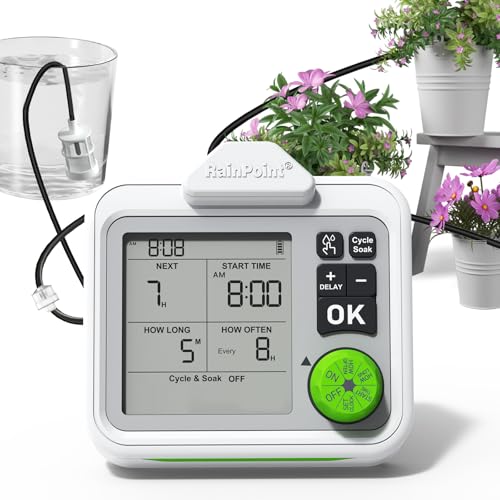
The screen is the whole point here. Instead of guessing when your plants last got a drink, the large LCD shows your interval setting and the next scheduled watering time side by side — so a quick glance settles it. You can set frequency anywhere from every 8 hours to every 30 days, and duration from 20 seconds to 20 minutes. For anything over two minutes, you switch to Cycle & Soak mode, which splits the watering into shorter bursts with rest periods in between so the soil absorbs rather than lets it run off.
This kit comes with 27 pieces versus the 15 in the Moistenland system above, and it weighs 0.72 kg against that kit’s 0.65 kg. That larger piece count translates into more emitters, barb fittings, and accessories for spreading water evenly across multiple pots — the included anti-siphon valve also cuts down on unwanted dripping and water imbalance. Two handy extras: your saved schedule survives a dead battery, so you don’t reprogram after recharging, and a delay function pauses watering for 24, 48, or 72 hours when the soil is still moist.
Where owners land on this one is split, honestly. Reliability and watering performance are the two things people praise most, and the practical result is a system that waters a greenhouse quietly while you’re away. The catch worth planning around: battery life draws mixed reports, and several owners find the batteries won’t charge past 50%. Water distribution gets similar mixed feedback, so calibrate your drippers with a practice run before you trust it with a trip. And if you change any setting — even the clock time — the whole program resets.
The strongest argument: a next-watering-time display removes the single biggest anxiety of drip watering — not knowing whether the schedule is actually running.
Best for: anyone who wants to see at a glance when the next watering is due and needs soak cycles for plants that hate runoff.
Look elsewhere if: you want long stretches between charges — plan on topping up the battery and expect a full reprogram if you touch the clock.
3. Beday Solar Drip Irrigation System, 490 Timer Modes
Solar power, 490 schedule combinations, and rain-ready waterproofing for a balcony or patio.
For a patio or balcony with no convenient outlet, this is the system built for the job. It’s rated IP67 waterproof — meaning it shrugs off rain and hose spray — and it charges two ways: a solar panel for daily top-ups and USB for gloomy weeks when the sun won’t cooperate. That dual-charging design is why it keeps running through winter instead of shutting down like solar-only units. The 50 feet of tubing reaches 15 potted plants, and the flow runs at 400 ml/min.
The scheduling is where it separates from the pack. You get 490 unique combinations built from 14 frequencies (every hour up to every 7 days) crossed with 35 durations (10 seconds up to 30 minutes), all shown on an LED screen that also displays battery level. There’s also a soil moisture sensor for humidity-based watering and a manual mode for instant drinks. Owners praise its performance in brutal heat — one Texas grower’s plants stayed healthy through summer, and the solar panel kept the battery near full after two weeks away.
Two honest caveats. The frequency ceiling is 7 days, and there’s no countdown display showing days remaining — so a plant that only needs water every two weeks in winter is beyond what the schedule can express. More importantly, several owners flag the tubing as non-standard, which makes adding fittings or extending the line genuinely annoying and can mean wasted money on incompatible parts. Factor that in before you plan a sprawling setup.
Why it stands out: 490 timer combinations is the widest scheduling range in this lineup, and IP67 plus solar charging means it lives outdoors without complaint.
Pick this one if: your plants sit outside, you want solar as the primary charge, and you like fine-tuning frequency and duration on a real screen.
skip it if: you need intervals longer than seven days or you plan to heavily extend the drip line — the non-standard tubing fights you.
4. SmartiLiving Drip Irrigation Stakes, 4 Week Waterer

No batteries, no tubes, no timer — just buried clay that seeps water as the soil dries.
If you’d rather not deal with pumps, wiring, or programming at all, this is the simplest route to automatic watering. Each set is four terracotta jars with cork tops, and each holds 12 ounces of water that seeps through the porous clay into the soil on demand. Because the bulb is buried, most of the body sits below the surface, which makes it far less noticeable than a glass globe poking out of a planter. You refill from the top without ever pulling the spike out.
Where these genuinely shine is large outdoor pots in extreme heat. Owners mention filling the jars and returning a week later to plants that never wilted. The look is a clear favorite too — the natural terracotta reads like part of the garden rather than hardware.
Here’s the honest trade-off, and it’s a big one: durability. The single most-discussed aspect is breakage, and it’s not isolated — cracks show up on arrival and sometimes after filling and inserting. Reviews vary on whether they last a month or just a couple of days. There’s also a seasonal rule worth knowing: store them somewhere mild before the first frost, because freezing temperatures cause them to crumble. Warmer climates and generous care get the most out of these.
The case for clay
- No pump, electricity, or timer — nothing to program or charge
- 12 ounces per jar delivers steady moisture for outdoor container plants
- Low-profile buried design looks tidier than glass globes
What you give up
- Terracotta arrives cracked often enough that replacements are common
- Freezing weather cracks them — store indoors before frost
- Watering duration varies widely, from about four weeks down to a couple of days
Made for: sunny-climate gardeners with big outdoor pots who want zero electronics and don’t mind a lower-tech approach.
Not the one if: you need predictable, measured schedules or live somewhere with hard freezes — the clay is fragile.
5. DAOTAILI Automatic Watering System, Dual Self-Priming Pumps

Two pumps, two schedules — the easiest way to keep thirsty herbs and a dry-loving cactus happy at once.
Two independent pumps are the reason this kit earns a spot. Each pump runs its own schedule and its own flow rate, so you can give succulents a trickle and herbs a heavier drink without compromising either. The kit covers up to 20 plants with adjustable drip emitters you can set from low to high flow to match different pot sizes. Power comes from USB-C or four AA batteries, and the battery backup keeps the schedule running if the main power drops.
Setup is what makes the strongest impression — it’s the aspect owners praise most, and with push-to-connect connectors it really is a quick build. The intake hose drops straight into a bucket, bottle, or water jug, so no faucet is needed, and using a larger container simply means fewer refills. The dual-zone layout also solves a real problem on long runs: splitting the line into two zones keeps water from getting thin at the far end.
Two things to plan for. The unit isn’t waterproof or UV-resistant, so if it’s going outside it needs a covered spot or a plastic shelter over it. Adjustability and leakage draw a mixed reception — some owners run it leak-free, while others hit dripping at the connections, which locking tubing and T-connectors help prevent. Place the water container below the pots and the flow settles down.
The dual-pump advantage: separate schedules and separate flow rates mean one system genuinely handles plants with opposite water needs.
Worth it for: indoor growers with a mixed collection who want two distinct watering zones and the freedom to run off a jug or bucket.
Second-guess it if: you need something that lives outdoors uncovered — this one wants shelter from rain and sun.
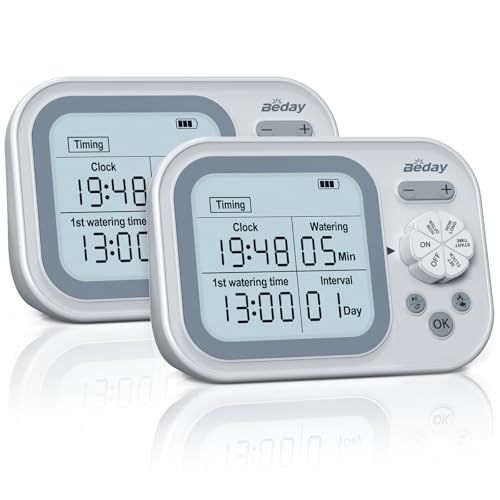
6. Beday Automatic Plant Waterer, Two-Pack for 15 Plants
Two full watering systems in one box, so two rooms get watered without sharing a single pump.
Buying two complete kits at once is the practical answer if your plants live in more than one room. Each system covers up to 15 pots with strong water pressure, and each ships with 33 feet of tubing, a Type-C cable, T-joints, and drippers — so upstairs herbs and downstairs houseplants both run on their own controller. Strong pump lift means a distant pot still gets its share, and the humidity mode automatically adjusts output when you’re unsure how much a new plant needs.
What makes owners happy is straightforward effectiveness — plants thriving rather than surviving, and coverage that stretches to a 55-gallon drum or a 5-gallon bucket as the reservoir. The controller is simple: manual, auto, or timed. The anti-siphon components and a filtered intake are included, and a single unit can run reliably for more than three months on a setup done right.
Two honest limitations show up in the details. The stakes are non-adjustable funnels rather than tunable drip heads, and the 1/4″ tubing is non-standard, so expanding the kit means hunting for compatible parts. Durability and battery life both draw a mixed picture, with some owners seeing the battery last around 14 days. A couple of owners also note the system isn’t rainproof, so an outdoor placement needs a cover.
What two packs buy you: full redundancy — if one controller needs troubleshooting, the second system keeps the rest of your plants on schedule.
Go for it if: you have plants in two locations and want both covered with their own controllers and tubing out of one purchase.
Give it a miss if: you want to fine-tune flow at each individual stake — these heads don’t adjust plant by plant.
7. LetPot Automatic Watering System, Wi-Fi & App Control

A quiet pump, a friendly app, and low-water alerts you can read from the other side of the world.
This is the pick for anyone who wants to check in on their plants from their phone. The LetPot app supports up to five simultaneous watering tasks, so you can run separate schedules and won’t be stuck at the unit to change them. A German-imported silent pump keeps the noise down — quiet enough to sit in a bedroom — and the upgraded 2.0 chip holds a stable Wi-Fi connection. It’s rated IP66 waterproof, so balconies and weather aren’t a problem.
The hardware backs it up. An anti-backflow valve stops the siphon effect that plagues cheaper drip kits, a spiral lock keeps water pressure consistent, and adjustable drippers let you pick continuous or intermittent watering. It ships with 10 meters of pipe, 10 adjustable drippers, connectors, brackets, and a filter — enough to support 10 to 20 pots. The app adds free plant information and a diary feature, and the whole package is backed by lifetime service and remote upgrades.
Owners consistently call out the build quality, and the app is genuinely easy to use. The thing to watch is leakage — it’s the one negative that keeps surfacing, and it usually traces back to dripper adjustment rather than the unit itself. The coiled PE tubing can also be stiff at first, making placement fiddly. The manufacturer’s own tip for installation is to soak the pipe head in warm water before pushing fittings on — do that, and assembly is much less of a fight.
Why the app crowd loves it
- Up to 5 simultaneous watering tasks set remotely from your phone
- IP66 waterproof plus a silent pump rated for indoor use
- Anti-backflow valve and spiral lock keep pressure steady
- 10-meter pipe and 10 adjustable drippers cover 10 to 20 pots
Where it asks for care
- Leakage is the recurring gripe — steer clear of over-tightened drippers
- Stiff coiled tubing takes patience to route
- No flow-rate graphics on the nozzles, so misadjustment can cause overflow
The right choice for: plant owners who travel often and want to adjust schedules and get low-water alerts from their phone.
Pass on it if: you’d rather set a dial and forget it — the app is the whole appeal, and misconfigured drippers can leak.
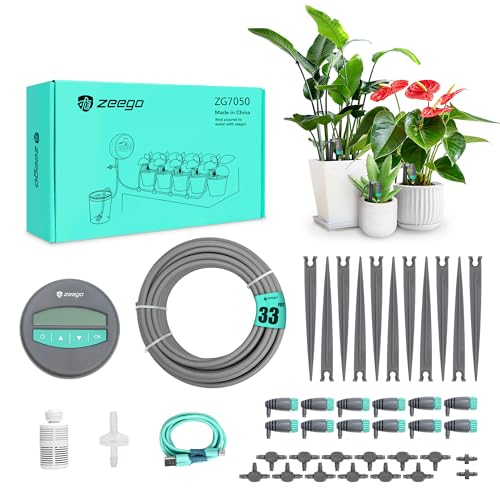
8. ZEEGO Automatic Plant Waterer, No Faucet Required
A no-faucet drip kit that pulls from a jug or barrel and covers ten pots from one controller.
This one is built around a simple idea: no plumbing required. The intake draws straight from a bucket, reservoir, or container, which makes it a natural fit for apartments, balconies, and patios where a tap isn’t handy. It waters up to 10 potted plants and comes with 33 feet of tubing, 10 drippers, connectors, a water filter, and tubing holders — everything to get running from the start. Dual power means it runs on batteries or an AC adapter, so it keeps going even in an outage.
Owners get real distance out of it. It has handled nine-day trips and kept plants watered for up to two weeks, and the battery-plus-AC combo survives a power cut. The targeted root-zone delivery helps reduce runoff, and the adjustable drippers let you dial water per plant where it’s needed.
The trade-off here is that setup and tuning take effort. Assembly requires some elbow grease — the hoses are tight and high quality, which is exactly why they’re stubborn to push onto fittings — and timer programming is the part that trips people up. It also keeps trips outdoors simple by working best indoors, and it has no humidity sensor, so timing is on you. One owner lost a plant to overwatering without that soil-moisture feedback. Drip also wets the top of the soil rather than deeply, so plants with deep roots may want a longer run.
In its favor: dual power plus a big reservoir keeps ten plants watered through outages and week-long trips without any faucet connection.
Consider this: if your plants are indoors or on a covered balcony and you want a no-faucet kit with outage-proof dual power.
Think again if: you want moisture-sensing automation — without a humidity sensor, overwatering is on you to watch.
9. Spider Farmer 4 Pot Gravity-Fed Self Watering System
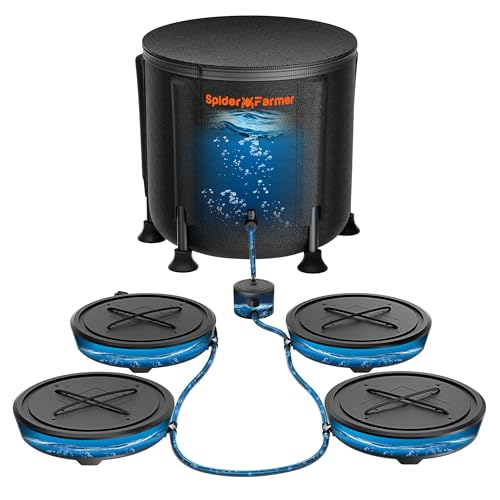
A 13-gallon reservoir and wick lines that feed four plants for weeks with zero electricity.
If you grow in a grow tent or want a completely silent setup, this is the one to look at. A 13-gallon reservoir sits under grow bags and water climbs through wick lines on its own — no pump, no timer, no electricity, no noise. A full 13-gallon reservoir feeds four plants for up to four weeks. The upgraded outlet sits 4 cm lower than the previous design to improve water utilization, leaving only 5 liters of residual water in the tank. The kit includes four self-watering bases, 5-gallon grow bags, wick lines, a shut-off valve box, and water tubes, and it supports up to 100 lbs.
Functionality is what owners praise most, and the practical result is a system that lets plants drink exactly what they need — which is why the wick design reduces both overwatering and underwatering. Customers note plants growing fast once the wicks are primed. One essential setup note: on the first fill, you may need to top-water the soil by hand to get the wicking process started.
Two things to weigh. The wicks can let roots grow through them into the small supply tubes, which clogs the flow and can hurt plants left unattended — a real risk for anyone away for long stretches. And the reservoir is a sewn-fabric tub rather than rigid plastic, so long-term durability is a commonsense question mark. A few owners also find pH drifts in two to three days, so pre-adjust your nutrients when refilling.
Why gravity wins here: silence, zero power draw, and a 13-gallon tank mean you can fill once and step away — no batteries to trust, no programming to learn.
Ideal for: grow-tent users and indoor rooms wanting a silent, no-electricity system that feeds four plants for weeks at a time.
Look past it if: you’re away for very long stretches without checking the wicks — root clogging in the lines is the risk to monitor.
Understanding the Specs
Watering frequency and duration
Frequency is how often the system waters — for example, every 8 hours or every 30 days. Duration is how long each watering lasts, from a 10-second splash to a 30-minute soak. These two settings together decide which plants a system can actually support. A range that starts at hourly intervals suits thirsty indoor plants, while a range that stretches toward a month is better for low-water species. Buyers should look for the stated range, not just a vague promise of “customizable” schedules.
Reservoir and water source
Most drip systems don’t hook to a faucet. Instead, an intake hose drops into a bucket, jug, or barrel, and the pump pulls from there. A larger container means fewer refills — one buyer watered a simple line setup from a 5-gallon pail for a full week away. To avoid unwanted dripping, keep the water source below the pots, or check whether the kit includes an anti-siphon valve.
FAQ
Will an automatic watering system work without a faucet?
How do I stop water from continuing to drip after the timer stops?
How many plants can one automatic watering system handle?
Should I place the water reservoir higher or lower than my plants?
Do automatic watering systems need batteries or can they run on solar?
Can these systems overwater my plants?
How long can I leave my plants with an automatic watering system?
Are the drip tubing and connectors standard sized?
Can an automatic watering system be used outdoors?
What is the difference between a drip system and a wick system?
Final Thoughts: The Verdict
For most people looking for an automatic plant watering system, the Moistenland Automatic Plant Waterer is the winner — a 15-piece kit with 33 feet of hose, battery or USB-C power, and a straightforward internal clock that keeps an indoor plant collection thriving through vacations. If you want a big display and soak cycles for fussy soil, the RAINPOINT Large Display Waterer is the one. And for outdoor watering where an outlet is out of reach, the solar-powered Beday Solar Drip Irrigation System handles the sun and the rain alike. Whichever you choose, matching the system to your water source and your plants’ thirst will keep your greenery healthy while you’re gone.
How We Picked
We do not accept paid placement. Every pick is matched to a real buyer and a real use-case; we do not hands-on test units.
Sources & Methodology
Specifications: manufacturer listings and product documentation. Review insights: verified customer reviews, as of September 2026. Pricing: not shown on this page (it changes often); check the current price via the retailer link.
As an Amazon Associate, Gadgets Feed earns from qualifying purchases. This does not affect which products we feature.