
Our readers keep the lights on and my morning glass full of iced black tea. As an Amazon Associate, I earn from qualifying purchases.
Specs are compiled from manufacturer listings and verified buyer reviews and can change over time — please confirm the key details on the product page before buying.
If you want a lawn that waters itself while you are at work or away on holiday, you do not need to dig up your yard or hire a contractor. You just need a controller or a hose timer that turns the tap on and off on a schedule you set once. The picks below cover both paths: wired controllers that drive buried valves and battery-powered tap timers that clip straight onto an outdoor faucet.
I’m Min — the founder and writer behind Gadgets Feed. This guide is built by comparing the manufacturers’ published specifications and the patterns across verified customer reviews, so you get each pick’s real strengths and trade-offs instead of marketing spin.
The biggest fork in the road is whether you already have buried valves or are starting from a plain garden tap. Rain Bird TRU6I is the strongest all-rounder in this category, but the right automatic sprinkler for you depends on your zones and your hydrant. Below, I break down what actually matters before you buy anything.
Our Picks at a Glance

How To Choose The Best Automatic Sprinkler
Before you spend a penny, work out what you are actually automating. The answer changes everything about which product fits. There are two separate product families hiding under the “automatic sprinkler” umbrella, and picking the wrong family is the single most common mistake buyers make.
Buried valves or a garden tap
If your yard already has a manifold of buried valves wired back to a wall-mounted box, you need a multi-zone controller. These take low-voltage wiring from each valve and run a schedule for each station. If you are working from a single outdoor spigot, you need a battery-powered hose timer instead. It threads onto the faucet and the hose threads onto it. No wiring, no trenching.
Confusing those two is how people end up with a controller they cannot physically install. Count your zones and check what is already on the wall before you buy anything.
Zone count and station capacity
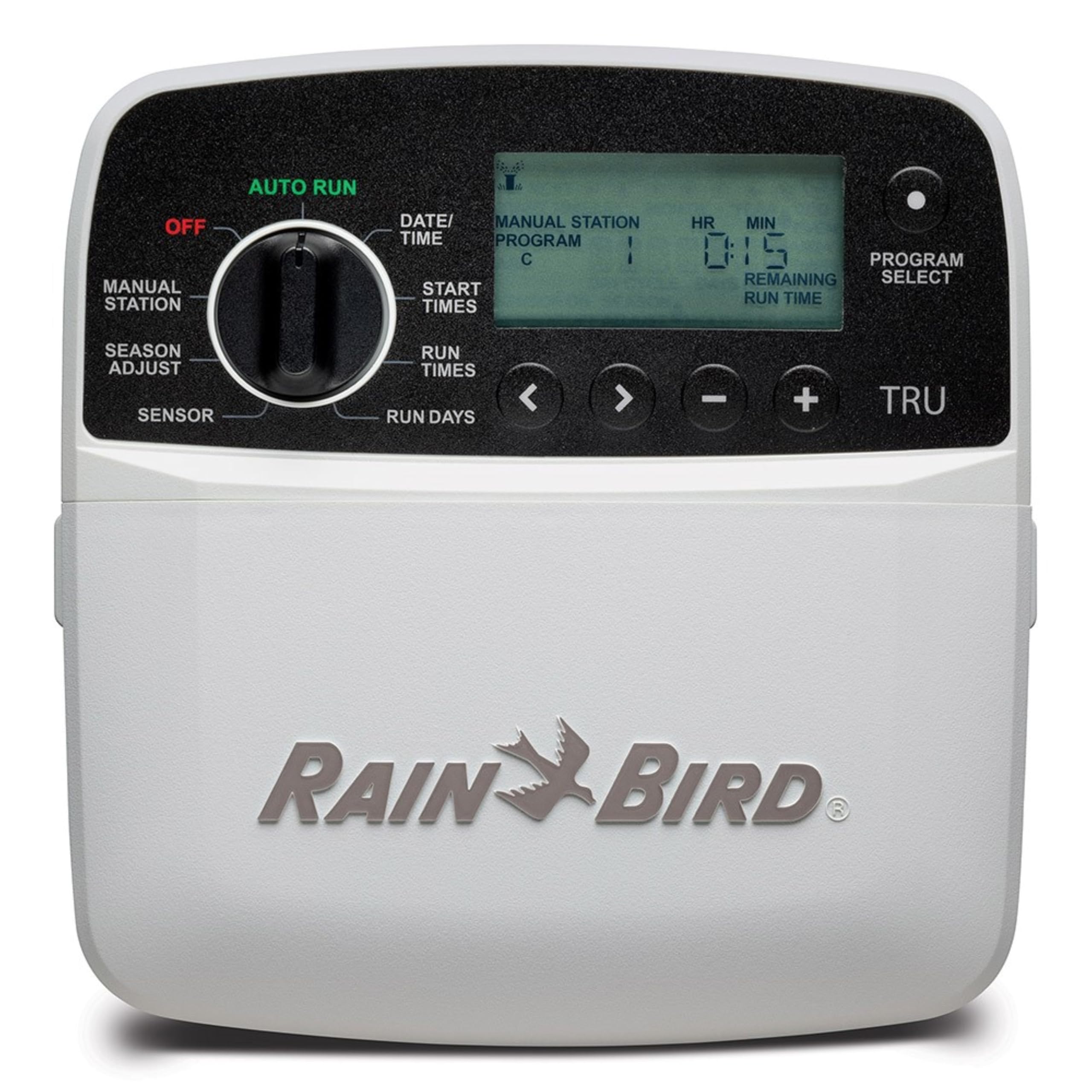
Count the number of separate watering lines in your yard: front lawn, back lawn, flower beds, drip lines and any soaker hose you run. That count is your zone number. A six-station controller such as the Rain Bird TRU6I drives up to six valves. A four-zone timer like the Smart Sprinklers Controller runs four hoses or drip lines. Buy one zone more than you need today so you have room to expand.
Brass versus plastic fittings
The threaded connection between your faucet and the timer is where most leaks start. Brass threads hold their shape through heat, cold and repeated hose changes. Plastic threads wear down and begin to drip. Several of the timers below use a brass inlet and outlet specifically for this reason, and buyers consistently report fewer leaks on the brass models.
Rain delay and weather skip
A basic rain delay pauses your schedule for a set number of hours after you tell it to. A weather-skip timer checks live forecast data and decides on its own whether to water. Both save water. The weather-skip version saves more because it acts without you lifting a finger, though it needs a stable Wi-Fi network to work.
Quick Comparison
| Model | Best For | Zones | Rain / Weather Skip | Fitting Material | Amazon |
|---|---|---|---|---|---|
| Rain Bird TRU6I★ Best Overall | Whole-yard wired systems | 6 stations | 1-14 day rain delay | Not stated | Amazon |
| Smart Sprinklers Controller HSC-400WBest App Control | App-controlled four-zone yards | 4 zones (16 plans) | Auto skip rain, frost, wind | ABS plastic | Amazon |
| Melnor 65133AMZ XT TurboBest for Big Lawns | Portable above-ground lawn watering | Single pattern, 1 connection | Built-in mechanical timer only | Plastic | Amazon |
| MOES 2 Zone Timer SGW06 | Two-hose yards, drip and lawn split | 2 independent zones | Rain delay | Brass inlet and outlet | Amazon |
| Unistyle 3 Zone Timer UNI-05DUS | Multi-area gardens on three taps | 3 zones | 1-7 day rain delay | Brass | Amazon |
| RAINPOINT Brass Hose Timer | Raised beds and drip lines | 1 zone | 24/48/72 hr rain delay | Brass inlet and outlet | Amazon |
| meross WiFi Water Timer MST100 | Smart home and voice control | 1 zone (hub supports 24) | Weather-based auto skip | Brass inlet and outlet | Amazon |
| RAINPOINT Metal Pipe Timer ITV105 | High-pressure drip systems | 1 zone | 24/48/72 hr rain delay | 100% metal pipe, brass inlet | Amazon |
| Orbit 62067 (2-Pack) | Two separate spigots on a budget | 1 zone each unit | 24/48/72 hr rain delay | Plastic | Amazon |
In‑Depth Reviews
1. Rain Bird TRU6I Program-Based Indoor Irrigation Controller
Our pick — 4.5★ from 450+ verified ratings; the strongest balance of quality and price.
A six-station indoor controller for yards with buried valves, with 1-minute to 6-hour run times per zone.
This is the pick for anyone who already has buried valves and wants a brain to run them. It controls up to six valves, with watering durations from 1-minute to 6-hours per zone, so you can drip-irrigate a bed for hours while you run a lawn station briefly. Each of its A, B and C programs supports up to four start times, giving you twelve distinct start times per zone. That is more schedule slots than most suburban yards will ever use.
What wins people over is how the scheduling actually works in practice. You program by days of the week, odd or even calendar days, or in a cycle every 1 to 30 days. The Season Adjust dial shifts every program up or down by 5% to 200% in one twist, which is the feature owners lean on most when summer heat ramps up. There is also a Permanent Days Off setting that stops watering on your landscaping crew’s visit day, and the whole program survives power outages because it stores settings permanently.
The catch is indoor-only placement and no built-in WiFi. You install it on a wall inside a garage or utility room, then run low-voltage wire back to the valves. WiFi is an optional upgrade if you add the LNK2 WiFi Module, sold separately. The display is also noticeably dim in poor lighting; a small lamp in the garage helps. Durability gets mixed feedback, as with any mechanical controller with an exposed dial, though the wide majority of users report years of trouble-free operation.
What owners keep coming back for
- Twelve start times per zone across three independent programs, enough to run a whole yard
- Season Adjust shifts every schedule by 5% to 200% from one dial turn
- Program survives power cuts thanks to permanent storage
- Rain delay pauses watering for 1 to 14 days, or add a rain sensor for automatic restarts
- Runs on six-station wiring with a master valve or pump start relay option
Where it shows its age
- Indoor mounting only — you need a garage, utility room or sheltered wall
- No WiFi from the start; the LNK2 WiFi Module is a separate purchase
- LCD dims quickly in low light, harder to read at dusk than you would expect
Strongest fit for: anyone with buried valves who wants a schedule-setter that stays put and keeps running for years.
Reconsider if: you want to control watering from your phone without buying a separate WiFi module.
2. Smart Sprinklers Controller 2.4GHz WiFi (HSC-400W)
A four-zone app timer that automates your hose bibs without a single wire run.
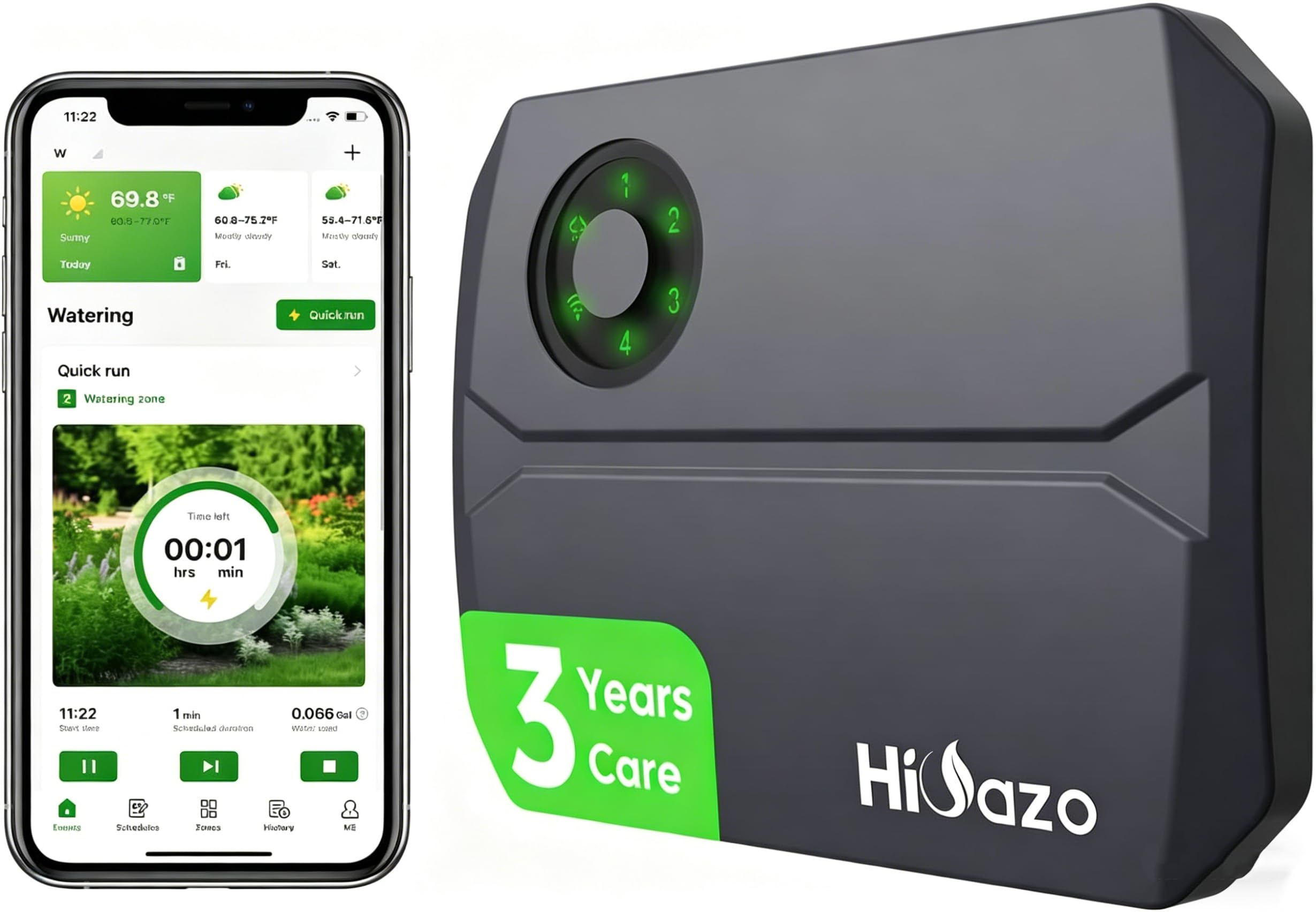
Where the Rain Bird above needs wire strung back to buried valves, this one threads onto your existing controller wiring and runs everything through the Hioazo phone app instead. Sixteen watering plans are spread across four zones, so you can drip a tomato bed daily, soak a lawn twice a week and top off a fern pot once a week without touching a dial again.
Setup is the headline here. Buyers report installs running as quick as fifteen minutes, with many owners describing it as easy for anyone with a screwdriver, and the manufacturer rates it compatible with 99% of existing sprinkler controllers. The weather skip side actually does the work: rain, frost and wind get checked automatically before each run, and the system cancels watering on its own to protect plants and save water. Two irrigation modes are built in, Standard for a straight soak and Soak for a slow, absorbent cycle so soil does not run off.
Two honest notes. The 2.4GHz-only WiFi is the big one: during setup most people have to disable the 5GHz band on their router for the timer to pair, then re-enable it. And the app cannot save seasonal schedules or run overlapping zones, a minor complaint that matters less on a four-zone yard. The ABS plastic body is light but not fussy, and the cover can be painted to match your wall. A three-year care warranty covers the unit.
Where it lands: a genuinely convenient four-zone controller for anyone who already has buried valves but wants to skip the wall-mounted box routine.
The one thing to know: 2.4GHz-only WiFi means a router-band workaround at setup time. Owners mention it as a one-time fuss, then it just runs.
Pick this if: you want full phone control over four zones and prefer a ten-minute install over running cable to a garage panel.
Look past it if: you run more than four zones or need the app to store separate summer and winter schedules.
3. Melnor 65133AMZ XT Turbo Oscillating Sprinkler With Timer
An above-ground oscillating sprinkler that covers a big lawn on its own built-in clock.
Not every yard is worth plumbing. If you are watering from one spigot and want an automatic stop without any timer box on the wall, this is the simplest option on the list. Twenty precision nozzles throw water across up to 4,000 square feet, and the built-in mechanical timer shuts the flow off after a set number of minutes, up to 2 hours. The TwinTouch controls adjust the width and the range of the watering arc independently, so you can blanket the whole lawn or narrow down to a single flower bed.
Owners describe it as the best sprinkler they have used, and the timer feature is the piece that gets singled out most. Coverage ranges that come up in reviews include 16×16 and 16×22 ft patches, with the adjustable spray widening or deepening to match. Melnor backs it with a lifetime limited warranty.
This is a plastic-bodied tool and it is honest about that. It lives outdoors, gets dragged around and eventually cracks, even though the drive is rated for well water and dirt-resistance. Owners who store it indoors between seasons report it surviving for years; owners who leave it out in full sun report it going brittle faster. Treat it as a portable tool, not a permanent installation, and it does its job well. The maximum flow rate is 1.5 gallons per minute at 40 PSI.
How it fits: the right answer when you have a big lawn, one spigot and no ambition to install anything permanent.
What to expect long term: plastic construction plus weather exposure equals a limited lifespan. Store it dry in the off-season and it lasts noticeably longer. One 2.5-year owner called it a fair trade for the coverage and price; several have repurchased a second unit.
Reach for this if: you want big-lawn coverage with its own shut-off clock and no wiring or battery hassle.
Think twice if: you want something that lives outside year-round without any seasonal care.
4. MOES 2 Zone Sprinkler Timer SGW06

Turn one tap into two independent watering lines with brass threads that hold through the seasons.
If you have one faucet but two things to water — say a lawn feed and a drip line for the vegetable patch — this timer splits them into two separately scheduled outlets. Each zone gets its own watering time, frequency and duration, so the tomatoes can drink daily while the lawn waits for its weekly soak. You set the program on a large LCD screen with a simple control panel, and a manual mode lets you trigger instant watering without disturbing the schedule.
The brass inlet and outlet are the piece that actually justifies the purchase. Brass holds its threads far better than plastic through heat, cold and repeated hose swaps, and buyers consistently report secure connections with no leaks around the fittings. Inside, a silicone potting compound seals the internal valve components against moisture and dust, which is what lets this timer survive on a wall through a full summer of rain and irrigation. The rain delay mode pauses your program during wet weather and picks it back up afterward.
The one thing to plan around: this is not a week-by-week scheduler. Owners describe it as a set-and-forget tool where you choose two zones, a watering time and an interval, and that is the whole program. There are no day-of-week settings. If your goal is “water this hose every N hours for this long,” it is ideal. If you want “every Tuesday and Friday at 6 a.m.,” look at one of the multi-zone app timers instead. Runs on AA alkaline batteries and accepts a standard 3/4-inch faucet connection with no tools required.
Snap this up if: you want two independent hose schedules with brass fittings that will not seize on you.
Keep shopping if: you need day-of-week scheduling or more than two zones on one timer.
5. Unistyle 3 Zone Sprinkler Timer UNI-05DUS
Three brass outlets on one wall unit, with a dial simple enough for a first-timer.
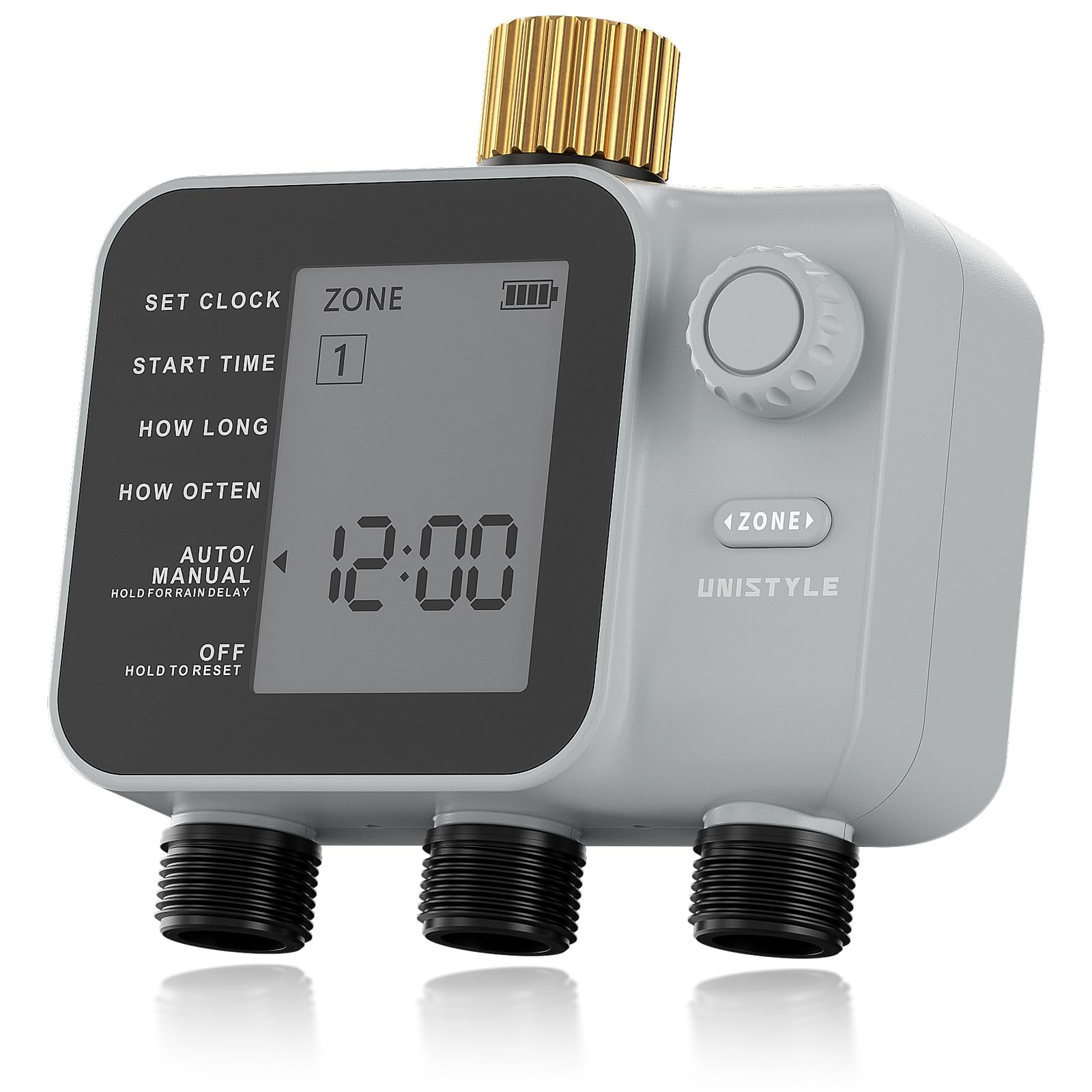
Three separate watering zones on a single hose timer is unusual, and it is what makes this model worth a look for anyone running a front bed, a back lawn and a drip line off one spigot. Each zone takes its own start time, a watering duration from 1 to 360 minutes, and a frequency of either every 1 to 23 hours or every 1 to 15 days. To shut off a single zone you just set its start time to OFF, which is a clean way to silence one line for a season without reprogramming everything.
The interface leans on a single rotary knob paired with a 2.5-inch LCD screen. Choose a zone, pick a value, move to the next field — no menus to dig through. Manual mode runs 1 to 480 minutes when you want to hand-soak something right now, and the child lock stops accidental button presses if children or pets are near the tap. The rain delay pauses on 1 to 7 days of forecast rain and then resumes your original schedule automatically. It fits standard 3/4-inch faucets and hoses and runs from 0.5 to 8 BAR of water pressure.
Build quality draws mixed feedback. Some owners describe it as well-made for the tier; others find the plastic shell light and the dial flimsier than they would like. A few report dripping at the connection, which often traces back to needing a fresh washer or clean threads. Fresh AA alkaline batteries are recommended and they are not included; do not mix old and new cells in this timer, because the unit will misbehave on mismatched power. Buyers who have run it through a full season report it staying accurate and reliable.
Why three zones stands out: it is the rare hose timer that covers a genuinely multi-area garden without stacking multiple units on one tap.
Honest sizing: the shell is not premium and the dial is the first part to feel cheap. Treat this as a value tier unit and keep threads clean and washers fresh.
Ideal buyer: someone watering three separate areas from one faucet who wants a dial-driven, no-app setup.
Not the right call for: buyers who want rock-solid metal construction or app-based control.
6. RAINPOINT Sprinkler Timer With Brass Inlet and Outlet

The best-reviewed brass-fitted hose timer here, and the one most often bought a second time.
Solid brass at both ends is the reason this timer keeps showing up on “buy two” lists. The inlet and outlet are pure brass metal thread rated to 116 PSI, and built-in metal filter gaskets keep sediment out of the valve. The shell is heavy-duty weatherproof as well as UV-resistant, ready for a full season on a sunny wall. Programming covers a start time, watering duration from 1 minute to 3 hours 59 minutes, and frequency from every 1 hour up to every 12 hours or every 1 to 7 days.
The dial and display are what most owners bring up when recommending it. The dial uses plain words — “How Long,” “How Often,” “Time,” “Start” — instead of icons, so the first setup takes minutes without the manual. A large LCD screen shows the current watering time and frequency at a glance. Rain delay modes pause the schedule for 24, 48 or 72 hours automatically, and manual mode runs from 1 minute to 8 hours without disturbing the program. The unit is designed for drip irrigation, lawn sprinklers, greenhouse misting and even pet watering or pool filling.
Honest caveats: the valve makes an audible thunk when it shuts off, which some owners find loud on a quiet morning, and you cannot manually turn on the sprinkler outside the programmed hours without disconnecting the hose. The setup also rewards care — programming requires turning the dial clockwise after each step to save it, and skipping that step sends you back to the start. Brass threads seal better with a wrap of Teflon tape at install.
What buyers rave about
- Brass inlet and outlet rated to 116 PSI with metal filter gaskets against sediment
- Plain-word dial — “How Long,” “How Often,” “Time,” “Start” — no icon guessing
- Reliable on/off through summer drought conditions, customers note
- UV-resistant shell and body keep the unit looking clean after a season outdoors
What to know before buying
- Loud thunk at valve shut-off, noticeable early on a quiet morning
- No on-demand watering outside programmed hours without disconnecting the hose
- Programming requires a clockwise dial turn after each step to actually save the settings
Best for: drip systems and raised beds where brass fittings and readable programming matter most.
skip it if: you want to manually trigger a watering cycle outside the schedule without unhooking the hose.
7. meross WiFi Water Timer MST100 With Hub
The smart-home tap timer that reads live weather and skips the watering for you.
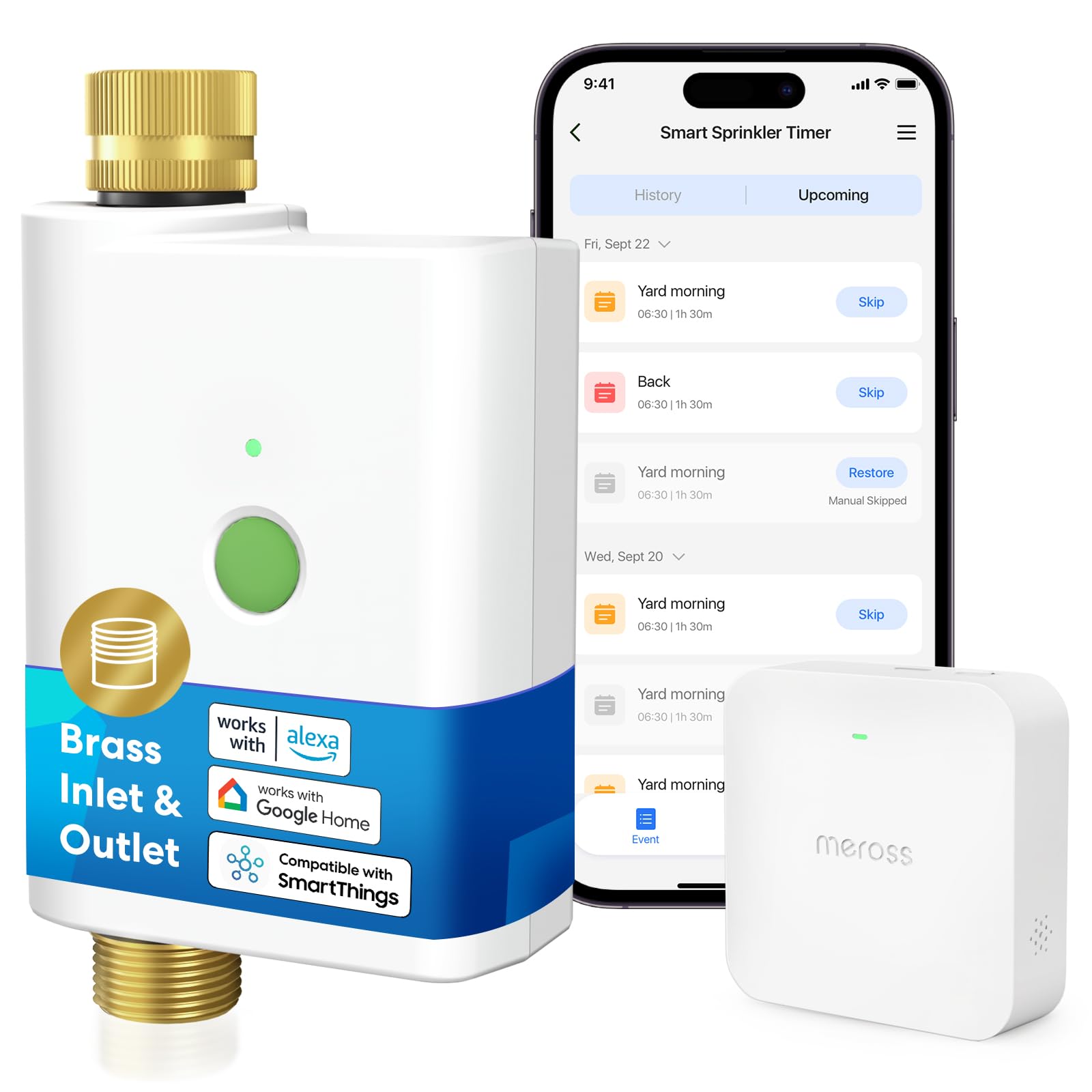
If you already live in the Apple Home, Alexa or Google ecosystem, this is the timer that plugs into it natively. It requires the included MSH400 hub, which handles HomeKit voice and remote control; if you already own either the MSH400 or the MSH450 hub, buy the “timer without hub” version instead. The outdoor timer itself uses brass construction for both inlet and outlet and carries an IP65 waterproof rating. It is limited to 2.4GHz networks only.
The headline feature is weather-based automatic skip. Using hyper-local weather data, the timer cancels watering before, during and after rain, and also in freezing or windy conditions — no button presses required. Notifications land in the Meross app with water usage tracking and alert reporting, so you see exactly how much you are using and know if something goes wrong with the hose. Watering duration runs from 1 minute to 11 hours 59 minutes, scheduled by day of week, and one hub supports up to 24 water timers if you want to build this out across a whole property. Manual watering is a single-button press, with a default 15-minute auto shut-off for when you forget to close the tap.
The catch is setup. The power compartment is tightly secured by design and needs a screwdriver to open from both sides carefully; mismatched pressure on the lid jams it. The 2.4GHz-only WiFi trips up anyone running a combined router band, and on-networks with HomeKit plus certain ISPs, some buyers have reported failure to pair the hub at all. The review pages sum it up: “HomeKit and AT&T does not work. Don’t waste your time.” On 2.4GHz-only routers with no HomeKit dependency, install runs in minutes. There is also a limit of one native watering run per day from the timer itself — multiple short runs require voice-assistant routines.
The core strength: full voice control plus automatic weather skip makes it the most hands-off timer on the list when the setup suits your network.
The gate to clear: a 2.4GHz-only network, a HomeKit-compatible hub, and a screwdriver for the battery compartment. If any of those are deal-breakers, look at the RAINPOINT or MOES timers instead.
Built for: smart-home households already running Alexa, HomeKit or Google Assistant who want to stop thinking about the tap.
Not the pick if: your router combines 2.4 and 5GHz bands and you have no patience for a setup workaround.
8. RAINPOINT Metal Pipe Timer ITV105

A single-tap timer built from a 100% metal pipe, ready for full-flow drip systems.
Plastic fittings are the usual failure point on garden timers, so this model skips them entirely. The internal pipe runs 100% metal from inlet through the valve body, rated to withstand 116 PSI without bursting, and the ball valve is full-bore with an oversized pipe diameter for high flow. This is what makes it a strong fit for drip irrigation and soaker hose setups where flow restriction would starve the far ends of a long run.
Programming is straightforward: a start time, watering duration from 1 minute to 3 hours 59 minutes, and frequency from every 1 hour up to every 12 hours or every 1 to 7 days. Rain delay holds the schedule for 24, 48 or 72 hours after a wet day, and manual mode runs 1 minute to 8 hours for hand-watering without touching the program. The inlet is a brass 3/4-inch threaded connection with an anti-twist lock that survives up to 800N of pulling force, and the IP65 rating covers outdoor wall mounting. RAINPOINT covers it with a 5-year warranty when you register the unit at purchase.
Two honest notes. The valve closes quickly, which creates a water hammer thud through the pipes; one owner with a prior pipe burst found that an in-line hammer arrestor did not solve it, though pipe clips reduced the noise. And the metal body design has one seasonal weakness: in a hot Southwest climate, UV can degrade the plastic housing over several seasons, so owners in extreme heat tend to rotate the unit indoors for winter. Batteries are two AA (not included), held in a tray that is snug to remove — squeeze the tabs and rock it out carefully.
Where it shines: high-flow drip and soaker systems get full water volume without the plastic joint failures that plague lesser timers.
The trade-off to accept: the valve snap-closes with an audible pipe thud, so this is a better fit for drip lines and soaker hose than for a yard with older metal plumbing that is sensitive to pressure shocks.
Pick this if: you run drip irrigation, soaker hose or a large garden needing full water flow without restriction.
Pass if: you have older, thin-walled metal plumbing where a water hammer is risky, or prefer plastic fittings with a softer shut-off.
9. Orbit 62067 Programmable Digital Hose Timer (2-Pack)
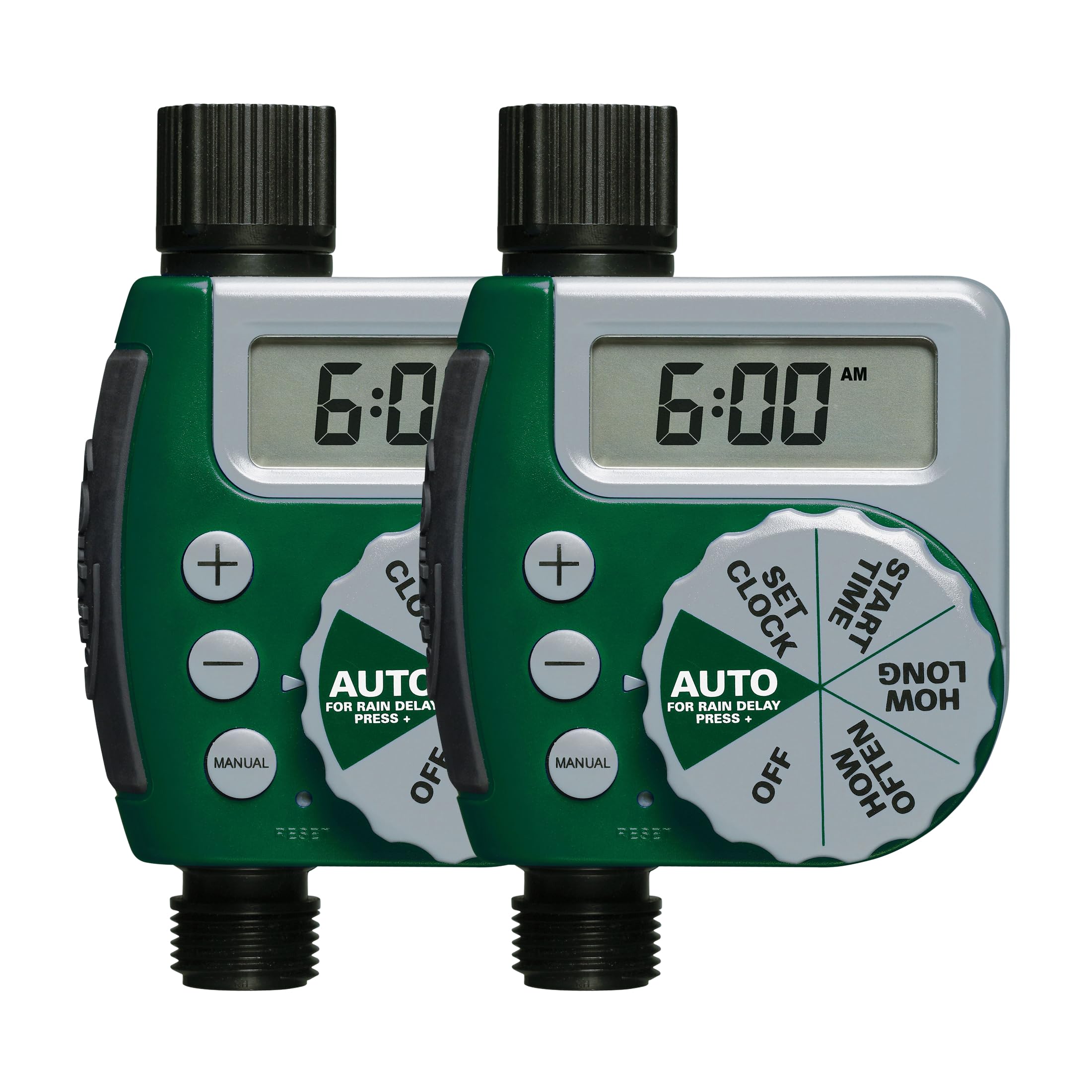
Two battery timers in one box, for two spigots you want scheduled independently.
This is the classic simple water timer, sold as a pair so you can cover two separate outdoor faucets without buying twice. Each unit runs on two AA batteries, keeps its program through battery changes, and covers start time, duration and frequency on a large easy-to-read LCD. The rain delay pauses the schedule for 24, 48 or 72 hours. Install is thread-on and set-and-forget.
Owners who have run these for years describe them as dirt simple to program and repeatedly reliable, with one long-term user noting the same pair handled pool filling, plants and trees through multiple seasons and an Arizona summer. Two AA batteries typically last about two years per unit. the strength here is the price-to-coverage ratio: two complete timers for what most single smart timers cost, which is perfect for someone with two spigots who does not need an app.
The honest limit is the water-resistant seal, not the electronics. Owners who leave these outdoors through a full season have reported water working into the seal around the battery compartment and shortening the unit’s life. The fix is simple and cheap: bring them inside during hard freezes, cover them from direct sun where the seal heats up, and swap the battery-door gasket if it starts to harden. Given how inexpensive a replacement is, most owners treat them as a consumable rather than a permanent fixture, and that is a fair expectation at this price tier.
Best for: two separate outdoor faucets on a tight budget, or stocking spares for a seasonal garden.
Only look elsewhere if: you want the unit to stay outdoors in full sun and rain without any seasonal care.
Understanding the Specs
Zones and stations — the first number to check
A zone is one separate watering line your timer can run on its own schedule. A station is one valve the controller can switch on and off. If you have a front lawn, a back lawn and two flower beds, that is four zones. A four-zone timer such as the Smart Sprinklers Controller handles that layout on hose bibs; a six-station controller like the Rain Bird TRU6I handles it and two more. Always buy one zone more than you think you need, because adding a line later costs more than the extra zone costs now.
Water pressure and flow rate
Your timer has to survive your home’s water pressure and still pass enough flow to feed your hoses. Ratings commonly seen here sit around 40 PSI minimum and 116 PSI maximum, with flow sometimes quoted as low as 1.5 gallons per minute for oscillating sprinklers and up to 10 gallons per minute for full-bore drip timers. Drip irrigation and soaker hose need the highest flow; a simple lawn sprinkler on a straight hose can run on much less. Check your faucet’s static pressure if you are unsure, and match the timer’s rating.
Rain delay versus weather skip
A rain delay is a manual pause: you tell the timer to skip watering for 24, 48 or 72 hours after a wet day, or up to 1 to 14 days on a multi-day controller. Weather skip is automatic: the timer reads live forecast data and decides whether to water on its own. Rain delay works on any timer; weather skip needs a stable WiFi connection and app. Both save water, and neither replaces a rain sensor if you want the most conservative setup.
Battery life and power
Hose timers run on AA alkaline batteries and typically last a full watering season per set. Two habits matter: never mix old and new batteries in the same unit, and always replace both cells at the same time when the indicator shows the timer is low. Wired controllers like the Rain Bird TRU6I draw from a transformer and store programs permanently through power cuts, so you never reprogram after an outage. Keep spare batteries on hand during high season so a dead pair never misses a watering cycle.
FAQ
Do I need a controller or a hose timer?
Will a hose timer work on my outdoor faucet without any special tools?
What happens to my watering schedule when the power goes out?
Is Weather-Based Skip better than a plain rain delay?
Why does my timer sometimes make a loud thud when it turns off?
Can I run more than one short watering session per day on a hose timer?
What is the right water pressure for my hose timer?
Do I need a smart home hub to run a WiFi watering timer?
How long do the AA batteries last in a hose timer?
Can a hose timer survive freezing winter temperatures?
Final Thoughts: The Verdict
For most buyers, the strongest automatic sprinkler buy here is the
The one honest nudge: every timer here gets the same treatment from its owners — put it in a covered spot, keep brass threads wrapped in Teflon tape, and bring it indoors when the season ends. Do those three things and any of these picks will comfortably outlast the plastic-fitted timers that plague garden centers.
How We Picked
We do not accept paid placement. Every pick is matched to a real buyer and a real use-case; we do not hands-on test units.
Sources & Methodology
Specifications: manufacturer listings and product documentation. Review insights: verified customer reviews, as of September 2026. Pricing: not shown on this page (it changes often); check the current price via the retailer link.
As an Amazon Associate, Gadgets Feed earns from qualifying purchases. This does not affect which products we feature.