
Our readers keep the lights on and my morning glass full of iced black tea. As an Amazon Associate, I earn from qualifying purchases.
Specs are compiled from manufacturer listings and verified buyer reviews and can change over time — please confirm the key details on the product page before buying.
You want a practice partner that never gets tired, never criticizes your footwork, and fires the next ball exactly where you need it. The right automatic tennis ball launcher makes solo practice possible — the wrong one wastes court time with jams and unreliable feeds. The Wilson Portable delivers a winning mix of a 110-ball hopper, 75 MPH speed, and simple knob operation that suits most intermediate and advanced players best.
I’m Min — the founder and writer behind Gadgets Feed. This guide is built by comparing the manufacturers’ published specifications and the patterns across verified customer reviews, so you get each pick’s real strengths and trade-offs instead of marketing spin.
For beginners finding your rhythm or seasoned players drilling down on topspin (forward rotation that makes the ball dip and kick) and lobs, the right automatic tennis ball launcher changes how you practice alone without needing a second person to shag balls.
Quick Picks
- Wilson Portable Tennis Ball Machine — Top Performer
- PUSUN PT-Smart Tennis Ball Machine — Tech Savvy
- LOBSTER Sports Elite Liberty Tennis Ball Machine — Battery Champ
- Nisplay N1 Portable Tennis Ball Machine (26lbs) — Spin Specialist
- Spinshot Pro Tennis Ball Machine (The Best Model for Easy Use) — Metal Build
- Furlihong 3807BH Tennis Ball Machine with Triangular Base — Mid-Range All-Rounder
- Furlihong 3819BH Portable Tennis Ball Machine — Budget Beginner
How To Choose The Best Automatic Tennis Ball Launcher
Picking the right machine saves you from fixing jams and retrieving balls instead of hitting. Here is what separates a machine that helps you improve from one that frustrates you.
Ball speed and feed interval (seconds between shots)
Ball speed, measured in miles per hour (MPH), determines whether the machine can simulate match pace. Beginners need around 30 MPH to build rhythm, while advanced players need 70+ MPH for live-fire drills. The feed interval (how often a ball fires, usually 1 to 10 seconds) controls drill intensity — a 1.5-second interval is great for volley practice, while 6 to 8 seconds gives you recovery time between groundstrokes.
Spin types and oscillation (side-to-side or up-down movement)
Topspin and backspin (underspin) change how the ball bounces and behaves after landing. Topspin makes the ball dip and kick forward; backspin makes it float and skid low. A machine that offers both spin types lets you practice heavy topspin drives or slice backhands. Oscillation (the machine moving side to side or up and down) forces you to move around the court instead of standing in one spot, which builds footwork and court coverage.
Ball capacity and portability
Capacity, usually stated as number of balls, controls how often you stop to reload. Entry-level machines hold around 20 to 30 balls, while premium models hold over 100. Fewer stops mean better workout flow. Portability depends on weight and wheels — a 26-pound machine with a folding handle is easier to maneuver than a 50-pound model that lacks a tow handle.
Power source and durability
Some launchers run on standard D batteries or AC power, while others use dedicated rechargeable lithium batteries that last 4+ hours. External lithium packs are handy because you can charge the battery without moving the machine. Durability is often tied to materials — metal builds and dust-proof mainboards survive more court time than plastic ones, especially on clay where grit wears down internal parts.
Quick Comparison
On smaller screens, swipe sideways to see the full table.
| Model | Best For | Max Speed | Ball Capacity | Item Weight | Amazon |
|---|---|---|---|---|---|
| Wilson Portable | Court coverage practice | 75 MPH | 110 balls | 38 pounds | $1,545.00Amazon |
| PUSUN PT-Smart | App-driven training | 75 MPH | 100+ balls | 32.6 lbs | $1,198.00Amazon |
| LOBSTER Elite Liberty | Long battery runs | 80 MPH (advertised) | ~85 balls (per charge cycle) | 38 pounds | $1,179.00Amazon |
| Nisplay N1 (26lbs) | Portable spin drilling | 68 MPH | 80+ balls | 26 pounds | $998.00Amazon |
| Spinshot Pro | Metal durability | — | ~60 balls | 49.8 pounds | $1,099.00$1,199.00Amazon |
| Furlihong 3807BH | Multi-axis oscillation | Low to High (knob) | ~30 balls (per battery) | ~15 lbs (machine only) | $284.99$299.99Amazon |
| Furlihong 3819BH | Budget entry-level | 30 MPH | ~21 balls | Lightweight | $227.99$239.99Amazon |
In‑Depth Reviews
1. Wilson Portable Tennis Ball Machine

The Wilson Portable holds 110 balls — 24 more than the PUSUN PT-Smart — for longer rally windows before reloading.
The touchpoints that matter most during a solo practice session — ball speed, spin, and elevation — are all controlled by physical knobs, so you never need a phone app or a manual. You get variable topspin and underspin (backspin) from light to heavy with a single dial, and the electronic elevation control lets you switch from groundstrokes to lobs without bending down. The feed interval ranges from every 1.5 seconds (great for rapid volley drills) up to every 10 seconds when you need recovery time between shots.
Buyers report that the random oscillator (which moves the machine side to side) delivers shots across the court so you practice hitting on the run rather than standing flat-footed. At 38 pounds with a towing handle and large wheels, reviewers find it easy to roll from an SUV onto the court. The built-in internal rechargeable battery provides up to four hours of playing time per charge, and the smart charger automatically shuts off overnight to prevent overworking the battery. One buyer did note that the advertised 75 MPH speed can feel slightly overblown, but praises the machine for consistent shot repetition.
The 3-year warranty (covering parts and labor) adds confidence that budget-friendly options lack. With a ball capacity of 110 balls, you get longer rally windows before reloading. If you train multiple times a week, this durable, no-fuss launcher holds over 100 balls and rolls to the court ready to fire — just be aware the price reflects the Wilson and Sports Tutor legacy, so budget buyers may find better value in entry-level options.
Reasons to put it in your car
- 110-ball hopper means fewer stops to reload during a session.
- Easy-to-use knob controls for speed, spin, feed interval, and elevation — no app, no programming.
- Random oscillation forces you to cover the court rather than standing in one spot.
What holds it back
- Some buyers feel the 75 MPH max speed is slightly overstated.
- Single low handle makes maneuvering across rough surfaces a bit cumbersome, per owners’ reports.
- No built-in remote control (optional purchase recommended for some users).
Reach for it if: you train multiple times a week and want a durable, no-fuss launcher that holds over 100 balls and rolls to the court ready to fire.
The one catch: the price reflects the Wilson and Sports Tutor legacy, so budget buyers may find better value in entry-level options.
2. PUSUN PT-Smart Tennis Ball Machine
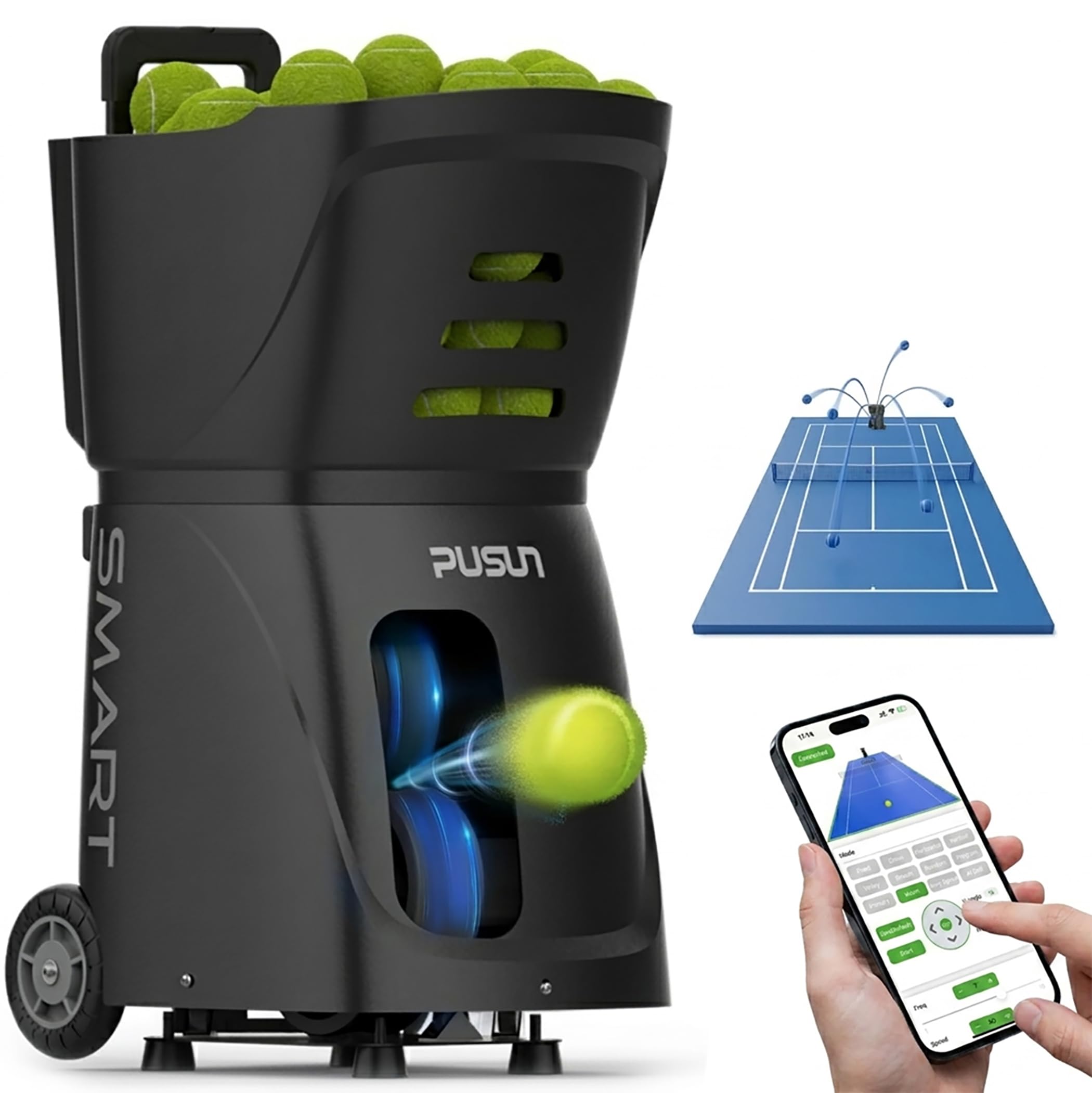
The PUSUN PT-Smart lets you program 28 landing points (specific spots on the court) — more than any other model here.
This machine swaps physical dials for an app, a remote, and even an Apple Watch controller. The 28 programmable landing points allow you to drill every corner of the court, and the external oscillation mechanism is visually clear so you can anticipate ball direction better. The app includes 12 built-in training modes that progress from NTRP 1.0 (beginner) up to NTRP 5.0 (advanced), plus a dedicated Padel Mode (for padel tennis) with 14 specialized drills if you also play padel. Speed ranges from 12 to 75 MPH, feed interval adjusts from 1.8 to 8 seconds, and you get six levels of spin control.
The external 153.6Wh battery delivers 4 to 6 hours of play (over 5,700 shots per charge) and can be charged separately from the machine — no need to drag the whole launcher to an outlet. At 32.6 pounds with a 100-ball collapsible hopper, it fits in most SUV trunks. However, some owners mention that the ball feed consistency varies, with a few units firing erratic shots before settling into the programmed rhythm, and a handful of users experienced the feed interval slowing unpredictably mid-session.
The high-impact ABS shell and metal base are dust-proof rated (resistant to grit ingress), meaning the mainboard resists clay erosion better than plastic-only builds. If you like to geek out over drill programming and want total control from your phone or watch, this machine delivers a depth of adjustment no knob-based launcher can match. Look elsewhere if consistent first-shot ball feed is non-negotiable for your warm-up routine.
What makes it stand out
- App, remote, and Apple Watch compatibility let you adjust speed, spin, and feed interval from your hitting stance.
- 28-point placement and 12 training modes cover everything from beginner consistency to advanced match simulation.
- Dust-proof mainboard lasts longer on clay courts than standard designs.
Inconsistent feed reports
- Several customers note the first 5–6 balls per session can be erratic before the machine settles into the selected rhythm.
- Occasional random feed slowdowns reported by a subset of users.
- Weight (32.6 lbs) is moderate but heavier than the lightest portable options.
A strong fit if: you want to program custom court drills from a phone and prefer an app-based setup over manual knobs.
Look elsewhere if: consistent first-shot ball feed is non-negotiable for your warm-up routine.
3. LOBSTER Sports Elite Liberty Tennis Ball Machine

The LOBSTER Elite Liberty fires balls at an advertised 80 MPH — 5 MPH faster than the Wilson Portable — for advanced pace training.
The Elite Liberty includes horizontal oscillation to spread shots randomly across the baseline, plus spin control ranging from heavy topspin to flat to heavy backspin. Speed is adjustable from 10 to 70 mph (with advertised capability up to 80 mph), and elevation ranges from 0 to 50 degrees for drilling lobs and low approach shots. The rechargeable 8.5 amp battery provides 2 to 4 hours of court time between charges, and one owner reported that hooking up an external XLR cable extends playtime to 6–8 hours with a second battery.
Reviewers point out that the machine delivers repeatable feeds — within 3 feet of the targeted spot — and true spin that feels match-realistic. The inverting hopper and folding metal handle make it easy to transport, and the large 8-inch wheels glide over grass, gravel, and curbs without tipping. One reviewer noted that the speed reduces by about 15–20 mph when heavy topspin is engaged, so keep that in mind if you plan to drill topspin at high velocity. The 2-year warranty provides solid coverage for regular use.
Compared to the Wilson Portable (which maxes at 75 MPH and holds 110 balls), the LOBSTER tops out at a faster 80 MPH but carries a smaller ~85-ball capacity per charge cycle. It is therefore better for speed-focused players than volume drilling. Consider another option if you rely on precise battery level feedback or need topspin at full velocity.
Why it earns its spot
- Top speed of 80 MPH is one of the highest in this list, useful for advanced pace training.
- Large 8-inch all-terrain wheels and folding handle make court transport easy.
- External battery modding option allows extended play sessions beyond the standard 4-hour limit.
Things to factor in
- Topspin engagement significantly cuts speed by around 15–20 mph per user reports.
- Battery indicator is vague, making it hard to gauge remaining playtime mid-session.
- No narrow oscillation or alternating forehand/backhand mode.
Grab it if: you prioritize top-end speed and want a machine that rolls smoothly over rough ground to the baseline.
skip it if: you rely on precise battery level feedback or need topspin at full velocity.
4. Nisplay N1 Portable Tennis Ball Machine (26lbs)

At 26 pounds, the Nisplay N1 is a full 23.8 pounds lighter than the Spinshot Pro — nearly half the weight — for easy one-person carrying.
That weight makes it lighter than the Spinshot Pro (49.8 pounds) by a notable 1.9x margin, so carrying it from car to court feels more like hauling a basketball than a home appliance. The dual motors can shoot the ball from end to end on the court at intervals of 1 to 9 seconds, and you can spin the ball for flat, topspin, or backspin at different levels. The oversized wheels and 3-foot ergonomic folding handle let it roll over grass, gravel, and curbs without struggling.
The external lithium battery is small enough to charge separately and provides 4+ hours of playtime. The 80-ball basket fits easily in a sedan trunk, helping one reviewer get a full workout without juggling multiple ball hoppers. On the downside, shoppers say that the machine jams 3–4 times per 80 balls, though it self-corrects through three ball holes. The oscillator lacks an on/off toggle on the remote, and the ball frequency knob is labelled counter-intuitively (turning it “higher” actually reduces ball output).
For players who want a spin-capable machine that does not dominate the car’s cargo space, the Nisplay N1 balances portability and power better than heavier alternatives like the Spinshot Pro. Consider another option if jam-free operation every session is your top priority.
Portability plus power
- At 26 pounds, it is the lightest full-featured dual-motor launcher in this roundup.
- Dual motors produce genuine topspin and backspin for varied shot practice.
- External lithium battery can be charged away from the machine.
The trade-offs
- Jams 3–4 times per 80 balls on average, though it self-corrects.
- Remote does not control oscillation on/off; knob labeling is counter-intuitive.
- Ball speed peaks at 68 MPH — slower than the LOBSTER’s 80 MPH.
Best suited for: players who need a lightweight, spin-friendly machine that fits in a small car trunk and is easy to lift solo.
Consider another option if: jam-free operation every session is your top priority.
5. Spinshot Pro Tennis Ball Machine (The Best Model for Easy Use)

The Spinshot Pro uses a metal body — not plastic — so it can handle frequent hard-court use without cracking.
That metal frame gives it a tank-like feel at 49.8 pounds — noticeably heavier than the Nisplay N1 at 26 pounds (a 1.9x gap) — but also means it can handle frequent use on hard courts without cracking. All key features (speed, rotation, spin, elevation) are controlled by physical knobs, so even a child can operate it without a manual. The hopper holds about 60 balls, which is modest compared to the 110-ball Wilson, but the durable construction is the trade-off for reduced capacity.
Buyers report that the new battery provides 4+ reloads of power, meaning multiple session tiers between charges. The separate remote control adjusts settings from the baseline, though some users note its range could be better. The machine is also heavy enough to require serious effort to move — one reviewer described it as “unportable.” Balls occasionally jam in the dispenser, and the hopper flaps are described as flimsy. Still, if you want a metal-built machine that survives rough treatment and prefer turning knobs over using a phone app, the Spinshot Pro fills a niche that few other launchers address. Pass on it if portability or a large ball hopper matters more to your practice routine.
The battery is shipped separately from the machine (the charger is included, the actual battery arrives in a different box), so expect some setup coordination.
Why the metal matters
- Metal body withstands constant court use better than plastic alternatives.
- All-knob controls are intuitive and easy for younger or less tech-savvy players.
- Battery provides 4+ reloads of power per charge, per user reports.
The heavy side
- At 49.8 pounds, it is the heaviest launcher reviewed and tough to move without wheels.
- ~60-ball hopper capacity means more reloads mid-session.
- Hopper flaps feel flimsy, and occasional ball jams were noted by buyers.
Choose this if: you want a metal-built machine that survives rough treatment and prefer turning knobs over using a phone app.
Pass on it if: portability or a large ball hopper matters more to your practice routine.
6. Furlihong 3807BH Tennis Ball Machine with Triangular Base

The Furlihong 3807BH swings the launch port up and down plus side to side — an automatic dual-axis movement rare at this price point.
The triangular iron base adds stability that keeps the launcher planted during fast feeds, while the automatic up-and-down swing launch port lets you set the angle electronically — something most machines at this level reserve for premium tiers. Speed is adjustable via a simple L-to-H knob, and the 22 x 22 x 38-inch footprint is the largest in this list, measuring 2.3x the dimensions of the smaller Furlihong 3819BH (9.5 x 18.5 x 35.4 inches). That bigger base helps with stability but also uses more trunk space.
Owners mention that rechargeable D batteries last about 3 sessions of 30 balls before needing a recharge, though you can also run it on AC power to avoid battery anxiety. The carrying bag makes transport more convenient, though some owners note the bag tore and the zipper broke after a few uses. A few reviewers experienced reliability issues — one went through four units within a few months — so consistent quality control is a concern. For the price, the 3-axis rotation (left-right, up-down, and adjustable speed) is a rare feature set that makes solo practice more dynamic.
Compared to the Nisplay N1’s 68 MPH speed, the Furlihong 3807BH’s max speed is unspecified (labeled simply “H”), so it is best suited for beginner to intermediate players rather than advanced speed drills. Reach for it if you want both horizontal and vertical oscillation to simulate real match movement without spending premium money — but be aware reliability seems hit-or-miss based on buyer reports.
Standout features
- Up-down and left-right oscillation in one unit — uncommon at this price tier.
- Triangular iron base provides solid stability during sustained use.
- AC adapter included, so battery power is optional.
Known weak points
- Inconsistent quality control: some buyers received defective units.
- Carry bag durability is poor; the zipper broke after minimal use per multiple reviews.
- Top speed is vague (no MPH number), making it unclear for advanced players.
Reach for it if: you want both horizontal and vertical oscillation to simulate real match movement without spending premium money.
Be aware: reliability seems hit-or-miss based on buyer reports — consider the warranty before purchasing.
7. Furlihong 3819BH Portable Tennis Ball Machine
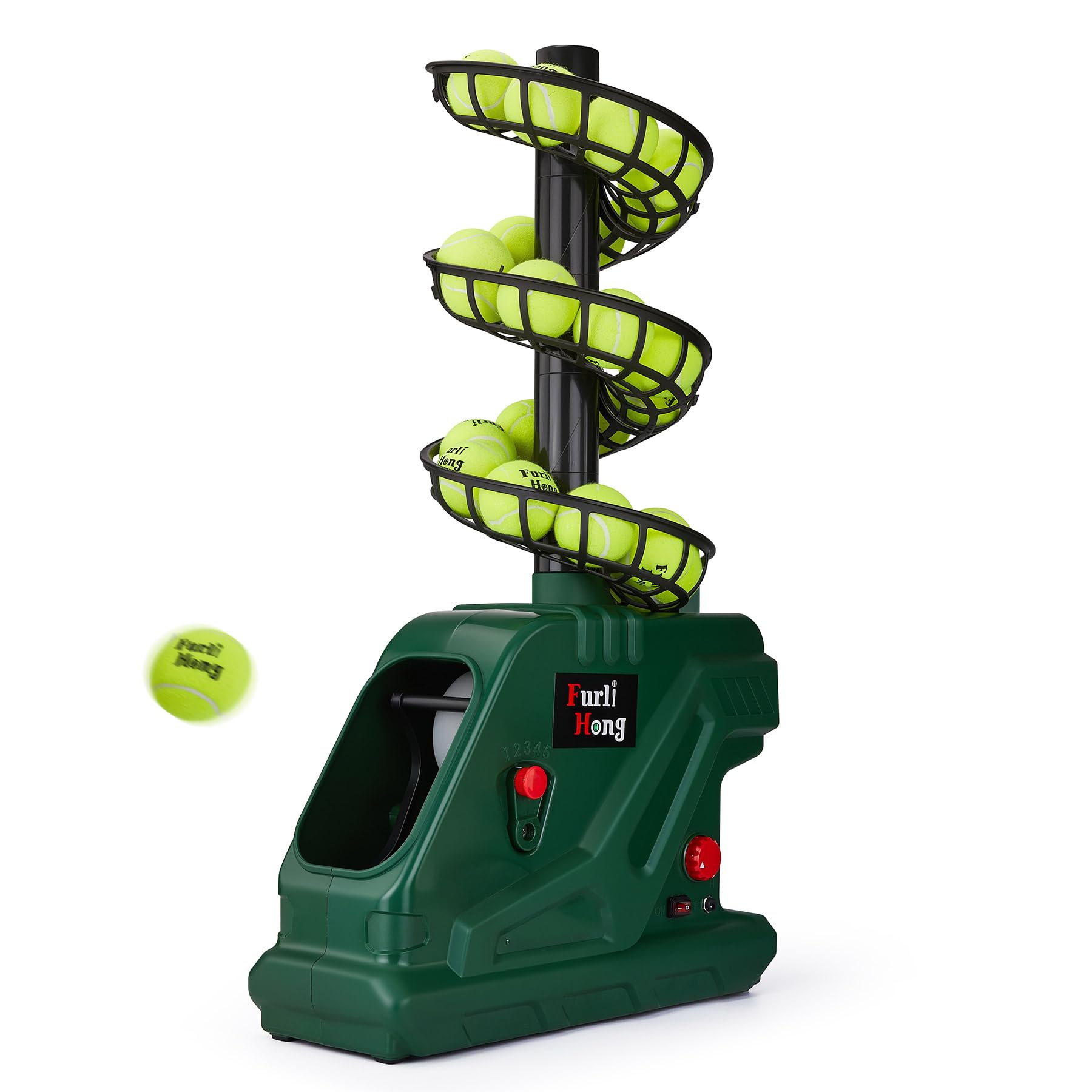
The Furlihong 3819BH tops out at 30 MPH — a comfortable, beginner-safe pace that is 50 MPH slower than the LOBSTER’s 80 MPH.
This is the most affordable entry point in the list, and it is designed specifically for casual players who are learning fundamentals rather than drilling match pace. The 5 angle settings let you practice forehand, backhand, flat, slice, and volley strokes, while the 2 power levels and 4 serve intervals give you enough variation to keep practice interesting without overwhelming a new player. Speed tops out at 30 mph, which is a comfortable pace for building timing and accuracy — the 2.7x difference from the LOBSTER’s 80 mph shows just how beginner-focused this machine is.
Customers note that the machine holds about 21 balls and has adjustable pace and feed, making it easy to use for seniors returning to tennis or kids learning the game. Powered by 8 D batteries or a power bank, it is cord-free on the court, though one buyer mentioned that the first ball launches extra high until the spiral feeder settles in. The 9.5 x 18.5 x 35.4-inch dimensions make it much more compact than the 3807BH (which is 2.3x larger), so it fits in small car trunks without issue.
For beginners or recreational players who just need a consistent partner to hit groundstrokes with, the 3819BH removes the intimidation of high-speed machines while keeping the essential training features accessible. It is ideal if you are new to tennis, returning after a long break, or want a low-stakes machine for casual practice with the family — and a clear pass for intermediate or advanced players needing faster ball speeds or larger ball hoppers for extended drills.
Perfect for beginners
- 30 MPH top speed is manageable for learning proper technique.
- 5 angle settings cover the essential stroke types (forehand, backhand, slice, lob, volley).
- Compact size fits easily in small vehicles.
Limitations to know
- Battery power (8 D cells or power bank) adds recurring cost or requires extra gear.
- ~21-ball capacity means frequent reloads during a session.
- Some units launch the first ball extra high; takes a moment to settle.
Ideal if: you are new to tennis, returning after a long break, or want a low-stakes machine for casual practice with the family.
Not for: intermediate or advanced players needing faster ball speeds or larger ball hoppers for extended drills.
Understanding the Specs
Ball Speed (MPH)
Ball speed, measured in miles per hour (MPH), determines how fast the ball travels through the air toward you. A machine that maxes out at 30 MPH is perfect for beginners learning timing and footwork, while machines capable of 70–80 MPH let advanced players simulate real match pace. The difference between a 30 MPH launcher and an 80 MPH launcher is roughly 2.7x in velocity — enough to change your preparation time from comfortable to reactive.
Ball Capacity (Number of Balls)
This is the maximum number of tennis balls the hopper can hold before you need to reload. A machine holding 110 balls lets you rally for minutes without interruption, while a 21-ball capacity means frequent stops to pick up and reload. If you drill alone (without a ball pick-up basket), higher capacity directly translates to more efficient practice sessions.
FAQ
How fast should an automatic tennis ball launcher be for a beginner?
What is the difference between topspin and backspin on these machines?
Do I need a machine with oscillation?
How long does the battery last on a typical tennis ball machine?
Can I use any tennis balls in these machines?
Are these machines hard to assemble from the start?
Do more expensive machines last longer than budget options?
Can I use an automatic tennis ball launcher for padel tennis?
Will a 75 MPH launcher feel too fast for a 3.0 player?
Do I need a remote control for solo practice?
Final Thoughts: The Verdict
Across the board, the automatic tennis ball launcher winner is the Wilson Portable because its 110-ball hopper, 75 MPH speed, and simple knob controls provide the best balance of capacity, speed, and reliability for intermediate to advanced players. If you want app-driven customization and 28-point drill placement, grab the PUSUN PT-Smart. And for budget-conscious beginners, the standout is the Furlihong 3819BH for getting started on the court without overspending.
How We Picked
We do not accept paid placement, and we did not hands-on test every unit. Instead, we match each pick to a real buyer and use-case by comparing the manufacturers’ published specifications against the patterns in verified customer reviews — so you get each pick’s real strengths and trade-offs instead of marketing copy.
Sources & Methodology
Specifications: manufacturer listings and product documentation. Review insights: verified customer reviews, as of July 2026. Pricing: not shown on this page (it changes often); check the current price via the retailer link.
As an Amazon Associate, Gadgets Feed earns from qualifying purchases. This does not affect which products we feature.
Product prices and availability are accurate as of the date/time indicated and are subject to change. Any price and availability information displayed on Amazon at the time of purchase will apply to the purchase of this product. As an Amazon Associate I earn from qualifying purchases.
CERTAIN CONTENT THAT APPEARS ON THIS SITE COMES FROM AMAZON. THIS CONTENT IS PROVIDED "AS IS" AND IS SUBJECT TO CHANGE OR REMOVAL AT ANY TIME.
Amazon and the Amazon logo are trademarks of Amazon.com, Inc. or its affiliates.