
Few things ruin a road trip faster than a tire failure on the highway. An automatic tire pressure monitoring system (TPMS) removes the guesswork by delivering live PSI and temperature data directly to a dashboard display, catching slow leaks and hot bearings before they strand you. For anyone towing a trailer, hauling gear in an RV, or driving a semi, this isn’t a luxury—it’s a critical safety tool that can prevent blowouts, save fuel, and extend tire life.
I’m Min — the co-founder and writer behind Gadgets Feed. To build this guide, I cross-referenced several dozen hours of customer feedback and spec sheets, focusing on sensor accuracy, signal range, solar charging efficiency, and real-world durability across both mid-range and premium kits.
After evaluating seven systems on metrics like PSI range, number of sensors, display readability, and alarm functionality, I’ve narrowed the field to the most reliable picks for every type of driver seeking the best automatic tire pressure monitoring system.
How To Choose The Best Automatic Tire Pressure Monitoring System
Selecting the right TPMS comes down to matching the system’s PSI ceiling, sensor count, and power source to your vehicle’s specific demands. A sedan towing a small camper needs a different setup than a Class A motorhome or a semi-truck hauling a 40-foot trailer.
PSI Range and Sensor Count
The maximum PSI rating determines which vehicles a system can serve. Most passenger-car and small-trailer systems top out at 87 PSI, while heavy-duty kits like the GUTA GT20 handle up to 188 PSI for commercial trucks. Sensor count matters equally — a standard 4-sensor kit covers a tow vehicle and a two-axle trailer, but multi-axle RVs or dually trucks require 6, 10, or even 24 sensors.
Signal Range and Power Source
Towed trailers over 36 feet can suffer signal dropouts if the TPMS lacks a booster or extended-range antenna. Solar charging on the display unit eliminates the need to fiddle with cords, but a USB-C backup port is essential for cloudy trips or winter parking. Auto-wake and sleep modes also prolong battery life by pausing updates when the vehicle is stationary.
Alarm Modes and Auto-Calibration
Look for a system that offers six alert types: high/low pressure, high temperature, rapid air loss, sensor low battery, and lost signal. Auto-calibration is a strong convenience feature — it sets the baseline PSI at installation and triggers warnings at a preset percentage deviation (typically +25% and -15%) without manual threshold entry.
Quick Comparison
On smaller screens, swipe sideways to see the full table.
| Model | Category | Best For | Key Spec | Amazon |
|---|---|---|---|---|
| GUTA GT20 | Premium | Heavy-duty towing & long trailers | 0-188 PSI range | Amazon |
| Tymate TM3 | Premium | Expandable RV monitoring with repeater support | Expandable to 10 sensors | Amazon |
| Tymate TM9 | Mid-Range | Compact windshield mount for cars & SUVs | Windshield mounting design | Amazon |
| Masoll M14+MZS2 | Mid-Range | 4-wheel sedans & small trailers | Auto-calibration (+25% / -15%) | Amazon |
| Masoll M13+MZS3 | Mid-Range | Set-and-forget with best solar efficiency | Anti-reflective LCD display | Amazon |
| Marcala V2-4-Sensor | Budget-Friendly | Entry-level RV monitoring with long range | 32 ft extended signal range | Amazon |
| Flydew T15 | Budget-Friendly | 6-tire dually trucks & tow vehicles | 6 sensors included (0-144 PSI) | Amazon |
In‑Depth Reviews
1. GUTA GT20
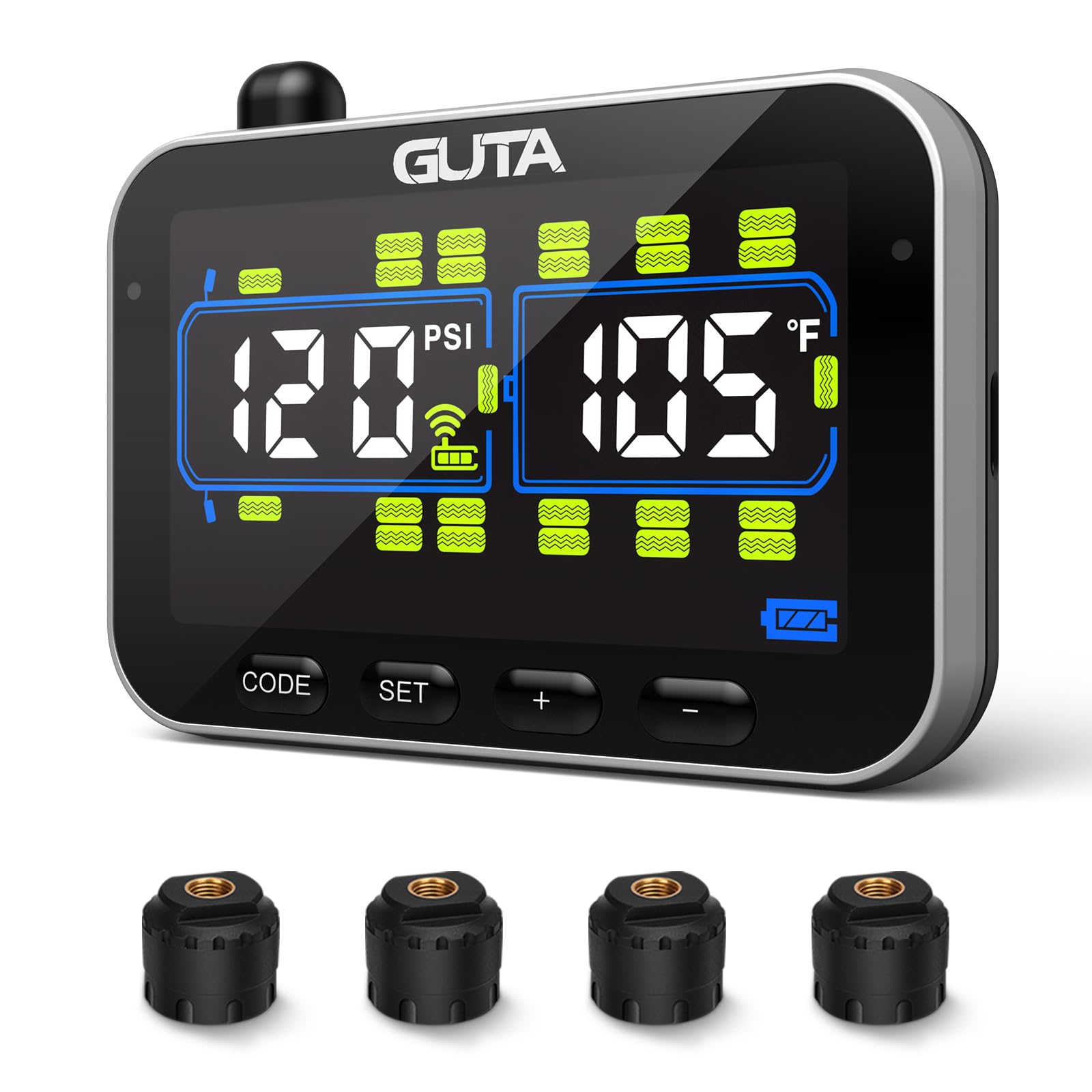
The GUTA GT20 is the definitive heavy-hauler TPMS, handling PSI readings from 0 to 188 and pairing with up to 24 sensors. That ceiling covers commercial semi-trucks, Class A diesel pushers, and triple-axle trailers without breaking a sweat. The system includes a signal booster in every kit except the 4-sensor bundle, so a 40-foot rig won’t drop connection. The large color LCD auto-adjusts brightness for day/night driving, and the rechargeable lithium battery delivers up to 15 hours per charge under heavy use — sufficient for a full day on the road.
Users consistently report reliable connectivity across long distances, with one reviewer running a 40-foot motorhome with a towed car and trailer reporting no false alarms on rough highways. The yellow tire icon that flashes constantly is a minor visual annoyance, and there’s no user-defined alarm threshold — the system auto-sets at +25%/-15% of the reference PSI. Pre-paired sensors out of the box mean installation takes minutes, and the remote’s included AAA batteries held charge for a full week in testing.
For fleet operators and serious RVers who need to monitor multiple axles, the GT20’s combination of extreme PSI headroom, signal stability, and expandability puts it in a class above. It’s the only system in this roundup that genuinely serves commercial-grade needs without compromise.
Why it’s great
- Monitors up to 24 tires with a dedicated signal booster for long trailers
- 188 PSI maximum range covers heavy-duty trucks and motorhomes
- Large color display with adjustable brightness and 15-hour battery life
Good to know
- Auto-set alarm thresholds cannot be manually adjusted by the user
- Flashing yellow tire icon on the display can be distracting at night
2. Tymate TM3
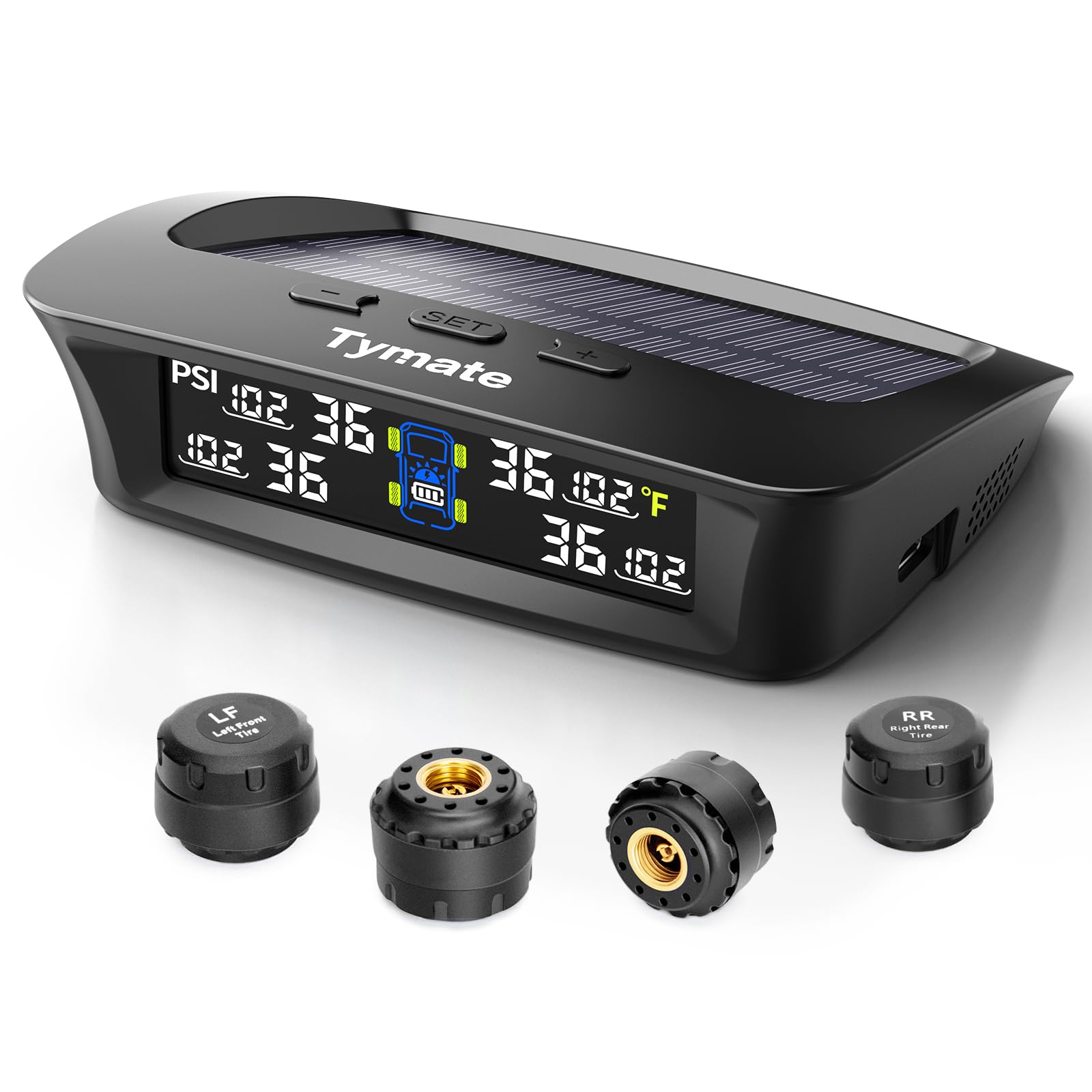
The Tymate TM3 sits at a premium price point but earns it with hardware designed for future expansion. The kit ships with four sensors but can scale to ten, making it a strong choice for RV owners who start with a single axle and later add a towed car or trailer. The sensors run on CR1632 batteries with a claimed lifespan of up to two years, and the IP67 waterproof rating keeps them functional in rain, snow, and mud. The color LCD uses adaptive backlighting that auto-adjusts for glare on sunny days and dims hands-free at night.
Real-world feedback is very positive: users report that sensors are laser-accurate compared to digital tire gauges, and the system performed flawlessly on a 100-mile trip with a U-Haul trailer. Setup is truly plug-and-play because each sensor is factory-paired to the monitor. The only frustration is that the head unit doesn’t automatically sleep — you have to manually power it off, which is an oversight in an otherwise polished package. Tymate recommends adding their repeater for trailers longer than 36 feet, which is a realistic and honest limitation.
If you plan to build out a multi-rig towing setup over time, the TM3’s expandability and robust sensor durability make it a smart long-term investment. The adaptive backlight and reliable 433.92 MHz signal keep data clear and consistent at highway speeds.
Why it’s great
- Expandable to 10 sensors for future towing setups
- IP67 waterproof sensors last up to 2 years per battery set
- Adaptive backlight LCD stays readable in direct sun and pitch dark
Good to know
- Monitor lacks auto-sleep; requires manual power-off to save battery
- Trailers over 36 feet need the separately sold repeater for stable signal
3. Tymate TM9
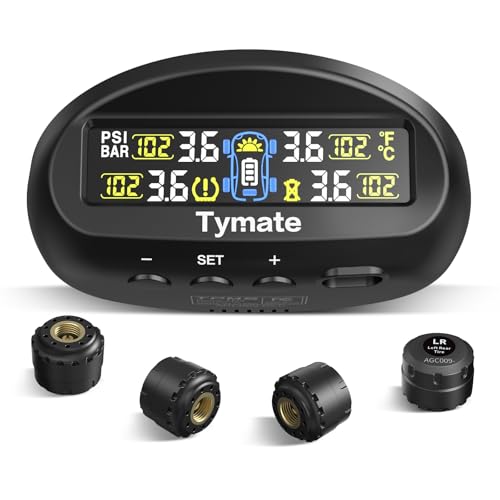
The Tymate TM9 is the narrow-category specialist for car and SUV owners who want a compact TPMS that doesn’t eat up dashboard real estate. Its windshield mounting bracket places the color LCD directly in the driver’s line of sight, and the unit’s small footprint makes it less obtrusive than bulkier solar-panel designs. The 0-87 PSI range fits nearly all passenger vehicles and small trailers, and the six alarm modes cover high/low pressure, rapid air loss, high temperature, low sensor battery, and lost signal.
Customer reviews highlight the TM9’s reliability over the long term, with one user confirming a year of trouble-free operation on a truck. The main limitation is the fixed alarm thresholds — the Set button is non-functional, meaning you can’t customize the +25%/-15% deviation. That’s fine for most drivers but could be a sticking point for those running aggressive off-road tire pressures. The sensors are pre-paired and pre-labeled, so setup clocks in under five minutes. Solar charging is supported, but a USB port (adapter not included) provides backup for winter months when sunlight is scarce.
For daily commuters and light-tow vehicles that don’t need expandability or extreme PSI headroom, the TM9 delivers a clutter-free installation and dependable real-time monitoring. The windshield mount is the standout differentiator here — it keeps the screen visible without blocking vents or infotainment systems.
Why it’s great
- Compact windshield mount preserves dashboard space
- Solar and USB-C charging provide year-round power flexibility
- Pre-paired sensors install in under five minutes
Good to know
- Alarm thresholds are fixed and cannot be manually adjusted
- Not compatible with the Tymate repeater for trailers over 36 ft
4. Masoll M14+MZS2

The Masoll M14+MZS2 hits the sweet spot between price and features for the budget-conscious RVer. It offers the same auto-calibration logic as pricier units — once installed, the system uses the current PSI as the baseline and alarms at +25% up and -15% down — but keeps the package simple with four permanent sensors and a user-replaceable CR1632 battery in each unit. The display combines solar and USB charging, and the auto-wake/sleep vibration sensor eliminates the need to remember a power button.
Reviews show that the system excels at catching slow leaks early. One owner reported that the alarm went off at 100 miles into a trip, allowing a safe tire swap before the rim dragged on asphalt. The display washes out in extreme heat above 100°F but recovers once the cabin air-conditioning cools the monitor. The maximum sensor pressure is 87 PSI, which covers all standard RVs, sedans, and SUVs but excludes heavy trucks. The build quality of the display unit feels slightly plasticky, but the sensor accuracy off the digital gauge is within 1.5 PSI in most reports.
For anyone with a 4-wheel tow vehicle and a single-axle trailer, the M14+MZS2 delivers essential safety features without the premium markup. The auto-wake and solar charging combo makes it nearly maintenance-free — it’s the no-fuss entry into reliable tire monitoring.
Why it’s great
- Auto-calibration sets alarm thresholds instantly at installation
- Solar charging with auto-wake/sleep reduces user intervention
- Accurate to within ±1.5 PSI in real-world testing
Good to know
- Display can become hard to read in temperatures above 100°F
- Monitor’s dashboard mount may not align for optimal solar exposure
5. Masoll M13+MZS3

The Masoll M13+MZS3 is the sibling of the M14 but tweaks the formula with an anti-reflective LCD coating that owners consistently praise for staying readable in direct sunlight. It shares the same auto-calibration intelligence — inflate tires to your target PSI, install the sensors, and the system sets alarm thresholds at +25% and -15% of that baseline automatically. The solar panel on the monitor is notably efficient; users in northern climates report no USB charging needed for four consecutive months of use.
The real-world feedback highlights a potential quirk: highway driving can trigger false low-pressure beeps due to heat buildup and rising PSI, but the alarm resets when the vehicle slows and tires cool. Sensor readings match a secondary digital gauge within 1 PSI in most cases. The 87 PSI maximum keeps this system squarely in the passenger-vehicle and small-trailer category — not a fit for commercial trucks. Some owners noted initial confusion pairing sensors to the correct tire positions, but the manual provides clear instructions once read thoroughly.
For drivers who prioritize solar independence and hate squinting at a glare-heavy display, the M13+MZS3 is the optimal mid-range choice. The anti-reflective screen makes a real difference in sunny conditions, and the self-sustaining solar charge means you can install it and basically forget it exists — until it saves you from a roadside disaster.
Why it’s great
- Anti-reflective LCD panel stays legible in strong sunlight
- Solar charging is so efficient that USB is rarely needed
- Auto-calibration eliminates manual threshold programming
Good to know
- Highway heat can trigger occasional false low-pressure alerts
- Requires a Masoll signal booster for trailers longer than 38 feet
6. Marcala V2-4-Sensor
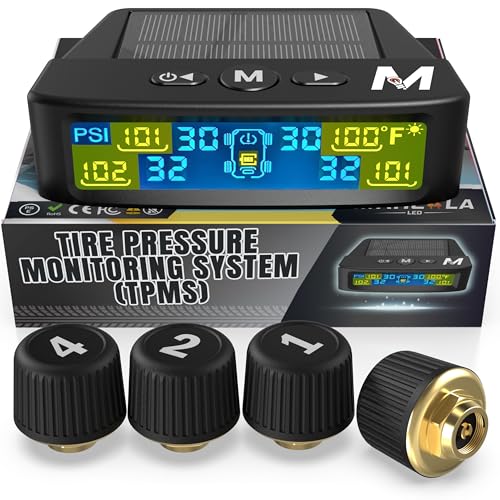
The Marcala V2-4-Sensor stakes its claim on an extended 32-foot signal range — a notable advantage for RV and fifth-wheel owners whose tow vehicle display sits far from the trailer axles. The system monitors up to 98 PSI (higher than the typical 87 PSI cap), which gives it a slight edge for larger trucks running higher tire pressures. The display uses both solar and USB-C charging, and the six alarm modes cover the essential safety bases without overcomplicating the interface.
Customer feedback is a mixed bag that paints an honest picture. On the positive side, the system pairs and syncs quickly, range holds up at highway speeds, and the display remains crisp in daylight. The solar charging is effective enough that most owners rarely plug in. On the negative side, some users report sensor failure after three to four trips, and the external sensors are bulky enough to unbalance wheels slightly at high speeds — a common issue with cap-style sensors. The locking nuts included for theft prevention are considered unnecessary by several reviewers who skipped them for convenience.
For budget-conscious RV owners who tow occasionally and value an extended signal reach, the Marcala V2 represents an affordable entry point. The 98 PSI ceiling and 32-foot range are legitimately better than many comparably priced competitors, but long-term durability appears inconsistent across units. The lifetime replacement policy from the American-owned company does provide peace of mind, but the failure reports suggest it’s not the most reliable long-haul option.
Why it’s great
- 32-foot signal range for larger RVs and fifth-wheels
- 98 PSI maximum covers vehicles needing higher pressures
- Lifetime replacement policy from an American family business
Good to know
- Sensor durability is inconsistent; some fail after a few trips
- Bulky external sensors can unbalance wheels at highway speeds
7. Flydew T15
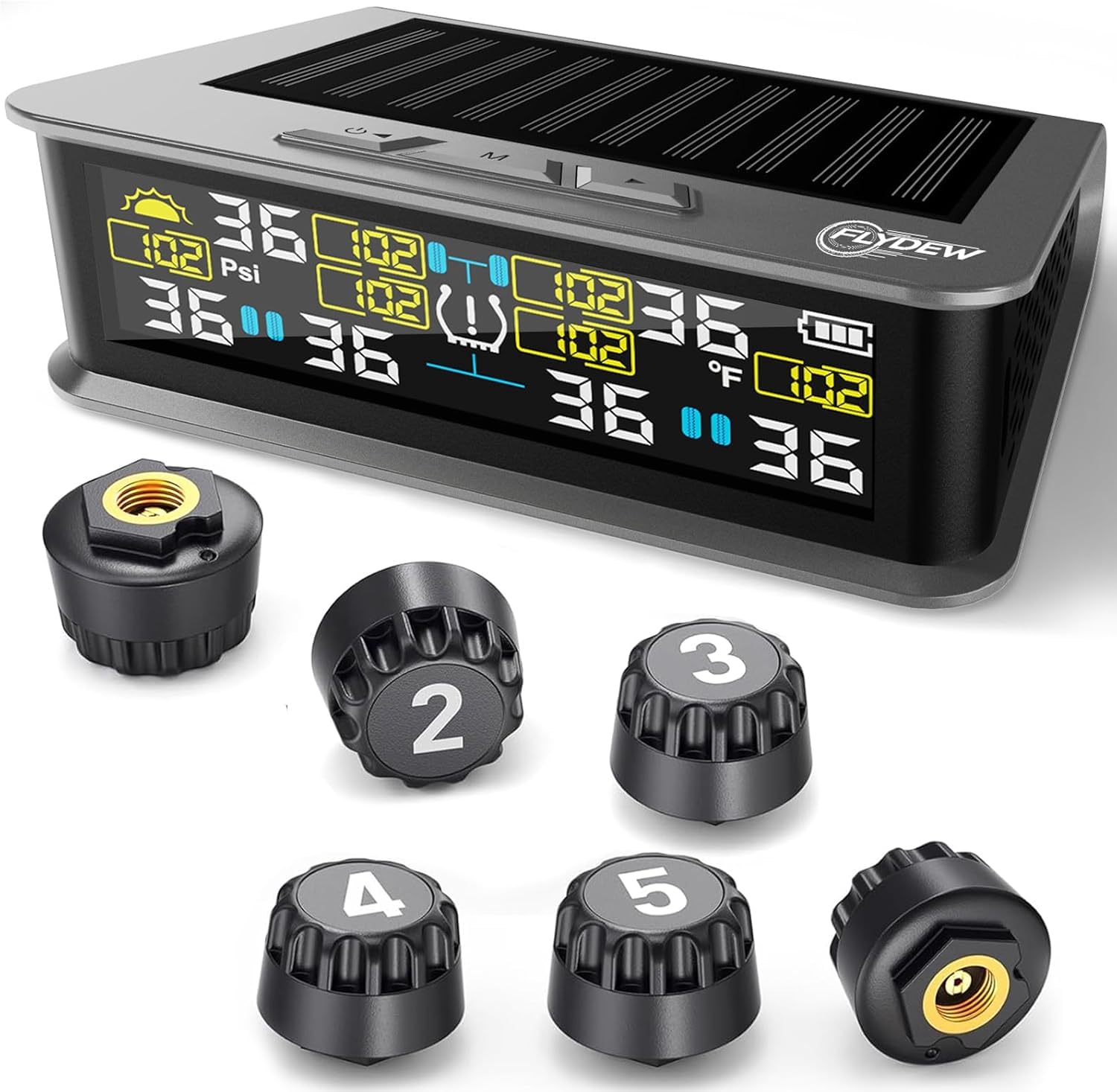
The Flydew T15 stands out for one simple reason: it includes six sensors at a price where competitors typically offer four. That makes it the natural pick for dually trucks, motorhomes with two axles, or anyone towing a trailer with four wheels. The PSI range spans 0 to 144, comfortably covering heavy-duty tow vehicles and large trailers without hitting the 188 PSI ceiling of commercial-grade units. The display is solar and USB-C rechargeable, with automatic brightness adjustment for day and night driving.
Owner experiences are sharply divided. On the encouraging side, multiple customers report that the system saved them from catastrophic tire failures — one semi driver detected a hot wheel from bad bearings and prevented a fire. Another reviewer praised the company’s customer service after breaking a sensor, receiving a full replacement system. On the cautionary side, a verified buyer reported the unit stopped working after 30 days, labeling it “pure junk.” The temperature readings can occasionally stick at 71°F until a manual reset is performed, suggesting firmware quirks that aren’t present in the more expensive Tymate or GUTA systems.
For the ultra-budget shopper who needs coverage for six wheels, the T15 delivers unmatched value per sensor. The 144 PSI rating and six-pack configuration are genuine advantages that few competitors match at this price level. Just be prepared for potential early failure — the mixed durability reviews make it a high-variance bet. If it works, it’s incredible value. If it doesn’t, you’ll be exercising the return window.
Why it’s great
- Six sensors included — ideal for dually trucks and dual-axle trailers
- 144 PSI maximum covers heavy-duty towing applications
- Solar and USB-C rechargeable display with auto-brightness
Good to know
- Some units fail within the first month of use
- Temperature readings occasionally stick and require manual reset
FAQ
Can I use an 87 PSI TPMS on a truck that requires 90 PSI cold?
Will external cap sensors cause air leaks or unbalance my wheels?
How do I test if the TPMS signal reaches my trailer tires?
Final Thoughts: The Verdict
For most users, the best automatic tire pressure monitoring system winner is the GUTA GT20 because its 188 PSI ceiling, expandability to 24 sensors, and stable long-range signal make it the only system that genuinely covers heavy-duty towing, commercial fleets, and multi-axle motorhomes without compromise. If you want a system with future expansion potential and IP67-rated sensors, grab the Tymate TM3. And for ultra-budget six-wheel coverage on a dually truck, nothing beats the value of the Flydew T15.