
Our readers keep the lights on and my morning glass full of iced black tea. As an Amazon Associate, I earn from qualifying purchases.
Specs are compiled from manufacturer listings and verified buyer reviews and can change over time — please confirm the key details on the product page before buying.
A brownout can erase an hour of work. A spike can kill a motherboard. The automatic voltage regulator sits between your wall outlet and your gear, catching those micro-swings that cheap surge strips let through. This guide breaks down seven real contenders so you can match the right level of protection to the price you pay for your electronics.
I’m Min — the founder and writer behind Gadgets Feed. This guide is built by comparing the manufacturers’ published specifications and the patterns across verified customer reviews, so you get each pick’s real strengths and trade-offs instead of marketing spin.
You want steady, safe power for your expensive electronics — a home theater, a PC workstation, or a workshop. This roundup of the best automatic voltage regulator options covers everything from compact plug-in protectors to heavy-duty line conditioners.
Our Picks at a Glance


How To Choose The Best Automatic Voltage Regulator
A voltage regulator is a straightforward buy once you understand the few specs that actually matter. Focus on capacity first, then the type of waveform your gear needs, then the extra protective features like surge joules and line noise filtering.
Capacity: Matching VA and Watts to Your Load
Every regulator has two power ratings — Volt-Amps (VA) and Watts. The VA number is the total power-handling capacity. The Watts number is the real usable power for your devices. For a desktop PC and monitor, a 550VA/300W unit is the minimum. A gaming rig or a home theater setup will need something in the 1500VA/1000W range. Always check the wattage draw of everything you plan to plug in.
Waveform: Sine Wave vs. Simulated Sine Wave
Active PFC (Power Factor Correction) power supplies in modern computers and some home theater gear need a pure sine wave to function correctly. A simulated or stepped sine wave can cause these devices to shut down randomly. If you own a newer PC or a high-end audio system, a regulator that outputs pure sine wave is a requirement, not a luxury.
The Extra Layers: Surge Joules, Filters, and Auto-Disconnect
The surge suppression rating, measured in joules, tells you how much energy the unit can absorb before it fails. A 316-joule rating is fine for basic surge protection. For more expensive electronics, aim for 1000 joules or more. EMI/RFI filters clean up line noise, which is crucial for audio equipment. An adjustable high/low voltage disconnect lets you set the exact cut-off thresholds, protecting appliances from both under-voltage and over-voltage conditions.
Quick Comparison
| Model | Best For | Capacity (VA/W) | Outlets | Surge Protection (Joules) | Amazon |
|---|---|---|---|---|---|
| CyberPower CP1500PFCLCD★ Best Overall | Gaming PCs & Workstations | 1500VA / 1000W | 12 (6 battery-backup) | — | Amazon |
| Tripp Lite LC1200Top Performer | Home Theater & Audio Gear | 1200W | 4 | 1200 | Amazon |
| Tripp Lite AVR550U | Home Offices & Small Electronics | 550VA / 300W | 8 (4 battery-backup) | 316 | Amazon |
| Tripp Lite AVR750U | Remote Workstations & Modems | 750VA / 450W | 8 | — | Amazon |
| Starlite WTX-5000 | International Voltage Conversion | 5000W | 3 (2x US, 1x Universal) | — | Amazon |
| YaeCCC ST-3000 | Dual Voltage Step Up/Down | 3000W | 3 (2x US, 1x Universal) | — | Amazon |
| BXST Surge Protector Outlet | Individual Appliance Protection | 1800W / 15A | 1 | 140 | Amazon |
In‑Depth Reviews
1. CyberPower CP1500PFCLCD PFC Sinewave UPS
Our pick — over 4.5★ from 11,000+ verified ratings; the strongest balance of quality and price.
The crowd favorite that keeps a gaming rig running through a brownout without a single hiccup.
This unit combines a 1500VA/1000W pure sine wave UPS with automatic voltage regulation, so both your AVR functions and a battery backup live in one box. The pure sine wave output is critical for active PFC power supplies — owners running a 2008 MacPro and even a modern RTX 5090 build report no random shutdowns, unlike some competing APC units they replaced. The multi-function color LCD panel tilts up to 22 degrees and displays real-time wattage, load, and runtime data.
Buyers across thousands of reviews consistently call it reliable, with one reporting a first unit that lasted roughly seven years, needing battery replacements only every two to three years. The 12 NEMA 5-15R outlets give you six battery-backed and six surge-only slots, plus two USB charge ports (Type-A and Type-C) for phones and tablets. The AVR (automatic voltage regulator) corrects minor fluctuations without draining the battery, extending its usable lifespan. The catch, according to some owners, is that the fan can produce a shrill whine under heavy load, and the pure sine wave electronics cost more than non-PFC (power factor correction) units — but the trade-off is flawless compatibility with demanding gear.
What makes it a winner
- Pure sine wave output handles active PFC power supplies without random shutdowns — a problem common with older UPS designs.
- 12 outlets (six with battery backup) offer more connectivity than any other pick here, with coax/ethernet protection included.
- The color LCD tilts for visibility and shows real-time voltage, power draw, and runtime — no guessing about your system’s status.
The honest trade-off
- At 24.9 pounds, it is the heaviest desktop unit here — moving it between rooms takes effort.
- Some buyers report a noticeable whine from the unit under load, which can be distracting in a quiet office.
Reach for this if: you run a high-end PC, a home server, or audio gear with active PFC power supplies — the pure sine wave output is a prerequisite, not a bonus.
Think twice if: you need a silent, fanless unit for a bedroom or recording space; the audible whine some units produce is a real annoyance.
2. Tripp Lite LC1200 Power Conditioner
A tank-like line conditioner that scrubs noise from your audio path while clamping surges.
This is not a UPS — there is no battery backup. What the LC1200 does instead is correct voltage output by boosting undervoltages by 9%, reducing overvoltages by 10%, and boosting severe undervoltages by 19%. The EMI/RFI filter removes up to 75 dB of line noise, which is exactly what sensitive audio equipment and home theater components need to perform cleanly. One owner has owned a unit for over six years, using it for everything from gold plating to a flat screen.
The 1200-joule network-grade surge suppression is well above the 316-joule floor of basic protectors. Four rear-panel NEMA 5-15R outlets are enough for a core system (router, computer, monitor, audio interface). Front-panel diagnostic LEDs show incoming voltage level and line status at a glance. The audible clicking sound during voltage regulation is a feature — it tells you the unit is actively working. Owners praise its reliability and the tank-like build, but the four-outlet limit means you will need a separate power strip for peripherals.
The pure conditioner pick: If you do not need battery backup but do need clean, regulated power for audio or A/V gear, the LC1200 is the best tool for that single job.
Best for: home theater enthusiasts and musicians whose gear is sensitive to line noise and voltage drift — the 75 dB noise filter is a clear win here.
Not for: anyone expecting battery backup during a blackout; this is a line conditioner only, with no stored power.
3. Tripp Lite 550VA UPS Battery Backup AVR (AVR550U)

A small UPS that keeps a modem and router running through short brownouts without taking up much desk space.
The AVR550U delivers 550VA/300W of battery backup with automatic voltage regulation that continuously corrects input voltages as low as 89V and as high as 145V back to nominal 120V power. That AVR function alone protects gas stove electronics from generator voltage fluctuations, as one owner confirmed after a dozen power failures. The unit provides an estimated 32 minutes of runtime for a basic desktop PC and small monitor. The 8 NEMA 5-15R outlets give you four battery-backed and four surge-only ports, with wide spacing to fit bulky wall warts.
The crowd-favorite status among 160+ reviews is earned through straightforward reliability and the Ultimate Lifetime Connected Equipment Insurance. The main drawbacks are a noticeable new-plastic odor that owners mention can last for about a month, and the fact that the 300W capacity is too low for a gaming PC or a refrigerator. But for a home office rig, it fits perfectly. Unlike the CyberPower 1500VA unit above, this one is significantly lighter and smaller — an advantage when you just need the modem, router, and one PC covered.
Where it shines
- Compact 12 x 6.4 x 4.3-inch size fits on a small shelf or can be wall-mounted using bottom keyhole tabs.
- 316 joules of surge suppression and RJ11/RJ45 dataline protection cover both power and network lines.
Where it falls short
- The new plastic smell can be strong for the first few weeks of use.
- 300W capacity is insufficient for high-end gaming rigs or multiple large monitors; treat this as a basic office guard.
Who it fits: home office workers who need a simple, compact buffer against brief power dips and surges for a single PC and network gear.
Who should pass: anyone with high-wattage gear (gaming desktops, home theater amps) — the 300W ceiling will leave them unprotected.
4. Tripp Lite 750VA UPS Battery Backup (AVR750U)

This is the mid-range balance: enough power for a full remote-work station plus networking gear, without the high cost of a larger unit.
At 750VA/450W, this unit steps up from the AVR550U with 50% more real-world power capacity. The automatic voltage regulation corrects input between 89V and 145V, protecting your devices without draining the battery. The ultra-compact form factor (12 x 7 x 4 inches) tucks under most desks while still providing 8 outlets. The internal battery is easy to replace with Tripp Lite’s RBC51 cartridge, which customers note keeps the unit going for four years or more before a swap.
The crowd of reviewers lands in a mixed place on this one. Some report two-hour runtimes for modem/router/hub setups and rely on it for remote work, saying it saved a video call from dropping during a surge. Others are frustrated — a few units failed after 12 to 18 months, and support did not always honor the warranty. The PowerAlert software enables safe unattended shutdown, and the USB cable is included. Overall, it is a capable mid-range pick, but the warranty support complaints mean it does not reach the reliability reputation of the CyberPower pick above.
The balanced view: Enough capacity for a full home office station, and the replaceable battery extends its life. The mixed reliability feedback is real, but most reviewers point out years of trouble-free service.
Reach for this if: you need a power buffer between your cable modem, router, laptop, and monitor — the 450W rating is a solid match for that load profile.
Think twice if: a single point of failure is unacceptable for your work setup; the warranty satisfaction rate is lower than the CyberPower option above.
5. Starlite WTX-5000 Voltage Converter Transformer
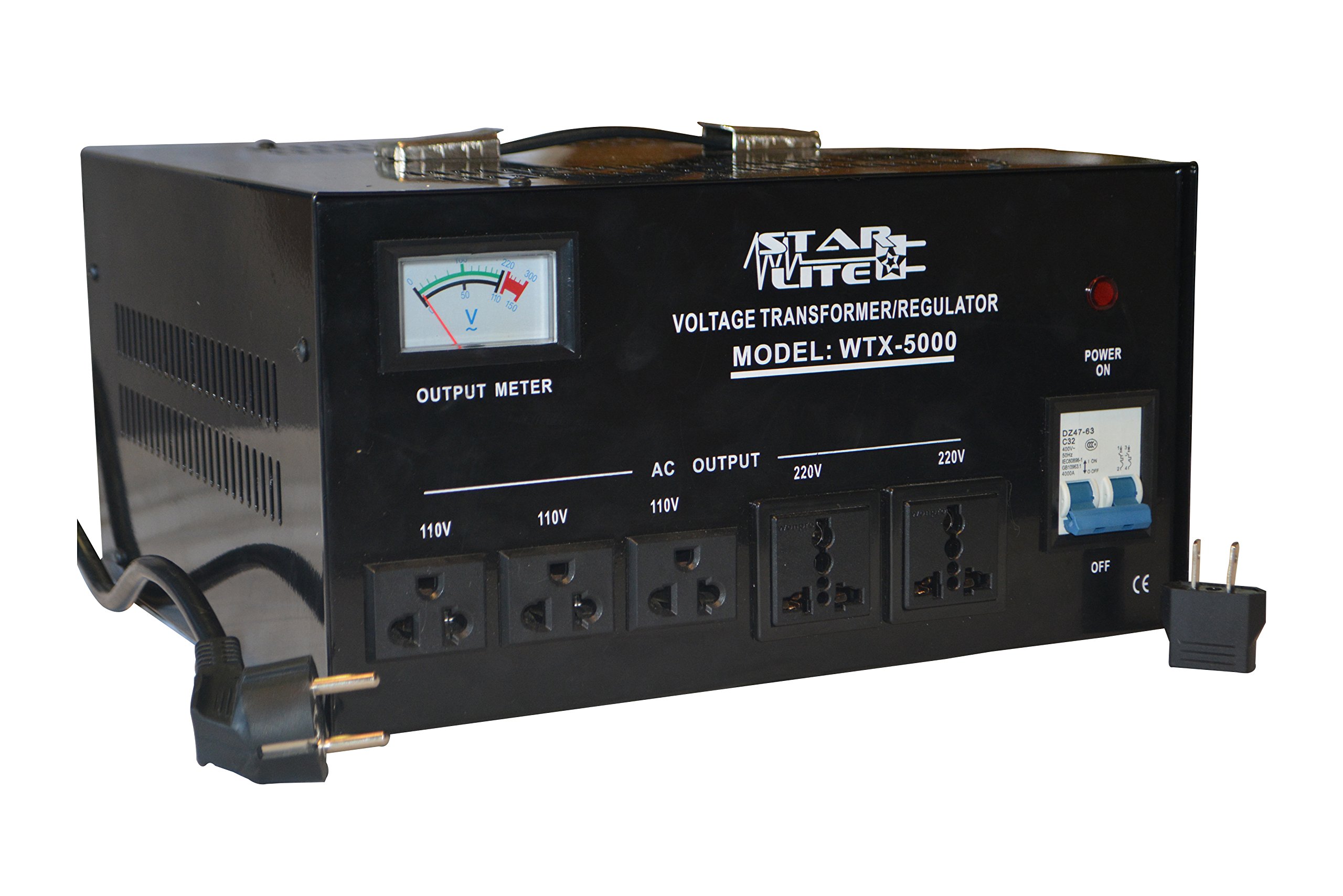
A massive 5000-watt transformer for running North American tools on 220-volt overseas power, and vice versa.
The WTX-5000 is built for situations where you need both voltage conversion and regulation in a single heavy-duty box. It converts 220/240 volts down to 110/120 volts, and it also steps up in the opposite direction. The 5000W continuous capacity is enough to run workshop equipment, large appliances, or multiple computers. The unit weighs 31.4 pounds and includes circuit breaker protection and a heavy-duty cord. Starlite backs it with a limited 5-year warranty covering both parts and labor, with the owner paying shipping.
Owner experiences are split. Many confirm it “works perfectly” and call it a solid transformer for international gear. A few, however, report the unit flickering and clicking after three months, causing brief power loss. The analog voltmeter is another common gripe — it cannot deliver an exact reading like a digital display would. For the price, this is still a strong option for anyone who genuinely needs 5000W of conversion and regulation in one package, but quality control appears to vary more than on the Tripp Lite products.
The big advantage
- 5000W continuous capacity dwarfs every other pick here — it can handle a workshop full of 110V tools on a 220V line.
- The 5-year limited warranty is the longest coverage window in this roundup, covering both parts and labor.
The practical downside
- At 31.4 pounds and measuring roughly 9.5 x 7.75 x 4.5 inches, this is a floor-mount unit — not something you stash on a shelf.
- Some shoppers say flickering and clicking behavior after a few months, suggesting intermittent quality control.
Who it suits: anyone shipping North American equipment to a 220V country, or vice versa, who needs high wattage and regulation in one box.
The honest limit: the flickering reports are too frequent to ignore; budget for a possible early replacement if reliability is mission-critical.
6. YaeCCC ST-3000 Voltage Transformer Converter Regulator

A dual-voltage transformer with built-in regulation that covers both 110V and 220V gear on a budget.
The ST-3000 regulates input voltage from AC 85V-130V or 180V-260V down to a stable output of either 110V or 220V, with a ±3% tolerance. That wide input window is useful in areas with notoriously unstable grid power. It has circuit breaker protection, a thick heavy-grade cord, and a front-panel voltage meter that shows the exact output voltage. The unit provides three sockets: two 110V US-standard outlets and one 220V universal socket that accepts most plug types except the large South African style.
The feedback from the 190+ ratings is generally positive — owners call it a heavy-duty and perfect purchase. However, a vocal minority reports units arriving non-functional, with one flatly calling it “a piece of junk.” The weight is 16.7 pounds, which is manageable for a floor-mounted converter. The value is strong for the price, but the quality-control variance is higher than on the Tripp Lite units. This pick is best reserved for non-critical appliances where a failure means inconvenience, not data loss or hardware damage.
The budget bridge: If you need to run a 110V appliance from a 220V line on a tight budget, the ST-3000 gets the job done. Just test it immediately and return any defective unit within the return window.
Best for: powering a single 110V appliance (a small refrigerator, a printer, a TV) from a 220V outlet without spending premium money.
Not for: computers or critical data equipment — the reliability split is too wide to trust it with a PC that holds important work.
7. BXST Surge Protector Outlet, Voltage Regulator (2-Pack)
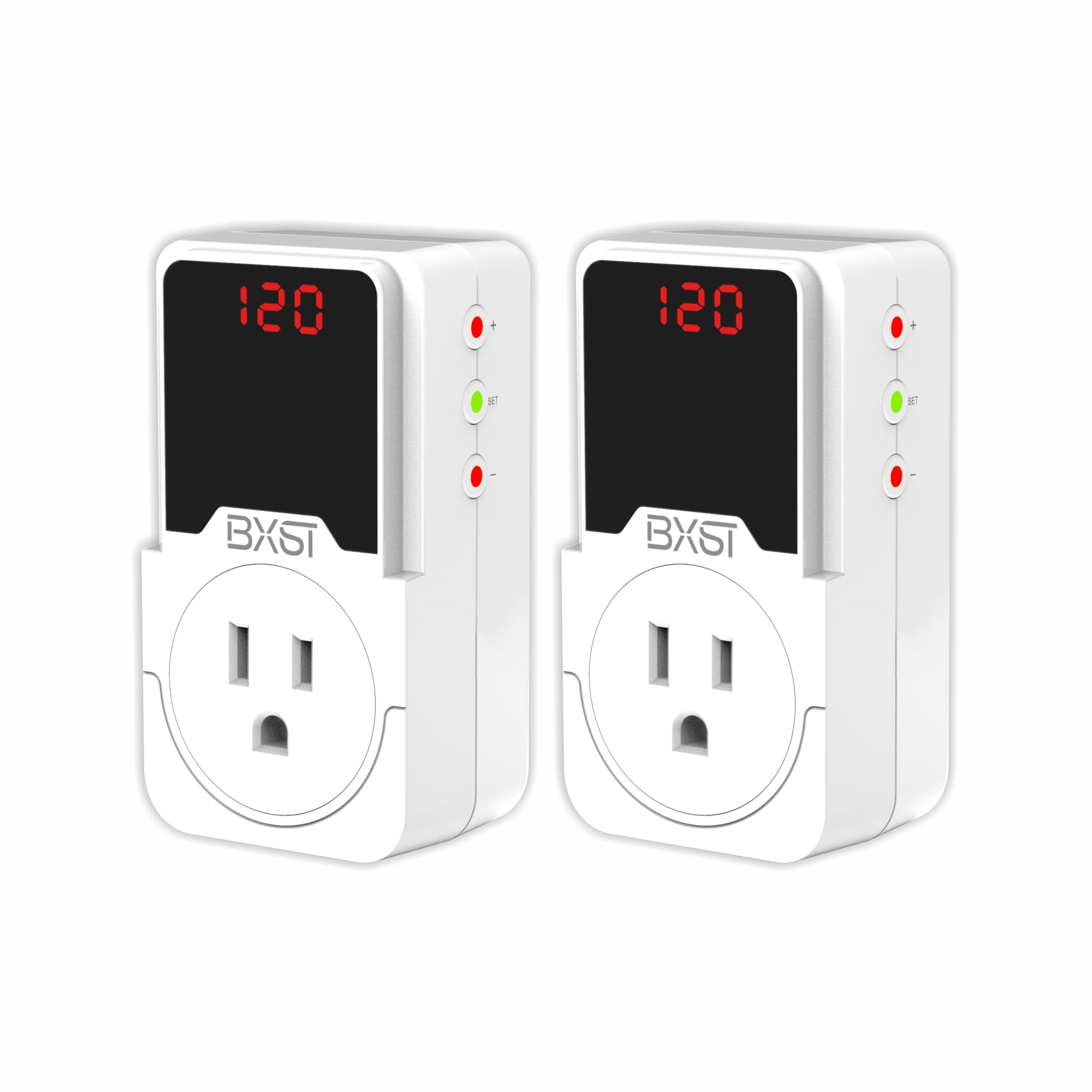
A wall-hugging regulator that lets you set your own voltage limits and cut-off delay for a single appliance.
This is the smallest and most focused unit in the lineup — it plugs directly into a wall outlet and protects a single device. The 15-amp, 1800W capacity is enough for a refrigerator, washing machine, or computer. The key feature is the adjustable high/low voltage protection: you can set the upper threshold between 130V and 150V, and the lower threshold between 80V and 100V. The delay time is also adjustable from 180 to 999 seconds, which is useful for compressor-based appliances that should not restart immediately after a power cut.
The 140-joule surge protection rating is low compared to the desktop units above, but it is adequate for the targeted use case of a single home appliance. The clear LED display shows real-time voltage and status codes. Owners appreciate the adjustable delay, with one reporting they bought multiple units for electronics not connected to a UPS. The setup requires a brief study of the buttons — no printed instructions come in the box, which some reviewers found frustrating. The 2-pack bundle makes it a cheap way to cover both a refrigerator and a washing machine.
What works
- Fully adjustable voltage cut-off thresholds (80-100V low, 130-150V high) let you tailor protection to your specific grid conditions.
- The 2-pack format covers two major appliances at once for a single purchase price.
What to know
- No printed instructions are included — you will need to figure out the SET button and +/- keys on your own.
- 140 joules of surge suppression is the lowest in this roundup; it will not survive a major lightning strike.
Reach for this if: you want a simple, appliance-level guard for your refrigerator or washing machine that you can set and forget.
Look elsewhere if: you need to protect a high-value computer or home theater — the 140-joule rating and single-outlet format are underpowered for that job.
Understanding the Specs
VA vs. Watts — They Are Not the Same Thing
Volt-Amps (VA) is the total electrical capacity the unit can handle, while Watts is the real power your devices actually consume. For most electronics, the Watts rating is about 60% to 70% of the VA rating. Always check the Watts number first. A 1500VA unit might only deliver 1000 usable Watts. If your PC draws 650W, a 1000W regulator is your minimum.
AVR — What It Actually Does
Automatic Voltage Regulation is the function that keeps output voltage steady when input voltage sags (brownout) or spikes. Basic AVR units correct swings of roughly 89V to 145V back to a nominal 120V. Better units add multiple boost/buck taps for finer control. Without AVR, your power supply has to work harder, generating more heat and wearing out faster.
FAQ
Do I still need a surge protector if I have an AVR?
Can an AVR damage my computer if it fails?
Will a voltage regulator stop my lights from flickering?
How many outlets do I really need?
What is the difference between a voltage regulator and a UPS?
Can I plug a power strip into an AVR?
What does pure sine wave mean and why does it matter?
How long does an automatic voltage regulator last?
Can I use a step-up/down transformer for a refrigerator?
What does the delay time setting do on an adjustable regulator?
Final Thoughts: The Verdict
For most buyers, the best automatic voltage regulator winner is the CyberPower CP1500PFCLCD because it combines the highest crowd-sourced reliability score with pure sine wave output and a battery backup, covering every base from brownouts to blackouts. If you only need clean, regulated power without a battery, grab the Tripp Lite LC1200. And for budget appliance protection, the BXST 2-pack is the cheapest way to guard a fridge and a washer in one step.
How We Picked
We do not accept paid placement. Every pick is matched to a real buyer and a real use-case; we do not hands-on test units.
Sources & Methodology
Specifications: manufacturer listings and product documentation. Review insights: verified customer reviews, as of July 2026. Pricing: not shown on this page (it changes often); check the current price via the retailer link.
As an Amazon Associate, Gadgets Feed earns from qualifying purchases. This does not affect which products we feature.