
Our readers keep the lights on and my morning glass full of iced black tea. As an Amazon Associate, I earn from qualifying purchases.
Specs are compiled from manufacturer listings and verified buyer reviews and can change over time — please confirm the key details on the product page before buying.
If your windows are tall, street-facing or just plain awkward to reach, an automatic window cleaner does the wiping while you keep both feet on the floor. The catch most buyers hit is that suction and edge handling vary a lot between models, so a robot that grips beautifully on a big patio pane can struggle on a narrow bathroom window. The picks below are sorted by what they actually do well — grip, water coverage, safety backup — not by marketing claims.
I’m Min — the founder and writer behind Gadgets Feed. This guide is built by comparing the manufacturers’ published specifications and the patterns across verified customer reviews, so you get each pick’s real strengths and trade-offs instead of marketing spin.
The short answer: pick your robot around the glass you actually own. A robot like the WINBOT W2S needs flat, smooth glass of at least 11.8 x 15.7 in, so it will not help you on a curved sunroom panel, and a slim body matters more than raw suction when your windows are narrow. Below you’ll find the strongest automatic window cleaner options ranked by real suction ratings, tank size and safety backups.
Our Picks at a Glance
How To Choose The Best Automatic Window Cleaner
These machines do one job: they stick to vertical glass by vacuum and crawl across it while spraying water and wiping with a pad. Everything that matters follows from that — how hard they suck, how much water they carry, and what happens if the vacuum fails.
Start with suction, because everything else depends on it
Suction is measured in Pa (pascals — a unit of pressure, here meaning how hard the robot pulls itself onto the glass). More Pa means a firmer hold on thick or large panes. The models here range from 2200Pa on the KKI up to 8000Pa, and the high-suction ones are the ones you want above a drop. A robot rated 2600–3200Pa copes with ordinary home windows; 6500Pa and 7200Pa models are built for larger, thicker panes.
Match the robot to your actual glass
Every one of these will refuse curved, cracked, heavily textured or unevenly framed glass — glass must be flat and smooth. One model here states a minimum pane of 11.8 × 15.7 in and a glass thickness of at least 0.12 in (3 mm). Another handles small panes from 30×30 cm. Measure the smallest window you plan to clean before you buy, because a big robot on a tiny pane wastes passes.
Know what the safety backup really does
The internal battery in these robots is not for cordless cleaning. It exists to keep the vacuum holding the machine against the glass for a while during a power cut — 25 minutes on several models, 30 minutes on the HUTT, while alarms sound. A safety rope is a separate line of defence, anchored to a fixed object for overhead or high-rise work. Use both, every time.
Check tank size and nozzle count before you commit
Water tank capacity runs from 60 ml to 120 ml across this list, and it decides how much glass one fill covers. Dual-nozzle and triple-nozzle spray systems wet the glass from the side the robot is heading toward, which cuts smearing. A single small tank means refilling mid-job on large windows.
Quick Comparison
| Model | Best For | Suction | Water Tank | Backup Hold | Amazon |
|---|---|---|---|---|---|
| WA9C Pro★ Best Overall | Balanced all-rounder | 2600–3200 Pa | — | 25 minutes | Amazon |
| ECOVACS WINBOT MINICompact Pick | Narrow windows and tight frames | 7500 Pa | 60 ml | — | Amazon |
| HIXZAP X1Top Performer | Deep clean with edge protection | 4800–6400 Pa | 85 ml | — | Amazon |
| GNOVEL 8KPa | Big glass walls and tiles | 8000 Pa | 120 ml | 5 minutes | Amazon |
| KKI Dual Spray | One-hand, ladder-free cleaning | 2200–3200 Pa | 85 ml | 25 minutes | Amazon |
| HIXZAP X1 PRO | Thick floor-to-ceiling glass | 7200 Pa | 85 ml | 25 minutes | Amazon |
| Tosima X1 Blue | Large windows plus small panes | Maximum (rated) | 85 ml | 25 minutes | Amazon |
| HUTT Round-Square | Streak-control on big panes | 6500 Pa | 80 ml | 30 minutes | Amazon |
| ECOVACS WINBOT W2S | Edge-to-edge coverage | 8000 Pa | 60 ml | — | Amazon |
In‑Depth Reviews
1. WA9C Pro Window Cleaning Robot, 4-Nozzle Dual Spray, 6 Cleaning Modes
Our pick — 4.5+★ from 200+ verified ratings; the strongest balance of quality and price.
Four nozzles wet the glass evenly, and the vacuum holds on for 25 minutes if the power dies.
The WA9C Pro solves the two things that annoy people most about window robots: patchy spray and the fear of a fall. Its four precision nozzles — two on each side — push air out of the internal water pipes and lay down an even mist across the glass as it moves. That means you are not left chasing dry patches with a cloth afterwards.
Grip comes from an adsorption force of 2600 to 3200 Pa (pascals, a measure of how hard the robot pulls itself onto the pane). A smart air pressure monitor and a bottom drop sensor keep checking the surface, so the machine holds its footing on ordinary home glass. If the power cuts, the internal battery keeps it stuck to the window for up to 25 minutes while it beeps and flashes a light. The safety rope still needs anchoring to something solid for overhead work.
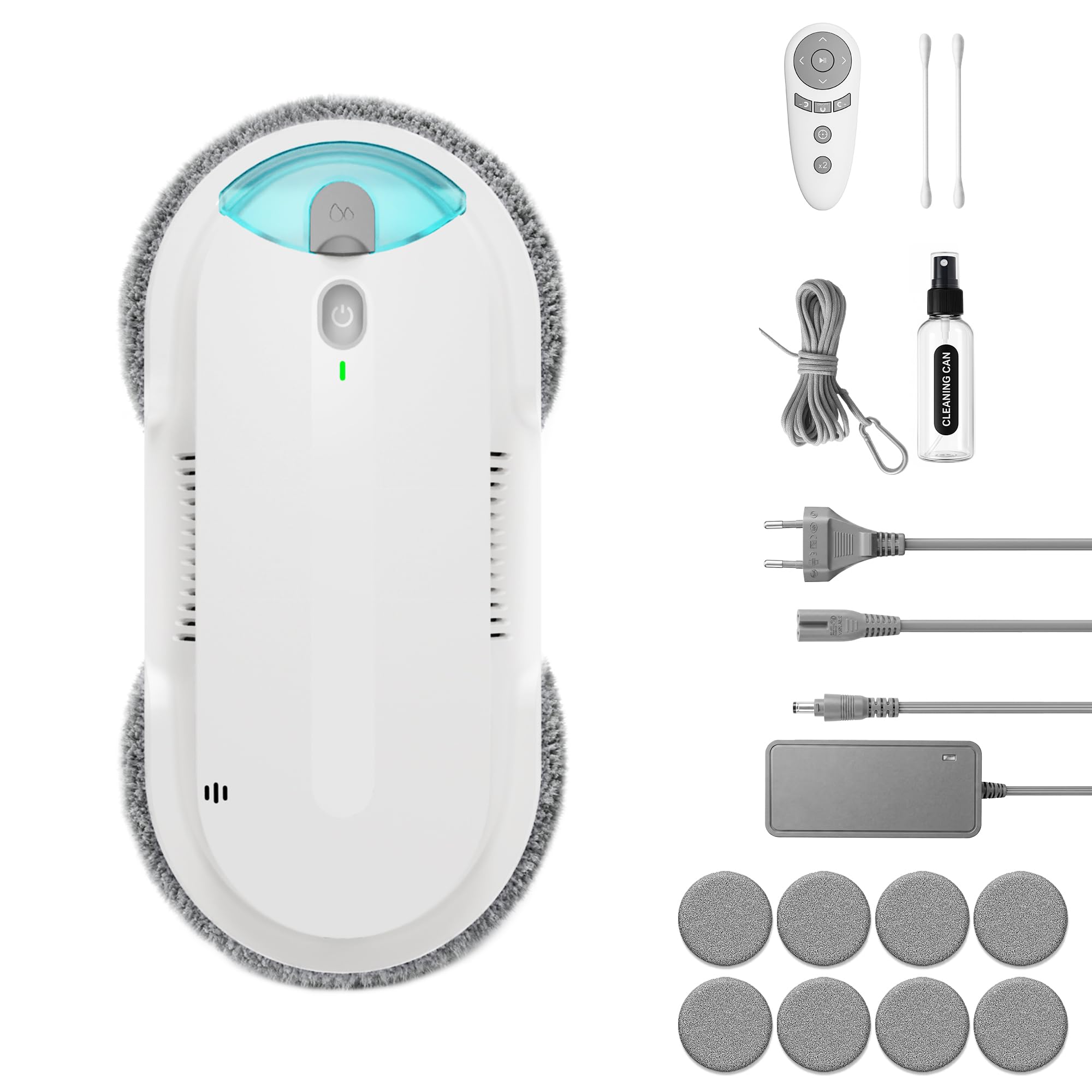
In the box you get the robot, four cleaning mops, an unclogging needle kit, a water bottle for filling, replacement nozzles and the AC adapter. The unscented crowd and the scented crowd both seem to notice the cleaning solution, and the build quality is what the review pages keep circling back to. What wins people over is the overall finish — this is a robot that behaves like a name-brand unit rather than a cheap imitation. The honest caveat: streak-free results are reportedly inconsistent, with some windows coming out spotless and others showing residue, so run a slow deep pass on very dirty glass before judging it.
What holds up under use
- 2600–3200 Pa suction with a pressure monitor and drop sensor that keep it planted
- 25-minute battery backup keeps the vacuum alive through a power cut
- Four nozzles spread water evenly so you are not chasing dry patches
- Full kit includes four mops, a filling bottle and spare nozzles
Where it asks for patience
- Streak-free results are mixed, so heavy grime may want a pre-wipe
- Safety rope must be anchored — the backup battery is not cordless cleaning
Reach for this one if: you want a well-equipped everyday robot that grips standard home windows and has a real power-cut backup.
Think twice if: your glass is very heavily soiled and you expect a single pass with zero follow-up wiping.
2. ECOVACS WINBOT MINI Window Cleaning Robot, Compact Design, Ultrasonic Spray
Built for the narrow window nobody wants to climb a ladder for.
A 2.17-inch profile is the whole pitch here. That slim body lets the WINBOT MINI fit between tight frames and onto small panes where a bulkier robot simply will not sit flat. If your awkward windows are narrow rather than huge, this is the shape to look for.
Suction is rated up to 7500 Pa, backed by a nine-stage safety protection system and a safety rope — meaning several layers of hold and one physical tether between the robot and the ground. A bumper-free design lets it wipe closer to edges and corners, so you spend less time finishing the border by hand. The 60 ml tank feeds an ultrasonic spray that turns water into an ultra-fine mist, loosening dust before the pad sweeps it away.
Setup is deliberately low-tech: plug in the power, press the button, and it plans its own path without an app or Wi-Fi. The ECOVACS HOME app adds Fast, Deep and Spot modes when you want them. What owners praise most is the cleaning itself — the robot lifts everyday grime and water marks without flooding the glass, and it finishes by returning toward its start point and alerting you. The catch: streaks and reliability both draw noise in the reviews, and the price is called out as steep by some. Treat it as a compact specialist, not a budget workhorse.
The real trade-off: you are paying for the slim body and the no-app simplicity. If your windows are large and flat, a bigger tank and wider cleaning head serve you better.
balance: it suits narrow bathroom and side windows, tight frames, and anyone who wants one-button operation with no phone involved.
Not the pick for: full glass walls where a 60 ml tank means refilling before the job is done.
3. X1 Window Cleaning Robot – Double Helix 4800-6400Pa Suction, Dual Ultrasonic Spray, 85ml Tank
Variable suction that dials itself up on dirt and backs off on clean glass.
This X1 is the highest-rated robot on the list, and the reason is the suction logic. Instead of one fixed pull, it runs a double helix 4800 to 6400 Pa variable frequency system that adjusts to how dirty the glass is. More grime means more grip and deeper scrubbing; clean glass means it eases off and keeps moving.
Water comes from dual ultrasonic atomization that sprays from the side, and the tank holds 85 ml with a window so you can see the level without pulling the robot off the glass. It sprays twice per movement and stops spraying the moment intelligent edge detection senses the frame — which protects your surrounding surfaces from overspray. An air pressure sensor handles anti-drop duty.
The trade-off is the paper trail. This model arrives with a strong spec sheet but only a small rating base so far, so its high rating rests on limited feedback. If you want the suction flexibility and the visible tank, it is a genuinely impressive package — just go in knowing you are an early buyer rather than following a crowd.
Specs that earn the score
- 4800–6400 Pa suction that self-adjusts to dirt level
- Visible 85 ml tank — no guessing when a refill is due
- Edge detection cuts the spray at the frame to protect surfaces
- Bidirectional ultrasonic atomization for even coverage
Things to weigh up
- A small rating base so far to lean on
- Battery-powered design still needs the safety setup for high glass
Worth it for: buyers who want adaptive suction and a tank they can eyeball without stopping the machine.
Hold off if: you would rather buy a robot with a deep track record behind it.
4. Window Cleaning Robot 8KPa Anti-Fall Auto Spray for High Rise Glass
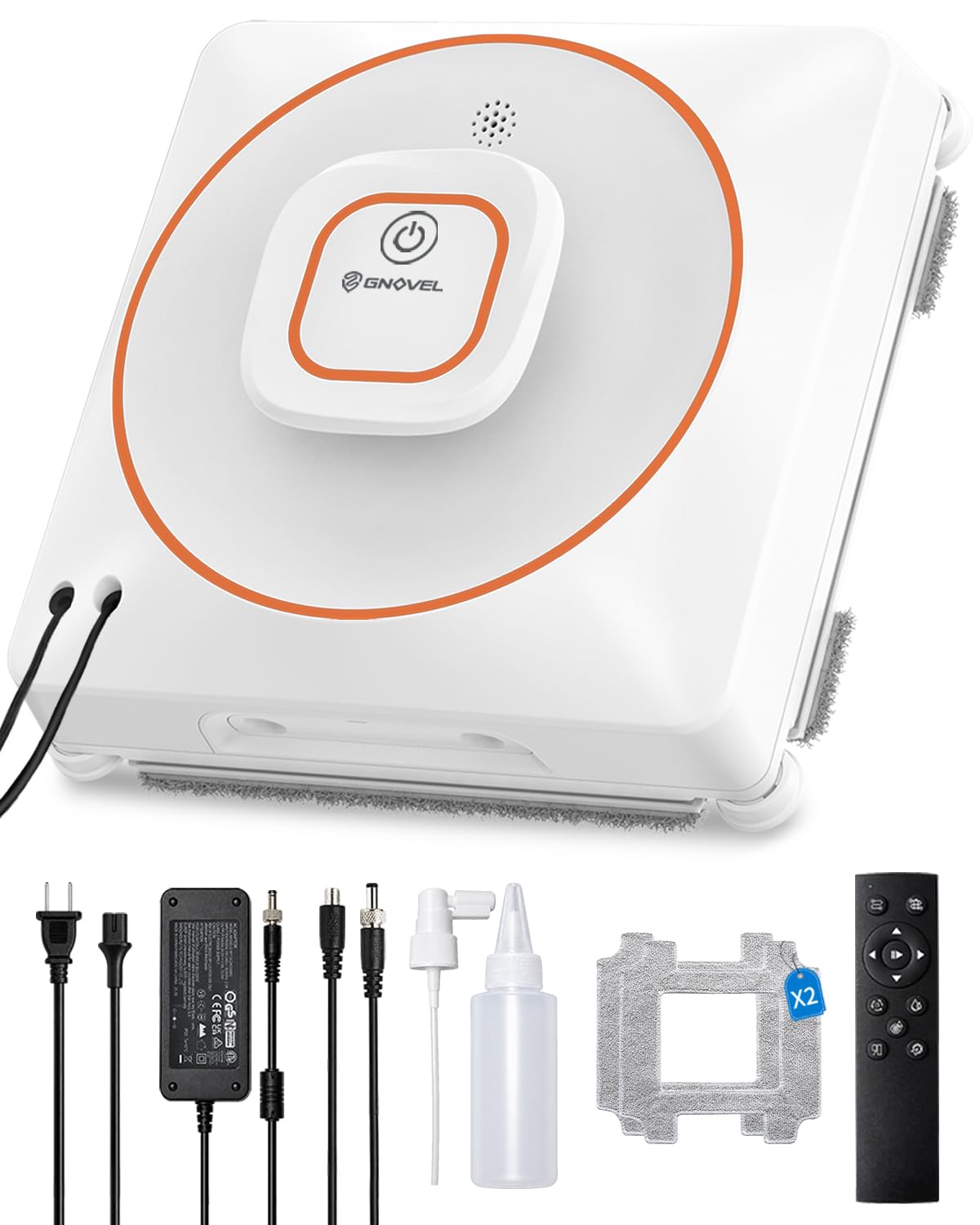
The tank here holds 120 ml versus 60 ml on the WINBOT MINI, so big panes get finished in one go.
Raw suction on this GNOVEL unit is 8000 Pa, the top figure on the list alongside the WINBOT W2S, paired with a 15-stage anti-fall system. In plain terms that is 8000 pascals of pull holding it to the glass, plus fifteen separate safety checks layered on top. Bird droppings and dried-on stains come up without a fight, and the same robot handles shower glass, mirrors, tile walls and railings.
The four-nozzle misting system works with that 120 ml tank to keep coverage even across wide surfaces, which is why large glass walls are its natural home. Four cleaning modes — Quick, Deep, N-Pattern and Edge — change the path rather than just the speed, and route planning plus real-time safety monitoring run on their own once you press start.
Performance is what gets praised here; the machine cleans tiles and windows without a fuss and the setup takes minutes. The honest gap is the backup battery, rated at 5 minutes of hold versus 25 minutes on several rivals. If your power is stable and your windows are big, that barely matters. On a high-rise where interruptions are a real worry, it does.
Where the value sits: tank capacity and suction — 120 ml and 8000 Pa mean fewer refills and a firm hold on expansive glass.
What to plan around: a short 5-minute power-off hold, and edge cleaning that some buyers find leaves smudge lines along the frame.
Choose this for: large glass walls, tiled shower screens and railings where a big tank saves you repeat trips.
Look elsewhere if: your windows are on a high floor and you want a long power-cut hold as insurance.
5. KKI Window Cleaning Robot with Dual Spray for High-Rise Windows, Black

Ten cloths in the box and a one-touch start make this the least fiddly robot here.
Ease of use is the point of the KKI, and the numbers back it up. A one-touch start on AC power handles a window without a ladder, which is why it suits older users or anyone who wants to press a single button and walk away. The 11.8-inch cleaning path is the widest on this list, so it covers more glass per pass than the 8-inch robots around it.
Its suction runs 2200 to 3200 Pa with automatic adjustment as the anti-drop system reads the surface, and the dual-direction spray was upgraded to 0.05 ml per spray from 0.03 ml with an atomized nozzle that resists clogging. One tank covers 20+ square meters of glass. The kit is unusually complete: ten cleaning cloths, an empty bottle, a safety rope, an adapter and a remote.
Two honest notes. Streak removal draws mixed feedback, with circular smears showing up on some windows, and a few buyers report the robot losing its hold. It is also rated for light to moderate dirt only — heavily soiled glass wants a pre-wipe, and concentrated cleaning solutions can clog the sprayer, so use plain water. Keep it to smooth glass and flat frames and it behaves well.
Best-for read: busy households that want one button, a wide 11.8-inch path and plenty of spare cloths in the box.
The honest limit: streak removal and stability both split opinion, so don’t expect perfection on the first pass.
Suits you if: you want the simplest possible start-up and a big supply of pads without paying premium prices.
skip it if: your glass is thick, very dirty or on an exposed high-rise where suction holds are your biggest worry.
6. X1 PRO Window Cleaning Robot – Double Helix 7200Pa Suction, Dual Ultrasonic Spray, 85ml Tank
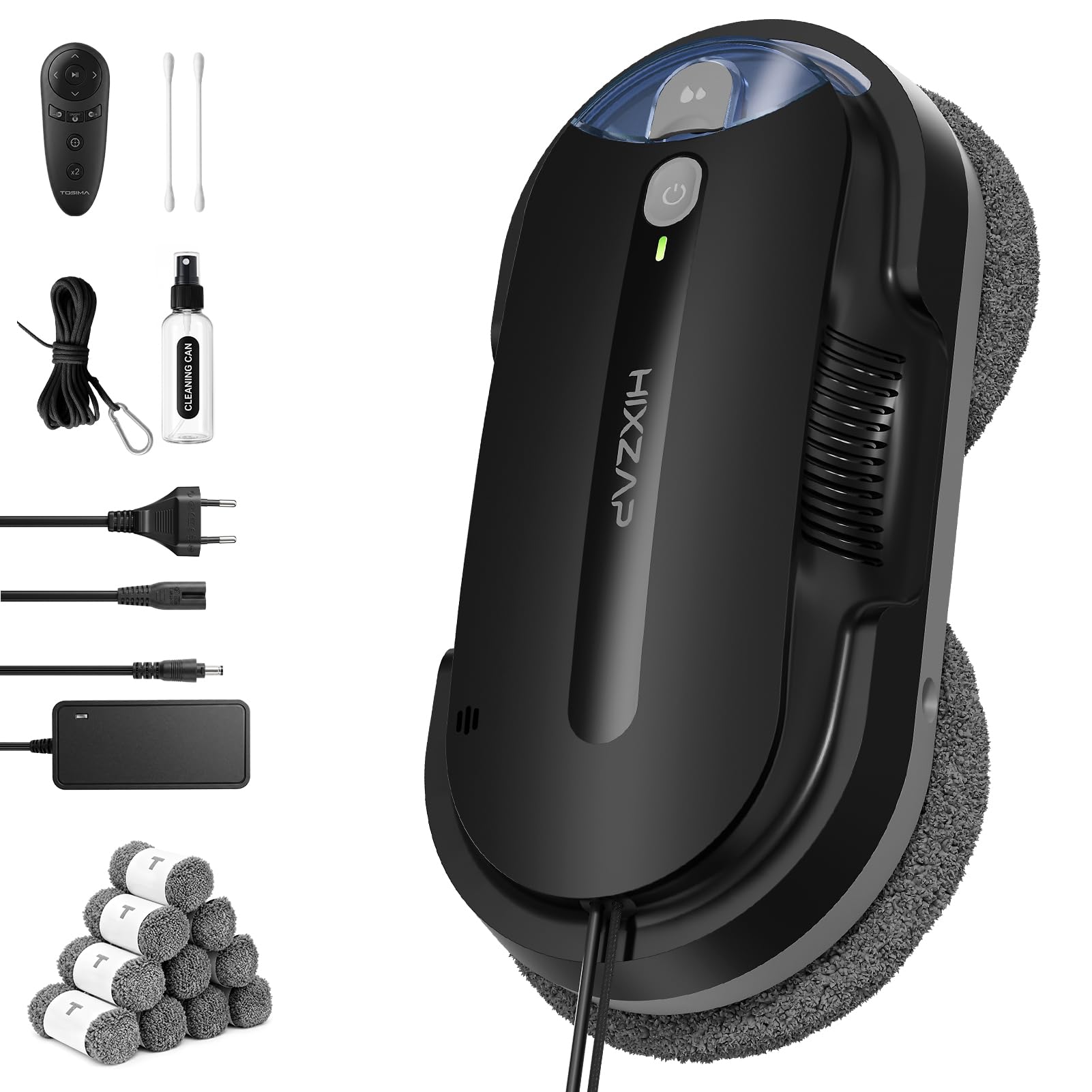
7200Pa of pull built for thick, floor-to-ceiling glass, with a 25-minute vacuum backup.
Here is the head-to-head worth knowing: this X1 PRO grips with 7200 Pa (pascals, a measure of suction force), while the GNOVEL above tops out at 8000 Pa. The GNOVEL wins on raw pull. The X1 PRO answers with a smarter spray — its dual ultrasonic nozzles (two misters that vibrate to spray water) mist only in the direction of travel, left nozzle going left and right nozzle going right, so the glass stays evenly wet instead of soaked in patches.
That 7200 Pa holds firmly to glass from 3 mm thick and up, which covers sliding doors, high-rise exterior panes and full-height windows. The S-shaped path is fully automatic: press start, the AI chip maps top-to-bottom coverage, and the machine beeps when it finishes. A built-in UPS battery keeps the suction alive for 25 minutes during an outage, alongside a safety cable rated to hold the robot’s full weight.
The kit is generous — 20 reusable microfiber mop pads, a remote for spray strength and manual steering, and no app or Wi-Fi required anywhere. It works on smooth glass from 12×12 inches up. As with the other HIXZAP model on this list, you are buying ahead of the review crowd rather than following one.
Built for: thick glass walls, sliding doors and second or third-storey panes where grip and a long power-cut hold matter most.
The catch: 20 pads and a smart spray are the sell here, but you will not find a long owner track record behind it yet.
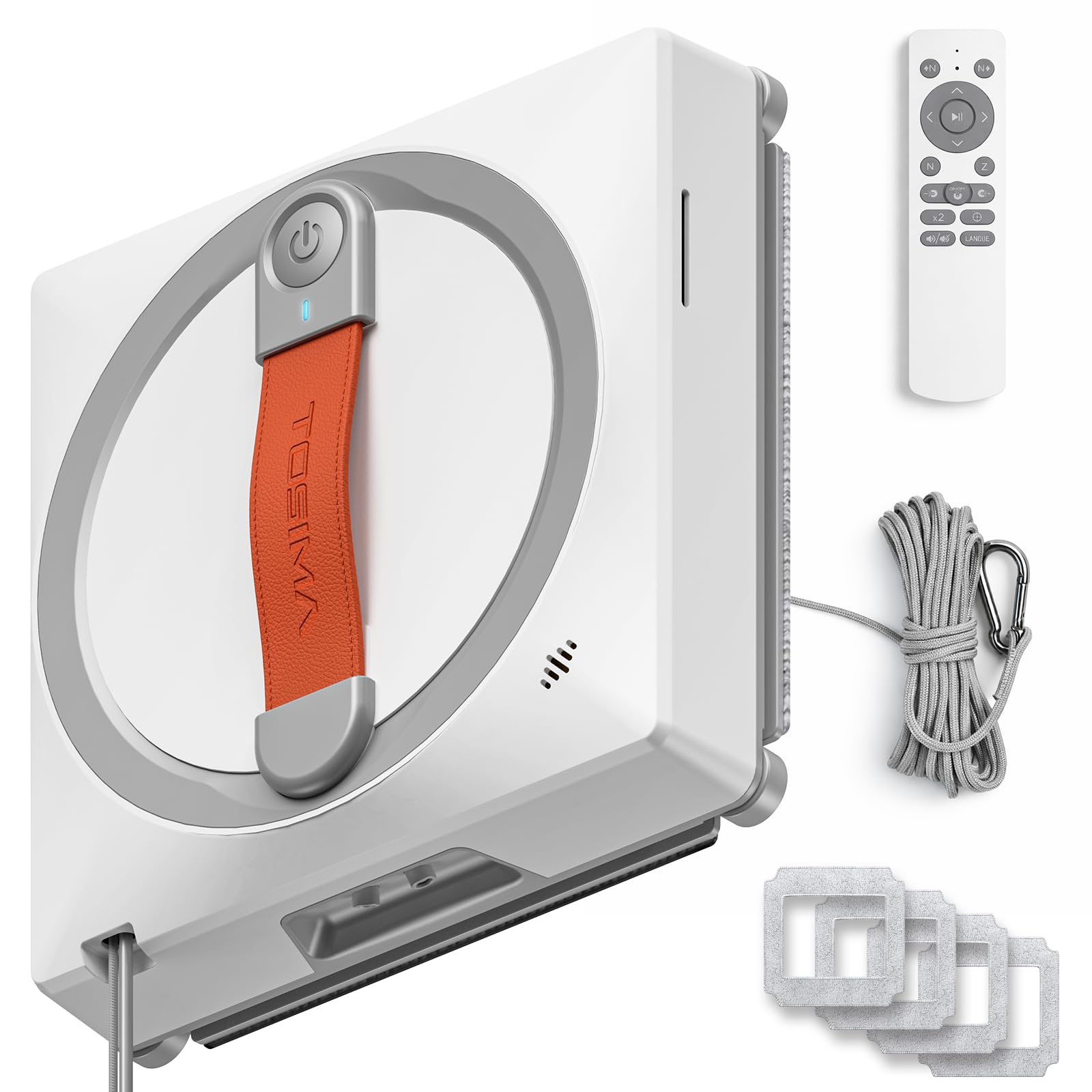
7. Tosima X1 Window Cleaning Robot – Dual-Nozzle Ultrasonic Atomization, 85 ml Visible Water Tank (Blue)
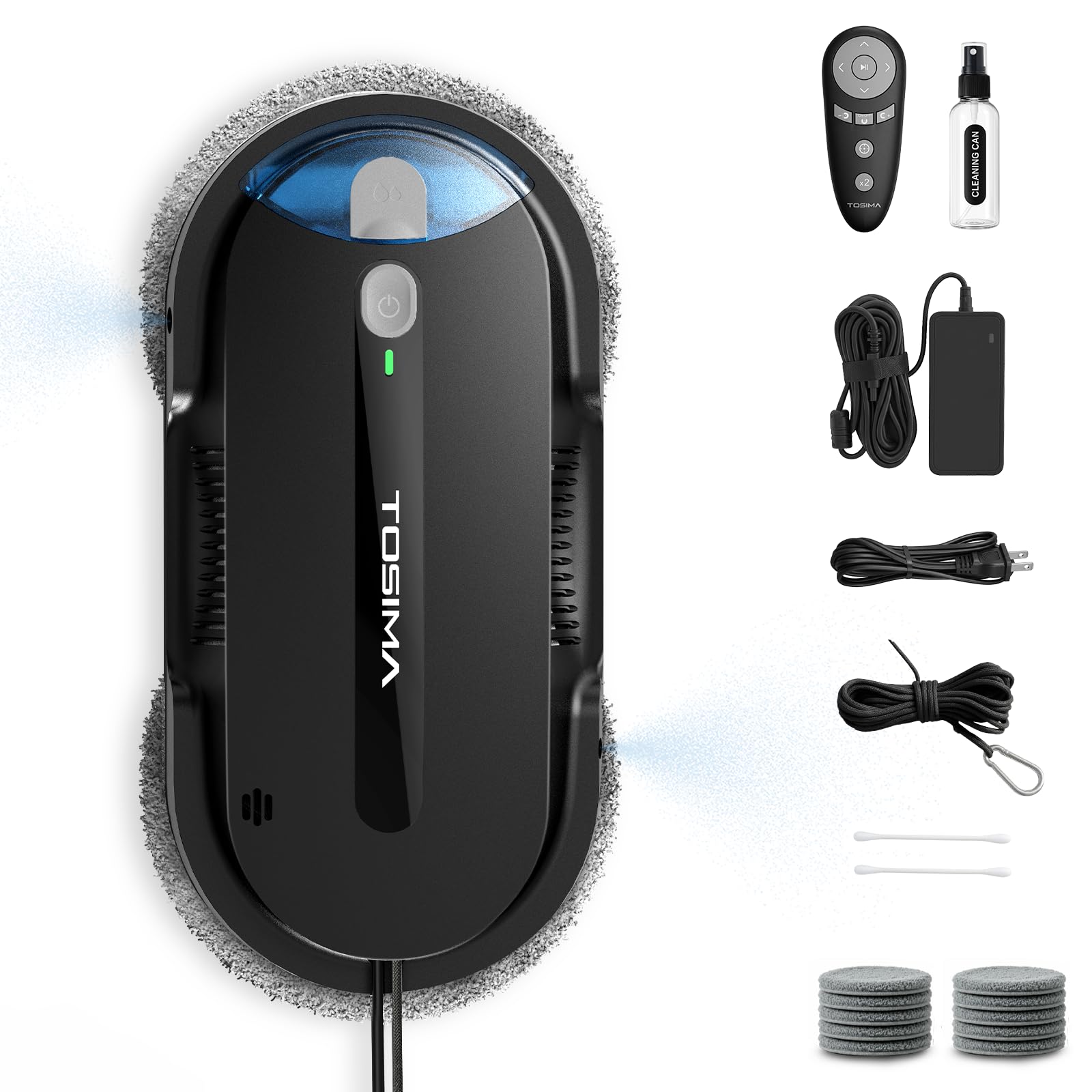
A viewing window on the tank so you never pull the robot off mid-job to check the water.
Tosima’s pitch is flexibility. The 85 ml tank has a viewing window, so a glance tells you how much water is left — useful when you are halfway up a sunroom pane. The robot cleans in an S-shaped path from top to bottom on its own, and the remote lets you steer it manually whenever a window is shaped awkwardly.
It handles both ends of the size range: large windows and smaller glass surfaces from 30×30 cm, and the same manual control works for overhead cleaning on sunroom windows. Dual nozzles release water only in the direction of travel, which cuts smearing, and a built-in battery keeps the unit attached for about 25 minutes if the power drops. The safety tether anchors to a fixed object for improve work.
Performance and build quality are what the review pages keep returning to, and the suction gets specific credit for holding firm on large panes. It is designed for household use in temperatures from 0 °C to 40 °C, so an unheated conservatory in winter is out of range. Cleaning performance itself draws some mixed notes, so plan for a second pass on stubborn marks.
Why it earns a spot: one robot that works a full patio door and a small bathroom pane, with a tank you can monitor at a glance.
Know before buying: the 0 °C to 40 °C operating range rules out cold rooms, and results on tough marks can vary.
Pick this if: your home has a mix of big windows and small panes, and you want to steer the robot yourself on awkward shapes.
Pass if: all your glass is simple and large, where a bigger tank does more for you than a visible one.
8. HUTT Window Cleaning Robot, Round-Square Dual-Stage Cleaning
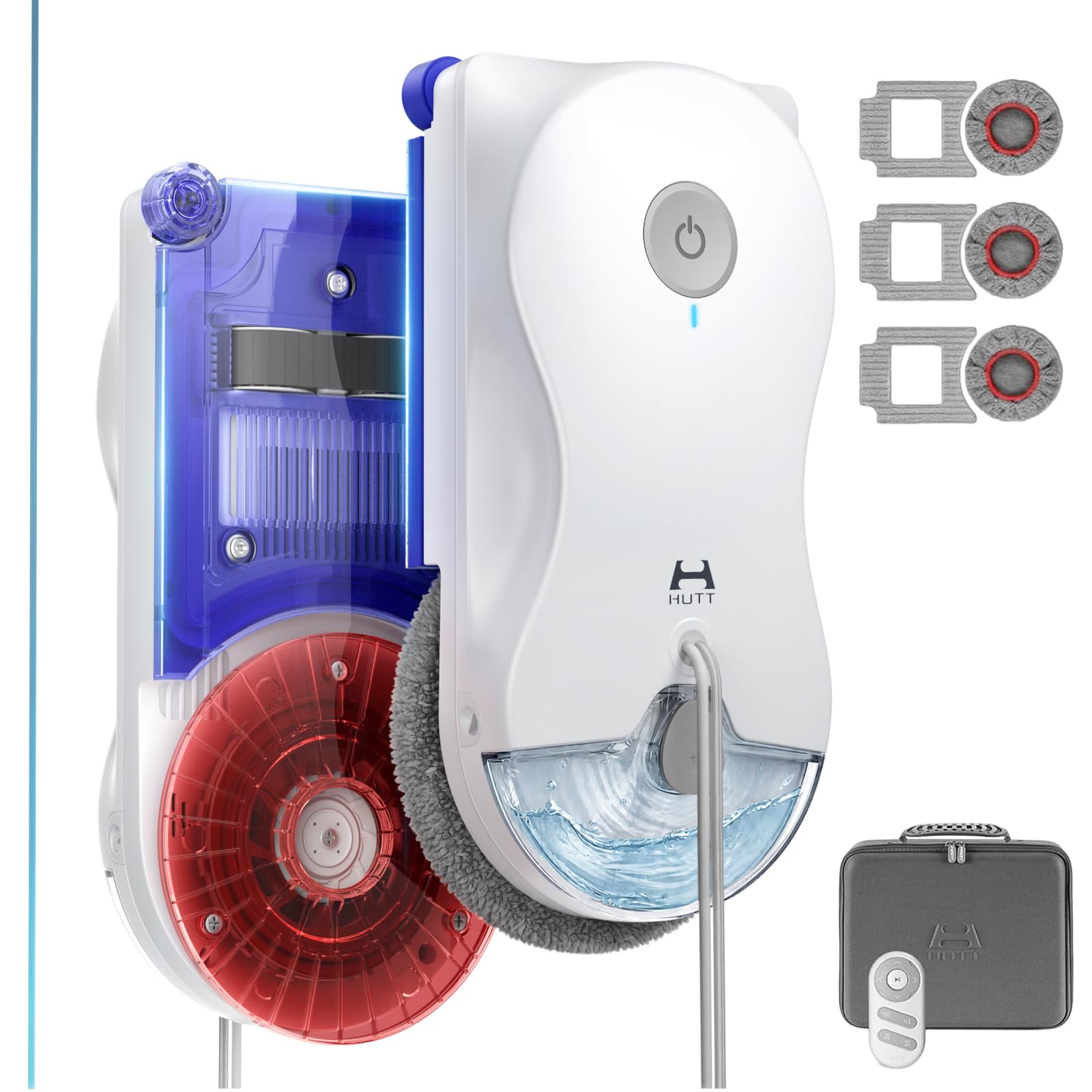
Wet-lift first, dry-polish second — two pads doing two different jobs on the same pass.
Most window robots wipe with one pad and hope for the best. The HUTT runs a two-stage system instead: a 70 RPM round pad lifts the wet dirt, then a precision square pad dry-wipes and polishes behind it. That second dry pass is the whole reason streaks get reduced rather than smeared around.
A brushless motor delivers 6500 Pa of suction for vertical adhesion, and a patented 3D suspension base keeps a constant 55 N of pressure (about 12.3 lbs of push) against the glass, mimicking the pressure of hand scrubbing. The 80 ml visible tank covers up to 60 square meters per refill, and dual ultrasonic mist hydrates the surface evenly as it goes. For best spray performance HUTT recommends purified water with minimal impurities to reduce mineral buildup, so skip your tap’s hardest water.
Safety and quiet are the other two numbers worth knowing: a mountaineering-grade rope rated to 220 kg (about 485 lb) and a UPS battery (an uninterruptible power supply that keeps it running if power drops) that holds adhesion for up to 30 minutes. Noise sits as low as 65 dB (decibels, a measure of sound level) and the body weighs 1.3 kg (about 2.9 lb). One operating note straight from the maker: if the robot drifts or slips, the usual cause is dust on the drive tracks or pads that are too wet — keep the tracks clean, use square pads dry, and wring out the round pads thoroughly.
What makes it different
- Two-stage round-then-square cleaning targets streaks directly
- Constant 55 N pressure mimics hand-scrubbing force
- Up to 30 minutes of power-off adhesion, the longest hold here
- 65 dB operation and a 1.3 kg body keep it manageable
Setup demands
- Pads need careful wringing and dry use on the square side to keep traction
- Purified water recommended to avoid nozzle mineral buildup
The right call for: buyers who care most about a streak-reduced finish and a long power-off hold on high windows.
Be ready to: manage pad moisture properly and use purified water, or the robot can lose traction.
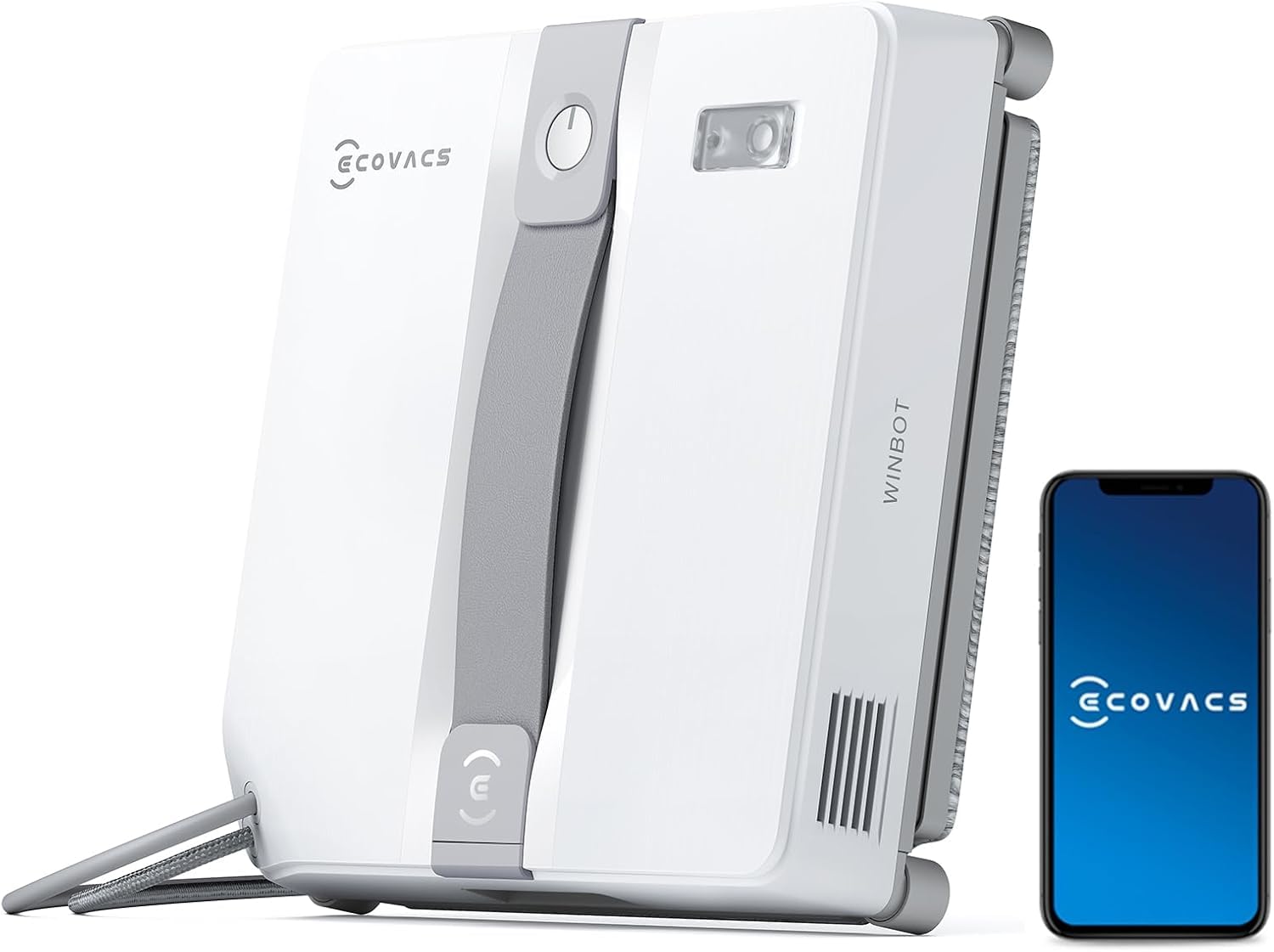
9. ECOVACS WINBOT W2S Window Cleaning Robot with TruEdge Cleaning
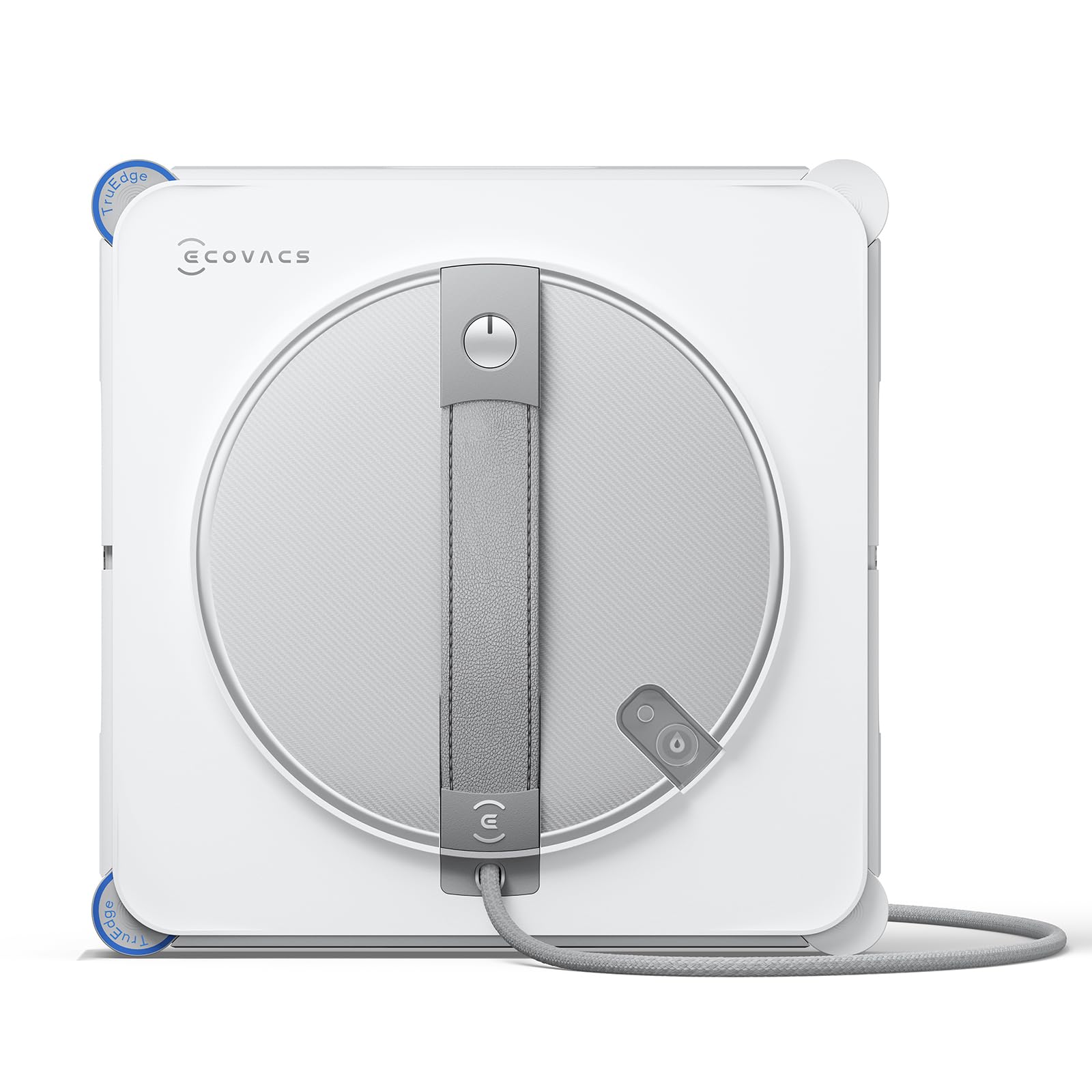
TruEdge scrubbers aim for the window border most robots leave behind.
Corners and borders are where window robots usually give up, and the W2S attacks them head-on. Its TruEdge scrubbers plus a dedicated Edge Cleaning Mode work as close as approximately 1.1 mm from compatible edges — under laboratory conditions, with a small margin possibly remaining depending on frame, seal and glass condition. It is the most deliberate attempt at edge coverage on this list.
Suction is rated 8000 Pa with WIN-SLAM 4.0 navigation planning systematic routes and detecting window edges to reduce missed areas. You get seven modes in the ECOVACS HOME app — Fast, Deep, Thorough, Edge, Spot, Zone and Heavy-Duty — plus a three-nozzle wide-angle spray system that applies solution according to movement and mode. Note that the spray can be intermittent rather than continuous, and you may need to prime the nozzles via manual spray in the app.
Two facts change how you plan. First, this is corded: it needs a working outlet through its adapter during cleaning, and the internal safety battery only maintains suction briefly during an interruption. It is not a cordless machine. Second, compatibility is strict — flat smooth glass at least 11.8 × 15.7 in, glass 0.12 in thick and up, tilt within ±45°, and no curved, cracked, textured or oily surfaces. Cleaning performance and reliability are what the review pages talk about most, and it earns its keep on hard, flat panes.
The case for premium: real edge cleaning down to roughly 1.1 mm, seven modes and 8000 Pa of grip — the most complete automation here.
Read the fine print: corded operation only, strict glass compatibility, and an app you will actually use.
For you if: your glass is large, flat and smooth, and you want the closest-to-the-edge clean available with app control.
Rethink if: you need a cordless robot or your windows are curved, textured or heavily framed.
Understanding the Specs
Suction in Pa and what it means on glass
Pa stands for pascal, a unit of pressure — here it describes how hard the robot pulls itself onto the pane. Higher numbers grip thicker or larger glass more confidently. Models here range from 2200Pa on the KKI up to 8000 Pa. Variable systems that adjust between two figures are dialing grip up on dirty glass and down on clean glass.
Tank size in ml and spray nozzle count
Water capacity decides how much glass one fill covers, and it ranges from 60 ml to 120 ml across these robots. Dual and triple nozzle systems spray only in the direction of travel, which keeps the glass evenly wet instead of soaked in patches. A visible tank lets you check the level without removing the robot.
The safety battery versus the safety rope
The internal battery is not for cordless cleaning. It holds the vacuum against the glass for a set window — 5, 25 or 30 minutes depending on the model — during a power cut, while alarms sound. The safety rope is a separate physical tether you anchor to a fixed object. For overhead or high-rise work you use both.
Edge detection and glass compatibility
Edge detection senses the frame and stops the spray or turns the robot, which protects surrounding surfaces. It does not make the robot suitable for curved, cracked, uneven or heavily textured glass. Check the maker’s minimum pane size and glass thickness before buying, because a robot cannot clean glass it cannot grip.
FAQ
Will an automatic window cleaner fall off a high window?
Can I use an automatic window cleaner on curved or textured glass?
Do these window robots need an app or Wi-Fi to work?
How long does the backup battery hold the robot during a power cut?
How big a window can one tank of water clean?
Will these robots clean right up to the window frame?
Why does my window robot drift or slip near the edges?
Can I put cleaning solution in the water tank instead of plain water?
Do these robots work on mirrors, tiles and shower doors too?
What is the smallest window an automatic cleaner can handle?
Final Thoughts: The Verdict
The automatic window cleaner worth starting with is the WA9C Pro, because its four-nozzle spray, 2600–3200 Pa monitored suction and 25-minute power-off hold cover the everyday job with a full kit in the box. If your awkward windows are narrow and tight-framed, the ECOVACS WINBOT MINI slips in where bulkier robots cannot. And for big glass walls where edge coverage matters, the app-driven ECOVACS WINBOT W2S reaches closest to the frame. Take your smallest and largest pane measurements before you order — that single check tells you more than any single spec.
How We Picked
We do not accept paid placement. Every pick is matched to a real buyer and a real use-case; we do not hands-on test units.
Sources & Methodology
Specifications: manufacturer listings and product documentation. Review insights: verified customer reviews, as of November 2026. Pricing: not shown on this page (it changes often); check the current price via the retailer link.
As an Amazon Associate, Gadgets Feed earns from qualifying purchases. This does not affect which products we feature.