
Our readers keep the lights on and my morning glass full of iced black tea. As an Amazon Associate, I earn from qualifying purchases.
Specs are compiled from manufacturer listings and verified buyer reviews and can change over time — please confirm the key details on the product page before buying.
An automatic window fan uses a built-in thermostat to turn on when the room warms and off when it cools, so you never wake up to a freezing room. The key is finding a model that holds its temperature setting, moves enough air, and fits your window securely. This guide compares four thermostat-controlled models to help you pick the one that fits your window and cooling needs.
I’m Min — the founder and writer behind Gadgets Feed. This guide is built by comparing the manufacturers’ published specifications and the patterns across verified customer reviews, so you get each pick’s real strengths and trade-offs instead of marketing spin.
You want a window fan that maintains your set temperature automatically. An automatic window fan does this with a built-in thermostat (a temperature sensor) that turns the fan on when the room gets too warm and off when it cools down.
Our Picks at a Glance
How To Choose The Best Automatic Window Fan
Before you buy, check three things: how the thermostat senses temperature, whether the fan fits your window size, and if you want remote or voice control. These choices determine whether the fan actually cools your room effectively.
Thermostat Quality Is the Real Feature
The “automatic” part only works if the thermostat reads temperature accurately. A sensor that sits right at the fan measures the air passing through the blades — not your room — so it can shut off before the room is actually cool. Look for a model with a clear LED display showing both the target and current temperature so you can see what it is doing.
Fit Width Determines Everything
Window fans use expandable side panels to bridge the gap between the fan body and your window frame. Measure your window opening first, then check the fan’s stated range. A fan that falls short leaves gaps that leak both air and noise, while one with a foam seal strip locks the airflow in place.
Airflow Direction and Speed Options
Reversible airflow lets you switch from pulling outdoor air in to pushing indoor air out — essential for clearing cooking smells or bringing in cool night air. More speed settings mean finer control, but the airflow rating (measured in cubic feet per minute, or cfm) tells you the raw power behind those settings.
Quick Comparison
| Model | Best For | Airflow (cfm) | Fit Width | Control Method | Amazon |
|---|---|---|---|---|---|
| Bionaire Window Fan★ Best Overall | Reversible airflow with remote | — | 24″ to 36″ | Remote + Button | Amazon |
| Comfort Zone Triple Window Fan | 1, 2, or 3 fan control | 432 cfm | 25″ to 36.7″ | Dial | Amazon |
| shinic 9″ Window Fan | Programmable thermostat range | — | 23.8″ to 37″ | Remote + Button | Amazon |
| Vornado TRANSOM AE | Alexa voice control | 1276 cfm | 26″ to 40″ | Voice + App + Button | Amazon |
In‑Depth Reviews
1. Bionaire Window Fan with Reversible Airflow Blades
Our pick — over 4★ from 21,000+ verified ratings; the strongest balance of quality and price.
The go-anywhere twin that pulls cool night air in and pushes stale air out.
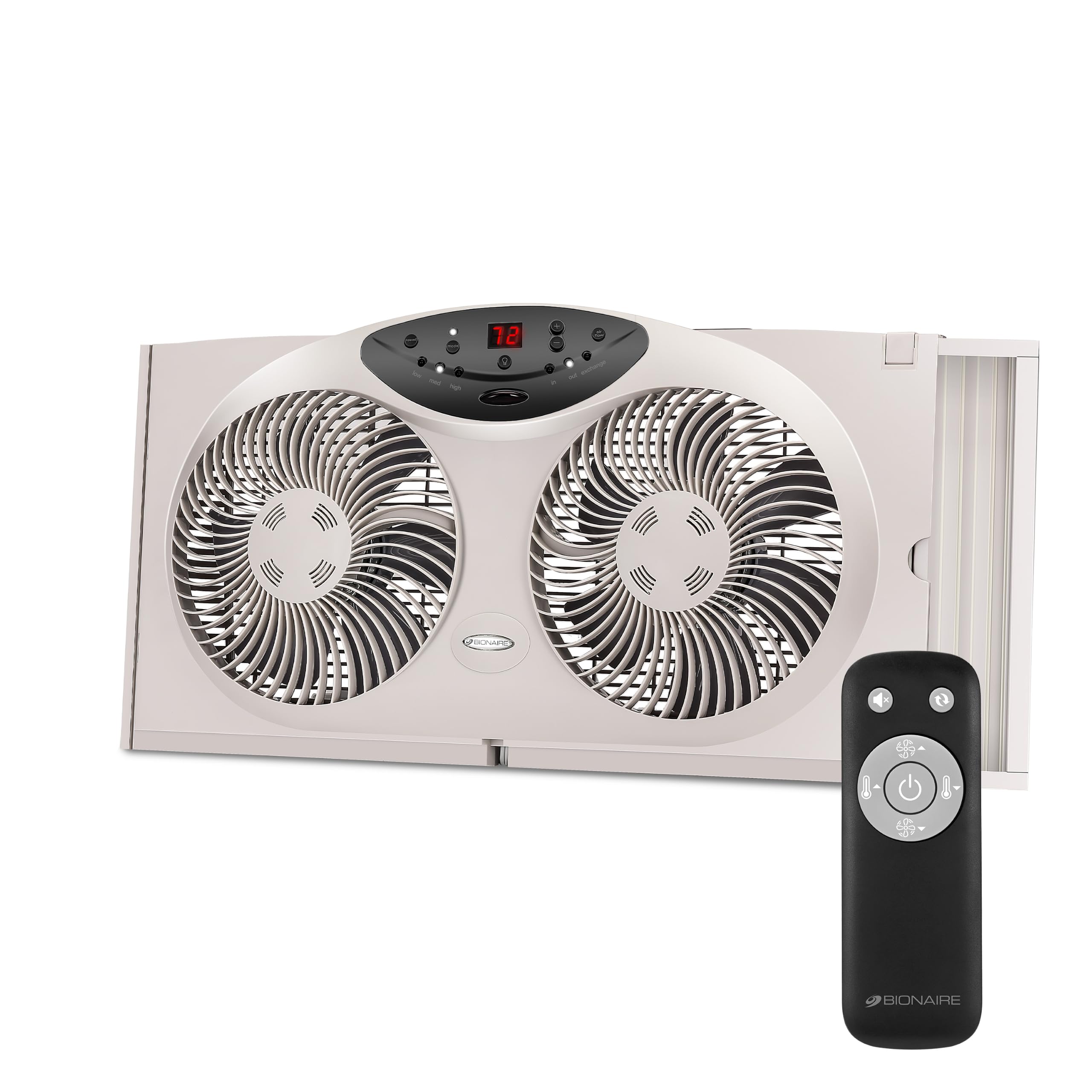
This is the crowd favorite for a reason — it handles nearly every window setup you own. The reversible blades let you draw in outdoor fresh air, exhaust warm indoor air, or run both directions at once, and the 8.58-inch blade length moves serious volume for a window unit. It fits most double hung, vertical slider, and casement windows thanks to a built-in accordion extender plus an additional panel, covering a 24″ to 36″ range. No assembly is required — you plug in the 6-foot cable and it is ready.
The programmable thermostat is the star here. It automatically powers the fan on and off based on the temperature you select, and the digital LED screen shows the current room temperature with a dimmer function so it won’t glow like a beacon at night. The included remote means you can adjust settings from across the room, which owners say is a lifesaver when rain rolls in and you do not want to lean over a wet sill. Cooling speed is real: Buyers report a room dropping from 80 to 70°F in about an hour., and the unit stays quiet enough for a bedroom.
The honest trade-off is reliability. A meaningful share of owners mention units stopping after a week or breaking within a month, and the value-for-money verdict is genuinely split. The temperature gauge also measures at the fan, not across the room, so it can shut off slightly early on hot nights. But for light, quiet, remote-controlled cooling that has held up for some owners over 3.5 years, it earns the top spot.
Why It Wins
- Reversible airflow for intake, exhaust, or both — handled by one button
- Truly light and quick to install, with a 3-year limited warranty backing it
- Remote control and dimmable LED display make night use easy
Who Should Look Elsewhere
- Reliability is the recurring worry — some units fail within the first month
- Thermostat reads temperature at the fan, not across the room
- Horizontal-only orientation; it cannot stand in a vertical window
Reach for this if: you want a light, remote-controlled fan that switches between intake and exhaust and fits most standard windows.
Look elsewhere if: you need a fan that will run all summer long without a hiccup — reliability reports are too mixed here.
2. Comfort Zone Triple Window Fan

Three fans and a manual thermostat in a slim frame built for slider windows.
This one solves a problem most window fans ignore: you do not always need all the airflow at once. The triple design lets you run one, two, or all three fans simultaneously using a straightforward manual dial, so a single fan runs quietly in a bedroom while all three clear out a kitchen. It is a genuinely different control scheme from the Bionaire above — no remote, no display, just a reliable physical dial that owners say beats flat buttons for dependability.
This fan stands out for its easy fit. It arrives fully assembled and is ETL certified (tested for safety and performance). Built-in side expanders adjust from 25 inches up to 36.7 inches, so it fits most double-hung or slider windows. The slim profile installs horizontally or vertically, and owners with slider windows like that it sits in the track without opening the window far. The airflow rating of 432 cfm (cubic feet per minute) is modest, so this is a steady, quiet mover rather than a hurricane. Customers note it is quieter than a Holmes fan while still pushing good air with 1 to 3 blades. Rubber bumpers keep it from rattling against the frame.
The catch is power and consistency. Some owners find the airflow underwhelming for large bedrooms, noting it delivers about as much force as a natural breeze through an open window. On the other end, owners praise its reliability — One owner notes a previous Comfort Zone lasted 3 years. — and the adjustable thermostat dial holds a consistent room temperature. The quality verdict is split, so treat this as a compact, dependable option for small-to-medium rooms rather than a whole-house air mover.
Who it’s for: slider-window owners who want a quiet, compact fan with the flexibility of running one, two, or three blades and a simple dial thermostat.
The honest limit: at 432 cfm it is not for large bedrooms — for those, the Vornado below moves more than twice the air.
3. shinic 9″ Window Fan with Thermostat & LED Display
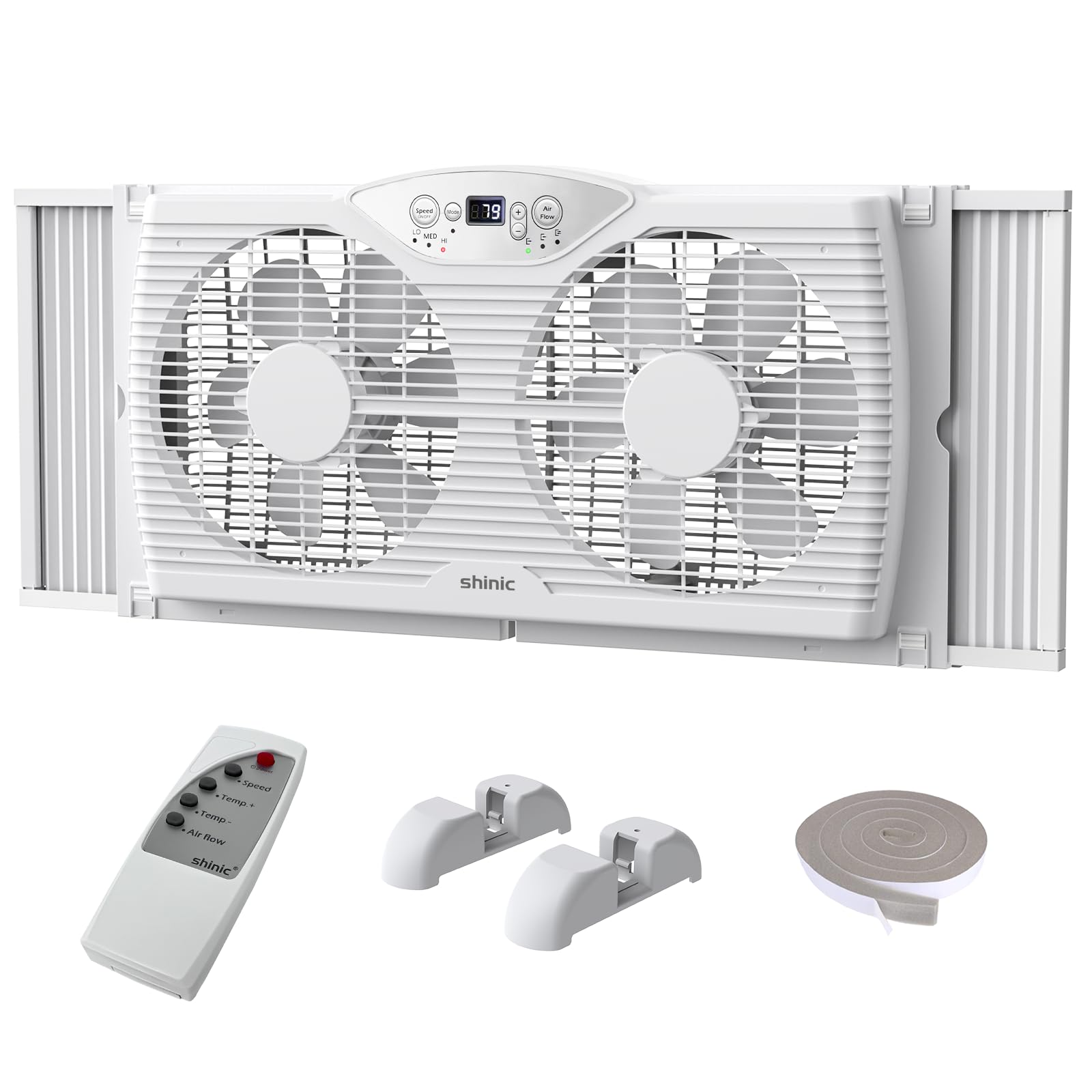
A twin fan with a wide thermostat range and a foam seal that locks the cool air in.
The defining spec here is the thermostat range — it maintains your chosen temperature anywhere from 60°F up to 85°F, which is the widest automatic range in this lineup. The built-in LED lights show both the temperature setting and the current room temperature, so you always know what the fan is doing. It also supports horizontal mounting, vertical mounting, and tabletop use, giving you placement flexibility the others do not match.
Owners praise the airflow most. The twin 9-inch blades move a lot of air on three speeds — LOW, MED, and HIGH — and the reversible function offers three modes: draw cool outside air in, exhaust hot indoor air, or exchange air between inside and out. The included foam seal strip is a genuinely useful addition; it fills the gap between fan and frame to eliminate leaks, reduce vibration, and keep the fan securely in place. The adjustable side panels span 23.8″ to 37″, covering most double-hung, vertical slider, and casement windows.
The flip side is noise. While many owners find it quiet on low settings, a notable share reports a loud hum, and one buyer describes the thermostat cycling on and off every two seconds with a 5°F accuracy gap. The motor is the recurring complaint — some call it louder than expected for nightly use, though others say the hum works as sleep-inducing white noise. For the price, the airflow, remote, and thermostat range make this a strong value pick if you can tolerate the sound.
What Owners Love
- Strong 3-speed airflow that cools bedrooms quickly on low settings
- Wide 60°F–85°F programmable thermostat with a clear LED display
- Foam seal strip and expandable panels for a tight, quiet fit
- Remote control plus easy installation in minutes
What to Know
- Noise is genuinely split — quiet for some, a loud hum for others
- Thermostat accuracy can drift by about 5°F, per one owner
- Side-panel adjustment is a bit cumbersome to resize
Grab it if: you want the widest thermostat range and a foam-sealed fit for the least money in this group.
skip it if: you are sensitive to motor hum — the noise feedback here is too divided to ignore.
4. Vornado TRANSOM AE Window Fan

The smartest fan here — 1276 cfm of airflow you can command by voice.
This is the powerhouse of the group, and it is also the only one that answers to your voice. The airflow rating of 1276 cfm is nearly three times the Comfort Zone’s 432 cfm, so it genuinely pulls cool air through an entire house. Owners describe it cooling a 91°F office down to 70°F. and moving more air than a box fan on high — all while running quieter than a box fan on low. It is the rare fan that is both the strongest and among the quietest in its class.
The smart controls are the headline. Four speed settings plus auto temperature control work with Alexa, so you can adjust the fan by voice, smartphone, or tablet through the Alexa app. The electronically reversible design switches from intake to exhaust with one button, and the weather-resistant casing means it can keep ventilating even when the weather turns. The patented Soft-fit foam block system seals it into single- or double-hung windows from 26″ to 40″ wide, and the low-profile design blocks outside light while it runs.
The premium label brings premium expectations, and the mixed reviews show it. Performance splits owners — many say it is fantastic, while others find the air movement underwhelming for the price. The Alexa version notably lacks a remote control, which some owners find inconvenient when they want to adjust it in the dark without talking. It only installs horizontally, measures 7.16″ tall, and the foam block fit struggles with non-standard window frames. If you want voice control and serious airflow, this is the pick — just know the value opinion is genuinely divided.
The verdict: the most powerful and most controllable fan here, with 1276 cfm and Alexa voice control — but expect to pay significantly more for that brain, and check your window depth first.
Who should pass: anyone with vertical-only windows or who wants a simple remote — this model installs horizontally only and skips the remote.
Understanding the Specs
Airflow (cfm)
Cubic feet per minute, or cfm, tells you how much air the fan pushes each minute. Higher numbers mean more raw cooling power — the Vornado’s 1276 cfm moves over twice the air of the Comfort Zone’s 432 cfm. For a small bedroom, a lower cfm is fine; for pulling cool air through a whole house, aim high.
Thermostat Range & Control
The thermostat is what makes a window fan “automatic.” It reads the room temperature and switches the fan on or off to hold your target. A wider range, like the shinic’s 60°F to 85°F, gives you more flexibility. A manual dial thermostat is simpler and often more reliable; a digital display lets you see the exact temperature.
Reversible Airflow
Reversible blades let you flip the direction of airflow. Intake mode pulls cool outdoor air in; exhaust mode pushes hot, stale indoor air out. Some fans, like the Bionaire, also offer a simultaneous exchange mode that does both at once for maximum ventilation.
Fit Width & Sealing
Expandable side panels bridge the gap between the fan and your window frame. Measure your actual window opening and match it to the fan’s stated range, like the Bionaire’s 24″ to 36″ or the Vornado’s 26″ to 40″. A foam seal strip — included with the shinic — fills leftover gaps to stop air leaks and reduce vibration noise.
FAQ
How does an automatic window fan thermostat actually work?
Will an automatic window fan fit my window?
Can I use these fans to push hot air out instead of pulling cool air in?
Is a higher cfm rating always better?
How loud are these fans in a bedroom?
Do these fans come with a remote control?
Can I install these fans in a vertical window?
Are these window fans safe to leave running unattended?
Final Thoughts: The Verdict
Across the board, the automatic window fan winner is the Bionaire Window Fan because it balances reversible airflow, a remote, and a wide 24″–36″ fit for the broadest everyday appeal. If you want the most powerful airflow and voice control, grab the Vornado TRANSOM AE with its 1276 cfm and Alexa compatibility. And for a compact, quiet triple-fan design that fits slider windows, the Comfort Zone with its flexible 1-to-3 blade control is the one to reach for.
How We Picked
We do not accept paid placement. Every pick is matched to a real buyer and a real use-case; we do not hands-on test units.
Sources & Methodology
Specifications: manufacturer listings and product documentation. Review insights: verified customer reviews, as of August 2026. Pricing: not shown on this page (it changes often); check the current price via the retailer link.
As an Amazon Associate, Gadgets Feed earns from qualifying purchases. This does not affect which products we feature.