
Our readers keep the lights on and my morning glass full of iced black tea. As an Amazon Associate, I earn from qualifying purchases.
Specs are compiled from manufacturer listings and verified buyer reviews and can change over time — please confirm the key details on the product page before buying.
You have a pile of scrap wire that feels like it is staring at you. Reaching for a manual hand tool every time you need to strip a few feet gets old fast. The right motorized machine turns that hour-long chore into a ten-minute feed-and-collect session, and the best models handle everything from thin #18 gauge thermostat wire up to beefy 1000 MCM service cable without breaking a sweat.
I’m Min — the founder and writer behind Gadgets Feed. This guide is built by comparing the manufacturers’ published specifications and the patterns across verified customer reviews, so you get each pick’s real strengths and trade-offs instead of marketing spin.
Whether you’re an electrician clearing job-site leftovers or a scrapper turning piles of insulated copper into cash, picking the right automatic wire stripping machine depends on matching motor power, wire-size range, and build quality to the volume you process every week.
Our Picks at a Glance


How To Choose The Best Automatic Wire Stripping Machine
The first surprise for most buyers is that many machines need a small learning curve to dial in the blade depth. You can’t just feed a wire and expect perfection every time. The second is that motor power is not just about speed—a weak motor will stall on a heavy 350 MCM cable, while an oversized motor can shred thin thermostat wire if you don’t slow the feed. Matching the machine to your typical wire load is the real trick.
Motor Power and Stripping Speed
The motor’s wattage (W) tells you how much grunt the machine has. A 60W gear motor is compact and quiet, good for occasional home-shop use on smaller wires up to about 10 AWG. A 180W motor handles medium-duty work like 12 AWG to 4/0 wire at speeds around 60 feet per minute. For daily heavy stripping of 250 MCM and larger, a 370W or even 1 HP (about 745W) motor is your baseline—it keeps the rollers turning even when the cable is thick and the insulation is stiff.
Wire Diameter Range and Channels
Every machine has a stated range, usually in inches or millimeters (like 0.06″ all the way up to 1.5″). That number is the outer diameter of the wire including insulation, not the copper conductor size. Machines with more channels let you drop different wire sizes into dedicated slots without re-adjusting the blade every time—seven channels is common on mid-range models, while premium units offer nine or more, plus a flat slot for ribbon-style cables.
Build Quality and Portability
Cast iron gives you vibration-dampening heft and long life, but a machine like the 50 lb VEVOR 370W is still portable enough to move between job sites. Full commercial units pushing 125 to 200 lbs demand a permanent bench or stand. Aluminum-alloy bodies are lighter and rust-resistant, but you trade some mass that helps keep the machine planted during high-speed stripping. Blade material matters too: 65Mn spring steel holds an edge longer than standard high-carbon steel, and manganese steel blades can be re-sharpened instead of replaced as often.
Quick Comparison
| Model | Best For | Motor Power | Wire Diameter Range | Weight | Amazon |
|---|---|---|---|---|---|
| VEVOR 60W (B0C26ZVQBN)★ Best Overall | Mid-range all-rounder | 60 W | 0.06″ – 0.98″ | 34.2 lbs | Amazon |
| VEVOR 370W (B09TVJSXLB)Premium Pick | Premium heavy-duty pick | 370 W | 0.06″ – 1.5″ | 50 lbs | Amazon |
| StripMeister E350x (B0872KNDFS)Top Performer | High-volume commercial | 1/4 HP | Ø1/8″ – Ø1″ | 24.3 lbs | Amazon |
| Happybuy 180W (B0748BQWS8) | Budget-friendly entry point | 180 W | 0.05″ – 0.98″ | — | Amazon |
| CREWORKS 180W (B0F3XW7JYJ) | Mid-range with foot pedal | 180 W | 0.06″ – 1.18″ | 27.8 lbs | Amazon |
| StripMeister E250 (B074KNPSYP) | Premium mid-weight pro | 1/4 HP | Ø1/8″ – Ø3/4″ | 21.4 lbs | Amazon |
| BLUEROCK MWS-808PMO (B01EMK8GNQ) | Industrial full-time use | 1 HP | 18 AWG – 1″ OD | 125 lbs | Amazon |
| BLUEROCK WS-212 (B001022D0C) | Maximum-capacity pro shop | 2 HP | 22 AWG – 1.5″ OD | 200 lbs | Amazon |
In‑Depth Reviews
1. VEVOR Electric Wire Stripping Machine 0.06″-0.98″ (B0C26ZVQBN)
Our pick — over 4.5★ from 550+ verified ratings; the strongest balance of quality and price.
The cast-iron workhorse that quietly chews through your scrap pile.
This VEVOR uses a 60W gear motor to pull wire through its seven channels (six round plus one flat slot), covering everything from 0.06″ thin wire up to 0.98″ cable. Builders cite the cast-iron body and transparent acrylic cover as the standout features—you can watch every strip happen while the machine stays planted. The blade is 65Mn spring steel, which holds up far longer than standard steel and can be adjusted with the top-mounted knob without opening the housing.
Owners consistently say it works great on all wire sizes right from the start with just minor tweaks to the blade depth. The only wish, as buyers report, is that the machine could be “a little bit quieter while operating.” The noise is a low mechanical hum rather than a screech, but it is noticeable in a garage or small shop. Compared to the Happybuy 180W, this VEVOR runs on 60W compared to the Happybuy’s 180W—yet the gearbox delivers enough torque for consistent stripping on most common scrap wire without stalling.
What Wins People Over
- Seven channels (six round, one flat) mean you rarely need to switch guides mid-job.
- Cast-iron chassis absorbs vibration and keeps the machine steady at speed.
- 65Mn spring-steel blade resists dulling far longer than standard steel blades.
The Honest Trade-off
- 60W motor stalls on heavy-gauge wire above 250 MCM—keep this to 4/0 and smaller.
- Noticeable mechanical noise; not silent enough for a bedroom workshop.
Reach for this if: you process regular scrap wire (14 AWG to 4/0) weekly and want a durable, mid-priced machine that works without constant fuss.
Look elsewhere if: your daily diet includes 350 MCM or larger cable—you need a 370W or 1-horsepower motor to handle that thickness.
2. VEVOR 370W Electric Wire Stripping Machine (B09TVJSXLB)
Eleven channels and a 370W motor that never flinches on heavy cable.
Stepping up to this VEVOR gets you a 370W motor that rips through insulation at 98 feet per minute. The machine accepts wire from 0.06″ all the way to 1.5″ in diameter, and its 11 channels (with 10 blades) mean you can feed several common sizes without touching the adjustment knob. The steel base and aluminum-alloy body keep the 50-pound unit stable, but it is still portable enough to lift onto a truck bed.
The Amazon summary calls it a “best purchase EVER” for quiet, fast operation—and owners note that depth adjustment is the only real skill to learn. The adjustability does get mixed feedback because finding the exact blade depth for a new wire size takes a few trial runs. Unlike the CREWORKS 180W, this 370W machine handles a 1.5″ diameter wire, and its 11 channels outnumber the CREWORKS’s five by more than double (11 to 5). The trade-off is that the machine ships without a printed manual and replacement blades are harder to find unless you go direct to VEVOR.
Best for high-volume scrappers: if you strip 250 MCM and larger cable daily, the 370W motor and 11 channels make this the balance between a mid-range toy and a five-figure industrial unit.
A fair caveat: the blade depth takes a few tries to dial in for each new wire size, and buying spare blades requires a separate order—they rarely come with the machine.
Grab this if: your scrap pile regularly includes wires from 10 AWG to 750 MCM and you want a single machine that can handle them all without swapping parts.
skip it if: you only strip small-diameter thermostat or alarm wire—a smaller 180W model will be cheaper and lighter.
3. StripMeister E350x (B0872KNDFS)
Handles mangled, twisted wire that would jam any other machine.
The headline feature here is the Ultra Grip Feeder—a patent-pending roller design that pulls even damaged, kinked, or bent cable through without slipping. This matters a lot if you are stripping demolition scrap, which rarely comes in neat coils. The E350x handles wire from Ø1/8″ up to Ø1″, including everything from #18 gauge to 500 MCM, and the 1/4 HP fan-cooled DC motor runs cool even after hours of continuous use.
Owners mention stripping 400 feet of 500 MCM and another 2,400 feet of 300 MCM on the same set of blades without needing a change. The same review pages note that heavy wire sometimes needs a gentle manual pull assist to keep the motor from straining, and you should monitor motor heat during marathon sessions. The E350x uses CNC-machined aircraft-grade aluminum parts with a 15mm drive shaft, making it noticeably tougher than the StripMeister E250—the E250 is limited to Ø3/4″ wire and lacks the next-gen feeder that prevents slips on twisted cables.
The Strong Points
- Ultra Grip Feeder handles twisted and mangled wire without jams—the main reason to choose this over the E250.
- 15mm drive shaft and CNC-machined parts mean less vibration and longer lifespan in daily commercial use.
- Strips medium-voltage 5kV insulation and #10 THHN equally well with one blade depth setting.
The Catch
- Heavy wire (500 MCM and larger) can overheat the motor if run non-stop without a manual pull assist.
- Blade depth adjustment takes patience—the smallest wrong setting nicks copper strands on fine wire.
Reach for the E350x if: your scrap comes from demolition sites with bent, jacketed, and irregular wire that other machines would reject.
Consider the smaller E250 if: all your wire is cleanly coiled and you rarely exceed 4/0 gauge—you save money and still get the StripMeister build quality.
4. StripMeister E250 (B074KNPSYP)

The pro-grade machine that earned a cult following among recyclers.
StripMeister’s E250 runs on a 1/4 HP DC motor with variable speed control, letting you slow the feed for delicate fine wire or crank it up for heavy Romex. The wire range caps at Ø3/4″, but that covers every common house wire from 14 AWG up to 4/0 service cable. The body is solid aircraft-grade aluminum with heat-treated tool steel parts, and the top-mounted blade depth knob lets you tweak the cut without reaching underneath. The machine is CSA and UL safety certified, so you can run it on any standard 110V outlet.
One owner who has been junking for 30 years calls it “the best stripper I ever used” and notes it allows him to strip wire while seated—a real ergonomic win over standing machines. Another upgraded from a drill-powered original and says the motor version finally lets him strip #10 or smaller wire, which increases his bare bright copper yield. The main weakness is that the feeder does not handle mangled wire as well as the E350x—clean, straight cable works best. And unlike the CREWORKS 180W which ships with a foot pedal, the E250’s pedal is an add-on unless you rig your own.
Who this is for: electricians and scrappers who process mostly clean, straight wire up to 4/0 and want a portable machine they can lift onto a tailgate (21.4 lbs vs. the 125-lb BLUEROCK).
Who should pass: if your scrap pile routinely includes 500 MCM or twisted demolition cable, step up to the E350x for the Ultra Grip Feeder.
Best for the pro who strips daily: the E250 is the most cost-effective pro machine for standard wire sizes, with a build quality that keeps working for years.
Think twice if: you only scrap wire a few times a year—a cheaper mid-range machine will cover your needs for less upfront cost.
5. CREWORKS 180W (B0F3XW7JYJ)
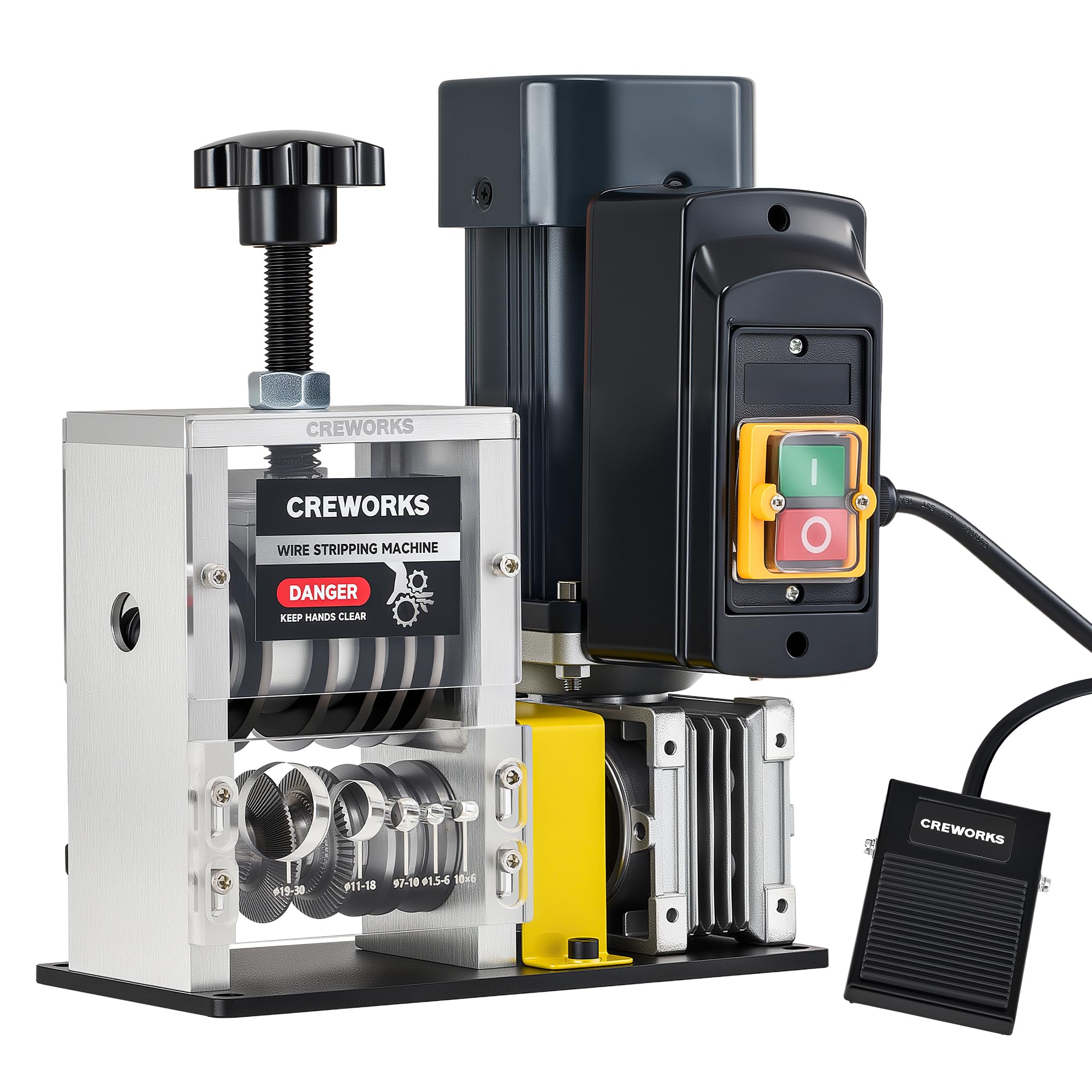
A compact speed demon that strips 98 feet per minute with five blades.
The CREWORKS packs a 180W motor into a surprisingly small frame—9.8 inches long by 6.9 inches wide—making it among the most portable full-power strippers on this list. It strips at up to 98.4 feet per minute; the Happybuy 180W strips at 60 feet per minute. The machine comes with two swappable feed plates (five channels each) that cover wire from 0.06″ up to 1.18″, plus a foot pedal for hands-free operation. The blade is manganese steel, and CREWORKS includes a sharpening rod to keep the edge fresh.
The built-in foot pedal is the standout differentiator here—neither the VEVOR models nor the StripMeister E250 include one in the box. Buyers rave about the reliability, saying it has “stripped thousands of feet of wire” without a problem. The compact size means it anchors to a bench but is easy to carry between the shed and the jobsite. The downside is that small-gauge wire (below 14 AWG) sometimes pops out of the rollers unless the blade height is absolutely perfect, and the 180W motor is noticeably less powerful than the 370W VEVOR—if you feed it heavy 350 MCM wire, it will struggle.
What Stands Out
- Foot pedal included in the box—no extra purchase needed for hands-free feeding.
- 98.4 ft/min stripping speed is among the fastest for a 180W machine.
- Weighs just 27.8 lbs with a footprint smaller than a sheet of paper, easy to transport.
The Limitation
- Small wires (14 AWG and thinner) can slip out of the rollers without precise blade alignment.
- 180W motor maxes out around 1/0 cable—heavy wire above 2 AWG will make it labor.
Ideal for the mobile scrapper: throw it in the car to process wire at the source and use the foot pedal to keep both hands on the cable.
Avoid if: your daily load is thick 4/0 or larger—the 180W motor lacks the torque to pull them consistently.
6. Happybuy 180W (B0748BQWS8)
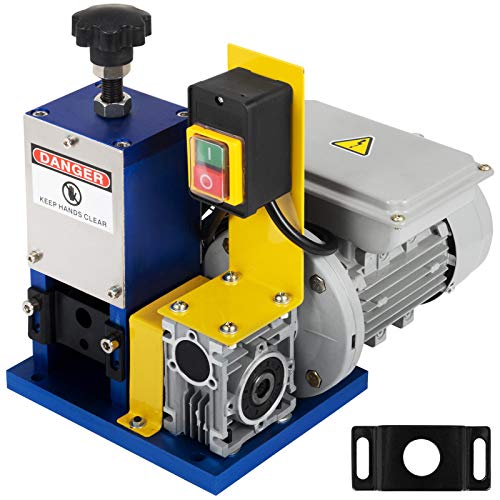
An entry-level machine that pays for itself after the first scrap run.
The Happybuy is the most affordable motorized stripper in this lineup, built around a 180W motor that feeds wire at 60 feet per minute. The body is solid aluminum alloy rather than cast iron, which keeps the weight down but means it needs to be bolted to a bench to stay put during operation. It handles wire from 1.5mm (0.05″) up to 25mm (0.98″) and includes an emergency stop button for those moments when a wire jams unexpectedly.
Customers note it strips 10 AWG stranded and 1 AWG aluminum service wire easily, and the general consensus is that the machine offers “great value” for the price. The speed gets mixed opinions—some find 60 ft/min fast enough for home use, while others wish it were quicker. There is a learning curve: the blade adjustment needs to be precise, and a few units have arrived with the blade slightly misaligned from the factory. That said, the value-for-money aspect is the top positive trait, with owners often noting it “paid for itself after the first use.” Compared to the CREWORKS 180W which hits 98.4 ft/min and includes a foot pedal, the Happybuy is slower and lacks the pedal, but it also costs less.
Perfect for the weekend scrapper: if you process wire a few times a month and want a motorized machine without spending over, the Happybuy is the logical starting point.
Not ideal for daily commercial use: the aluminum body transmits more vibration than cast iron, and the mixed speed feedback means you may outgrow it quickly if your volume increases.
Buy it if: you want a low-cost entry to motorized stripping and are willing to dial in the blade settings yourself on first use.
pass on it if: you need a foot pedal or plan to run the machine for hours daily—the CREWORKS 180W or the VEVOR 60W are better for sustained use.
7. BLUEROCK MWS-808PMO (B01EMK8GNQ)

A 125-lb cast-iron monster that handles 750 MCM without flinching.
The MWS-808PMO is a US-patented machine (US8839695B2) that trades portability for brute strength. A 1-horsepower (approx 745W) motor drives nine cutting channels that accept wire from 18 AWG up to 1 inch in outside diameter. The heavy-duty 125-pound steel chassis keeps vibration near zero, and the nine channels mean you can wire up to nine different sizes at once and run them through without swapping guides. BLUEROCK claims the machine is built for “industrial-grade” daily use, and the feedback bears that out—one owner says it paid for itself in the first half-hour on a large 500 MCM pile.
The multiple input ports eliminate the need to pre-sort wires by size, which is a huge time saver when you have a mixed batch of scrap. Owners also praise the customer support, noting a next-day replacement when FedEx damaged the first shipment. The real-world limit shows up on 750 MCM wire, which one buyer says “doesn’t work too well”—it handles 500 MCM easily but the largest cable needs to be cut into 5-foot segments. Compare that to the StripMeister E350x which handles 500 MCM but tops out at a smaller Ø1” diameter; the BLUEROCK has a wider range and significantly more motor power.
Why It Stands Out
- Nine channels eliminate the need to re-adjust or swap plates between wire sizes.
- 1 HP motor powers through thick 500 MCM insulation without slowing down.
- 125-lb steel body remains absolutely stable at full speed, no bench bolting required.
The Practical Limit
- Not a portable machine—at 125 lbs it stays on a dedicated stand or bench.
- 750 MCM wire requires cutting into 5-foot lengths and may still struggle intermittently.
Best for the full-time scrapper or recycling yard: if you process 500 MCM and smaller daily, the MWS-808PMO will earn its cost back in a week of steady work.
Too heavy for mobile use: if you need to move the machine between job sites, the 27.8-lb CREWORKS or 21.4-lb StripMeister E250 are better choices.
8. BLUEROCK WS-212 (B001022D0C)

The end-of-the-line machine that strips 1000 MCM in a single pass.
If your scrap pile regularly includes the thickest industrial cable, the WS-212 is the only machine here that handles insulation up to 1.5 inches in outside diameter (22 AWG through 1000 MCM). Its 2-horsepower motor (about 1,490W) springs are fitted on both the upper and lower rollers to maintain consistent cutting pressure even when a wire has a flat spot or a dent. BLUEROCK rates the machine at 205 lbs, and it is 23.5 inches long by 14.5 inches wide—this is a permanent fixture, not a tool you move around.
The nine cutting channels and two cut-and-feed roller sets mean the WS-212 slices through thick jacketing on both the top and bottom of the wire in one pass, which is unique on this list. A UL-rated motor starter with overload protection shuts the machine down before the motor can burn out. Owners who run “miles and miles of wire” through it confirm it works well, though the high price tag means you need serious volume to justify it. One negative review details a chain break within five minutes due to a loose nut, which suggests you should check all bolts before the first run. Compare that to the MWS-808PMO which tops out at 1″ OD and 125 lbs; the WS-212 handles up to 1.5″ OD versus the MWS-808PMO’s 1″ OD.
Who should own this: recycling yards and commercial electricians who strip 350 MCM to 1000 MCM daily and need a machine that can run all day without stalling.
Who should not: home shop users or anyone who strips wire less than a few hundred pounds per month—the WS-212 is overkill and takes up a lot of floor space.
Get it if: you regularly process thick industrial cable (up to 1.5″ OD) and want the most powerful motor in this comparison to handle it easily.
Consider the MWS-808PMO if: your biggest cable is 500 MCM or you need to keep the budget reasonable—the WS-212’s extra capacity is wasted on smaller wire.
Understanding the Specs
Motor Wattage (W)
This is the most direct measure of how much force the machine can apply to pull a wire through the blades. A 60W gear motor (like the 60W VEVOR) is efficient for wire up to about 4/0 AWG but will bog down on larger gauges. A 180W motor (Happybuy, CREWORKS) offers a good balance for common scrap wire up to 2/0. A 370W or 1 HP motor starts to handle 500 MCM and larger with ease, while a 2 HP motor (BLUEROCK WS-212) is built for 1000 MCM industrial work. Higher wattage also usually means higher stripping speed — measured in feet per minute (ft/min) — but speed is not the same as torque; a geared motor can be slower but more consistent on thick wires.
Wire Diameter Range (inches / mm)
This number refers to the outer diameter of the wire including its insulation, not the bare copper core. A machine that claims 0.06″ to 1.18″ can theoretically strip a hair-thin thermostat wire at the small end and a heavy service cable at the large end. In practice, the machine works best in the middle two-thirds of its range — the smallest wire might slip out of the rollers, and the largest wire may need a slow feed or multiple passes. Multiple channels (six, seven, nine, or eleven) let you drop different sizes into dedicated holes without re-adjusting the blade each time, which adds up to major time savings on mixed batches.
Feed Mechanism and Grip Technology
The rollers that grab the wire and pull it through are often the difference between a machine that feels easy and one that causes constant cursing. Basic rollers work fine on clean, straight wire. “Ultra Grip Feeder” technology (found on StripMeister’s E350x) uses a patent-pending roller profile that digs into mangled, bent, or kinked cable without letting it slip. A foot pedal (included with CREWORKS 180W) frees both hands to manage long or heavy wire, which is a meaningful upgrade over a standard on/off switch. Emergency stop buttons (Happybuy, VEVOR 370W) are a safety essential if you feed wire quickly.
Build Material and Weight
Cast iron gives the best vibration damping and keeps the machine planted, but it adds serious weight (34+ lbs for compact models, 125+ lbs for industrial units). Aluminum alloy is lighter and resists rust, but the machine may need to be bolted to a bench to stop it from walking during high-speed stripping. Aircraft-grade aluminum (StripMeister E250, E350x) offers the best strength-to-weight ratio — it holds up to daily use without the sheer mass of cast iron. Consider how often you move the machine: a 21-lb unit is easy to toss in the trunk, while a 200-lb machine lives on a dedicated stand.
FAQ
Will an automatic wire stripping machine work on solid Romex cable?
How do I set the correct blade depth for a new wire size?
Can these machines strip wire with a non-circular jacket, like flat ribbon or oval cable?
What is the difference between a drill-powered stripper and a full motorized machine?
How often do the blades need to be replaced?
Will these machines work on aluminum wire or only copper?
Can I process wire that still has connectors or lugs attached?
What does “5 channels” or “7 channels” mean for daily use?
How loud are these machines during operation?
Is it worth spending more for the BLUEROCK WS-212 over the VEVOR 370W?
Final Thoughts: The Verdict
For the majority of shoppers, the automatic wire stripping machine winner is the VEVOR 60W because it delivers the best combination of build quality (cast iron), capacity (seven channels), and real-world owner satisfaction for the price. If you need a higher speed and a foot pedal for hands-free operation, grab the CREWORKS 180W. And for heavy industrial use where 500 MCM cable is the daily norm, the BLUEROCK MWS-808PMO is the one to reach for.
How We Picked
We do not accept paid placement. Every pick is matched to a real buyer and a real use-case; we do not hands-on test units.
Sources & Methodology
Specifications: manufacturer listings and product documentation. Review insights: verified customer reviews, as of July 2026. Pricing: not shown on this page (it changes often); check the current price via the retailer link.
As an Amazon Associate, Gadgets Feed earns from qualifying purchases. This does not affect which products we feature.