
Our readers keep the lights on and my morning glass full of iced black tea. As an Amazon Associate, I earn from qualifying purchases.
Specs are compiled from manufacturer listings and verified buyer reviews and can change over time — please confirm the key details on the product page before buying.
If you’re checking blood pressure daily, the wrist monitor you pick sets how much you actually learn from each squeeze. The best ones read accurately at heart level, store enough history to show trends, and speak the results so you never squint at a screen. This guide cuts through the spec sheets to the nine automatic wrist cuffs worth your attention, starting with the one that wins on reliability.
I’m Min — the founder and writer behind Gadgets Feed. This guide is built by comparing the manufacturers’ published specifications and the patterns across verified customer reviews, so you get each pick’s real strengths and trade-offs instead of marketing spin.
Finding the right automatic wrist bp monitor means balancing accuracy, memory size, and how easy the cuff is to use every single day. We break down the top models by real-world fit, so you can choose with confidence.
Our Picks at a Glance

How To Choose The Best Automatic Wrist BP Monitor
Wrist monitors are the most portable blood pressure tools you can own, but their accuracy depends heavily on two things: how you wear them and what the device itself can store. You want a cuff that fits your wrist snugly and a memory that holds enough readings to show your doctor a real trend, not just today’s number.
Position and Fit Are Everything
Your wrist must sit level with your heart during a reading, which is why every wrist cuff needs to be snug but comfortable. Most models here adjust from roughly 5.3 inches up to 8.5 inches, so measure your wrist before you pick. A cuff that’s too loose or too tight will give you numbers you can’t trust.
Memory Means Trend Tracking
Plenty of monitors store readings for two users, which is perfect for a couple tracking health together. Look at how many total readings the device keeps — 60 is fine for a single user, but 120 or 240 gives you weeks of history to spot patterns. Date and time stamps help you see when your numbers spike.
Voice and Visual Alerts Help You Act
If your eyes struggle with small screens, voice broadcast reads your systolic, diastolic, and pulse out loud. Irregular heartbeat detection flags rhythm concerns instantly, and color-coded risk indicators help you see at a glance whether you’re in a normal range. These features turn a simple reading into actionable information.
Quick Comparison
| Model | Best For | Memory | Cuff Range | Power | Amazon |
|---|---|---|---|---|---|
| LotFancy (Best Overall)★ Best Overall | Voice-guided daily tracking | 120 readings (2 users) | 5.3″-8.5″ | 2 AAA | Amazon |
| PARAMEDTravel Ready | Travel-ready kit with case | 90 readings | 5.3″-7.6″ | 2 AAA (incl.) | Amazon |
| HealthSmartClinically Accurate | Clinically accurate home use | 60 readings (2 users) | 11.75″-16.5″ | 4 AA | Amazon |
| Double love | Touchscreen with color alerts | 99 readings/user (2 users) | 5.3″-7.6″ | Rechargeable USB-C | Amazon |
| SureLife | Multilingual voice readouts | 120 readings (2 users + guest) | — | 2 AA (incl.) | Amazon |
| Oklar | Rechargeable with big display | 240 readings (2 users) | 4.92″-8.46″ | Rechargeable USB-C | Amazon |
| Windray | Color-coded hypertension alerts | 120 readings/user (2 users) | — | 2 AAA | Amazon |
| A&D Medical UB-525 | App syncing and large digits | 60 readings | 5.3″-8.5″ | 2 AAA (incl.) | Amazon |
| Beurer BC57 | Bluetooth smart tracking | 120 total (60/user, 2 users) | 5.3″-7.7″ | 2 AAA (incl.) | Amazon |
In‑Depth Reviews
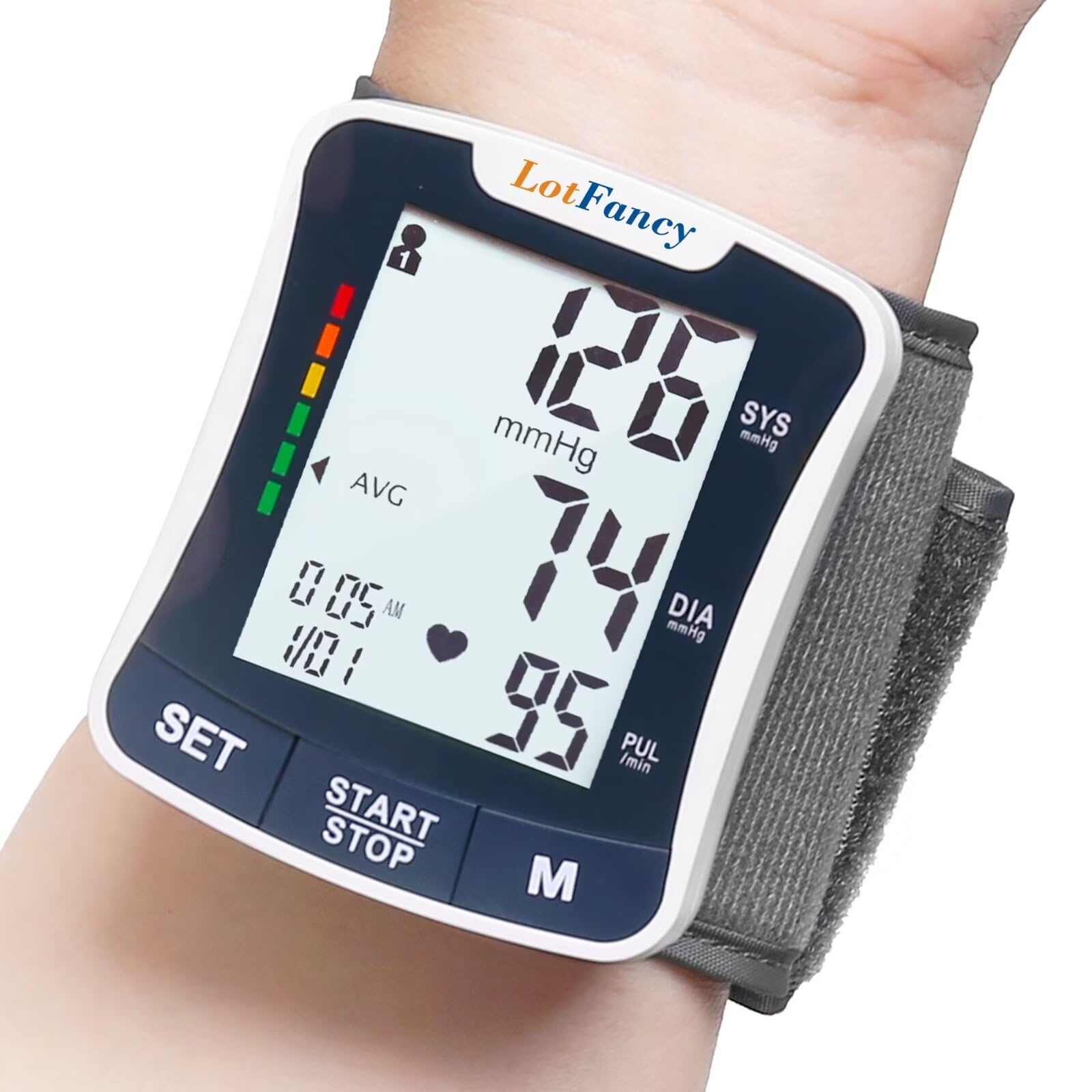
1. LotFancy Wrist Blood Pressure Monitor
Our pick — over 4★ from 650+ verified ratings; the strongest balance of quality and price.
The talking cuff that turns every reading into a clear, spoken sentence for aging eyes.
The voice broadcast reads systolic, diastolic, and pulse aloud, eliminating the need for reading glasses. Buyers report: “Blood pressure taken on this device was checked against a standard cuff, and it has been very accurate.” This suits seniors and low-vision users managing hypertension at home.
Storage is generous at 120 combined readings across two users, each stamped with date and time so you can watch trends over weeks. One-touch automatic inflation handles the whole measurement, and the cuff adjusts from 5.3 to 8.5 inches to fit most adult wrists. It runs on 2 AAA batteries, which you’ll need to supply yourself.
What wins people over is the build quality — it’s the most-discussed positive by a wide margin, and the ease of use follows close behind. Portability gets a shout-out too, with a carrying case included for travel. The occasional complaint about inconsistent readings is worth noting; wrist monitors demand correct positioning, so follow the placement guide carefully.
Why Owners Stay Loyal
- Voice broadcast is a lifeline for visually impaired users
- 120-reading memory tracks trends for two people
- Compact with a carry case for travel
Placement Demands
- Accuracy depends heavily on wrist position at heart level
- Batteries not included in the box
Reach for it if: you want a voice-guided monitor that a senior or low-vision family member can use independently.
Look elsewhere if: you’re unwilling to practice correct wrist positioning — every wrist cuff needs it, and this one is no exception.
2. PARAMED Automatic Wrist Blood Pressure Monitor
A full kit that arrives ready to use with batteries, a case, and a 90-reading memory.
PARAMED packs everything you need into the box: 2 AAA batteries, a durable carrying case, a quick start guide, and the manual. At just 8 ounces and 3.94 inches cubed, it’s the most portable setup here — noticeably lighter than the HealthSmart at 13.4 ounces. Owners mention: “I like this brand. It’s reliable & accurate for a wrist cuff, easy to use, store & handle.”
The ease of use is the clear crowd favorite, with readability of the large LCD display close behind — the top two positives by far. It flags irregular heartbeats during measurement, adding safety for home monitoring. The universal cuff fits 5.3 to 7.6 inches, accommodating most wrists.
Accuracy feedback is mixed—some owners find it precise, others see inconsistent numbers. Reliability concerns mean treat it as an everyday tracker, not a diagnostic tool. Included accessories make it a complete, reasonably priced package.
Kit-Complete Convenience: Most competing monitors force you to buy batteries and a case separately — this one arrives whole and ready to measure.
Fit-Note Reality: Accuracy and long-term reliability get mixed feedback, so use it for trend tracking and verify against a doctor’s cuff periodically.
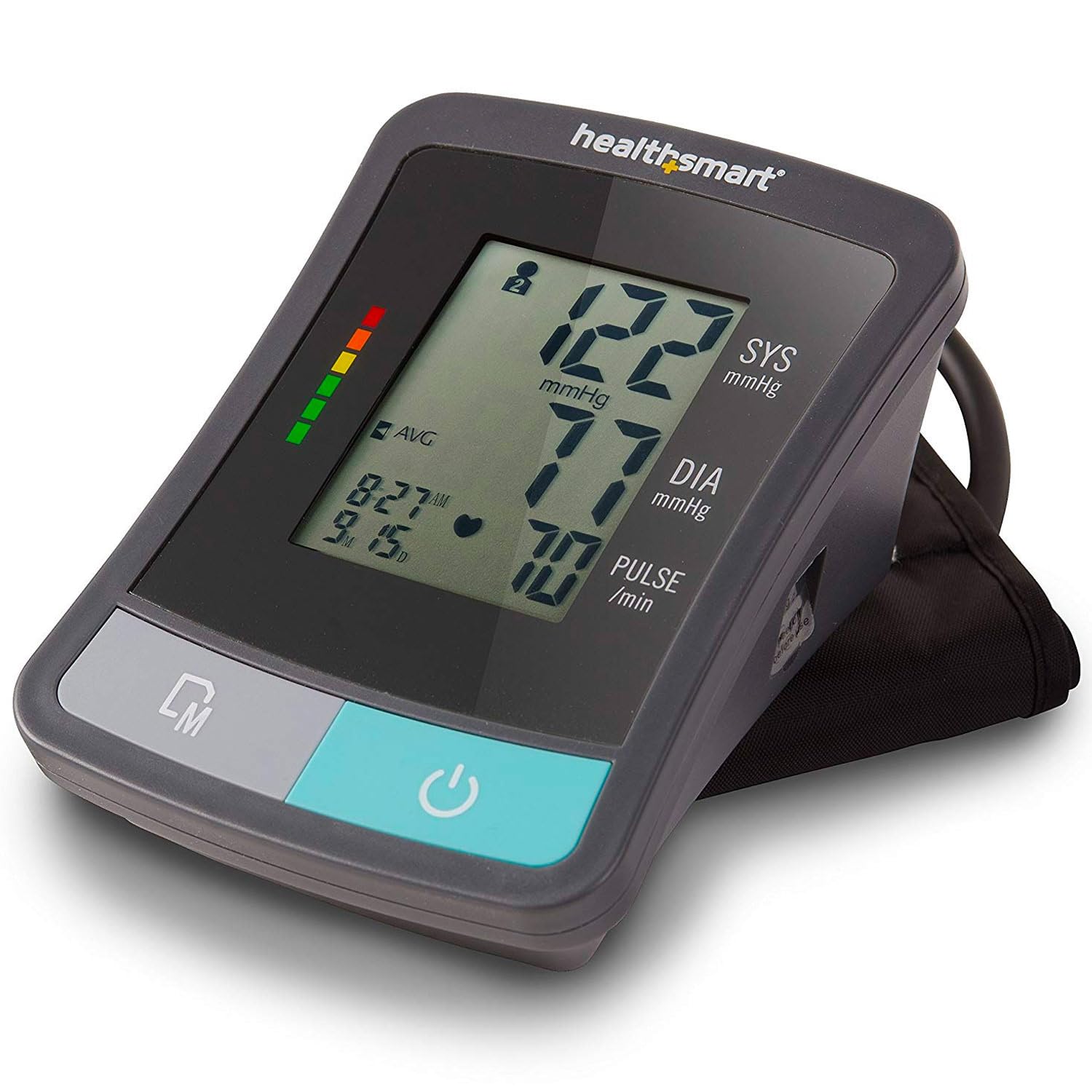
3. HealthSmart Digital Standard Wrist Monitor
The accuracy-first pick that averages three readings to smooth out daily fluctuations.
HealthSmart leans into clinical utility: it detects irregular heartbeats, monitors your pulse rate, and averages three successive readings for a steadier result. The 60-reading memory for two users is more modest than the LotFancy’s 120, but the 3-year warranty and solid build reassure long-term buyers. Customers note: “Compact, clear display, easy cuff placement (11.75-16.5″), 3-reading averaging, irregular heartbeat detection, 60 readings for 2 users, clock/calendar, good guide, low battery light, accurate, 3-year warranty, good build.”
That 3-reading average is the standout — it cuts through the natural variation that makes single wrist readings feel untrustworthy. The cuff fits a wider 11.75 to 16.5 inches, though it needs 4 AA batteries, which aren’t included. The LCD is clear, and controls are intuitive for single-user operation.
The compression cycle is a gripe—tight and slow at ~50 seconds, causing discomfort for those with low muscle tone. There’s no backlight either, so low-light reading is harder than on LED rivals. If you value clinical features over portability, this earns its place.
Pick this for: medically-minded home users who want irregular heartbeat alerts and averaged accuracy over raw portability.
Think twice if: your wrist is on the smaller side or you’re sensitive to a firm, lengthy squeeze.
4. Double love Wrist Blood Pressure Monitor

A touchscreen wrist cuff that flashes your results in color-coded health zones.
This one modernizes the category with an upgraded LED touchscreen — results show in three different colors so you instantly know if your pressure sits in a normal range or needs attention. It’s the lightest pick here at 3.93 ounces, easy to slip into a bag, and it charges over USB-C so you never buy batteries. Each of two users gets their own 99-reading memory bank.
The voice broadcast announces when your measurement is correct and reads back the results, which pairs nicely with the large display. The cuff adjusts from 5.3 to 7.6 inches, and the material is comfortable against skin. A charging cable is included, though you’ll provide your own adapter.
Here’s the honest tension: appearance and convenience win praise, but accuracy and charging reliability draw real criticism. Some reviewers point out wildly swinging numbers, and the charging light behavior confuses others — it can persist after hours with the charge level capped. The built-in lithium battery also means when it dies, you can’t just pop in fresh AAs. This is a style-forward pick for light use, not a primary medical device.
Visual Appeal: The three-color LED is genuinely helpful for quick interpretation at a glance — nothing else here offers that.
Trust Gap: Accuracy and charging reliability get mixed-to-negative feedback, so treat readings as indicative rather than definitive.
5. SureLife Premium Wrist Blood Pressure Monitor

The trilingual talker that reads results in English, Spanish, or French on a jumbo display.
SureLife’s party piece is the voice readout in three languages, making it a rare fit for bilingual households or anyone comfortable in Spanish or French. The jumbo HD LED display backs that up with oversized numbers, and the monitor face angles to the side so it’s easier to read while on your wrist. It’s fully automatic with one-touch operation.
Memory runs to 120 total readings across two users plus a guest mode that saves nothing — perfect for visitors who just want a quick check. It detects irregular heartbeats during measurement and runs on 2 AA batteries that are included in the box. Owners find the setup simple and the voice quality clear.
Accuracy is the mixed note: some owners find it pretty accurate, others report readings that run low, so positioning is critical — it must sit on the bottom of your wrist. The plastic build feels quality, and batteries stretch to roughly 45 days with twice-daily use. It’s a functional, friendly device for multilingual homes rather than a precision instrument.
Household Friendly
- Voice in English, Spanish, and French
- 120-reading memory with a no-save guest mode
- Side-angled display eases on-wrist reading
Position Sensitive
- Accuracy varies if the cuff isn’t placed low on the wrist
- Some shoppers say low readings versus arm cuffs
Best suited to: multilingual families and visually impaired users who rely on spoken results in their preferred language.
Consider something else if: you need laboratory-grade consistency — this one rewards careful placement and patience.
6. Oklar Wrist Blood Pressure Monitor

The FDA-cleared rechargeable that packs the biggest memory and a backlit screen for dark rooms.
Oklar leads the premium tier with FDA clearance, a 240-reading memory split between two users, and a built-in rechargeable battery charged via USB-C. At just 3.59 ounces, it’s featherlight for a bag, and the adjustable cuff spans 4.92 to 8.46 inches — the widest range here, a boon for very small wrists. Each measurement completes in about 35 seconds, and the device powers off after 60 seconds of inactivity.
The large LED backlit display keeps numbers readable even in low light, and the voice broadcast volume adjusts or switches off via the SET and MEM buttons — a small detail owners appreciate. Quality and reliability are the two things people praise most, with reliability matching quality at the top. It’s ideal for home health patients who want to skip battery shopping entirely.
Accuracy gets mixed feedback, though many owners note readings improved once they learned proper technique — wrist at heart level, bare skin, palm up. Battery life is also a mixed point, and the case latch is a noted weak spot that some tape shut for travel. One owner’s unit stopped after seven months, though the seller replaced it free. The charger adapter isn’t included, just the cable.
Reach for it if: you want the largest memory, a rechargeable battery, and FDA clearance in one compact cuff.
Be ready for: practicing correct positioning for accuracy and treating the case latch gently during travel.
7. Windray Automatic Digital BP Machine

A color-coded hypertension scale that translates your numbers into green, yellow, or red at a glance.
Windray’s defining touch is the Hypertension Classification Indicator, which follows international guidelines: green for average pressure, yellow for light hypertension, and orange or red for moderate to heavy hypertension. That instant visual verdict makes it genuinely useful for people who struggle to interpret raw numbers. It stores up to 120 readings per user, across two users, with the newest overwriting the oldest.
Owners specifically praise how it handles tiny arms — the adjustable cuff suits smaller wrists comfortably — and the memory function for tracking previous checks. It’s one-button automatic and compact at 4.16 ounces, sliding into a daily bag without fuss. Buyers report it’s “very reliable and tested against the Dr office monitor and it was accurate.”
The accuracy story is split: some find it matches the doctor’s machine closely, while one owner reported consistently high readings of 35-40 points versus a clinic monitor. The manual stresses that inaccurate results usually trace back to wrong posture, so follow the placement instructions carefully. It runs on 2 AAA batteries that aren’t included, and one unit arrived with pre-existing readings in memory — worth a reset before first use.
Instant Interpretation: The green-yellow-orange-red scale removes guesswork, making it perfect for quick daily checks.
Accuracy Variance: Results range from spot-on to noticeably high depending on technique and unit, so verify against a clinic reading early on.
8. A&D Medical UB-525 Wrist Monitor
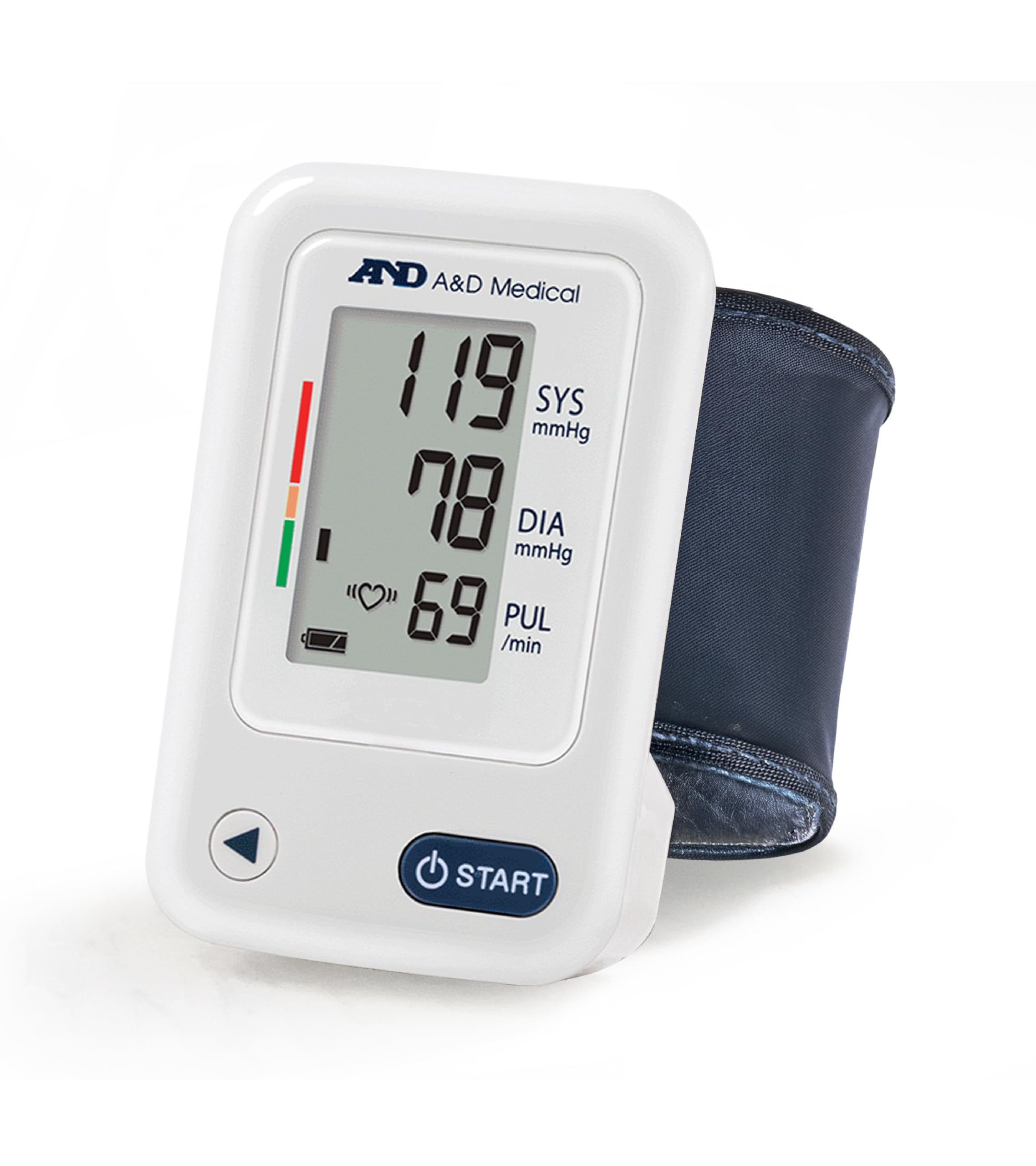
A gentle-inflation wrist cuff with a companion app for logging unlimited measurements.
A&D Medical pairs reliable hardware with software: the free Heart Track App lets you manually log unlimited readings on iOS or Android, building a long-term record your doctor can review. The monitor itself stores 60 readings on-device and shows oversized numbers on a large LCD, so the display is legible even at arm’s length. Two AAA batteries come in the box.
The cuff adjusts from 5.3 to 8.5 inches and inflates gently, which owners find more comfortable than aggressive pumps. The build quality is the strongest praise, and the one-button operation makes daily use genuinely simple. The fit earns positive notes for comfort, and the display is easy to read.
Accuracy feedback is mixed — some owners get readings consistent with their doctor, while others see wild highs and lows. One reviewer noted the cuff can over-inflate and cause pain if it runs too long, though relaxing your arm on a table yields accurate results. Reliability is also split, so test it against a known monitor before trusting it fully. The app requires manual entry rather than wireless sync, which suits some routines better than Bluetooth.
Choose this for: data-minded users who want to build a long-term log in one free app without fighting Bluetooth pairing.
skip it if: you’d rather have automatic wireless sync — this app relies on manual logging over time.
9. Beurer Bluetooth Smart Wrist Monitor

The Bluetooth wrist cuff that syncs readings to your phone and waits for you to be truly rested.
Beurer’s BC57 is the connected choice: it pairs over Bluetooth with the HealthCoach app, so readings transfer automatically with no manual logging. A resting indicator illuminates only when you’re settled enough for an accurate measurement, which is a genuinely smart coaching feature. It stores 60 readings per user for two users — 120 total spaces — and packs a plastic storage case.
The large display features a color-coded risk indicator for quick interpretation, and irregular heartbeat detection sounds an alarm when it finds a rhythm concern. The cuff adjusts from 5.3 to 7.7 inches to fit most wrists, and it runs on 2 AAA batteries included in the box. The app pairing is straightforward for most owners.
Here’s the catch: Bluetooth connectivity is the most-discussed negative, with multiple owners reporting pairing and connection issues that frustrate the smart-sync promise. Accuracy is genuinely mixed — some find it accurate while others report readings “all over the place,” and one owner measured a dangerous +20 mmHg difference versus a clinic device. It’s the priciest pick here, so the Bluetooth feature needs to work reliably to justify it; verify readings against a trusted cuff early.
Smart Features
- Automatic Bluetooth sync to HealthCoach app
- Resting indicator coaches better measurement timing
- Color-coded risk display with irregular heartbeat alarm
Connected Hiccups
- Bluetooth pairing issues are the top complaint
- Accuracy varies noticeably between units
- Premium price for a feature that can stumble
Reach for it if: you want automatic app tracking and a coaching indicator that nudges you toward better timing.
Look elsewhere if: you need rock-solid reliability — the Bluetooth and accuracy issues make this a gamble at its price.
Understanding the Specs
Memory Capacity
This is how many past readings the device keeps, usually split between two users. A 60-reading memory suits a single user tracking weekly trends, while 120 or 240 readings give you a fuller picture over weeks. Date and time stamps on each reading let you and your doctor spot patterns — like higher numbers after meals or stress — instead of reacting to one snapshot.
Cuff Range and Fit
Wrist cuffs list an adjustable diameter range, typically starting around 5.3 inches. A snug fit is non-negotiable for accuracy: a loose cuff reads high, a tight one reads low or causes discomfort. Measure your wrist before buying, and check the range — some cuffs here extend to 8.5 inches for larger wrists, while others top out at 7.6 or 7.7 inches.
FAQ
Why do wrist monitors give different readings than arm cuffs?
How many readings do I need stored for useful trend tracking?
What does irregular heartbeat detection actually tell me?
Is voice broadcast worth paying extra for?
Rechargeable or AAA batteries — which is better for a wrist monitor?
How do I position the cuff for the most accurate reading?
What is a hypertension classification indicator?
What’s the difference between manual and automatic wrist monitors?
How often should I check my blood pressure with a wrist monitor?
Final Thoughts: The Verdict
Across the board, the automatic wrist bp monitor winner is the LotFancy because it pairs a 120-reading memory with voice broadcast that seniors and low-vision users genuinely rely on. If you want the biggest memory and a rechargeable battery in a featherlight cuff, grab the Oklar. And for automatic app syncing and a coaching indicator, the Beurer BC57 is the connected one to reach for — if you can accept its Bluetooth quirks.
How We Picked
We do not accept paid placement. Every pick is matched to a real buyer and a real use-case; we do not hands-on test units.
Sources & Methodology
Specifications: manufacturer listings and product documentation. Review insights: verified customer reviews, as of August 2026. Pricing: not shown on this page (it changes often); check the current price via the retailer link.
As an Amazon Associate, Gadgets Feed earns from qualifying purchases. This does not affect which products we feature.