
Our readers keep the lights on and my morning glass full of iced black tea. As an Amazon Associate, I earn from qualifying purchases.
Specs are compiled from manufacturer listings and verified buyer reviews and can change over time — please confirm the key details on the product page before buying.
You plug your phone into your car’s built-in USB port, and the battery percentage keeps dropping — even while you navigate. That frustrating trickle of power (usually 5 to 10 watts) cannot keep up with screen-on driving. An aftermarket charger changes that by pushing enough wattage (the measure of electrical power it delivers) to top up a drained Samsung or iPhone during a single errand. This guide covers seven capable options and separates the ones that actually deliver their promised power from the ones that just look good in a listing photo.
I’m Min — the founder and writer behind Gadgets Feed. This guide is built by comparing the manufacturers’ published specifications and the patterns across verified customer reviews, so you get each pick’s real strengths and trade-offs instead of marketing spin.
To find the right automobile cell phone chargers, you need to match the wattage, port count, and installation style to your vehicle and devices. A compact plug works for daily driving. A high-power socket handles a laptop on a road trip. A waterproof unit fits a boat.
Our Picks at a Glance
How To Choose The Best Automobile Cell Phone Chargers
Built-in vehicle USB ports are often rated at just 5 to 10 watts — barely enough to keep a phone from dying while using GPS. An aftermarket unit that supports Power Delivery (PD — the universal fast-charging standard that uses USB-C to send higher wattage, typically 18W to 100W) or Quick Charge 3.0 (QC 3.0 — Qualcomm’s fast-charging protocol for many Android devices) can cut that charge time by more than half.
Plug-in or Panel-Mount
The simplest option is a cigarette-lighter adapter — you push it into your 12V auxiliary outlet and you are done. These are perfect for daily drivers and rental cars. Panel-mount chargers require drilling a hole and hardwiring them to your battery or fuse box. They are common in boats, RVs, golf carts, and off-road builds where you want a permanent, waterproof installation with a physical on/off switch.
Total Power vs. Per-Port Power
A charger advertised as 90W total might split that across four ports, so each USB-C port only gets 45W. That is plenty for a phone or tablet. But if you want to charge a MacBook Air or another laptop, you need a single port that can deliver at least 60W. Look for chargers that list the per-port maximum, not just the combined total.
Voltage Display and Build Quality
Some chargers include a small LED screen that shows your car battery’s voltage (a measure of electrical pressure, roughly 12.6V when fully charged and off) in real time. That gives you an early warning if your alternator or battery is starting to fail. Metal-bodied units dissipate heat better than plastic ones, which matters when you are pulling 100W or more for long drives.
Quick Comparison
| Model | Best For | Total Power | USB-C Ports | Max USB-C Output | Amazon |
|---|---|---|---|---|---|
| JUNVANG 90W 4-Port★ Best Overall | Best overall plug-in | 90W | 2 | 45W | Amazon |
| Graaci 320W 6-PortMaximum Power | Max device capacity | 320W | 4 | 100W | Amazon |
| JUNVANG 130W 3-Port | Voltage monitoring | 130W | 2 | — | Amazon |
| WIDAQUO 90W 4-Port | Samsung fast charging | 90W | 2 | 45W | Amazon |
| Hapytrip PD65W | Charging laptops | — | 1 | 65W | Amazon |
| Zennova 12V USB Outlet | Simple panel install | — | 2 | 20W | Amazon |
| Qidoe 12V USB Outlet | Budget panel mount | 66W | 1 | 30W | Amazon |
In‑Depth Reviews
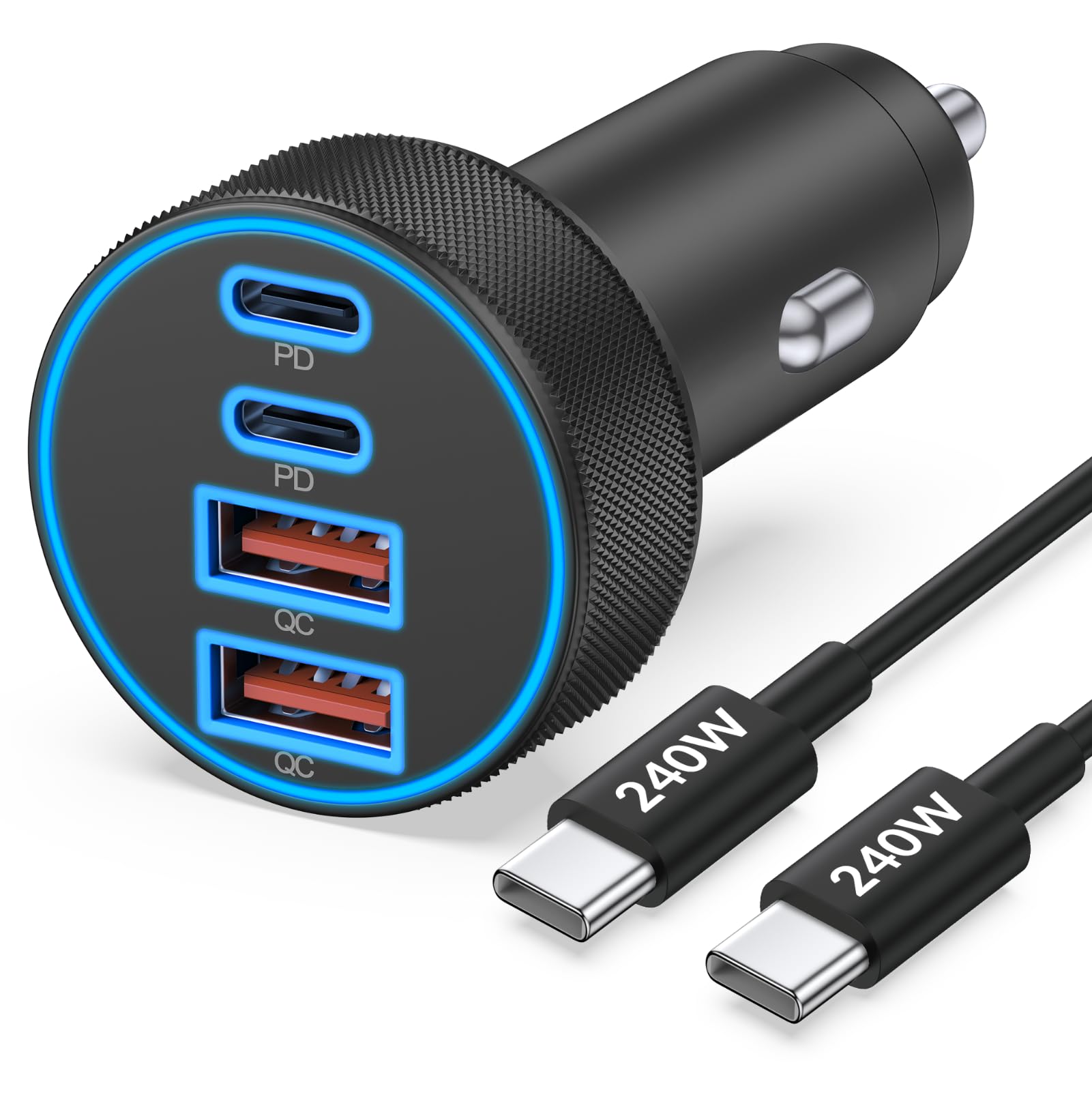
1. JUNVANG 90W 4-Port USB C Fast Car Charger (iPhone 17 16 15 Car Charger Fast Charging)
Our pick — over 4.5★ from 750+ verified ratings; the strongest balance of quality and price.
The 90W four-port everyday champ that balances speed, port count, and build quality without getting pricey.
This is the one that hits the balance for most drivers. Its 90W total splits across 2 USB-C ports (each 45W max) and 2 USB-A ports (each 45W max). You can fast-charge four devices at the same time — two phones and two tablets — without any port dropping to a slow trickle. The input voltage is rated for 24 Volts, making it safe for trucks and older European cars that run higher electrical system voltages. That is a 2.0x gap in input voltage range compared to the Qidoe model below, which is limited to 12 Volts.
The 240W-rated USB-C cable included in the box is a real bonus. Owners mention it is still working great after several months, and several reviews specifically mention the surprise of getting a quality cable they did not expect at this price. The metal enclosure helps with heat dissipation during long charging sessions.
One honest trade-off: its per-port output of 45W is not enough to fast-charge a modern laptop. If you need to power a MacBook Pro or a Dell XPS from your car, step up to the Graaci 320W or the Hapytrip 65W panel-mount. For phones, tablets, and a portable DVD player for the kids, this is the most balanced pick in the lineup.
What Stands Out
- Includes a 240W-rated USB-C cable — many competitors sell the cable separately.
- Metal body runs cooler than plastic chargers under sustained load.
- Wide compatibility list covers iPhone 17 down through older Android models.
The Limitation
- 45W per USB-C port is not enough for laptop charging.
- Lacks a voltage display that some rivals include at similar prices.
Best for: Anyone who wants a reliable, multi-device charger for phones and tablets without spending extra for laptop power they do not need.
skip it if: You need to charge a MacBook or other USB-C laptop from your car — the 45W per port falls short.
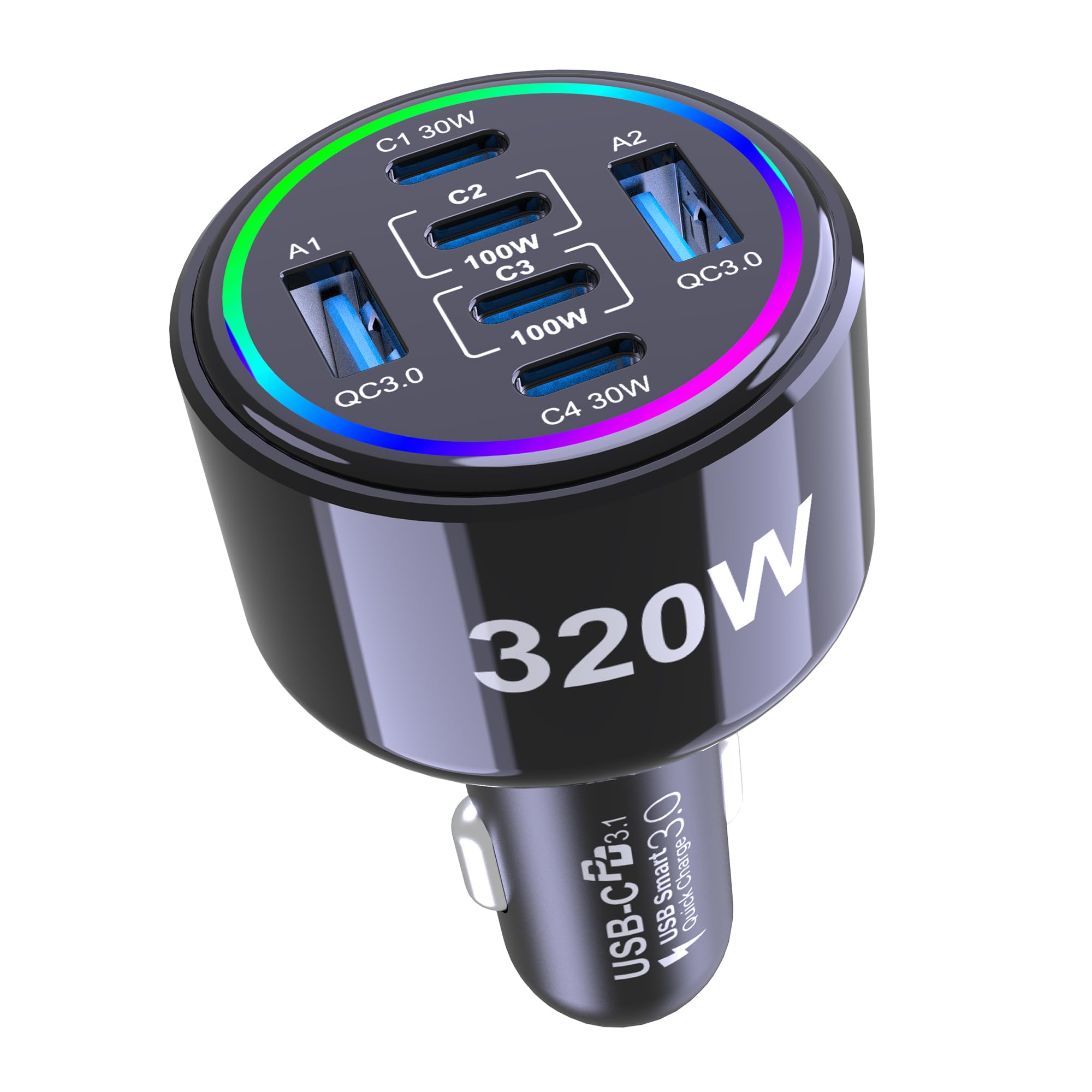
2. Graaci 320W USB C Car Charger, 6 Ports
The 320W six-port charger that turns your 12V outlet into a charging station for the whole family.
If you have ever fought over a single USB port on a road trip, this charger ends that argument permanently. It delivers 320W total across six ports (four USB-C and two USB-A), and the two primary USB-C ports can each output 100W. That wattage is enough to fast-charge a MacBook Pro, an iPad, and two phones at the same time without slowing any port. The built-in LED lights add a subtle glow so you can find the charger in the dark. A trickle mode (a gentle initial charge) is designed to reduce battery stress during overnight charging, according to the product description.
Buyers report the plug fits tightly and does not wiggle out when you connect multiple cables — a common problem with cheaper units. The Graaci 320W uses ABS+PC fireproof plastic instead of metal, which makes it lighter but relies on internal design for heat management.
However, this unit is noticeably wider than a standard single-port charger. It can block access to a second 12V outlet if your vehicle has twin sockets side by side. This is the right pick for drivers who carry multiple devices or have passengers who need power, but it is overkill for someone who just wants to top off one phone.
Peak Capacity: The highest total-wattage unit in this roundup — 320W split across six ports — and it comes with a 12-month warranty, which is rare at this tier.
One Limitation: Its wide body can crowd a second cigarette-lighter socket, so check your car’s layout before ordering.
Reach for this if: You need to charge a laptop and multiple phones at highway speeds, or you regularly drive with a car full of devices.
Look elsewhere if: You want a compact charger that disappears into the dash and leaves adjacent outlets free.
3. JUNVANG 130W 3-Port USB C Super Fast Car Charger (with Voltage Display)
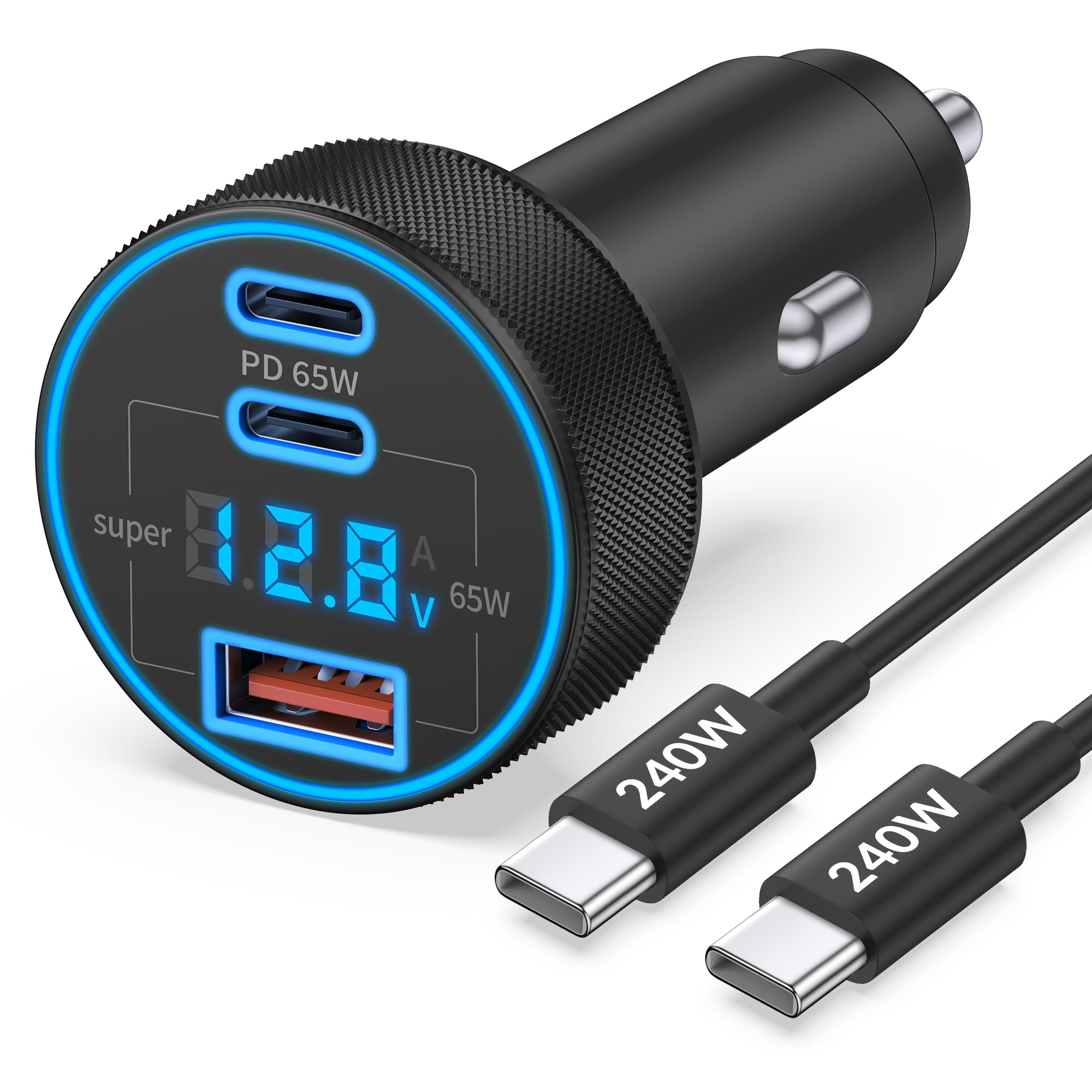
The 130W plug-in with a live battery gauge that lets you spot alternator trouble before you are stranded.
A small LED voltmeter sits on the face of this charger and constantly reads your car battery’s voltage. If you see the number drop below about 12 volts while the engine is running, your charging system may be failing — that is a genuinely useful early-warning feature. The unit delivers 130W total across 2 USB-C ports and 1 USB-A port, and it handles 24-volt electrical systems (common in trucks and some RVs) as easily as standard 12-volt cars. Unlike the Graaci 320W, this one does not list maximum per-port wattage in the published specs.
The included 240W-rated USB-C cable is noticeably thicker than the typical freebie that comes with budget chargers. One reviewer noted the cord feels much more durable than the one they replaced, which makes this kit a better long-term value than buying a charger and cable separately.
At 130W total across three ports, you get less wattage per device than the 320W Graaci. If you plan to charge a power-hungry laptop while also fast-charging two phones, the 100W-per-port Graaci is the stronger play. For phones, tablets, and a single laptop, this voltage-display model is the smarter, more compact choice.
Real-Time Voltage: The LED display is a genuine diagnostic tool — it shows your car battery’s health at a glance, which most chargers in this price band skip entirely.
Thick Included Cable: The 240W-rated USB-C cord is heavy-duty, not the flimsy wire that comes with cheaper kits.
Perfect for: The driver who wants both a fast charger and a basic battery monitor in one device.
Not for: Power users who need to simultaneously fast-charge multiple laptops — this unit’s per-port wattage tops out lower than the 100W-capable models.
4. WIDAQUO 90W 4-Port Car Charger USB C Fast Charge with 240W Type C Cable
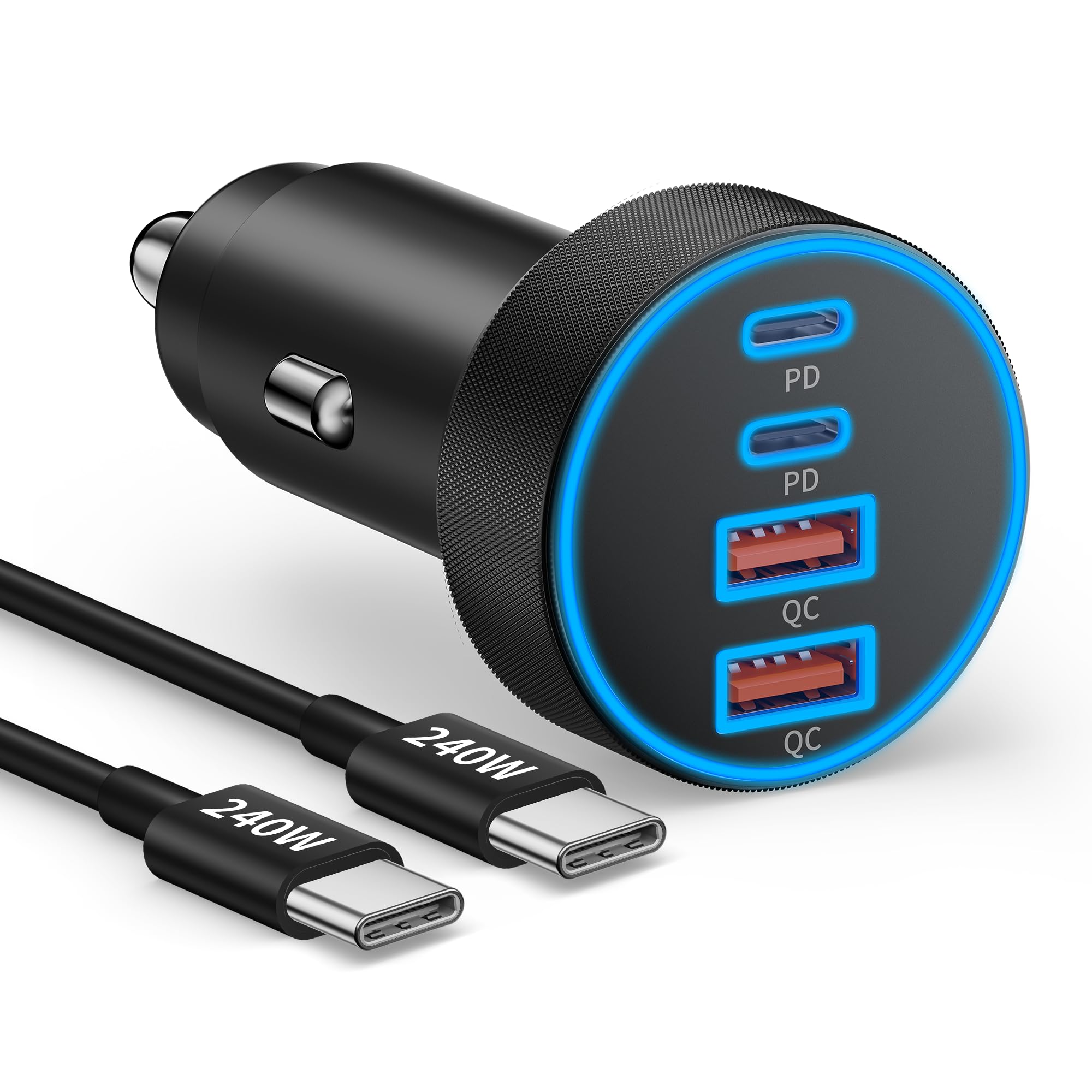
The 90W Samsung-first plug that uses PPS tech to push a Galaxy S26 to 80% in about 35 minutes.
This charger is built for the Galaxy ecosystem. It supports PPS (Programmable Power Supply — a Samsung fast-charging standard that adjusts voltage in tiny increments for optimal speed) that other manufacturers often omit. It delivers the same 90W total and 4-port layout as the JUNVANG 90W, with 45W per USB-C port and 45W per USB-A port. The key difference is the protocol focus: if you own a Samsung Galaxy S26, S25, or S24, this charger will top it up faster than a generic PD charger because it speaks the phone’s native language.
The 240W cable includes an E-Marker chip (a small intelligence chip inside the cable that negotiates the correct power level with your device) that the brand claims checks current and voltage 32,500 times per second for precise power delivery. That is overkill for a phone, but it makes the cable future-proof for whatever higher-wattage devices come next. Customers note the charging speed is “completely amazingly fast” and that the subtle blue LED at night is helpful without being distracting.
Compared to the JUNVANG 90W, the WIDAQUO is a near-identical twin in raw specs — same total power, same port layout, same 12-24V compatibility. The deciding factor is which brand you trust more and whether the Samsung-specific PPS optimization matters to you. For Samsung owners, this is the sharper pick.
PPS for Galaxy: Tuned for Samsung’s fast-charging protocol, meaning Galaxy devices charge at their maximum negotiated speed instead of falling back to generic PD rates.
Premium Cable: The included 240W cord uses an E-Marker 3.0 chip that the brand says monitors power delivery at an extremely granular level.
Choose this if: You use a Samsung Galaxy as your daily driver and want the fastest possible charge from your car.
Consider the JUNVANG instead if: You have an iPhone or a mixed-device household — the JUNVANG offers identical specs with broader universal compatibility coverage.
5. Hapytrip PD65W USB Outlet Aluminum Car Charger with Voltmeter and Switch

The 65W panel-mount charger that boosts 12V to 20V so you can actually charge a laptop on the go.
This is not a cigarette-lighter plug — it is a hardwired socket you install directly into your dash, boat console, or RV panel. It has a built-in boost converter that takes your vehicle’s 12V input and steps it up to 20V output, delivering up to 65W through the USB-C port. That is enough to charge a MacBook Air or a Dell XPS 13 while driving, something most car chargers cannot do because they lack the voltage boost circuitry.
The aluminum body handles heat much better than plastic. The LED voltmeter shows both the input voltage from your battery and the output voltage from the PD port in real time. One buyer who installed it in their Lexus LX470 confirmed it “can indeed boost from 12 to 20 volts output” and that they use it daily for laptop and phone charging. The physical on/off switch prevents parasitic drain (slow battery drain when the device is not in use) when the vehicle is parked.
The installation requires drilling a 1.18-inch (3cm) hole and running the included 23.6-inch wire with a 10A inline fuse to your battery or fuse box. That is straightforward if you have basic wiring tools, but it is not a five-second install like the plug-in chargers above. The QC 3.0 USB-A port is only 18W — fine for phones, but do not expect laptop-level speed from that port.
The Big Win
- 65W USB-C PD output with 20V boost — this is the only unit in this roundup that can charge a full-size laptop at full speed.
- Aluminum alloy body for superior heat dissipation.
- Displays both input and output voltage, rare at this price tier.
Installation Note
- Requires hardwiring and a 1.18-inch hole — not a plug-and-play solution for the average driver.
- Only one USB-C port; cannot charge multiple laptops simultaneously.
Ideal for: Van-lifers, overlanders, and boat owners who need a permanent 65W laptop charging station in their vehicle.
Not for: Someone who just wants to plug a charger into the lighter socket and drive — this is a DIY installation project.
6. Zennova 12V USB Charger, PD 20W USB-C Power Socket and QC 3.0 Socket

The 20W straightforward panel socket that trades raw power for reliable, no-hassle daily charging.
If you do not need laptop-level wattage and just want a clean, permanently installed USB outlet for phones and tablets, this Zennova model gets the job done. It delivers 20W over the USB-C PD port (enough for an iPhone’s fast-charge ceiling) and 18W over the QC 3.0 port. It can charge three devices independently at the same time without one port stealing power from another. The physical momentary switch avoids the “random on/off glitch” that the product description says some touch-switch versions suffer from, and it defaults to off so you can control parasitic drain.
Buyers who hardwired it to a 100Ah LiFePO4 battery (a type of deep-cycle lithium battery common in off-grid setups) reported zero problems after months of daily use, including powering a dash cam in parking mode. Installation is straightforward with the included 3.3-foot wire and insulated terminals, and the metallic finish gives it a more premium look than all-plastic alternatives.
The honest limitation is speed. At 20W, the USB-C port is about half as fast as the 45W ports on the JUNVANG 90W plug-in above. If you are charging a Galaxy S23 Ultra or another device that can accept 45W, this socket will leave charge speed on the table. It is a capable budget-friendly panel mount, but power-hungry users will want the Hapytrip 65W unit instead.
Smart Switch: The physical push-button avoids the reliability issues of capacitive touch switches found on some competing panel-mount chargers.
Easy Install: Comes with 3.3 feet of wire and insulated terminals, so you do not need to buy extra hardware for a basic installation.
Best suited for: DIYers who want a simple, reliable USB outlet for phones and tablets in a car, boat, or golf cart without needing high-wattage laptop charging.
Consider the Hapytrip instead if: You need 65W for a laptop and are comfortable with a slightly more involved installation.
7. Qidoe 12V USB Outlet Dual 18W Quick Charge 3.0 Port & 30W PD 12V USB C Car Charger Socket

The 66W entry-level panel charger that brings QC 3.0 speed and a voltage display to older boats and vehicles.
This is the most affordable way to add a professional-looking USB charging socket to a boat, golf cart, or classic car. Its total power output is 66W, with one USB-C port delivering 30W PD and two USB-A ports each pushing 18W via Quick Charge 3.0. The removable waterproof cover protects the ports from spray and dust. The blue LED voltmeter shows your battery’s charge level at a glance.
One buyer mentioned wiring it directly to a 24V mobility scooter battery with an on/off switch — proof of its 12V-24V compatibility. The same buyer noted it is “only one specified for 12-24V systems” at this price point, which makes it a unique option for electric scooters, older European cars, and dual-battery off-road setups. The 5-year free replacement warranty also inspires more confidence than the typical 30-day return window.
Compared to the Zennova, the Qidoe offers a higher total power (66W vs. roughly 38W combined for the Zennova), but its 30W USB-C port is slower than the Hapytrip’s 65W. The installation hole size requires a 1-1/8-inch drill bit (not the more common 1-inch size), so check your tool kit before cutting. Buyers mention the voltage display is dim, especially with the cover closed, but it is still readable at night.
Why It Earns a Spot
- Works on both 12V and 24V systems — rare in the budget-panel category.
- Removable waterproof cover protects against rain and splashes.
- 5-year free replacement warranty is unusually generous at this price tier.
Watch Out For
- Requires a 1-1/8-inch hole; the common standard is 1 inch, so you may need a specific step bit.
- 30W USB-C port is adequate for phones but cannot charge a laptop.
A solid fit if: You are on a tight budget and need a waterproof panel-mount charger for a 12V or 24V vehicle, boat, or scooter.
Pass if: Laptop charging is a requirement — this unit’s 30W USB-C port cannot power a MacBook or Dell.
Understanding the Specs
Wattage and Per-Port Power
The total wattage of a car charger — 90W, 130W, 320W — is the combined maximum all ports can share. What matters more for your real-world use is the per-port maximum. A phone that supports 45W fast charging (like many Galaxy S models) needs a USB-C port rated for 45W or higher. If a charger splits its total 90W across four ports, no single port may deliver more than 45W. For laptops, look for a port rated at 60W or above, and check that the charger can actually boost the voltage since most cars output only 12V and laptops need 15V to 20V.
QC 3.0 vs. PD vs. PPS
Quick Charge 3.0 (QC 3.0) is Qualcomm’s fast-charging protocol, common in Android phones. Power Delivery (PD) is the universal standard used by iPhones, iPads, MacBooks, and most modern USB-C devices — a PD charger can talk to any PD device and negotiate the fastest safe speed. PPS (Programmable Power Supply) is an extension of PD that Samsung uses for its “Super Fast Charging” feature. A charger that supports all three protocols is the most future-proof choice, while a charger that only supports QC 3.0 will leave iPhone and laptop users charging at slower speeds.
FAQ
Can I charge a MacBook Pro from a car charger?
Will a 24V-rated charger work in my 12V car?
Does a higher-wattage car charger damage my phone battery?
What is the difference between a plug-in and a panel-mount car charger?
How many devices can I charge at the same time without slowing down?
What does the voltmeter on a car charger actually tell me?
Are car chargers with metal bodies better than plastic ones?
Can I use a car charger in an RV or boat with a 24V system?
Final Thoughts: The Verdict
If you want one dependable pick, the automobile cell phone chargers winner is the JUNVANG 90W 4-Port because it delivers 45W-per-port across four devices with a metal body and an included 240W cable at a reasonable price. If you want a live voltage display and a thicker cable, grab the JUNVANG 130W 3-Port. For charging a laptop on the go from a permanent panel-mount socket, the standout is the Hapytrip PD65W.
How We Picked
We do not accept paid placement. Every pick is matched to a real buyer and a real use-case; we do not hands-on test units.
Sources & Methodology
Specifications: manufacturer listings and product documentation. Review insights: verified customer reviews, as of July 2026. Pricing: not shown on this page (it changes often); check the current price via the retailer link.
As an Amazon Associate, Gadgets Feed earns from qualifying purchases. This does not affect which products we feature.