
Our readers keep the lights on and my morning glass full of iced black tea. As an Amazon Associate, I earn from qualifying purchases.
Specs are compiled from manufacturer listings and verified buyer reviews and can change over time — please confirm the key details on the product page before buying.
If you are tired of crawling under the dash every time a fuse pops, a resettable automobile circuit breaker replaces the fuse you keep swapping. Instead of digging out a replacement blade fuse, you push a button or flip a lever to restore power. The picks below cover every job — a 50-amp marine breaker that doubles as a battery disconnect, mini diagnostic fuses that let you chase a short without emptying a fuse box, and heavy 200-amp units built for winches and big audio systems.
I’m Min — the founder and writer behind Gadgets Feed. This guide is built by comparing the manufacturers’ published specifications and the patterns across verified customer reviews, so you get each pick’s real strengths and trade-offs instead of marketing spin.
The right breaker depends on matching its amp rating to your load and picking a mounting style you can actually reach. Below you will find the best automobile circuit breakers for trolling motors, solar banks, car audio, and everyday troubleshooting.
Our Picks at a Glance

How To Choose The Best Automobile Circuit Breakers
Picking the wrong breaker usually means it trips before it should, or it never trips at all when you actually need it to. Here is what actually matters before you buy.
Start With The Amp Rating
The amp rating is the amount of current the breaker lets through before it cuts power. Match it to your load, not to whatever number looks safe — a 200A breaker on a small stereo will never trip when a real fault happens. A 30A unit suits a 1000W car audio amp or a small solar bank. A 50A unit suits trolling motors and mid-size solar setups. A 200A unit handles winches and big battery banks.
Manual Reset vs Auto Reset
Manual reset means you physically push a button or flip a lever to restore power, and you can also use that switch as a kill switch to cut power entirely. Auto reset means the breaker cools and reconnects itself with no input from you. Auto reset is handy for quick diagnostics; manual reset gives you a visible on/off state and control over when power returns.
Mounting And Where It Lives
Surface mount and panel mount breakers bolt down to a firewall or panel. Blade-style fuses plug straight into an existing fuse block slot. If your breaker is going under the hood or on a boat, check the waterproof rating — IP67 handles splashes and rain, while a plain housing will corrode over time.
Quick Comparison
| Model | Best For | Current Rating | Voltage | Reset Type | Amazon |
|---|---|---|---|---|---|
| RED WOLF 50A Circuit Breaker★ Best Overall | Trolling motors and solar banks | 50 A | DC 48V | Manual reset | Amazon |
| RED WOLF 30A Car Circuit BreakerPremium Pick | Car audio and RV solar | 30 A | DC 48V | Manual reset | Amazon |
| Gloaso DC 12V Auto Reset Fuse Breaker 6-Pack | Troubleshooting a repeating short | 5A – 30A mixed | 12V DC | Auto reset | Amazon |
| Nerites ATM Manual Resettable Fuse Kit | Low-profile blade slots and diagnostics | 5A – 30A mixed | 28V DC | Manual reset | Amazon |
| Hamolar 100A Circuit Breaker 3-Pack | Overland truck and RV main power wires | 100 A | DC 48V | Manual reset | Amazon |
| Hamolar 300A Circuit Breaker 3-Pack | LiFePO4 solar banks and large inverters | 300 A | 12V / 24V | Manual reset | Amazon |
| T Tocas E9 200A Circuit Breaker | Winches, car audio, and cable runs | 200 A | DC 48V | Manual reset | Amazon |
In‑Depth Reviews
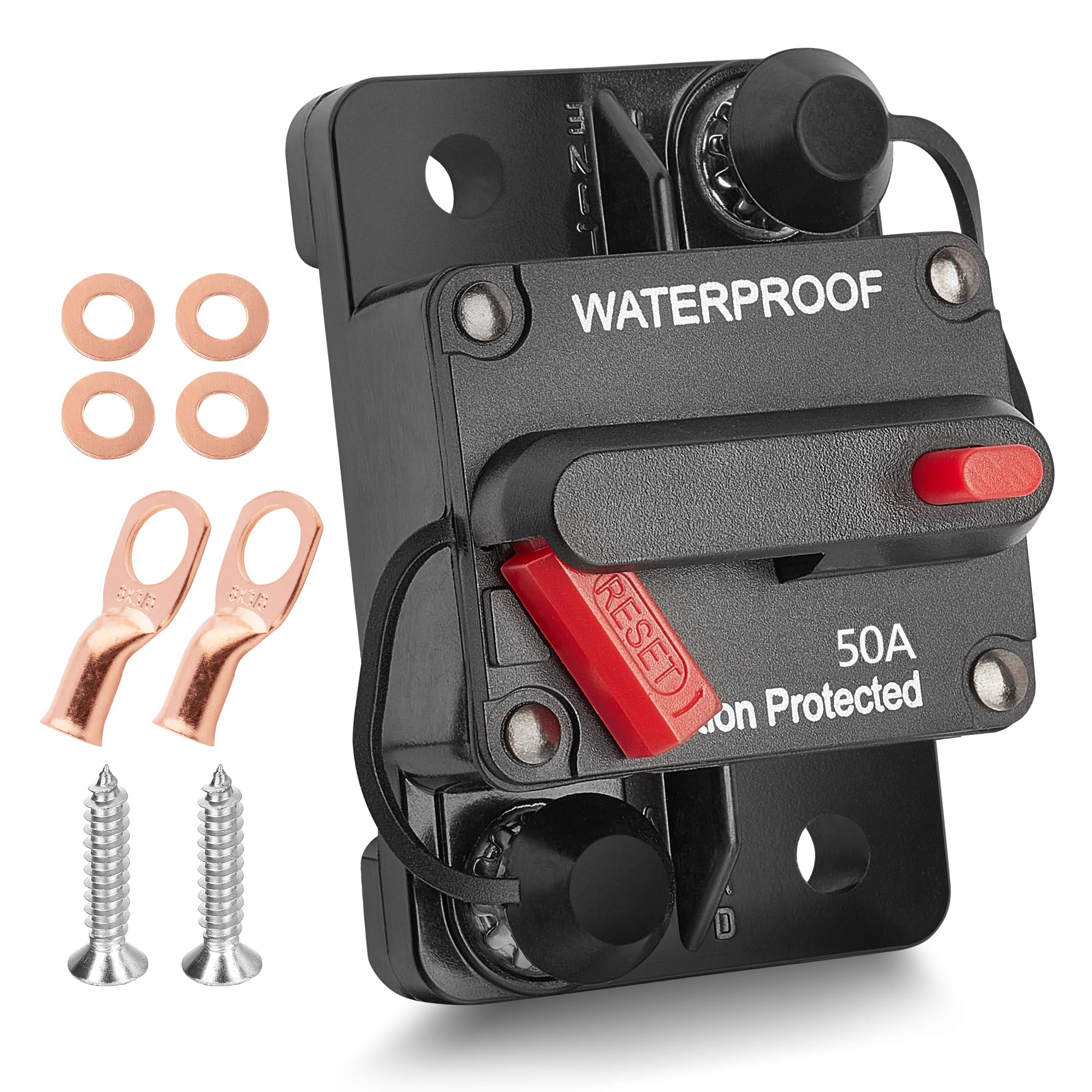
1. RED WOLF 50A Amp Circuit Breaker for Boat Trolling Motor Marine ATV Vehicles
Our pick — over 4.5★ from 750+ verified ratings; the strongest balance of quality and price.
A 50-amp workhorse that doubles as a battery killer switch when you need power completely off.
This is the breaker to reach for when you want one device to guard a mid-size load and give you a manual kill switch at the same time. It carries a 50 A current rating and works across a DC 48V range, so the same unit suits a trolling motor circuit, a solar bank, or a DC sound amplifier. Mount it on a panel or firewall and the push-button reset doubles as an on/off switch — no more pulling wires to safely disconnect a battery. It ships with copper-core cable and ring terminals, so most installs need nothing extra.
What wins people over is the build. The waterproof housing passed professional electrical performance and aging tests, so it holds up in marine and outdoor battery compartments. Fellow boaters rely on it to link a 36-volt lithium battery to a trolling motor, and car-audio builders trust it to protect amplifiers. One battery-conversion owner ran it on a kids’ ride-on and reported stable running after multiple rides, with no random trips and no terminal heat once the lugs were crimped properly.
Compared with the 30A RED WOLF below, this one carries a 50 A rating versus 30 A — the higher ceiling that suits heavier draws like trolling motors. The honest catch is durability under hard use. A summary of buyer feedback notes the unit holds up for many, but some report severe internal corrosion over time, so if your install sits in a damp bilge, check the connections periodically. There is also the price-per-job trade-off: you buy this one for the higher amp ceiling, not because you need a multi-pack.
The Case For It
- 50 A rating on a DC 48V-capable unit covers trolling motors, solar, and audio amps with one part
- Manual reset push button works as a kill switch — no need to disconnect wires to cut power
- Comes with copper-core wire and ring terminals, so the install is plug-and-protect
- Waterproof-resistant housing holds up in marine and outdoor battery compartments
Worth Knowing
- Some buyers report internal corrosion over the long haul — inspect connections in wet installs
- Occasional premature trips are mentioned by a few users running heavy loads
Reach for this if: you need a single resettable breaker that guards a 50-amp circuit and gives you a manual disconnect for a boat, ATV, or solar rig.
Look elsewhere if: your install sits somewhere it will stay soaked for years — a heavily sealed alternative may hold up better against internal corrosion.
2. RED WOLF Car Circuit Breaker 30A AMP w/Manual Reset Switch Inline Fuse Holder
The sealed 30-amp option for anyone whose breaker lives outside the cab in rain and road spray.
Where this one separates itself is weatherproofing. The housing carries an IP67 rating, which means it shrugs off splashes and dust the way a plain breaker never would, and the screw inside is made of pure copper. For an RV or trailer owner replacing an OEM metal-cased unit that has corroded away outside the battery box, that matters — this is a direct answer to the rust problem. It handles DC 12V to 48V, so it is equally at home on a 12-volt car circuit or a 48-volt setup.
Value leads the feedback here. Buyers describe it as a straightforward install with good money-for-value, and the surge protection draws praise for genuinely shielding generators and inverters from excessive currents. A solar-system builder wired this between a 10S3P battery and an inverter and found it flawless, and one buyer used it as a 1000W car-audio breaker with “descent connections” — his words — that have held up. RV owners on small solar setups report the included copper terminals made wiring simple.
The visible reset lever is the quiet win: you can see at a glance whether the breaker is open, and the push button also doubles as a master disconnect for the whole circuit. Set against the 200A T Tocas pick far below, this is the far smaller-current breaker — 30 A against 200 A — so choose it for a modest circuit and leave the big breaker for winches and heavy battery banks. The trade-off most buyers would flag is that durability and battery-life feedback comes in mixed; treat it as a rock-solid everyday breaker rather than a heavy-load one.
The value angle: Buyers rate the money-for-value and ease of installation highest, with the surge protection winning extra praise for how well it shields generators and inverters from current spikes.
One thing to weigh: Durability feedback is split — most installs run clean for years, but hard-use systems are the ones worth watching closely.
Who it beats: anyone routing power outside the cab — the IP67 seal and pure-copper screw make it the smarter pick over an unsealed breaker bolted to a trailer tongue.
Where it stops short: it is a 30 A unit, so a winch or 200+ amp draw will trip it long before it helps.
3. Gloaso DC 12V Auto Reset ATO ATC Fuse Circuit Breaker 6-Pack

Six self-resetting blade fuses that end the fuse-swapping loop while you hunt down a short.
If you are chasing a short that keeps blowing the same fuse, this six-pack is the tool that stops the bleeding. You get 5A, 10A, 15A, 20A, 25A and 30A breakers in one set, each shaped like a standard ATO/ATC blade fuse so it drops into your existing fuse-block slot. When the fault clears, the breaker resets itself with no button to press — that automatic recovery is the entire point. The UL-Rated 94V0 thermoplastic body uses tin-plated copper alloy terminals to resist corrosion.
Here is the practical edge: instead of burning through a dozen fuses to isolate a problem, you drop one of these in, watch it trip, and keep going. Owners mention burning through 15 fuses before installing one of these and finally solving the issue without replacing anything. It is the same logic for a truck blowing a 15A engine fuse — cycling the key restarts the truck instead of requiring a fresh fuse each time. The one fit note to plan around: these breakers stand taller than a plain fuse, so check your fuse box or cover has room before you commit.
Compared with the RED WOLF 30A unit above, this is the narrower, taller blade form factor — 0.25″D x 0.78″W vs the RED WOLF’s 3″D x 1.9″W — so it slots into a factory fuse block rather than mounting to a panel. The trade-off a few owners hit is fit. In tight fuse boxes, a blade case may need light filing to seat, and one owner with a Range Rover had to file down the case to fit the cramped glove-box block. It is a both-sides-of-the-coin issue: the taller profile is exactly what makes the reset feasible.
Why Tinkerers Grab This Set
- Six amp ratings in one pack means no guessing which size your job needs
- Self-resetting design saves you from buying replacement fuses every trip
- Standard ATO/ATC blade shape fits common fuse blocks from the start
- UL-Rated 94V0 body with tin-plated copper terminals resists corrosion
Fit Notes
- Taller than a standard fuse, so a shallow fuse box or cover may not close
- Tight fuse blocks can require filing the case to seat fully
Best for the short-hunter: anyone repeating the same blown fuse and wanting to diagnose the fault without a pocket full of spares.
Not the pick if: your fuse box is shallow or fully enclosed — measure the clearance your taller blade breaker needs first.
4. Nerites ATM Manual Resettable Fuse Low Profile Mini Blade Fuses Kit

Manual-reset mini blades that let you see exactly when and why a circuit pops.
This kit flips the diagnostic logic. Instead of an auto-resetting breaker that hides the fault, these are manual reset — you see it trip, you know the fuse blew, and you push to reset it deliberately. You get eight amps in one set, spanning 5A, 6A, 7.5A, 10A, 15A, 20A, 25A and 30A, all in the low-profile ATM form with 2.9 mm-wide blades that fit 280-type fuse blocks. Voltage runs DC 12V to 28V, suited for car, boat, RV and marine low-voltage systems.
Functionality is where this kit earns its keep, with diagnostics close behind — buyers rate both highest. Technicians rely on it to plug a resettable fuse into a suspect circuit and hunt a fault without wasting a box of fuses. It fits Toyota fuse boxes cleanly, and the amperage spread covers most jobs. A dash-cam owner used one to trace a camera pulling too many amps, which had been draining the battery, and a home-mechanic owner keeps one in each vehicle precisely because a blown fuse can strand you.
The manual reset is the reason to pick this over the auto-reset Gloaso set above — you trade the hands-off recovery for a visible trip state that tells you a fault exists. That makes it a diagnostic tool first and a permanent replacement second. The honest limit is fit: the fuse box cover often will not close once a taller breaker is seated, and the blades can sit tight. Treat these as test fuses you pull once the fault is fixed rather than permanent residents.
What buyers rave about: the sheer time savings — no more torching a pack of fuses to isolate a shorted wire behind the dash.
Where they fit and where they don’t: standard slots take them fine, but the added height means your factory fuse-box lid may no longer snap shut.
For the deliberate troubleshooter: pick this if you want to watch a fault trip, confirm it, then reset by hand once you have found the problem.
Skip this if: you want a permanent, hands-off breaker that resets itself and never needs an on/off decision.
5. Hamolar 3 Pack 100 Amp Circuit Breaker Manual Reset

Three 100-amp breakers that handle overland main power runs and dump 400 amps before they quit.
The headline here is the amp ceiling and the count: three 100 A breakers in one pack, each rated for DC 12V to 48V and built to protect amplifiers and power supplies from overload. They work as a kill switch too — the push-button reset doubles as a master disconnect. The -32°C to 82°C range tolerates engine bays and cold mornings, and each 110 g unit ships with wire lugs and copper washers.
Function and value top the feedback. Buyers on overland trucks use them for several main power wires, and RV solar builders run them on 2x110AH battery arrays with a 2000W inverter. One owner found the trip behavior dialed in correctly — near 4000W of cold-start surge from a 1HP air compressor passed, but a restart that pulled roughly 400 amps tripped both breakers right at their set limits, exactly as designed. That is the proof the unit does its job. The disconnect feature gets called out repeatedly for making installs and shutdowns simple.
Compared with the T Tocas 200A pick further down, this sits at half the current rating — 100 A against 200 A — so it suits a main power run where you want headroom without going all the way up to a 200-amp ceiling. The caveat to know before you buy: quality and durability feedback comes back mixed, and a few owners in marine environments report the cap popping off and the reset getting flaky over time. Treat it as a solid workhorse for dry, accessible installs rather than a saltwater-first component.
The proof point: these tripped at exactly their rat-ted limit when a compressor restart spiked near 400 amps, which is what you want from a protective device — it stops the surge instead of passing it.
The honest caveat: quality and reliability feedback is split, and marine use draws the most gripes about the cap and reset — keep it dry where you can.
Reach for this if: you are running several main power wires on an overland build or RV and want three matched 100-amp breakers with a built-in disconnect.
Look elsewhere if: your breaker will live in a wet marine environment — the feedback on corrosion and reset longevity points you toward a sealed alternative.
6. Hamolar 3 Pack 300A Circuit Breaker with Manual Reset

For serious battery banks — 300 amps of headroom in a three-pack with a kill switch built in.
When your draw is measured in hundreds of amps, this is the tier to step into. It carries a 300 A current rating across a 12V / 24V range, built to shield amplifiers and power supplies from overload and to prevent a battery from cracking or exploding under a short. The push-button reset works as a kill switch, and the -32°C to 82°C working range handles hot engine bays and cold starts.
The standout use case is a solar bank running big loads. Owners power a fridge, an air conditioner and a microwave through a busbar off LiFePO4 batteries, using one of these as a quick single or all-battery disconnect, with no heat issues reported after months of use. That combination of huge amp capacity and instant shutoff is the draw. With three in the pack, you can protect several battery runs at once without buying separately.
Set beside the T Tocas 200A unit below, this one carries a 300 A rating against 200 A — the larger ceiling for the heaviest inverters, though the T Tocas adds an IP67 sealed shell (a waterproof enclosure rating) this one does not list. The important caution is mechanical: the mounting posts split feedback sharply, and owners who overtighten them have shattered units during install. Go gentle with the torque and this becomes a dependable heavy-load protector. It is a case of the right tool used with the wrong amount of force being the only real failure mode.
Why Heavy-Duty Builds Choose It
- 300 A rating handles inverters and LiFePO4 banks with real headroom
- Manual reset doubles as a kill switch for one-piece battery disconnection
- Three-packs protect multiple circuits without buying separately
- Wide -32°C to 82°C range suits engine bays and cold-weather starts
Handle With Care
- Posts are the weak point — overtightening can shatter the housing
- Bulkier mounting may need extra clearance in tight install bays
For the high-draw builder: solar arrays, large inverters and multi-battery disconnects are exactly what three 300-amp breakers are for.
Watch the torque: the mounting posts are the one thing to treat gently — snug them down, do not crank them, and the housing survives.
7. T Tocas E9 200A Amp Circuit Breaker w/Manual Reset Switchable 3/8″ Studs

A sealed 200-amp tank rated 2,500A @ 14V that shrugs off engine-bay heat and fuel-fume arcs.
This is the pick for anyone whose breaker shares space with serious heat and current. It is rated 2,500A @ 14V and 1,500A @ 48V, meets SAE, J1171 and UL1500 ignition-protection specs, and its IP67 UL 94V0 shell works from -32°C to 82°C. The Type III manual reset acts as a reusable fuse holder — flip the switch and power returns, no replacement fuses. It comes with 3/8″-16 threaded studs and a protective cover, and it fits all 12V to 48V DC systems.
Construction is the throughline in owner experience. The button action is described as satisfying and solid, and the comparison against a flimsier breaker that broke during install is a recurring theme — this one feels like the opposite of cheap. What owners like most is that it simply does not nuisance-trip. One owner held steady through intermittent loads of 187 amps at 13.5 volts over three weeks. Others run 3/8″ lug connections because they are beefier than the smaller 1/4″ or 5/16″ studs on cheaper units.
Measured against the Hamolar 300A pack above, this trades raw amp ceiling for sealing and ignition protection — 200 A against 300 A, but with IP67 and SAE ratings the Hamolar does not list. The one thing to know: this 200A model has the onboard switchable disconnect, whereas the maker’s 250A version lacks that switch — so pick this one if you want the kill-switch function. Between the two, the seal and the stud size are what make it the go-to for engine-bay and audio installs.
What earns the loyalty: the absence of nuisance trips — owners running near 190 amps of intermittent load report stable, no-surprise operation.
The one trade: it tops out at 200 A, so a 300 A battery bank will leave you wanting the bigger Hamolar pack instead.
Built for: winches, car-audio systems and cable runs where you want a sealed, ignition-protected breaker with chunky 3/8″ studs and a real switch.
Only if you want the switch: the larger 250A version of this line drops the onboard disconnect — so buy this 200A model when the kill-switch matters.
Understanding the Specs
Amp Rating Explained
The amp rating is simply how much current the breaker passes before it cuts power. Too high a number and it never trips when a fault hits; too low and it trips on normal start-up surges. Match the rating to the device: a small stereo or diagnostic job runs on 5A to 30A, a solar bank or trolling motor lives in the 50A to 100A range, and winches and large inverters push toward 200A and beyond.
Voltage Range & Waterproofing
Most automobile breakers are rated for DC systems spanning 12V to 48V, which covers standard 12-volt car circuits up through 48-volt trolling-motor and solar setups. Many list a single voltage ceiling — read it as the maximum, not a required match. Waterproofing is measured by IP ratings: IP67 tolerates splashes and dust, which matters for anything mounted outside the cab or in a bilge. An unsealed housing will corrode in a wet install over time.
FAQ
What amp circuit breaker do I need for a car amplifier?
What is the difference between manual reset and auto reset breakers?
Can I use a circuit breaker instead of an inline fuse holder?
Will a blade-style breaker fit my car’s fuse box?
How do I stop a breaker from nuisance tripping?
Is a circuit breaker better than a blade fuse?
Can I mount a circuit breaker under the hood?
What voltage range do these breakers support?
Can a circuit breaker be used as a kill switch?
How do I reset a tripped circuit breaker?
Final Thoughts: The Verdict
For most people, the automobile circuit breakers winner is the RED WOLF 50A Amp Circuit Breaker because it packs a 50-amp rating, DC 48V range, and a manual reset that doubles as a kill switch into one sealed unit — it is the crowd favorite at 4.7 stars across 700+ ratings. If you need a sealed, ignition-protected breaker for winches and car audio, grab the T Tocas E9 200A. And for chasing a short without torching fuses, the Gloaso auto-reset six-pack is the one to reach for. Whatever your load, match the amp rating first — a breaker that never trips is no protection at all.
How We Picked
We do not accept paid placement. Every pick is matched to a real buyer and a real use-case; we do not hands-on test units.
Sources & Methodology
Specifications: manufacturer listings and product documentation. Review insights: verified customer reviews, as of September 2026. Pricing: not shown on this page (it changes often); check the current price via the retailer link.
As an Amazon Associate, Gadgets Feed earns from qualifying purchases. This does not affect which products we feature.