
Our readers keep the lights on and my morning glass full of iced black tea. As an Amazon Associate, I earn from qualifying purchases.
Specs are compiled from manufacturer listings and verified buyer reviews and can change over time — please confirm the key details on the product page before buying.
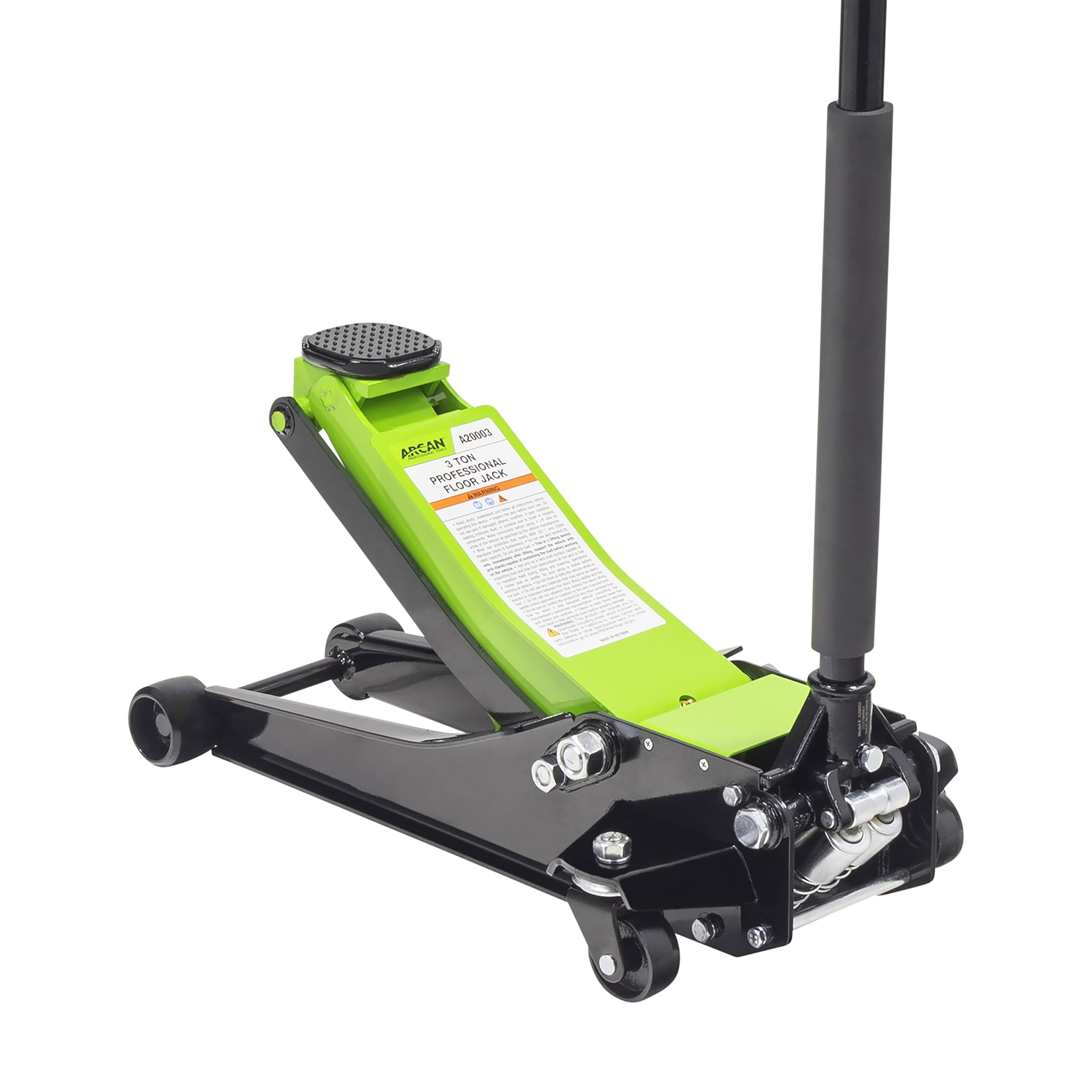
A floor jack has to do three things: lift smoothly, hold pressure, and lower under control. Paint, handle finish, and brand name matter far less than whether the hydraulic pump holds pressure while you’re under the car. The picks below are ranked for exactly that, and the ARCAN 3-Ton takes the top spot with 4.7 stars across 300+ ratings because it balances a low-profile frame with a 6,000-pound load capacity and a build that professional mechanics keep comparing to premium shop jacks.
I’m Min — the founder and writer behind Gadgets Feed. This guide is built by comparing the manufacturers’ published specifications and the patterns across verified customer reviews, so you get each pick’s real strengths and trade-offs instead of marketing spin.
Below you will find nine hydraulic floor jacks sorted by how well they match real garage work — from low-profile racing jacks to heavy steel service jacks — along with the lift range, capacity, and weight numbers that actually determine whether a jack fits your car. Whether you drive a lowered coupe or a full-size pickup, this breakdown covers the best automobile floor jack for your clearance and capacity needs.
Our Picks at a Glance


How To Choose The Best Automobile Floor Jack
A floor jack is a hydraulic lever that uses fluid pressure to raise your vehicle off the ground so you can change a tire, swap brake pads, or slide jack stands underneath. Getting the right one depends on four numbers you should check before you buy anything: minimum lift height (how low the saddle sits at rest), maximum lift height (how high it reaches fully extended), load capacity (the weight it is rated to hold), and the type of hydraulic pump inside. Miss any one of those and you will end up with a jack that either cannot fit under your car or runs out of travel before the wheels clear the ground.
Match the minimum height to your car’s clearance
If you drive a lowered coupe, a sports car, or anything with a body kit, the number that makes or breaks the purchase is minimum height. A jack that starts at 3 inches will slide under a Corvette or a 370Z. One that starts higher than that simply won’t fit. Measure the gap between your car’s jacking point and the ground before you order. On stock sedans and crossovers, a minimum height between 3.4 and 5.5 inches covers almost everything. Trucks and lifted vehicles need more saddle travel rather than an ultra-low frame.
Check load capacity against your actual vehicle weight
A jack’s capacity — measured in tons or pounds — tells you the maximum weight it can raise. A 2.5-ton (5,000 lb) jack handles sedans, hatchbacks, and most crossovers. A 3-ton (6,000 lb) jack adds headroom for SUVs, minivans, and half-ton pickups. The general rule is to pick a jack rated well above the weight of whichever corner you plan to lift, because a floor jack carries most of the vehicle’s weight on a single point at the saddle. Overshoot rather than undershoot, and never count on being at exactly the limit.
Single piston vs. dual piston pumps
Every hydraulic floor jack here uses a piston to push fluid into a reservoir and raise the saddle. A single-piston pump gets the job done with more strokes — think 15 to 25 pumps to full height. A dual-piston (sometimes called a dual-pump or quick-lift) design cuts that roughly in half, which matters when you’re lifting repeatedly on a project car. Dual-piston jacks cost more, but you feel the difference the first time you do a brake job and don’t have to pump 20 times to get the wheel off the ground. Racing-style jacks almost always use dual pistons; budget service jacks usually use a single piston.
Steel, aluminum, and the weight trade-off
Steel frames are heavier but stand up to years of garage use and cost less. Aluminum and aluminum-steel hybrid jacks shed weight so you can lift them into a trunk or carry them to a track day, at a higher price. A steel 3-ton jack will weigh well over 60 pounds; an aluminum-and-steel 3-ton typically lands in the 55 to 60-pound range. Neither material is inherently safer — both have rated capacity limits. Pick steel for a stationary home garage, and aluminum-steel for anything that needs to travel.
Quick Comparison
| Model | Best For | Capacity | Lift Range | Weight | Amazon |
|---|---|---|---|---|---|
| ARCAN 3-Ton A20003★ Best Overall | All-around garage work | 3 Ton (6,000 lb) | 7.5″ min height | 76.8 lbs | Amazon |
| AV Steel 2.5 Ton Low ProfileBest Value | Sedans and low-clearance cars | 2.5 Ton (5,000 lb) | 3.4″ to 14.6″ | 30 lbs | Amazon |
| Big RED T825051Budget Pick | Budget passengers-car lifts | 2.5 Ton (5,000 lb) | 3-3/8″ to 14-15/16″ | 28.5 lbs | Amazon |
| Maxority 3-Ton Low Profile | Low cars and workshop duty | 3 Ton (6,600 lb) | Max height 19.9″ | — | Amazon |
| AV Steel 3 Ton | Trucks, SUVs, and minivans | 3 Ton (6,000 lb) | 5.5″ to 18.5″ | 63.9 lbs | Amazon |
| Jack Boss 3 Ton | Racing and lowered vehicles | 3 Ton (6,600 lb) | 3-15/16″ to 18-5/16″ | 58.5 lbs | Amazon |
| DNA Motoring TOOLS-00475 | Heavy duty industrial use | 3 Ton (6,000 lb) | 3″ to 20″ | 74 lbs | Amazon |
| YELLOW JACKET 3 Ton | Mobile mechanics | 3 Ton (6,600 lb) | 3-15/16″ to 18-5/16″ | 58.6 lbs | Amazon |
| Torin T83505W BlackJack | Low-profile pickup-truck work | 3 Ton (6,000 lb) | 3.7″ to 18.07″ | — | Amazon |
In-Depth Reviews
1. ARCAN 3-Ton Steel Low Profile Floor Jack, Model A20003
Our pick — over 4.5★ from 350+ verified ratings; the strongest balance of quality and price.
Heavy in the hand, rock-steady under the car — the one that professional mechanics keep comparing to shop-floor jacks.
The ARCAN’s defining number is its 6,000-pound load capacity — enough headroom to lift one corner of a half-ton pickup or an SUV with a little room left over. It uses a quick-rise dual-piston pump, which cuts the number of handle strokes needed to reach full lift compared to a single-piston design. The frame is low-profile, so it slides under vehicles with limited ground clearance where a standard service jack would catch the bumper. High carbon steel side plates reinforce the chassis for repeated heavy use.
Two safety valves handle the moment that matters most: a bypass valve and an overload valve both kick in if you try to lift beyond rated capacity, so the jack cannot drive itself past its own limits. The long handle gives you leverage for controlled lifting and lowering, and the wide front wheels plus ball-bearing rear casters keep the jack stable while you roll it under the car. Internal wiper seals protect the hydraulic fluid from dirt that would otherwise work its way in during garage use. Buyers who have run this jack for a couple of years describe the pump and frame as durable and consistent, with no bleeding needed from the start.
What wins people over is the build: thicker chassis steel, smoother-rolling casters, and a dual-piston pump that lifts fast under load. The recurring gripe is the weight: at 76.8 pounds this is a serious, two-hands-to-move tool, not something you’ll carry to a track day. It also arrives as a heavy parcel, and a few units have shown cosmetic damage in transit, though the jack itself still works. The 1-year ARCAN warranty backs the pump and structure. If you have a permanent garage bay and mostly work on cars, trucks, or SUVs, this is the jack to build around.
What buyers keep coming back to
- 6,000-pound load capacity lifts big cars, SUVs, and pickups without strain
- Dual-piston quick-rise pump needs fewer strokes to reach full height
- Bypass and overload valves cap the jack at its rated capacity for safety
- Wiper seals keep hydraulic fluid clean over years of garage use
- Low-profile frame gets under vehicles standard jacks can’t touch
The trade-off to plan for
- 76.8 pounds means you won’t be carrying it into a trunk
- Shipping packaging has occasionally arrived damaged, jack intact
- Longer handle can feel unwieldy in tight spaces
Reach for this if: you have a home garage bay and want one jack that handles sedans, SUVs, and light trucks — the 6,000-pound capacity and low-profile frame give you room to grow.
Look elsewhere if: you need to carry your jack in a car or lift it onto a shelf; the 76.8-pound weight will wear you out before the jack does.
2. AV Steel Low Profile Floor Jack 2.5 Ton (5,000 lbs)
The lightweight low-profile specialist for people who mostly lift sedans, coupes, and daily-driver crossovers.
Start with the number that decides whether this jack fits your car at all: a 3.4-inch minimum height, thanks to the low-profile frame. That’s low enough to slide under a lowered sedan or sports car where a standard service jack catches the rocker panel first. The lift range runs from 3.4 inches to 14.6 inches, which covers tire changes and brake work on most passenger cars. Capacity is rated at 2.5 tons (5,000 pounds) with a single-piston quick-lift hydraulic pump that raises the vehicle with minimal strokes. Two rear rotating wheels keep it a one-hand tool as you roll it into position — at 30 pounds it is one of the lightest jacks in this guide.
The AV Steel and the Big RED T825051 both measure at 2.5 tons, but the AV Steel stands 23.38 inches long versus the Big RED’s 24.7 inches — slightly tighter for storage in a cramped garage corner. It’s also the only jack here with a 360-degree rotating saddle, which lets you line the pad up with the jacking point without needing to reposition the whole jack. That saddle design matters more than most people expect; a misaligned saddle is how pinch welds get crushed. An overload-protection valve caps the pressure if you push past capacity, and a 12-month warranty covers design, materials, and workmanship defects.
Buyers who run this jack on Boxsters, older sedans, and low crossovers report it handles tire changes and brake jobs as advertised, with the 3.4-inch low profile and 30-pound weight cited most often. Two honest limits show up in the pattern: this is not a truck or SUV jack, and the short handle is the most-discussed downside. Under a rear differential, the handle can sit under the car and force you into awkward positions until the vehicle is already partway up. The single-piston pump also needs more strokes than a dual-piston model. For passenger cars with normal clearance, the 2.5-ton rating and 30-pound frame make this a genuine lightweight bargain.
Short bar, low reach
- 3.4″ minimum height clears most lowered sedans and sports cars
- 30 pounds makes it one of the easiest jacks here to move and store
- 360-degree rotating saddle helps you align the load pad without fuss
- Overload valve stops pressure past rated capacity
Where it doesn’t fit
- Not rated for trucks, SUVs, or lifted vehicles
- Short handle is the most-discussed complaint in buyer feedback
- Single-piston pump requires more strokes than dual-piston designs
Suits: the sedan or sports-car owner who needs a jack light enough to grab off a shelf and low enough to slip under a lowered car without lifting the whole frame first.
Skip if: your driveway holds an SUV, pickup, or lifted vehicle — the 14.6-inch max lift and 2.5-ton rating won’t get you there.
3. Big RED T825051 Torin Hydraulic Low Profile Trolley Service/Floor Jack
The bare-bones trolley jack that gets lowered Mazdas and old Porsches off the ground without spending much.
At 28.5 pounds, the Big RED T825051 is the second-lightest jack in this guide — light enough that a buyer with a hand disability can still wheel it around the garage, and small enough to tuck into a trunk for a road trip. It offers a 2.5-ton (5,000-pound) capacity with a lift range of 3-3/8 inches to 14-15/16 inches, which lands right in the balance for passenger cars. Safety is handled by a bypass system that stops the pump if you push past rated capacity. Two large steel casters and two 360-degree swivel casters make it easy to steer, and a built-in carrying handle on top lets you lift the whole unit by hand.
Versus the AV Steel low-profile jack above, the Big RED is 24.7 inches long — 1.32 inches longer in the frame — and it holds the same 2.5-ton rating. That extra length shows up mostly in tight storage spots. On the plus side, the Big RED’s carrying handle is a genuinely useful detail the AV Steel lacks; lifting 28.5 pounds off a concrete floor with a top-mounted grip is easier than wedging your fingers under a chassis. Buyers report the pump takes more strokes than a racing jack, so plan on a slow, steady lift rather than a quick-up motion. The handle requires a twist to release, and the descent is controlled rather than fast.
The pattern in buyer feedback here is mixed rather than glowing. Some report solid, reliable performance for years; others had a unit fail early or found the jack couldn’t lift an SUV off the ground despite the 2.5-ton rating. Treat this as a fit question rather than a defect: this jack is for lowered Mazdas, Spec-Miata-adjacent cars, and daily-driver sedans, not a heavy 4WD truck. The 5-star buyers are clear about the trade-off — plenty of lift for the money, but slower and less refined than the ARCAN or the AV Steel. If your vehicle is a passenger car and you want the lowest-cost entry to a functional low-profile jack, this is a reasonable place to start.
The bottom line on value: the Big RED is the most affordable way to get a hydraulic trolley jack with a low profile, a bypass valve, and a carrying handle — the fundamental tools are all there, just without the refinement of the higher picks.
Plan around this: it is slow to pump and clearly aimed at passenger cars. Owners who bought it for an SUV sized it wrong; owners who bought it for a lowered sedan tend to keep it for years.
Pick it when: a passenger car needs a low-cost low-profile jack, and you want something light enough to lift with one hand on a top handle.
Don’t pick it when: you drive a truck, an SUV, or anything lifted — the 14-15/16-inch max height and mixed lifting history on heavy vehicles make this the wrong tool.
4. Maxority 3-Ton (6600lbs) Low Profile Hydraulic Heavy-Duty Steel Floor Jack
The beefed-up 3-ton with RAPID PUMP dual pistons and a 6,600-pound ceiling for men and women who don’t want margin to be a question.
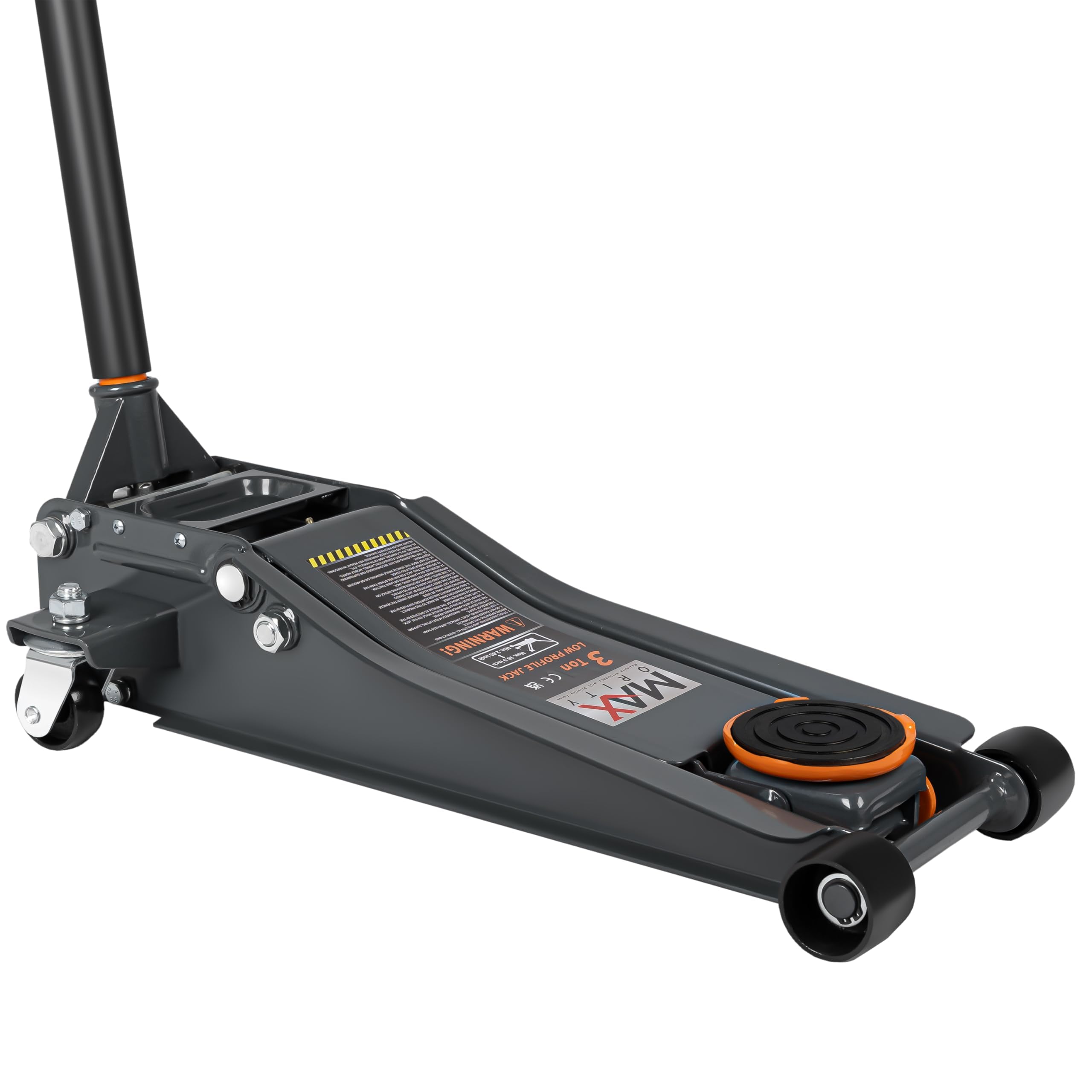
The Maxority’s headline number is 6,600 pounds — 600 pounds more headroom than a standard 3-ton jack, which matters when you’re lifting one corner of a loaded SUV or a vehicle with aftermarket modifications. The RAPID PUMP hydraulic system uses dual pistons to reach full height in fewer strokes than a single-piston jack. The maximum lift height is 19.9 inches, which is on the upper end of this group and gives you plenty of room to slip jack stands under the frame. The frame itself is high-strength steel with a low-profile design that slides under low-clearance vehicles. An integrated safety valve in the lift saddle stops overloading, and the wide saddle keeps the load stable while the vehicle is improve.
The 6600-pound rating puts this closer to a premium racing jack than to the entry-level 2.5-ton options. If you compare it to the Big RED T825051’s 2.5-ton (5,000-pound) rating, the Maxority carries substantially more headroom — worth knowing if you ever plan to lift a larger vehicle. The dual-piston pump brings quick-lift response that single-piston jacks at this level can’t match; buyers describe lifting low cars with a handful of pumps rather than a long workout. The saddle geometry keeps the load seated, and the 19.9-inch max height means tall vehicles don’t leave you stuck trying to fit a jack stand.
What most buyers point to is the build: a solid chassis, uniform welds, and strong value for a 6,600-pound 3-ton jack. The recurring caveats are the release valve being sensitive (it drops more suddenly than some drivers expect) and the handle assembly needing clear instructions — the two-piece handle snaps together, and the setup guide isn’t always thorough. This jack is also heavy enough that you won’t move it casually. A 90-day warranty covers the unit, which is shorter than most competitors here, so factor that in if you want longer coverage. For a home garage lifting sedans and crossovers, it does what it promises.
Where it shines
- 6,600-pound capacity beats a standard 3-ton rating
- Dual-piston RAPID PUMP reaches height in fewer strokes
- 19.9-inch max lift leaves room for jack stands under taller vehicles
- Safety valve on the saddle prevents overload
Keep in mind
- Sensitive release valve can drop the load faster than expected
- Setup and bleeding instructions are not always clear
- 90-day warranty is shorter than most jacks here
Right for you if: you want maximum lift headroom with quick dual-piston response, and the vehicle you lift most often is a car or crossover with a little extra weight on board.
Think twice if: you want a long warranty window or a jack you can carry — the 90-day coverage and heavy frame make this a stationary home-garage tool more than a portable one.
5. AV Steel 3 Ton Floor Jack (6000 lbs), Lift Range 5.5″ to 18.5″

A 3-ton steel service jack built for pickups, minivans, and any garage where the working vehicle is bigger than a sedan.
The AV Steel 3 Ton is the truck-lifting counterpart to the lightweight 2.5-ton AV Steel above, and the difference starts with the minimum height: 5.5 inches instead of 3.4. That means it won’t fit under a lowered sports car, but a standard pickup or SUV jacking point is well within reach. The lift range climbs to 18.5 inches of maximum height, giving you room to place jack stands under taller frames. Capacity is 3 tons (6,000 pounds), which covers most standard cars, SUVs, minivans, and half-ton pickups — not lifted vehicles, heavy-duty trucks, or RVs. The 63.9-pound steel frame is the reason buyers describe stability as a non-issue, and the large 360-degree rotatable saddle keeps the load seated during the lift.
Two features separate this from a simple budget steel jack. The safety valve automatically prevents overloading, cutting the pump if you push past capacity. And the frame meets ANSI/ASME PASE safety standards, which is note if you work professionally or just want assurance that the steel wasn’t skimped on. The 12-month warranty covers design, materials, and workmanship. If you’re lifting an EV, AV Steel recommends a jack point adapter so the saddle properly aligns with the manufacturer-specified lift points — worth planning for if you drive an electric vehicle. The single-piston pump is the same class as the Big RED — solid but not quick-lift — and the note in the shop listing points you toward a dual-piston model if stroke count matters to you.
Buyers consistently describe this jack as sturdy and good value for money, and a few describe lifting a 17-foot boat or a van side. The most-discussed nuance is the drop when you release: several owners note that lowering moves faster than a dual-piston racing jack, so you need to feather the handle. Weight is the second recurring point — 63.9 pounds is heavier than the 2.5-ton AV Steel by more than double, so plan on a fixed bay rather than rolling it across a driveway. If your garage sees trucks and SUVs, this jack’s combination of 6,000-pound capacity and 18.5-inch max height is the practical match.
Straightforward strength: 6,000-pound capacity, 5.5-to-18.5-inch range, and an ANSI/ASME PASE-compliant frame add up to a service jack that keeps its footing when larger vehicles go up.
Plan for this: the release valve moves the vehicle down quickly once you crack it open, so plan to lower with a deliberate hand; and the near-64-pound body stays where you leave it.
Made for: the garage that regularly lifts minivans, SUVs, and half-ton pickups — the 6,000-pound capacity and 18.5-inch max height keep heavier vehicles fully supported.
Not made for: lowered cars, EVs without an adapter, or lifted trucks and RVs, where the 5.5-inch starting height either won’t fit or the 6,000-pound rating isn’t the right match.
6. Jack Boss 3 Ton Low Profile, Aluminum and Steel Racing Floor Jack

The aluminum-and-steel racing jack for lowered cars — 3-15/16″ minimum height, 3-ton capacity, and dual-piston speed.
The Jack Boss starts low at 3-15/16 inches and reaches 18-5/16 inches fully raised — a range that covers everything from a Jaguar F-Type with extended rocker covers to a mid-size SUV. The frame combines an aluminum body with a welded steel frame, which is why it manages a 3-ton (6,600-pound) capacity at 58.5 pounds — noticeably lighter than a comparable steel-only jack. A dual-piston pump lifts faster with fewer strokes than a single-piston design. The large rubber saddle grips the lift point and protects the paint on the underside of your car, and the two-piece handle makes it easy to position and carry. Factory testing to 4.5 tons (9,900 pounds) — 1.5 times its rated capacity — is where the safety margin comes from, and it meets ANSI/ASME PASE standards with a limited 1-year manufacturer warranty.
Against the ARCAN 3-Ton, the Jack Boss runs 58.5 pounds versus the ARCAN’s 76.8 — a difference of 18.3 pounds, which matters every time you pull it out of the garage. It also starts lower (3-15/16 versus the ARCAN’s stated minimum). The 3-ton rating is identical. Where it lands squarely in its own lane is low-profile racing use — the lowered vehicles that a standard service jack can’t reach. Buyers describe the dual-piston response as quick and the descent as precise, which is unusual at this weight class and price band. The wheels roll smoothly over concrete, and the handle is long enough to give good leverage on the lift strokes.
The thing most owners notice right away is the build quality — the welds look solid, the pump feels tight, and it works without needing to bleed it first. The one recurring gripe is the weight: despite the aluminum in the frame, this jack is heavier than buyers expect for an aluminum-labeled product, so the “lightweight” label deserves an asterisk. A secondary complaint — a registration issue through the QR code — is cosmetic rather than functional; the jack itself holds up. If you want a racing jack that sits low and lifts fast without the price tag of a full aluminum-only tool, this is the strong middle ground.
Racing-focused strengths
- 3-15/16″ minimum gets under lowered cars like a Jaguar F-Type
- Dual-piston pump lifts fast and lowers with precision
- Tested to 4.5 tons (9,900 lb) — 1.5x rated capacity — for safety margin
- Rubber saddle protects paint at the lift point
Honest limitations
- Heavier than buyers expect from an aluminum-labeled jack
- Warranty registration via QR code doesn’t always work
- Not rated for slammed cars despite the low-profile frame
Worth it if: you work on lowered sports cars and want a jack that starts below 4 inches while still carrying a full 3-ton rating and dual-piston speed.
Pass if: your car is slammed to the ground or if you need one-hand portability — the 58.5-pound body and 3-15/16″ minimum won’t cover either extreme.
7. DNA Motoring Low Profile Hydraulic Trolley Service/Floor Jack, 3 Ton

Twenty inches of lift and a 3-inch starting height — a wide-swinging range for one jack to cover most driveway work.
The DNA Motoring’s defining pair of numbers is the range itself: 3 inches minimum to 20 inches maximum, out of a 3-ton (6,000-pound) capacity. That combination is generous — the 3-inch entry clears low-profile vehicles, and the 20-inch top is the highest in this group, which gives you real headroom for placing jack stands on SUVs and larger cars. A dual-piston pump raises the saddle to the desired height with fewer strokes than a single-piston jack. A large saddle with a rubber pad protects the vehicle at the lift point. The frame is heavy-duty steel with large steel casters and 360-degree swivel casters, so it rolls predictably across the garage floor.
Against the ARCAN 3-Ton above, this DNA Motoring costs more, and the practical payoff is the extra lift reach — 20 inches vs. the ARCAN’s stated minimum of 7.5 inches at one end, and the ARCAN’s higher ceiling at the top end leaves the DNA’s upper limit class-leading in this guide. In plain terms: the DNA is the jack you pick when you consistently work on vehicles tall enough that a standard 18-inch reach isn’t going to clear the frame rails. The rubber saddle pad and thick steel casters reinforce the sense that this was designed for heavier shop-style use. The published note that this jack is designed for vertical lifting only — not as a jack stand to hold a load for prolonged periods — is worth keeping in mind.
Owners describe the lifting experience warmly: SUVs go up quickly, the descent is controlled, and the jack feels solid under load. The one clear caveat that shows up is maneuverability on the ground — several owners mention it is heavy to pick up from the floor, and one aspect of the wheel design gets mixed reviews when the jack has to be repositioned. That’s the cost of a 74-pound steel chassis with heavy casters. If your use case is a stationary garage and you need reliable reach above 18 inches, the DNA Motoring delivers the height where other 3-ton jacks tap out.
The height case: a 3-inch starting point and a 20-inch ceiling in one jack is the widest spread here — the reason this lands for anyone working on mixed-height vehicles out of a fixed bay.
Lifting by hand is not the point: at 74 pounds with heavy casters, this jack rewards a permanent floor position more than a shuffle-in-and-out-of-the-trunk routine.
Best pick when: your garage holds both a lower car and taller vehicles, and you want one 3-ton jack whose 20-inch max height covers both without buying two tools.
Wrong pick when: you want a jack you can carry or easily wheel across rough ground — the heavy steel chassis and casters want a smooth concrete floor.
8. YELLOW JACKET Floor Jack 3 Ton Hydraulic Low Profile Aluminum and Steel Racing Car Jack

A 58.6-pound aluminum-and-steel racing jack that splits into two handles and rolls over rocks and grass — the mobile mechanic’s pick.
The YELLOW JACKET runs 3-15/16 inches to 18-5/16 inches of lift range with a 3-ton (6,600-pound) capacity, matching the Jack Boss on paper but landing at 58.6 pounds versus the Jack Boss’s 58.5 — effectively identical in weight class. The dual-piston pump lifts faster than a single-piston design. The frame mixes aluminum and steel for sturdiness without the weight of an all-steel body, and the low-profile design lets it slide under vehicles with roughly 3.94 inches of clearance. A large rubber saddle plus a foam bumper on the handle protects the vehicle from metal-to-metal contact during the lift. A load-limiting device automatically engages when the jack is overloaded.
What makes this one stand out for mobile work is the handle system: it splits into two pieces, and both parts fit in a trunk with the jack, so you can carry it to a job site without needing a truck bed. Buyers who use it professionally describe rolling it over rocks, grass, and dirt to reach a vehicle, which isn’t something you’d ask of a heavy steel service jack. Two universal casters plus two front rollers keep the frame stable while the wheels move. The published note that the jack must be used for vertical lifting only — not to hold a load for long periods and not for side or downward force — is a real operating constraint worth knowing before you buy.
The most-discussed limitation is the rubber pad on the saddle: several owners mention it can slide and feels thin, so a little care at the contact point pays off. Weight is the second honest note — 58.6 pounds is portable, but “portable” here means trunk-transportable, not one-hand-carryable. The 1-year manufacturer warranty covers the unit, and the frame meets ANSI/ASME safety standards. If you’re rotating tires in a driveway or popping a wheel off on the side of the road, this is the jack built for exactly that rhythm.
Portability wins
- 58.6 lb frame with a two-piece handle that stores in a trunk
- Dual-piston pump for quick lifts on the road or in the driveway
- Rolls over rocks, grass, and dirt for mobile-mechanic work
- Large rubber saddle and foam handle bumper protect the vehicle
Small catches
- Saddle rubber is thin and can slide at the lift point
- 58.6 pounds is portable but not a one-hand carry
- Not rated for side or downward force — vertical lifting only
Built for: mobile mechanics and driveway warriors who need a 3-ton, 6,600-pound jack that travels in a trunk and still starts at 3-15/16 inches.
Not built for: anyone who needs to hold a load up for hours — this jack is for lifting, and jack stands belong under any vehicle once it’s in the air.
9. Torin T83505W BlackJack Hydraulic Low Profile Steel Racing Floor Jack

A big, low-profile Torin racing jack that slips under a lowered ’69 Camaro and lifts a 1964 Corvette for real garage work.
The Torin T83505W BlackJack pairs a 3-ton (6,000-pound) capacity with a lifting range from 3-7/10 inches to 18-7/100 inches — low enough to slide under a lowered classic and tall enough to reach a standard modern vehicle’s jacking point. The frame is high-strength alloy steel, so it takes a beating without flexing. A single-piston quick-lift pump raises the saddle to the working height so you can slide jack stands in. A foam bumper on the handle protects the vehicle’s paint from accidental metal contact. The chassis is a low-profile racing design, and buyers describe it getting under a lowered ’69 Mustang and a 1964 Corvette for fuel-pump and tire work.
Against the AV Steel 3 Ton above, the BlackJack is a taller, larger-frame jack with a longer reach — the AV Steel starts at 5.5 inches while the Torin starts at 3-7/10, which is roughly 1.8 inches lower at the base. That difference is what lets it slide under classic lower-profile vehicles. The 3-ton capacity matches the AV Steel and the Maxority, so the choice between them depends on height range and frame feel rather than lifting muscle. The foam bumper is a small but meaningful detail on a jack this size — the handle reaches over the vehicle when fully extended, and the bumper stops it from marring paint.
Buyers describe the quality and functionality as thestrong suit — the frame feels solid, and it handles what it’s asked to lift without complaint. The most-discussed caveat is weight: this jack is heavy enough that moving it around the garage takes effort, and several owners note it requires more handle force than expected because of the low mechanical advantage of the racing design. A small number of units have arrived with a crooked weld or run on three wheels, and a handful of owners mention gear-teeth wear after heavy use — worth checking on arrival. If you drive a lowered classic and want a Torin racing jack that sits low, this is the one to grab.
Standout stat: a 3-7/10-inch starting height opens the door to lowered classics, and the 6,000-pound capacity means modern trucks and SUVs are also within reach.
Check on arrival: buyers describe solid long-term performance and honest lifting strength, but a small share of units arrive with weld or wheel issues — inspect the frame and caster alignment on delivery day.
Strong choice for: classic-car owners and anyone lifting lower-profile vehicles who wants 6,000-pound capacity in a racing-style frame with a foam handle bumper.
skip it if: you want the lightest or quickest-lifting option — a dual-piston quick-lift jack will outpace this single-piston pump on repeated lifts.
Understanding the Specs
Load Capacity and Why More Is Better
Load capacity is the maximum weight the jack is rated to lift — usually listed in tons or pounds. A 2.5-ton rating equals 5,000 pounds; a 3-ton rating equals 6,000 pounds. Because a floor jack supports most of the vehicle’s weight at one point under the frame, you want a capacity rating comfortably above the heaviest corner of your car. The ARCAN and AV Steel 3 Ton both carry 6,000 pounds, the Maxority and Jack Boss and YELLOW JACKET carry 6,600, and the DNA Motoring and Torin BlackJack carry 6,000. Never count on lifting exactly at the rated limit — leave headroom for uneven ground and off-balance loads.
Minimum and Maximum Lift Height
Minimum height is the lowest the saddle sits at rest — the number that decides whether the jack fits under a lowered car. The AV Steel 2.5 Ton starts at 3.4 inches, the DNA Motoring at 3 inches, the Jack Boss and YELLOW JACKET at 3-15/16, and the Torin BlackJack at 3-7/10. Maximum height is as important on the other end: the DNA Motoring reaches 20 inches, the Maxority 19.9, the AV Steel 3 Ton 18.5, the Jack Boss and YELLOW JACKET 18-5/16, and the Torin BlackJack 18-7/100. Measure both ends against your vehicle before ordering — a jack that fits can still come up short.
Hydraulic Pump Design and Stroke Count
Every floor jack uses a hydraulic pump to push fluid into a reservoir and raise the saddle. Single-piston pumps take more handle strokes to reach full height, which slows down repeated lifts. Dual-piston (quick-lift) pumps cut the stroke count roughly in half. In this guide, the ARCAN, Maxority, Jack Boss, YELLOW JACKET, and DNA Motoring use dual-piston pumps. The AV Steel 2.5 Ton, AV Steel 3 Ton, Big RED, and Torin BlackJack use single-piston designs. Neither is unsafe — the difference is effort and speed, not lift capability.
Safety Valves, Saddle Design, and Load Physics
An overload valve caps the hydraulic pressure so the jack can’t be pumped past its rated capacity. A bypass system serves the same purpose on the AV Steel and Big RED jacks. Saddle design matters for stability: the AV Steel 2.5 Ton and AV Steel 3 Ton use a 360-degree rotatable saddle for alignment; the Jack Boss and YELLOW JACKET use a large rubber saddle with a foam handle bumper to protect paint. Always set jack stands under the vehicle before going underneath — every manufacturer here notes the jack is for lifting, not holding a load.
FAQ
How do I know if a floor jack will fit under my car?
Is a 3-ton floor jack better than a 2.5-ton jack?
What is the difference between a single-piston and dual-piston floor jack?
Can I leave my car on the floor jack without jack stands?
How much does a floor jack weigh, and does it matter?
Will a 2.5-ton floor jack lift my SUV or truck?
Do I need a jack point adapter for an electric vehicle?
How do I lower a car safely after a lift?
Do I need to bleed a new floor jack before first use?
How long should a floor jack last?
Final Thoughts: The Verdict
For most garages, the best automobile floor jack winner is the ARCAN 3-Ton A20003 — the 6,000-pound capacity, dual-piston quick-rise pump, wiper-sealed hydraulics, and reinforced steel chassis put it a step above the rest for anyone lifting cars, SUVs, or trucks at home. It’s heavy at 76.8 pounds, but that weight is the reason it feels solid under the car. If portability matters more, grab the AV Steel 2.5 Ton at 30 pounds with a 3.4-inch low-profile entry — it’s the lightest way to get a proper low-profile jack and the budget pick that most owners would rank higher than its rating suggests. And if your garage sees trucks and half-ton pickups on the regular, the AV Steel 3 Ton with its 5.5-to-18.5-inch range and 6,000-pound capacity is the one to reach for. Whichever you pick, pair it with a set of jack stands — every jack here is a lifting tool, not a support.
How We Picked
We do not accept paid placement. Every pick is matched to a real buyer and a real use-case; we do not hands-on test units.
Sources & Methodology
Specifications: manufacturer listings and product documentation. Review insights: verified customer reviews, as of September 2026. Pricing: not shown on this page (it changes often); check the current price via the retailer link.
As an Amazon Associate, Gadgets Feed earns from qualifying purchases. This does not affect which products we feature.