
Our readers keep the lights on and my morning glass full of iced black tea. As an Amazon Associate, I earn from qualifying purchases.
Specs are compiled from manufacturer listings and verified buyer reviews and can change over time — please confirm the key details on the product page before buying.
If your phone still loses battery while it’s plugged in on the highway, the problem isn’t your phone — it’s the port. A weak 12V socket adapter can’t outrun navigation, music and a bright screen at the same time, so your battery percentage slides downhill all the way to your exit. The picks below fix that, and they also fix the second, quieter problem: plugs that pop loose over potholes, so your dashcam stops recording without telling you.
I’m Min — the founder and writer behind Gadgets Feed. This guide is built by comparing the manufacturers’ published specifications and the patterns across verified customer reviews, so you get each pick’s real strengths and trade-offs instead of marketing spin.
Start by choosing a plug-in adapter or a hardwired socket panel, then match the port’s wattage to your devices. Below are nine options, each a solid pick for a specific kind of owner. If you want the short answer, the Anker 323 is the crowd favorite — 4.7 stars across 8,000+ owners — and it is the safest first automobile usb port to buy.
Our Picks at a Glance

How To Choose The Best Automobile USB Port
Almost every car has a round 12V socket near the gear lever, and what you plug into it decides whether your phone gains or loses charge. The two big questions are how much power the port can push, and whether it stays seated in the socket when the road gets rough.
Output wattage decides whether your battery climbs or falls
Navigation, music and a bright screen together can pull more power than a weak adapter supplies. A 30W USB-C port (30 watts of delivered power) is enough to push a modern phone upwards while it runs maps. The LIHAN 120W Car Splitter’s dedicated 36W USB-C PD port is built specifically so your percentage goes up on a two-hour highway drive. Anything much below that tends to just slow the drain instead of reversing it.
Plug-in adapter or hardwired socket panel
A plug-in adapter drops into the socket you already have — nothing to wire, nothing to drill. A hardwired socket panel replaces the cigarette lighter or mounts through a drilled hole, and it usually adds a voltmeter (a small display showing your battery’s live voltage) plus an on/off switch. Hardwired units are the better call for boats, RVs, golf carts and older trucks where the factory socket is worn out. Plug-in adapters win for rental cars and quick swaps.
Fit and fuse matter more than most shoppers expect
Two numbers decide whether a panel fits cleanly: the drill hole size and the wiring gauge. The Hapytrip 12 Volt USB Outlet calls for a 1.18 inch (3cm) hole, and some owners find the body slightly larger than a standard 12V hole and trim the opening. On the fuse side, look for a built-in auto-reset fuse rather than a one-time blade fuse, so an overload doesn’t leave you hunting for a spare on the shoulder.
Quick Comparison
| Model | Best For | Form Factor | Ports | Fast-Charge Standard | Amazon |
|---|---|---|---|---|---|
| Anker 323 52.5W★ Best Overall | Everyday plug-in charging | Plug-in adapter | 1x USB-C, 1x USB-A | PD + PowerIQ 3.0 | Amazon |
| Hapytrip 12 Volt USB OutletBest DIY Upgrade | DIY socket replacement | Hardwired panel | 2x USB-A, 1x USB-C | QC3.0 + PD3.0 | Amazon |
| LIHAN 120W Car SplitterMost Versatile | Family road trips | Plug-in splitter | 5 USB + 3 sockets | PD36W | Amazon |
| Qidoe 12 Volt USB Outlet Panel | All-metal dash installs | Hardwired panel | 1x USB-C, 1x USB-A | PD3.0 + QC3.0 | Amazon |
| Lpluziyyds 84W 4-Port Socket | Wet and dusty environments | Hardwired panel | 4 ports | Dual PD3.0 + Dual QC3.0 | Amazon |
| AINOPE 4.8A Car Charger | Flush low-profile fit | Plug-in adapter | 2x USB-A | — | Amazon |
| VANONE Dual PD & QC3.0 Socket | Motorcycles and boats | Hardwired panel | 2x USB-C, 2x USB-A | Dual PD3.0 + dual QC3.0 | Amazon |
| TIANWIDJEW 78W 3-Port Socket | Vintage-car socket retrofits | Hardwired panel | 2x USB-C, 1x USB-A | Dual PD 30W + QC3.0 | Amazon |
| LISEN Retractable Car Charger | Cable-clutter-free road trips | Plug-in adapter | 2 retractable cables + 2 USB | PD 45W / 36W | Amazon |
In‑Depth Reviews
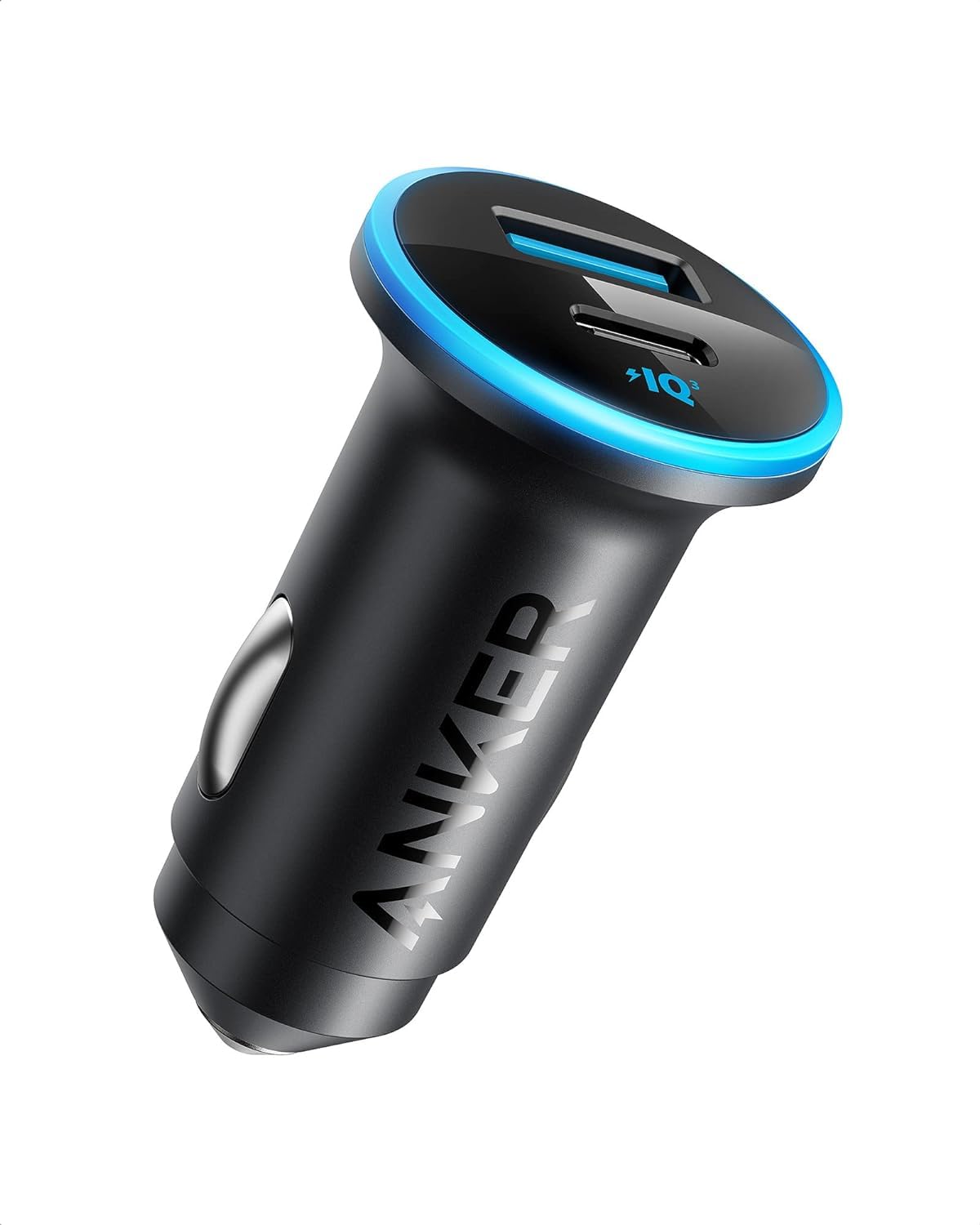
1. Anker 323 52.5W USB C Car Charger with 30W PowerIQ 3.0 Fast Charging
Our pick — over 4.5★ from 8,500+ verified ratings; the strongest balance of quality and price.
The small black plug that has quietly become the default answer for a rental car.
The headline number is the one buyers actually feel: the USB-C port puts out 30W, which is enough to take an iPhone 14 Pro from empty to 50% in about 25 minutes, and a Samsung S23 to the same mark in roughly 27 minutes. The second port is a USB-A rated up to 22.5W, so a passenger can run a second phone or a tablet at the same time without either device slowing down. Combined, that’s a 52.5W total output from a body that sits flush in the socket and leaves your console tidy.
Anker’s PowerIQ 3.0 (their chip that negotiates the fastest safe speed with whatever you plug in) handles the compatibility so you don’t have to think about it — the published support list runs from the iPhone 17 series back through the iPhone 12 line, plus Samsung and USB-C tablets. What owners talk about most is how quickly this thing moves a battery needle. The blue ring light is the second thing people notice: it glows when the socket has power and goes dark when you shut the car off, so you can tell at a glance whether the outlet is live before you leave. ActiveShield 2.0 adds a temperature watch that trims output if the charger starts to warm up, and the enclosure is plastic — light in the hand, but the build still feels solid.
Worth knowing before you order: the fit gets mixed feedback in the reviews. Some buyers report it seats tightly enough that it won’t budge on rough roads; a handful find it doesn’t stay put in their particular socket, which is a vehicle-to-vehicle thing rather than a flaw in the design. Charging capability gets the same mixed read — the USB-C port doesn’t work with an iPhone 17 Pro for some buyers. Compared with the Hapytrip outlet’s 5A rating against this unit’s 1.5A, the Hapytrip holds the higher amperage figure on paper, but for a plug-and-play everyday charger the Anker’s welcome guide and 18-month warranty are the easy part to like.
What earns the top spot
- 30W USB-C plus 22.5W USB-A, so two devices charge at full speed together
- Blue ring light tells you the socket is live without starting the car
- Compact enough to disappear into the console, with a flush fit
- PowerIQ 3.0 compatibility across iPhone 12 through 17 and Samsung
- Backed by an 18-month warranty and a welcome guide in the box
The honest trade-offs
- Fit varies by vehicle; a minority find it doesn’t stay seated
- USB-C port reported not to work with iPhone 17 Pro for some owners
- Plastic enclosure rather than metal, so it’s light rather than armored
- No voltmeter, no on/off switch — it’s a plain charger
Reach for this if: you want one reliable plug-in adapter for commuting, rentals and road trips without thinking about it again.
Look elsewhere if: your car’s socket is worn and loose, or you want a hardwired panel with a voltage readout for a boat, RV or older truck.
2. Hapytrip 12 Volt USB Outlet Dual Quick Charge 3.0 Port and PD3.0 USB C Car Battery Chargers Socket, Waterproof 12V Power Outlet Cigarette Lighter Replacement DIY Kit with Voltmeter and Switch for Boat
Three ports, a live voltmeter and a kill switch you wire into the dash yourself.
This is the fix for anyone whose factory cigarette lighter is a dead relic. You drill a 1.18 inch (3cm) hole, slide the body in, tighten the ring, and connect two wires — red to the silver plug (positive), black to the gold plug (negative). Get those backwards and the unit simply won’t power on, which is a safe way to fail. The included 23.6-inch wire carries a 10A fuse, and the amperage rating on the whole unit is 5A — higher than the 1.5A figure on the Anker above, which matters if you’re feeding hungrier gear than a phone.
Charging is three-way at once: dual QC 3.0 USB-A ports (Qualcomm Quick Charge, the older fast standard) plus one PD3.0 USB-C connector, each with its own chip that identifies the device and picks the right current. The blue soft-light display shows your battery’s voltage in real time, which is genuinely useful on a boat or a car that sits for weeks — low voltage is the warning you want before you turn the key and hear nothing. A push-button switch cuts power to the voltmeter and all three charging ports, so the outlet stops sipping from your battery while the car is parked. The case is high-grade ABS plastic that the maker says won’t get hot, and the built-in chip adds overcurrent, overheating and overcharge protection.
Buyers consistently rate reliability as this unit’s strongest point — it’s the quality that gets the most praise, followed by how simple the install is, with most owners finishing inside an hour. The one recurring note is on fit: the body runs slightly larger than a standard 12V hole, so some owners have trimmed the opening with a box cutter before it drops in. In most cases the wide flange covers the marks afterwards. The push connectors used for wiring are another small detail worth flagging for anyone who has only ever crimped before.
Why it lands here: a waterproof-rated chassis, a real voltmeter and a switch — three things no plain plug-in adapter gives you, all in a -tier accessory.
One thing to plan for: if your dash hole is exactly standard size, budget a few minutes with a file or box cutter before you start wiring.
The right call for: boat owners, older trucks, campers and DIY installers who want a permanent socket with a voltage readout and a kill switch.
Consider a plug-in adapter instead if: you drive a lease, a rental, or anything you’d rather not drill into.
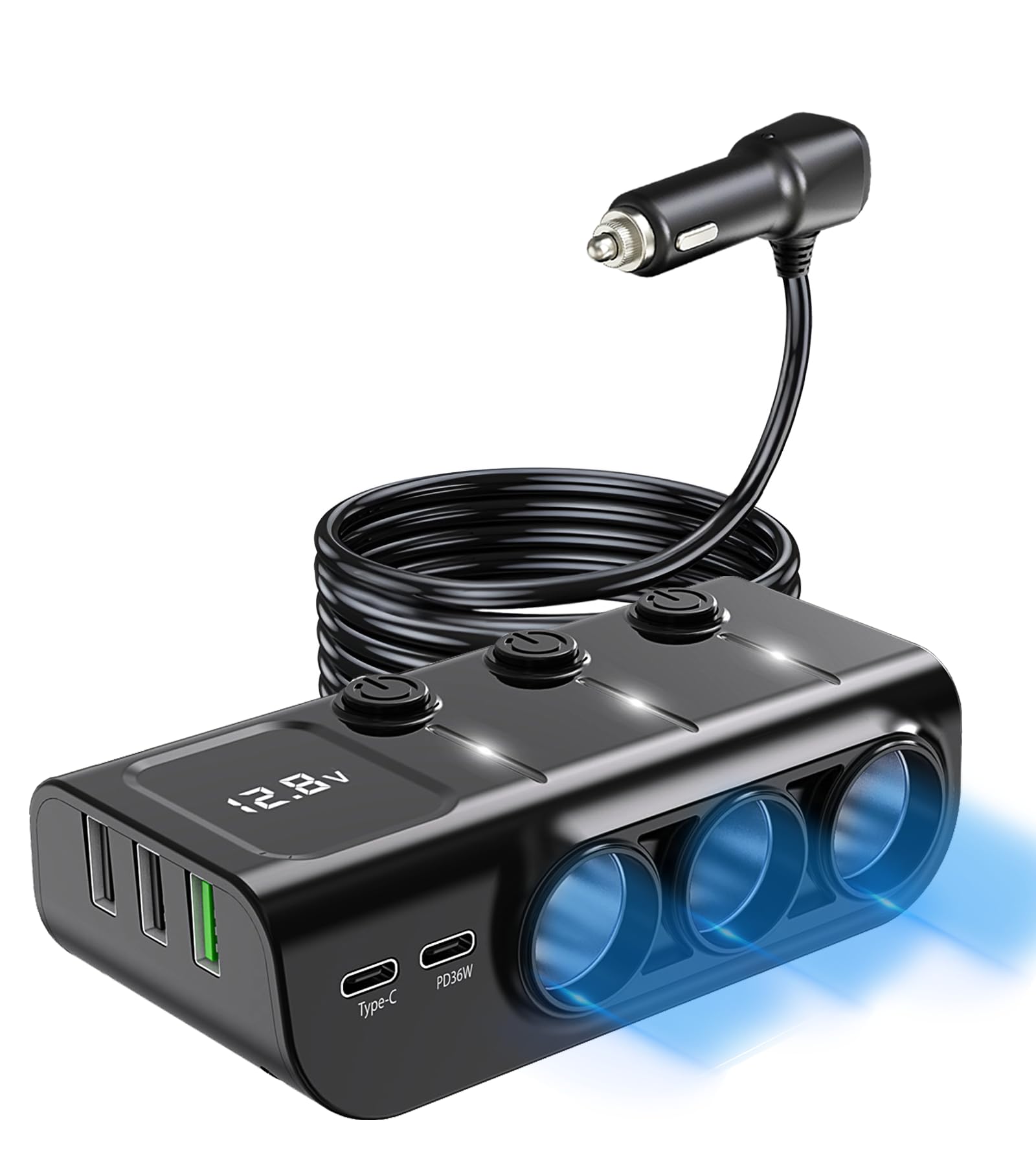
3. LIHAN 120W Car Splitter, 3 Cigarette Sockets Adapter, 5 USB, PD36W 8-in-1
Eight outlets, one master switch, and a 3.3-foot cord that ends the falling-plug problem.
If your 12V socket is worn enough that plugs drop out over potholes and your dashcam silently stops recording, the extension cord here is the actual cure. You leave a lightweight connector seated at the dash and route the bulk of the adapter to a cup holder or the center console, where it stays put. Total power across the three cigarette sockets runs up to 120W, and the amperage rating on the unit is 10A — headroom for a dashcam, a GPS, a Bluetooth FM transmitter and higher-draw gear like a tire inflator or a car fridge.
The dedicated 36W USB-C PD port is the reason your phone’s percentage climbs rather than holds on a two-hour highway run with maps, music and full screen brightness all going. Five USB ports in total — PD36W, a second Type-C, QC3.0 and two USB-A — each with a chip that auto-detects the right current, so nothing has to wait in line. There’s a real-time LED voltage display that flashes if your battery drops below 12V, giving you a heads-up on alternator trouble before it leaves you stranded.
The master power switch is the feature that tends to hook people: a single press cuts everything to all three sockets and all five USB ports, which matters in vehicles that keep the lighter socket live with the engine off. Below that, individual socket switches let you toggle a dashcam or FM transmitter independently while you’re driving. Fuses are handled without a trip to the parts store — if the adapter overheats or overloads, a built-in auto-reset fuse cuts power and restores it once things cool. Six-layer protection covers over-voltage, overload, overheating, short-circuit, over-current and over-charging.
Quality is what this splitter’s owners rave about, and versatility follows close behind — it’s the kind of accessory that quietly handles a TPMS, a backup camera, a CarPlay head unit and a dashcam at once. The honest caveat in the reviews is long-term durability, with one owner reporting it gave out after a few months. It’s the most ambitious accessory here by a wide margin, and the one asking the most of a single socket, so treat it as a convenience hub rather than a permanent electrical fixture.
Where it shines
- 3 sockets plus 5 USB ports from one 12V outlet — no daisy-chaining
- 3.3-foot cord keeps the connector seated at the dash instead of sagging loose
- Master switch kills everything in one click; individual switches for dashcam and FM
- Auto-reset fuse means no spare-blade scramble on the roadside
- Voltage display flashes under 12V as an early warning
Where it asks for care
- Durability is the mixed part of the record, with some units giving out in months
- Rated 10A, so it isn’t meant to run a heavy inverter through the sockets
- Master switch cuts everything at once — no separate always-on pairing
Best fit: families and long-haul drivers who need five gadgets powered simultaneously without cable chaos or dead batteries.
Less ideal if: you want one permanent fixture and would rather wire a socket panel than manage an expandable hub.
4. Cigarette Lighter Socket 12 Volt USB Outlet: PD 20W C and QC3.0 Car Port Aluminum Metal 12V Plug, 150W Charger Panel with Power Switch LED Voltmeter for Marine Boat RV Golf Cart

Two outlets in one panel, wrapped in aluminum instead of plastic — and it still fits a golf cart.
This is a 2-in-1 panel: the 12V cigarette socket and the USB charging ports share one compact body, so you cut a single hole instead of two. The socket itself carries a total power rating of 150W-300W across 12V-24V vehicles, which is enough to feed a dashcam, GPS, handheld vacuum or small air purifier from the same accessory port your phone charges from. Amperage is rated 10A.
The USB-C PD port tops out at 20W and will take an iPhone 13/12/11/Pro Max, an iPad, AirPods or a tablet from 0% to 55% in about 35 minutes — with the standard caveat that newer iPhone fast charging needs a USB-C to Lightning cable rather than the one in the box. The QC 3.0 USB-A port maxes at 18W, backward compatible with QC2.0 and QC1.0, so older gear still charges at its own top rate. The enclosure is aluminum alloy rather than the ABS plastic of many rivals, which the maker pitches as sturdier with better texture and a safer feel than plastic — particularly relevant on a motorcycle or a boat where the panel sits exposed.
Installation is the part buyers mention most after functionality, and it’s genuinely flexible: the front panel is optional, so it works either popped into the panel cutout or mounted flush against the dash. The voltmeter reads accurately enough that owners cross-check it against a multimeter and find it matches. A power switch lets you kill the digital readout when you don’t want the glow in your eyeline at night, and it also curbs the small drain the display can put on the battery when parked. Wiring expects a 1 1/4-inch hole, but no drill bit or paper template ships in the box.
The honest note here is on wiring gauge. The included leads are on the thin side for heavy loads, which is fine for phones, tablets and small TVs but not for running an inverter through the 12V socket. Durability is the weakest aspect in the owner record, and the 12V port stays live when wired in the default configuration — the switch controls the voltage display side. Worth knowing before you wire it up if you want a full kill on the socket itself.
Why it’s here: an aluminum 2-in-1 panel with a 150W socket is a sturdier, better-looking way to add both a lighter socket and fast USB charging at once.
The catch to plan around: the supplied wiring is fine for small electronics but not for high-draw gear, and no drill bit or template comes in the box.
Pick this when: you’re refreshing a camper, trailer, golf cart or bike and want one metal panel that does a cigarette socket and fast USB duty in the same footprint.
Think twice if: you plan to run an inverter or other heavy load off the 12V port, or if you need the wiring to handle more than phone-tier draw.
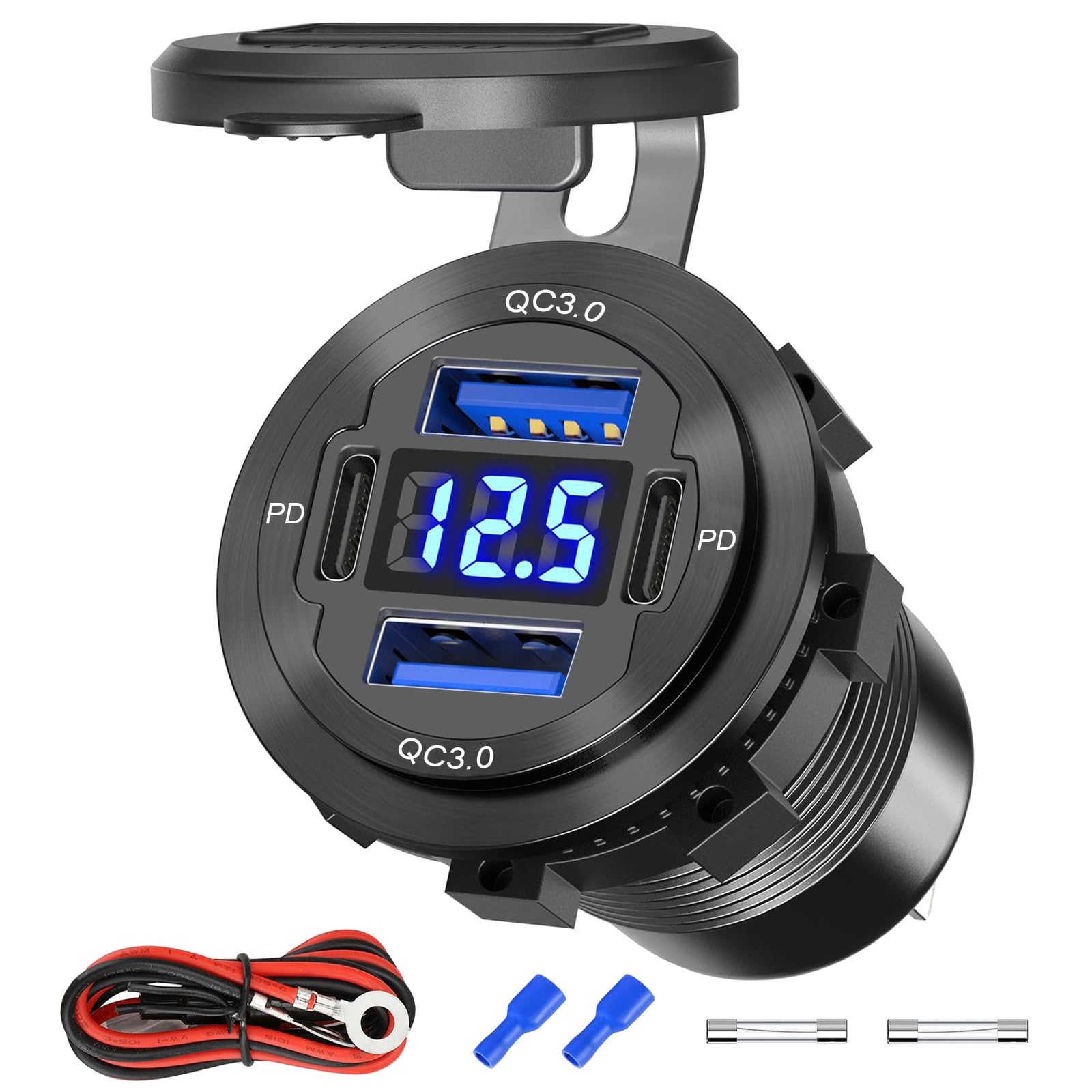
5. 84W 4-Port 12V/24V USB Car Charger Socket with Dual PD3.0 & Dual QC3.0 Fast Charging, Aluminum Alloy Waterproof USB C Outlet with LED Voltmeter, Compatible for Cars Boats Trucks RVs Motorcycles Marine
The one that shrugs off monsoons, dust storms and a motorcycle handlebar.
Four ports and 84W total output: dual PD30W USB-C ports paired with dual QC18W USB-A ports, so a family’s worth of devices can charge side by side off one socket. That 84W figure is the highest combined output of any hardwired panel here, and it’s split across ports with enough headroom that no single device should starve.
The enclosure is what sets this one apart. Aircraft-grade aluminum handles 360° heat dissipation, and the port faces carry an IP66 rating (a protection level that keeps out dust and strong jets of water), so it’s built for exposed installs — a motorcycle dash, a boat console, the bed of a truck that lives outside. The blue LED voltmeter tracks 12V-24V battery health while you’re charging, giving you a running read on whether your electrical system is healthy or heading toward a problem.
Universal compatibility covers cars, trucks, RVs, boats and motorcycles with an easy 15-minute install, and the kit ships with fused cables plus spare fuses. Protection is layered: overvoltage, overheating and short-circuit safeguards are all claimed, with certifications backing the safety story. Construction: aluminum alloy, single unit, 12V input and 12V output.
Where the owner experience gets spottier is outright reliability. The sample set on this model is smaller than the bigger names here, and the ratings read unevenly: some units have arrived with a partially failed LCD, and at least one buyer reports a unit that quit within about a month. If your vehicle lives rough and gets rained on, the IP66 aluminum housing is a strong argument; if you want the safest bet on pure durability, the higher-volume brands in this roundup have deeper track records.
Standouts
- 84W across 4 ports — dual PD30W USB-C plus dual QC18W USB-A
- IP66 waterproof and aluminum-alloy body built for exposed installs
- Blue LED voltmeter tracks 12V-24V battery health as you charge
- Fused cables and spare fuses included in the box
- 360° heat dissipation from the metal housing
Worth knowing
- Some arrivals come with a partially failed LCD readout
- One reported unit gave out inside the first month
- Thinner owner track record than the bigger names in this roundup
Go here when: the install lives outdoors or on a bike, and IP66 water protection plus an aluminum body matters more than a long owner history.
Step back if: you want the least risk on reliability and would rather pay for a longer track record than weather resistance.
6. AINOPE 4.8A Car Charger Adapter, Cigarette Lighter USB Car Charger

A thumb-sized plug that all but disappears into the socket and charges two phones at once.
At 1.7 inches long and 0.9 inches wide, this plug barely protrudes past the socket edge. At 1.7 inches long and 0.9 inches wide, it barely protrudes past the edge of the outlet, so it blends into your console instead of jutting out into the shifter’s path. Total output is 4.8A across two USB-A ports — 2.4A each — which the maker frames as roughly twice the speed of the older 1A/5W chargers that ship with some devices. The body is full zinc alloy, so it stays cool longer than a plastic shell and resists scuffs.
Two things buyers should know that aren’t in the headline number. This adapter does not support Qualcomm Quick Charge, and the phone will not display the “fast charge” flag while it’s plugged in — it’s a solid charger for a lot of phones, but it’s not going to trigger fast charge on a modern flagship. The other thing is the LED: the small soft blue light comes on when there’s power, which is convenient in some cars and less convenient in others, because certain vehicles keep the socket live after you switch off and the LED keeps quietly pulling from the battery. The maker calls this out themselves.
Build and function are the two things this plug gets right most reliably. The flush fit is the whole selling point, and buyers who want it tend to love it — paired with a good USB-to-USB-C cable, the combination keeps a phone topped up on long drives without the charger sticking out. It also sits well enough below the eye line that it doesn’t reflect or distract. The body is metal, so under a dual-phone load it stays only barely warm rather than hot to the touch.
The friction points are worth naming. Fit is genuinely vehicle-dependent — some owners find it seats almost flush with the lighter socket, others report it doesn’t fit their particular car at all. And the charger can work itself loose over time in a worn socket, pushing itself back out; only a few vehicles are affected, but if yours has a tired outlet, that’s the one to watch. The shrink-wrap packaging is also notoriously hard to get off with no tab or perforation to help.
The strongest argument: flush-fit design at 1.7 inches long and 0.9 inches wide is the reason this plug stays in the socket and out of the way.
The one you should hear before buying: it charges fast, but it doesn’t trigger Quick Charge or display the “fast charge” indicator — that’s a real limitation for buyers chasing peak speeds on a flagship.
Great for: anyone who hates a bulky charger blocking the shifter and just wants a low-profile way to top up two phones on the daily drive.
Probably not for: owners chasing Quick Charge on a modern phone, or anyone with a known-worn socket that pushes plugs out.
7. Dual PD USB C Ports & Dual Quick Charge 3.0 Ports Car Charger Socket, VANONE Aluminum Alloy Waterproof 12V USB Outlet

Four ports of fast charging in a metal body that lives through rain and winter on a bike.
Dual PD 3.0 USB-C ports at 20W each plus two 18W/3A QC3.0 USB-A ports, so four devices charge simultaneously at fast speeds. The maker frames that 18W rate as roughly four times a conventional charger, and the ports are backward compatible with QC2.0 and QC1.0 so old gear still charges at its own best speed. Amperage is rated 3A, and the published compatibility runs through iPhone 15/14/13/12 through XS Max, Samsung Galaxy S24 Ultra down to S20, Huawei P9, LG G5, HTC 10 and ZTE Axon 7.
The body is metal — not the nylon shell many rivals use — which the maker pitches as better heat dissipation plus non-flammable, wear-resistant and stable. The integrated LED voltage display reads your battery’s live status, and the fixed protective cap over the USB interface doubles as a water shield against splashes. Mount it in 20 minutes by connecting “+” to positive and “-” to negative; an on/off switch can be added if you want to cut power entirely while parked. The maker notes the display only lights when it’s connected to the battery, and the charger draws at most 30mA when the car is off.
Reliability is the single quality owners praise most on this model — this is the type of socket that comes back after a winter of rain and cold, and it’s the voltage readout that earns the next round of praise. Several buyers use it on motorcycles and fishing electronics rigs, where it lives outdoors permanently. The one honest technical note is unusual: if your phone has reverse charging enabled, there’s a chance it tries to send power back through the USB-C port into the charger instead of the other way around. That’s a phone-side setting toggled off, not a fault with the outlet.
What works
- Dual PD3.0 USB-C at 20W each plus two QC3.0 ports at 18W/3A
- Charges up to 4 devices at once without dropping to slow speeds
- Metal body with better heat dissipation than nylon-shell rivals
- Waterproof protective cap covers the USB ports when not in use
- Integrated LED voltage display, 30mA max drain when parked
Minor notes
- Reverse-charging phones can try to push power back through the USB-C port
- Fit is vehicle-dependent — a mixed aspect in the owner record
- Two holes to cut and two wires to terminate, so it’s a real install
Spec this if: you ride year-round or run electronics outdoors and need 4 devices charging off one switched, waterproof outlet.
Not the pick if: you’d rather avoid cutting holes at all, or your phone can’t turn off reverse charging and you plan to use the USB-C ports heavily.
8. 12V USB Outlet 3 Port Car Charger Socket, 78W Dual PD USB C 30W and Quick Charge3.0 Port Aluminum Charger Waterproof with Voltmeter and Button Switch

Drops into the cigarette-lighter hole on a vintage truck like it was always there.
Two PD 30W USB-C ports and one QC3.0 18W USB-A port deliver up to 78W combined across three devices. Backward compatible with Quick Charge 2.0 and 1.0, and rated for DC 12-24V vehicles. The kit includes a 23.7-inch cord with a fuse plus a spare fuse, and install is designed to take about 20 minutes — plug “+” to positive, “-” to negative, and connect an on/off switch if you want to kill it while parked.
It fits the standard round cigarette-lighter hole on cars that predate USB ports — a 1990s pickup, a classic, a work van. The aluminum-alloy case handles heat dissipation and carries an anti-scratch surface treatment the maker says holds up even in harsh conditions, plus a protective cap that keeps dust and water out of the USB ports. A push button switch controls all three USB ports and the LED voltmeter at once, so you’re not bleeding the battery after you turn off the engine. That voltmeter reads live battery and electrical-system status whenever the unit has power.
Reliability gets the strongest praise on this model, followed by functionality, and the retrofit use-case shows up again and again in owner stories — vintage cars, older pickups, trucks where the factory lighter socket is just a steel hole with nothing useful in it. Superfast USB-C charging is a common note too, with buyers running Samsung and Apple devices, laptops and tablets off it without complaint. The push button has one quirk to know about: when it’s switched on and a USB-A cable is plugged into the top port, it can partly block the voltage readout, and the hinged protective door does the same while it’s flipped open. Neither stops the unit from working, they just make the display less readable during use.
Where it earns a place: 78W across 3 ports in the exact footprint of an old cigarette lighter is a clean way to modernize a vintage dash without a bracket or a spacer.
The only detail to plan for: the hinged door and the top USB-A port can obscure the voltage display while in use, so mount it where you can glance at it from the driver’s seat.
Ideal when: you’re retrofitting a classic or work truck and want fast USB-C charging and a voltmeter in the same hole the lighter used to occupy.
Skip this instead: if you want a plain plug-and-play adapter with no drilling or wiring, or need the voltage display to stay fully readable at all times.
9. LISEN Retractable Car Charger, 84W Car Charger USB C Fast Charge, 4 in 1

Two cords built into the charger — pull them out, let them snap back, and the console stays clean.
Instead of cables you stow and untangle, this unit has two retractable cords built in: a USB-C and an older iPhone connector, each extending up to 31.5 inches. Pull to extend, give it a little extra tug and it reels itself home. Two more USB ports sit alongside, so four devices can charge simultaneously from a single 12V socket. Total output runs up to 84W, delivered through a 45W PD USB-C port, a 12W USB-A port and the built-in cords, with smart power distribution keeping speeds high even when several devices are drawing at once.
The 45W PD USB-C port is the numbers that matter if you’re on an iPhone 18 Pro Max or Duo — it hits peak charging speed for those latest models and can take the phone to 50% in around 15 minutes while you drive. There’s one important caveat in the fine print: 45W is only available under a 24V vehicle supply. On a standard 12V socket, peak output caps at 36W, which is still fast but a different ceiling to plan around. The unit also explicitly does not support CarPlay, Bluetooth or data transfer, and it isn’t compatible with Micro-USB devices.
The other standout is the mount. The head articulates through 180° so you can angle it away from your shifter or your cupholders, and the structure is built to stay stable on rough roads, so it doesn’t creep out of the socket with every bump. The retractable cords are the feature buyers single out most after reliability and charging speed. Owners who value a tidy car love it, and so do parents on family trips. It’s also a genuinely nice-looking piece of hardware in grey metal.
The honest trade-off is durability on the retractable cords. Reports split here: many units run for years without issues, but a share of owners see one cord give out within about six months — typically the USB-C side — while the other inputs keep working. It’s the kind of failure you can live with by using the remaining ports, and the maker’s 24-month replacement promise covers the case, but buyers who want the retractable cords specifically to be their single source of charging should know that going in.
What to know before you buy
- 45W PD only under 24V power; a standard 12V socket caps at 36W
- No CarPlay, Bluetooth or data transfer — charging only
- Retractable cords are the durability weak spot; some fail inside months
- Not compatible with Micro-USB devices
Buy this if: you want a car with zero loose cables and a fast USB-C port that keeps your phone topped up on the daily commute.
skip it if: you need CarPlay or data pass-through, drive a 24V vehicle you’re counting on for full 45W, or would rather not depend on a retractable cord.
Understanding the Specs
PD and QC3.0 — the two fast-charging standards
PD stands for Power Delivery, the standard that carries power over a USB-C cable and negotiates the fastest rate the device will accept safely. It shows up here in ports rated 20W, 30W, 36W and 45W depending on the model. QC3.0 is Qualcomm Quick Charge, the older standard that runs over USB-A and is backward compatible with QC2.0 and QC1.0. Many of the hardwired panels carry both — PD for modern phones and tablets, QC3.0 for cameras, dashcams and older accessories that don’t speak Power Delivery. On a plug-in adapter with USB-A only and no Qualcomm support, the phone still charges but the “fast charge” indicator won’t appear.
Amperage, wattage and the voltage display
Amperage (measured in amps, or A) is the current rating the unit is built to carry, and wattage is roughly amps times volts. The Anker 323 is listed at 1.5A, the Hapytrip at 5A, the LIHAN and the Qidoe panel at 10A — a higher amperage rating means the unit can feed heavier loads without tripping protection. Raw wattage is the number your devices actually feel, from a QC3.0 port at 18W up to a PD port at 45W. Then there’s the voltmeter: a small LED or LCD readout on the panel that displays your battery’s live voltage. Cars typically run around 12V, so a display that reads noticeably below 12V while the engine is running is an early signal — and owners use it to catch alternator and grounding issues before they become roadside breakdowns.
FAQ
Will a 12V car USB charger work with my iPhone and Samsung phone at the same time?
How do I know if a car USB charger will fast-charge my phone?
Does a hardwired 12V USB outlet drain my battery when the car is off?
What is the difference between a plug-in car USB adapter and a hardwired socket panel?
Will a 12V hardwired USB outlet fit in my car’s existing cigarette lighter hole?
Can I run a dashcam and a tire inflator off the same 12V socket?
Why does my phone lose charge while it’s plugged into the car?
Do I need a car USB charger with a voltage display?
What does IP66 mean on a 12V USB outlet?
Why does my 12V plug keep falling out of the socket?
Final Thoughts: The Verdict
For most drivers the automobile usb port that covers the widest range of situations is the Anker 323 52.5W USB C Car Charger, and the reason is simple: 30W USB-C plus 22.5W USB-A in a body small enough to forget. It doesn’t need wiring, it comes with an 18-month warranty, and it works in a rental car as easily as your own. If you’d rather wire in a permanent fixture with a voltmeter and a kill switch, the Hapytrip 12 Volt USB Outlet is the DIY pick with the higher 5A rating.
If you’re still using the factory 1A port, your phone loses charge on every drive. A single upgrade takes your phone from “dying during navigation” to “topped up before you park.”
How We Picked
We do not accept paid placement. Every pick is matched to a real buyer and a real use-case; we do not hands-on test units.
Sources & Methodology
Specifications: manufacturer listings and product documentation. Review insights: verified customer reviews, as of September 2026. Pricing: not shown on this page (it changes often); check the current price via the retailer link.
As an Amazon Associate, Gadgets Feed earns from qualifying purchases. This does not affect which products we feature.