
The air circulating inside your car’s cabin directly impacts your alertness, allergy symptoms, and long-term respiratory health—yet most drivers ignore their automotive AC filter until the blower struggles or mildew odor sets in. A clogged or inferior filter forces your HVAC system to work harder and recirculates dust, pollen, and exhaust fumes directly into your breathing space.
I’m Min — the co-founder and writer behind Gadgets Feed. I’ve spent hundreds of hours cross-referencing filtration efficiency ratings, media densities, and customer fitment reports across dozens of automotive AC filter models to separate genuine upgrades from packaging hype.
Whether you drive a sedan, SUV, or hatchback, finding the right best automotive ac filter means balancing HEPA-grade particle capture with proper airflow for your specific make and model.
How To Choose The Best Automotive AC Filter
Selecting an automotive AC filter involves more than matching a part number. You need to prioritize filtration media type, sheet thickness, and compatibility with your vehicle’s HVAC airflow direction. The wrong choice can restrict airflow, strain the blower motor, or fail to capture microscopic particulates.
Filtration Media and Efficiency Rating
Standard pleated filters capture visible dust and larger pollen grains, but HEPA-rated media using melt-blown electrostatic layers traps 99.97% of particles at 0.3 microns—including mold spores, bacteria, and fine soot from traffic exhaust. If you suffer from allergies or drive through urban areas, prioritize a filter that explicitly lists its micron-efficiency rating rather than generic “high performance” claims.
Carbon Layer and Odor Neutralization
Filters with activated carbon or charcoal-impregnated fabric absorb volatile organic compounds, ozone, and unpleasant smells from diesel fumes or roadkill. Some premium variants add a baking soda infusion for extra odor control. However, denser carbon layers increase airflow resistance by roughly 15-25 percent, so vehicles with weaker blower motors may benefit from a standard particulate-only filter.
Quick Comparison
On smaller screens, swipe sideways to see the full table.
| Model | Category | Best For | Key Spec | Amazon |
|---|---|---|---|---|
| BOSCH 6055C HEPA | HEPA Premium | Broad Toyota / Lexus / Subaru fit | 99.97% at 0.3 microns | Amazon |
| BOSCH 6031C HEPA | HEPA Premium | VW / Audi European models | MERV 16, 99.97% at 0.3 microns | Amazon |
| PureFlow PC99594X | Carbon + Baking Soda | Hyundai / Kia / Genesis models | 4-layer media with activated charcoal | Amazon |
| PureFlow PC99238X | Carbon + Baking Soda | Chrysler Pacifica / Grand Caravan | 4-layer media with activated charcoal | Amazon |
| ACDelco Gold CF1184C | OE Grade Carbon Fiber | GM / Chevrolet full-size trucks | Carbon fiber media for odor reduction | Amazon |
| RICHWEI CF10285 | Carbon HEPA Value | Wide Toyota / Lexus range | Pleated with activated carbon beads | Amazon |
| ECOGARD XC25863 | Budget Standard | Subaru BRZ / Toyota 86 / Honda Fit | Filters 99.5% airborne solids | Amazon |
In‑Depth Reviews
1. BOSCH 6055C HEPA Cabin Air Filter

The BOSCH 6055C is the gold standard for drivers of Toyota, Lexus, and Subaru vehicles who refuse to compromise on air purity. Its melt-blown electrostatic layer traps 99.97% of particles at 0.3 microns—matching medical-grade HEPA standards—while an additional static cotton layer increases dust-holding capacity without sacrificing airflow.
Structural ribs reinforce the filter media against collapse under high fan speeds, a common failure point in thinner budget filters. Users consistently report immediate reductions in dashboard dust accumulation and fewer seasonal allergy symptoms after swapping out their old filter. The multi-colored media layers visually confirm the filter’s dense construction.
Installation is a straightforward five-minute job behind the glove box, though owners of 2018 Subaru Outbacks should note that the airflow direction arrow points downward toward the blower motor, opposite of the OEM orientation. Cross-reference your vehicle’s trim level using Amazon’s fitment checker before purchase.
Why it’s great
- True HEPA efficiency at 0.3 microns
- Structural support ribs prevent media collapse
- Broad compatibility with Toyota, Lexus, Subaru, Pontiac, and Scion
Good to know
- Does not contain activated carbon for odor absorption
- Some Subaru models require arrow-down orientation
2. BOSCH 6031C HEPA Cabin Air Filter

The BOSCH 6031C brings the same HEPA-grade filtration to European nameplates, covering Audi A3 and Q3 models plus the entire Volkswagen lineup from Beetle to Tiguan. With a MERV 16 rating—commercial-grade efficiency—this filter captures sub-micron particulates that standard pleated media let through, making it a serious upgrade for VW Jetta and Passat owners.
Bosch engineered this filter with a melt-blown electrostatic layer sandwiched between dense nonwoven media, plus a final static cotton layer that increases the filter’s dust-holding capacity by roughly 30 percent compared to entry-level aftermarket options. Users swapping from generic brands report a noticeably cleaner cabin environment within the first week of driving.
One trade-off: the 6031C lacks an activated carbon layer, so it won’t neutralize fuel odors or diesel fumes as effectively as a charcoal-infused filter. The bottom frame is also less rigid than the OEM Mann filters found in many VW models, though most users confirm it seals perfectly inside the filter housing. Replace annually or every 12,000 miles for consistent performance.
Why it’s great
- MERV 16 rated for commercial-grade filtration
- Electrostatic + static cotton dual-layer media
- Precise fit for Audi and VW cabins
Good to know
- No carbon layer for odor removal
- Frame less sturdy than OEM Mann filters
3. PureFlow PC99594X Cabin Air Filter
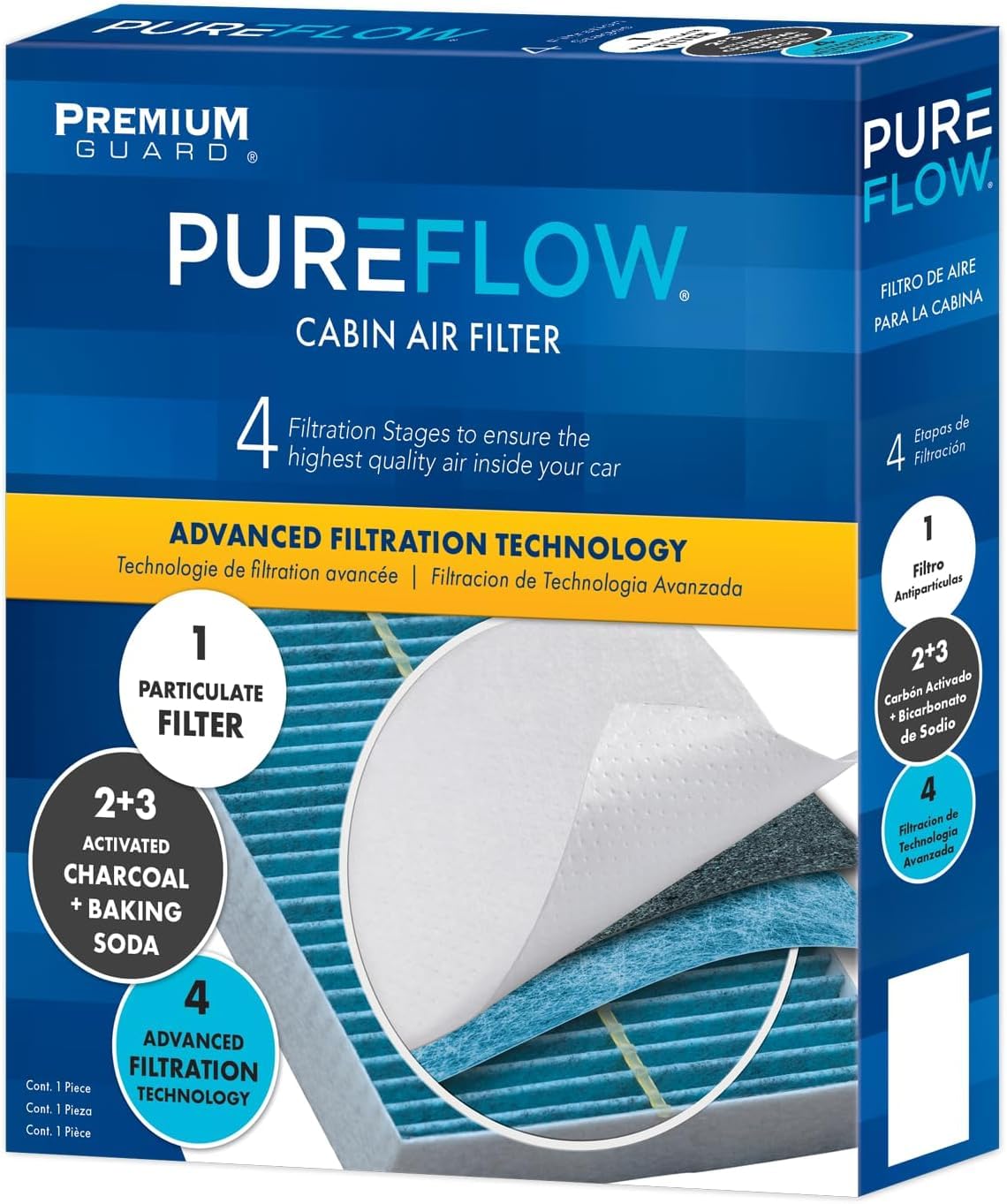
The PureFlow PC99594X is engineered specifically for late-model Hyundai and Kia vehicles including the Tucson, Elantra, Santa Fe, Sportage, and Sorento. Its four-layer filtration architecture combines particulate media for dust and pollen, an activated charcoal bed for gas absorption, and a baking-soda-infused layer that actively neutralizes persistent odors from pet dander or spilled food.
Premium Guard designed this filter as a direct replacement for OEM part numbers 97133-L1000 and 97133N9000, and owners of 2024 Hyundai Elantra and 2025 Tucson Hybrid confirm it fits perfectly without trimming. The carbon layer density does introduce a modest airflow reduction—roughly 20 percent at high fan speed—but most users find the trade-off worthwhile for the crisp, odor-free cabin air.
Installation requires removing the glove box and sliding the filter into the housing with the airflow arrow pointing toward the blower motor. For Ioniq 5 and Kia EV6 owners, verify fitment through the vehicle filter lookup tool, as these electric models share the same housing design as their ICE counterparts.
Why it’s great
- Four-layer media with activated charcoal and baking soda
- Direct OEM replacement for late-model Hyundai and Kia
- Excellent odor neutralization for urban driving
Good to know
- Reduces airflow by roughly 20% on high setting
- Not tested for HEPA 0.3-micron efficiency
4. PureFlow PC99238X Cabin Air Filter
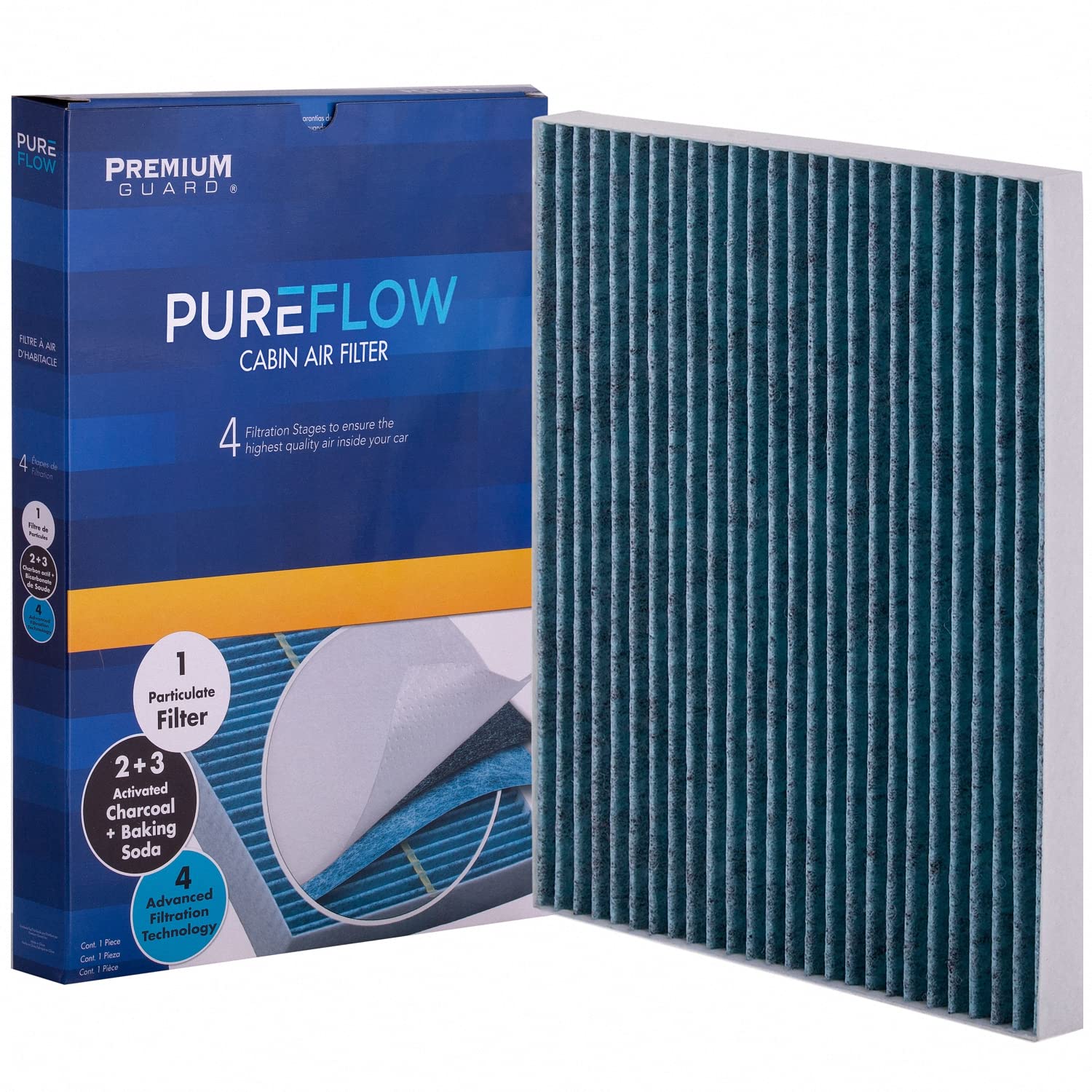
The PureFlow PC99238X targets Chrysler Pacifica, Voyager, and Grand Caravan owners who need odor control for family-hauling duty. Like its sibling, this filter uses a four-layer design with activated charcoal and baking soda to combat the unique smells of spilled milk, wet sports gear, and fast-food leftovers that accumulate in minivan cabins.
Compatibility spans 2017 through 2025 Pacifica models including the Hybrid variant, plus 2021-2025 Grand Caravan and 2020-2025 Voyager. The filter replaces Chrysler part 68308950AB and fits snugly—some owners note that the Pacifica’s narrow housing requires careful manipulation to seat the filter without bending the corner media. Once installed, users report a noticeable reduction in exterior exhaust odors filtering through the HVAC system.
One limitation: the filter does not completely eliminate the musty AC smell that develops in humid climates when the evaporator coil accumulates moisture. For that issue, pair this filter with a foam-based evaporator cleaner. The PureFlow PC99238X is slightly thinner than some competitors at 0.79 inches, but the dense charcoal media compensates with effective gas-phase filtration.
Why it’s great
- Four-layer filtration with baking-soda odor control
- Exact fit for Chrysler Pacifica and Grand Caravan
- Reduces exterior diesel and exhaust smells
Good to know
- Snug fit requires careful installation in Pacifica
- Does not eliminate musty AC evaporator smell
5. ACDelco Gold CF1184C Cabin Air Filter
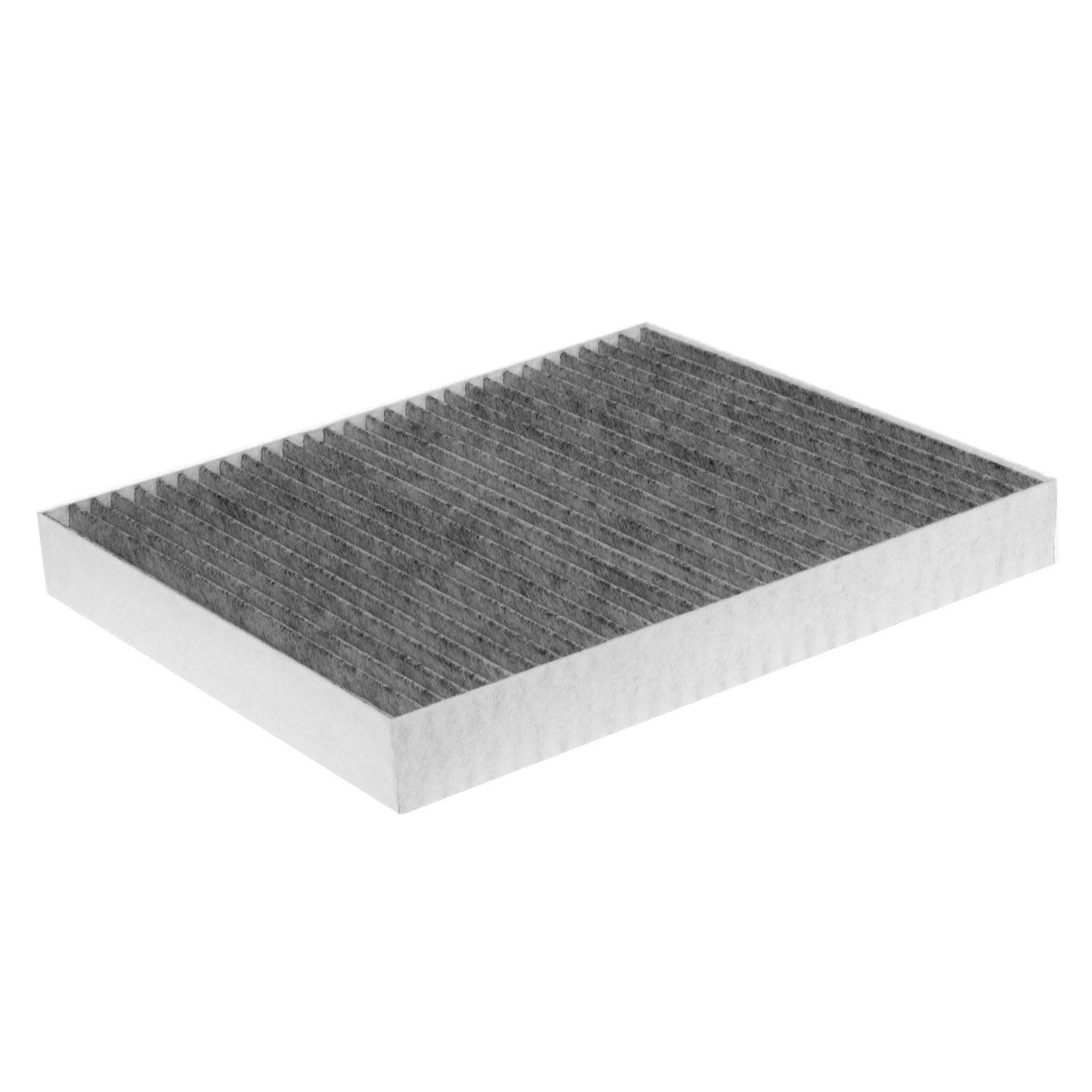
ACDelco Gold CF1184C is the go-to choice for Chevrolet Silverado, Impala, and other GM full-size trucks and sedans where OEM-grade reliability matters. The filter uses carbon-fiber-infused media to reduce odors while maintaining unrestricted airflow—a critical factor for truck owners who run their HVAC blower at max speed during summer towing or winter defrosting.
This filter is a direct replacement for the factory-installed unit in 2015-2021 Silverado and 2014-2019 Impala models, and it installs in minutes behind the glove box with no trimming required. The carbon fiber material is noticeably lighter than the OE carbon filter in some Chevy applications, but users report zero airflow restriction and identical dust-trapping performance.
The trade-off is that this filter is not HEPA-rated and lacks the electrostatic charge needed to capture sub-0.3-micron particles. For highway commuters in rural areas, that’s rarely an issue. But if you drive behind diesel trucks or through construction zones, consider pairing it with a higher-efficiency option. Replace every 12,000 miles to keep cabin air fresh.
Why it’s great
- Carbon-fiber media for odor control without airflow restriction
- OE-grade fit for GM trucks and sedans
- Much cheaper than dealership replacement
Good to know
- Not HEPA-rated for sub-micron particles
- Slightly less robust than some OEM carbon filters
6. RICHWEI CF10285 Cabin Air Filter

The RICHWEI CF10285 delivers activated carbon HEPA performance at a price that undercuts most dealership alternatives by a wide margin. This filter covers an astonishingly broad range of Toyota, Lexus, Scion, Subaru, and even Land Rover and Jaguar models, making it a one-cartridge solution for households with multiple vehicles from the Toyota family.
The pleated media is infused with activated charcoal beads that provide a noticeable reduction in outside odors—users driving 2013 RAV4 and 2011 Avalon Limited report instantly cleaner-smelling cabin air after installation. The filter replaces over 25 OEM part numbers including 87139-02020 and 87139-YZZ08, though the dense carbon layer does cause an estimated 25 percent airflow reduction at the highest fan setting, a common trade-off in this price bracket.
Owners of 2024 4Runner and 2018 Highlander confirm the fit is precise, and the pleats are stiff enough to resist sagging over 15,000 miles of use. If you prioritize raw airflow over absolute filtration density, this may not be the optimal choice. But for drivers who want carbon-adsorbed air without spending dealer-level money, it is a standout option.
Why it’s great
- Activated carbon beads for odor absorption
- Widest vehicle compatibility in this range
- Excellent value compared to dealer-priced filters
Good to know
- Reduces high-speed airflow by about 25%
- Not certified HEPA to ISO 29463 standard
7. ECOGARD XC25863 Cabin Air Filter

The ECOGARD XC25863 is the entry-level option for drivers of Subaru BRZ, Toyota 86, Scion FR-S, and Honda Fit who simply need a fresh filter without breaking their budget. It filters 99.5 percent of airborne solids and impurities from outside air before they reach the cabin—a step below true HEPA but more than adequate for keeping leaves, road dust, and large pollen out of the HVAC system.
With dimensions of 9.4 by 7.7 by 2.3 inches, this filter slides into the housing of 2013-2020 BRZ and 2007-2008 Honda Fit without any modification. Users report that it installs in under five minutes, and several mention using it as a high-frequency replacement filter, swapping it every 15,000 miles or even refreshing by shaking out debris and reusing for another interval—though the manufacturer recommends replacement, not reuse.
The catch is that some users notice a reduction in finer particle filtration compared to denser OEM or HEPA alternatives. More dust and odors may pass through, especially if you drive in heavy traffic or on unpaved roads. For these applications, consider stepping up to a carbon or HEPA-rated filter. But for the price-conscious driver of a sports car or commuter hatch, the ECOGARD delivers reliable basic protection.
Why it’s great
- Captures 99.5% of airborne solids
- Precise fit for BRZ, 86, FR-S, and Fit
- Extremely affordable for frequent replacement
Good to know
- Less effective on sub-micron particles and odors
- Some users report better filtration from OEM alternatives
FAQ
How often should I replace my automotive AC filter?
Does a thicker automotive AC filter provide better filtration?
Can I clean and reuse my cabin air filter instead of replacing it?
Final Thoughts: The Verdict
For most users, the best automotive ac filter winner is the BOSCH 6055C HEPA because its certified 99.97% filtration at 0.3 microns delivers true HEPA protection across the widest range of Toyota, Lexus, and Subaru vehicles without adding chemical odorants. If you need activated carbon odor neutralization for a Hyundai or Kia, grab the PureFlow PC99594X. And for Volkswagen and Audi owners who want MERV 16 efficiency, nothing beats the BOSCH 6031C HEPA.