
There’s nothing more frustrating than finishing an AC recharge, buttoning up the bay, and finding a puddle of refrigerant on the ground the next morning. The weakest link in any automotive AC system is often the fittings themselves—the tiny connectors between your hoses and compressor or condenser that decide whether your system holds pressure or bleeds out. Picking the right set means the difference between a summer of cold air and a recurring headache of lost refrigerant and wasted time.
I’m Min — the co-founder and writer behind Gadgets Feed. I’ve spent countless hours cross-referencing thread types, O-ring materials, and beadlock designs to separate the fittings that actually seal from the ones destined to leak.
Automotive AC fittings come in specific sizes (like #6, #8, and #10), thread pitches (UNF and metric), and angles (straight, 45°, 90°) that must match your vehicle’s ports. This guide breaks down seven of the top contenders to help you find the best automotive AC fittings for your next repair job.
How To Choose The Best Automotive AC Fittings
Automotive AC fittings must handle high-pressure refrigerant, constant vibration, and extreme under-hood temperatures. Choosing the wrong type—whether it’s the wrong thread pitch, the wrong angle, or the wrong sealing mechanism—will guarantee a leak. Focus on these three factors to get it right the first time.
Thread Size and Pitch: Match Your Port
The single most common mistake is grabbing a fitting with the correct nominal size (#6, #8, #10) but the wrong thread pitch. Standard automotive AC threads are UNF (Unified Fine) for aftermarket setups—5/8-18UNF for #6, 3/4-16UNF for #8, and 7/8-14UNF for #10. Many OEM systems, particularly GM and Chrysler, use M12 x 1.5 metric threads on their service ports. Verify your compressor or condenser port before ordering, and always check whether the fitting uses a beadlock jacket or a simple O-ring seal.
Angle and Routing: Clearance Is King
A straight fitting works fine when you have plenty of space and the hose runs directly away from the port. But in tight engine compartments—where the compressor sits inches from the frame rail or the condenser port faces a radiator—a 45° or 90° fitting can save you from kinking the hose and choking refrigerant flow. Kits that include multiple angles per size give you the flexibility to reroute without buying additional pieces.
Sealing Mechanism: Beadlock vs. O-Ring vs. Schrader
Beadlock fittings use a crimped metal jacket that mechanically clamps the hose barb, creating a permanent seal ideal for custom hose assemblies. O-ring fittings rely on a replaceable rubber seal that can be swapped during service. For service ports (like the high-side port on a GM truck), a Schrader valve fitting with a replaceable core lets you fix a leak without replacing the whole port. Professional-grade couplers, like the Robinair manual set, use a 6-ball design that grips the service port more securely than cheaper 4-ball versions.
Quick Comparison
On smaller screens, swipe sideways to see the full table.
| Model | Category | Best For | Key Spec | Amazon |
|---|---|---|---|---|
| Robinair 18192 | Premium Coupler Set | Professional AC service | 6-ball coupler, chrome-plated brass | Amazon |
| Sherco-Auto M12 x 1.5 High Side Port (10-Pack) | Premium Service Port | Replacing leaking ball-valve ports | M12 x 1.5 thread, replaceable Schrader core | Amazon |
| Lichamp R1234YF/R134A Adapter Kit | Mid-Range Adapter Kit | Cross-refrigerant service (R134a to R1234yf) | Copper+aluminum+steel, snap-lock couplers | Amazon |
| Orion Motor Tech 8-Piece Adapter Kit | Mid-Range Tool Kit | DIY charging with R134a can tap | Aluminum+brass, includes R410A adapters | Amazon |
| Wisepick #6 Straight/45/90 Set | Mid-Range Angle Set | Custom #6 hose routing | 5/8-18UNF, 3-angle, beadlock + O-ring | Amazon |
| Wisepick 6-Piece Set (6/8/10) | Budget Multi-Size Set | Building multiple hose sizes | 90°, #6/#8/#10, beadlock, zinc-plated steel | Amazon |
| TANYA HARDWARE 28-Piece Brass Coupler Kit | Budget Brass Kit | Air tool connections (not AC) | 1/4″ NPT, solid brass, 28 pieces | Amazon |
In‑Depth Reviews
1. Robinair 18192 R-134A Manual Replacement Coupler Set

Robinair’s 18192 set is the gold standard for R-134a service couplers. These couplers use a 6-ball design—two more contact points than the typical 4-ball coupler—which means they grip the service port more evenly and resist wobble that can cause micro-leaks. The chrome-plated brass body is machined precisely, so the coupler seats smoothly without forcing.
What really sets these apart is the manual twist knob that opens the Schrader valve after the coupler is fully seated. This prevents the sudden blast of refrigerant you get with cheaper automatic couplers, and it protects against the coupler kicking off under pressure—no frostbite risk. The compact body fits into tight engine bays where other couplers won’t clear the firewall or fender liner.
The set includes both high-side and low-side couplers. They require separate 14mm to 1/4″ SAE adapters for most Asian vehicles, but once connected, the seal is leak-free. One user reported a missing seal in the package; Robinair replaced it without hassle. If you service AC systems regularly, this set is built to last a shop lifetime.
Why it’s great
- 6-ball design grips ports more securely than 4-ball alternatives
- Manual knob prevents refrigerant loss and frostbite
- Chrome-plated brass resists corrosion and wear
Good to know
- Requires separate 14mm to 1/4″ SAE adapters for Honda/Asian ports
- Premium investment compared to budget coupler sets
2. Sherco-Auto OE Style M12 x 1.5 High Side Port Adapter (10-Pack)
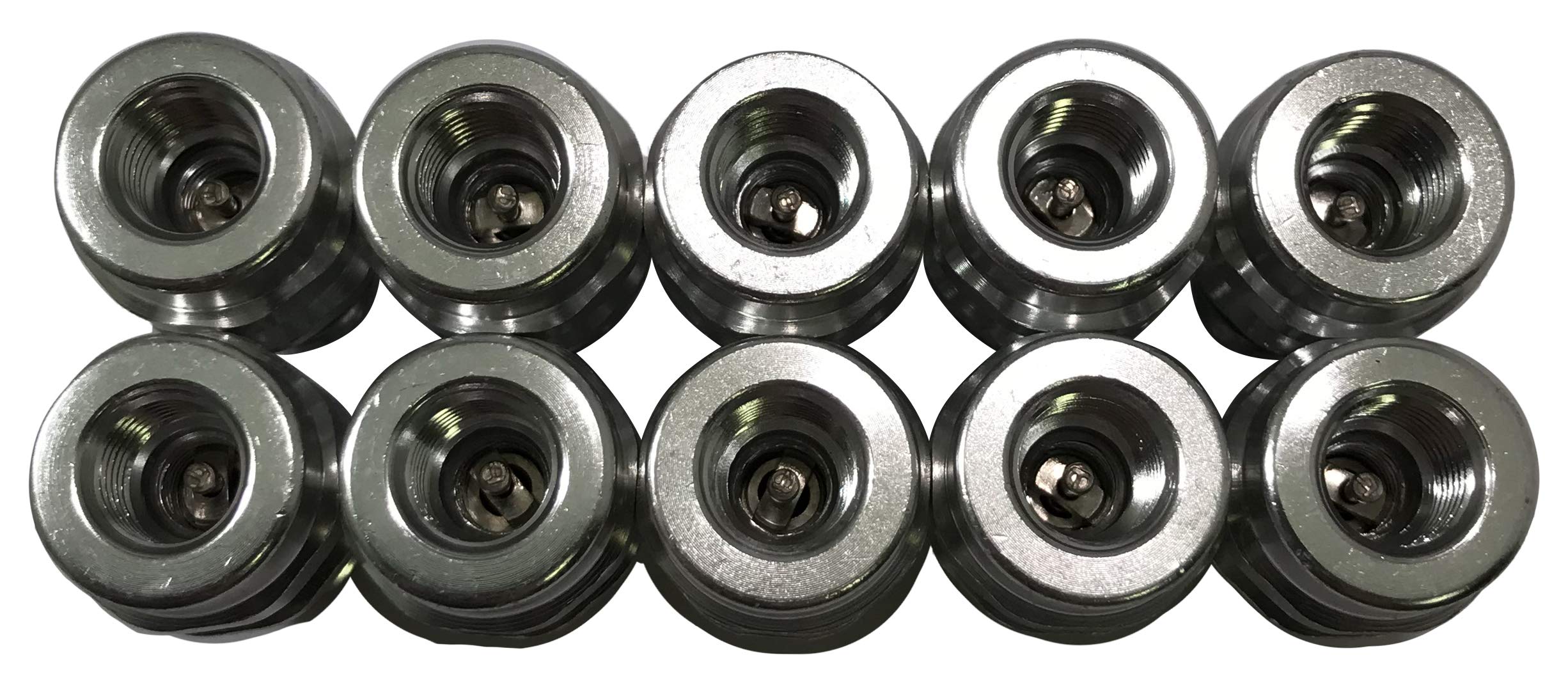
The factory ball-valve style high-side ports on many GM, Ford, and Chrysler vehicles are notorious for leaking after a few service cycles. Sherco-Auto’s solution is a direct M12 x 1.5 threaded replacement that screws into the same port and uses a standard replaceable Schrader valve core. Once installed, it stays put—no more chasing a leak every season.
The adapter is made from machined aluminum with a corrosion-resistant finish. The Schrader core can be swapped with a simple valve core tool, so if the seal wears out, you don’t have to buy a new adapter. Users have reported fitting these on 2004 Buick Rainiers, 1998 Dodge Rams, and F-250 Super Duties with zero clearance issues and no leaks after multiple gauge connections.
The 10-pack is designed for professional shops or fleet maintenance—you get enough to convert multiple vehicles at once. The threads are clean and sharp, and the O-ring pre-installed on the base seals against the port without needing thread sealant. If your high-side port is weeping, this is a permanent, one-and-done fix.
Why it’s great
- Direct replacement for leaking GM/Ford/Chrysler ball-valve ports
- Replaceable Schrader core for long-term serviceability
- Corrosion-resistant aluminum with clean M12 x 1.5 threads
Good to know
- Requires a 3/8″ deep socket or specialized adapter for installation
- Designed only for high-side M12 x 1.5 ports, not low-side
3. Lichamp Car A/C R1234YF R134A Adapters

The Lichamp kit bridges the gap between older R-134a equipment and newer R-1234yf systems. It includes a pair of 1/4″ male quick couplers that convert your manifold gauges to work on R-1234yf service ports, plus a dual-head valve core remover. The couplers are made from copper, aluminum, and steel—a mixed-material construction that keeps weight down while resisting refrigerant corrosion.
The snap-lock mechanism requires a firm push into the port and can be a bit stiff on first use—one reviewer had to tap the coupler on with a mallet. Once seated, the rubber O-rings create a tight seal with no detectable leakage. The knurled grip ring gives you good purchase even with greasy gloves. For dye injection work, this kit lets you use your existing R-134a dye injector on a 1234yf system, saving you from buying separate tooling.
Note that some users found the low-side adapter fit slightly loose on specific Honda models, causing a hiss if the hose shifted. This may be a unit variance, but it’s worth checking the fit on your particular vehicle before relying on it for a full evacuation.
Why it’s great
- Allows R-134a tools to service R-1234yf systems
- Snap-lock couplers with precise fine-thread sealing
- Includes dual-head valve core remover
Good to know
- Low-side coupler may fit loose on certain Honda 1234yf ports
- Initial seating can require a firm mallet tap
4. Orion Motor Tech 8-Piece AC Adapter Tool Kit

This kit is built for the DIY mechanic who wants one box that covers manifold gauge hookup, can tapping, and HVAC adapter work. It includes high and low-pressure R-134a quick couplers, an R-134a can tap with a 1/4″ female to 1/2″ male adapter, two R-410a angled adapters, plus a tank adapter and valve core remover. The aluminum and brass construction resists the corrosion that tends to kill cheaper steel fittings.
The can tap is designed for puncture-style R-134a cans—not the newer self-sealing cans. This is a critical distinction: if you use a self-sealing can, the tap’s depressor pin will permanently destroy the can’s built-in valve. For DIY users working with standard puncture cans, the tap threads cleanly and seals without leaking. The quick couplers feature a thimble-style grip that gives you good control for opening and closing the refrigerant flow.
A professional reviewer noted the kit nitrogen-tested his AC system for several days without a single leak. The main compromise is that the components feel slightly lighter than full-pro gear, but for home use and occasional shop work, the value-to-performance ratio is excellent.
Why it’s great
- All-in-one kit: couplers, can tap, R-410a adapters, and core tool
- Aluminum and brass resist corrosion
- Thimble design provides precise control of refrigerant flow
Good to know
- Can tap only works with puncture-style R-134a cans
- Build quality is more DIY-focused than professional-grade
5. Wisepick #6 AC Fitting Set (Straight, 45°, 90°)

If you’re building a custom #6 hose assembly, having the right angle on hand can save you from routing a hose through a torturous path. Wisepick’s set gives you a straight, 45°, and 90° fitting—all with the same 5/8-18UNF thread and #6 hose size. Each fitting uses a beadlock steel jacket that crimps around the hose, combined with an aluminum tube and an O-ring at the thread end for a reliable seal.
The beadlock jacket features a sight hole that lets you visually confirm the hose is fully seated before you crimp—a detail that DIY builders appreciate. The zinc-plated finish on the steel parts resists surface rust, though the aluminum tube can show minor oxidation over time if exposed to moisture. All three fittings threaded easily onto test compressors without cross-threading, and the O-rings came pre-installed and properly seated.
Note that these fittings do not include replacement O-rings, so you’ll need to buy a separate O-ring assortment for future service. For someone piecing together a single #6 line—say from a Sanden compressor to a condenser—this set gives you the flexibility to route the hose without ordering three separate fittings.
Why it’s great
- Three angles in one set covers most #6 routing needs
- Beadlock jacket with sight hole for correct hose insertion
- Clean 5/8-18UNF threads with pre-installed O-rings
Good to know
- No spare O-rings included
- Aluminum tube may show oxidation if stored in damp environment
6. Wisepick 6-Piece AC Fitting Set (6/8/10)
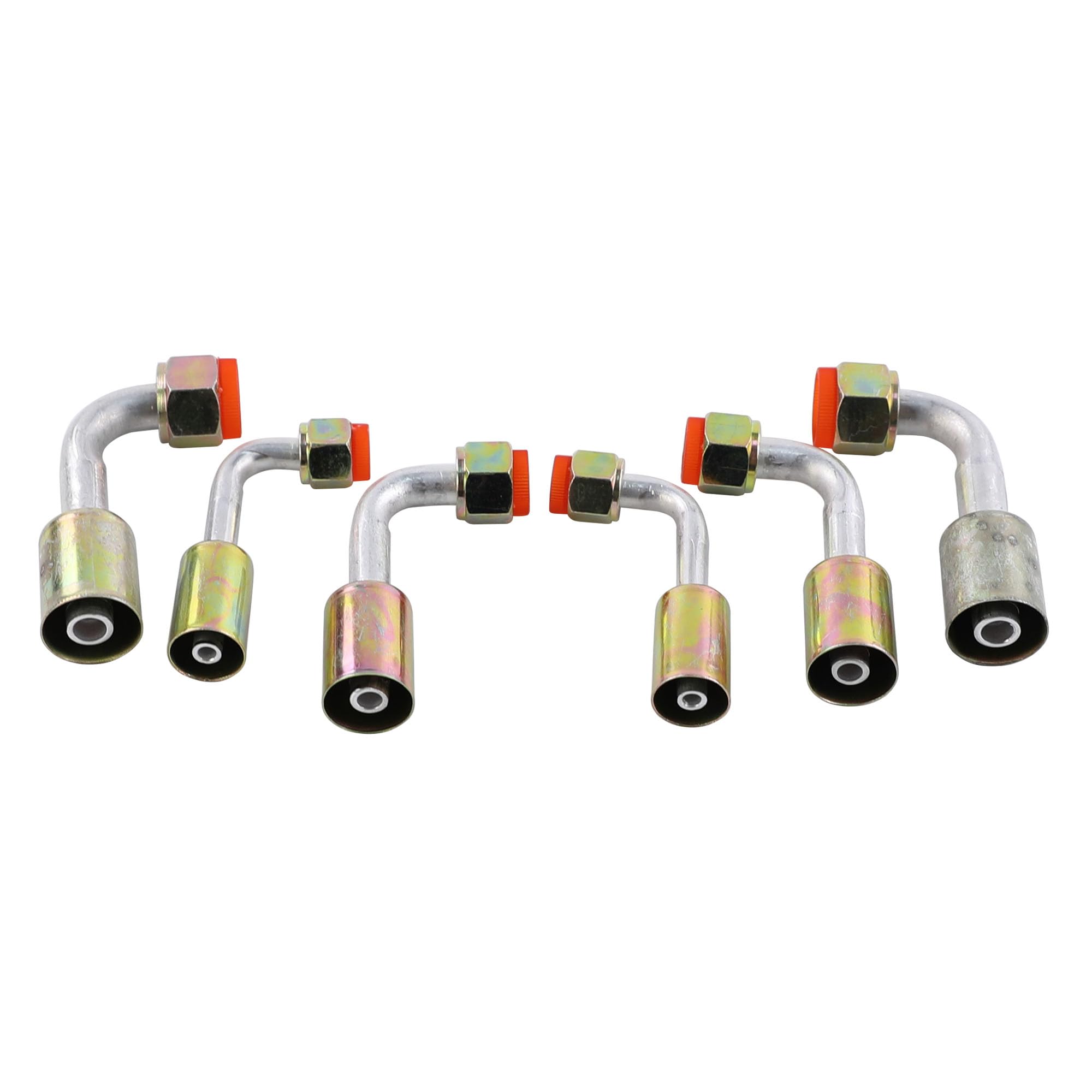
This is the Wisepick set that covers the three most common fitting sizes in one package: two each of #6, #8, and #10 female O-ring beadlock fittings, all at a 90° angle. The inclusion of three sizes makes this an ideal starter set if you’re building multiple hoses or replacing worn fittings across different parts of the same system—say a #6 line from the compressor and a #10 line from the condenser.
Each fitting follows the same construction: aluminum tube for the refrigerant path, iron screw for the threaded connection, and an iron jacket with blue-white zinc plating. The zinc finish helps prevent the steel parts from rusting in the engine bay. The 90° angle works well for tight corners where a straight fitting would force the hose into a sharp bend. Users report the threads match standard UNF sizes cleanly, and the O-rings seal on the first try.
The main trade-off is that all six fittings are 90°—no straight or 45° options. If you need a straight run for a particular port, you’ll have to buy those separately. Also, the iron jacket is heavier than all-aluminum designs, so factor that into hose-routing weight if you’re concerned about vibration fatigue.
Why it’s great
- Covers #6, #8, and #10 sizes in one affordable set
- Beadlock design secures hose without separate hose clamps
- Zinc-plated steel resists under-hood corrosion
Good to know
- All fittings are 90°—no straight or 45° included
- Iron jacket adds weight compared to all-aluminum fittings
7. TANYA HARDWARE 28-Piece Brass Coupler and Plug Kit
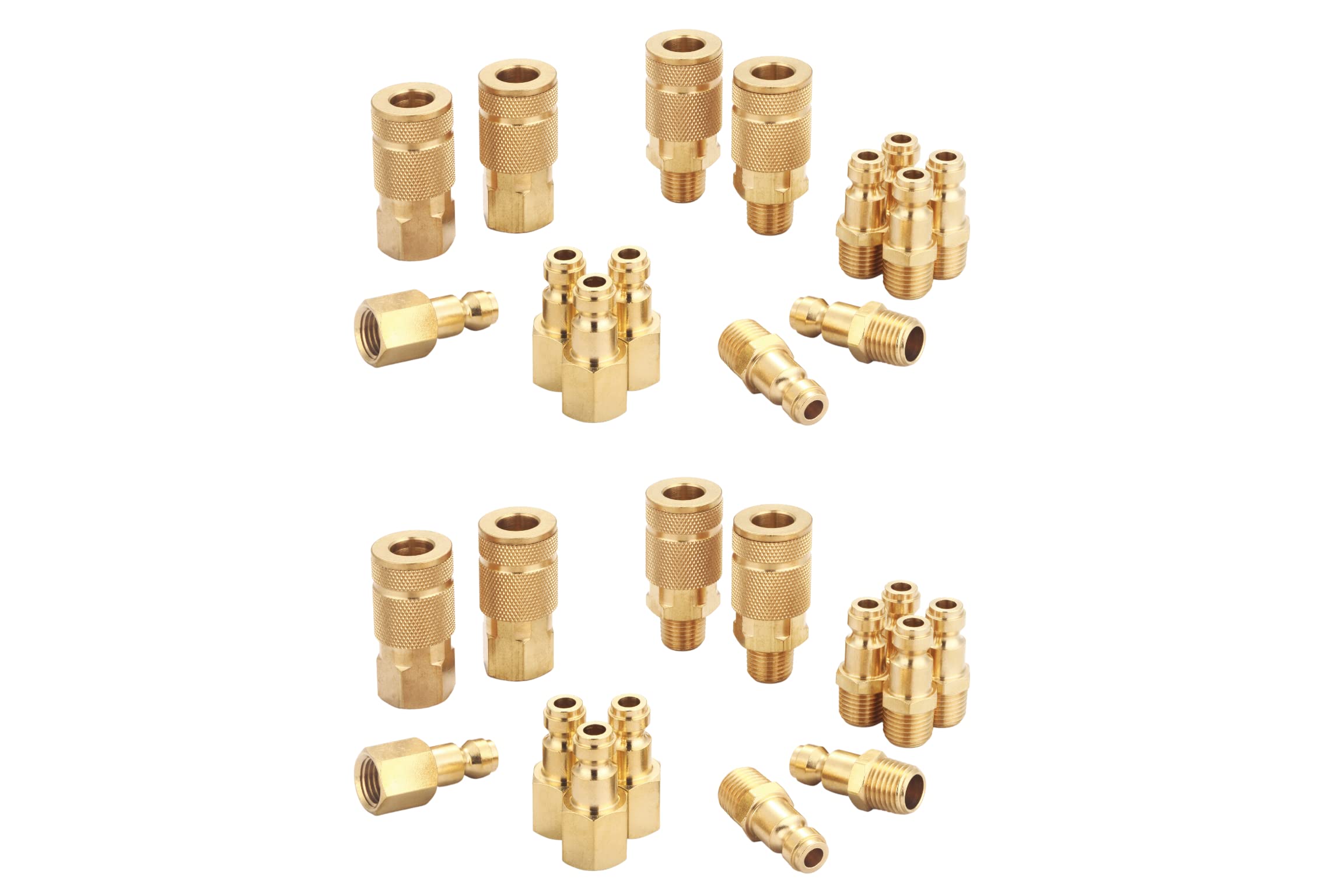
This kit is an outlier for the automotive AC category because it focuses on pneumatic air tool connections rather than refrigerant fittings. However, for a shop technician who needs reliable quick-disconnect couplers for blow guns, impact wrenches, and tire inflators, these Automotive Type C (compatible with Trueflate) brass fittings are a workhorse addition to the toolbox. The 28-piece set gives you 4 female couplers, 4 male couplers, 8 female plugs, and 12 male plugs—enough to equip multiple air hoses and tools.
The solid brass construction is significantly more durable than aluminum—it won’t deform if you drop a tool on it, and it resists the galling that aluminum couplers sometimes suffer. The 1/4″ NPT threads are standard across most air tool systems in the US. The chuck provides excellent sealing: one reviewer noted zero leaks when connected, and the coupler accepts plugs smoothly without binding.
These are not designed for AC refrigerant service—do not use 1/4″ NPT brass fittings on R-134a or R-1234yf lines intended for 1/4″ SAE flare or metric threads. But if you run a shop where you’re switching between AC work and air tool work, having a brass coupler set like this prevents the frustration of cheap steel fittings that seize up or leak after a few months.
Why it’s great
- Solid brass construction lasts longer than aluminum or steel
- 28-piece set equips multiple hoses and tools at once
- Compatible with Trueflate and Automotive Type C systems
Good to know
- Not suitable for AC refrigerant service—pneumatic use only
- 1/4″ NPT threads require adapters for metric or SAE flare ports
FAQ
What is the difference between #6, #8, and #10 AC fittings?
Can I use 1/4″ NPT brass fittings for automotive AC refrigerant lines?
How do I know if my AC fitting needs a 45° or 90° angle?
Are Robinair 18192 couplers compatible with all R-134a vehicles?
Final Thoughts: The Verdict
For most users, the best automotive ac fittings winner is the Robinair 18192 because its 6-ball coupler design and manual shutoff valve provide professional-grade reliability and leak-free sealing. If you need a permanent fix for a leaking factory high-side port, grab the Sherco-Auto M12 x 1.5 adapter. And for a versatile multi-size set that covers common hose builds on a budget, the Wisepick 6-Piece Set is the right call.