
Our readers keep the lights on and my morning glass full of iced black tea. As an Amazon Associate, I earn from qualifying purchases.
Specs are compiled from manufacturer listings and verified buyer reviews and can change over time — please confirm the key details on the product page before buying.
A dead A/C in summer usually isn’t a dead compressor — it’s a pinhole leak you can’t see. Soap bubbles miss micro leaks, UV dye takes hours, and a sniffer will false-alarm on your car’s carpet. The right detector pinpoints the leak in minutes, so this guide matches you to the model that finds your car’s specific leak.
I’m Min — the founder and writer behind Gadgets Feed. This guide is built by comparing the manufacturers’ published specifications and the patterns across verified customer reviews, so you get each pick’s real strengths and trade-offs instead of marketing spin.
Whether you DIY once a season or trace leaks daily as a tech, sensitivity, refrigerant coverage, and battery life decide which Electronics Gadget Feed’s automotive air conditioning leak detector recommendation will save you hours under the dash.
Our Picks at a Glance


How To Choose The Best Automotive Air Conditioning Leak Detector
Choosing a detector starts with the leak size you’re chasing. A slow seep in an evaporator core needs a detector rated in fractions of an ounce per year, while a hissing compressor seal is easy enough for any unit. Match the detector’s sensitivity rating to the leak size you’re chasing.
Sensitivity: The Number That Matters Most
Sensitivity is stated as an annual leak rate, like 0.03 or 0.25 oz/yr. Lower oz/yr ratings detect smaller leaks. If you’re chasing an ultra-slow leak that bubbles can’t reveal, you need a detector in the 0.03–0.14 oz/yr range. Cheaper units rated higher will simply walk right past the pinhole you’re after.
Refrigerant Coverage: R134a vs. R1234yf
Older cars run R134a, newer ones run R1234yf, and the newest use A2L refrigerants like R32 and R454B. Confirm your detector names the exact refrigerant in your car. A unit that covers CFCs, HCFCs, HFCs, and HFOs handles both older and current systems without needing a second tool.
Probe Length and Battery Life
You cannot reach the evaporator core or the back of a compressor with a stubby probe. Look for a flexible probe around 14 to 17 inches to snake into tight engine bays. Battery life matters: an 18-hour rechargeable unit lasts multiple workdays, while a 3-hour sniffer dies mid-job.
Quick Comparison
| Model | Best For | Max Sensitivity | Probe Length | Battery Life | Amazon |
|---|---|---|---|---|---|
| Fieldpiece DR58★ Best Overall | Pro micro-leak hunting | <0.03 oz/yr | 17-inch | 18 hours | Amazon |
| Lichamp KitBest Value | Budget sniffer + UV combo | 0.21 oz/yr | 7.9-inch | 20 hrs (UV) | Amazon |
| Simbow 3-in-1Dual-Mode Pick | Fast ppm & %LEL reads | — | Metal flex probe | 20 hours | Amazon |
| Elitech CPU-1G | Budget halogen sniffer | 0.11 oz/yr | 14-inch | 2 C batteries | Amazon |
| Sensor Technology SFD201 | Freon plus combustible gas | — | — | Rechargeable USB-C | Amazon |
| Aprvtio ALD-200 | Pro-grade with TFT display | 0.14 oz/yr | 16-inch | Full day | Amazon |
| Elitech ILD-200 | 10-yr infrared sensor | 0.14 oz/yr | 12-inch body | — | Amazon |
| Inficon TEK-Mate | No-false-alarm reliability | 0.25 oz/yr | — | 8 hours (2 D) | Amazon |
| Fieldpiece SRL8 | Auto-zero pro sniffer | — | Long reach tube | 15 hours | Amazon |
In‑Depth Reviews
1. Fieldpiece DR58 Heated Diode Refrigerant Leak Detector
Our pick — over 4.5★ from 200+ verified ratings; the strongest balance of quality and price.
A pro-grade sniffer that catches leaks other detectors miss.
This detector finds the leak that has already beaten other tools. It’s rated to find leaks under 0.03 oz/yr, which is roughly 20x more sensitive than the bubble method — the difference between replacing a compressor and finding the dime-sized pinhole in a line. It sniffs every HFC, CFC, HCFC, HFO, H2N2 tracer gas, and their blends, and it’s A2L compatible for newer systems.
The 17-inch flexible probe reaches the back of an evaporator case or a buried compressor port that shorter wands can’t touch. Fieldpiece’s numbers on the probe length put it at over twice the reach of the Lichamp kit’s 7.9-inch sniffer — a 2.2x gap that matters when the leak is buried deep in the dash. The backlit LCD shows leak intensity, the tip LED and beep pinpoint the spot, and the 18-hour USB-rechargeable battery survives full workdays.
Buyers report: “Excellent product, this was the only thing that could find an ultra slow leak that not even the accutrak supersonic listener could detect, half the price too.” Techs running R-410A systems found near-perfect accuracy on indoor coil fins. The fair warning is the sensor’s 300-hour life and IP54 rating against moisture and oil mean you treat the tip with care, and owners note a low-level false positive when strong odors like dryer sheets are present.
Pro-grade pick: you’re a technician or serious DIYer chasing slow leaks that cheaper sniffers can’t lock onto.
Budget buyers: you only need to confirm an obvious hiss once a year — this much sensitivity costs more than that job needs.
2. Lichamp AC Freon Leak Detector Kit
A sniffer, UV flashlight, and glasses kit that equips the home mechanic affordably.
This kit attacks the leak two ways: an electronic sniffer plus a 385–395 nm UV flashlight with 100 LEDs to spot dye already in the system. Owners mention: “Sniffer & UV light found truck A/C leak instantly at suspected high-pressure port; no false positives.” That’s the outcome you want — confirmation at the exact fitting, not a wild beep.
The sniffer triggers on R410A, R134A, R1234YF, R502, and all chlorinated refrigerants including HFCs, CFCs, and HCFCs. Warm-up is 6 seconds with response in 3 seconds, and there are 7 sensitivity levels with a top sensitivity of 0.21 oz/yr. That max rating is the honest catch: it will find a decent leak, but it is nowhere near the Fieldpiece’s reach into micro-leak territory.
One owner found the sniffer gave false alarms from slight shaking and missed a visible leak, while praising the UV light for finding a condenser leak. For dyed-system tracing, the kit shines; as a pure sniffer, the other value pick above is more consistent. The batteries (4 AAA for the sniffer, 6 AA for the light) are not included, so budget for those.
Complete kit value
- UV flashlight sees dye even in daylight without glasses
- 3-second sniffer response and 6-second warm-up
- Non-slip aluminum UV light with lanyard, rated IP44
Basic sensitivity
- 0.21 oz/yr top sensitivity misses the slowest leaks
- Sniffer can false-alarm from physical shaking
Starter choice: you want one budget kit that sniffs and traces dye across R134a and R1234yf systems.
Pro jobs: you’re chasing a leak so slow that bubbles already failed you — step up in sensitivity.
3. Simbow 3-in-1 Refrigerant Leak Detector
Fast dual-mode readings that sniff Freon and dangerous gas levels alike.
This unit answers a question most sniffers ignore: not just “is there a leak” but “how big is this leak.” It measures in ppm (parts per million, for tiny traces) and %LEL (percent of the lower explosive limit, for combustible danger), all on a clear digital display. Response is as fast as 2 seconds — a 50% quicker reaction than the Lichamp kit’s 3 seconds — so you trace the source without hovering.
The compatibility list is huge: R134a, R410A, R404A, and A2L refrigerants like R454B, R32, R1234yf, R290, and R600A, plus the full traditional CFC/HCFC/HFC/HFO families. That makes it a single tool for the family fleet mixing old R134a cars with newer R1234yf ones. The all-metal flexible probe reaches tight spots, and auto calibration at startup keeps false alarms low.
Customers note: “The 1800mAh battery legit goes 20 hours.” Owners ran it two full workdays without charging, and the mute button keeps it quiet for residential work. The minor noted flaw is cosmetic — the display film can peel slightly at the edges — but owners agree it doesn’t affect function. If your work mixes automotive A/C with checking gas appliances, this dual-mode reach is the differentiator.
Versatile option: you want ppm and %LEL measurements plus A2L refrigerant coverage in one rechargeable tool.
Long sessions: you need maximum micro-leak sensitivity — this one prioritizes breadth and speed over the lowest oz/yr rating.
4. Elitech CPU-1G HVAC Leak Detector

A traditional corona sensor that finds the leak without the premium price tag.
This is the budget pick for the weekend mechanic who still wants real diagnostic muscle. It’s rated to 0.11 oz/yr maximum sensitivity with 7 adjustable levels, so you can dial it down to trace a strong leak to its exact source without constant triggering. It warms up in 6 seconds and responds in 3 seconds, and it triggers on R11, R22, R134A, R404a, R410A, and all halogenated refrigerants — including HFCs, CFCs, HCFCs and blends.
The flexible stainless steel probe extends to 14 inches, which reaches valve cores and compressor seals on most cars. Two C alkaline batteries are included, and the modular sensor design means you can swap a sensor tip instead of the whole unit. That serviceable approach is why technicians describe it as well-made and worth its price, with some noting it performs like costlier models.
The honest trade-offs show up in the field: owners find it effective on valves and service ports, but the beep runs loud, and build quality reads mixed — some call it rugged while others say it feels cheaply built. One experienced tech found leaks even through walls and praised the instant on/off with no tare wait, but warned that very slow leaks may need dye and UV backup. If the leak is obvious and pressurized, this sniffs it fast; if it’s glacial, plan a second method.
Everyday carry: the home mechanic who wants 0.11 oz/yr sensitivity and a long probe without paying pro prices.
Large systems: the audible alarm is loud, and genuine micro-leak hunts are better served by a heated diode unit.
5. SENSYX SFD201 Refrigerant and Combustible Gas Leak Detector
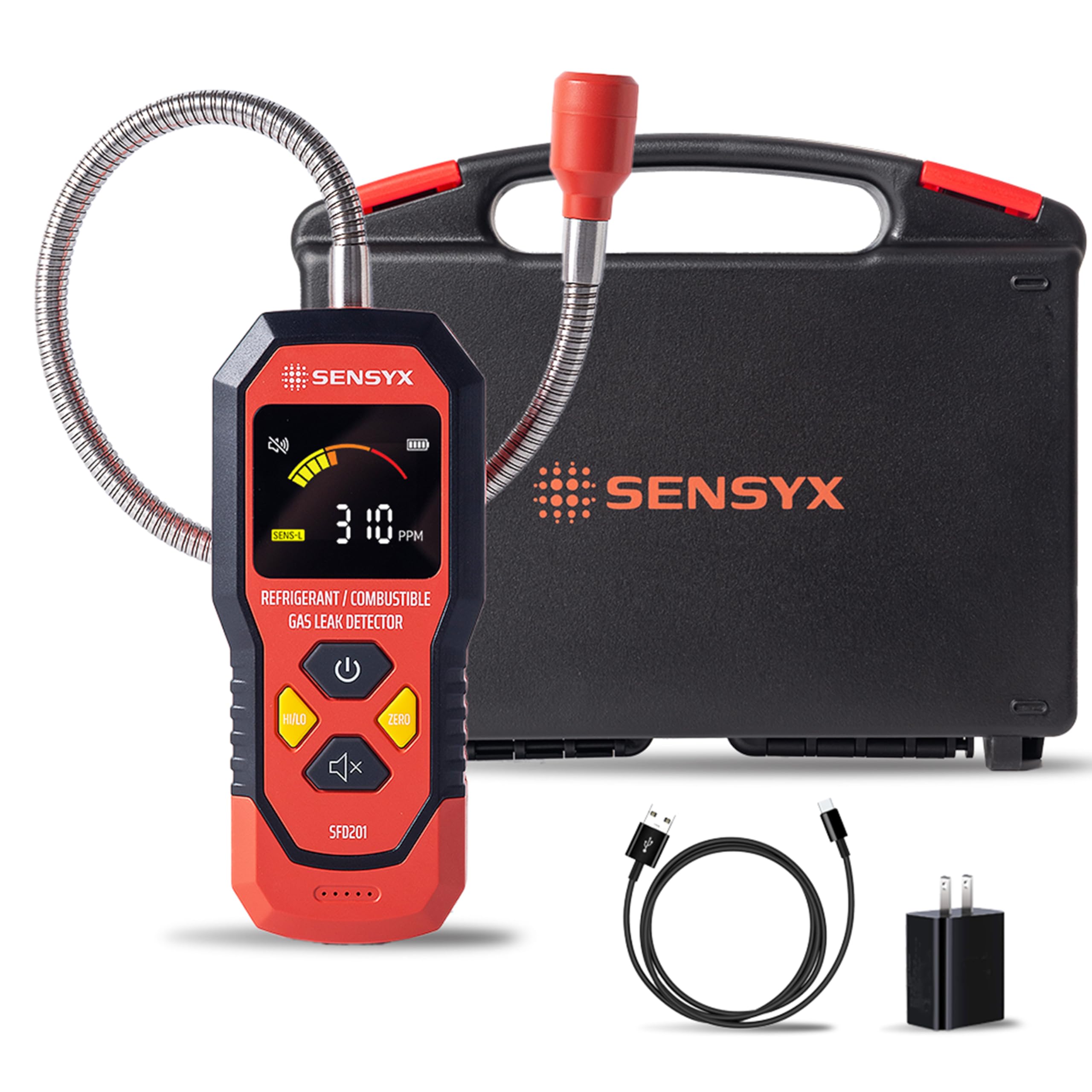
One sniffer that catches Freon and propane, so the garage stays safe both ways.
This 2-in-1 model, the SFD201, does double duty: it sniffs halogen refrigerants for your A/C work, and it also detects combustible hydrocarbons like R290 propane, R600a isobutane, and methane. The Japan-made heat dioxide semiconductor sensor drives adjustable High/Low sensitivity, and a large color LCD shows the leak level clearly so you can work in silence.
For automotive use, the refrigerant list covers the essentials — R134a, R1234yf, R410a, R404a, R407c, R22, and R32 among the HFCs and HFOs. Owners consistently report it finding leaks in minutes that the bubble method failed to reveal for weeks, with one pinpointing a leaking O-ring in an A/C condenser. There’s a reason the maker lists a UL1484 safety standard: this unit is held to a recognized benchmark for gas detection reliability.
The practical notes from owners are worth knowing: power it on in the same area as your target to avoid a false positive from the warm-up, and expect about a 30-second warm-up before it’s ready. A very sensitive unit can be “too sensitive” for small jobs, per one owner, who still appreciated the safety factor. The USB-C rechargeable lithium battery removes the disposable-cell hassle entirely.
Dual threat: your work or home involves both A/C refrigerant and combustible gas checks in one tool.
Single-task use: the extreme sensitivity can trigger in clean air if you don’t let it warm up near the target area.
6. Aprvtio ALD-200 Refrigerant Leak Detector
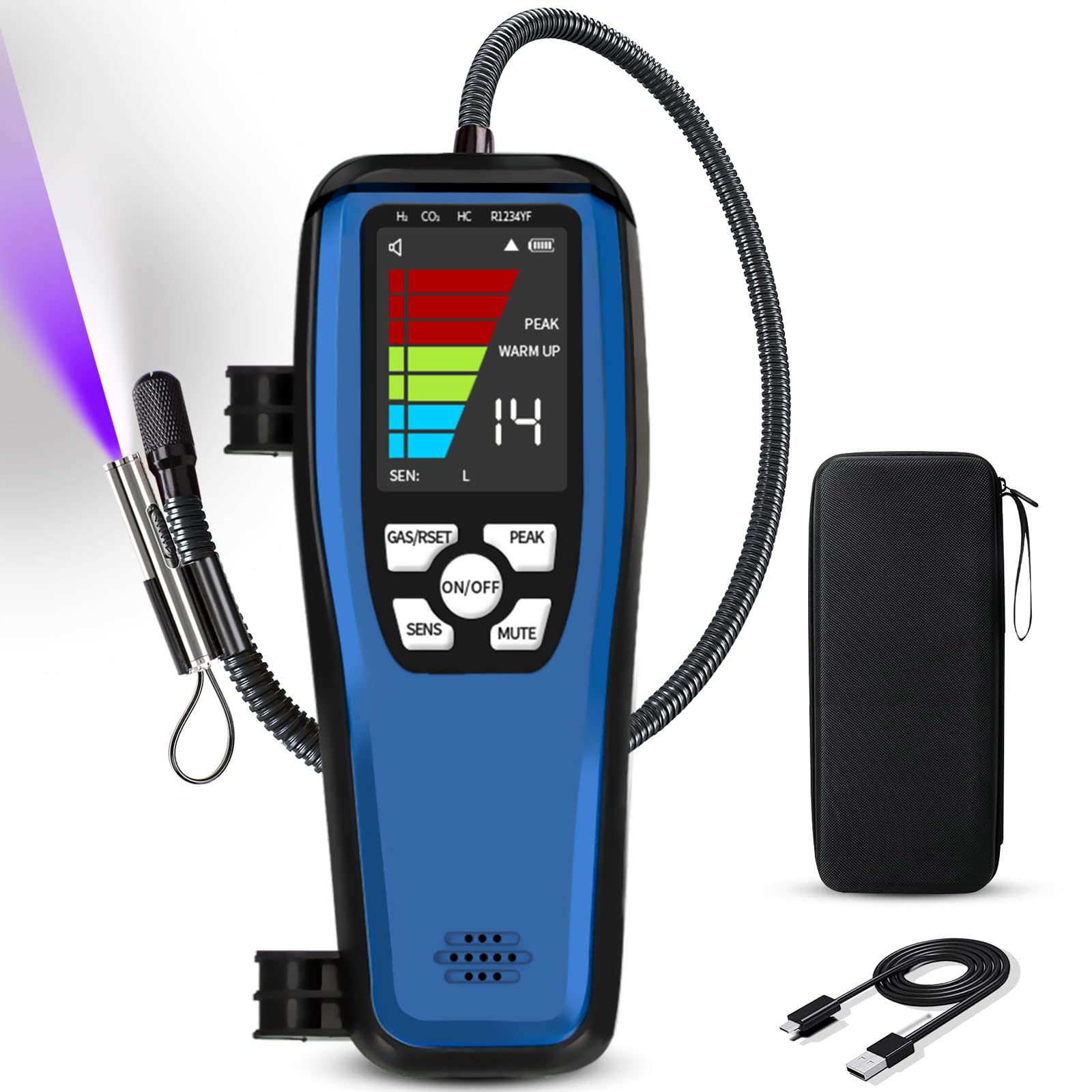
A 2.8-inch color display turns leak hunting into a visual trace, not just a beep.
This is the detector that shows you the leak. The clear 2.8-inch TFT color display reads concentration levels visually, and the beep frequency climbs as you near the source — so you’re not guessing which direction the beep is coming from. Its next-generation heat diode sensor covers A1 (R410A), A2L (R32, R454B), and A3 (R290, R600) refrigerants plus H2/N2 tracer gas, calling it true 3-in-1 detection.
Sensitivity adjusts up to 0.14 oz/yr, which is enough to catch micro leaks that soap bubbles or dye routinely miss. The 16-inch probe is 2 inches longer than the Elitech CPU-1G’s 14-inch wand, giving you that extra reach into tight automotive spaces. Owners found it easy to use right from the start, with the flexible probe reaching tight compressor areas and a carrying case included.
Smart features reduce guesswork: Peak Mode captures the maximum reading so you don’t miss a spike, and a Reset Function recalibrates the sensor to minimize false alarms. Both the housing and display are built for the job — oil-resistant and impact-resistant, with visibility that works in dark basements and bright outdoors. It found a slow basement A/C leak owners never would have noticed, and tracked down a small R410A leak that an older detector missed.
Budget smart: you want a color visual display and adjustable micro-leak sensitivity for both home and car A/C work.
Rough handling: battery life draws mixed owner feedback, so keep the charger handy for long sessions.
7. Elitech ILD-200 Infrared Refrigerant Leak Detector

Infrared tech that resists interference, so the false alarms stay away.
Instead of a heated diode, this uses an infrared sensor — and that swap changes the experience. Infrared brings strong anti-interference ability, faster response, better accuracy, and a longer service life, which Elitech backs with a 10-year sensor life claim. It detects all halogenated refrigerants, including CFCs, HFCs, HCFCs, HCs, HFOs, and blends like R11, R22, R404a, R410a, R600a, and R1234yf.
Sensitivity is adjustable through High/Medium/Low levels with a maximum of 0.14 oz/yr. The 2.8-inch screen includes a peak display that indicates the direction of the leak point, giving you a quiet way to work. It’s a setup that owners put to real use — locating three separate leaks in evaporator coils in a single week, and pinpointing an A/C coil leak in minutes well enough to get the manufacturer to replace the unit.
The feedback is honest about limits: false positive readings happen occasionally, and reviewers point out the screen can scratch easily, so it earns its spot in a case, not loose in a toolbox. One owner sums up the experience collectively — the sensor is overly sensitive and can be damaged if treated roughly, but for most users it’s an effective leak finder that outperforms expectation for the price. The rechargeable 3.7V battery keeps it running through long jobs.
Leak hunting: you want anti-interference infrared accuracy and a 10-year sensor life for steady professional use.
Drop-prone sites: the display scratches easily and the sensor is sensitive, so a case is non-negotiable between jobs.
8. Inficon TEK-Mate Refrigerant Leak Detector

The made-in-America sniffer that refuses to cry wolf over soap or carpet.
This is the detector for people sick of chasing false alarms. Its proven heated diode sensor triggers on all CFCs, HCFCs, HFCs, and HFOs, and it’s A2L certified — but the real story is what it doesn’t do: it won’t false-alarm on soap solutions. Automatic background adjustment, called “zeroing,” constantly recalibrates so you’re not chasing ghost readings around the engine bay.
Sensitivity is rated at 0.25 oz/year (7 g/year), which is a different use case than the micro-leak Fieldpiece above. This is a reliable workhorse for finding standard service-port and seal leaks, not the ultimate ultra-slow pinhole hunter. Owners tracking a tiny R410A leak praised its high sensitivity range, and one found it detected the leak with no false positives while noting that cheap units false-alarm on carpets.
It runs on two D-cell alkaline batteries with an 8-hour average life, and the built-in media includes a heated diode sensor, D-size batteries, filters, and a rugged carrying case. Calibration time varies — sometimes 30 seconds, occasionally over 2 minutes — but the trade-off is a detector owners consistently describe as worth its higher price for reliable, no-nonsense leak checking. A2L certification means it’s ready for the newest refrigerants.
Field favorite: false alarms have burned you before and you want a dependable, USA-made sniffer for standard leaks.
Feature seekers: at 0.25 oz/yr, glacial micro-leaks may need the higher-sensitivity detectors higher up this list.
9. Fieldpiece SRL8 Heated Diode Refrigerant Leak Detector

The professional sniffer that re-zeros every two seconds to lock onto the source.
This unit’s defining move is auto-zeroing: it re-calibrates automatically every two seconds until a leak triggers the sensor, then you can manually zero to pinpoint further. That constant background adjustment is what keeps it from drifting into false positives as you sweep across a warm engine bay. It triggers on all CFCs, HFCs, HCFCs, and blends, noting it’s more sensitive to some refrigerants than others.
The 15-hour rechargeable, user-replaceable battery lasts almost two full workdays on a charge, and it runs while plugged into the wall or a vehicle charger — a detail that saves you mid-job. The filter system protects the sensor from moisture and oil: if the tip hits condensation, the filter swells and shuts off the pull to protect the sensor from failure. Owners found it finds leaks that other tools missed, ready in about 30 seconds with adjustable sensitivity.
It’s built for the professional rhythm: a back magnet, long reach tube, and rugged case come standard, and the battery is replaceable rather than sealed in. Owners clearly prefer this heated diode version over infrared for instant R22 detection on low sensitivity, with sensor replacement needed only every other season. The significant caveat is value — some owners call it worth the money, others call it a waste, so it’s a buy for working techs who will use it weekly, not for the once-a-year DIYer.
Top performer: you’re a working tech who wants auto-zero reliability, a vehicle charger, and a hot-swappable battery.
Casual users: this is a professional investment — a casual user won’t justify the premium over the Elitech CPU-1G.
Understanding the Specs
Sensor Type
Heated diode sensors are the most common automotive choice, offering excellent sensitivity to halogen refrigerants and fast response. Infrared sensors resist interference from other odors and gases, which reduces false alarms in dirty engine bays, and they tend to last longer. Corona sensors are the budget classic — they work, but the beep runs loud and they lack the finesse of the newer types.
Sensitivity in oz/yr
This measures the smallest annual leak rate a detector can catch. A rating of 0.25 oz/yr finds obvious service-port leaks. A rating of 0.03–0.14 oz/yr reaches into micro-leak territory that soap bubbles and dye will miss. Lower is better here, but a very high sensitivity means more chance of false positives in a contaminated garage — so match the rating to the job.
FAQ
Will a leak detector work on both R134a and R1234yf car systems?
What does 0.03 oz/yr sensitivity actually mean for finding my leak?
How long does a detector probe need to be for a car?
Is a UV dye kit better than an electronic sniffer?
Why does my cheap leak detector false-alarm on carpet and soap?
How long do leak detector sensors last?
Can I use a detector while the A/C system is off?
Why does my detector beep everywhere at first?
Final Thoughts: The Verdict
For the majority of shoppers, the automotive air conditioning leak detector winner is the Fieldpiece DR58 because its sub-0.03 oz/yr sensitivity catches the ultra-slow leaks that defeat everything else. If you want the best value for standard leaks, grab the Lichamp kit for its sniffer-plus-UV combo. And for a color display that makes tracing intuitive, the Aprvtio ALD-200 is the one to reach for — the crowd favorite across all three holds a strong 4.7-star score backed by hundreds of owners.
How We Picked
We do not accept paid placement. Every pick is matched to a real buyer and a real use-case; we do not hands-on test units.
Sources & Methodology
Specifications: manufacturer listings and product documentation. Review insights: verified customer reviews, as of September 2026. Pricing: not shown on this page (it changes often); check the current price via the retailer link.
As an Amazon Associate, Gadgets Feed earns from qualifying purchases. This does not affect which products we feature.