
Our readers keep the lights on and my morning glass full of iced black tea. As an Amazon Associate, I earn from qualifying purchases.
Specs are compiled from manufacturer listings and verified buyer reviews and can change over time — please confirm the key details on the product page before buying.
A flat battery always picks the worst moment — a frosty morning, a car park after a late shift, a boat trailer the day before a trip. A maintainer keeps a stored battery topped up; a 10-amp charger revives a deeply discharged one before it strands you. This guide separates multi-stage smart maintainers from basic trickle boxes, using published specs and verified owner reviews.
I’m Min — the founder and writer behind Gadgets Feed. This guide is built by comparing the manufacturers’ published specifications and the patterns across verified customer reviews, so you get each pick’s real strengths and trade-offs instead of marketing spin.
The short answer: match the amperage to your battery size and chemistry, then check whether the charger has a float mode for unattended months. Everything below follows that logic, so read on for the strongest automotive battery charger picks sorted by real-world fit rather than flashy claims.
Our Picks at a Glance


How To Choose The Best Automotive Battery Charger
The first thing to work out is if you need long-term maintenance or fast charging. Keeping a weekend motorcycle alive over winter is a very different job from jump-starting a dead truck in a cold car park. Match the charger’s amperage to that job and most of the confusion disappears.
Amperage: match the current to the battery
Amperage is the rate the charger pushes energy into the battery, and low numbers here are not a weakness — they are the point. A 1.25-amp charger like the Battery Tender moves energy slowly and safely, which is exactly right for a battery sitting idle. A 10-amp charger fills a deeply drained battery in far less time, and a 200-amp engine start is built for cranking the car right there in the driveway.
Stages and chemistry: the specs that protect the battery
Stage count tells you how carefully the charger treats a battery across a full cycle. A 4-step program runs initialization through bulk charge to float; an 8-stage unit builds in extra conditioning steps. Chemistry matters just as much: if you run a lithium (LiFePO4) battery, confirm the charger explicitly supports lithium before you connect. Running the wrong charger on the wrong chemistry is the easiest way to damage a battery.
Unattended use and safety circuitry
Most buyers want to connect the charger and walk away for weeks. Look for float or pulse maintenance that resumes after a voltage drop, plus spark-proof and reverse hook-up protection so a fumbled clamp cannot ruin your day. Temperature compensation matters too — it adjusts output as the air heats up or cools down, which prevents overcharging in summer and undercharging in winter.
Portability and cable reach
A charger that never leaves the garage can be bulky and on wheels; one that travels to the boat or into a crowded engine bay needs to be small. Check the cable lengths and whether the unit ships with both alligator clips and ring terminals, so you can bolt a permanent lead onto the battery and just plug in.
Quick Comparison
Scan the amperage, stage count and chemistry support side by side. Amperage, stage count and chemistry support tell you more about how a charger will behave than any marketing line.
| Model | Best For | Amperage | Stages | Chemistry Support | Amazon |
|---|---|---|---|---|---|
| Battery Tender Plus 12V 1.25 AMP★ Best Overall | Long-term storage | 1.25 A | 4-step | 12V lead-acid | Amazon |
| NOCO GENIUS5 5APremium Pick | All-round smart charging | 5 A | — | Lead-acid & LiFePO4 | Amazon |
| CTEK MXS 5.0Cold-Weather Pick | Cold-weather charging | 4.3 A | 8-step | 12V lead-acid & AGM | Amazon |
| BOSCH C40-Li | Lithium-first charging | 5 A | — | Lead-acid & LiFePO4 | Amazon |
| CRAFTSMAN CMXCESM258 | Fast garage charging | 12 A | Multi-stage | Standard, AGM, LiFePO4 | Amazon |
| Schumacher SC1446 | Engine starting | 10 A (200 A engine start) | Manual timer | Standard, AGM, gel, deep-cycle | Amazon |
| NEXPEAK NC202 | Lithium and lead-acid repair | 10 A | 8-stage | Lead-acid & LiFePO4 | Amazon |
| Battery Tender Junior 6V | 6V battery maintenance | 1.25 A | 4-step | 6V lead-acid, AGM, gel | Amazon |
| NEXPEAK NC201 | Budget all-rounder | 10 A | 7-stage | Lead-acid (AGM, GEL, SLA, Flooded) | Amazon |
In‑Depth Reviews
1. Battery Tender Plus 12V 1.25 AMP Car & Motorcycle Battery Charger and Maintainer
Our pick — 4.5+★ from 21,500+ verified ratings; the strongest balance of quality and price.
The patient one that keeps a stored battery alive without ever cooking it.
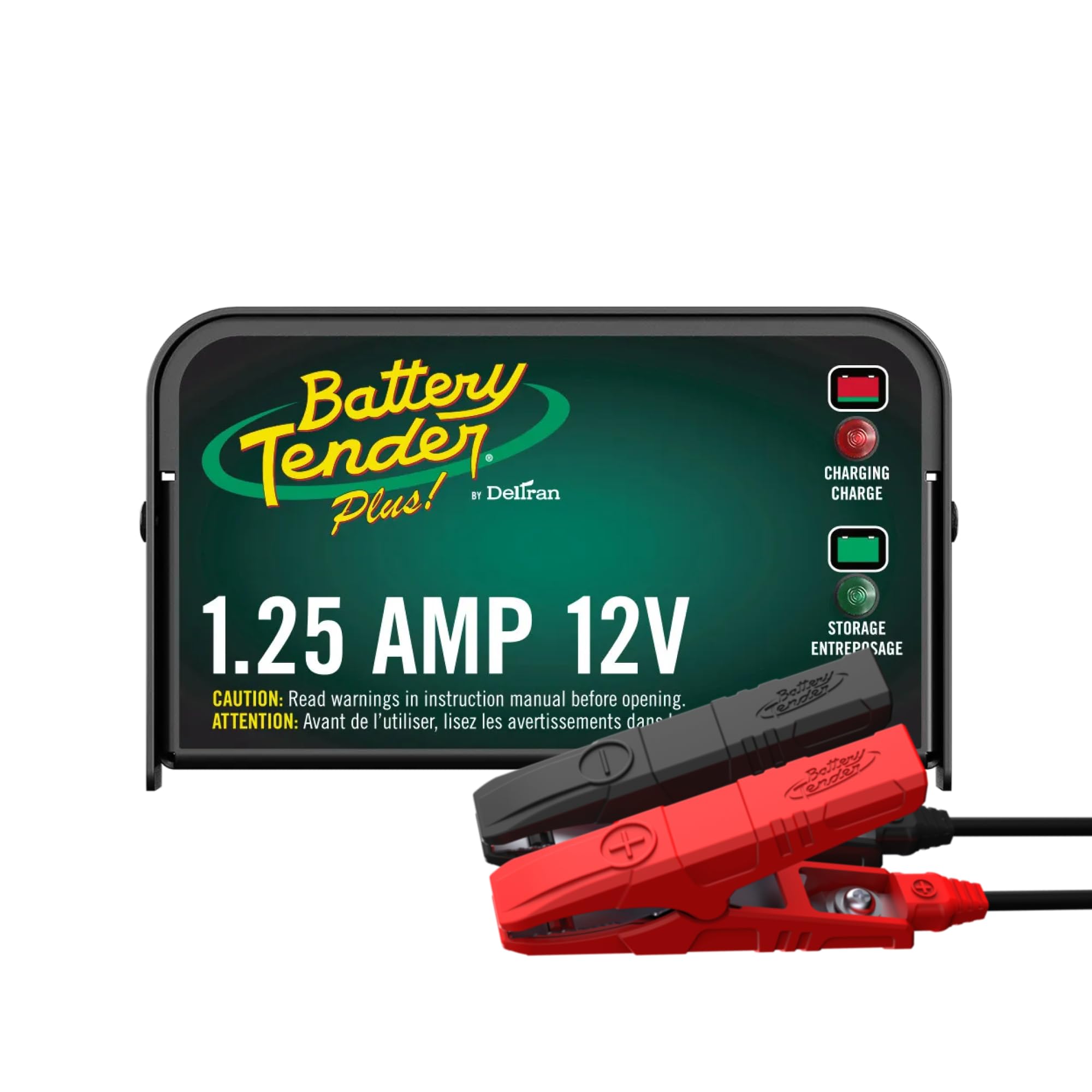
The number that defines this charger is 1.25 amps. That is a deliberately gentle rate, designed to trickle energy in over hours rather than rush a big charge. For a motorcycle parked through winter or a lawn mower that only fires up in spring, that slow pace is precisely what keeps the battery healthy instead of stressed. The 4-step charging program runs the battery through initialization, bulk charge and then float mode, so it settles into a non-overcharging holding pattern once full.
Owners talk most about two things: how well it works and how long it lasts. You connect it, a solid-state two-color LED (a light that shows charge state without moving parts) tells you the state of charge, and you forget about it. The unit is genuinely small, so it tucks onto a shelf or into the corner of an engine bay. It ships with both fused ring terminal and alligator clip cables, so you can bolt a permanent lead onto the battery and simply plug in.
Here is the catch worth knowing before you commit. At 1.25 amps, this is a maintainer first and a charger second — it is not the tool for reviving a fully dead car battery in a hurry. If your battery is deeply discharged and you need it running this afternoon, a 10-amp unit will move far faster. But for keeping a healthy battery healthy, the slow approach is the whole point, and it is backed by a 10-year manufacturer’s warranty.
What earns it the top spot
- 1.25-amp output keeps stored batteries topped up without overcharging
- 4-step program with float mode for genuine long-term maintenance
- Two-color LED shows charge state at a glance
- Ships with ring terminals and alligator clips for flexible hook-up
- 10-year manufacturer’s warranty
Where it asks patience
- The gentle 1.25-amp rate is slow for a fully dead battery
- Built for 12V systems, so 6V batteries need the Junior model below
Best for: Anyone storing a motorcycle, ATV or seasonal car who wants the battery ready the moment they return.
Think twice if: You need a drained battery charged fast — step up to a 10-amp charger instead.
2. NOCO GENIUS5 5A 6/12V Smart Battery Charger, Trickle Charger & Maintainer
A do-everything smart charger that reaches batteries other units give up on.
Most chargers treat a flat battery as a lost cause. The GENIUS5 does not. It can charge batteries from as low as 1 volt, and its Force Mode lets you manually push current into one that is completely dead at zero volts. That single feature separates it from the more cautious maintainers here — it is the pick for a neglected battery you are not quite ready to replace. The unit reads the battery and adapts, whether it lives in a car, boat, RV or tractor.
The other standout is safety over time. An integrated thermal sensor adjusts the charge based on the ambient temperature, which prevents overcharging when it is hot and undercharging when it is cold. The intelligence means you can leave it connected indefinitely for maintenance without babysitting it. Precision pulse charging also works to detect and reverse sulfation (the hard crust that builds on plates and saps performance) on a battery that has been sitting too long.
A fair caveat: owners sometimes find the instructions on the thin side, and the smart modes reward someone who reads the manual rather than guessing. But get familiar with it and the Force Mode plus thermal compensation make it the most capable general-purpose smart charger in this group, equally at home on a litany of 6-volt and 12-volt lead-acid and lithium batteries.
The recovery feature: Force Mode down to zero volts genuinely distinguishes it — it is the pick that tries to save a battery before you write it off.
Worth noting: The menu of charge modes takes a little learning, so budget five minutes with the manual to get the most from it.
Reach for this if: You want one smart charger that handles dead batteries, lithium, and long-term maintenance across a whole fleet.
Look elsewhere if: You prefer a dead-simple plug-and-forget maintainer for a single healthy battery.
3. CTEK MXS 5.0 Fully Automatic 4.3 amp Battery Charger and Maintainer 12V
The workshop-grade maintainer built to keep going through a freezing winter.
The 8-step charging program is the headline here. More steps mean more careful conditioning across a full cycle, and the MXS 5.0 folds in a reconditioning function aimed at restoring underperforming batteries and improving the lifespan of healthy ones. It is rated for 12-volt lead-acid and AGM batteries, and it is designed to charge optimally in all conditions — which is why cold-weather drivers are its natural audience.
What makes it trustworthy in a garage is the build. The unit is splash, dust, spark and shock proof, with a short-circuit-proof design that guards against reverse polarity. CTEK’s patented float/pulse charging lets you low-maintenance for months without harming the battery, and you do not need to disconnect the battery while it runs. Owners treat it as a long-haul device precisely because it keeps a battery fully charged without overcharging — the kind of behavior that matters when a car sits outside all winter.
The honest trade-off is output and pace. At 4.3 amps it is not a fast charger, and the reconditioning benefit leans on a healthy battery rather than a dead one. If your goal is rescuing a fully flat battery quickly, the higher-amp units will do it in a fraction of the time. But for the deep, careful, set-and-forget treatment that a seasonal vehicle wants, few chargers feel as purpose-built.
The match: A 12-volt car or bike that lives outdoors and needs reliable winter maintenance with rugged external protection.
Not the tool for: A completely flat battery you need woken up fast — this is a conditioner, not a rapid charger.
4. BOSCH C40-Li 5A 6V/12V Next-Gen Battery Charger for Lead-Acid & Lithium
A lithium-aware charger for riders who have moved past plain lead-acid.
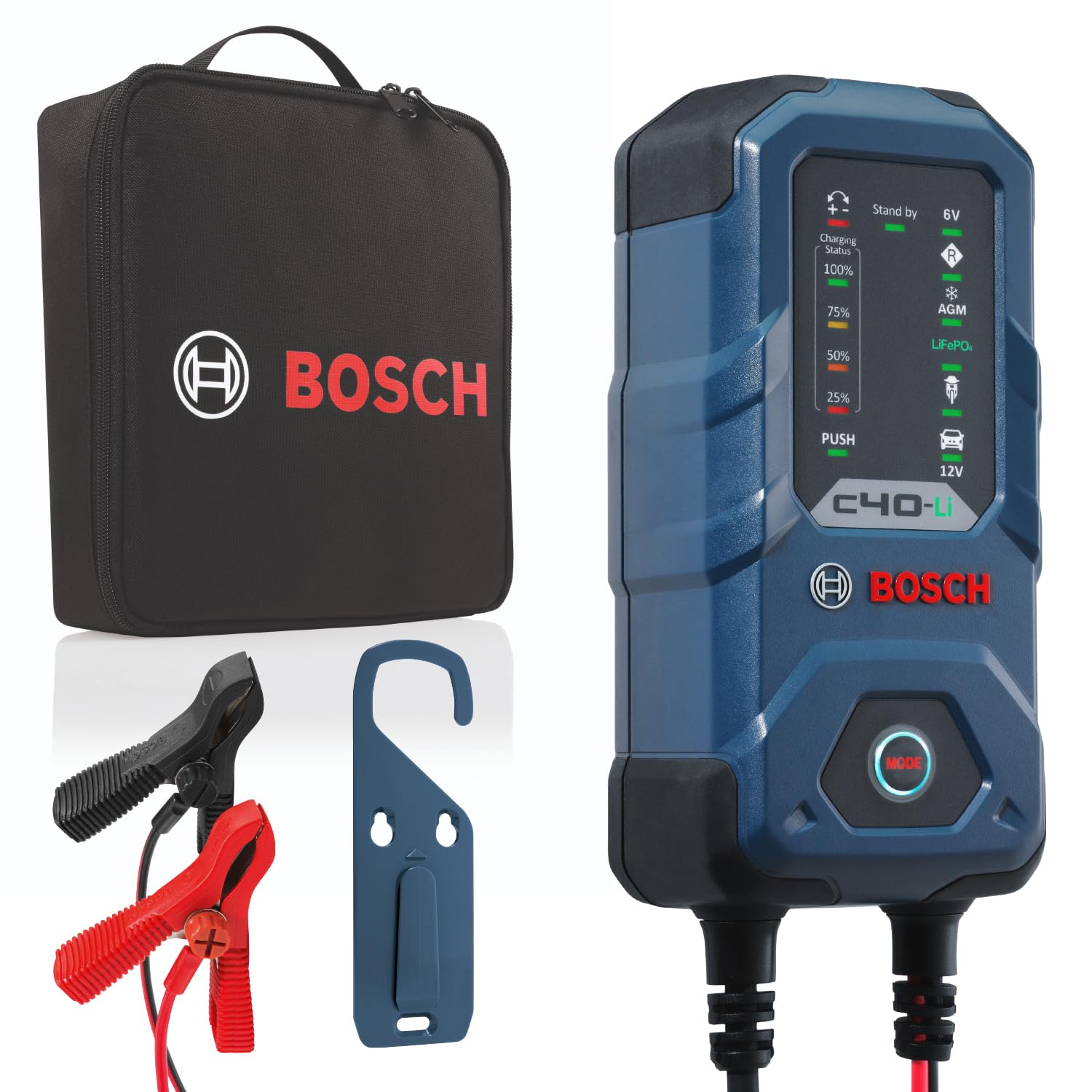
If your garage has shifted to lithium, the C40-Li is built for exactly that. It charges 12-volt lithium-ion (LiFePO4) batteries as well as 6-volt and 12-volt lead-acid, AGM, EFB, GEL and SLI batteries, with a dedicated motorcycle and lithium-ion mode delivering up to 5 amps. That chemistry coverage is the reason to pick it over a purely lead-acid maintainer — you are not locked out of your newer battery pack.
The clever bit is a small convenience you feel every time. An integrated microprocessor drives faster charging times, and the charger remembers the last selected charging mode — so if the power briefly drops, it resumes in the same mode without you resetting it. Maintenance and regeneration functions add the long-view care that seasonal vehicles need, working to prevent the offseason discharging cycles that shorten battery life. At 1.7 pounds it is light enough to hang or stow without fuss.
The trade-off is track record. This is a newer entry with a far shorter history than the established maintainers here, so you are leaning on Bosch’s electronics pedigree rather than thousands of logged winter seasons. The 5-amp output is also mid-weight — good for maintenance and moderate charging, not the pick for a dead-flat battery you need roaring back in minutes. For a lithium battery and a careful owner, though, the chemistry fit alone justifies it.
The smart detail: Mode memory resumes charging after a power blip in the same mode — a small touch that matters in a garage with dodgy sockets.
Keep in mind: Its shorter history means you are trusting the brand rather than a long, logged service record.
Suits you if: You run a LiFePO4 battery alongside lead-acid and want one charger with a true lithium mode and 5-amp output.
Consider another pick if: You want a proven long-season reputation or faster recovery of a deeply flat battery.
5. CRAFTSMAN 12A Car Battery Charger & Maintainer, 6V/12V – CMXCESM258
The quick one — 12 amps that bring a weak battery back with real speed.
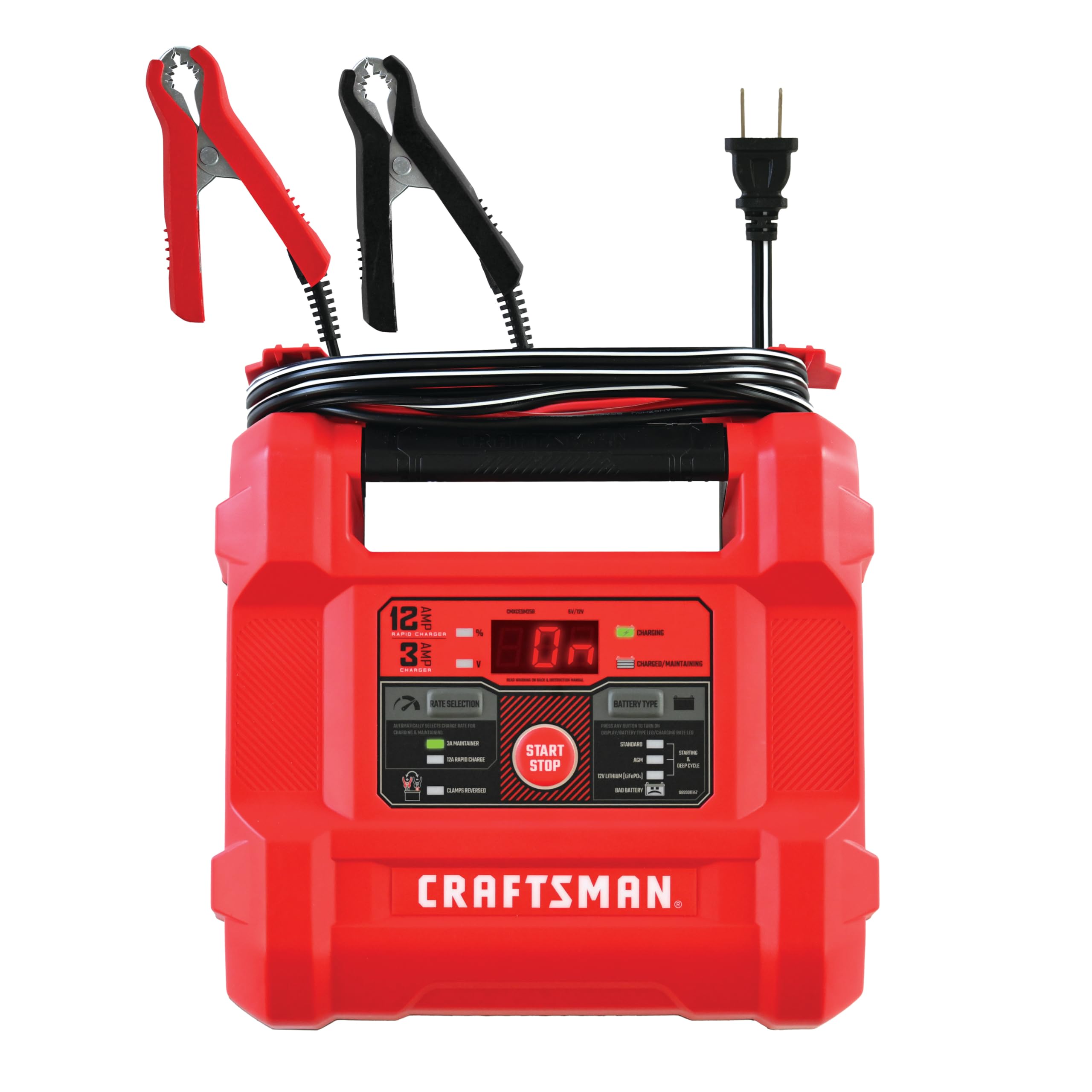
Twelve amps is the difference-maker here, and it is a big step up from the trickle-maintainers. At 12 amps versus the Battery Tender unit at 1.25 amps, that translates directly into less waiting when a battery is genuinely drained. The device is a 4-in-1 unit that charges, maintains, tests and restores, handling standard, AGM, deep-cycle and 12V lithium (LiFePO4) batteries. If you want a garage workhorse that covers seasonal and infrequently used vehicles, this is built for that role.
Owners consistently point to quality and charging speed as the reasons they rate it — the amps do the talking, and a weak battery is back to full in a practical timeframe rather than overnight. A microprocessor controls the cycle, with a digital display, automatic 6V/12V voltage detection, reverse hook-up protection and smart trickle charging once the battery tops out. An advanced desulfation mode adds the longer-term maintenance layer.
The recurring gripe is build feel — some find the housing plasticky for the badge on it, and a few report a battery still lifeless after use, which is the nature of trying to rescue a battery that may be beyond saving. None of that stops it being the fast charger to reach for when you want quick, versatile power in the garage rather than a slow winter maintainer. Just size your expectations: this is built to charge briskly, and a battery that is truly dead will not always come back.
Why it earns its place
- 12-amp output charges a weak battery far faster than a trickle unit
- 4-in-1: charges, maintains, tests and restores
- Auto 6V/12V detection with reverse hook-up protection
- Advanced desulfation mode and digital display
Honest limits
- Housing feels plasticky for the brand name on it
- A battery that is truly past saving will not always revive
Pick it for: Fast, versatile garage charging across lead-acid and lithium, with testing and restoration built in.
skip it if: You only need a gentle all-winter maintainer for one healthy battery — the 12-amp pace is more than you need.
6. Schumacher Electric 10A Car Battery Charger & 200A Engine Start – SC1446

A wheeled powerhouse that both charges and cranks the engine for you.
This is a different animal from the pocket-sized maintainers. It delivers a 200-amp engine start and a 40-amp boost, so beyond charging a battery it can also crank the car right there in the driveway. For a daily driver, truck or high-performance car that needs to be operational on demand, that engine-start function is the feature no small trickle charger can match. It supports 6V and 12V standard, AGM, gel and deep-cycle batteries.
Control is manual and deliberate. A 135-minute timer gives you precise, hands-on command over the charging process, which pro and DIY mechanics like because they can tailor the cycle to a specific battery rather than trusting a locked program. It rolls on its own wheels, so moving a heavy unit around the shop is not a chore. Craftsman-grade expectations aside, this is a substantial floor device — the kind that lives in the garage, not the glove box.
The catch is that manual operation cuts both ways. There is no microprocessor babysitting it, so you set the timer and stay mindful of it. For someone who wants to plug in and forget for a month, this is the wrong tool — it is a mechanic’s charging station, not an unattended winter maintainer. But when the job is starting a stubborn engine or fast-boosting a deeply discharged battery, nothing else in this group does it with this much headroom.
The raw capability: 200-amp engine start plus a 40-amp boost makes it the only pick here that can crank the vehicle as well as charge the battery.
Fair warning: The timer is manual, so this one wants your attention while it runs rather than set-and-forget convenience.
Best fit: A shop or driveway where starting a dead engine and fast-boosting batteries is a regular need.
Not for you if: You want to leave a charger connected for weeks unattended — the manual timer is hands-on by design.
7. NEXPEAK NC202 10-Amp Battery Charger, 12V 24V LiFePO4 Lead Acid

A large-screen charger that handles lithium repair work and long cable runs.
The 10-amp output pairs with true dual chemistry support here — 12V 10-amp and 24V 5-amp across both LiFePO4 and lead-acid batteries, including AGM, GEL, SLA and flooded types in cars, trucks, motorcycles, lawnmowers and boats. That makes it a rare pick that does not force you to choose between a lithium battery and an old flooded one in the same garage. The 8-stage program, with its automatic trickle/float mode after a full charge, is particularly useful for batteries left sitting in stored vehicles over winter.
The extra-large LCD screen separates it from most rivals — it stays readable under sunlight and shows charge voltage and current, internal temperature, charge percentage, and both summer and winter modes. A lengthened 10ft charging cable gives you more reach, which matters when the battery is buried or the socket is across the garage. There is a pulse repair function that works to detect sulfation and acid stratification and restore lost performance for stronger starts.
One limit to respect: this charger cannot activate or charge a totally dead (0V) battery, so a battery that is already flat-dead is not coming back here. It is also physically the largest unit in this group, so portability is not its strength. For an owner who wants lithium support, visible readouts and a long cable rather than a featherweight pocket charger, the trade-offs are easy to accept.
What it does well
- Handles both LiFePO4 and lead-acid at 10A (12V) and 5A (24V)
- Large sunlight-readable LCD shows voltage, current, temperature and charge percentage
- 8-stage program with automatic trickle/float for stored vehicles
- 10ft cable for extra reach; pulse repair for sulfated batteries
What to weigh
- Will not charge a totally dead (0V) battery
- The largest, least portable unit in this group
Go for it if: You juggle lithium and lead-acid batteries and want clear on-screen readouts plus a longer cable.
Rather not say: Portable and pocket-sized — it is a bench charger that wants a home on a shelf.
8. Battery Tender Junior 6V, 1.25 AMP Battery Charger and Maintainer

The 6-volt lifeline for old tractors, mowers and toys the big chargers ignore.
Most chargers here speak 12-volt. This one speaks 6-volt, and that is its entire reason to exist. It is compatible with all 6V lead-acid, flooded, AGM and gel cell batteries, running a complete 4-step charging program through initialization, bulk charge and float mode. If you own an older tractor, a vintage motorcycle or a ride-on toy that runs a 6V battery, the 12-volt units literally cannot help you — this one can.
It carries the same careful maintenance philosophy as its 12-volt sibling, but in a tiny 0.65-pound body. The spark-proof circuitry ensures no-spark connections at the clamps, and automatic reversed hook-up detection verifies you have connected the right way before charging begins. Once full, the automatic charge cycle switches to float mode, and if the voltage drops under load, adaptive charging resumes full output to top it back up. A solid-state two-color LED keeps the state of charge visible.
The mixed signal worth flagging is longevity. Some owners see it extend battery life nicely; a few report their battery only lasted months. That is the nature of maintaining an already-aging 6V battery — the charger keeps a healthy one alive but cannot make an old cell young again. For genuinely low-voltage equipment, the value-for-money and ease-of-use here make it a no-brainer.
The niche it owns: True 6V output with a 4-step program — the only pick here that does 6-volt maintenance properly.
Keep perspective: It maintains a healthy 6V battery well, but cannot reverse the decline of one that is already failing.
Made for: Owners of 6V equipment — older tractors, mowers and toys — who need a proper low-voltage maintainer.
Wrong pick for: Anyone with a 12-volt car or motorcycle; you need the Plus model above for that.
9. NEXPEAK NC201 10A Car Battery Charger Automotive Trickle Charger 12V 24V Maintainer

The entry-level multi-tool that covers charging, maintaining and repair in one box.
For a modest outlay this unit packs a 10-amp quick charge at 12V and 5-amp at 24V, with a 7-stage program that runs noticeably faster than an 8-amp or 5-amp automatic charger. It charges all 12-volt and 24-volt lead-acid batteries — AGM, GEL, SLA and flooded — across cars, trucks, SUVs, motorcycles, lawn mowers and boats. It is a lot of coverage for the price point, and the large LCD shows charge voltage, current, internal temperature, charge percentage and summer/winter modes.
It automatically detects battery sulfation and acid stratification (the layering that builds in a tired battery) and works to restore lost performance for stronger engine starts. Multiple protections — reverse hook-up, overcurrent, overcharge, short circuit, plus temperature compensation for hot and cold climates — keep the charging safe. A fireproof housing adds a reassuring layer when it is running unattended over winter.
The honest limitation is chemistry: this one is lead-acid only, with no lithium support, so a LiFePO4 owner should look at the NC202 above. Like its sibling, it also cannot activate or charge a totally dead (0V) battery. For the budget-conscious buyer with plain lead-acid batteries, though, it delivers a fast, feature-rich charging station without the premium price.
An easy reach for: A cost-conscious owner with lead-acid batteries who wants fast charging, a clear display and repair modes in one unit.
Pass on it if: You run lithium batteries or need to rescue a 0V battery — neither is in this unit’s range.
Understanding the Specs
Amperage: what the “A” actually controls
Amperage is the current the charger pushes into a battery, so it sets the pace. Low numbers like 1.25 A are for gentle maintenance — ideal for a battery sitting idle for weeks. Mid numbers like 5 A strike a balance between care and moderate charging. High numbers like 10 A bring a weak battery back fast, and an engine start rated in the hundreds of amps is there to crank the vehicle. None is better than the others — a 1.25 A maintainer, a 5 A all-rounder and a 10 A fast charger each solve a different job.
Stage count: how careful the charger is
Stages describe the steps a charger walks a battery through, from initial sensing to bulk charging and then float maintenance. A 4-step program is the careful minimum; 7- and 8-stage units build in extra conditioning. More stages usually mean gentler, more thorough treatment across a full cycle, which is why maintenance-focused chargers tend to advertise higher counts.
Float and maintenance: safe for months
Float mode is the trick that lets you connect a charger and leave it. Once the battery is full, the unit slips into a low, gentle holding pattern that keeps the voltage up without overcharging. A good maintainer resumes full output if the battery voltage drops under load, so it can sit connected all winter and keep a stored battery ready to fire.
Chemistry and safety circuitry
Battery chemistry sets a hard compatibility line. Lead-acid, AGM (absorbed glass mat), gel and flooded are common; lithium (LiFePO4) needs a charger that explicitly lists it. Alongside chemistry, look for the safety net — spark-proof and reverse hook-up protection stop a fumbled clamp causing damage, temperature compensation prevents over- or under-charging in extremes, and fireproof or splash-proof housing lets you run it in a real garage.
FAQ
Will a 1.25-amp charger actually charge a dead car battery?
Can I charge a lithium LiFePO4 battery with any of these chargers?
How long can I leave a battery maintainer connected?
What is the difference between a trickle charger and a maintainer?
Will these chargers work on a boat or marine battery?
What do the stage counts like 4-step or 8-step mean?
Can a charger revive a completely dead battery?
Do I need a fast charger or just a maintainer for winter storage?
Is a 200-amp engine start overkill for a normal car?
Will a charger work on both 6V and 12V batteries?
Final Thoughts: The Verdict
For most owners, the automotive battery charger that earns the top spot is the Battery Tender Plus 12V 1.25 AMP. Its 1.25-amp, 4-step approach is exactly what a stored motorcycle or seasonal car wants, and it is the safest bet for keeping a healthy battery healthy. If you want one charger that can also rescue a dead battery and handle lithium, the NOCO GENIUS5 with its Force Mode covers the widest range of jobs.
And if your priority is cranking a dead engine in the driveway, the Schumacher SC1446 brings a 200-amp engine start that nothing else here matches. Match amperage and chemistry to the battery in front of you, and any of these picks will serve you for years.
How We Picked
We do not accept paid placement. Every pick is matched to a real buyer and a real use-case; we do not hands-on test units.
Sources & Methodology
Specifications: manufacturer listings and product documentation. Review insights: verified customer reviews, as of November 2026. Pricing: not shown on this page (it changes often); check the current price via the retailer link.
As an Amazon Associate, Gadgets Feed earns from qualifying purchases. This does not affect which products we feature.