
Our readers keep the lights on and my morning glass full of iced black tea. As an Amazon Associate, I earn from qualifying purchases.
Specs are compiled from manufacturer listings and verified buyer reviews and can change over time — please confirm the key details on the product page before buying.
You park the boat in October, come back in April, and the battery is flat as a pancake — that slow drain from clocks, alarms and stereos is the whole reason a battery shut-off switch exists. The short answer: fit one between your battery and the vehicle’s wiring, turn the knob to OFF when you leave, and the battery stops feeding anything at all. This guide covers seven switches, and for most people the best pick is the 300A RVMARINEPAT unit — it carries a 4.5+ star rating across 300+ ratings, a 300A continuous crank rating and an IP54 weather rating, and it handles 12V to 48V systems.
I’m Min — the founder and writer behind Gadgets Feed. This guide is built by comparing the manufacturers’ published specifications and the patterns across verified customer reviews, so you get each pick’s real strengths and trade-offs instead of marketing spin.
Some switches are bare studs and a knob, while others add a voltmeter, a remote fob or a fistful of copper lugs in the box. The trick is matching the amp rating to your engine and the mounting style to the space you actually have. That is exactly what this breakdown of the automotive battery shut off switch does, spec by spec.
Our Picks at a Glance

How To Choose The Best Automotive Battery Shut Off Switch
A battery disconnect switch is a simple gate: a knob or lever you flip so the battery stops feeding the vehicle. Pick the wrong one and you get a switch that heats up on a cold start, arcs, or fogs up in a boat bilge. Pick the right one and the battery still cranks after weeks of storage.
Match the amp rating to what your engine pulls
Your starter motor pulls a huge surge for a few seconds, then settles down. That is why switch specs list two numbers: a continuous rating for steady load, and an intermittent or crank rating for that short burst. The RVMARINEPAT switch, for example, is rated 300A continuously and withstands 900A for 30 seconds and 500A for 5 minutes. A switch rated at 200A continuous is fine for a car or smaller outboard, but a big diesel starter can ask for far more than that in the moment.
Continuous amps versus cranking amps
Continuous amps is what the switch can carry all day without cooking. Cranking amps is the burst it survives for seconds. Both numbers matter, and ignoring the crank figure is the most common beginner mistake — a switch that looks heavy-duty by its continuous rating can still arc and fail on the first hard start. Look for an explicit ignition-protected crank rating if your engine is large.
Mounting: top post, side post or inline studs
Some switches clamp straight onto the round battery post, which means no extra cable and a very short install. Others bolt inline on a heavy cable and mount to a panel, a battery box or a tongue box. If your battery sits in a tight compartment, measure the space before you buy; a switch that clamps onto the post needs clearance above it.
Weather sealing and the water rating
A car engine bay sees road spray, and a boat bilge sees damp air year-round. An IP rating tells you how well the housing blocks dust and water — IP54 keeps out splashing water and dust, while IP65 handles water jets and dust completely. For a marine or open-trailer install, the higher the second digit, the better your contacts stay dry.
Quick Comparison
| Model | Best For | Current Rating | Voltage Range | Water Rating | Amazon |
|---|---|---|---|---|---|
| RVMARINEPAT 300A★ Best Overall | All-round pick for cars, boats and RVs | 300 A | 12-48V DC | IP54 | Amazon |
| FEITON 200A MasterBudget-Friendly | Budget-friendly metal housing | 200 A | 12-48V DC | — | Amazon |
| Spurtar 200A Kit | Complete kit with lugs and heat shrink | 200 A | 12-48V DC | — | Amazon |
| FEITON Remote 200A | Key-fob kill from outside the vehicle | 200 A | 12V DC | — | Amazon |
| Joinfworld 200A Bracket | Side-post mount with steel bracket | 200 A | 12-48V DC | IP65 | Amazon |
| SUNMORN 275A | Sealed rotary body with 6AWG cables | 275 A | 12-48V DC | — | Amazon |
| AWBLIN Top Post Voltmeter | Real-time voltage readout on the battery | 250 A | DC 5-80V | IP65 | Amazon |
In‑Depth Reviews
1. RVMARINEPAT 300A Boat Battery Disconnect Switch
Our pick — 4.5+★ from 300+ verified ratings; the strongest balance of quality and price.
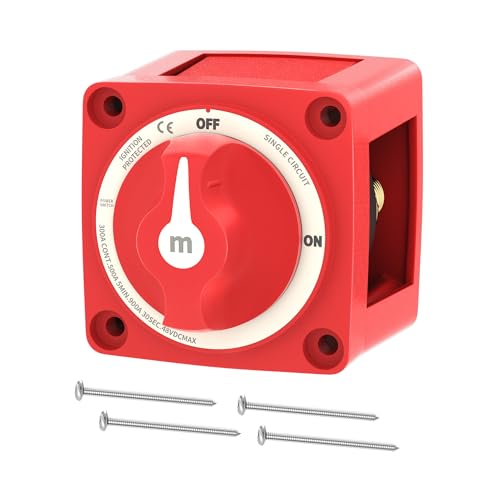
The heaviest crank rating here, in a body small enough to squeeze into a tight battery box.
Here is the number that earns this pick the top slot: a 300A continuous rating, backed by an ignition-protected crank rating that withstands 900A for 30 seconds and 500A for 5 minutes. A 200A switch, by contrast, tops out at a lower continuous current — 300 A versus 200 A. That extra headroom is what lets a bigger engine crank without the contacts arcing, and it is why this one suits boats, RVs and trucks alike rather than just a small outboard.
It is a single-circuit ON/OFF rotary switch — one knob, turned to ON or OFF — and it works across 12V to 48V DC systems. For a boat or camper that sits for weeks, that means you can cut the power entirely and stop the slow leakage that kills a battery between trips. The IP54 rating (dust-protected plus splash-resistant) means road spray and bilge damp do not sit on the contact plate. Mounting screws come in the box, and the shell opens up with room inside to complete the wiring, with a partition in the base to keep the wires separated.
The honest catch is that this is a plain manual switch — no remote key fob and no voltage display, so you walk over and turn the knob by hand every time. That is the trade for a simpler, sealed unit that just sits there and works. As owners put it, the build quality and the easy install are what earn it the praise, and it holds 4.5+ stars.
What earns it first place
- 300A continuous rating with a 900A / 30-second crank burst — real headroom for larger starters
- IP54 housing keeps spray and dust off the contacts
- Works across 12V to 48V DC systems, so one switch fits cars, boats and campers
- Mounting screws included and an open shell that leaves room for the wiring
What you give up
- Manual knob only — no remote fob, so you open the hood or hatch every time
- No voltmeter to read battery state at a glance
Built for: anyone who wants one sealed, high-amp switch to cover a car, a boat or an RV without overthinking the install.
skip it if: you want to kill the power from the driver’s seat or read your battery voltage off the switch itself.
2. FEITON 12-48V Master Battery Disconnect Switch
A metal-bodied 200A switch with a definite click and a one-year warranty behind it.
If you want the cheapest way to cut a battery without buying a flimsy plastic knob, this FEITON is the one — the housing is an aluminum alloy meant to shrug off harsh conditions, and it is rated 200A continuous with a 1000A intermittent burst for starting. It fits 12-48V DC systems, so the same switch covers an ATV, a trailer, an RV or a marine outboard. The rotary lever gives a clear on/off indicator and a satisfying click, and it ships with a one-year warranty for a replacement if it fails.
Fitting it is a four-step job with no modifications required: disconnect the battery and pick the negative cable, choose your mounting spot, connect the cables (not at the same time — that is how you shut off the switch), then reconnect and test. The reliability is the part owners talk about most, and not arcing when activated is the detail that keeps coming up.
The trade-off is durability, which lands squarely in mixed territory. Some owners find it genuinely heavy-duty, while others have had one fail within months, as well as notes about low voltage output. This is a budget pick for a light-duty rig — an ATV, a trailer, a small outboard — not the switch to hang a big diesel starter on. The metal body and the click are real strengths; just go in knowing the long-term record is split.
Where it shines: the aluminum housing and the 1000A intermittent burst make it a sturdy shut-off for a modest vehicle at a low-tier price, and the on/off indicator removes any guesswork.
The honest caveat: the durability record is genuinely mixed — treat it as a light-to-medium-duty switch and do not ask it to carry a heavy continuous load.
Reach for this if: your rig is an ATV, trailer or small boat and you want a metal-body switch on a tight budget.
Look elsewhere if: you need proven long-term durability under a heavy starting load.
3. Spurtar Battery Disconnect Switch

The one that shows up with the lugs, heat shrink and insulator sleeves already in the box.
Most switches leave you hunting down copper lugs and heat shrink before you can finish the wiring. This Spurtar kit skips that trip: you get the 200A switch plus 2x 3/8″ copper lugs, 2x heat shrinks and 2x rubber terminal insulator sleeves to stop incidental shorting and tidy up the wiring. It is rated 200A continuous and 1000A intermittent for a 12-48V DC system, and the face plate is marked on/off so you never second-guess the knob position.
The build is the standout — a metal body that owners describe as genuinely heavy-duty, and the durability is the trait praised most. That metal construction is the reason it takes the abuse of a camper, a tractor or a forklift install. The toggle throws with a clear click and does not jam, and people mention how it keeps the battery topped off when everything is switched out.
Two things to weigh. The disconnection side is mixed — a few buyers report the switch leaving them stranded, so check it holds firm before you rely on it. More consistently, the adjustability draws criticism for being too loose, which is worth a careful tighten at install. Treat the toggle with a firm hand and it does the everyday job of isolating a battery for storage.
Why it earns a spot
- Complete kit — copper lugs, heat shrink and insulator sleeves all included
- Metal housing that owners call genuinely heavy-duty
- Marked on/off face plate and a click that does not jam
- 200A continuous / 1000A intermittent for 12-48V systems
Worth knowing first
- The adjustability is criticized as too loose — tighten firmly at install
- Disconnection reliability is mixed, with a few reporting being stranded
Solid pick for: the buyer who wants one box with every bit of hardware for a clean, tidy wiring job.
Think twice if: your priority is a switch you never have to think about again rather than a value kit.
4. FEITON Remote Battery Disconnect Switch

Cut the power from a key fob instead of opening the hood every morning.
This is the switch for someone who parks in a sketchy lot or leaves a rig sitting for weeks and does not want to pop the hood each time. It is an electromagnetic remote unit — rated 200A at DC 12V with a 360A starting figure — and the point is simple: press the fob and the car’s power is dead, so a thief cannot start it and the battery stops draining. Installation is the trait owners praise most, and the anti-theft side is the second reason people buy it. Connect the red wire to the positive post, clamp the negative to the battery, and the black negative wire is already fitted at the bottom of the switch for convenience.
Two things the maker spells out plainly. On some vehicles you need to wait about 6 seconds after reconnecting before pressing the start switch. And if your car stereo cannot fully power down, it will need re-matching once you cut the battery completely. Build-wise it uses silver contacts and pure copper wires, with the wiring harness included so there is nothing extra to buy.
The durability record gives real pause — this is the pick with the most mixed feedback on battery life, remote control and build quality, and durability is the trait drawing the most negative notes. A lot of owners still get a smooth install and working anti-theft, but go in with eyes open: this suits a project car, a seasonal camper or a boat rather than a daily driver you cannot afford to troubleshoot.
Smart use case: a stored vehicle, a seasonal trailer or a boat where the fob-based kill saves you a walk to the engine bay every time.
Fair warning: the 6-second wait and any stereo re-matching are quirks to plan around, and the long-term reliability record is genuinely uneven.
Worth it for: anyone who wants anti-theft and drain protection without leaving the driver’s side.
Not for: the daily driver where a hiccup in the switch would leave you stranded and frustrated.
5. Joinfworld 12V Battery Disconnect Switch

The side-post mount that clamps the switch down tight and keeps water out with an IP65 body.
Where most switches float loose on a couple of screws, this one sits in a heavy-duty steel side-post mounting bracket, which speeds up the install and keeps the body fixed where you want it. It is an on/off two-position switch rated 200A with a 1000A intermittent crank and 2 x 3/8″ (M10) studs. The studs and nuts are tinned copper for reliable conductivity, and the IP65 rating means it is dust-tight and protected against water jets — a real step up for a boat or an open trailer. It runs on 12-48V DC and can stand alone or lock together with other switches.
The mounting hardware is the nice surprise — you get the switch, 3 stainless screws, 2 copper lugs and 2 rubber terminal insulators in the box, so nothing else is needed. Quality is what owners praise most, with the easy install and clean look close behind.
Durability is the split here. Some find it a heavy-duty switch that is worth it, while others report one falling apart. For a mid-range manual switch the value story is good, and the bracket plus IP65 body are genuine advantages for a marine install — but if you need the absolute toughest build, the top pick covers more load. Owners who want a tidy, well-secured install will feel at home with this one.
The standout: a steel side-post bracket plus an IP65 body makes it the neatest fixed mounting on this list for a boat or camper install.
Size the caveat: build consistency is uneven, so inspect it at arrival and tighten the terminals well before you rely on it.
Good match for: the boat or trailer owner who wants the switch bolted down solid and sealed against spray.
Look past it if: a rock-solid long-term build matters more to you than the mounting convenience.
6. SUNMORN Battery Disconnect Switch 12V-48V
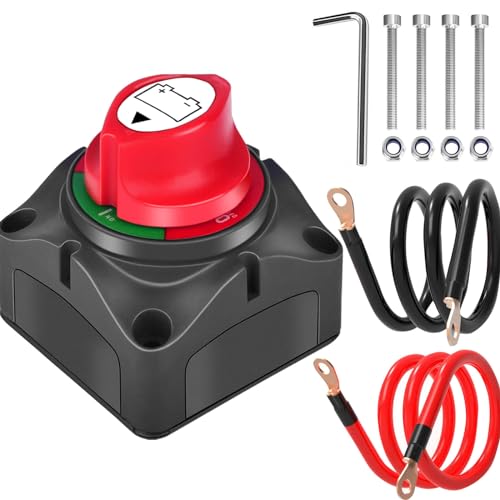
A sealed rotary body with an O-ring and a red/green ring you can read in a dark engine bay.
The detail that sets this one apart is the sealed rotary design with a reinforced O-ring — moisture and road spray stay off the contact plate, and the housing is rated from -40°F to 221°F for diesel and off-road vibration. That matters for a boat that sits in a damp bilge or a camper parked through a wet winter. The amp story is a 275A peak with 150A continuous, which the maker frames for engine starting and parking isolation rather than continuous high-amp loads. It is a different balance from the top pick’s 300A continuous: this one leads on sealing, while the RVMARINEPAT leads on steady current and on crank headroom — 900A for 30 seconds versus this switch’s 275A peak. It also has a firm detent that resists vibration, plus a red/green ring that shows power status at a glance and draws no current when the switch is off.
The box comes with 2 x 6AWG tinned copper cables, 20 inches each, pre-crimped with lugs and heat shrink — add your own extension for a long boat run. Mounting is a wrench job with no special tools, and the compact base fits a battery box or tongue box. Owners rate functionality top and quality second, and the easy install comes up again and again.
Two honest notes: build quality is mixed, with some finding it solid and others not strong enough, and there is a durability concern about corrosion on a long-term marine install. It is also explicitly a starter-and-isolation switch, not the one to feed a big inverter. If your load is a starter motor and you want sealed protection from the wet, this fits.
Where it wins
- Sealed rotary body with an O-ring keeps moisture off the contacts
- Red/green ring reads power status in a dim bay and draws no current when off
- 275A peak with 6AWG pre-crimped cables included
- Rated -40°F to 221°F for diesel and off-road vibration
The trade-offs
- Build quality is uneven across units
- A corrosion concern on long marine installs
- Not meant for continuous high-amp loads like inverters
Made for: the wet-bilge boat or the off-road rig where a sealed, vibration-proof body and a starter burst matter most.
Not ideal if: you plan to run a heavy continuous load such as an inverter.
7. AWBLIN Top Post Battery Disconnect Switch with Voltmeter
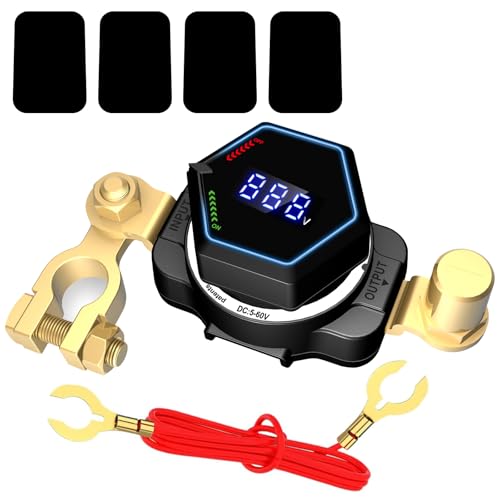
The only switch here that shows your battery voltage in real time while you cut the power.
If you have ever wondered whether your battery is fading before a trip, this is the one: a large matte LED screen shows the voltage in real time when the switch is on. When it is off, the screen goes dark and the switch sits in a completely power-off state with zero standby current. Turned on, the display draws 30mA. It is a top-post switch that clamps onto 16-17mm (0.63in-0.67in) negative battery posts, so measure yours before buying, and both side terminals unbolt so you can change the angle for a flexible install.
Current-wise it runs 250A continuous at DC 12V with a 300A interval figure, and it spans a wide DC 5-80V range — the broadest voltage spread on this list, covering 6V, 12V, 24V, 48V and 60V systems. The shell is nylon 66, which is more flame-retardant than ABS, and the internal screw uses copper plated silver with silver contacts for better conductivity and oxidation resistance. It wears an IP65 rating for dust and water-jet protection, and the box includes four rubber gaskets and a positive connection wire.
The one thing that splits opinion is the readout accuracy — the display is handy, but readings are not always exactly agreed on. Functionality is what wins people over, and the built-in voltmeter is a genuinely useful extra you will not find on any other switch here. Think of it as a monitor as much as a shut-off, and check the numbers you rely on against a solid multimeter if precision matters.
Best-loved detail: the real-time LED voltage readout — the only one on this list — plus a 5-80V spread that covers everything from a 6V cart to a 60V setup.
Check before you commit: it only fits 16-17mm negative posts, so measure first, and verify the voltage readings against a trusted meter if accuracy is critical.
Choose this if: you want to cut the battery and read its health off one dial without digging out a meter.
pass on it if: your battery posts fall outside the 16-17mm fit range.
Understanding the Specs
Continuous Amps vs Cranking Amps
Continuous amps is how much current the switch carries for a long stretch without heating, while cranking (or intermittent) amps is the short burst it survives for a few seconds of engine start. A switch rated 200A continuous with a 1000A intermittent burst is built for starting a car, not for feeding a high-amp load all day. Match the continuous figure to your vehicle’s biggest steady draw and the crank figure to your starter’s surge.
IP Ratings Explained
An IP rating has two digits: the first for dust and the second for water. IP54 means dust-protected and splash-resistant — fine for an engine bay that sees the odd spray. IP65 means dust-tight and protected against water jets — the safer bet for a boat bilge or an open trailer. For a marine install, higher is better on both digits.
Top Post vs Inline Mounting
A top-post switch clamps straight onto the round battery post, so you need clearance above the battery and a post in the 16-17mm range to fit. An inline switch bolts onto a heavy cable and mounts to a panel or box, which suits tight compartments where nothing can sit on top of the battery. Measure the space before choosing between the two.
Voltage Range
The range tells you which systems the switch covers. A 12-48V DC rating handles standard cars, RVs, boats and 48V golf carts. A wider 5-80V range covers those plus 6V and 60V setups. Check your system’s voltage sits comfortably inside the switch’s stated range before you install.
FAQ
Will a 12V battery shut off switch work on my 48V golf cart?
Do I install the kill switch on the positive or negative battery cable?
Will a disconnect switch stop my car battery draining while stored?
Can a battery switch act as an anti-theft device?
What is the difference between continuous and intermittent amp ratings?
How do I know which top post size fits my battery?
Do these switches work on a boat as well as a car?
Will cutting the battery reset my car stereo or settings?
Does the built-in voltmeter drain my battery when the switch is off?
Is a remote kill switch better than a manual knob?
Final Thoughts: The Verdict
For most buyers, the winner is the RVMARINEPAT 300A switch — its 300A continuous rating carries more steady current than any other pick here, and the 900A / 30-second crank burst handles a real starter without arcing. If you want a voltage readout and the broadest 5-80V fit, the AWBLIN top-post voltmeter switch is the one to reach for. And for killing the power from a key fob on a stored rig, the FEITON remote unit earns its place despite a more uneven long-term record. Whichever you pick, match the continuous and crank amp ratings to your engine first; mounting and sealing come second.
How We Picked
We do not accept paid placement. Every pick is matched to a real buyer and a real use-case; we do not hands-on test units.
Sources & Methodology
Specifications: manufacturer listings and product documentation. Review insights: verified customer reviews, as of November 2026. Pricing: not shown on this page (it changes often); check the current price via the retailer link.
As an Amazon Associate, Gadgets Feed earns from qualifying purchases. This does not affect which products we feature.