
Our readers keep the lights on and my morning glass full of iced black tea. As an Amazon Associate, I earn from qualifying purchases.
Specs are compiled from manufacturer listings and verified buyer reviews and can change over time — please confirm the key details on the product page before buying.
Dropped calls, texts that spin for minutes, and maps that freeze right when you need a turn — that is the reality of driving through a cellular dead zone. An automotive cell phone booster grabs whatever weak signal is floating around outside your vehicle, amplifies it, and sends it inside so your phone can actually use it. This guide compares the top seven boosters for cars, trucks, and RVs by range, band coverage, and verified buyer experiences.
I’m Min — the founder and writer behind Gadgets Feed. This guide is built by comparing the manufacturers’ published specifications and the patterns across verified customer reviews, so you get each pick’s real strengths and trade-offs instead of marketing spin.
Whether you commute through rural valleys or drive a semi across the plains, the right automotive cell phone booster turns a frustratingly silent stretch of road into a reliably connected one — and we have found the models that actually deliver on that promise.
Our Picks at a Glance

How To Choose The Best Automotive Cell Phone Booster
Booster performance varies by vehicle type and signal environment. Match the booster’s frequency bands, gain, and antenna design to your driving routes and carrier.
Frequency Bands — The Carrier Match
Your cell carrier broadcasts on specific slices of the radio spectrum called bands (700MHz, 850MHz, 1900MHz, etc.). A booster that does not support your carrier’s band is a paperweight. Check your phone’s band support and compare it directly against the booster’s listed bands before buying.
Gain (dB) — How Much Muscle
Gain is measured in decibels (dB), and it tells you how much the booster amplifies the incoming signal. Most vehicle boosters sit between 50dB and 65dB. Excessive gain without proper antenna separation can cause oscillation that shuts the system down.
Antenna Type — Where the Signal Lives
Omnidirectional antennas pull signal from all directions, ideal for driving through changing terrain. Directional yagi antennas focus on one tower, better for parked use. Longer antenna cables allow higher mounting but introduce more signal loss.
Quick Comparison
| Model | Best For | Max Gain | Frequency Bands | Antenna Type | Amazon |
|---|---|---|---|---|---|
| weBoost Drive 4G-X OTR★ Best Overall | Semi-truck use | — | 12/17/13/5/4/25/2 | 17″ omni + 3-way mount | $449.99Amazon |
| SureCall Fusion2Go UltraTop Performer | All-around power | 50 dB | 12/17/13/5/2/25/4 | Magnet-mount exterior | $499.99Amazon |
| weBoost Drive Reach OTR | Farthest reach | 50 dB | 12/17/13/5/4/25/2 | RV antenna + mast kit | $519.99Amazon |
| HiBoost Travel 2.0 RV | RV flexibility | 50 dB | 12/17/13/5/4/25/2 | Omni-directional exterior | $399.99$449.99Amazon |
| PRACOA RV Booster | Wide vehicle compatibility | 65 dB | 2/4/5/12/13/17/25/66 | Magnet exterior + patch interior | $158.00Amazon |
| ANNTLENT V50 | Easiest installation | — | 2/4/5/12/13/17/25 | All-in-one with built-in exterior | $249.00Amazon |
| JACOOL V01 | Budget band-specific | 50 dB | 700MHz (12/13/17) | Magnet exterior + patch interior | $109.00Amazon |
In‑Depth Reviews
1. weBoost Drive 4G-X OTR (470210)
Our pick — over 4★ from 900+ verified ratings; the strongest balance of quality and price.
A 17-inch antenna keeps the whole cab connected on days-long hauls, making it a proven pick over the lighter Drive Reach OTR for heavy-duty mounting.
Built for the men and women who live in a truck for days at a time, the weBoost Drive 4G-X OTR uses a 17-inch omnidirectional (picks up signal from every direction) weather-resistant antenna with a 3-way CB antenna mount (a bracket that fits common truck radio antenna holes), mast extension, and side exit adapter. It supports bands 12/17, 13, 5, 4, and 25/2 — covering Verizon, AT&T, T-Mobile, Sprint, and US Cellular. At 5 lbs and 6.25″D x 1″W x 4.5″H, the booster is compact despite the serious antenna hardware, and compared to the 1.8 lb weBoost Drive Reach OTR, the 4G-X is noticeably heavier-duty in its mounting kit.
Buyers on the pipeline and long-haul routes report consistent results. One verified review notes: “In weak signal area, boosted from 1 to 3 bars with clear call; without booster, call almost lost.” Another reviewer mentioned that on an I-10 drive, they had reception the entire time — a one-time purchase with no monthly fee that also works on a boat or beach setup. The booster provides up to 2 hours of additional talk time by reducing battery drain from the phone hunting for signal.
FCC approved (ID PWO460021), this is a multi-user system, so everyone in the cab benefits simultaneously. The only catch is the antenna installation — the big 17″ antenna needs a proper mirror mount or similar bracket, and reviewers caution that thread-lock packets are basically superglue, so plan your placement carefully.
What riders gain
- Multi-user support — driver and passengers all get boosted signal
- Massive 17″ antenna pulls in weak signals other boosters miss
- Reduces phone battery drain by stopping constant tower searches
What to plan for
- Antenna installation requires a truck mirror mount or drilling
- At 5 lbs, the kit is heavier than the 1.8 lb Drive Reach OTR
- Some users report the internal antenna must stay separated from roof metal to avoid feedback
Reach for this if: You drive a semi or large truck through remote stretches daily and need a rugged, proven kit with real-world reviews backing its muscle.
Look elsewhere if: You are in a small SUV or car — the 17″ antenna and bracket kit is overkill for a passenger vehicle.
2. SureCall Fusion2Go Ultra
This model turns a one-bar whisper into a usable signal, thanks to the highest uplink power in our roundup.
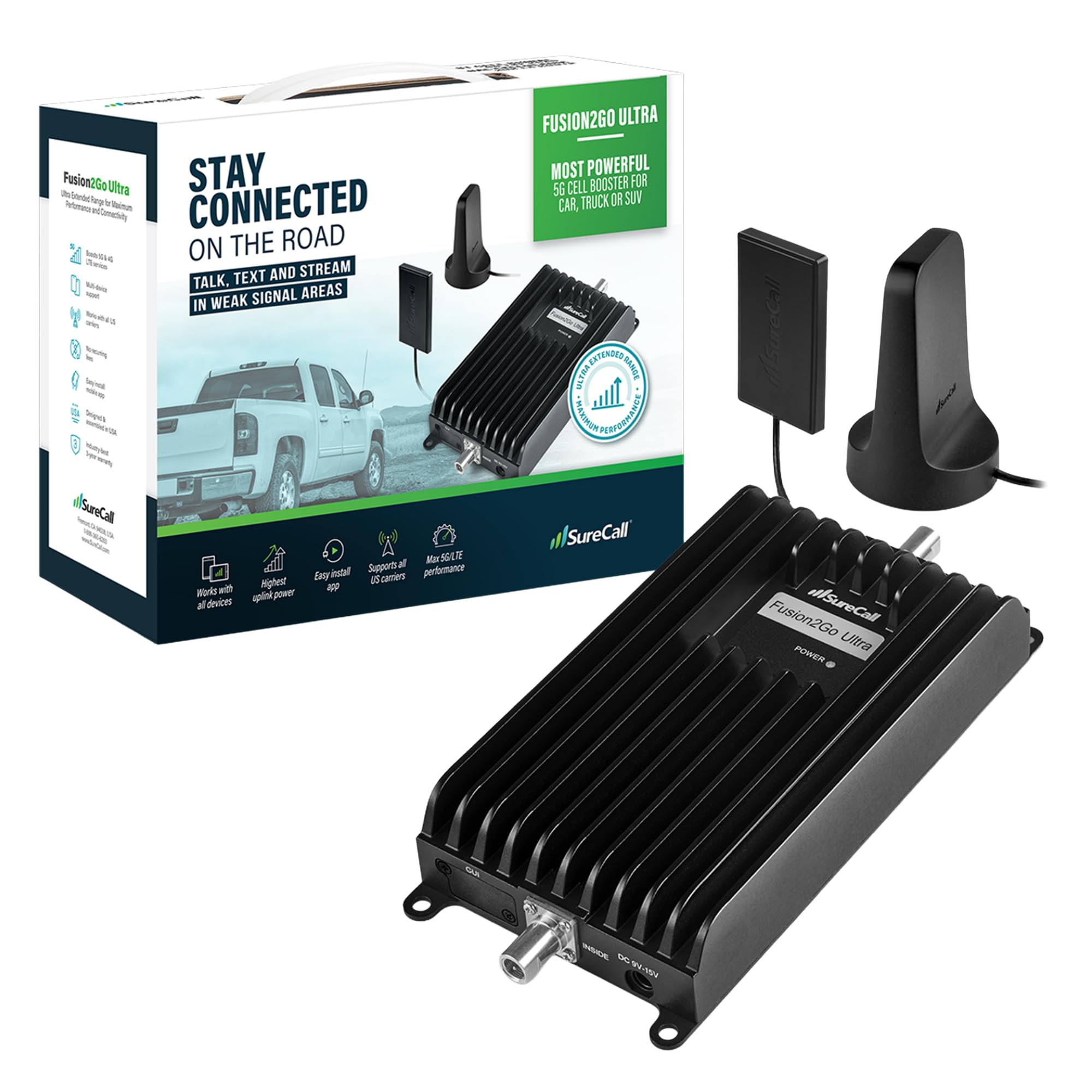
The SureCall Fusion2Go Ultra delivers up to 50 dB gain and the highest uplink power on the market at 30 dBi (a measure of how strongly your phone can “shout” back to a distant tower). It covers bands 12/17/13/5/2/25/4, so it works with Verizon, AT&T, T-Mobile, US Cellular, Google Fi, Mint Mobile, and Boost Mobile. Unlike the JACOOL V01 which only covers 700MHz bands, the Fusion2Go Ultra blankets nearly all major US frequencies. Buyers report a massive difference: one reviewer measured upload speed jumping from 1.23 Mbps to 20.6 Mbps, and the phone switched from LTE (Long-Term Evolution, the standard for 4G) to 5G after installing the booster.
The kit includes a magnet-mount exterior antenna with a 12.5 ft cable, an interior patch antenna, and a power supply. An optional free iOS/Android app helps you find the best antenna placement. The trade-off is the cable lengths — owners mention the interior and power cords barely reach in a compact car, and there is no hardwire kit included if you want a permanent install.
It is built and tested in the USA with FCC certification (certification number RSN-F2GULTRA), backed by a 3-year warranty and lifetime US-based support. At 4 lbs and measuring 8″D x 1.4″W x 4″H, the amplifier itself is compact enough to stash under a seat.
Uplift that proves itself: The upload-speed data from real buyers (1.23 to 20.6 Mbps) is the kind of concrete proof that makes this worth the money for anyone who drives through marginal signal zones daily.
Best for: Rural commuters and truck drivers who need the strongest possible connection and are willing to measure and mount carefully.
Not for: Drivers who want a zero-effort magnet-and-go setup — cable routing takes patience in smaller vehicles.
3. weBoost Drive Reach OTR (477154)
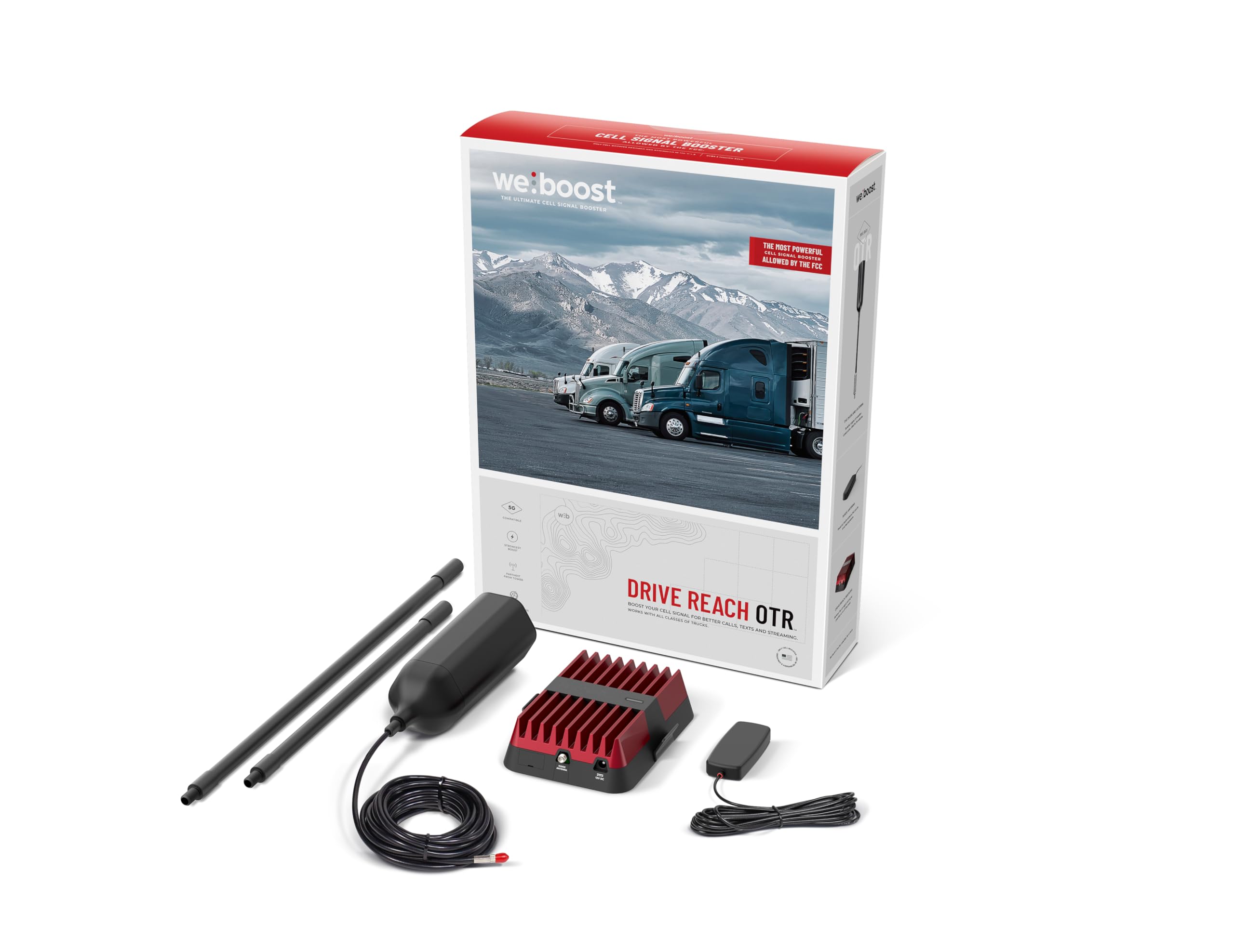
If the Drive 4G-X is the workhorse, the Drive Reach OTR is the long-haul champion that reaches twice the distance of weBoost’s previous model. With 50 dB max gain and support for the same comprehensive band set (12/17/13/5/4/25/2), it is compatible with all US carriers including Verizon, AT&T, T-Mobile, and US Cellular. The 5G-ready booster comes with a Drive RV antenna, mounting bracket, power supply, slim low-profile antenna, coax cable (the wire that carries the signal), side exit adapter, mast extensions (one 13-inch, one 18-inch), and an antenna spring — everything a big truck or RV needs for a permanent install.
Buyers are emphatic about its performance in the toughest conditions. One reviewer who ordered four for company semi trucks says: “they do what they say they do. no more dropped calls while on the road in west tx and new mexico.” Another notes that the booster takes signal from 1 bar to 3-4 bars, enabling calls, texts, and emails in areas that had zero service before. The booster box does get hot, so it needs ventilation, and the power plug includes a handy on/off switch.
FCC approved (ID PWO460061) with a 2-year warranty and US-based customer support. At 1.8 lbs, it is significantly lighter than the 5 lb Drive 4G-X OTR despite the more advanced range — a meaningful difference when you are hauling gear across state lines. The biggest complaint is that the instructions are written primarily for semi trucks, so RV and SUV owners need to get creative with mounting.
Best for: Over-the-road truckers and serious RVers who want the absolute farthest reach and are fine with a moderately involved install.
Not ideal for: Casual SUVs or daily commuters — the range and price point are overkill unless you regularly hit true dead zones.
4. HiBoost Travel 2.0 RV Booster Kit

A 13-foot indoor cable lets you move the signal from the cab to the campsite—a feature no other pick here matches.
The HiBoost Travel 2.0 is purpose-built for RV life, and the standout feature is the 13-foot indoor antenna cable. That extra length means you can move the interior antenna around the RV — by the TV for streaming, near the bed for overnight calls, or next to your desk for hotspot data. It supports bands 12/17, 13, 5, 4, and 25/2, covering Verizon, AT&T, T-Mobile, and US Cellular, with up to 50 dB max gain for 5G and 4G LTE signals. The kit includes an outside omni-directional antenna (pulls signal from all sides), the booster unit, a power supply with a cigarette lighter adapter, and a 15-foot cable.
Customers note a significant increase in bars in areas that were “close to dead but not quite.” One verified reviewer on the road says: “it only took a few minutes to climb on the ladder to the roof and mount the antenna to the ladder.” The Signal Supervisor app (no subscription) lets you monitor signal strength in real time, though some reviewers mention the Bluetooth connection to the app can be sporadic.
FCC approved (ID OWWC110505S) with a 3-year warranty and US-based support by phone, email, and app chat. The range is listed at 1-2 miles — notably shorter than the PRACOA’s claimed 5-8 mile communication distance. The customer service experience gets mixed marks: several reviewers report difficulty reaching support for returns or troubleshooting.
Flexibility first: The 13-foot indoor antenna cable is a genuine advantage for RVers who want to move signal to where they sit, not sit where the signal lands.
Reach for this if: You live in an RV part-time or full-time and want a booster that adapts to different interior layouts.
Skip if: You need a quick plug-and-play solution — the install, while straightforward, still requires roof access and cable routing.
5. PRACOA RV Cell Phone Signal Booster
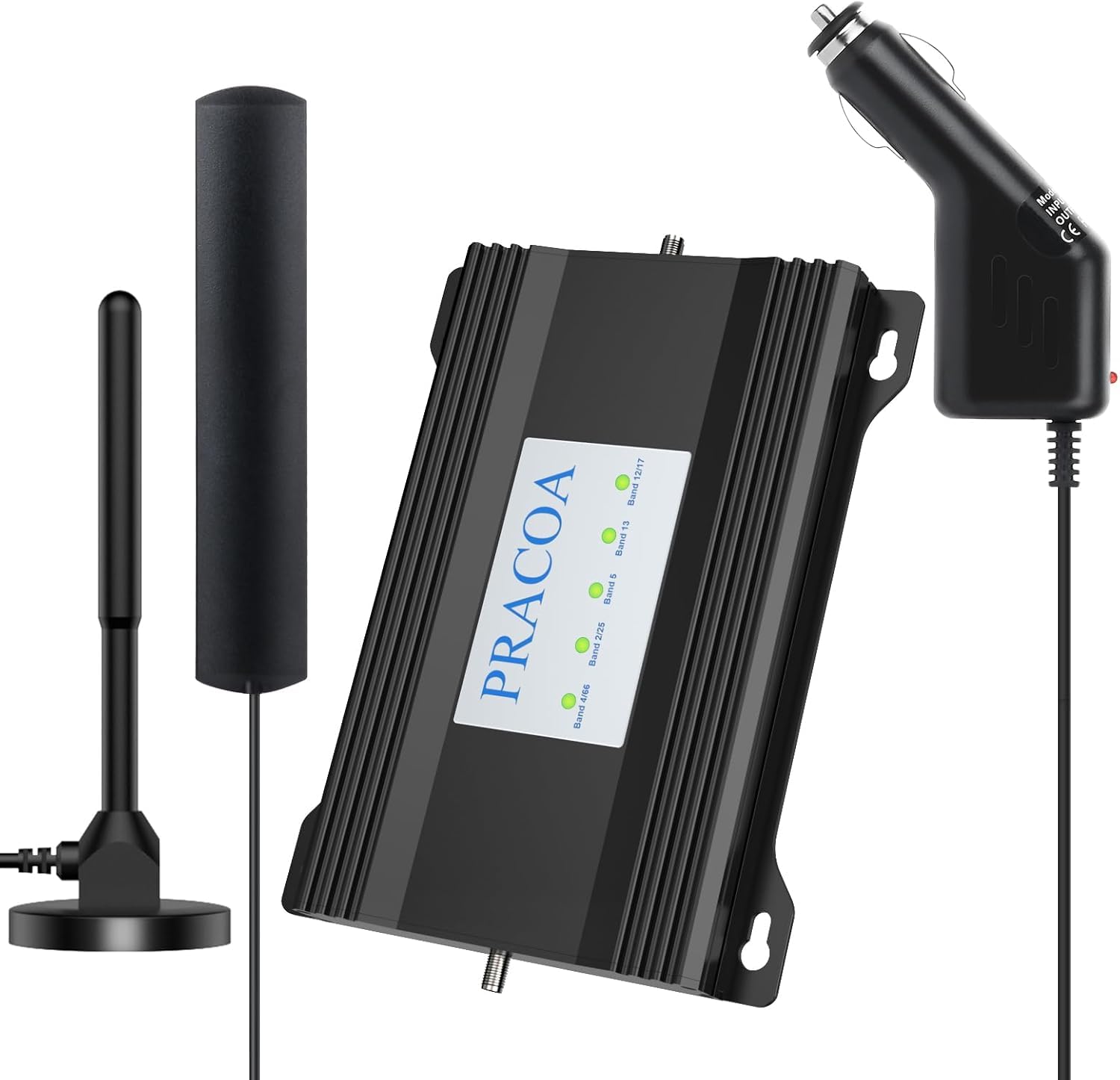
With a claimed 65 dB gain, this model has the highest amplification in the lineup—15 dB more than the HiBoost—and covers band 66, which most others miss.
The PRACOA booster stands out with a claimed 65 dB high gain — 15 dB more than many competitors — and a stated maximum communication distance of 5-8 miles. That is significantly farther than the HiBoost’s 1-2 mile range. It covers the widest band set in this roundup: bands 2, 4, 5, 12, 13, 17, 25, and 66, making it compatible with all major US carriers including Verizon, AT&T, T-Mobile, Straight Talk, Cricket, and US Cellular. The kit includes a booster amplifier, indoor patch antenna with a 10ft RG174 cable, outdoor magnet antenna with a 16ft RG174 cable, and a 12V 3A power adapter.
Buyers in rural areas have seen real results. One reviewer shares: “We set this up at his home in the north woods and now we hear him clear as a bell, no matter where he is in his home.” Another user in a metal-sided house (functioning as a Faraday cage, which blocks radio waves) noted that careful antenna aiming with cell tower mapping tools was essential to get the best performance — a good reminder that high gain alone is not magic without proper placement.
The booster measures 8.27″D x 5.7″W x 0.86″H in a sleek metal RF enclosure with LED status indicators for power and antenna faults. It features Automatic Gain Control (self-adjusts power to avoid feedback), Inactivity Mode (powers down when no signal is present), and Oscillation Elimination (prevents the echo loop that shuts down systems) — smart circuitry that self-adjusts as driving conditions change. A 2-year warranty backs the unit.
What stands out
- Highest claimed gain in this lineup at 65dB
- Broad band coverage including Band 66
- 5-8 mile communication distance claim
What to consider
- Fewer reviews (27) than established brands
- Some users report the supplied SMA cables have connector quality issues
- Installation may require additional parts like a lightning arrestor
Best for: Adventurers who regularly camp in deep backcountry and want the highest possible gain to grab distant towers.
Not for: Buyers who want a well-known brand with thousands of reviews — PRACOA is a newer player with a leaner track record.
6. ANNTLENT V50 All-in-One Booster
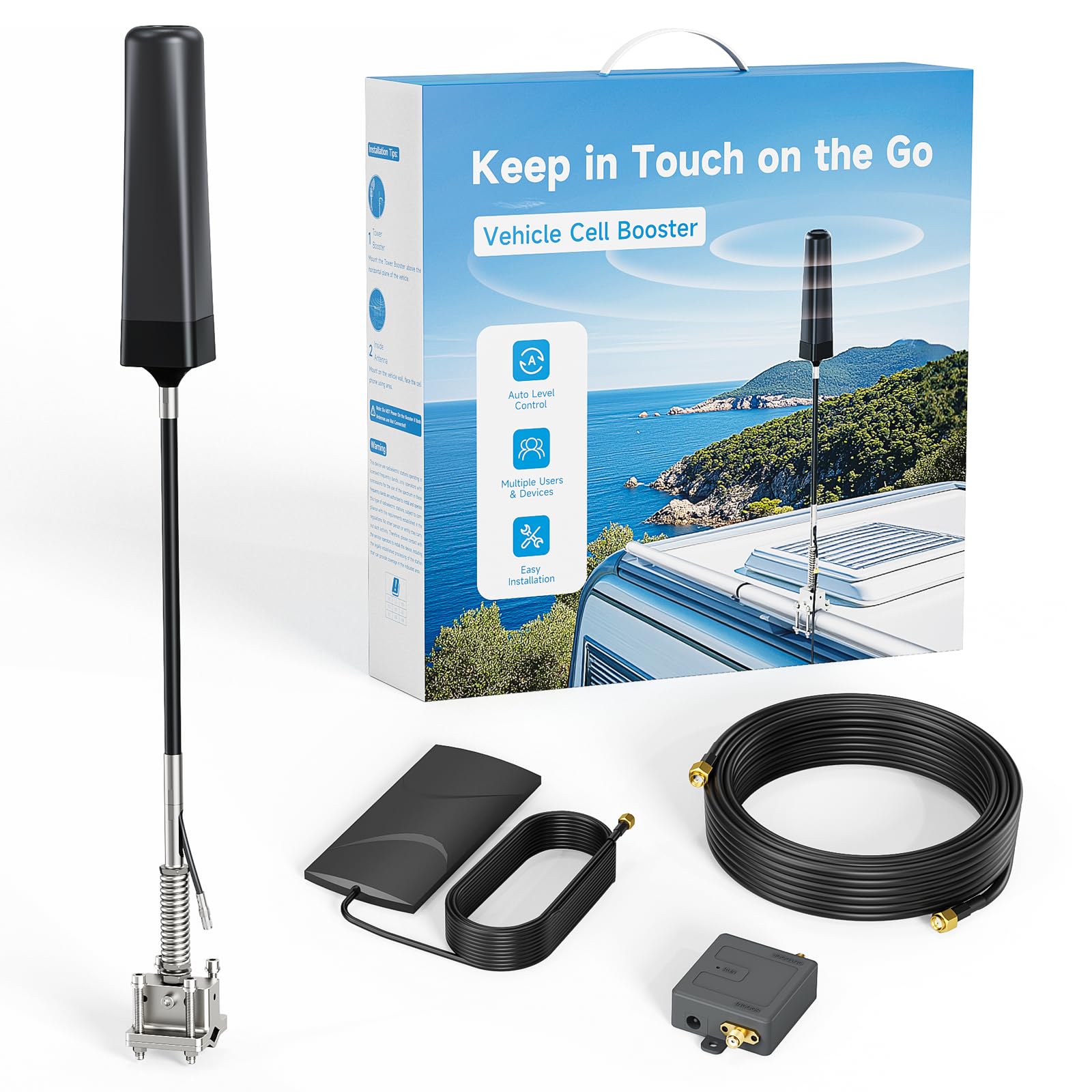
This all-in-one design skips the long cable routing entirely, making it the fastest install—but results depend on having a usable signal outside.
The ANNTLENT V50 takes a radically different approach: instead of a separate exterior antenna connected by a long cable, the amplifier and antenna are combined into one All-in-One unit. The booster amplifies the signal directly at the antenna, which the company calls “zero signal loss” because there is no cable delay between the antenna and the amplifier. It covers bands 2, 4, 5, 12, 13, 17, and 25, supporting Verizon, AT&T, T-Mobile, and more. A companion smart app helps you find the best mounting location by showing real-time signal strength and tower direction.
Buyer experiences are split. Some see real gains: one reviewer in a canyon home reports finally getting full bars after years of dropped calls. Others see no improvement at all — one frustrated buyer writes: “Had 4G with 2 signal bars before starting. Ended with 4G with 2 signal bars. WASTE OF.” The difference likely depends on whether the user’s usable outdoor signal is strong enough for the booster to work with in the first place — no booster creates signal from nothing.
The kit includes the V50 Tower Booster, inside antenna, cable, power supply, waterproof tape, and cable management tape. It is FCC certified and comes with a 30-day money-back guarantee, 3-month free replacement, and 3-year manufacturer replacement. The all-in-one design makes it the fastest install in this guide.
Reach for this if: You want the cleanest, simplest install with no long exterior cable to route — ideal for campers and trailers where drilling is not an option.
Look elsewhere if: You are in a very weak signal area — the all-in-one design trades some gain for convenience, and results are less consistent than a traditional separate-antenna setup.
7. JACOOL V01 Cell Phone Booster
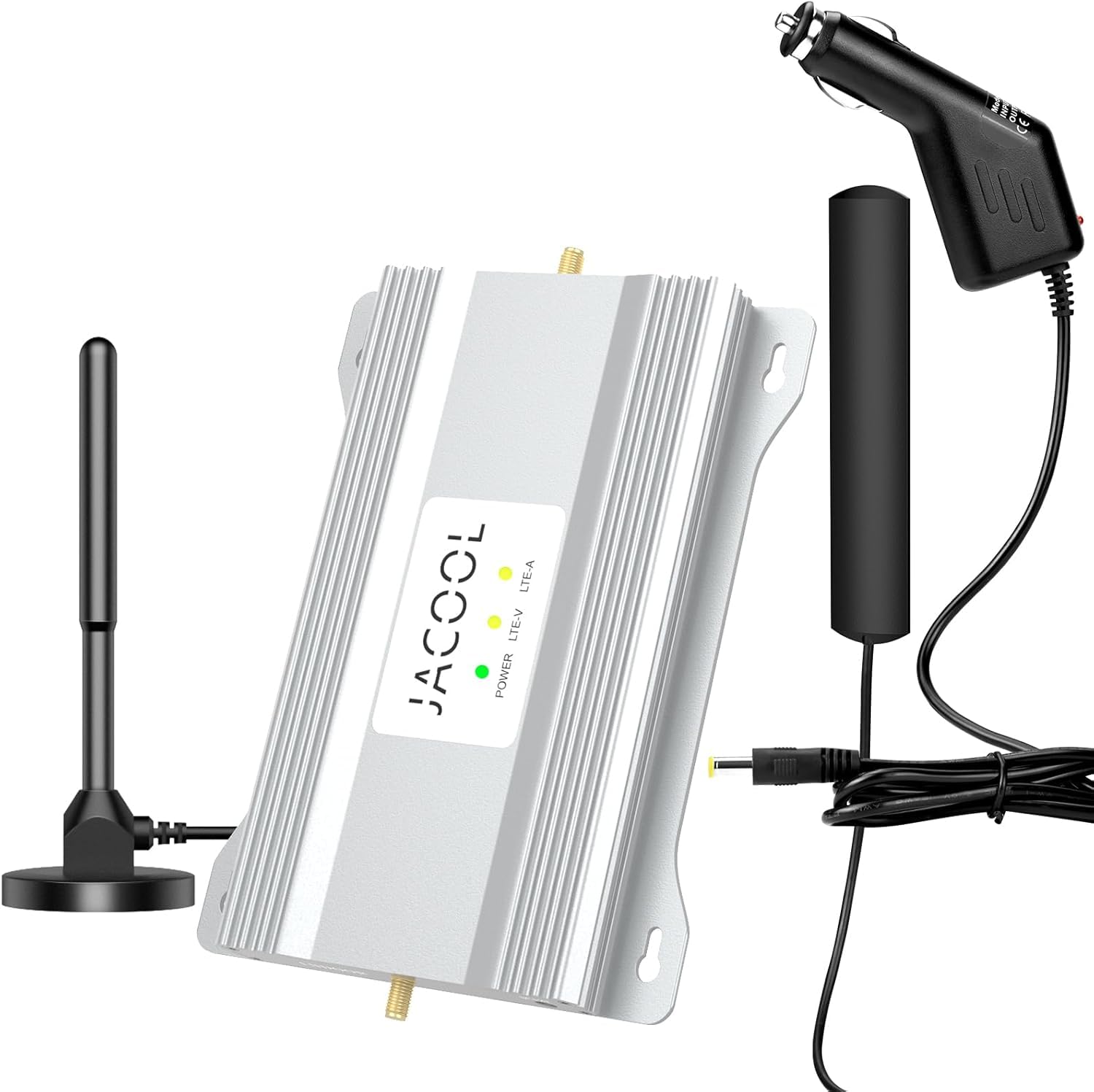
This is the budget option for one specific frequency range: 700MHz bands 12, 13, and 17 only.
The JACOOL V01 is a single-band booster that specifically targets 700MHz frequencies — bands 12, 13, and 17. That makes it compatible with Verizon, AT&T, and T-Mobile on their 4G LTE and some 5G networks that operate on that range, but it will not help with signals on Band 4 (1700/2100MHz) or Band 2/25 (1900MHz). The 50dB AGC (Automatic Gain Control) amplifier automatically adjusts its power to maintain stable operation and prevent oscillation (feedback that shuts the system down). The kit includes the booster amplifier, an omnidirectional suction-cup antenna, an indoor antenna, cables, and a power adapter.
Buyer results are mixed but instructive. One reviewer reports: “Improved T-Mobile 5G signal from 2-3 to 3-4 bars in rural Illinois.” Others found no improvement at all — one user tested across an iPhone 12, Google Pixel 5/6 Pro, and a Verizon 5G home hub and saw zero gain in data signal or connectivity. The narrow band focus is the likely culprit: if your carrier operates mostly on Band 4 or Band 2 where you drive, this booster simply will not help.
FCC approved and built for vehicle use with LED status indicators and a low-power sleep mode. The 2-year warranty is a solid bonus at this tier. This is a capable tool, but only if you know your signal lives in the 700MHz range.
Know your band first: The JACOOL is effective — but only if your carrier’s signal in your area runs on 700MHz. Check your phone’s field test mode before buying, or you may be disappointed.
Best for: Budget-conscious buyers who have confirmed their carrier uses Band 12/13/17 in their driving area and want a simple, low-cost solution.
Not for: Anyone who needs multi-band coverage or drives through areas where the local towers use Band 4 or Band 2 — this booster will not touch those frequencies.
Understanding the Specs
Gain (dB) — The Muscle Behind the Boost
Gain is measured in decibels (dB), and it tells you how much the booster amplifies the incoming signal from the tower. Most vehicle boosters range from 50dB to 65dB. Higher dB means more amplification, but it also requires more careful separation between the exterior and interior antennas — if they are too close, the system can create feedback (oscillation) and shut down. A 50dB booster is generally the balance for vehicle use, offering strong gain without excessive installation sensitivity.
Frequency Bands — The Language Your Phone Speaks
Cellular carriers broadcast on specific slices of the radio spectrum numbered as “bands.” Band 12/17 (700MHz) travels far and penetrates walls well, Band 4 (1700/2100MHz) offers faster speeds in urban areas, and Band 2/25 (1900MHz) is common for older 4G LTE. A booster that covers multiple bands (especially 12/17, 13, 5, 4, and 25/2) works with more carriers and more towers. Single-band boosters like the JACOOL V01 work only if your carrier uses that exact frequency in your area.
FAQ
Will an automotive cell phone booster work with any carrier?
Can a booster create signal where there is absolutely none?
How hard is it to install a vehicle cell phone booster?
Do I need to drill holes in my vehicle to install a booster?
Will a booster work with 5G phones and networks?
What is the difference between omnidirectional and directional antennas?
Can multiple people use one booster at the same time?
How long do vehicle cell phone boosters typically last?
Will a booster drain my vehicle’s battery?
Is there a monthly fee for using a cell phone booster?
Final Thoughts: The Verdict
For most people, the automotive cell phone booster winner is the SureCall Fusion2Go Ultra because it pairs the highest uplink power on the market with broad band coverage and real-world speed data that proves its value. If you want a rugged truck-specific kit with years of field testing behind it, grab the weBoost Drive 4G-X OTR. And for RVers who need the flexibility to move their signal around inside the living space, the standout is the HiBoost Travel 2.0 with its 13-foot indoor antenna cable.
How We Picked
We do not accept paid placement. Every pick is matched to a real buyer and a real use-case; we do not hands-on test units.
Sources & Methodology
Specifications: manufacturer listings and product documentation. Review insights: verified customer reviews, as of July 2026. Pricing: not shown on this page (it changes often); check the current price via the retailer link.
As an Amazon Associate, Gadgets Feed earns from qualifying purchases. This does not affect which products we feature.
Related Guides
Product prices and availability are accurate as of the date/time indicated and are subject to change. Any price and availability information displayed on Amazon at the time of purchase will apply to the purchase of this product. As an Amazon Associate I earn from qualifying purchases.
CERTAIN CONTENT THAT APPEARS ON THIS SITE COMES FROM AMAZON. THIS CONTENT IS PROVIDED "AS IS" AND IS SUBJECT TO CHANGE OR REMOVAL AT ANY TIME.
Amazon and the Amazon logo are trademarks of Amazon.com, Inc. or its affiliates.