
Our readers keep the lights on and my morning glass full of iced black tea. As an Amazon Associate, I earn from qualifying purchases.
Specs are compiled from manufacturer listings and verified buyer reviews and can change over time — please confirm the key details on the product page before buying.
You need an under-dash heater to blow warm air at your windshield for defogging and defrosting, or to take the chill off a small cab. The trick is matching the type to your vehicle’s electrical system and space. An electric PTC heater (a ceramic heating element that self-regulates temperature) pulling 800 watts can drain your battery fast if you aren’t moving. A coolant-fed unit delivers serious heat (measured in BTU, or British Thermal Units) but needs hose connections. Here are six distinct approaches so you know which one fits your truck, UTV (utility task vehicle), camper, or classic car.
I’m Min — the founder and writer behind Gadgets Feed. This guide is built by comparing the manufacturers’ published specifications and the patterns across verified customer reviews, so you get each pick’s real strengths and trade-offs instead of marketing spin.
After sorting through PTC ceramic blowers, 500-watt and 800-watt battery-powered units, and a coolant-loop cab heater, the crowd favorite for a no-compromise warm cab is the saihisday 12v car auxiliary heater. It combines a strong 4-port design with a powerful blower motor at a reasonable price, so you get steady defrosting without draining your battery at idle.
Quick Picks
- Saihisday 12V Car Auxiliary Heater, 4 Ports — Best Overall
- XuSha 8000 BTU 4 Ports 12 Volt Coolant Heater — Powerhouse Heat
- Therwen 12V Universal Car Auxiliary Heater — Compact Fit
- CYDZSW 12V 800W Car Heater Battery Powered — Quick Defrost
- CYDZSW Car Battery Powered Heater, 500W 4 Holes — Wider Coverage
- Rossesay 12V 800w Car Heater 2 Hole — Budget Pick
How To Choose The Best Automotive Electric Heater
Buying an automotive heater isn’t as simple as grabbing the highest wattage off the shelf. You need to match the heater’s electrical draw to your vehicle’s alternator output, decide between a battery-powered PTC unit or a coolant-loop design, and figure out how you want to route the warm air. Here are the three decisions that matter most.
Wattage and Electrical Load
An 800-watt heater running on a 12V system draws roughly 67 amps. That is a lot of current. If your vehicle is idling, the alternator may not keep up, and a PTC unit can drain the battery in minutes. A 500-watt heater pulls about 42 amps, which is safer for smaller alternators but still demands heavy-gauge wiring direct to the battery. Know your alternator’s rated output before you pick a wattage.
PTC Electric vs. Coolant-fed Heaters
PTC (Positive Temperature Coefficient) ceramic heaters are self-regulating — they draw full power when cold and taper off as they get hot, which makes them safe and efficient for spot heating. Coolant-fed heaters, like the 8000 BTU XuSha unit, run off your engine’s hot radiator fluid, so they produce real cab-warming heat without any extra electrical load. The trade-off is that coolant heaters require hose connections and won’t work until the engine is warm.
Port Configuration and Airflow Direction
Two-port heaters (like the Rossesay) send warm air through a single or split hose aimed at the windshield. Four-port heaters spread the heat across a wider area, often with telescopic tubes you can aim at your feet, the windshield, or a passenger. More ports generally mean more coverage, but also more places for air to leak if the tubes aren’t clamped tight.
Quick Comparison
| Model | Best For | Wattage / BTU | Ports | Weight | Amazon |
|---|---|---|---|---|---|
| Saihisday 12V Auxiliary | Best Overall 4-Port Value | N/A (Blower Motor) | 4 | 7.04 lbs | Amazon |
| XuSha 8000 BTU Coolant Heater | Serious Cab Heat (Coolant Fed) | 8000 BTU | 4 | 7.0 lbs | Amazon |
| Therwen 12V 4-Port | Compact Underdash Fit | N/A (Blower Motor) | 4 | 6.93 lbs | Amazon |
| CYDZSW 12V 800W | Quick Windshield Defrost | 800W | 2 | 2.12 lbs | Amazon |
| CYDZSW 12V 500W 4-Hole | Wider Coverage in Small Cabs | 500W | 4 | 3.1 lbs | Amazon |
| Rossesay 12V 800W | Budget Windshield Defogger | 800W | 2 | 2.23 lbs | Amazon |
In‑Depth Reviews
1. Saihisday 12V Car Auxiliary Heater, 4 Ports

The best-rounded four-port auxiliary heater for value and ease of install
This Saihisday unit is the crowd favorite for a reason, and it delivers a strong blast of cab-warming air through four vent holes. Buyers find the installation straightforward, and the build quality feels solid for the price, with the unit weighing 7.04 pounds and packing a powerful blower motor that moves real air. One owner installed it in a 1998 Chevy S10 single cab and reported that, it provided heat where there was none before.
The value for money is what people praise most — it is cheap enough to be a no-brainer for an old truck or UTV. The blower motor is a bit weak at full tilt, so it won’t pressurize a leaky cab, and a few units arrived with a defective switch that needed wiggling. Still, the consensus is clear: it heats well, it is easy to install, and it saves hundreds over a shop repair.
Compared to the lighter PTC units, this Saihisday heater doesn’t rely on a PTC element — it uses a blower motor that pushes warm air from wherever you mount it. That means it won’t drain your battery as aggressively as an 800W PTC unit, but it also means the heat is only as warm as the air around it. Pair it with your vehicle’s existing heater core or a coolant-fed heater for the best results.
Worth the spend: Good built unit, easy to install on a Polaris Ranger 900XP under dash — the pipe fittings could be better, but for the price it is a really good heater.
Watch for: Some buyers report a weak fan and hose clamps that strip under pressure; plan to use your own clamps.
Reach for this if: You need a cheap, four-port blower that is easy to install and delivers good value for an old truck or UTV with limited space.
Look elsewhere if: You have a large cab or need powerful, forced-air heat — this heater’s blower is mild, not aggressive.
2. XuSha 8000 BTU 4 Ports 12 Volt Coolant Heater

Real engine-heated warmth through 4 ports for serious cab heating
Unlike every other heater on this list, the XuSha is a coolant-fed unit — it taps into your vehicle’s radiator hoses to pull hot engine water through a small factory-style heater core. The result is real, cab-warming heat rated at 8000 BTU, which is a completely different league from the PTC electric units. Owners consistently report “plenty of heat,” with one bypassing a failed heater core in a 57 Dodge pickup and clearing the windshield easily on cold mornings.
The installation requires fitting a 5/8-inch (16mm) inner diameter water hose (not included), so it is not a plug-and-play cigarette lighter job. The heat output depends entirely on your engine coolant temperature — once the engine is warm, this thing pours out heat. Weighing 7 pounds and measuring 10.6 x 8.4 x 4 inches, it is compact enough for tight underdash spaces. A few units arrived missing mounting screws, and the switch burned out after a couple uses for one owner, so inspect it carefully upon arrival.
Compared to PTC heaters (ceramic-element heaters) that struggle to keep a cab warm at idle, the XuSha delivers stronger heat once the engine is running. It also avoids the heavy electrical draw of an 800W heater, making it ideal for vehicles with smaller alternators (the part that charges your battery while driving).
What wins people over
- Real 8000 BTU heat from engine coolant, not a 12V battery drain
- Plenty of heat output even at idle once engine is warm
Fair warnings
- Needs 5/8-inch water hose and coolant system knowledge to install
- Noise from vibration and switch failure reported by some owners
This is for: Anyone with a failed heater core, or a classic car or truck that needs real cab heat without draining the battery.
Pass if: You want a simple plug-in heater — this requires hose connections and a warm engine to work.
3. Therwen 12V Universal Car Auxiliary Heater, 4 Ports

A compact 4-port underdash heater that fits tight spots and works quietly
The Therwen is built to slip under the dash of an SUV, UTV, or camper and deliver focused defrosting air without taking up much space. Weighing 6.93 pounds, it is slightly lighter than the Saihisday and is designed for quick defrosting and demisting. One owner installed it in a 91 S10 and reported it heats really well. Another mounted it below the glove compartment of a 2010 Dodge Journey and found a logical spot for it.
The heat output is where things get mixed — some owners say it heats well, while others found it not warm enough for their needs. The fans are a little loud, but the noise is tolerable for most. It doesn’t come with mounting bolts, so be prepared to source your own hardware. The build quality is decent, and one owner used it in a short bus to heat the back area pretty well, which shows it can move a decent volume of air.
Compared to the Saihisday, the Therwen is slightly more expensive but offers a similar four-port layout. The functionality is praised, but the heat output is the highest-discussed aspect and it is mixed — meaning it is a fit for sealed cabs more than drafty ones.
Installed well: Works great in a 91 S10 and heats really well — one owner summed it up.
A few notes: The switches feel cheap, the fan is a bit loud, and you will need to supply your own mounting bolts.
Best for: Someone with a smaller vehicle or UTV who needs a compact four-port heater that is easy to install under the dash.
Not for: Large, drafty cabs where you need high-volume heat — look at the coolant-fed XuSha instead.
4. CYDZSW 12V 800W Car Heater Battery Powered

An 800W PTC ceramic heater that is light enough to move between vehicles
This CYDZSW unit packs 800 watts of PTC ceramic heating power into a package that weighs just 2.12 pounds — making it 46% lighter than the 500W 4-hole version from the same brand. Owners mention that it raised the temperature inside a forklift cab by 25-35°F above ambient, which is a solid real-world gain. It is designed for windshield defrosting and defogging, with two air outlets aimed at the glass.
The installation is straightforward for anyone comfortable with wiring, but there is no cigarette lighter plug — you must hardwire it. The quick connect plug melted after a few hours for one owner, so direct wiring is recommended. At 800W and 67 amps, it can strain an idling alternator, and some owners warn it could damage a car’s electrical system if not connected properly. The durability is a concern, with reports of fuses blowing and units breaking within a week.
Compared to the Rossesay 800W, this CYDZSW unit has a better track record for actually producing noticeable warmth — the forklift test proves it works. The biggest trade-off is that the high electrical draw makes it a gamble on a stock vehicle battery at idle.
Where it shines
- 800W PTC ceramic heating raises cab temp 25-35°F above ambient
- Weighs only 2.12 pounds — very portable
Fair warnings
- No cigarette plug — requires hardwiring; connector is known to melt
- Heavy 67-amp draw can damage a stock alternator at idle
Grab it if: You need a lightweight, powerful defroster for a forklift, golf cart, or UTV with a strong alternator and you are comfortable with hardwiring.
Skip if: You want a plug-and-play solution for your daily driver — the electrical demands are too high for most stock cars.
5. CYDZSW Car Battery Powered Heater, 500W 4 Holes

Four aluminum hose ports spread 500W of heat across a wider cab area
This CYDZSW model steps down to 500 watts but steps up to four air outlets, giving you wider coverage compared to the 800W two-port sibling. At 3.1 pounds, it is 46% heavier than the 800W version, largely because of the four metal telescopic tubes and brackets included. The PTC ceramic heating element is designed to reach temperatures as high as 86~100 degrees Celsius, which is genuinely hot at the source.
The heat output is the most-discussed aspect and it is mixed — some owners find it adequate for a small cab, while others say it barely takes the chill off. One owner tried it in a Kubota 4-person cab as auxiliary heat and found that if the engine idled for more than 5 minutes, the battery would be dead. The draw is still heavy at roughly 42 amps. The cables do not get hot, which is a good sign for safety, but the fan volume is limited, so the warm air does not travel far.
Compared to the XuSha coolant heater, this unit is simpler to install (just wires) but delivers much less overall warmth. It is best suited for a well-sealed, compact space like a UTV cab or a small tractor.
What it is good for: The cable never got hot, and the PTC element produces real warmth at the hose — just don’t expect it to fill a large cab.
Consider this: The fan is not strong, and the 42-amp draw can drain a battery at idle; use heavy-gauge wire and run the engine above idle.
Best if: You have a sealed UTV, forklift, or small tractor cab and need four hose outlets to aim at different spots.
Pass if: Your cab is drafty or large — the 500W PTC will not keep up, and the battery drain is risky.
6. Rossesay 12V 800w Car Heater 2 Hole
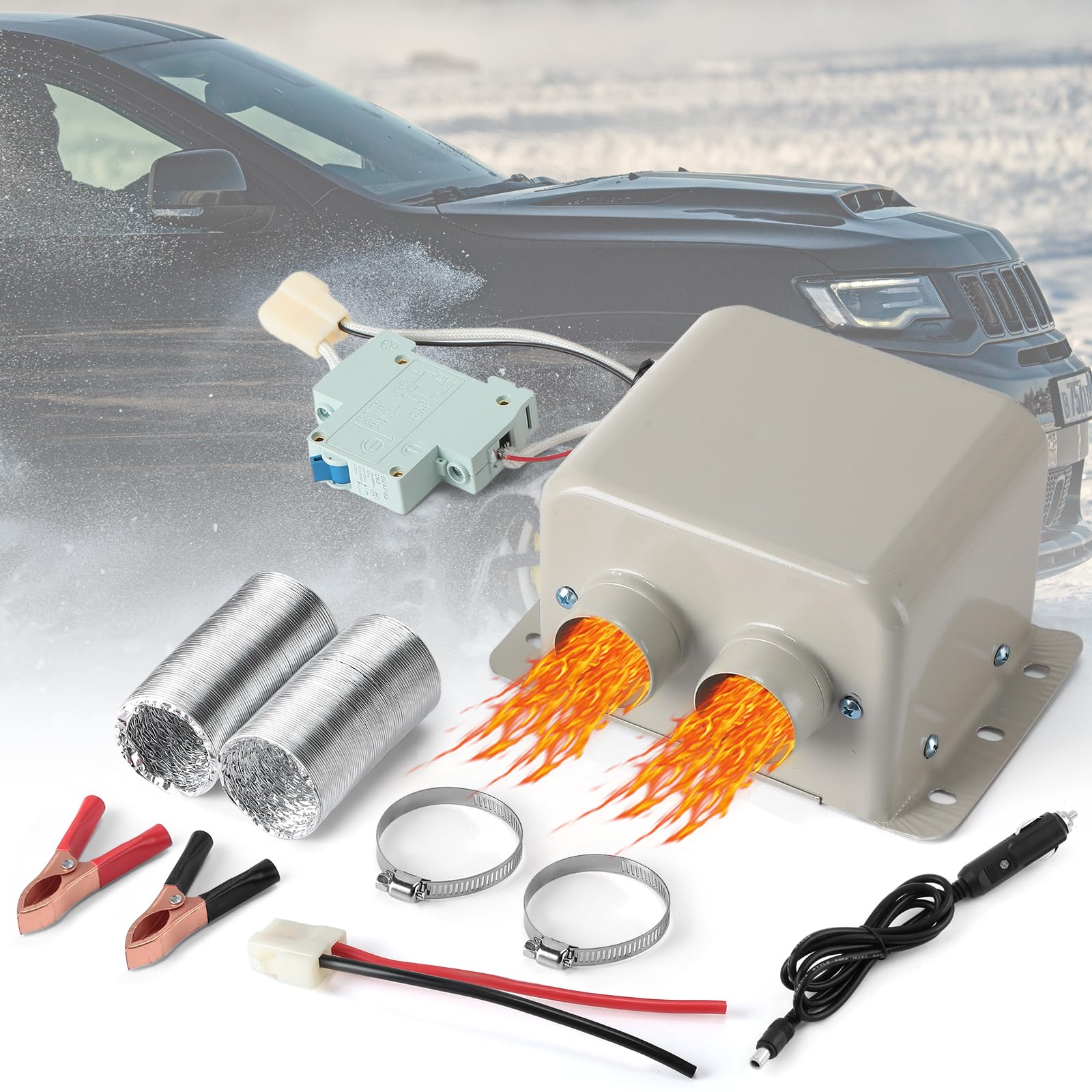
An 800W PTC defogger that is cheap but has the lowest owner satisfaction
This Rossesay unit is the least expensive option on the list and the lowest-rated. It uses an 800W PTC ceramic heating element aimed at the windshield through two aluminum air outlets, which are a step up from plastic pipes in durability. It weighs 2.23 pounds and measures 10.24 x 6.3 x 4.72 inches, making it compact enough to wedge under a dash or seat.
The heat output and airflow are the most-discussed aspects, and both are negative. As buyers put it: “Rated 800W but outputs minimal heat, worse than old 200W unit.” The fan blows too fast and actually cools the heated element, so the air coming out is barely warm. A few owners did get it to work as a slow defogger, but the consensus is that it is underwhelming. The 12V adapter requires hardwiring — no cigarette plug is included on the heater unit itself.
Compared to the CYDZSW 800W, which is a similar price, the Rossesay is notably weaker. It is best viewed as a last-resort defogger for a vehicle that has no existing heat, but even then, it is a gamble.
The one plus
- Very low price is the only consistent positive
- Compact size fits in small spaces
The honest trade-offs
- Heat output is widely reported as minimal — weaker than some 200W units
- Fan blows too fast, cooling the heating element and reducing effectiveness
Only buy if: Your budget is truly tight, you need a last-ditch defogger for a parked vehicle, and you accept the risk of underwhelming performance.
Skip it: For any serious daily use or if you need to stay warm — spend a bit more on the Saihisday or the coolant-fed XuSha for real results.
Understanding the Specs
Wattage vs. BTU: What These Numbers Really Mean
Wattage (e.g., 500W or 800W) tells you how much electrical power the heater draws from your battery and alternator. An 800W PTC heater pulls about 67 amps, which is a heavy load that can drain a small battery in minutes at idle. BTU (British Thermal Units, like 8000 BTU) measures actual heat output, not electrical draw. A coolant-fed heater produces heat from engine fluid, not electricity, so BTU is a better measure of how warm the cab will get.
PTC Ceramic vs. Blower Motor Heaters
PTC (Positive Temperature Coefficient) ceramic heaters are self-regulating — they draw full power when cold and reduce draw as they heat up, making them safe and efficient for spot heating. Blower motor heaters (like the Saihisday and Therwen) simply push air from your existing heat source or ambient air; they don’t generate heat themselves. If you are running a PTC heater, the warm air comes from the element. If you are running a blower, the warmth depends on your engine’s coolant or auxiliary heat source.
FAQ
Can I use a 12V automotive heater in a 24V vehicle?
Will an 800W car heater drain my battery if the engine is idling?
What is the difference between a PTC heater and a coolant heater?
How do I hardwire a 12V car heater safely?
Can I use a 12V automotive heater in my RV or camper?
How do I aim the air hoses for best defrosting?
Will a coolant heater work if my engine is not running?
How many ports do I need for a pickup truck cab?
Final Thoughts: The Verdict
For most buyers, the best automotive electric heater is the Saihisday 12V Car Auxiliary Heater because it delivers a strong four-port blower at a price that makes it a no-brainer for any older truck, UTV, or camper. If you have a classic car with a failed heater core and want real cab heat, grab the XuSha 8000 BTU Coolant Heater. And for a compact four-port underdash fit, the Therwen 12V 4-Port Heater is the one to reach for.
How We Picked
We do not accept paid placement. Every pick is matched to a real buyer and a real use-case; we do not hands-on test units.
Sources & Methodology
Specifications: manufacturer listings and product documentation. Review insights: verified customer reviews, as of July 2026. Pricing: not shown on this page (it changes often); check the current price via the retailer link.
As an Amazon Associate, Gadgets Feed earns from qualifying purchases. This does not affect which products we feature.