
Our readers keep the lights on and my morning glass full of iced black tea. As an Amazon Associate, I earn from qualifying purchases.
Specs are compiled from manufacturer listings and verified buyer reviews and can change over time — please confirm the key details on the product page before buying.
That bubbling paint job you fear usually starts with moisture sneaking in under the topcoat. Epoxy primer locks that moisture out at the bare-metal stage, so this guide sorts the six strongest epoxy primers by how they spray, how fast they dry, and what surfaces they truly bond to. You’ll find the right pick whether you are sealing a full truck roof, a motorcycle gas tank, or an aluminum boat hull.
I’m Min — the founder and writer behind Gadgets Feed. This guide is built by comparing the manufacturers’ published specifications and the patterns across verified customer reviews, so you get each pick’s real strengths and trade-offs instead of marketing spin.
Every option here is a true two-part epoxy system, but the right automotive epoxy primer for you depends on your spray setup, your patience for dry times, and the metal you are protecting.
Our Picks at a Glance


How To Choose The Best Automotive Epoxy Primer
Epoxy primer is a two-part chemical system — a resin base and a hardener that you mix together right before spraying. Once mixed, the clock starts, so the first thing to match is your mixing ratio and your working pace to the size of the job.
Match the mix ratio to your patience
A simple 1:1 mix (one part resin, one part activator) is the easiest to get right and leaves little room for error, while a 4:1 mix gives you more product per can but demands a careful measuring cup. Before you buy, check whether the ratio suits how you plan to apply it — a rattle can already contains the activator and only needs a trigger pop, while a quart kit requires you to stir both parts yourself.
Look at pot life and dry time together
Pot life is the window after mixing when the epoxy stays usable — once it starts to gel, it will ruin your gun. Fast-drying formulas let you sand within hours, which suits a same-day workflow, while slower systems stay wet longer and need more patience between coats. Pair that with the full cure time so you know how long before you can safely lay down a topcoat.
Check the coverage against your panel size
A single aerosol can goes much further on a motorcycle fender than on a full truck cab, so read the stated square-foot coverage before you order one can or two. For large panels like a truck roof or a boat hull, keeping coverage number and pot life in your head at the same time tells you whether a single can finishes the job or leaves you mixing a second batch mid-panel.
Quick Comparison
| Model | Best For | Coverage | Dry Time | Mixing Ratio | Amazon |
|---|---|---|---|---|---|
| Eastwood 2K Epoxy Gray Primer★ Best Overall | Small projects and spot repairs | 10-16 sq ft | 48 hours | Aerosol | Amazon |
| Speedokote Gray Quart KitBare Metal Bond | Bare steel panels with a spray gun | Medium | 3 days (full cure) | 4:1 | Amazon |
| Speedokote Black Quart Kit | Project bikes and gloss black bases | Medium | 3 days (full cure) | 4:1 | Amazon |
| Custom Shop KEP White Primer | Direct-to-metal with a spray gun | Rust protection | 3 days (full cure) | 1:1 | Amazon |
| TotalBoat Aluminum Barrier Coat | Aluminum hulls and underwater metal | 200 sq ft | 3 hours | 3:1 by volume | Amazon |
| SprayMax 2K Epoxy Primer Black | Motorcycle repaints in a rattle can | Not listed | 12 hours | Aerosol | Amazon |
In-Depth Reviews
1. Eastwood 2K Epoxy Gray Primer
Our pick — over 4.5★ from 250+ verified ratings; the strongest balance of quality and price.
The rattle can that sprays like a pro gun for small panels and spot repairs
The biggest headache with aerosol primers is the sputter and uneven fan, and Eastwood solved it with a nozzle built to spray in a wide fan pattern instead of a wet dot. That matters most when you are covering a roof that needs a flat, streak-free base — the thing owners praise most is how it lays down flat and smooth, whether on steel, aluminum, or fiberglass.
For a small 2-foot square area, this single 12-ounce can is almost perfectly sized and eliminates cleanup completely, but it has a real coverage limit you need to respect. The spray covers 10-16 sq ft, and the owner consensus is blunt about it: one can only lasted about 1.5 coats on a large truck roof, so budget two cans for anything bigger than a small car panel. The engineered 2K formula — a gray epoxy base plus an activator inside the can — gives you a 48-hour pot life once activated, which is a very forgiving window if you pause mid-job.
It is waterproof, cures fully in 48 hours, and is made in Germany. The trade-off is that 48-hour dry time demands more patience before you can sand or topcoat compared to faster systems, so plan around that window rather than against it.
Wide-Fan Advantage
- Sprays a wide, flat fan pattern that lays down smoothly
- 48-hour pot life gives you a long working window
- Serves steel, aluminum, and fiberglass from one can
Coverage Math
- Only covers 10-16 sq ft per can
- Large panels like truck roofs need a second can
- 48-hour cure slows a same-day workflow
Reach for this if: you want pro-style spray control out of an aerosol can for small panels, spot repairs, or a single fender.
Look elsewhere if: your job is a full-size body panel — the coverage simply will not stretch, and you will be buying a second can anyway.
2. Speedokote Epoxy Fast Dry DTM Primer & Sealer Gray
The fast-dry workhorse that grips bare steel better than any enamel you have tried
Some primers stick, and some primers bond like they were welded on — this gray Speedokote is firmly in the second camp, with owners reporting it adhered wonderfully to sanded, clean steel on a custom motorcycle bracket where enamel primer simply never would. It is built as a direct-to-metal (DTM) system, meaning it goes straight onto bare steel, aluminum, fiberglass, body fillers, and existing finishes without an extra etching step.
The formula is a true 2K epoxy that lays down super smooth at a simple 4:1 mix ratio, with an optional 5-10% reduction using a 0-VOC reducer. Buyers praise its hard, rust-sealing dry time most after quality, making it a reliable corrosion barrier. Owners describe it as easy to spray, covering well, and adhering strongly to bare steel, and it takes a full 3 days to cure completely so you can sand and topcoat with confidence.
One practical note from the shop floor: the gray is a medium-to-lite gray straight out of the can, not a pure lite grey. One owner mixing it for a specific Cadillac color just stirred in a lite grey base color to hit the exact tone, so if your topcoat demands a precise grey, plan to tint it yourself.
Bond Strength: the adhesion to bare steel is the standout — buyers report it held where enamel primer failed completely.
The Catch: it is a quart kit, so you need a spray gun and a 3-day cure window before you can topcoat.
Best if: you already own a spray gun and want a bond that holds on bare steel, with a fast-dry formula that seals out rust.
skip it if: you have no way to spray a liquid kit — this needs a gun, unlike the aerosol picks.
3. Speedokote Epoxy Fast Dry DTM Primer & Sealer Black

The black base that gives project bikes a flawless foundation under gloss
For anyone spraying a fender, a door, or a whole project bike, this black Speedokote is engineered as a true 2K epoxy with no unreacted polymers, and the sprayability is the thing owners praise most. Beginners and seasoned builders alike report it sprays out beautifully with a smooth coating and dries well — one first-time sprayer shot primer, base coat, and clear coat on a 2013 Taurus fender and door with a budget spray gun and got a great basecoat finish.
It uses the same easy 4:1 mix ratio as its gray sibling, with an optional 5-10% reduction with a 0-VOC reducer, and it lays down super smooth. The adhesion and corrosion resistance are excellent on steel, aluminum, fiberglass, body fillers, and existing finishes, and it takes a full 3 days to cure completely. Owners love that it dries super fast — one sprayed in hot weather and was sanding within 4 hours — though the block notes the mixed feedback: some find it dries almost too fast for comfort.
The honest caveat here is thickness. Even when mixed with the catalyst, this primer is very thick, and one owner found the reducer is not optional when spraying with a siphon-type gun — he had to reduce it just to get it to flow. If you spray with a siphon gun, budget for that reducer from the start.
Spray Ease: the flow and smooth coating make it a forgiving first epoxy for beginners with a spray gun.
Thickness Warning: it is very thick straight out of the can — plan on reducing it for siphon guns.
Who it suits: the DIY builder spraying a bike or a couple of car panels who wants a smooth black base that dries fast.
Who it does not: anyone without a spray gun, or anyone who wants a ready-to-pour consistency without mixing in reducer.
4. Custom Shop KEP Series White DTM Epoxy Primer

The 1:1 mix primer that keeps the math simple and grabs bare metal hard
Mixing ratios are where epoxy primers go wrong, and Custom Shop’s KEP series sidesteps that entirely with an easy 1:1 mix ratio — one part resin, one part activator, no induction time before you spray. Owners praise its smooth spray and 4-hour pot life, comparing it favorably to pricier epoxies.
This is a direct-to-metal (DTM) system with advanced resin technology that delivers superior adhesion to bare metal, steel, bare aluminum, fiberglass, gelcoat, body fillers, and sanded OEM finishes. It is lead and chromate free, loaded with anti-corrosive additives for maximum rust defense, and offers excellent salt spray resistance — a real selling point if your panels see moisture. It is also a 2.1 VOC lbs/gallon product, which means it is formulated to be used coast to coast without regional VOC compliance headaches.
The honest fit note is that quality feedback is genuinely mixed, even though it is the most-discussed aspect. A few owners found the mixing experience hard, with one reporting a hard black ball inside the can that a paint shaker could not break up, requiring manual stirring. When the mix is right, though, owners describe it as durable, easy to spray even for a beginner, and sealing well with a finish that came out great and laid very nice.
The 1:1 Advantage: the simplest mix ratio on this list, with spray performance that earns consistent praise.
The Reality Check: an occasional can arrives with a hardened lump inside, and mixing is inconsistent enough that a few owners call it nearly impossible.
Choose it for: a spray-gun project where you want a simple to use 1:1 mix and factory-grade adhesion to bare metal.
Think twice if: you lack a way to manually stir a thick, possibly settled can — a paint shaker alone may not be enough.
5. TotalBoat Aluminum Boat Barrier Coat Marine Epoxy Primer

The aluminum hull specialist that dries in 3 hours and covers 200 square feet
When your project is a boat hull or any underwater aluminum, the rules change — you need a high-build barrier coat, and this TotalBoat primer covers a full 200 square feet per quart kit, a massive 20x leap over the Eastwood aerosol’s 10-16 sq ft. It is a two-component epoxy that provides excellent corrosion prevention on aluminum hulls and pontoon boats, and owners mention it etches and bonds to even lightly oxidized aluminum, which is exactly the situation that defeats ordinary primers.
The standout advantage is speed: it dries in just 3 hours, a 16x gap versus the Eastwood’s 48 hours, and needs no sanding between coats. It is built for use above and below the waterline, is fully waterproof, and can be overcoated with bottom paints or other 1- and 2-part paints. Owners praise its quality and coverage, with one gallon covering two full coats and a rigger using it on a corroded motor shaft.
The honest trade-off is that for all its toughness, it is not complete armor — one owner reported that a month after painting, the keel had lost some paint, and it is not truly waterproof without a topcoat. It also mixes at a precise 3:1 ratio by volume (5.6:1 by weight), and the instructions confused one buyer enough that they shorted the mix and needed a replacement. Get the ratio right and this is about as protective as a brush-on primer gets for aluminum.
Boat-Ready Bond: etches and bonds to lightly oxidized aluminum where other primers simply fail — the thing owners praise most.
Not Full Armor: it is tough but not indestructible, needs a topcoat for true waterproofing, and demands a careful 3:1 mix.
Reach for it if: you are coating an aluminum hull, pontoon boat, or any underwater metal that needs real corrosion defense.
Look elsewhere if: your job is automotive body panels — this is purpose-built for marine aluminum, not car sheet metal.
6. SprayMax 2K Epoxy Primer Black
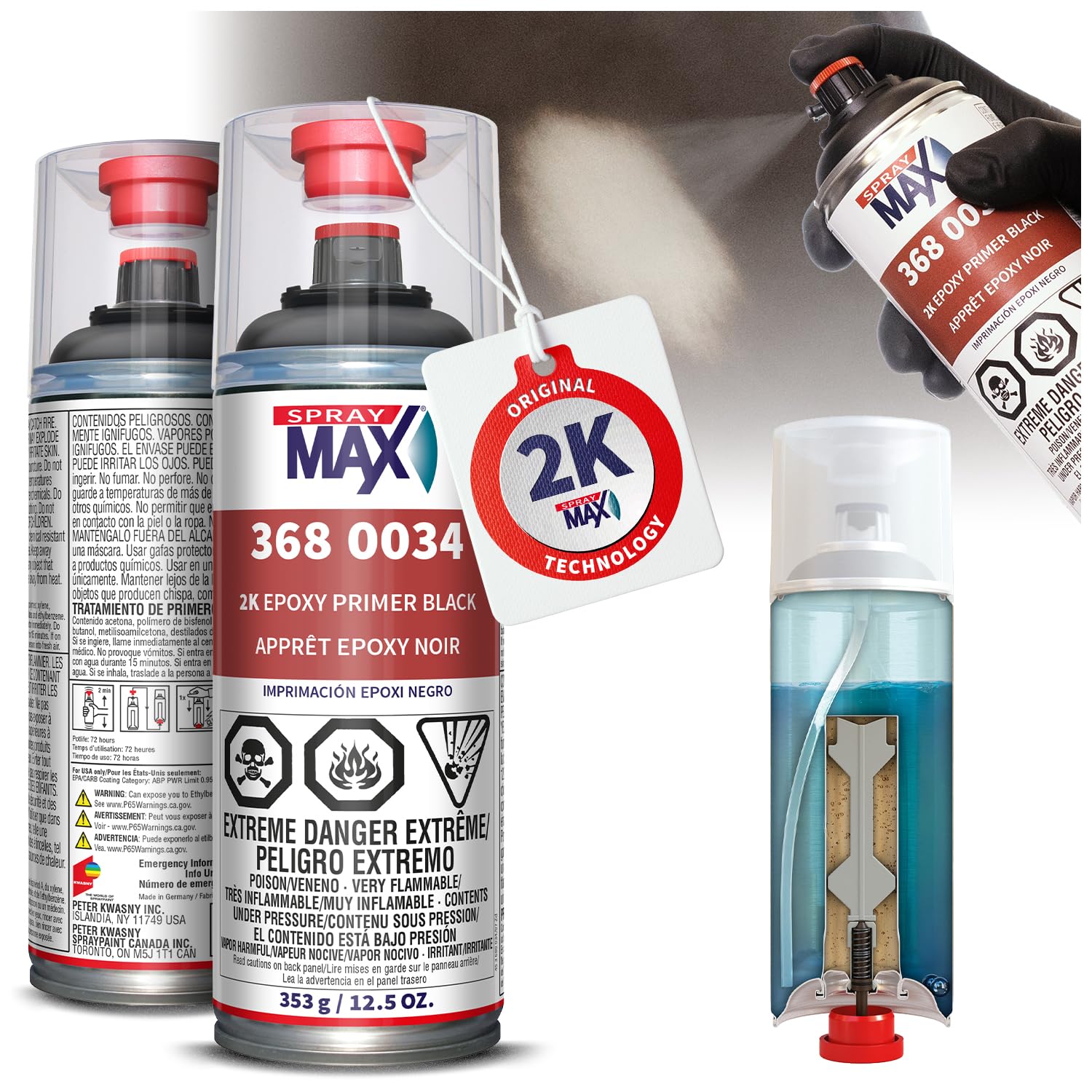
The aerosol 2K that handles a full motorcycle repaint without a compressor
For the budget-minded builder who wants professional-grade bonding without buying a spray gun, this SprayMax aerosol packs a true 2K epoxy system into a rattle can, and the quality is the most-discussed aspect — though it splits opinion harder than anything else here. On the plus side, customers note excellent even coverage, consistent spray, and strong adhesion to metal, with one completing a full motorcycle repaint of the gas tank, fenders, and side plastics using 3 cans for 2 coats each, pairing it with a Rust-Oleum adhesion promoter.
The feature that makes it work is the variable nozzle for precise control, and it is fast-drying — dust-dry in just 15 minutes, with a full cure in 12 hours, and ready to sand within hours for a smooth, efficient workflow. It offers superior corrosion protection with excellent adhesion on steel, aluminum, and galvanized metal, making it ideal for cars, motorcycles, and restorations.
The honest split is that a minority of cans disappoint. Some reviewers point out a loose spray head and a thin stream that sputters after a few seconds, and one had to resurface a hood because the primer was unusable. The consensus is that when a can behaves, it is a genuine professional-grade aerosol 2K; the fit note is to test-spray each new can on scrap before committing it to a visible panel.
Pro Bond in a Can: the variable nozzle and true 2K chemistry deliver strong adhesion and even coverage on full motorcycle repaints.
Can-to-Can Variance: the most-discussed aspect, quality, is genuinely split — most cans are excellent, an occasional one sputters.
Best for: the DIY enthusiast spraying a motorcycle or small car panels who wants 2K bonding power without buying a compressor or gun.
Not for: anyone who cannot afford a surprise bad can — keep scrap metal nearby for a test spray before the real panel.
Understanding the Specs
Pot Life vs. Dry Time
Pot life is the window after you mix the resin and activator when the epoxy stays liquid enough to spray — once it gels, it is ruined, so a longer pot life (like 48 hours on the Eastwood) suits slow, careful work. Dry time is how long the coating needs to harden before you can sand or topcoat; fast dryers like the TotalBoat at 3 hours let you finish a job in a day, while 48-hour systems demand patience between stages.
Mix Ratio and Direct-to-Metal
The mix ratio tells you how much hardener to add to the base — a 1:1 mix is the simplest and hardest to get wrong, while a 4:1 mix gives you more product but needs a measuring cup and careful attention. Direct-to-metal (DTM) means the primer bonds straight to bare steel, aluminum, or fiberglass without a separate etching step, which saves time and one entire layer of product.
FAQ
Can I apply automotive epoxy primer over existing paint?
How long does epoxy primer take to dry before I can sand it?
What is the difference between 1:1 and 4:1 epoxy primer?
Is epoxy primer waterproof?
How much area does one can of epoxy primer cover?
Will epoxy primer stick to aluminum?
Can I use epoxy primer on fiberglass or body filler?
How long does epoxy primer last in the can before it goes bad?
Final Thoughts: The Verdict
For most people, the best all-around automotive epoxy primer is the Eastwood 2K Epoxy Gray Primer because it delivers professional spray control out of an aerosol can, making pro-grade epoxy accessible without a gun. If your panels are bare steel and you already own a spray gun, grab the Speedokote Gray Quart Kit for its standout bond and fast-dry seal. And for an aluminum boat hull that needs real marine-grade corrosion defense, the TotalBoat Aluminum Barrier Coat is the one to reach for — its 200 sq ft coverage and 3-hour dry time leave the aerosols behind.
How We Picked
We do not accept paid placement. Every pick is matched to a real buyer and a real use-case; we do not hands-on test units.
Sources & Methodology
Specifications: manufacturer listings and product documentation. Review insights: verified customer reviews, as of August 2026. Pricing: not shown on this page (it changes often); check the current price via the retailer link.
As an Amazon Associate, Gadgets Feed earns from qualifying purchases. This does not affect which products we feature.