
Your car’s interior trim rattling loose, a bumper bracket snapped mid-highway, or a mirror housing dangling by a thread—these are the moments where a standard household glue just won’t cut it. Automotive environments punish adhesives with constant vibration, extreme temperature swings, road grime, and oil exposure. The wrong formula cracks, softens, or simply lets go, turning a quick fix into a recurring headache. This guide cuts through the noise to match you with the right bonding chemistry for the specific part you’re repairing.
I’m Rikta — the co-founder and writer behind Gadgets Feed. I’ve spent years deep in product research, analyzing technical specifications of automotive adhesives, comparing tensile strength ratings, thermal thresholds, and material compatibility across dozens of formulations to find what truly works under the hood and on the body panel. (And Homer 🐱 vetoed every tube that smelled too interesting on his desk).
From gel cyanoacrylates that stay put on vertical trim to steel-reinforced epoxies that survive underhood heat, the right fix depends on matching the glue to the job. Whether you need a fast-drying bond for a plastic bracket or a structural adhesive for a quarter panel, this guide to the best automotive glue narrows the options to proven performers that won’t fail when the road gets rough.
How To Choose The Best Automotive Glue
Selecting the right automotive adhesive starts with three questions: what material are you bonding, what temperature and vibration will it face, and how fast do you need it to set. Cyanoacrylate gels excel for quick fixes on plastic trim and rubber seals, while two-part epoxies deliver the structural strength needed for body panels and metal brackets. Understanding these fundamental categories prevents the frustration of a failed repair.
Match the Chemistry to the Material
Plastic trim repairs demand a flexible bond that won’t crack under vibration — urethane-based adhesives or flexible epoxies handle this well. For metal-to-metal bonding on brackets or body panels, a steel-reinforced epoxy with a tensile strength above 3,000 PSI is the standard. Fiberglass and carbon fiber composites require a specialized formula that won’t attack the resin matrix, such as a polyester or slow-cure epoxy system.
Consider Thermal and Mechanical Stress
Underhood repairs need adhesives rated for at least 250°F (120°C) to survive near the engine block. Exterior trim and bumpers face road salt, UV exposure, and thermal cycling from hot asphalt to freezing rain. A glue that resists oil, gasoline, and coolant is critical for any repair in the engine bay or near fluid lines. Check the product’s stated continuous operating temperature range before applying.
Quick Comparison
On smaller screens, swipe sideways to see the full table.
| Model | Category | Best For | Key Spec | Amazon |
|---|---|---|---|---|
| J-B Weld 8281 Steel Reinforced Epoxy | Epoxy | High-heat metal repairs | 5020 PSI tensile strength | Amazon |
| Starbond 5 Minute Epoxy Pro Kit | Epoxy | Flexible, vibration-resistant bonds | 2600 lb shear strength | Amazon |
| Buck Panel Bonding Adhesive | Structural Epoxy | OEM-grade panel bonding | 400 ml cartridge, 45 min cure | Amazon |
| 3M Heavy-Bodied Seam Sealer 08308 | Epoxy Sealer | Vertical seam sealing | Self-mixing cartridge, 200 ml | Amazon |
| J-B Weld Plastic Bonder 50139 | Urethane Adhesive | Plastic and composite repairs | 3770 PSI tensile strength | Amazon |
| 3M Hi-Strength 94 ET Spray Adhesive | Spray Contact | Large surface laminations | 60-minute open bonding time | Amazon |
| KRAFTPROTZ Automotive Super Glue Gel | Cyanoacrylate Gel | Quick plastic and trim fixes | Heat resistant to 230°F | Amazon |
In‑Depth Reviews
1. J-B Weld 8281 Professional Size Steel Reinforced Epoxy

This is the benchmark for heavy-duty automotive epoxy, delivering a tensile strength of 5,020 PSI with a temperature tolerance up to 550°F (287°C). The two-part paste mixes at a 1:1 ratio and cures to a dark grey finish that can be drilled, tapped, and sanded — essential for structural repairs on engine blocks, exhaust brackets, and radiator housings where lesser adhesives would soften or delaminate. The 10-ounce professional size provides enough material for multiple substantial repairs without running out mid-project.
The 4-to-6-hour set time and 15-to-24-hour full cure demand patience, but the resulting bond is waterproof and resists petroleum, chemicals, and acids. Users consistently report success on metal, plastic, PVC, wood, concrete, and fiberglass, with the steel reinforcement creating a bond described as stronger than the surrounding material. A single 5-star review notes the cured epoxy forms razor-sharp peaks if left untooled, so shaping during the working window is recommended.
For anyone repairing a cracked engine component, reattaching a motor mount, or filling a hole in a metal panel, this epoxy is the gold standard. The longer cure time is the only trade-off for its exceptional strength, making it less suitable for quick roadside fixes but unbeatable for workshop-quality repairs that need to outlast the car itself.
Why it’s great
- 5020 PSI tensile strength — one of the strongest consumer epoxies available
- Withstands continuous heat up to 550°F, ideal for engine bay components
- Multi-surface versatility: metal, plastic, wood, ceramic, fiberglass, concrete
- Can be machined, drilled, sanded, and painted after full cure
Good to know
- Requires 15-24 hours for full cure — not for impatient repairs
- Tubes may contain trapped air, reducing the usable volume slightly
2. Starbond 5 Minute Epoxy Pro Kit

The Starbond Pro Kit offers a toughened, flexible epoxy formula that maintains structural integrity under vibration and impact — critical for automotive applications where rigid adhesives fail over time. With a shear strength of 2,600 lb, it handles stress loads on plastic brackets, interior trim, and non-structural metal components without becoming brittle. The 5-minute handling time provides enough working window to position parts before the gel sets, while full cure at 24 hours ensures maximum bond durability.
The 8-ounce kit includes screw-cap bottles, reusable mixing trays, and applicator tools that eliminate the mess of syringe-based systems. The 1:1 mixing ratio by volume is straightforward, and the clear finish makes it suitable for visible repairs where appearance matters. One user testing a butt joint on crown molding reported failure, but the same epoxy performed well on other substrates — the flexible nature works best when the bond line experiences shear or peel forces rather than pure tension.
This kit shines for repairs on interior panels, plastic housings, and any area where the part will flex or move during use. The included accessories and clean application make it a strong mid-range option for DIYers who want professional-grade flexibility without the premium price tag of structural panel adhesives.
Why it’s great
- Toughened formula absorbs vibration without cracking — ideal for trim and interior parts
- 5-minute set time balances speed with adjustment window
- Complete pro kit with mixing trays, spatula, and screw-cap bottles reduces waste
- Cures clear for discreet visible repairs
Good to know
- Butt joint strength may fall short in pure tension scenarios
- Full 24-hour cure required for maximum load capacity
3. Buck Panel Bonding Adhesive

Engineered to meet OEM standards for structural panel bonding, this two-part polyurethane adhesive delivers professional-grade adhesion for door skins, roof panels, quarter panels, and bumper covers. The 400 ml cartridge provides nearly twice the volume of standard 200 ml automotive epoxy cartridges, making it the economical choice for full-panel replacement jobs. It bonds reliably to steel, aluminum, plastic, fiberglass, and composite panels — covering nearly every material found in modern vehicle construction.
The adhesive cures at room temperature without heat assistance, reaching handling strength within 45 minutes, with chemical and corrosion resistance built into the formulation. Users report successful repairs on a 1956 Chevy floor pan and a Tesla Model 3 bumper light mount, demonstrating versatility from classic car restoration to modern EV repairs. The included three static mixing nozzles ensure consistent 1:1 ratio mixing, though a standard 400 ml dispensing gun (not included) is required for application.
This is the right choice for anyone performing body panel replacements, bonding structural reinforcements, or needing a true OEM-grade bond on collision repairs. The upfront cost is higher than smaller epoxy kits, but the material cost per repair is lower when measured against the volume delivered and the durability of the finished bond.
Why it’s great
- OEM-grade structural bond for body panels, door skins, and quarter panels
- 400 ml cartridge offers nearly double the volume of standard automotive epoxies
- Cures at room temperature — no heat lamp or oven required
- Resists chemicals, water, and corrosion for long-term durability
Good to know
- Requires a 400 ml dispensing gun (not included in the package)
- Initial cost is higher than smaller-format adhesives
4. 3M Heavy-Bodied Seam Sealer 08308

This two-part epoxy from 3M is purpose-built for sealing vertical and horizontal seams to match OEM appearance, with a heavy-bodied, non-flowing formula that stays exactly where applied. The dual-syringe cartridge mixes the epoxy automatically through the included static mixing nozzle, eliminating manual stirring and ratio guesswork — critical for consistent cure in collision repair environments. The non-sag property allows tooling to match factory seam contours without dripping or running down the panel.
At 75°F, the sealer provides ample working time before curing to a hard, paintable finish in about 8 hours. Users in collision repair centers consistently rate it as a trusted 3M product, with specific praise for its bond on properly prepared surfaces. One detailed review on a 2003 Ford F350 roof ditch repair highlights the importance of applying it over epoxy primer rather than acid-etching primer to ensure adhesion. The 200 ml cartridge is ideal for focused seam sealing jobs rather than large panel bonding.
For restorers replacing roof skins, repairing door seams, or sealing drip rails, this sealer delivers factory-quality results. The auto-mixing cartridge saves time and reduces waste, while the heavy-bodied formula gives the control needed for professional-looking seam finishing.
Why it’s great
- Self-mixing cartridge ensures perfect 1:1 ratio every time — no measuring required
- Non-sag, heavy-bodied formula holds vertical applications without dripping
- Matches OEM seam appearance when tooled correctly
- Trusted by collision repair centers for professional results
Good to know
- Requires a caulk-style dispensing gun for application
- Bonds poorly over acid-etching primer — use epoxy primer base instead
5. J-B Weld Plastic Bonder 50139

This two-part urethane adhesive paste from J-B Weld is specifically formulated for bonding thermoplastics, thermoset composites, carbon fiber, and coated metals — materials that typically resist cyanoacrylate adhesives. With a tensile strength of 3,770 PSI, it significantly outperforms general-purpose plastic glues while maintaining the flexibility needed for plastic components that expand and contract with temperature changes. The 15-minute set time allows for positioning adjustments before the paste reaches handling strength at 30 minutes.
The black paste consistency works well as both an adhesive and a gap filler, with users reporting success filling cracks in motorcycle fairings and bonding a BMW front air dam before sanding smooth for paint. The syringe applicator delivers a thick, putty-like bead that won’t drip on vertical surfaces, though reviewers note that holding the syringe upright before opening the cap minimizes uneven material discharge. Surface preparation with alcohol is critical for maximum adhesion, especially on slippery plastics like polypropylene.
For repairing cracked plastic bumper covers, reattaching broken interior clips, or bonding carbon fiber trim pieces, this urethane adhesive offers the right balance of strength and flexibility. The ability to sand and paint the cured bond makes it suitable for visible repairs where appearance matters.
Why it’s great
- Specifically formulated for thermoplastics, carbon fiber, and coated metals
- 3,770 PSI tensile strength — strong for plastic-specific adhesives
- Thick paste fills gaps and can be sanded smooth for painted repairs
- Sets in 15 minutes, handling strength at 30 minutes
Good to know
- Requires clean, alcohol-prepped surface for reliable bond
- Putty-like consistency may leave visible seam on smooth panels
6. 3M Hi-Strength 94 ET Spray Adhesive
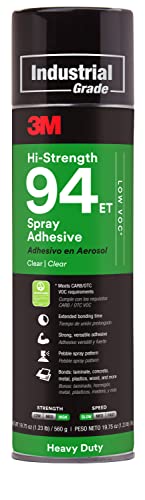
This spray adhesive from 3M fills a specific niche in automotive work: bonding large surface areas like headliners, carpet, foam sound-deadening panels, and trunk liners where tube adhesives would take hours. The spray pattern delivers an even coat across wide panels, with an open bonding time of up to 60 minutes — far longer than contact cements — allowing precise positioning of materials like carpet and foam without rushing. The low-VOC, GREENGUARD-certified formulation makes it suitable for interior work where air quality is a concern.
The aggressive tack holds materials firmly even in cold temperatures, as confirmed by a user who applied foam soundproofing in a hunting blind during freezing conditions. Another review notes successful bonding of insulation to metal van walls, with a strong solvent smell that demands proper ventilation and a respirator. The 19.75-ounce can provides extensive coverage, with one user reporting 18 months of shelf life after first use, though the spray nozzle can clog if not cleaned between applications.
For any project involving upholstery, carpet replacement, foam insulation, or headliner repair, this spray adhesive saves hours compared to rolling or brushing on contact cement. The longer open time is a genuine advantage for DIYers who need to make adjustments before the bond becomes permanent.
Why it’s great
- 60-minute open time allows precise positioning of large materials
- Aggressive tack bonds foam, carpet, and insulation to metal and plastic
- Low-VOC formula with GREENGUARD certification for interior use
- Excellent coverage — a single can covers substantial surface areas
Good to know
- Strong solvent odor requires ventilation and respiratory protection
- Spray nozzle may clog between uses if not cleaned properly
7. KRAFTPROTZ Automotive Super Glue Gel
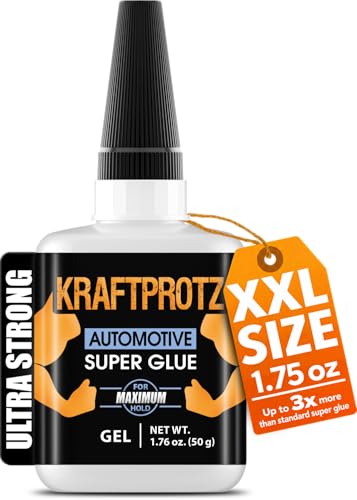
For quick, accessible fixes on car trim, mirror housings, and rubber seals, this XXL 1.76-ounce cyanoacrylate gel delivers three times the volume of standard super glue tubes at an accessible price point. The no-drip gel formula stays in place on vertical surfaces — essential for dashboard panels, fender clips, and door trim where liquid super glue would run and ruin upholstery. It withstands temperatures up to 230°F (110°C) and resists oil, making it suitable for engine bay trim and underhood plastic components.
The anti-clog tip and precision nozzle maintain consistent gel flow even after weeks between uses, which is important for mechanics and restorers who use adhesive incrementally. Real-world fixes include a Volkswagen Golf R front bumper separation (saved from a body shop bill), a side truck mirror reassembled after a collision, and RV rubber molding reattachment. The slower 2-3 minute setup time compared to instant glues actually benefits automotive work by allowing positioning before the bond locks permanently.
This is the go-to for drivers who need a quick, reliable bond on plastic or rubber automotive parts without the cost of two-part epoxies. It is not a substitute for structural panel bonding, but for trim, gaskets, and non-structural repairs, it provides a durable hold that survives weather and road vibration.
Why it’s great
- No-drip gel formula holds vertical surfaces — won’t run onto upholstery
- Heat resistant to 230°F and oil-resistant for engine bay use
- 1.76 oz bottle offers 3x the volume of standard super glue tubes
- Anti-clog tip keeps nozzle clear for repeated use across multiple repairs
Good to know
- Slower setup (2-3 minutes) than instant cyanoacrylates — requires clamping
- Chemical odor during application requires ventilation
FAQ
Can I use regular super glue on car trim?
How do I prep a surface before applying automotive glue?
What’s the difference between a urethane adhesive and an epoxy for car repairs?
Final Thoughts: The Verdict
For most users, the best automotive glue winner is the J-B Weld 8281 Steel Reinforced Epoxy because it combines the highest tensile strength (5,020 PSI) with extreme heat resistance (550°F) and works across virtually every automotive material — from engine blocks to body panels. If you need a flexible bond for plastic trim and interior parts that vibrate, grab the Starbond 5 Minute Epoxy Pro Kit. And for quick, affordable fixes on mirror housings or loose trim without the complexity of two-part epoxies, nothing beats the KRAFTPROTZ Automotive Super Glue Gel.