
Driving under a scorching sun turns your vehicle’s cabin into an oven, while roaring road noise and engine vibration turn commutes into a chore. Automotive heat insulation is the science of blocking radiant thermal energy and dampening structure-borne sound, transforming a tin can into a sanctuary. The right material cuts interior temperature by double digits and drops decibel levels by a measurable margin, making every drive quieter and cooler.
I’m Min — the co-founder and writer behind Gadgets Feed. I’ve spent countless hours dissecting butyl rubber formulations, closed-cell foam densities, and aluminum foil reflectivity ratings to find which products actually deliver on their thermal and acoustic promises.
Every mat, sheet, and roll reviewed here was selected and ranked based on measurable performance specs like thickness in mils, coverage area, material composition, and real customer temperature data to crown the true winner of the best automotive heat insulation.
How To Choose The Best Automotive Heat Insulation
Choosing between a reflective bubble sheet, a butyl deadener, or a closed-cell foam barrier is a decision rooted in your specific pain: excessive cabin heat, engine drone, or both. The following three criteria will guide you to the right match.
Material Core: Butyl vs. Closed-Cell Foam vs. Reflective Bubble
Butyl rubber mats are heavy, dense, and excel at converting vibration energy into negligible heat — they are the gold standard for sound deadening and provide a secondary thermal block. Closed-cell PE foam is lighter, resists moisture absorption, and offers superior thermal insulation per unit thickness. Reflective double-bubble aluminum foil works as a radiant barrier, bouncing 95% of infrared heat away before it enters the cavity. For maximum results, layer a butyl damper with a foam barrier; for a budget radiant fix, the reflective foil alone can drop surface temperatures by 10°F or more.
Thickness and Coverage
Thickness is measured in mils (thousandths of an inch) or millimeters. A 2mm (80 mil) sheet is ideal for flat panels like doors and floors where clearance is tight. A 5mm (200 mil) mat provides a deeper thermal and acoustic buffer and suits hoods, trunks, and firewall sections. Coverage area determines how far your money goes — 25 to 36 square feet is enough for doors and trunk of a sedan, while full-cabin projects need 50 square feet or more.
Adhesive Backing and Temperature Tolerance
A permanent, high-tack adhesive saves install time and prevents sagging on vertical panels, especially inside engine bays or on hoods where under-hood temperatures can exceed 200°F. Look for a working temperature range of at least -40°C to +149°C if you live in extreme climates. Closed-cell PE foam often handles higher sustained heat without breaking down compared to thick butyl rubber, which can become runny if not properly formulated.
Quick Comparison
On smaller screens, swipe sideways to see the full table.
| Model | Category | Best For | Key Spec | Amazon |
|---|---|---|---|---|
| Siless Hybrid 3in1 | 3in1 Composite | Total cabin transformation | 200 mil / 5mm thick, 25 sqft | Amazon |
| Siless Max 120 mil | Butyl Dampener | Professional-level vibration kill | 120 mil / 3mm thick, 30 sqft | Amazon |
| Zhengmy 196 mil | Closed-Cell Foam | Large-area thermal + sound | 196 mil / 5mm thick, 53.9 sqft | Amazon |
| CUKWUYBY 80mil | Butyl Dampener | Affordable vibration control | 80 mil / 2mm thick, 36 sqft | Amazon |
| CHAOGANG 200mil Foam | PE Foam | Moisture-proof thermal barrier | 200 mil / 5mm thick, 36.16 sqft | Amazon |
| Storystore 394 mil | Fiberglass Mat | Extreme thickness insulation | 394 mil / 10mm thick, 16.5 sqft | Amazon |
| MRPAPA Double Bubble | Radiant Barrier | Window and quick radiant fix | 6mm thick, 24″x10ft sheet | Amazon |
In‑Depth Reviews
1. Siless Hybrid 3in1 200 mil

The Siless Hybrid 3in1 stacks a butyl mastic layer, a PE foam core, and a mass-loaded butyl membrane into a unified 200-mil sheet that tackles vibration, heat, and low-frequency drone in one pass. Users report cabin temperature drops of 13°F after installation in a Chevy Express, while exhaust noise in a Fiesta ST became barely audible inside. The 25-square-foot coverage is modest, but the composite construction eliminates the need to layer separate products.
Installers praise its flexibility — it cuts cleanly with scissors and molds into complex contours without fighting back. The adhesive is aggressive and bonds permanently to clean metal, though it will stick to clothing if mishandled. Unlike pure butyl mats, the foam layer adds genuine thermal resistance beyond mass damping, making this a true dual-purpose solution rather than a sound killer with marginal heat blocking.
For anyone intending to treat doors, floor pans, and the firewall simultaneously, this Hybrid 3in1 delivers the broadest benefit per square foot. The only downsides are the price per square foot being higher than single-layer alternatives and the fact that no roller is included — you will need one to seat the butyl firmly against irregular surfaces.
Why it’s great
- Three-layer design solves heat, vibration, and noise in one installation
- Measured 13°F cabin temperature drop after full install
- Soft and pliable for complex curves and tight spaces
Good to know
- Only 25 sqft — large vehicles need multiple boxes
- No roller included; hand-rolling is critical for adhesion
2. Siless Max 120 mil

If your primary complaint is road noise and panel resonance, the Siless Max 120 mil butyl mat is the refined solution. Its Bmastic formulation — a proprietary butyl compound — offers higher internal damping than generic rubber mats, transforming door panels from ringing drums into deadened masses. One user reported that a 2010 Civic base model now feels as quiet as a Lexus after treating doors, trunk, and floor. The 30-square-foot coverage is generous enough for a sedan’s four doors and trunk lid.
Thermal performance here is a secondary benefit: the rubber mass acts as a moderate heat barrier, but it does not include a dedicated foam or reflective layer. On a Toyota Yaris, a full install kept the cabin noticeably cooler, though users in extreme sun climates still add a closed-cell foam overlay on top. The material has no off-gassing odor, which is a common issue with lower-grade asphalt-based deadeners.
Installation requires thorough surface prep — the adhesive is tenacious and will not release once set. Users who skipped cleaning saw sagging on vertical panels. A roller is not included but is strongly recommended to activate the butyl bond. For pure vibration control with decent thermal bleed reduction, this is the benchmark.
Why it’s great
- Superior Bmastic butyl compound outperforms generic rubber deadeners
- Zero odor or off-gassing after installation
- Excellent value: 30 sqft at competitive price per square foot
Good to know
- No thermal foam layer — best paired with a separate heat barrier
- Adhesive requires meticulous surface cleaning for long-term hold
3. Zhengmy 196 mil Foam Roll

The Zhengmy 196-mil closed-cell foam roll delivers 53.9 square feet of coverage — enough to insulate the entire cabin floor, roof, and firewall of a full-size sedan in one purchase. At 5 mm thick, its closed-cell structure resists moisture and provides a consistent thermal barrier across every panel. A user with a Corvette reported a 7-10 dB reduction in highway noise, while heat dissipation from the exhaust tunnel was noted as modest but present.
What sets this roll apart is the inclusion of two muffler rollers in the package, which simplifies the install process and ensures the adhesive backing bonds uniformly. The foam is flame-retardant and oil-resistant, making it suitable for engine bay adjacent applications where safety is a concern. The aluminum foil facing reflects radiant heat, though the foam itself does the bulk of thermal work.
The adhesive is strong but not aggressive enough to hold on heavily textured surfaces without extra pressure — users with OEM sound-deadening coatings on their floor pans may need to clean down to bare metal. The roll format also means the material arrives flat, avoiding crease issues common with folded sheets. This is the best single-roll solution for large-scale projects where surface area coverage is the priority.
Why it’s great
- Massive 53.9 sqft covers an entire vehicle in one roll
- Includes two rollers for proper adhesion during install
- Flame-retardant and oil-resistant for high-heat zones
Good to know
- Adhesive may struggle on textured or painted surfaces
- Heat dissipation is moderate, not transformative for extreme temperatures
4. CUKWUYBY 80mil Butyl Kit
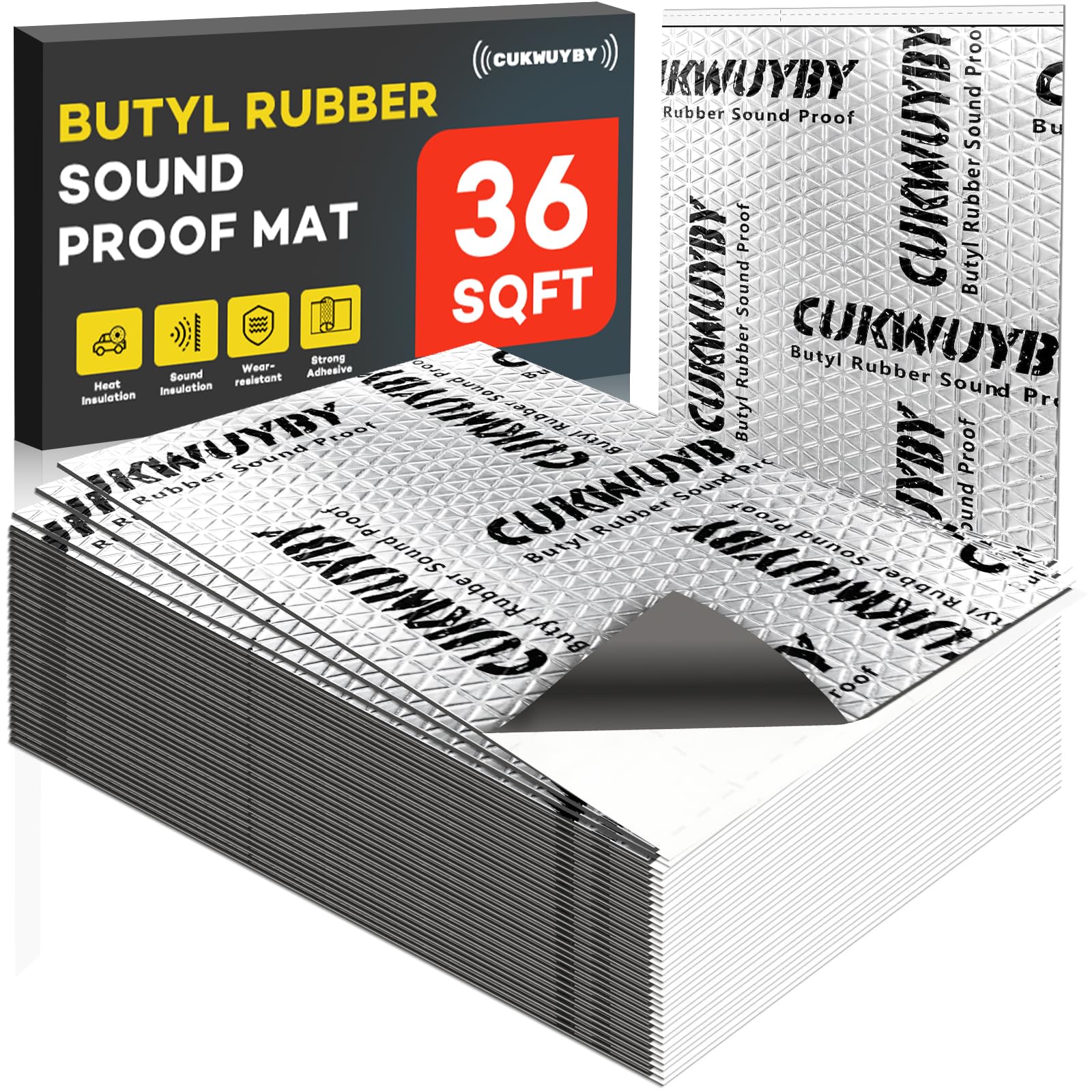
The CUKWUYBY 80-mil butyl mat uses an 8-wire reinforced aluminum foil outer layer paired with a 2 mm butyl rubber core, offering a lightweight vibration dampener with an integrated heat reflective skin. At 36 square feet across 33 individual sheets, this kit provides enough material to treat all four doors and the trunk of a 2018 Durango with enough left over for the rear gate. Users report a complete elimination of door rattle after audio system upgrades.
The thermal benefit comes from the aluminum foil layer, which reflects radiant engine heat away from the cabin, though the 2 mm butyl thickness limits its ability to block conducted heat from the exhaust tunnel. This makes it ideal for door panels and roof skins where heat reflection is useful but vibration is the main enemy. The adhesive is described as “very sticky” and bonds onto clean paint permanently, requiring heat to remove if needed.
One test on a 2000 Tahoe showed excellent sound deadening with zero smell, and users who compared it to name-brand butyl mats found no meaningful performance difference — confirming that the premium is in the material formulation, not the sticker. The only caution is that 80 mil is thin by deadening standards, so it will not kill deep subwoofer resonance as effectively as a 120- or 200-mil mat.
Why it’s great
- Fraction of the cost of premium butyl brands with equivalent performance
- 8-wire foil facing provides genuine radiant heat reflection
- 33 pre-cut sheets make installation fast and consistent
Good to know
- 2mm thickness is light for deep bass dampening
- Adhesive is near-permanent; repositioning is difficult
5. CHAOGANG 200mil PE Foam

The CHAOGANG 200-mil closed-cell PE foam is a dedicated thermal and moisture barrier that excels where condensation is a concern — think door cavities, trunk floors, and roof panels. Its high-density polyethylene foam structure absolutely refuses to absorb water, and the 5A-grade aluminum foil facing blocks UV radiation while reflecting heat. With a working temperature range of -40°C to +149°C, this mat can sit on a firewall without degrading or off-gassing.
The 36.16-square-foot roll (315 inches long by 16.5 inches wide) suits narrow panels and tight runs; users on a VW Taos and Ram 1500 layered it over butyl matting to achieve a 100% elimination of road noise at 55 mph with the A/C on low. The foam adds a compressible thermal layer that butyl alone cannot provide, trapping air for insulation value.
The adhesive is strong but not so aggressive that it cannot be repositioned within the first few seconds. That said, the foam itself is somewhat fragile — rough handling can tear the aluminum facer or dent the PE core. It is best used as a secondary layer over a butyl damper rather than a standalone sound killer. For pure heat insulation with moisture resistance, this is a top contender.
Why it’s great
- Zero moisture absorption — ideal for door cavities and floor pans
- Wide temperature tolerance from -40°C to +149°C
- Strong aluminum foil reflects radiant heat effectively
Good to know
- Foam core is fragile and can tear during aggressive handling
- Not a standalone vibration dampener — pair with butyl mat for best results
6. Storystore 394 mil Fiberglass Mat
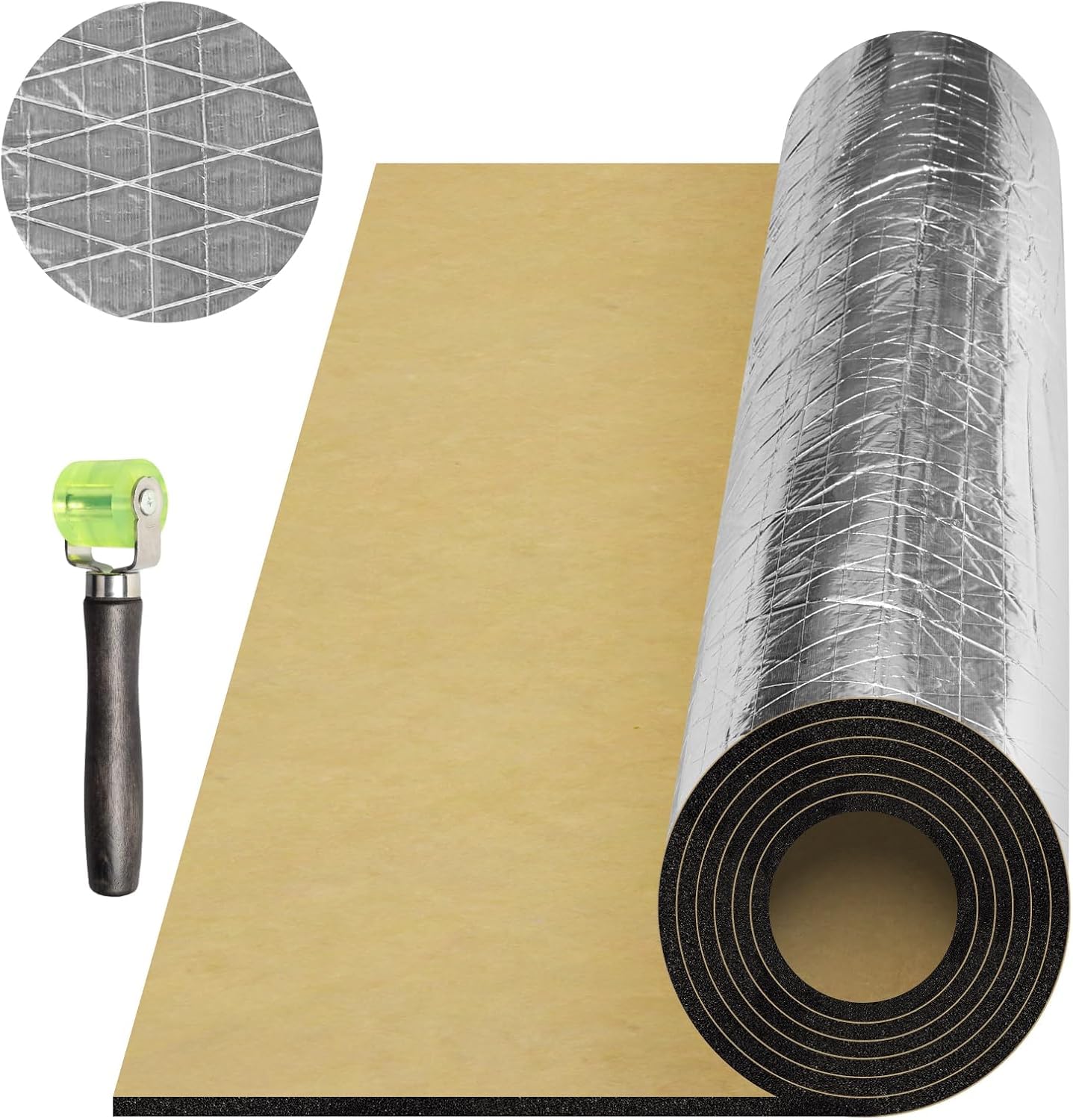
At a massive 394 mils (10 mm), the Storystore fiberglass-based insulation mat is the thickest product in this lineup, offering 16.5 square feet of coverage. Its fiberglass core provides superior thermal resistance per millimeter compared to foam or rubber, making it a serious contender for firewall, transmission tunnel, and engine bay heat management. Users on a 1966 GTO and 1972 GMC reported a noticeable difference in both noise and interior temperature after a single application.
The fiberglass construction gives this mat a rigid, dense feel — it holds its shape even under pressure, which is useful for areas that see physical contact like floorboards. However, installation requires careful cutting with a sharp blade, and the material lacks the pliability of butyl or PE foam for complex curves. Some users noted that adhesive bonding on hoods required extra weight or washers to hold the heavy mat in place while the glue cured.
Sound deadening results are excellent for low-frequency engine drone, but the 16.5-square-foot coverage is limited — it covers roughly one large surface (the entire floor pan of a compact car) with little leftover. For extreme thermal isolation in targeted zones like the firewall or exhaust tunnel, this mat is unmatched. For full-cabin coverage, you will need multiple packs.
Why it’s great
- 10 mm thickness provides massive thermal and acoustic resistance
- Fiberglass core holds shape under pressure and high heat
- Excellent for targeted firewall and tunnel insulation
Good to know
- Limited 16.5 sqft coverage — multiple units needed for full cabin
- Rigid material does not conform to complex body curves easily
7. MRPAPA Double Bubble Foil Sheet
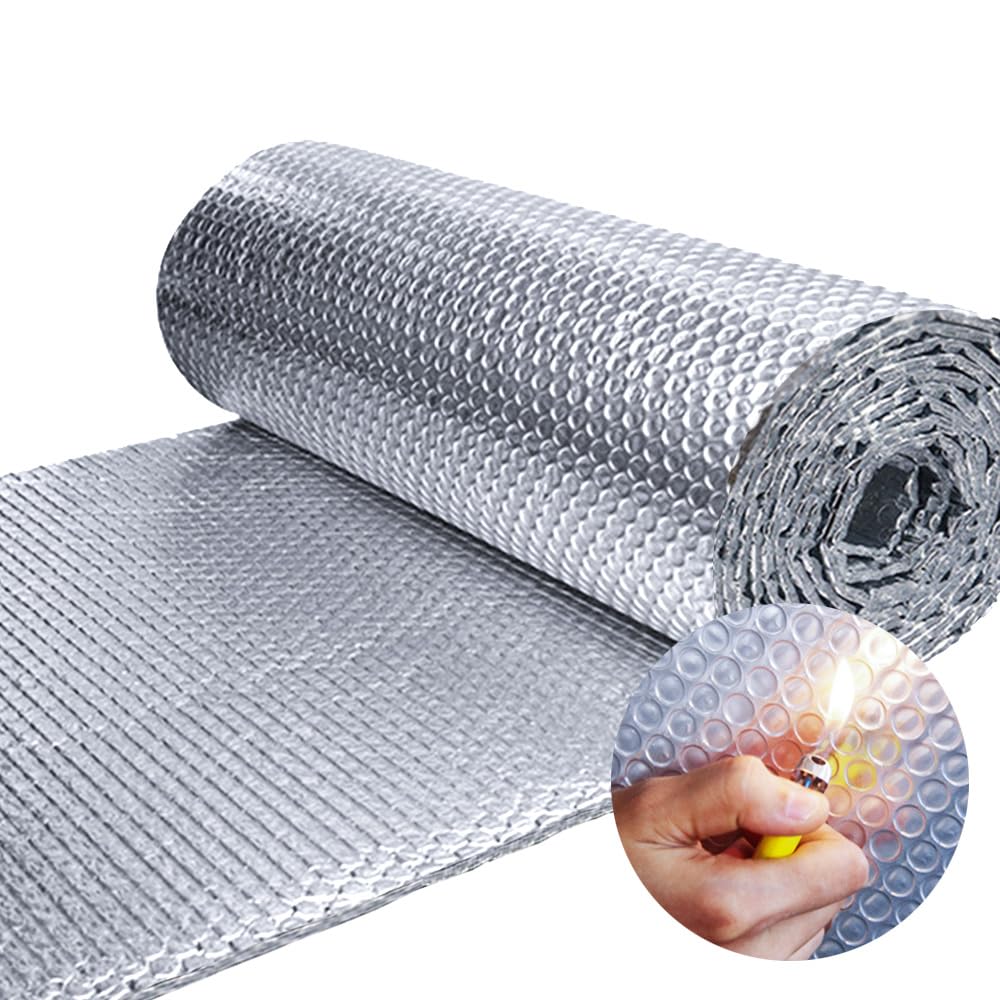
The MRPAPA reflective double-bubble sheet serves a very specific niche: a lightweight, easy-to-cut radiant barrier for windows, sunroofs, and RV windshields. Its 6 mm air-bubble core sandwiched between two layers of aluminum foil reflects 95% of radiant energy, making it ideal for blocking solar heat before it enters the cabin. Real-world testing with a laser thermometer showed no temperature difference between the attic cover and ceiling on a hot day — indicating the heat was reflected rather than absorbed.
Unlike butyl or foam mats, this sheet is not self-adhesive across its entire surface. It comes with 70 peel-and-stick pads for mounting, which work well on flat, clean surfaces like window frames but struggle on textured or curved panels. Some users noted it arrived folded rather than rolled, causing permanent crease lines that compromise total light block — ordering earlier in cool weather helps the material retain its roll shape.
For RV owners battling window heat transfer or homeowners insulating garage doors, this sheet offers a dirt-cheap solution that installs in minutes with scissors. It is not a substitute for butyl deadening on metal panels — it will not stop vibration or rattle — but for its specific job of blocking radiant heat through glass, it outperforms many thicker alternatives.
Why it’s great
- Reflects 95% of radiant energy — laser thermometer verified
- Ultra-light and easy to cut with scissors for custom shapes
- Perfect for window, sunroof, and RV windshield applications
Good to know
- Arrives folded, not rolled — creases may affect light block performance
- Included adhesive pads are only suitable for flat, smooth surfaces
FAQ
Can I use automotive heat insulation on my car windows?
What is the best material for blocking engine heat through the firewall?
How much automotive heat insulation do I need for a full sedan?
Will automotive heat insulation reduce road noise?
Final Thoughts: The Verdict
For most users, the best automotive heat insulation winner is the Siless Hybrid 3in1 because its three-layer composite delivers measurable heat reduction and noise dampening in a single install, eliminating the guesswork of layering separate products. If you want maximum coverage for a large vehicle, grab the Zhengmy 196 mil foam roll. And for pure vibration control at the best value, nothing beats the Siless Max 120 mil butyl mat.