
Our readers keep the lights on and my morning glass full of iced black tea. As an Amazon Associate, I earn from qualifying purchases.
Specs are compiled from manufacturer listings and verified buyer reviews and can change over time — please confirm the key details on the product page before buying.
If you are still hauling around a 40-pound lead-acid block under the hood, you are carrying dead weight you do not need. Switching to a lithium automotive battery cuts weight by up to 30 pounds, delivers faster cold-weather cranking, and lasts 5–10 years versus 3–5 for lead-acid. Lithium batteries vary: some maximize starting power, others combine deep-cycle capacity for boats or RVs, and a few target modern start-stop systems.
I’m Min — the founder and writer behind Gadgets Feed. This guide is built by comparing the manufacturers’ published specifications and the patterns across verified customer reviews, so you get each pick’s real strengths and trade-offs instead of marketing spin.
Here is what really matters when shopping for the best automotive li-ion battery: cold cranking amps (CCA), weight savings, the built-in Battery Management System (BMS), and physical fit — because a lithium battery that does not fit your tray or does not talk to your alternator is useless.
Quick Picks
- LiFePO4 Lithium Car Battery, 12V 90AH 1300CCA Group 49 Starting-Stop — Top Performer
- TET Car Start-Stop Lithium Battery For Car BCI Group 40R — Best Overall
- WEIZE 12V 105AH 1000CCA Dual Purpose LiFePO4 Battery, Group 31 — Dual Purpose Ace
- Lithium Car Battery 12V Group 26 600CCA LiFePO4 Start and Stop — Budget Champion
How To Choose The Best Automotive Li-Ion Battery
Lithium iron phosphate (LiFePO4) car batteries are not one-size-fits-all. You need to match the battery’s group size, power output, and BMS behavior to your vehicle’s demands — or you will get a paperweight that looks great in the tray.
Group Size: The Fit Check
Your car’s battery tray is a fixed rectangle. A Group 40R measures 11″ L x 6.93″ W x 6.93″ H, while a Group 26 battery measures 8.14″ L x 6.88″ W x 7.08″ H. Measure your old battery’s length, width, and height, plus note where the positive and negative terminals sit. A battery that is half an inch too wide will force you to modify the box or strap.
Cold Cranking Amps (CCA)
CCA is the number that tells you if your engine will fire on a January morning. It measures how many amps a battery can deliver at 0°F for 30 seconds without dropping below 7.2 volts. A big V8 diesel needs more than 1000 CCA; a four-cylinder sedan gets by on 600 CCA. Going higher than your car requires never hurts — the engine just cranks faster.
Battery Management System (BMS) Safety
A BMS is the small circuit board inside a lithium battery that prevents overcharge, over-discharge, overcurrent, and extreme temperatures. Without it, a lithium cell can be permanently damaged or become unstable. The BMS also handles the “sleep” mode — some lithium batteries will shut off completely when voltage drops too low, so you need a model that lets you wake it up (often with a built-in button or via a smartphone app).
Dual Purpose vs. Starting-Only
If you are running a trolling motor, a refrigerator, or a sound system while the engine is off, you need a dual-purpose battery that combines starting power with deep-cycle capacity — like a unit offering 1000 CCA and 105 amp-hours (AH) of storage. A pure starting battery delivers high burst power but does not like being drained low repeatedly.
Quick Comparison
On smaller screens, swipe sideways to see the full table.
| Model | Best For | CCA | Weight | Warranty | Amazon |
|---|---|---|---|---|---|
| WEIZE 12V 105AH | Marine & RV dual-purpose | 1000 CCA | 22 lbs | 10 Years | $399.99Amazon |
| TPE Group 49 | High-CCA starting & longevity | 1300 CCA | 24 lb | 60 Months | $398.99Amazon |
| TET Group 40R | Diesel & start-stop systems | 1200 CCA | 5.8 kg (12.8 lb) | 2-year | $260.49$277.24Amazon |
| SDULIBITIY Group 26 | Budget-friendly daily driver | 600 CCA | 11 lbs | 5 Year | $202.89Amazon |
In‑Depth Reviews
1. LiFePO4 Lithium Car Battery, 12V 90AH 1300CCA Group 49 Starting-Stop
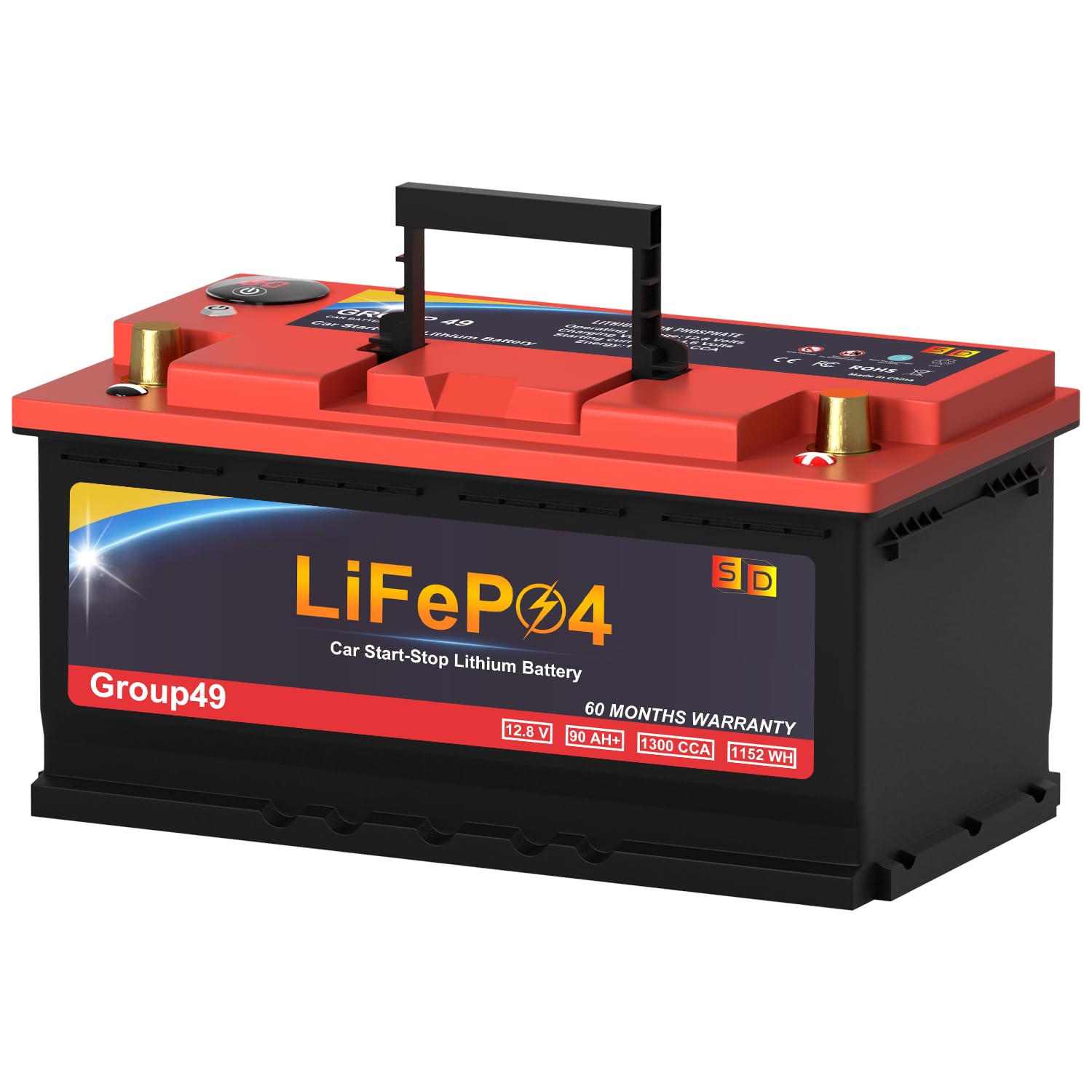
This Group 49 battery delivers 1300 CCA — enough to spin a heavy V8 or diesel without hesitation.
You get brute-force starting for big engines, backed by a lithium iron phosphate (LiFePO4) chemistry (a type of lithium battery known for long life and stability) that the manufacturer says is built to cycle over 2,000 times. Compare that to roughly 300 cycles for a standard AGM (absorbent glass mat) lead-acid battery, so your engine starts consistently for years. The brand claims it can start more than 50,000 times over its service life. At 13.89″ L x 6.88″ W x 7.48″ H, this is a larger footprint — it fits Group 49 and DIN60 trays, so measure your old battery bay before ordering. The built-in BMS protects against overcharge, over-discharge, overcurrent, and temperature extremes, which keeps the cells safe.
However, one reviewer found the actual weight to be 24 lb — not the lighter figure they expected, so the weight savings depend heavily on what you are replacing. Another owner reported a defective unit that showed only 500 CCA from the start, which points to the importance of checking voltage and CCA on arrival. This pick offers 1300 CCA, while the TET Group 40R is listed at 1200 CCA, but it lacks the TET’s Bluetooth monitoring and weighs 24 lb versus 12.8 lb.
Major Strengths
- 1300 CCA cranking power handles cold starts and large engines.
- Rated for over 2,000 charge cycles at full depth-of-discharge.
- 60-month warranty provides long-term confidence.
Watch For
- Heavier than some lithium competitors — 24 lb actual weight may surprise weight-focused buyers.
- Mixed reports of defective units with low CCA on arrival — test immediately.
Grab it if: you drive a large SUV, truck, or diesel and want maximum cranking power plus a five-year warranty backing your investment.
Think twice if: every pound counts in a race or track car, because this battery is heavier than other lithium options.
2. TET Car Start-Stop Lithium Battery For Car BCI Group 40R
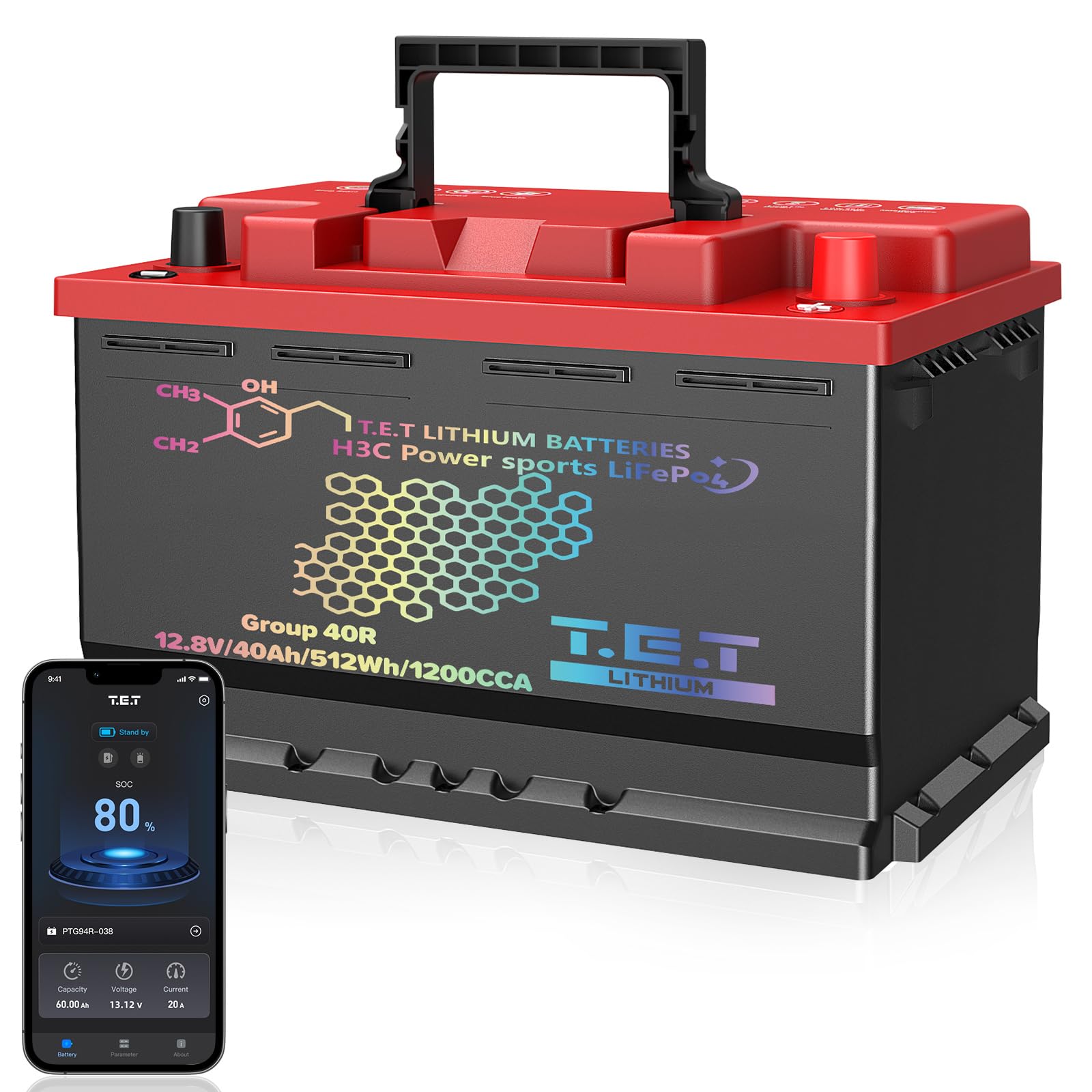
The lightweight start-stop specialist with Bluetooth smarts and diesel-grade cranking power.
This battery packs 1200 CCA into a 5.8 kg (12.8 lb) package. Its built-in Bluetooth app (a smartphone BMS monitor) lets you check charge, voltage, and overall health from your phone. It measures 11″ L x 6.93″ W x 6.93″ H, which is the BCI Group 40R standard (a standard size tray for many European and Asian vehicles with start-stop systems). The manufacturer rates the LiFePO4 cells for over 1,500 cycles at 100% depth of discharge (DoD — how much of the battery’s capacity you use before recharging), compared with around 500 cycles at 50% DoD for a typical lead-acid battery.
Buyers report impressive real-world results: one owner replaced dual AGM 700 CCA batteries in a Ford 7.3L diesel with a single TET battery and found it cranked slightly faster. Another user installed it in a 2014 Honda Civic and praised the instant starts and maintenance-free operation. The Bluetooth app draws particular praise for showing remaining capacity and allowing the battery to be turned off for security. The catch is that some alternators on older diesel trucks may not play well with lithium charging profiles, and one Chevy Silverado diesel owner had to return the battery because the truck’s system did not like it. The 2-year warranty is shorter than the TPE’s 60-month warranty, but customer service is reported to be responsive.
Why It Stands Out
- Bluetooth BMS for real-time monitoring via smartphone app.
- Weighs only 12.8 lb — massive weight saving over lead-acid.
- Rated for over 1,500 cycles at full discharge.
Consider Before Buying
- 2-year warranty is shorter than some rivals offering 5+ years.
- Not universally compatible with all diesel alternator charging profiles.
Best suited for: owners of start-stop vehicles, diesel trucks looking to ditch dual AGM setups, and anyone who wants battery telemetry on their phone.
Avoid if: your older diesel truck has a non-standard alternator voltage that may conflict with lithium charging needs.
3. WEIZE 12V 105AH 1000CCA Dual Purpose LiFePO4 Battery, Group 31

The one-battery solution that starts your engine and runs your trolling motor all day.
This Group 31 battery delivers 1000 CCA for starting plus a 105 amp-hour capacity (Ah — how much energy it stores for running your electronics) for deep-cycle loads like fish finders, trolling motors, and RV appliances. At 22 lb it is much lighter than many lead-acid marine batteries. The LiFePO4 chemistry is rated for over 2,500 cycles at 100% DoD, compared with around 500 cycles at 50% DoD for a typical lead-acid deep-cycle battery. The built-in BMS handles overcharge, over-discharge, overcurrent, and short-circuit protection, and the terminal adapter lets you swap between marine and automotive connectors.
Owners mention it works well in boats — one owner uses it to start a 150 hp Mercury outboard and says it is much lighter than the SLA it replaced. Another reviewer put it in a Club Car golf cart and found it lasts all day, noting that dropping the lead-acid weight made the cart noticeably faster and more fun. The catch is that dual-purpose batteries usually cannot match pure starting batteries in raw CCA, and at 22 lb it is heavier than smaller lithium starting-only units like the TET (12.8 lb). The manufacturer recommends using a dedicated lithium charger and warns against connecting more than two batteries in series, which may limit some 24V setups. Its 10-year warranty handily beats every other pick here.
Standout Features
- Dual-purpose: 1000 CCA starting + 105 Ah deep-cycle capacity.
- 10-year warranty — longest in this lineup.
- Rated for over 2,500 full-discharge cycles.
Limitations
- Heavier than pure starting lithium batteries at 22 lb.
- Requires dedicated lithium charger; not compatible with all lead-acid alternators.
Perfect for: boat owners, RV campers, and golf cart users who need one battery for both starting and running electronics — the 10-year warranty is hard to argue with.
Not ideal for: a pure race car or weekend track toy where every pound matters more than deep-cycle endurance.
4. Lithium Car Battery 12V Group 26 600CCA LiFePO4 Start and Stop
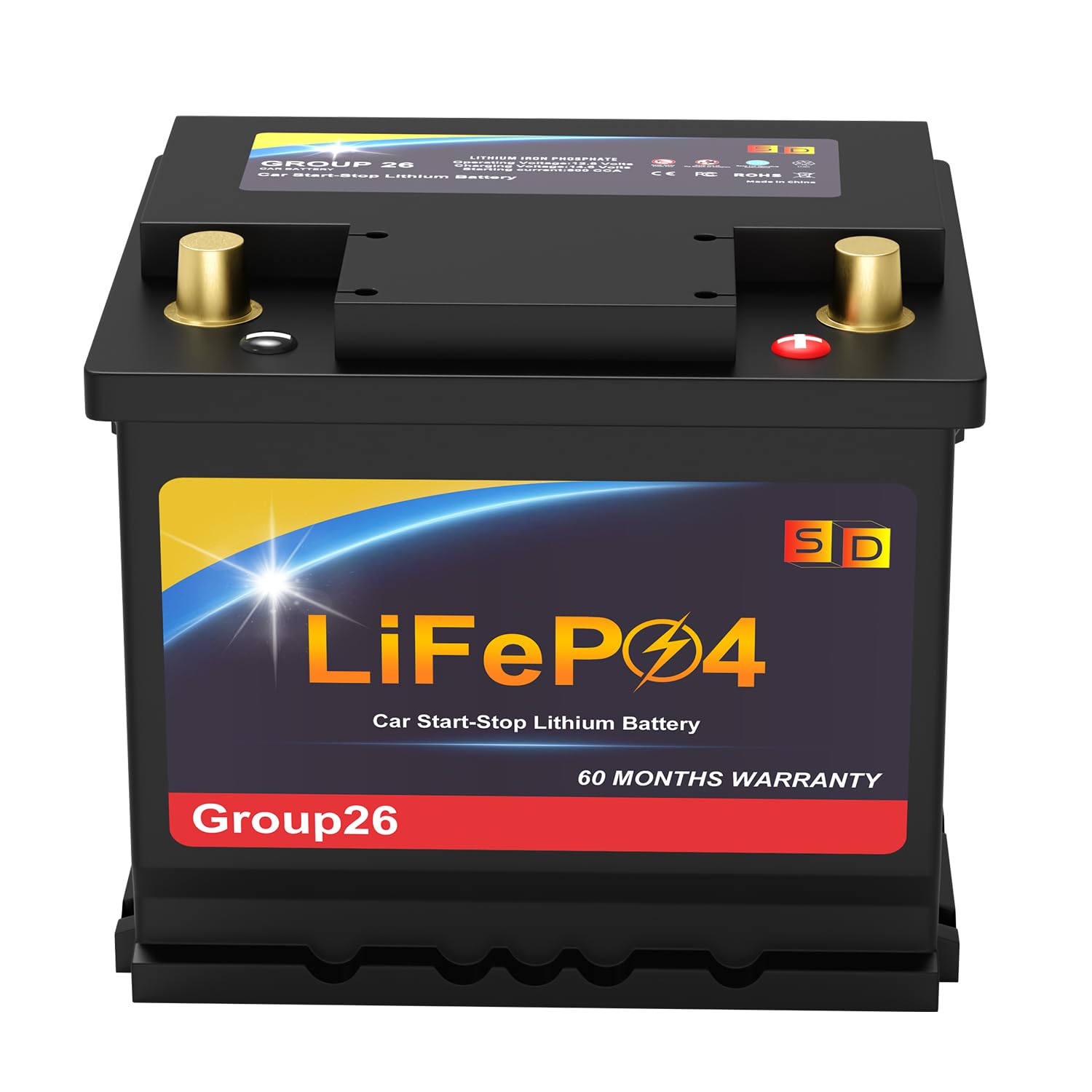
The featherweight entry point into lithium starting power for compact daily drivers.
At only 11 lb, this Group 26 battery is the lightest option here. It delivers 600 CCA, which is adequate for four-cylinder and small V6 engines in most climates. The BCI Group 26 dimensions are 8.14″ L x 6.88″ W x 7.08″ H, making it a compact fit for cars like the Subaru STi, Lexus LS400, and VW Beetle, as reported by buyers. The BMS provides the standard set of protections: overcharge, over-discharge, overvoltage, and overcurrent.
Buyers are split. On the positive side, one owner of a 2004 Subaru STi noted the battery cranked faster than the old unit and idles at 13.8V, and another Lexus LS400 owner loved the fast crank speed during an arctic blast. However, a 2008 VW Beetle owner reported serious issues after a week: radio restarting, driving hiccups, dim headlights, and a charging voltage drop from 14.4V to 13.4V — problems that disappeared after switching back to an AGM battery. Another reviewer flagged a past BMS failure, though two high-CCA units from the same brand were reliable for eight months. The inconsistent voltage behavior suggests this battery works best in vehicles with stable charging systems that tolerate lithium profiles. At this price and 11 lb, it is the lowest-cost way into lithium, but the TET Group 40R offers Bluetooth diagnostics for just a small step up.
Key Positives
- Ultra-light at 11 lb — the best weight savings in this guide.
- 600 CCA is sufficient for most compact cars and sedans.
- 5-year warranty for a budget-tier battery is generous.
Key Risks
- Reports of voltage drops and BMS failure raise reliability concerns.
- Incompatible with some older alternator charging profiles.
Reach for this if: you drive a compact car with a simple charging system and want the absolute lightest, most affordable lithium upgrade with a reasonable warranty.
Look elsewhere if: your car has a sensitive alternator or you cannot afford to troubleshoot voltage hiccups — the mid-range TET battery offers Bluetooth monitoring for better diagnostics.
Understanding the Specs
Cold Cranking Amps (CCA)
CCA is the number that tells you if your engine will start on a freezing morning. It measures how many amps a battery can push at 0°F for 30 seconds before its voltage drops below 7.2 volts. A diesel truck needs 1000+ CCA; a small sedan can manage with 600 CCA. More is always better — it just spins the engine faster. Do not use Pulse Cranking Amps (PCA) or Marine Cranking Amps (MCA) for comparison because those are measured at higher temperatures and give an inflated number.
Battery Management System (BMS)
The BMS is the battery’s brain. It monitors each cell’s voltage and temperature, and it cuts power if anything goes wrong — overcharge, deep discharge, short circuit, or overheating. Without a working BMS, a lithium battery can be damaged in one deep discharge event. Some BMS units also include Bluetooth for monitoring from your phone, a “start” button to wake the battery from sleep, and the ability to turn the battery off for long-term storage.
Group Size & Terminal Layout
BCI group numbers (like Group 26, 40R, 49, 31) define the physical dimensions of the battery case and where the positive and negative terminals sit. A Group 40R battery at 11″ long will not fit in a tray designed for a Group 26 battery at 8.14″ long. Always measure your old battery’s length, width, and height, and note whether the positive terminal is on the left or right. “R” in a group number means the positive terminal is on the right side.
Depth of Discharge (DoD) Cycles
This spec tells you how many times the battery can be drained and recharged before its capacity drops significantly. Lead-acid batteries typically handle around 500 cycles at 50% DoD. LiFePO4 batteries are rated for 1,500 to 2,500 cycles at 100% DoD, meaning you can fully drain them without damage — this is what gives them a much longer service life. A battery rated for 2,000 cycles at 100% DoD will outlast most cars you put it in.
FAQ
Can I replace my lead-acid battery with a lithium one without modification?
Does a lithium battery need a special charger?
Will a lithium battery work in freezing temperatures?
What happens if a lithium car battery dies completely?
How much weight will I save switching to lithium?
Is it safe to mount a lithium battery on its side?
Can I use a lithium battery for my car and also for my trolling motor?
How long does a LiFePO4 car battery actually last?
Will a lithium battery damage my car’s alternator?
What does the BMS “sleep mode” do and how do I wake the battery?
Final Thoughts: The Verdict
For most drivers, the automotive li-ion battery that delivers the best balance of weight savings, smart features, and pure starting muscle is the TET Group 40R — its Bluetooth monitoring, 1200 CCA, and 12.8 lb weight give you real feedback and real savings without the sticker shock of the premium tier. If you need a single battery for both the starter and a trolling motor, go with the WEIZE Group 31 and its class-leading 10-year warranty. And for the budget-conscious driver with a compact car, the SDULIBITIY Group 26 gets you into lithium at the lowest entry weight — just check your alternator compatibility first.
How We Picked
We do not accept paid placement, and we did not hands-on test every unit. Instead, we match each pick to a real buyer and use-case by comparing the manufacturers’ published specifications against the patterns in verified customer reviews — so you get each pick’s real strengths and trade-offs instead of marketing copy.
Sources & Methodology
Specifications: manufacturer listings and product documentation. Review insights: verified customer reviews, as of July 2026. Pricing: not shown on this page (it changes often); check the current price via the retailer link.
As an Amazon Associate, Gadgets Feed earns from qualifying purchases. This does not affect which products we feature.
Product prices and availability are accurate as of the date/time indicated and are subject to change. Any price and availability information displayed on Amazon at the time of purchase will apply to the purchase of this product. As an Amazon Associate I earn from qualifying purchases.
CERTAIN CONTENT THAT APPEARS ON THIS SITE COMES FROM AMAZON. THIS CONTENT IS PROVIDED "AS IS" AND IS SUBJECT TO CHANGE OR REMOVAL AT ANY TIME.
Amazon and the Amazon logo are trademarks of Amazon.com, Inc. or its affiliates.