
Our readers keep the lights on and my morning glass full of iced black tea. As an Amazon Associate, I earn from qualifying purchases.
Specs are compiled from manufacturer listings and verified buyer reviews and can change over time — please confirm the key details on the product page before buying.
Swapping out a car battery used to be simple: pull the old one, drop in the new one, and drive away. On a modern vehicle, that quick swap can erase your radio presets, reset your clock, clear your seat and mirror memory, and even scramble the engine’s learned driving patterns — forcing a trip to the dealer for a reflash. An automotive memory saver is the small tool that plugs into your car’s OBD-II port and keeps the electronics alive with a backup power source while you work, so every setting stays exactly where you left it.
I’m Min — the founder and writer behind Gadgets Feed. This guide is built by comparing the manufacturers’ published specifications and the patterns across verified customer reviews, so you get each pick’s real strengths and trade-offs instead of marketing spin.
The right automotive memory saver boils down to one thing: does it reliably keep your car’s electronics awake during a battery swap without a hitch.
Our Picks at a Glance


How To Choose The Best Automotive Memory Saver
Your decision hinges on whether you prefer a 9V battery, USB, or 12V source for backup power. Here is what to look at before you buy.
Power Source: 9V Battery vs. USB vs. 12V Source
A 9-volt battery is the simplest option — just pop one in and plug into the OBD-II port. It is light and portable, but the battery can drain quickly if the car’s electronics draw more than a few hundred milliamps. USB-powered models pull from a phone charger or power bank, which is convenient, but some cars need a full 12V supply to hold memory, and a 5V USB connection might not cut it. The most reliable route is a 12V source — either from a jump starter, another car’s cigarette lighter, or an internal battery — because it matches the voltage the car’s computer expects.
Cable Length and Build
A short cable (around 1.5 meters or 5 feet) is fine if you are working right next to the OBD port with your backup battery. A longer cord, like the 10-foot cables you see on some models, lets you reach a second vehicle’s 12V port or place your power source farther from the work area. Hard plastic housing tends to be more durable than soft PVC, and a built-in fuse is a must — it prevents a short from sending too much current into the car’s computer.
Safety Features
Look for a blocking diode, which stops the 9V battery from being charged by the car’s system (a 9V battery getting hot is a sign this protection is missing). Reverse-polarity protection keeps the unit from powering up if you connect the clips backward. A buzzer or LED indicator that warns you when the backup power is low is a nice bonus — it saves you from finishing the job only to find the memory was never saved.
Quick Comparison
| Model | Best For | Power Source | Cable Length | Fuse | Amazon |
|---|---|---|---|---|---|
| Mem Retain 9V OBD-II★ Best Overall | Best Overall | 9V battery | — | Diode protected | Amazon |
| EZRED MS4000Top Performer | Professional / built-in battery | Internal 12V 4.5Ah battery | Direct wired OBDII | 4 amp circuit breaker | Amazon |
| Mem Retain USB/9VFlexible Pick | Dual power flexibility | USB or 9V battery | — | Safe voltage diode | Amazon |
| All-Sun GK504 | Cigarette lighter use | 9V battery | — | — | Amazon |
| JEUCLEL USB OBD-II | USB power convenience | USB / 5V | — | Buzzer + indicator | Amazon |
| Sharutia 12V Cigarette Lighter | Budget pick | 9V battery | — | — | Amazon |
| Jtron OBD2 2-in-1 | Long reach / alligator clip | 12V source | 10 ft (3m) | 10 amp fuse | Amazon |
| OLLGEN OBD2 with Display | Digital display monitoring | 12V source | 1.5m (5ft) | 5A fuse + reverse protect | Amazon |
| E-Z Red MSBD28 | OBD-II with indicator light | 12V source | Long cord | Fuse protection | Amazon |
In‑Depth Reviews
1. Mem Retain 9 Volt Battery Powered OBD-II Memory Saver
Our pick — over 4.5★ from 450+ verified ratings; the strongest balance of quality and price.
The simple OBD-II plug that keeps your radio stations safe with a fresh 9V battery.
Nearly 500 owners rate this 4.6 stars for its simple, reliable operation. Pop in a 9V battery (not included), plug into the OBD-II port, and the built-in safe voltage blocking diode protects the battery while keeping your car’s computer, clock, and radio presets alive. Buyers report it holds settings across multiple vehicles and even preserves navigation systems.
Its dependability and clear instructions make it a five-minute setup for any user. The catch? A few owners mention that the 9V connector can be tough to pull off, and there is no LED to tell you the battery is getting low. Bring a fresh lithium 9V for the best results.
Compared to the cigarette-lighter models below, this one connects straight to the OBD port — so it works even on vehicles where the 12V outlet shuts off when the key is out. The review pages sum it up: “Works great.”
Solid connection, no surprises: If you want the easiest, most-trusted way to keep your settings through a battery swap, grab this before you touch the wrench.
Keep an eye on the battery: Without a low-battery light, you need to start with a fresh 9V every time — a lithium helps with the current draw.
Reach for this if: you want the highest-rated, most-reviewed OBD-II saver that owners reliably call “simple” and “worth it” — just add a fresh battery.
Think twice if: you prefer the convenience of USB power or need a built-in battery-level indicator.
2. E-Z Red MS4000 Automotive Memory Saver With Built In Charger
The all-in-one unit with its own rechargeable battery that also charges yours.
This is the heavy-duty solution for frequent battery changers. It packs a 12-volt, 4.5 amp hour sealed lead acid battery right inside the unit, so you never need a donor car, a jump pack, or a 9V battery. The direct-wired OBDII connector plugs in, and a 4 amp circuit breaker protects everything.
Owners who use it regularly note it can save anti-theft radio codes, keyless entry settings, and even tire pressure monitoring system data. The built-in charger means you just plug it into AC power between uses. The trade-off is its size and cost—at 1.9 pounds and the highest price, it is not glove-box-friendly. A few owners have flagged that the internal battery can struggle to hold a charge over long storage, so keep it topped up.
Compared to the 9V-powered Mem Retain above, this unit gives you a full 12V supply that matches what the car’s computer expects to see, which is more reliable for longer jobs or for vehicles with higher current draw. One owner summed it up: “I was able to change my battery with no problem. It didn’t have to reprogram anything.”
Built for the long haul
- Internal 12V 4.5Ah battery — no donor car or 9V needed
- 4 amp circuit breaker for extra safety
- Saves anti-theft codes, keyless entry, and TPMS data
- Simple AC charging between uses
Not for occasional use
- Bulky and relatively heavy — not a glove-box tool
- Internal battery needs periodic charging or it may lose capacity
- The most expensive option by a wide margin
Grab this for: a repair shop, a fleet vehicle, or a serious DIYer who does multiple battery swaps a year and wants zero hassle with external batteries.
skip it if: you are a once-every-few-years battery swapper — the 9V or USB options will serve you fine at a fraction of the size and cost.
3. Mem Retain USB/9V Powered OBD Connector Memory Saver
Two power options in one slim unit — USB from your phone charger or a standard 9V.
This is the same brand as the first pick, but with a major upgrade: you can power it from a USB source (a power bank or phone charger) or a 9V battery. The USB adapter acts as a 5V-to-12V upconverter, delivering roughly 800mA at 12V. That means you can use a common USB power bank instead of hunting for a fresh 9V.
Owners praise it for retaining radio presets, diagnostic codes, and ECU learned procedures. A buyer who paired it with a USB power bank reported it worked perfectly for a full battery swap. The safe voltage blocking diode protects both power sources. A few experienced owners note that power banks with auto-sense charging can throttle the current, so a 9V battery or a PD USB connection is more reliable on cars with higher draw. The construction has drawn occasional “junky build” comments, but the consensus is that it does the job.
Unlike the all-in-one MS4000 above, this unit is pocket-sized and costs much less — but it lacks the internal battery, so you still need to supply your own power.
Two ways to power it: The USB option is a real convenience if you carry a power bank, but check your car’s idle current — if it pulls more than around 800mA, stick with the 9V battery.
Build could be better: Some owners mention the housing feels a bit cheap for the price, but it works reliably when connected correctly.
Best suited for: the person who already owns a power bank and wants the flexibility of USB power plus the fallback of a 9V battery.
Look elsewhere if: you want a rugged, shop-grade feel or you prefer a single power source without cables to manage.
4. Jtron OBD2 Memory Saver 2-in-1 with Alligator Clip-On

A 10-foot cable that reaches from another car’s 12V outlet straight to your OBD port.
This is the pick for the situation where your drive battery is dead and you need to use a second vehicle as a donor. The standout feature is the 10-foot (3-meter) cable — long enough to run from the cigarette lighter of a running car two parking spots over. It also includes alligator clip-ons and a cigarette lighter plug, so you can connect to any 12V DC source: a jump starter, a spare lead-acid battery, or another car’s outlet.
Gold-plated OBD pins provide better corrosion resistance and conductivity than the zinc-plated pins found on cheaper units. A built-in 10 amp fuse protects against overloads. Owners consistently praise the cable length: “I like it because the longer leads can hook up to another car battery.” The honest downside — a few buyers received units where the OBD pin was wired to the wrong position, rendering it useless for their specific vehicle. Check the pinout immediately when it arrives.
Unlike the USB-powered JEUCLEL below, this unit requires a true 12V source — there is no upconverter here, which means it is more reliable for vehicles that need full voltage to hold memory.
Versatile and long
- Super-long 10 ft / 3m cable reaches another car’s outlet
- Gold-plated OBD pins for better contact
- 10 amp fuse for solid overload protection
- Works with any 12V source: jump starter, battery, or another car
Quality control risk
- Occasional units with incorrectly pinned OBD connector — test on arrival
- No built-in battery; requires a separate 12V source
Pick this if: you often need to borrow power from a second vehicle or your battery is too dead to hold even a minimal charge.
pass on it if: you only do battery swaps in your own driveway with a fully charged vehicle — a 9V unit will be simpler and cheaper.
5. OLLGEN OBD2 Memory Saver with Digital Display

The only memory saver with a live display of voltage and current — so you know it is working.
Every other memory saver in this guide leaves you guessing: is the battery still good? Is the connection live? This unit solves that with a digital screen that cycles between voltage (red numbers) and current (blue numbers) so you can see exactly what is flowing. The 5A fuse and reverse-connection protection add serious confidence — if you hook up the clips backward, the digital tube simply stays dark and no power reaches your car.
Owners who value certainty love the feedback. A buyer called the display “an added bonus over the others where you just guess and hope.” The cable runs to a 12V source — you will need a spare battery or jump pack. A few owners were surprised to discover this upfront. The instructions are described as “poorly translated,” but the device itself is straightforward: red shows volts, blue shows amps, and the numbers change when it is hooked up.
Unlike the simpler picks above, this one doubles as a leakage detector — you can read the car’s quiescent (resting) current when everything is off.
See what is happening: The live voltage and current readout is genuinely useful — you will never wonder if the connection is working or if your 12V source is too weak.
Rough manual: The instructions are confusing, but the device is intuitive enough that most owners figure it out quickly.
Grab this for: the confidence that comes from seeing voltage and current numbers live — ideal if you are methodical about your work.
Not for you if: you want a dead-simple plug-and-play tool with no screens or settings.
6. All-Sun GK504 Automotive Setting Keeper

A rugged, no-fuss design that plugs into your cigarette lighter, not the OBD port.
Not every vehicle has an easily accessible OBD-II port, and some owners prefer the simplicity of the 12V power outlet they already know. This unit plugs into any vehicle cigarette lighter and draws from a 9-volt alkaline battery (not included) to keep the on-board computer alive. The rugged hard plastic body and durable cable are built to survive a garage environment.
Customers note it works well for saving radio presets and computer memory, especially on vehicles like the Jeep Wrangler JK. A buyer noted it saved all settings after a new battery install, including a smart Bluetooth radio. The catch is the 9V battery can get warm — there is no blocking diode visible in the specs, so the battery is not fully isolated from the vehicle’s electrical system. Also, it only works if your vehicle’s 12V outlet is powered when the ignition is off — some modern cars cut power to the lighter socket when the key is out.
Compared to the OBD-II connected Mem Retain above, this one is a different form factor entirely — choose it if you prefer the 12V outlet location, but check that your car keeps that outlet live with the key off.
Easy cigarette-lighter use: If you want to plug into a familiar port and your car keeps the 12V outlet alive when off, this is the simplest route.
Watch the battery: The 9V battery can heat up during use, so use a fresh alkaline and do not leave it connected longer than necessary.
Reach for this if: you prefer the cigarette lighter port over the OBD-II port and your vehicle keeps the outlet live with the ignition off.
Look elsewhere if: your car cuts power to the 12V outlet when the key is removed — the OBD-II connected units work regardless.
7. JEUCLEL USB Powered OBD II Connector Memory Saver with Buzzer

A modern take that runs from any USB power bank — no 9V batteries needed.
This unit is built around the idea that everyone has a USB power bank lying around. It uses a USB connection to supply 5V to the vehicle’s computer, and three indicator lights plus a buzzer keep you informed. The buzzer is especially useful — it sounds when the USB power is low or the connection is interrupted, so you can focus on the battery swap without constantly checking the tool.
The build uses new PVC material, which is non-toxic and designed for longevity. A one-year manufacturer warranty covers any defects. The honest picture here is more mixed than the top picks: the reliability aspect draws the most owner discussion, with some reporting it works perfectly and others finding it failed to save memory. The main pitfall is that some vehicles genuinely need a full 12V supply to hold memory, and a 5V USB source (even at 2A) cannot substitute. A buyer who used it with a CAT jump starter USB port reported it “worked great,” while another who lost all data learned that their mechanic said the car specifically needs 12V.
It is a neat concept that works for many cars, but not for all. Unlike the USB/9V Mem Retain above, this one lacks a 9V fallback if USB is not enough.
Convenient USB power: If your car’s computer is okay with 5V, this is the easiest tool — grab a power bank from your pocket and go.
Not universal: Some vehicles require a true 12V supply — check your car’s power draw before relying on a USB-only solution.
Best for: a newer vehicle with modest memory current draw and a person who always carries a USB power bank.
Not for: older European cars or any vehicle known to need 12V for ECU retention — go with a 12V source model instead.
8. E-Z Red MSBD28 Auto Memory Saver

A quality OBD-II saver with a long cord and an indicator light that shows power flow.
From a brand known for automotive tools, this unit focuses on doing one thing well: keeping power flowing from a 12V source (like a jump pack or another car’s outlet) into the OBD-II port. The long cord is a major plus — it reaches comfortably from a donor vehicle’s 12V outlet to your car’s OBD port without stretching. An indicator light shows that power is actively passing through.
Owners praise it as “simple to use” and a “time saver.” One buyer hooked it to their portable jump pack and successfully swapped the battery on a 2013 Acura RDX, preserving seat and mirror profiles, radio presets, and even a custom dash clock image. The main concerns: the coiled wiring is stiff, especially in cool weather, and the built-in fuse can blow if the positive terminal accidentally touches ground — a tricky situation in newer vehicles with fuse blocks mounted directly on the battery.
Unlike the OLLGEN unit above, it does not give you a digital readout — just a simple on/off light. But for pure reliability and build quality, it is a favorite among the nearly 200 owners who rated it highly.
Dependable and long-reaching: The indicator light and long cord make it a no-guesswork tool for a 12V source — plug in, see the light, swap the battery.
Watch for shorting: The fuse is a safety feature, but a brief ground contact can blow it. Take care with the positive terminal during removal.
Pick this if: you already have a jump pack or a donor car and want a trusted brand with an indicator light and long reach.
Pass on it if: you want a self-contained unit with its own battery or you prefer a USB/9V hybrid.
9. Sharutia 12V Memory Saver for Cigarette Lighter
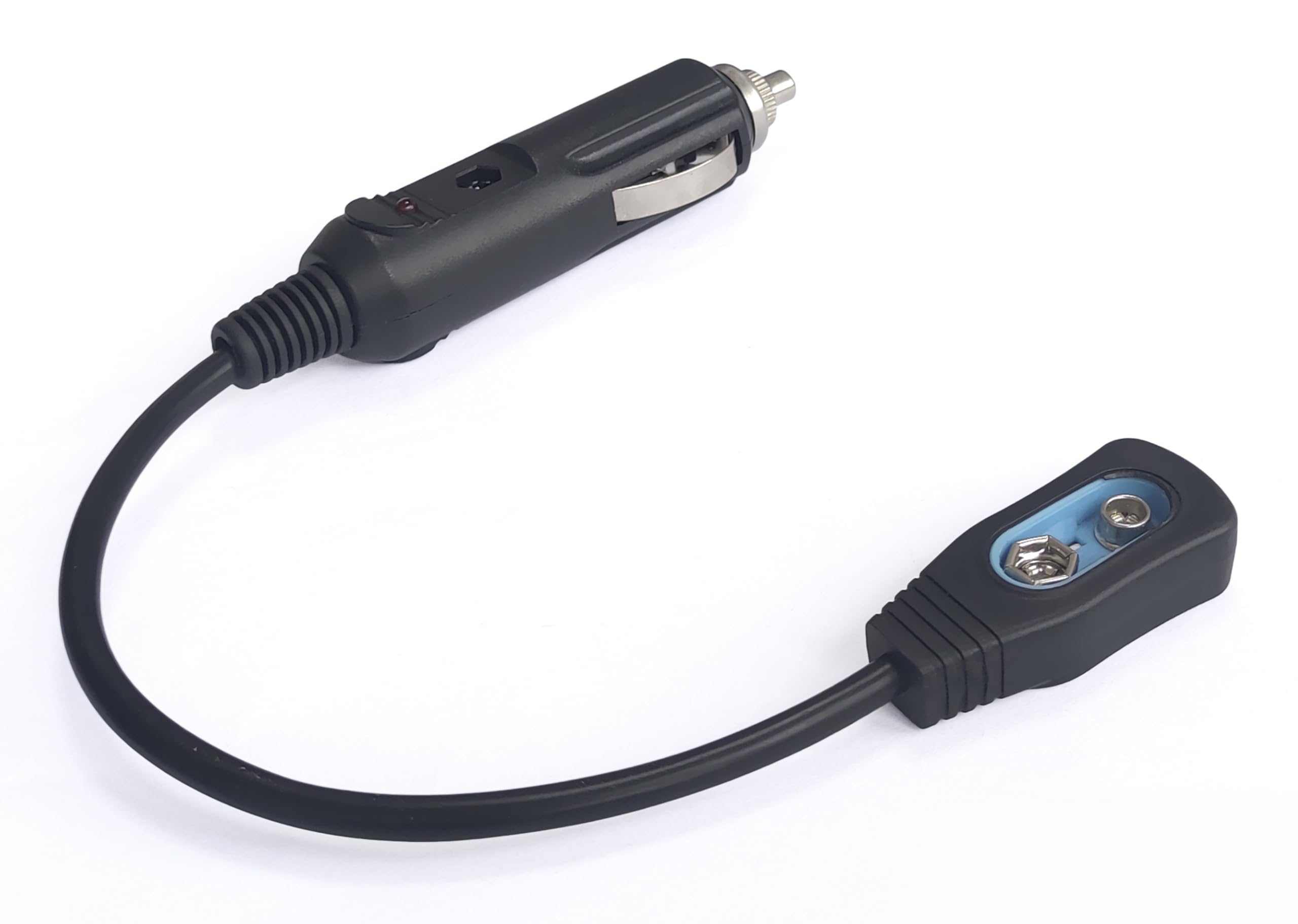
A basic, wallet-friendly option that plugs into your car’s 12V power port.
If you only change your battery once every few years and want the lowest possible cost of entry, this unit fits the bill. It plugs into the cigarette lighter socket, runs on a 9-volt alkaline battery (not included), and preserves radio presets, seat positions, and climate control settings during a swap. The maker also claims it helps prevent immobilizer lockout — a real fear on modern vehicles.
Owners who used it reported it worked well. One buyer successfully replaced their battery with “no configurations lost.” Another noted the 9V battery got warm during use but the device still functioned and saved all settings. The obvious limitation is the small number of reviews — fewer than 40 at the time of writing — so the long-term reliability picture is less clear than the top picks. A single negative review reported it did not work on their car.
It shares the same cigarette-lighter design as the All-Sun above but at a slightly lower entry point. Like the All-Sun, it depends on your 12V outlet staying live with the key off.
Low-risk entry: For the price, it is the cheapest way to test if a memory saver improves your battery-changing experience — just keep a fresh 9V in the glove box.
Not a proven performer: With so few reviews, it is hard to know how it holds up across different vehicle models.
Consider this if: you are on a strict budget and only need a memory saver for occasional battery swaps on a single vehicle.
Buy a more proven unit if: you want decades of owner history and a higher confidence level that it will work on the first try.
Understanding the Specs
Amperage Draw and Fuse Rating
Every car’s computer draws a small amount of current — measured in milliamps (mA) — to keep memory alive. Most modern cars need between 200 mA and 800 mA. A memory saver’s fuse (rated at 5A, 10A, or protected by a circuit breaker) is there to blow if a short occurs, sending far less current through than would damage the ECU. A higher fuse rating does not mean the tool is better; it just means the fuse can handle more current before blowing, which might not protect your car as effectively in a direct short.
Blocking Diode vs. No Diode
A blocking diode inside the saver prevents electricity from flowing back from the car into the battery that powers the saver. On a 9V battery unit, this matters because without a diode, the car’s 12V system can try to charge the 9V battery — causing it to heat up rapidly. Models that advertise a “safe voltage blocking diode” are much more reliable and safer for the backup battery. USB-powered savers use a different internal circuit (a DC-to-DC upconverter) to handle this, so the same issue does not apply.
FAQ
Will a memory saver work if my car battery is completely dead?
Can I use a USB power bank with any memory saver?
How long will a 9V battery last while connected?
Do all memory savers fit every car?
Is a memory saver the same as a battery tender or charger?
Can I use a memory saver while the car is running?
What does the buzzer on a memory saver do?
Can a memory saver damage my car’s computer?
Which is better: OBD-II connector or cigarette lighter plug?
Final Thoughts: The Verdict
For most people, the automotive memory saver winner is the Mem Retain 9V OBD-II because it earns a 4.6-star rating across nearly 500 owners who call it simple and reliable — just add a fresh 9V battery and plug in. If you need a self-contained unit with its own rechargeable battery, the EZRED MS4000 is the professional-grade choice. And for the most flexibility in power sources, the Mem Retain USB/9V lets you choose between a USB power bank and a traditional 9V battery, whichever you have on hand.
How We Picked
We do not accept paid placement. Every pick is matched to a real buyer and a real use-case; we do not hands-on test units.
Sources & Methodology
Specifications: manufacturer listings and product documentation. Review insights: verified customer reviews, as of July 2026. Pricing: not shown on this page (it changes often); check the current price via the retailer link.
As an Amazon Associate, Gadgets Feed earns from qualifying purchases. This does not affect which products we feature.