
Every time you run your hand across a hood marred by swirling micro-scratches or water spots etched into the clear coat, you feel that nagging disappointment. A high-quality automotive paint cleaner is the only bridge between that dull, weathered surface and a deep, mirror-like gloss that turns heads at every stoplight.
I’m Min — the co-founder and writer behind Gadgets Feed. I’ve spent hundreds of hours cross-referencing grit ratings, cutting chemistry, and real-world application data from professional detailers and body shops to separate the compounds that actually resurface paint from those that just smear greasy fillers over the problem.
This guide breaks down the most effective formulas on the market, from aggressive heavy-cut compounds to precision finishing polishes, so you can confidently select the right automotive paint cleaner for your specific paint correction project without wasting time on products that can’t deliver.
How To Choose The Best Automotive Paint Cleaner
Selecting a paint cleaner isn’t about picking the most expensive bottle on the shelf. It’s about matching the abrasive technology, grit rating, and chemistry to the severity of your paint defects and the equipment you own. A heavy-cut compound on a soft clear coat can haze panels, while a mild polish on oxidized paint will waste hours of labor for zero results.
Understand Abrasive Chemistry and Grit Rating
The grit number (e.g., P100, P800, P1000, P2000) tells you how coarse the abrasive particles are — lower numbers cut more aggressively, higher numbers refine the surface. Modern compounds use alpha ceramic alumina or aluminum oxide abrasives. Ceramic-based formulas run cooler and generate less dust, letting you work longer cycles without drying out the compound on the pad.
Match the Cut to Your Paint Condition
Deep scratches from fingernails or keys require a heavy-cut compound rated for P100-P600 grit sanding marks. Light swirl marks and oxidation respond better to a medium-cut (P1000-P1500) product. If you’re applying a ceramic coating afterward, you must use a dedicated oil and polish remover as a final panel wipe — conventional compounds leave behind oils that prevent coating adhesion.
Quick Comparison
On smaller screens, swipe sideways to see the full table.
| Model | Category | Best For | Key Spec | Amazon |
|---|---|---|---|---|
| Menzerna Polishing Set | 3-Step System | Complete scratch-to-showroom correction | 24 oz total (3 x 8 oz) | Amazon |
| Meguiar’s M11032 | Heavy Cut Compound | Heavy swirl removal, beginner-friendly | 32 oz, P1200 grit capability | Amazon |
| 3D ACA 500 | Extra-Cut Compound | Deep scratch correction, P100 grit | 8 oz, ceramic alumina tech | Amazon |
| Malco Super Duty | Heavy Cut Compound | Oxidized paint and gel coat restoration | 32 oz, P800 grit, wool pad | Amazon |
| CARPRO Eraser | Panel Wipe | Pre-ceramic coating prep | 34 oz, anti-static, no silicone | Amazon |
| P & S Paint Gloss | Detailer Spray | Quick touch-up and clay lubricant | 1 Gallon, streak-free gloss | Amazon |
| Custom Shop KW901 | Grease & Wax Remover | Surface prep before painting | 128 oz, dissolves wax and silicone | Amazon |
In‑Depth Reviews
1. Menzerna Polishing Set 8oz (HCC1000, MCC2500 & 3800)
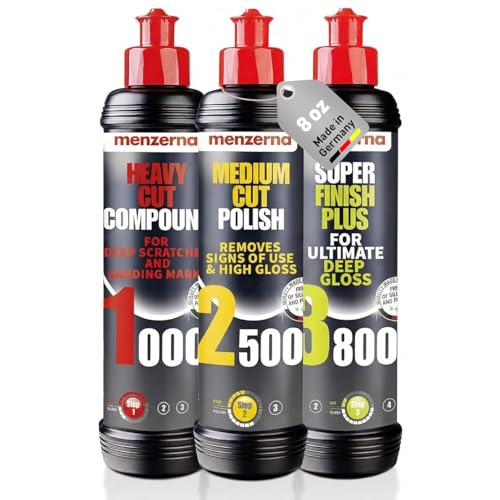
This three-bottle set from Menzerna delivers a complete paint correction workflow in one purchase. Step 1 (HCC1000) uses aluminum oxide and zirconia alumina abrasives to cut through scratches and swirls effectively, rated for P1000 grit and coarser defects. Step 2 (MCC2500) refines the surface by removing holograms left from the heavy cut, and Step 3 (Super Finish 3800) produces a deep, mirror-like gloss that rivals a freshly applied ceramic finish.
Professional detailers appreciate that each compound works cleanly without excessive dusting, and the 8 oz bottles strike a practical balance between cost per panel and longevity. One user on a black Tacoma reported that after following all three steps, the paint achieved a glassy depth that made them skip the wax entirely. The system is especially effective on single-stage urethane and modern clear coats alike.
The only catch is that for severely oxidized paint or P600 sanding marks, the HCC1000 may require multiple passes or a more aggressive cutting pad. Beginners should also note that stepping through all three stages takes time — this is not a one-spray solution. But for anyone chasing showroom-level correction from a single kit, this set is the most complete option available.
Why it’s great
- Complete correction cycle from heavy cut to mirror finish
- Residue wipes off cleanly with no oily film
- Bottles last multiple full-vehicle corrections
Good to know
- Requires dedicated pad changes between steps
- Heavy cut step may need extra passes on deep defects
2. Meguiar’s Professional Ultra Pro Speed Compound M11032
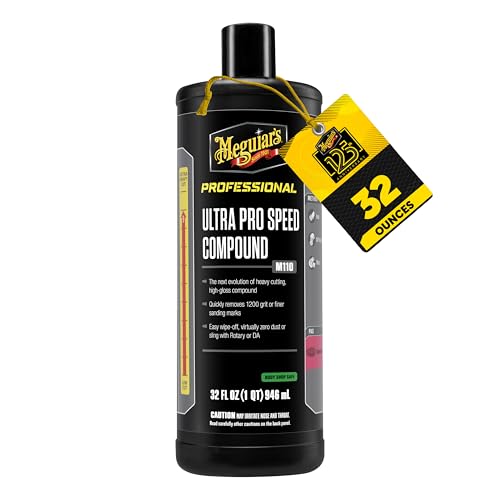
Meguiar’s M11032 is engineered with aluminum oxide abrasives that balance aggressive cutting power with surprisingly low dust generation. Advertised to remove P1200 grit sanding marks, this compound performs reliably on clear coat, single-stage, and even repainted panels. Users consistently report that it spreads easily and wipes off without leaving stubborn residue, even when worked with a DA polisher at variable speeds.
One detailer switched from 3M Perfect-It to this compound and found the M11032 required less pressure to achieve the same depth of correction. For beginners, the forgiving cycle time means you can learn proper technique without fear of burning through the clear coat. Follow it with Meguiar’s M210 finishing polish for a deep, wet-looking shine that rivals a multi-step system.
Where it falls short is on truly deep scratches — those from keys or heavy scuffs that go below the P1200 threshold. For those defects, you’ll need a companion heavy-cut compound like the 3D ACA 500 before stepping down to this product. Also, the 1-gram weight listed on the spec sheet appears to be a data error; the 32 oz bottle is substantial and will handle multiple vehicles.
Why it’s great
- Easy to spread and wipe off — low learning curve
- Low dusting formula keeps workspace clean
- 32 oz bottle offers excellent cost per use
Good to know
- Not aggressive enough for P800 or coarser sanding marks
- Requires a dedicated finishing polish for maximum gloss
3. 3D ACA 500 Cutting Compound – Step 1 Extra-Cut
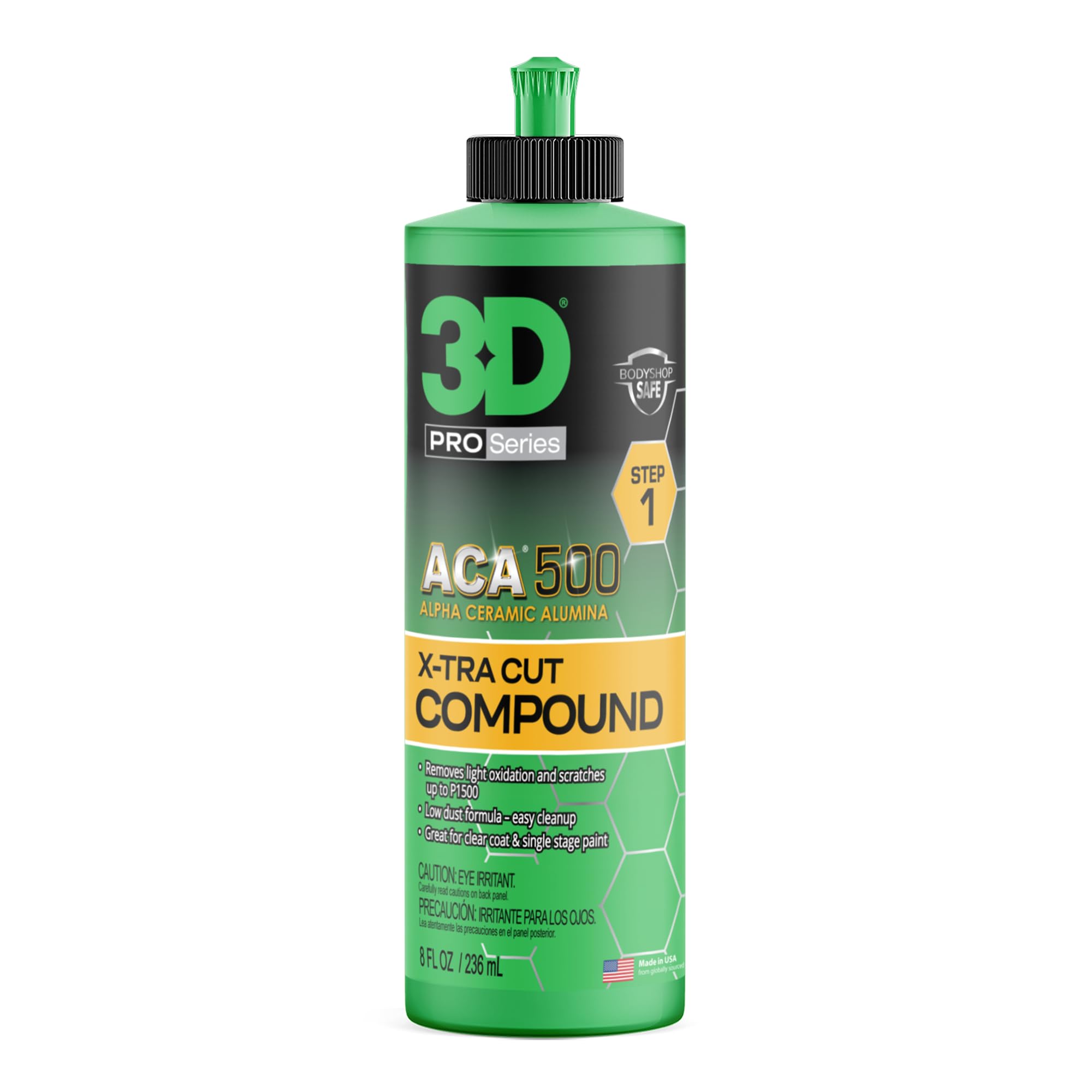
The 3D ACA 500 uses advanced alpha ceramic alumina technology to cut through P100 grit sanding marks — making it one of the most aggressive compounds available for consumer purchase. Unlike traditional aluminum oxide formulas that generate excessive heat and risk burning clear coat, the ceramic abrasives in this compound run cooler and self-sharpen as you work, maintaining consistent cut throughout the polishing cycle.
Real-world testing shows impressive results even by hand on sanded clear coat — one amateur tester reported removing deep scratches and restoring shine without introducing new swirl marks. The low-dust formulation keeps your work area and paint free from airborne abrasives that can settle and create secondary defects. It also works effectively on headlights, chrome trim, and even gel coat surfaces.
The main drawback is the small 8 oz bottle, which goes quickly on a full-vehicle correction. Professionals working on multiple cars will want to buy larger quantities. Additionally, because it’s so aggressive, it’s easy to over-cut soft clear coats if you use too much pressure or run the polisher at too high a speed. Beginners should test on a small inconspicuous panel first.
Why it’s great
- Ceramic alumina cuts cooler and reduces heat damage risk
- Effective on P100 sanding marks and deep scratches
- Low-dust formula keeps panels cleaner during correction
Good to know
- 8 oz bottle is small for large-scale projects
- Too aggressive for soft clear coats without care
4. Malco Super Duty Heavy Cut Compound 32 oz
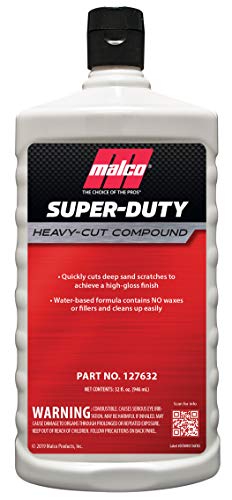
Malco’s Super Duty compound is a workhorse for tackling heavily oxidized single-stage urethane and gel coat surfaces. Its P800 grit abrasive system cuts aggressively — one user restored a 2008 Honda Accord with severe oxidation using just an orbital buffer and wool pad, exceeding expectations for a compound at this price point. The 32 oz bottle provides substantial volume for multiple restorations or large boats and RVs.
Unlike some heavy-cut compounds that gum up wool pads and require frequent cleaning, Malco’s formula maintains a consistent cut and finishes with a high-gloss result that minimizes the need for a secondary polish step. Professional detailers note that it outperforms compounds like Meguiar’s 105 on oxidized single-stage paints, especially when working with a rotary polisher.
On the downside, the compound can leave some residue if overworked, and removal becomes more difficult if you let it dry completely on the panel. It also produces moderate dusting — not as clean as the 3D ACA 500, but expected for a P800 abrasive. For soft clear coats, this compound may haze the surface, requiring a finishing polish to restore clarity.
Why it’s great
- Large 32 oz volume at an excellent cost per ounce
- Cuts P800 sanding marks and heavy oxidation efficiently
- Finishes with high gloss, reducing steps needed
Good to know
- Moderate dusting while buffing
- Not ideal for soft clear coats without finishing polish
5. CARPRO Eraser Polish & Oil Remover 34 oz

CARPRO Eraser is not a cutting compound — it is a dedicated panel wipe designed to remove polishing oils, fillers, and dust residues before applying ceramic coatings or sealants. Its anti-static properties prevent airborne dust from re-adhering to the panel during the critical coating application window, which is a common source of coating failure. Users report that a single pass with Eraser leaves the surface chemically clean and ready for CQUARTZ or any other ceramic coating.
Beyond its primary use, Eraser doubles as an excellent glass cleaner and degreaser. Several detailers have used it to clean vinyl trim before PPF installation and found that areas wiped with Eraser showed perfect adhesion, while untouched edges had lifting issues. The included sprayer produces a fine mist that covers evenly without dripping, helping you conserve product on each panel.
The primary complaint is cost — at 34 oz per bottle, heavy users can burn through it quickly on large vehicles or multiple jobs. Some users suggest diluting it for less demanding cleaning tasks, but for its intended ceramic prep use, full-strength application is mandatory. It also cannot be shipped to California due to state regulations, so buyers there will need to find local alternatives.
Why it’s great
- Anti-static formula keeps dust off during coating application
- Excellent glass and trim cleaner versatility
- Streak-free finish with no silicone residue
Good to know
- Expensive per ounce compared to general panel wipes
- Not available for sale in California
6. P & S Professional Detail Products Paint Gloss Spray N Shine 1 Gallon

P & S Paint Gloss Spray N Shine occupies a different niche than the heavy-cut compounds above — it is an instant detailer designed for quick touch-ups between washes. The gallon-sized bottle provides enormous value for users who maintain multiple vehicles or detail professionally. Its slick formula works effectively as a clay bar lubricant, allowing the clay to glide across the paint without scratching.
The gloss finish it leaves is genuinely impressive for a spray-and-wipe product. Multiple users on black and dark-colored vehicles report a deep, wet-looking shine that rivals a freshly waxed surface. It also works well for removing light dust, fingerprints, and smudges without leaving streaks. One user reported mixing it with Bead Maker and Dream Maker to increase slickness and reduce dust attraction.
The main drawback is that this product is not a paint cleaner in the correction sense — it cannot remove scratches, swirls, or oxidation. It’s purely a maintenance layer. Some users also note that the formula attracts dust after a day or two, though mixing it with products like Bead Maker helps mitigate that issue. For true paint correction, use this only as a final dressing after a proper compound and polish cycle.
Why it’s great
- Gallon size offers exceptional cost per use
- Works as both detailer spray and clay lubricant
- Leaves a glossy, streak-free finish
Good to know
- Not a correction product — won’t remove scratches
- Can attract dust after drying
7. Custom Shop Restoration KW901 Grease & Wax Remover 1 Gallon

Custom Shop KW901 is a surface prep cleaner designed specifically to dissolve grease, wax, tar, and silicone before painting. Unlike acetone, which smears contaminants across the surface, this formula liquifies and lifts them for easy wipe-off with a clean lint-free cloth. One user who switched from acetone to KW901 reported dramatically better results when prepping panels for paint, with no risk of fish-eyes or adhesion failure.
The 1-gallon can provides massive coverage for body shop work or large restoration projects. It works on painted surfaces, bare metal, plastic, epoxy, and fiberglass, making it a versatile addition to any workshop. The fast-drying formula leaves no residue, ensuring the surface is chemically clean and ready for primer or topcoat within minutes.
However, this product is not a paint cleaner for correction or detailing — it is strictly a contaminant remover for pre-paint preparation. Using it as a quick detailer or panel wipe before waxing is not recommended, as it will strip any existing protection layers. Additionally, the 128 oz can is large and heavy, so storage space is a consideration. For body shop professionals, this is an essential prep step; for casual detailers, it’s overkill.
Why it’s great
- Liquifies and lifts wax, grease, and silicone effectively
- 1-gallon size lasts through many prep jobs
- Fast-drying with no residue
Good to know
- Not for paint correction or detailing touch-ups
- Large container requires dedicated storage space
FAQ
Can I use a heavy-cut compound by hand or do I need a machine polisher?
What’s the difference between a compound, a polish, and a panel wipe?
Will a paint cleaner remove clear coat failure or peeling?
Final Thoughts: The Verdict
For most users, the automotive paint cleaner winner is the Menzerna Polishing Set because it provides a complete correction system from heavy cut to mirror finish, eliminating the guesswork of mixing brands and grits. If you want a single high-performing compound that balances aggression with beginner-friendly wipe-off, grab the Meguiar’s M11032. And for deep scratch removal on heavily damaged paint, nothing beats the ceramic-powered cutting of the 3D ACA 500.