
Our readers keep the lights on and my morning glass full of iced black tea. As an Amazon Associate, I earn from qualifying purchases.
Specs are compiled from manufacturer listings and verified buyer reviews and can change over time — please confirm the key details on the product page before buying.
Anyone who has priced a bumper respray knows the sting: the paint itself is the cheap part, and the labor is the killer. So the real question is not which automotive paint looks prettiest in the listing photos — it is which can, kit, or gallon actually lays down flat, cures hard, and survives a summer of sun without turning chalky. Short answer: match the chemistry to the job, because a single-stage enamel and a two-part urethane clear coat are built for very different projects.
I’m Min — the founder and writer behind Gadgets Feed. This guide is built by comparing the manufacturers’ published specifications and the patterns across verified customer reviews, so you get each pick’s real strengths and trade-offs instead of marketing spin.
Some of these options are single-stage colors you spray and walk away from, while others are two-part clear coats that need a hardener stirred in before you ever touch the gun. Below you will find the honest breakdown of the best automotive paint for a driveway respray, a scale model, or a full trailer overhaul.
Our Picks at a Glance


How To Choose The Best Automotive Paint
Automotive paint splits into single-stage and two-part systems, and buying the wrong one for your project wastes more money than a bad spray technique. Single-stage products carry the color and the gloss in one can, so you spray color and you are essentially done. Two-part systems separate the color coat from the clear coat, which means an extra step but a much harder, more chemical-resistant top layer. Decide which job you are doing before you compare labels.
Single-Stage Color vs. Two-Part Clear Coat
Single-stage acrylic enamel like the Restoration Shop gallon sprays straight from the can with no separate clear step, which is why it suits frame rails, gates, trailers, and fleet gear. A two-part urethane clear coat instead sits on top of a basecoat and needs a hardener measured in at a fixed ratio — that is the 4:1 and 8:1 language you see on these kits. The payoff is a finish that flows out flatter and resists solvents and chipping better once cured. If your project is a daily driver you want to look sharp, the clear coat route is usually worth the extra mixing.
Why the Mix Ratio and Hardener Quantity Decide Your Project
Every two-part kit here names its ratio, and that ratio governs how far the product stretches and whether you run out of one component before the other. A 4:1 kit means four parts paint to one part hardener, so a gallon plus a quart of hardener sprays as a larger batch than the fluid volume alone suggests. Owners who measure carefully get even coverage; those who eyeball it hit thin patches or a batch that never fully cures. Buy an 8:1 cup if the kit calls for it, and read the included-components list so you know exactly which cans arrive.
Quick Comparison
| Model | Best For | Type | Volume | Finish | Amazon |
|---|---|---|---|---|---|
| FC 720 Quart Kit W/FH 612 Hardener★ Best Overall | Spot and panel clear coat | Urethane clear coat | 720 quarts listed | Gloss | Amazon |
| LiME LiNE Metal Flake BasecoatCustom Effects Pick | Custom sparkle accent work | Urethane basecoat spray | 14 fluid ounces | High-Gloss | Amazon |
| POR-15 Top Coat, Chassis BlackRust Fighter Pick | Rust protection on metal | Direct-to-metal coating | 16 fluid ounces | Gloss | Amazon |
| Restoration Shop 2K Clear Coat Kit | Overall clear coat on a budget | Urethane two-part clear | 40 fluid ounces | High-Gloss | Amazon |
| LiME LiNE 1K Urethane Basecoat | Fast black basecoat coverage | Urethane basecoat | 32 fluid ounces | Matte | Amazon |
| 2K Clear Coat Gallon Kit | Full vehicle respray | Acrylic 2K clear | 900 fluid ounces | High gloss | Amazon |
| Speedokote Gloss Black 2K Urethane | Wheels, frames, gates | Acrylic urethane single-stage | 1.25 quarts | Gloss | Amazon |
| Speedokote Jet Black 2K Urethane | Trailers and race panels | Acrylic urethane | 1 gallon | High-Gloss | Amazon |
| Restoration Shop Jet Black Acrylic Enamel | Full-car single-stage coverage | Acrylic enamel | 1 gallon | Gloss after clearcoat | Amazon |
In‑Depth Reviews
1. FC 720 Quart Kit W/FH 612 Hardener a Sherwin Williams Finish1 Urethane Clear Coat Restoration Auto Paint
Our pick — over 4.5★ from 150+ verified ratings; the strongest balance of quality and price.
The clear coat that levels out so flat it skips the wet-sand stage.
Panel repair and spot clear coating is where this kit earns its keep, and the headline is a coverage rating of 6,500 sq ft per coat — the most generous figure on this list by a wide margin. Paired with a can of FH 612 hardener, it mixes into a urethane clear coat that sprays slick and flattens on its own. What wins people over most is the finish quality itself: reviewers keep coming back to how flat and mirror-like the result lands.
Buyers who work in stages report real success with it. As owners put it, one ran “Applied 2 coats, overnight wait, 1500 wet scuff, 2 more coats” — a stacked process that hardened beautifully and added thickness for cut and buff. It also holds its own against the pricier clears: it sprays cleaner and levels better than the economy 2K gallon kit further down this list, with a 4.7 rating behind it.
The honest catch is sizing. The listing reads 720 quarts of volume, which is clearly a data quirk rather than a literal measure, so plan your purchase around the quart kit description and the coverage rating rather than that number. It is also a clear coat, not a color — you still need a basecoat underneath. The recurring polite wish is simply a bigger can at a friendlier price, which tells you how much people like spraying it.
What It Gets Right
- Flattens out on its own, so minimal cut and buff is needed
- 6,500 sq ft/coat coverage rating — the highest here
- Hardens properly when the multi-coat schedule is followed
Where It Asks More Of You
- Clear coat only — a basecoat is a separate purchase
- Listed volume figure is inconsistent, so buy by the quart description
- Best results reward a patient, layered spray schedule
Grab this one if: you are clearing a fender, a tank, or a scale model body and want a finish that reads as factory-deep without a second polishing pass.
Think twice if: you need color, not topcoat — this is the finishing layer, so budget for a basecoat too.
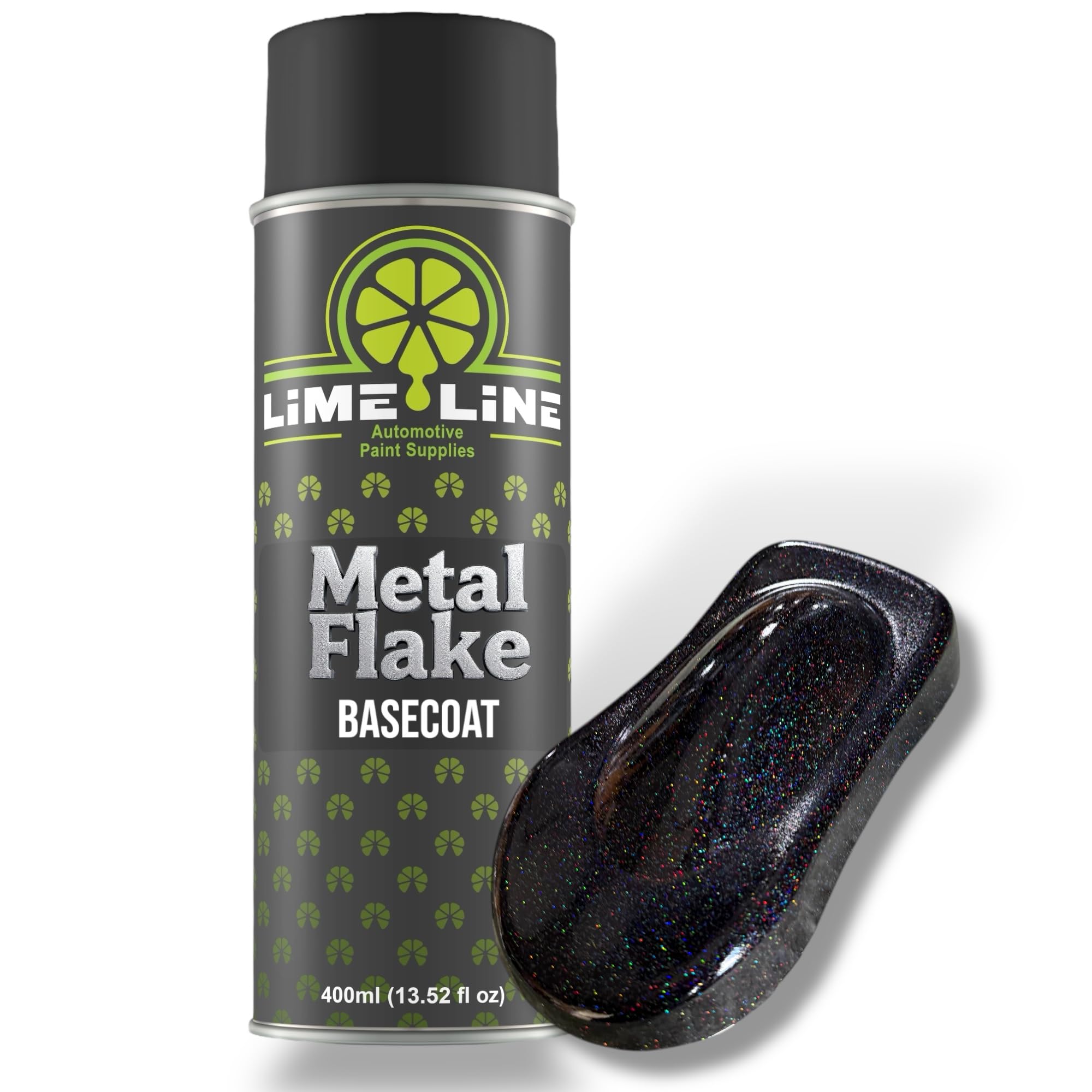
2. LiME LiNE Metal Flake Basecoat Automotive Grade Sparkle Spray Paint (Black Rainbow Iridescent)
Sparkle in a can — when the can cooperates, it genuinely glitters.
This is the one pick built for riders and custom builders chasing a rainbow-flake look on a tank or a fender, and it comes as a 14 fluid ounce aerosol that skipped the spray-gun setup entirely. In a good batch it sprays fine flake over a black base and delivers exactly the shifting sparkle the color name promises.
The mixed reviews here are very real, and they are worth reading before you commit. Buyers report “1 of 3 cans faulty, sputtered, wouldn’t spray” — a mid-project headache that a replacement shipment usually sorted out. The trick that separates the happy outcomes from the frustrating ones is prep: shake hard, and several owners pre-soak the can in hot water first because the flake settles aggressively at the bottom. Get that right and the coverage and color land beautifully.
Treat this as a specialist accent product rather than a workhorse. It works best over a primer-and-basecoat system, and one hobbyist finished a whole Harley Sportster tank and fender off a single can. Check the nozzle assembly before you start, and remember the reliability is the gamble you take for that flake effect.
Shop the flake: This is a niche pick — the audience is small and specific, and it hunts the iridescent sparkle a standard gun-based basecoat simply cannot lay down from a rattle can.
Read the fine print: The most-discussed theme across buyers is consistency of the cans themselves. Prep and patience are not optional here; the flake settles hard, and the spray mechanics are the variable that decides whether your project goes smoothly or stalls halfway through a panel.
Right for you if: you are doing a small custom accent — a tank, a fender, a bike panel — and the rainbow-flake look is the whole point.
Not for you if: you need dependable, repeatable output across large areas without babysitting each can.
3. POR-15 Top Coat Paint, Direct to Metal Paint, Long-term Sheen and Color Retention, 16 Fluid Ounces, Chassis Black
The chassis-and-gate coating that clings to bare metal and shrugs off weather.
For anyone fighting rust on a frame rail, a trailer, a garden gate, or a set of cast iron patio furniture, this is the direct-to-metal option built for the job. It goes on without a primer or undercoat, dries in 24 hours, and lays down at a coverage rating of 120 sq ft per 16 fluid ounces. That same tin holds 16 fluid ounces versus the 14 fluid ounces in the LiME LiNE flake can, so you are getting a bit more product for the scuff-and-coat work. What everyone raves about is the sheer toughness once cured — a hammer-hard finish the maker says will not crack or peel.
The real-world proof is in the longevity. One owner reports “Followed instructions, applied multiple coats for thickness; still holding after 3 years” on a repaired axle bell housing. Another used it across rusty garage support beams, metal statues, an old water drainage pipe, and a filing cabinet, noting a small can goes a very long way. Chassis Black is a deep, glossy black that hides faded, dull metal well. Just know the paint is a commitment once it cures — it is not the kind of thing you clean off casually.
That permanence cuts both ways, and it is the honest trade-off. This stuff grips bare skin with a vengeance, so gloves and long sleeves are mandatory, and one reviewer notes it stays on the metal even through solvent pop in low humidity. Apply it with a foam brush or a solvent-resistant roller for the cleanest result. Once it sets, it sets for good.
Where it shines: Beyond its primary use, dozens of customers have repurposed this as an all-purpose coating for rusty metal odds and ends around a property, from garden statuary to old drainage pipes. The 120 sq ft per 16 fl oz coverage and the hammer-hard finish once cured are what drive the repeat praise.
Pick this if: rust is your enemy — restore it, coat it, forget it. The hard, weather-shedding finish and long-term color retention do the job of a primer and a finish coat in one.
skip it if: you are spraying a big, glossy auto body panel and need something you can sand and refine. This is a permanent, structural coating.
4. Restoration Shop 1.25 Quarts 2K Clear Coat Automotive Paint Kit, 1 Quart
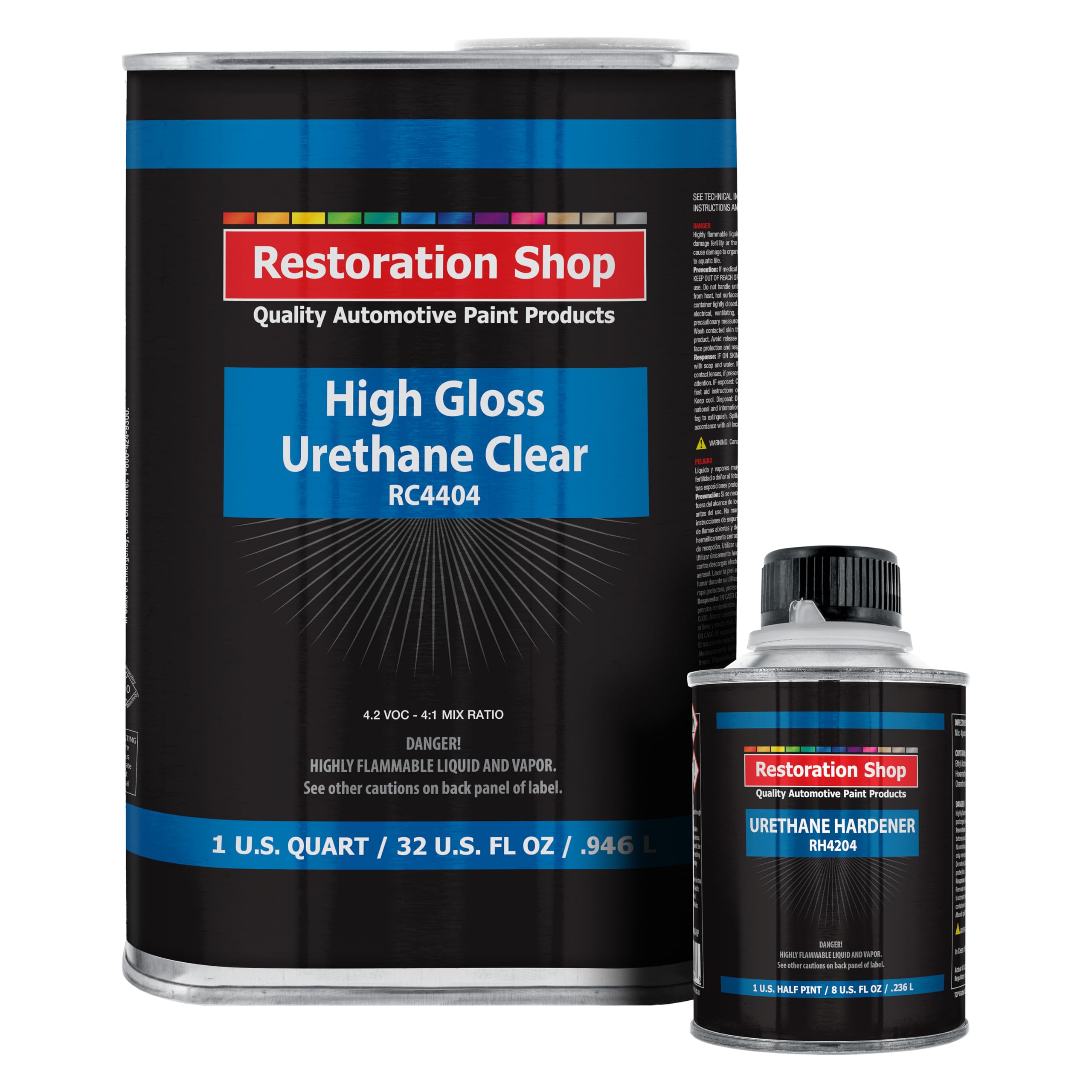
A first-timer’s 2K clear coat that sprays smooth even without a practiced hand.
Mixing two-part clear coat is the step that trips most people up, and this kit makes it easier with a simple 4 to 1 ratio — one quart of urethane clear plus a half pint of hardener, which blends into 1.25 quarts of sprayable product. It dries in 8 hours, so you can keep moving on a project without long waits, and it covers 175 square feet at 1 mil (a mil is one-thousandth of an inch, a standard paint thickness). That is enough to clear a full car body or handle spot and panel work while you dial in your technique. At 4.2 VOC (volatile organic compounds, the solvents that evaporate), it meets national rule compliance.
New sprayers tend to be delighted by how forgiving it is. Reviewers describe it laying down like glass, spraying smooth and even with a high-gloss wet look, and one first-timer admitted to causing runs purely from inexperience before dialing in technique and getting fantastic results. The clarity earns the most praise across the board, and the ability to eyeball the mix ratio with clean cups and a clean gun makes it unusually beginner-friendly.
It is a workhorse for the price of an entry-level clear, but it is not a show-car-only product. Used over most multi-stage topcoat systems and even on top of other basecoat brands, it holds up well. If you want the deepest possible depth on a black panel you may eventually want a premium 2K kit, but for everyday clear coat work it is a safe, easy bet.
Clarity leads the pack: The clarity of the clear coat and the crisp, glass-like finish are what reviewers return to most. Application and gloss also draw steady praise.
A beginner-friendly note: The slow, even flow of this clear rewards a careful hand but punishes a heavy trigger. Runs come from too much material per pass, as one self-described first-timer acknowledged before smoothing out their technique.
Ideal for: the spray-painter who is still building confidence and wants a 2K clear with a no-nonsense 4:1 mix and plenty of working time.
Look elsewhere if: you want a gallon-scale batch — this kit rounds out at roughly 1.25 quarts of sprayable material.
5. LiME LiNE Automotive Basecoats, 1k Urethane Base Coat Color (Black Basecoat Quart)
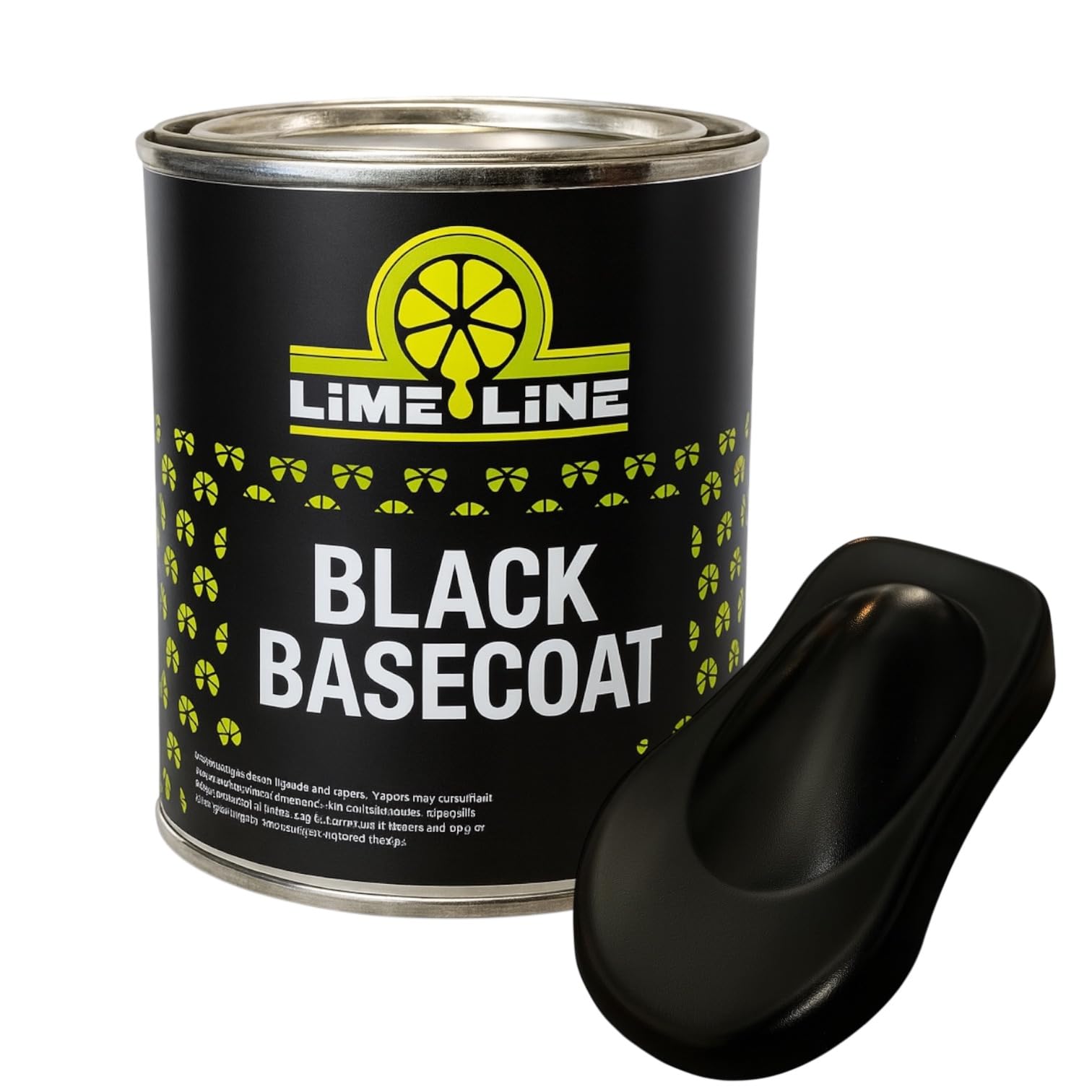
The black basecoat people reach for before the sparkle goes on.
Sparkle flake and custom topcoats need a black stage underneath to look right, and this quart of 1K urethane basecoat (a one-part undercoat that does not need a hardener) is that underlayer, shipping at 32 fluid ounces. It mixes 1-to-1 with urethane reducer, so the batch math stays simple, and it covers 102 square feet. On its own it dries matte, which is exactly what you want from a basecoat — it is not the final look, it is the foundation the clear coat sits on and pops.
Reviewers like what happens once the clear goes on top. Owners mention it sprays excellently, covers well, and dries very quickly. One buyer blended it into a Victory Cross Country Black and found the match so close the repair was invisible — no visible blend line at all. Across the board, the pattern is a basecoat that behaves predictably and ends up looking like the coat above it made it glow.
There is one honest caveat worth knowing if you are an efficiency-minded painter. The black comes through a touch thin, and several owners find it takes three coats for even coverage where a more premium base might do it in two. For a standard black, that is a fair trade for the price. Just mix it 1-to-1 with reducer and expect to build a layer or two more than you might with a denser brand.
What lands well: The finish after clearcoat is the standout — the deep, even black that shows no blend line is the recurring upside. Sprayability also draws steady, positive notes.
The coverage trade-off: It is thinned for laying down smoothly, and the extra coat or two it takes to reach full opacity is the price you pay for the smooth spray and the easy price tag.
Suit yourself with this if: you need a reliable black basecoat for a modern finish and are willing to build two or three coats for full coverage.
Look at a denser basecoat if: you want to cover in two passes and are spraying large panels where extra coats mean extra time.
6. 2K Clear Coat Automotive Paint Kit, High Gloss Acrylic Clear Coat 4:1 Mix Ratio with Medium Hardener, 1 Gallon (3.78L) + 1 Quart, Professional Automotive ClearCoat for Cars, Durable Auto ClearCoat
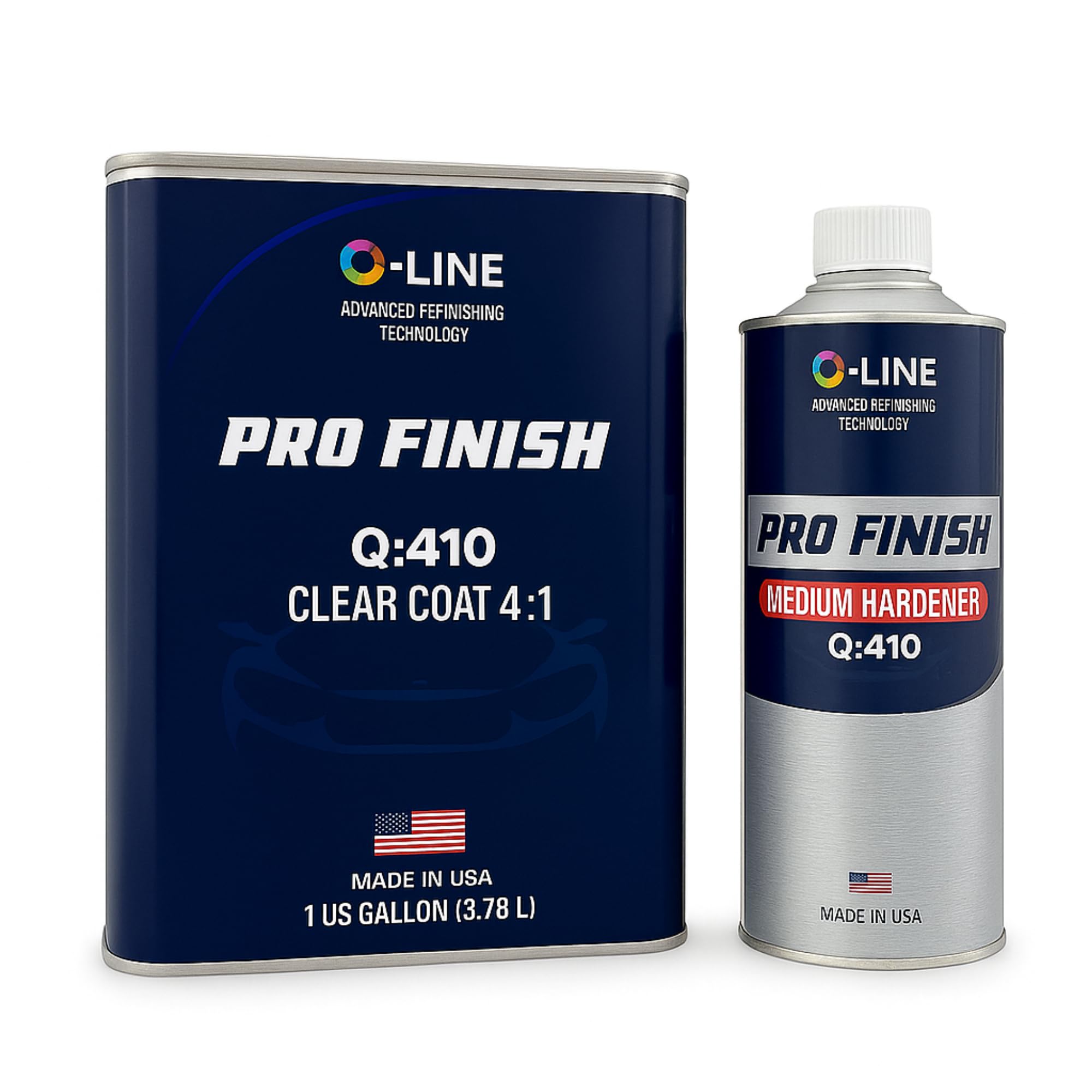
Pro-scale clear coat volume for a full respray, at a fraction of the cost.
Full vehicle resprays burn through clear coat fast, and this kit answers with sheer volume — a gallon of acrylic clear coat plus a quart of medium hardener, mixed at an easy 4 to 1 ratio. That large format is the whole point here: it gives you enough material to do a complete car or truck without stopping to reorder mid-panel. It dries in 24 hours, is rated waterproof, and is built to help resist UV exposure, oxidation, fading, chemicals, moisture, peeling, and chipping.
Buyers keep coming back because of the real-world results. The gloss is the star: reviewers describe it as glossy with a deep finish, one compared the laid-down result to glass over red scuffed paint, and another said it sprays and buffs better than Transtar products. The value comes up again and again — owners cannot quite believe the quality they get from an economy-price 2K clear (a two-part clear coat that mixes clear and hardener). The 4:1 ratio scales cleanly when you mix a larger batch.
The catch is curing speed, and it is worth factoring in. One buyer reports the 1oz pot life exceeding 8 hours uncapped and that it needs an accelerator to cure faster for automotive use, which eats into the cost savings. Others counter that it sprays nicely and finishes decently if left untouched for 12 hours. So this is a kit that rewards a patient painter who is not on a clock.
Where it wins: The shine of the finished coat is what buyers praise most, followed closely by the value for the money — a gallon-plus-quart kit at this price is the standout story. Quality and drying draw steady positive notes too.
The curing nuance: This clear wants a slower cure than some users expect, so if you are on a tight timeline, plan for extra wait time or an added accelerator.
Reach for this if: you are clearing an entire vehicle, truck, or motorcycle project and want maximum coverage per round.
Consider a faster-curing clear if: you are working against a deadline and cannot wait out a long pot life between panels.
7. Speedokote Gloss Black 2K Acrylic Urethane, 4:1 Gallon Medium Kit, SSP-15/SSPA-M

The go-everywhere black that covers wheels, gates, and a truck frame alike.
This single-stage gloss black (a paint that needs no separate clear coat) is the practical middle child — a 4 to 1 acrylic urethane that arrives as 1.25 quarts and covers between 250 and 400 square feet, enough for wheels, a set of gates, or a frame with product to spare. It cures to a hard gloss, resists UV (ultraviolet) light, and is formulated for exterior use, so it should hold its color against the sun. The coverage is the headline: with a 4:1 mix, one kit goes a lot further than you might expect from the can size.
What it does best is spray cleanly right out of the batch. It appears pre-reduced, so one painter ran it through a SATA gun with a 1.4 tip, laid a tack coat plus two medium wet coats, and got a great result with no fuss. Owners use it on wheels for their kids’ trucks, on outdoor side gates through an air sprayer, and even under a chameleon topcoat for a novelty finish. Reviewers return to the spray performance and the hard, even gloss this single-stage lays down.
Know what you are buying, though. This is a single-stage product — it carries its own gloss rather than relying on a separate clear — and on a hot day it may want a touch of extra reducer for clean flow. Once it cures hard, black shows scratches, so a little care in handling pays off. It lays down with almost no orange peel, which is the pleasant surprise.
Main draw: The spray performance and the quality of the finish are the two qualities that come up most, with a high gloss that flows out well. The UV-resistant formulation and the forgiving spray pattern are what keep people coming back to this line.
Go for this if: you spray small-to-medium jobs — wheels, gates, frames, parts — and want a hard, UV-resistant gloss black with wide coverage headroom.
pass on it if: you are painting a whole car and need gallon-scale volume with a dedicated clear step.
8. Speedokote High Gloss Jet Black 2K Acrylic Urethane, 3/4 Gallon Black and 1 Quart Activator, SMR-9705-M

Jet black so deep it makes a tired trailer look showroom-new again.
Pick this one when you want a true, deep jet black across a big surface — a trailer, a race car, a set of rims — and you want it to cure fast. It ships as three-quarters of a gallon of black plus a quart of activator, dries in 6 hours, and delivers a high-gloss finish with high DOI (distinctness of image, which means reflections stay sharp and crisp rather than hazy). The acrylic formulation resists UV light for long-term weathering, so the gloss should not fade out on a sun-baked panel.
The results buyers describe are genuinely show-grade. One repainted a dull trailer and it came out looking transformed, and another after sanding, epoxy-sealing, and reducing it 20 percent for a 1.7 HVLP tip sprayed three even coats onto a large trailer that held up well. What owners praise most is the quality — flawless jet black, mirror-like gloss, minimal orange peel, no runs or sags, and a finish that cures hard and weather-resistant. It has the highest gloss and effectiveness praise of any single-stage here.
Two honest notes for the planner. The color counts as mixed in reviews despite the jet-black name, so if exact shade matters to you, spray a test panel first. And it takes real prep — sanding, sealing, thorough mixing — which one reducer-heavy owner found essential to get that glassy result.
The gloss is the hook: Buyers return to the high gloss and deep, mirror-like jet black, which holds up against pricier paint from the same maker’s lineup.
This is your pick if: you want a gallon-scale jet black with high gloss and a fast 6-hour dry for trailers, race panels, or a full respray.
Weigh the alternative if: you need a perfectly uniform gallon every time — some arrive short-filled, so check the level before you start a two-car job.
9. Restoration Shop Jet Black (Gloss) Acrylic Enamel Auto Paint – Gallon Kit

One kit, one gallon, and a full car painted without a separate clear step.
If you want a complete single-stage system in one box, this gallon kit is the fullest package on the list: a gallon of acrylic enamel color, a pint of AE3001 wet-look hardener, plus five 190-micron nylon strainers (filters that catch particles as small as 190 microns) and five mixing sticks. It mixes 8 to 1, needs no reducer as packaged, and comes in at 2.8 VOC. The whole point of a single-stage enamel is that you spray the color and you are done — no separate clear coat layer to mix and lay on top, which is why it suits full-car refinishing, fleet equipment, and anyone who wants a fast, forgiving process.
The shine is what stands out once it cures. Users describe a mirrored finish and a wet, glossy look, and this system resists chipping, cracking, and UV fading as it cures. It is forgiving enough for first-timers — one user sprayed an entire 2006 Toyota Highlander with less than half a gallon through a 1.3mm gun and got a wet, shiny look with no runs. The included accessories mean you are not chasing down strainers and sticks separately. Add a quality gun and compressor and it lets a careful beginner get genuinely professional results.
There is one quirk to plan around, and it is the resin settling. The 8-to-1 ratio means you can run short on hardener if you are not careful with your mixing cup, and more than one user has run out with a quarter of the batch left. It also cures to a working pot life of about 8 hours, so mix what you can spray. Read the label closely if a perfectly flat black is your goal.
Verdict on finish: When the shine lands, it lands beautifully — the wet, mirrored gloss this enamel cures to is what buyers remember. But the value story is genuinely split, with strong support from some painters and caution from others depending on their setup and technique.
Best suited to: a determined DIYer or small-shop painter who wants a complete, self-contained single-stage enamel kit and is willing to measure hardener carefully and practice on a panel first.
Not the best fit if: you want a simple spray-and-pour experience — this kit rewards careful prep and precise mixing, and running short on hardener mid-panel is a real risk to avoid.
Understanding the Specs
Single-Stage vs. Two-Part (2K) Chemistry
Single-stage products like the acrylic enamel and the Speedokote blacks carry their gloss in the color itself, so one spray pass gives you the finished look. Two-part — or 2K — products instead split into a clear coat and a hardener you stir together at a fixed ratio, which is why a 4:1 kit pours as paint plus activator. The cured 2K layer tends to be harder and more solvent-resistant, which is the reason body shops top a basecoat with clear rather than spraying a single glossy color. Match the chemistry — single-stage enamel or two-part urethane — to your project, not to the prettiest can.
Mix Ratio and Coverage
The mix ratio is the number that tells you how to combine paint and hardener before you spray — an 8:1 kit takes eight parts color to one part hardener, while a 4:1 kit takes four. Get it wrong and the batch either never fully cures or flashes too fast to flow out. Coverage, meanwhile, is rated in square feet per coat or per fluid ounce, and it is your guide to how far one kit stretches. A 6,500 sq ft/coat rating on a clear coat covers a lot, while a 120 sq ft per 16 fl oz direct-to-metal coating reflects a thicker, high-solids formula meant for fewer, heavier coats.
FAQ
Can I use a 2K clear coat over any basecoat brand?
What does the mix ratio like 4:1 or 8:1 actually mean?
Is a single-stage paint easier than a two-part clear coat for a beginner?
How long does automotive paint take to dry and cure?
Do I need a spray gun and compressor for these paints?
Will a jet black paint have metallic flakes in it?
Can I apply a top coat straight to bare metal without primer?
How much area does a gallon of automotive paint cover?
Why does some paint run out of hardener before the color does?
Final Thoughts: The Verdict
For a spot or panel clear coat, the FC 720 Quart Kit with FH 612 Hardener is the one to beat — its 6,500 sq ft/coat coverage rating is the most generous here, and it hardens to a deep, factory-like finish when you follow a layered schedule. For a full respray that needs gallon-scale volume, reach for the 2K Clear Coat gallon kit instead. And if you are fighting rust on bare metal and want to skip the primer entirely, the POR-15 Top Coat goes straight on and stays put for the long haul — a smart move for anyone restoring a frame, a trailer, or a set of gates who wants a finish that will not fade out on them.
How We Picked
We do not accept paid placement. Every pick is matched to a real buyer and a real use-case; we do not hands-on test units.
Sources & Methodology
Specifications: manufacturer listings and product documentation. Review insights: verified customer reviews, as of September 2026. Pricing: not shown on this page (it changes often); check the current price via the retailer link.
As an Amazon Associate, Gadgets Feed earns from qualifying purchases. This does not affect which products we feature.