
Our readers keep the lights on and my morning glass full of iced black tea. As an Amazon Associate, I earn from qualifying purchases.
Specs are compiled from manufacturer listings and verified buyer reviews and can change over time — please confirm the key details on the product page before buying.
An automotive power converter (a device that plugs into your vehicle’s 12-volt battery and outputs the same 120-volt AC power you get from a wall outlet) lets you run a laptop, TV, or small fridge on the road. Before you buy, you need to know two things: how many watts your devices actually draw, and whether they need pure sine wave power (clean, stable electricity that mimics utility power) or can run on modified sine wave (a cheaper, choppier waveform). This guide explains the wattage math, the waveform difference, and the port setups so you pick the unit that matches your rig, not just the biggest number on the box.
I’m Min — the founder and writer behind Gadgets Feed. This guide is built by comparing the manufacturers’ published specifications and the patterns across verified customer reviews, so you get each pick’s real strengths and trade-offs instead of marketing spin.
If you’re kitting out an RV, prepping for outages, or just need laptop power on the road, the right automotive power converter matches your exact wattage and port needs — so your devices stay powered on every trip..
Our Picks at a Glance

How To Choose The Right Automotive Power Converter
Start by listing every device you’ll run simultaneously. A phone charger needs almost nothing, a laptop draws around 60-100 watts, and a microwave or power tool can demand 1000 watts or more. Your converter must handle the continuous load of everything running at once, plus a brief surge for appliances that draw extra power when they first start up.
Continuous vs. Peak Wattage
Continuous wattage is what the unit can deliver hour after hour; peak (or surge) wattage is the short burst it can handle for a few seconds when a motor or compressor kicks on. A fridge might run fine on 300 watts but needs an 800-watt surge to start. If you only look at the peak number, you’ll buy something that overheats or shuts down under steady load.
Modified vs. Pure Sine Wave
Waveform defines how cleanly the inverter delivers power. Modified sine wave is cheaper and runs most simple devices like lights and power tools fine. Pure sine wave produces cleaner, smoother power that matches what comes out of your home wall socket, which sensitive electronics — laptops, CPAP machines, some gaming consoles — prefer for reliable operation and less internal strain.
Quick Comparison
| Model | Best For | Continuous Power | Waveform | AC Outlets | Amazon |
|---|---|---|---|---|---|
| TOPBULL 3000W★ Best Overall | Heavy RV & off-grid loads | 3000W | Modified Sine | 2 | Amazon |
| DrimMek 300WBest Value | Compact laptop charging | 300W | Modified Sine | 2 | Amazon |
| Pro Chaser 400WTop Performer | Road trip device charging | 400W | Modified Sine | 2 | Amazon |
| POTEK 500W | Small electronics on the go | 500W | Modified Sine | 2 | Amazon |
| Giandel 300W Pure Sine | Sensitive electronics care | 300W | Pure Sine | 2 | Amazon |
| Giandel 300W Car Adapter | Clean power for laptops/CPAP | 300W | Pure Sine | 2 | Amazon |
| YSOLX 1000W | RV multi-device charging | 1000W | Modified Sine | 3 | Amazon |
| BESTEK 1000W | Power tools & appliances | 1000W | Modified Sine | 2 | Amazon |
| TOPBULL 3000W Remote | Remote-controlled off-grid | 3000W | Modified Sine | 2 | Amazon |
In‑Depth Reviews
1. TOPBULL 3000W Power Inverter
Our pick — over 4.5★ from 450+ verified ratings; the strongest balance of quality and price.
The powerhouse that turns your camper into a rolling kitchen, running microwaves and mixers without breaking a sweat.
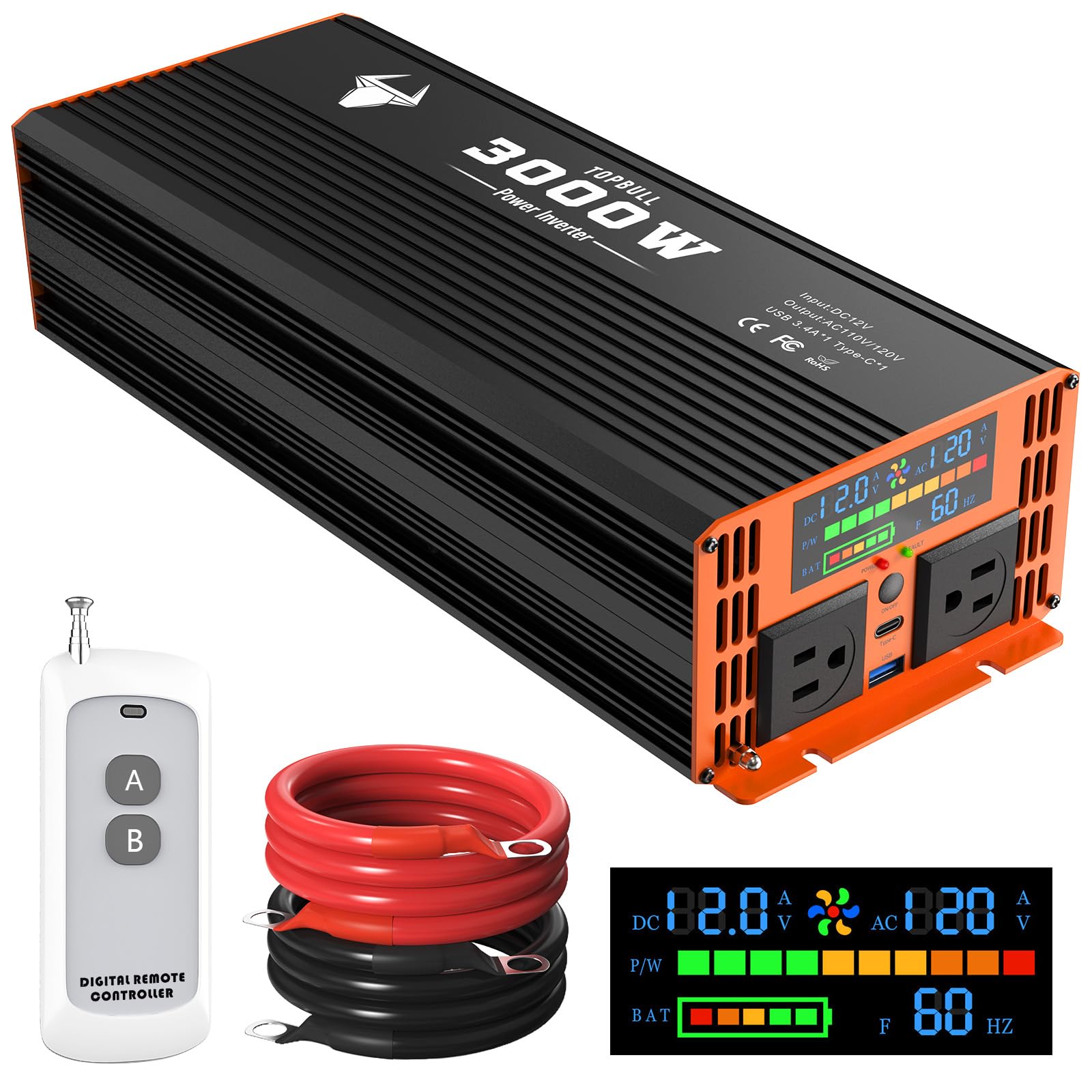
You can run a refrigerator, coffee machine, or even a small oven off your 12V battery with the TOPBULL 3000W, because it delivers 3000 watts continuously and 6000 watts of peak surge, versus 300W for the compact adapters below. That headroom is exactly what over a hundred reviewers praise most: how well it handles real appliances. The dual 20A AC sockets, a 3.4A USB port, and a 30W Type-C interface give you plenty of connection options without needing a separate hub.
The build backs up the brawn. Buyers report it’s a quality unit with a great color screen on the end showing voltage, power, and working status in real time, plus quality cables included — “Don’t let the price tag scare you away; this is a quality unit!” is how the review pages sum it up. The remote control supports 200-foot operation, so you can switch it on and off from across the campsite, and the dual smart fans run quietly without the annoying buzz that plagues cheaper inverters. It’s a favorite for home solar backup setups, not just vehicles.
peak wattage king
- Massive 3000W continuous / 6000W surge handles appliances
- Remote control works from up to 200 feet away
- 10-fold protection including overload, short circuit, and overheating
- Quiet dual smart fans with clear LCD display
needs big battery
- Modified sine wave, not ideal for the most sensitive electronics
- At 7.5″L x 7.77″W x 3.4″H, it needs a solid mounting spot
max output: you need to power real appliances — microwaves, mixers, fridges — in an RV, camper, or off-grid solar setup.
heavy draw: it’s bulky and outputs modified sine wave, so the most finicky medical or audio gear might prefer a pure sine unit.
2. DrimMek 300W Car Power Inverter
The glovebox-sized unit that fast-charges laptops on the move, with a 65W USB-C port leading the charge.
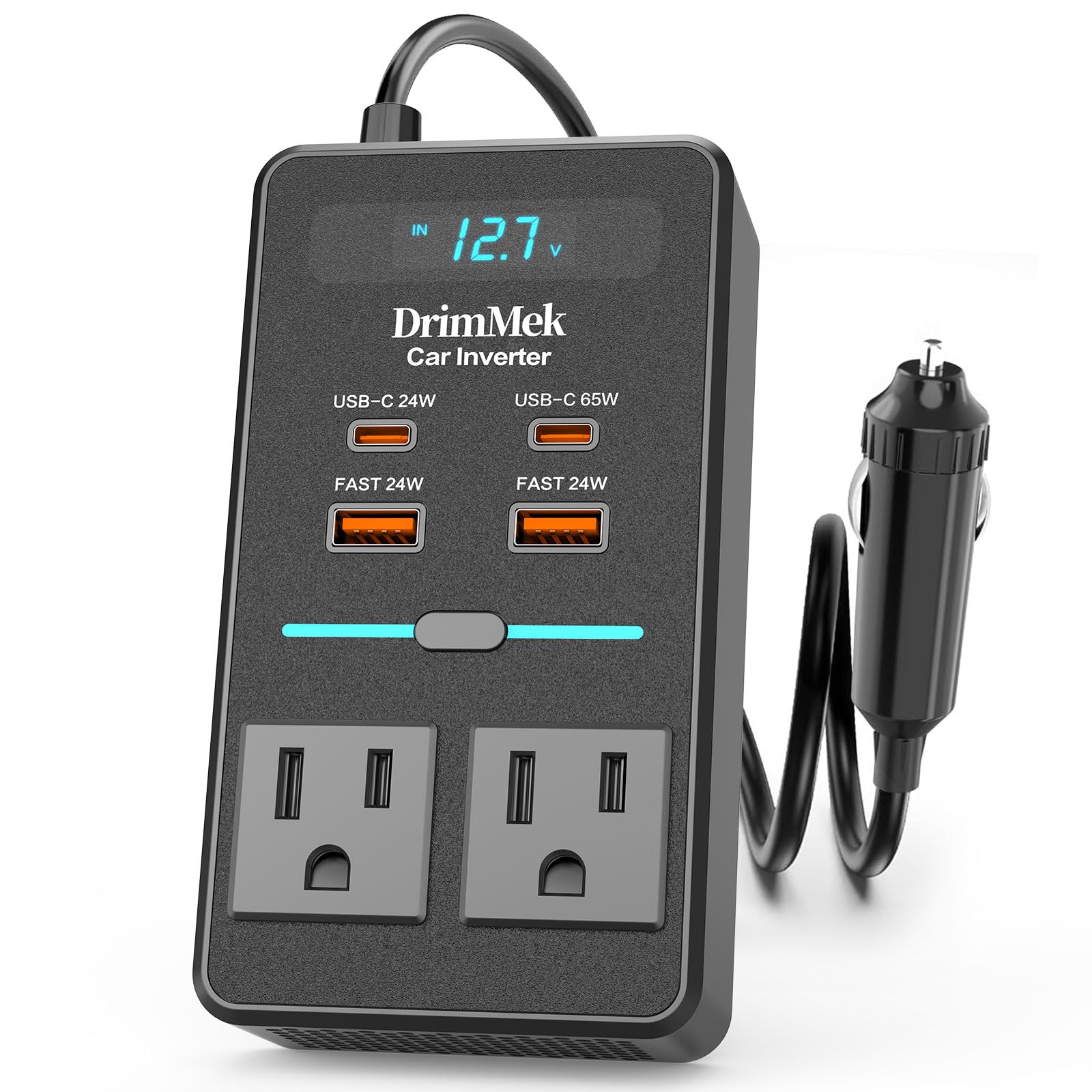
If you live in your car for work or long road trips, this 300W adapter is a 10.0x step down in power from the 3000W TOPBULL above, but that’s the point — it’s built for devices, not appliances. The thing everyone raves about is charging speed: a 65W USB-C port and a second 24W USB-C, plus two USB-A 24W ports, so your laptop, tablet, and phone can all fill up at once. It’s only 5.5″L x 3″W x 1.4″H and 8 ounces, which is 36% smaller than the big unit, so it slips into a center console and disappears.
Owners found it reliable on road trips, charging phones, laptops, and even game systems during long drives. It works exactly as advertised, with the AC outlets handling a laptop and the USB-C fast charging proving very convenient. The plug-and-play design needs no installation — just push it into the 12V socket — and the built-in quiet fan keeps it cool and noise-free. A one-year replacement-only warranty backs the compact build.
compact travel mate: the multi-port layout makes this the best travel companion for anyone whose cargo is mostly gadgets.
laptop only: at 300W, don’t expect to run a hair dryer or kettle — this is strictly for laptops and small electronics.
3. Pro Chaser 400W Car Power Inverter
The cross-country lifesaver that kept multiple devices alive, with a reassuring 400W of continuous output.
Bumping up to 400 watts continuous and 800 watts peak, this one adds a little more muscle than the 300W options while staying compact. It performed well charging work lights and laptops, and buyers love the included USB-to-USB-C adaptors that make the dual USB ports (6.2A total) work with just about any cable you own. The 30-inch cord gives you some reach from the outlet, and the automatic cooling fan only kicks on when things get to 113°F.
Road-trippers found it a lifesaver on cross-country drives, charging multiple devices at once, and the USB ports even work without pressing the power button. The quiet operation and lack of overheating in direct sunlight impressed owners. Still, the honest caveat: some owners mention units failing within minutes of use, so reliability is the one area where this pick trails the others — if you need absolute dependability, the DrimMek above held steadier feedback.
starter pick: a budget-friendly middle ground that charges laptops, cameras, and rafts pumps at the beach with a 12-month warranty.
sparse features: you’ll rely on it daily for critical gear — the reliability reports are more mixed here than on the other picks.
4. POTEK 500W Power Inverter

A quiet 500W workhorse that powered drills and online school laptops, rarely needing its cooling fan at all.
This one splits the difference between the tiny 300W adapters and the big 1000W+ units, offering 500 watts continuous and 1000 watts surge — enough for a drill via extension cord or a laptop for online school. What stands out is how quiet it runs; the fan rarely kicks in, and owners noted it gets warm but not hot even under load. The build quality earned consistent praise, with a straightforward, easy-to-use design that includes 2 AC outlets and a single USB 2.0A port.
At 2.2 pounds and 6.7″L x 4.1″W x 2.2″H, it’s mountable and portable, ideal for vehicle use and camping trips. Owners who upgraded from smaller 150W units found the extra capacity and the second plug made a real difference, and it handles heavy loads up to around 400W comfortably. The 30A fuses and multi-protection (overload, overheat, short circuit) add safety without adding complexity.
mid-range balance: more grunt than the 300W adapters but still light enough to toss in a bag.
fan noise: only a single USB port and modified sine wave, so it’s best for tools and simple electronics rather than a charging hub.
5. Giandel 300W Pure Sine Wave Inverter
The clean-power specialist that ran a 5000BTU window AC, protecting sensitive gear with true pure sine output.
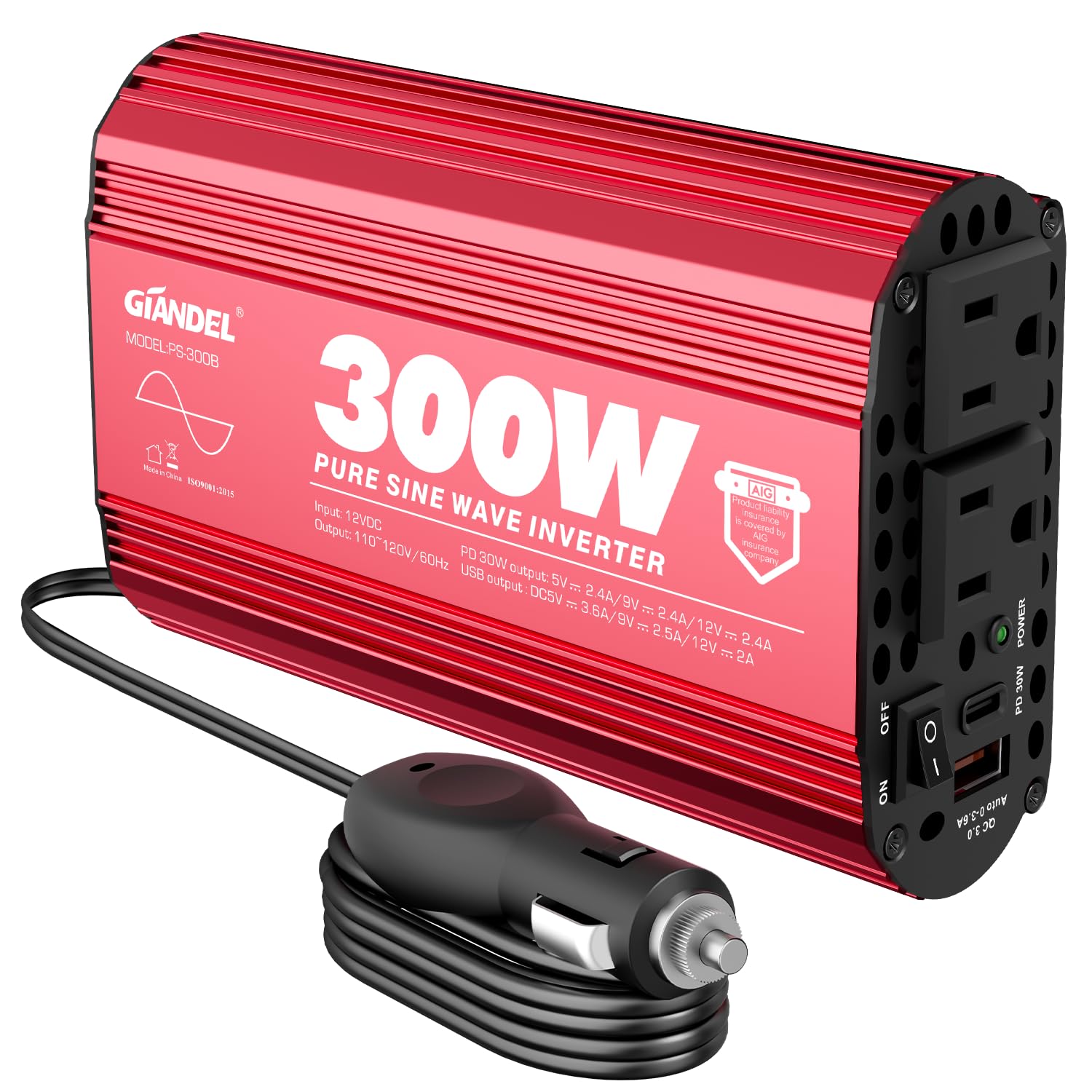
Here’s where waveform matters most. This Giandel outputs pure sine wave, which is noticeably cleaner than the modified sine wave on the TOPBULL and DrimMek units — owners confirmed it handles sensitive loads with care, even powering a 5000BTU window AC unit. At 300 watts continuous, the reliability is the most-praised aspect, with owners trusting it for off-grid solar systems and winter storm outages. The PD30W USB-C and QC3.0 USB ports auto-detect devices to deliver fast charge speeds up to 3.6 amps.
It’s a smart cooling fan design that keeps the unit quiet at light loads, with solid copper wire cutting idle current to just 0.35A max — meaning less battery drain when you’re not actively using it. A replaceable 30-amp fuse protects against overvoltage, short circuit, and overload. One owner successfully ran a furnace and microwave overnight without overheating, which speaks to real-world stamina beyond its modest rating.
sensitive gear: anyone running laptops, CPAP machines, or delicate electronics that deserve the cleanest power a 12V system can produce.
costly choice: the fan can get loud under heavier loads, so it’s not the stealthiest unit in a quiet cabin.
6. Giandel 300W Pure Sine Car Adapter

A rugged aluminum-shelled pure sine adapter that powered a PS4 Pro on a cross-country trip.
The second Giandel on this list takes the same clean pure sine wave approach but wraps it in a durable aluminum alloy housing that shrugs off drops and bumps. With 300 watts continuous and 600 watts peak, it’s specifically built for inductive devices like smartphones, laptops, fans, and CPAP machines in cars, trucks, and RVs. The smart cooling fan stays silent until needed, and the cigarette lighter plug makes setup instant.
Cross-country travelers found it reliable, with the clean 60Hz frequency keeping a PS4 Pro running smoothly in a Camry — though it correctly warned against high-draw items without the engine running. The isolated input/output safety tech protects against overvoltage, undervoltage, overload, short circuit, and overheat. One owner measured a clean true sine wave on a scope, confirming the power quality claim, and the 18-month warranty adds confidence.
rugged casing: the metal shell and pure sine output make this the tough, clean-power option for travel.
bulky size: the cigarette plug limits real-world draw to around 120W despite the 300W rating, so heavy sustained loads aren’t its strength.
7. YSOLX 1000W Power Inverter
The port-packed multitasker with 3 AC outlets and dual cigarette lighter sockets, juggling every device on the road.
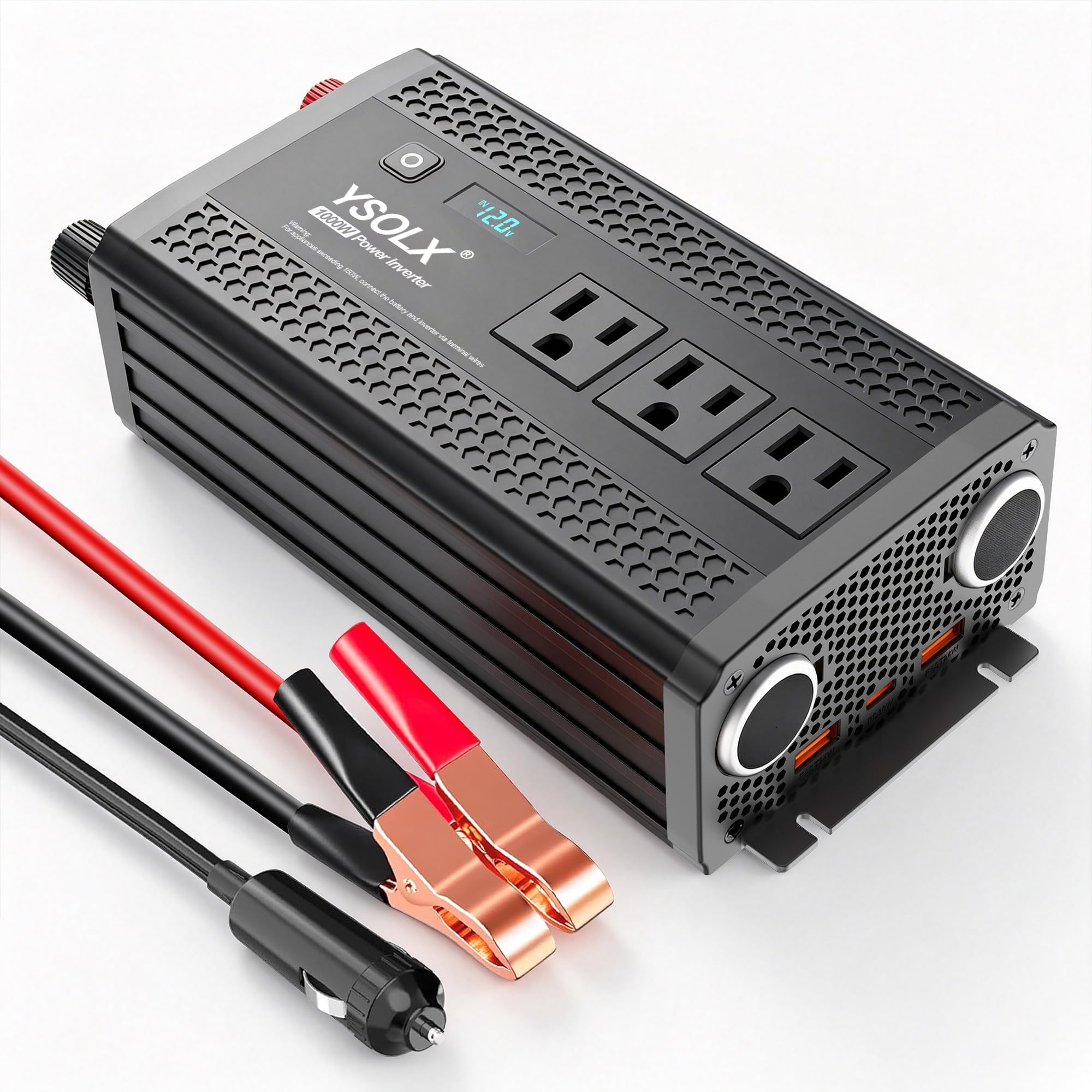
You can charge laptops, phones, fans, and more simultaneously on any road trip with this 1000W unit, thanks to its 3 AC outlets, 2 USB-A ports, a 30W USB-C PD port, and dual 12V cigarette lighter sockets. The 1000 watts continuous and 2000 watts peak surge come from premium high-frequency transformers and 100% pure copper cables, delivering reliable power for laptops and power tools.
The LED display shows real-time battery voltage, and built-in E1-E6 error codes (diagnostic codes for undervoltage, overvoltage, overload, short-circuit, and overheat) give instant fault alerts that speed up troubleshooting. Owners found it handy for charging a 100Ah lithium battery and appreciated the alligator clips and car cigarette lighter included in the box. The 1-year warranty plus lifetime technical support adds confidence.
big appliances: you need the most connections per dollar — a genuine multi-device charging hub for RV camping and home emergency backup.
install effort: reliability gets mixed feedback, and it won’t handle 700-watt polishers, so match your loads to its continuous rating.
8. BESTEK 1000W Power Inverter

The ETL-certified workhorse that ran a chainsaw and fridges, with intelligent fans that only roar under load.
This BESTEK delivers 1000 watts continuous and 2000 watts peak surge, and it puts that power to work — owners ran an 8-amp chainsaw at 450 watts without a shutdown and handled two fridges simultaneously at over 1000W without overheating. The performance is the most-praised aspect by a wide margin, with quality and value for money following close behind. The dual intelligent cooling fans adjust speed with temperature, staying quiet until you really push it.
The PD30W USB-C and QC18W USB-A ports provide fast charging for iPhones and laptops, and the ETL certification backs the safety claims with an AI smart chip and built-in fuse for double protection. A key owner tip: the cigarette lighter adapter is limited to around 120W, so for full 1000W output you need to connect directly to the battery with the included clamps. The 180-day refund and 18-month replacement warranty show confidence in the build.
dual outlets: the fan design and proven performance make this the pick for power tools and real appliances on battery power.
heat buildup: it’s modified sine wave, and the fan gets noticeably loud at full load — fine for work, less ideal for a quiet cabin.
9. TOPBULL 3000W Remote Power Inverter
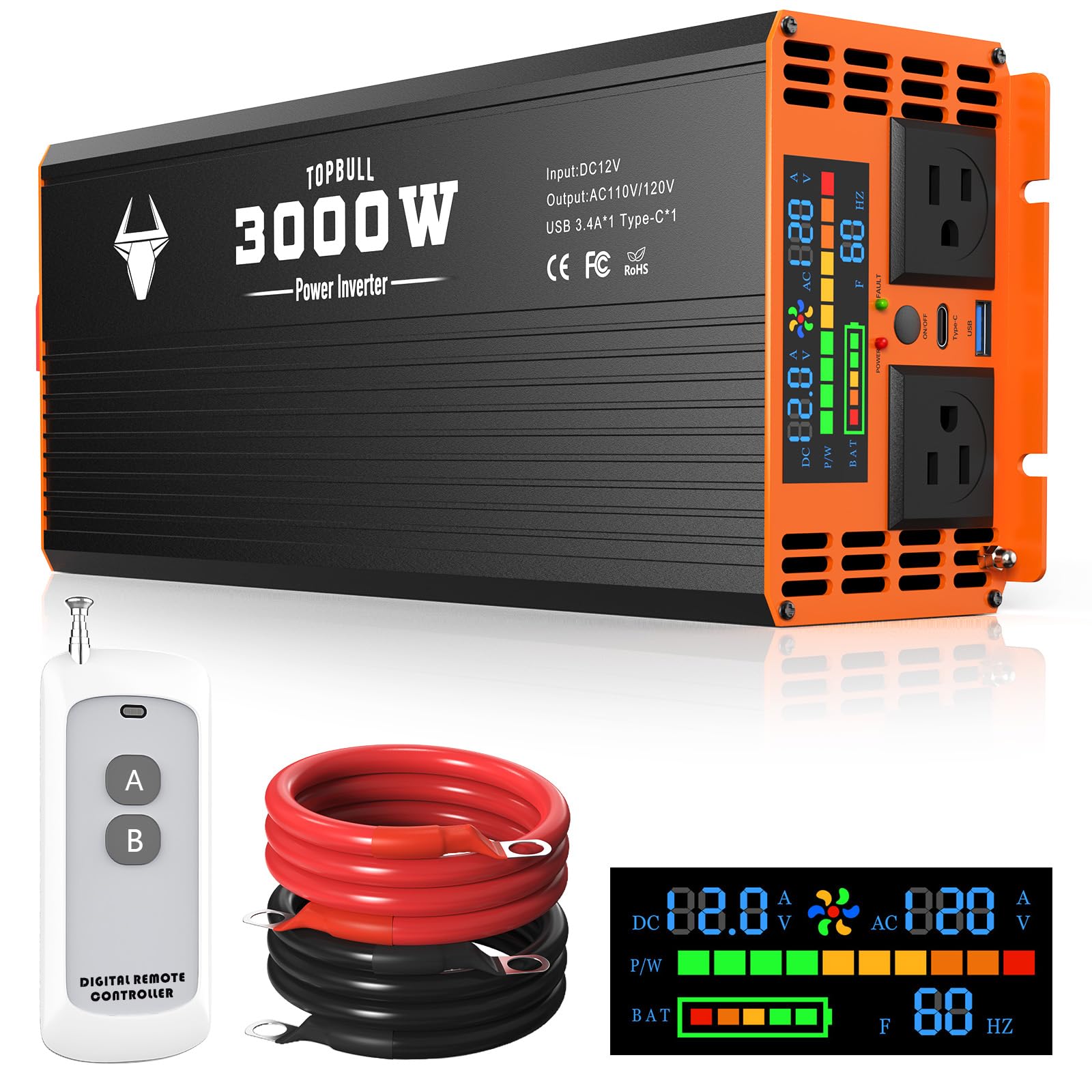
The remote-controlled giant that powered a 3000W draw flawlessly, with fans that auto-adjust and a display that informs.
Another 3000W continuous / 6000W surge monster from TOPBULL, this version adds a 200-foot remote control and a high-quality aviation aluminum alloy shell that withstands harsh environments and collisions. Owners powered a 120V charger drawing 25A (a true 3000W load) flawlessly with an Optima battery, and the fans auto-adjusted without the unit getting hot. The reliability is the standout, with the highest praise count of any aspect on this unit.
The super large LED color screen shows battery level and output clearly, and the built-in power management system (IPM), voltage regulation (AVR), and intelligent fan control (IFC) work together to boost conversion efficiency. It ran an SDS MAX hammer drill for two hours straight for ground rods in remote areas, and owners found it silent with minimal heat. The 4 AWG battery cable included means you’re ready to wire it up immediately.
distance access: remote off-grid setups and RVs where you want full power control from a distance and rugged durability.
extra cost: unlike the first TOPBULL, this runs modified sine wave and skews larger at 16.14″L x 6.14″W x 3.45″H, so it’s a commitment in space.
Understanding the Specs
Watts and Waveforms
Modified sine wave suits basic tools, while pure sine wave protects sensitive electronics like laptops and CPAP machines.
Ports and Protections
Check that the AC and USB ports match your device count. A 65W USB-C port fast-charges a laptop, while multiple AC outlets let you run several devices at once. Safety features like overload, short-circuit, and overheat protection shut the unit down before damage occurs — look for these in every spec sheet.
FAQ
How much wattage do I actually need in an automotive power converter?
What’s the difference between modified and pure sine wave?
Can I run a 3000W inverter off my car’s cigarette lighter?
Will a power inverter drain my car battery?
Can an inverter run a refrigerator or power tools?
What does peak surge power mean?
Is a pure sine wave inverter worth the higher price?
How do I connect a high-wattage inverter to my battery?
What safety protections should I look for?
Can I use an automotive inverter for home solar backup?
Final Thoughts: The Verdict
For most buyers, the crowd favorite — 4.6 stars across 400+ owners — is the automotive power converter winner: the TOPBULL 3000W, because it delivers serious 3000W continuous power with the remote control and quiet fans that make RV and off-grid living easy. If you want fast laptop charging on the road, grab the DrimMek 300W for its 65W USB-C port. And for clean power that protects sensitive electronics, the Giandel 300W Pure Sine is the one to reach for — the reliability (150 owners sing its praises) makes it the safest bet for delicate gear.
How We Picked
We do not accept paid placement. Every pick is matched to a real buyer and a real use-case; we do not hands-on test units.
Sources & Methodology
Specifications: manufacturer listings and product documentation. Review insights: verified customer reviews, as of August 2026. Pricing: not shown on this page (it changes often); check the current price via the retailer link.
As an Amazon Associate, Gadgets Feed earns from qualifying purchases. This does not affect which products we feature.