
Our readers keep the lights on and my morning glass full of iced black tea. As an Amazon Associate, I earn from qualifying purchases.
Specs are compiled from manufacturer listings and verified buyer reviews and can change over time — please confirm the key details on the product page before buying.
Washing your car with a garden hose leaves a film of grime, and a gas pressure washer risks blasting right through your clear coat. the balance for detailing is an electric unit that pairs enough pressure to lift dirt with enough water flow to rinse it away safely. You need to know three numbers—PSI (pounds per square inch, the cleaning force), GPM (gallons per minute, the rinse speed), and portability—to pick the one that fits your driveway and your paint.
I’m Min — the founder and writer behind Gadgets Feed. This guide is built by comparing the manufacturers’ published specifications and the patterns across verified customer reviews, so you get each pick’s real strengths and trade-offs instead of marketing spin.
Finding the right automotive pressure washer means matching water flow, pressure, and hose reach to how often you actually wash your ride.
Our Picks at a Glance


How To Choose The Best Automotive Pressure Washer
Choosing a pressure washer for your car isn’t about grabbing the most powerful machine on the shelf. For automotive use, you need enough pressure to remove dirt without damaging the paint, and enough water flow to rinse soap away efficiently. The balance between PSI and GPM decides how safe and how fast your wash will be.
Focus on Flow Rate (GPM) for Faster Rinsing
The gallons per minute (GPM) tells you how much water the machine pushes out. While PSI blasts dirt loose, GPM is what actually sweeps it off the surface. A higher GPM means faster rinsing and better soap removal. For washing a car, a machine with a higher GPM, even with moderate PSI, often cleans quicker than a high-pressure, low-flow unit.
Match PSI to Your Paint’s Safety
PSI (pounds per square inch) is the force of the water jet. For car paint, you don’t need extreme force. Using a wide-angle nozzle like a 40-degree tip spreads the spray and softens the impact, making it safe for clear coats. High PSI is great for driveways and concrete, but for panels and trim, a controlled PSI with the right nozzle is the key to a swirl-free finish.
Look for Pump Longevity and Portability
A 5-piston pump with an induction motor outlasts a standard axial pump, so check the pump type before buying. Axial pumps are common in consumer units, while induction motors and 5-piston pumps offer more durability and quieter operation. Portability matters too—check the wheel size, overall weight, and hose length to ensure the unit is easy to maneuver around your vehicle without constantly moving the machine.
Quick Comparison
| Model | Best For | Max Pressure | Max Flow Rate | Weight | Amazon |
|---|---|---|---|---|---|
| Westinghouse ePX3500★ Best Overall | Best Overall | 2500 PSI | 1.76 GPM | 19 pounds | Amazon |
| Greenworks 1800 PSISmall & Mighty | Small & Mighty | 1800 PSI | 1.1 GPM | — | Amazon |
| Worx WG605Best Value | Value Pick | 1800 PSI | 1.4 GPM | 13.8 pounds | Amazon |
| A-iPower E2800-FM | Best Pressure | 2800 PSI | 1.7 GPM | 18.2 pounds | Amazon |
| Westinghouse WPX2300e | Induction Motor | 2300 PSI | 1.76 GPM | 27.5 pounds | Amazon |
| Sun Joe SPX3000 | Crowd Favorite | 2030 PSI | 1.2 GPM | 24.3 pounds | Amazon |
| CAT Electric | High Flow | 1800 PSI | 2.0 GPM | — | Amazon |
| Active 2.0 | Detailing | 1800 PSI | 2.0 GPM | 24 pounds | Amazon |
| Greenworks 3000 PSI | Top Power | 3000 PSI | 2.0 GPM | 23 kg | Amazon |
In‑Depth Reviews
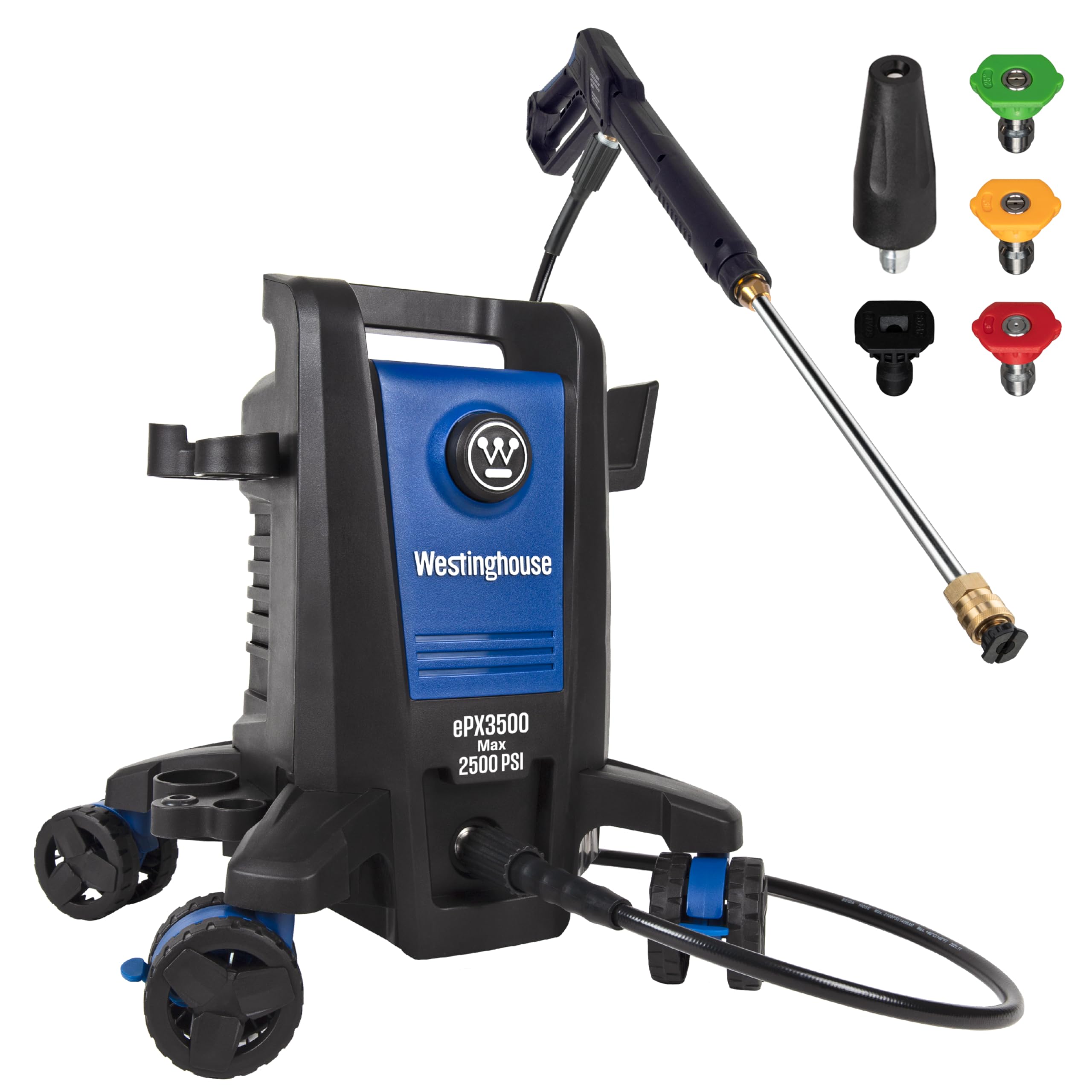
1. Westinghouse ePX3500 Electric Pressure Washer
Our pick — over 4.5★ from 13,000+ verified ratings; the strongest balance of quality and price.
The compact powerhouse that rolls on 360° wheels and never tips over mid-wash.
You get a 2500 max PSI jet for lifting road grime, paired with a 1.76 max GPM flow that strips soap suds off panels in a hurry. The machine is rated at 2000 PSI and 1.2 GPM continuously, which is plenty for routine washes without worrying about your clear coat. It stands just 16.5 inches tall and weighs 19 pounds, so it tucks into a garage corner when the wash is done.
The build quality is what wins people over—thousands of owners highlight the solid feel and the tool-free assembly. This unit delivers more pressure than the Greenworks 1800 PSI model (2500 PSI vs 1800 PSI, a 39% gap) and a higher flow rate (1.76 GPM vs 1.1 GPM, a 60% gap), making it a clear step up for anyone who also wants to clean driveways. The pump automatically stops when you release the trigger, which saves energy and protects the motor over years of use.
An occasional note is that the small soap tank and the holster require a firm snap to stay put. Buyers report the 25-foot hose and 5 quick-connect nozzles—including a turbo and soap applicator—make short work of a driveway in about 2 hours. Backed by a 3-year limited service, labor, and parts coverage, this is the one to beat for most households.
Why It Wins
- Highest verified workflow in its tier (1.76 GPM vs the Greenworks 1800’s 1.1 GPM)
- 19-pound frame with anti-tipping wheels glides around a car easily
- 5 quick-connect nozzles cover everything from paint-safe rinses to concrete blasting
Watch Out For
- The onboard soap tank is on the small side, so big jobs need refills
- Some owners note the wand holster needs a firm click to stay locked
The Pick for Most: If you want one machine that moves from car to driveway to patio without a second thought, this is it.
Reach For It If: You value sheer cleaning speed and a compact, stable frame over the absolute lowest price.
2. Greenworks 1800 PSI Electric Pressure Washer
A tiny unit with a big heart that refuses to overheat even after hours of use.
This is the machine for light-duty residential work—washing cars, trucks, motorcycles, boats, and patio furniture. It delivers 1800 PSI at 1.1 GPM, which is gentle enough for a weekly rinse but strong enough to lift light dirt and grime. The included 40° nozzle is your paint-safe friend, while the turbo nozzle handles tougher spots like bug splatter.
What truly stands out is the endurance. Owners mention running it for three hours straight without any overheating or struggling, proof of its simple, no-maintenance design. There’s no gas, oil, or pull cord—just a push-button start and a 35-foot power cord with a GFCI plug (a safety device that auto-shuts off power if it detects a short). Its compact footprint (10.63″L x 9.06″W x 12.8″H) makes it among the most storable units here.
The trade-off is flow. At 1.1 GPM, it rinses slower than the Westinghouse ePX3500’s 1.76 GPM, so washing a large SUV takes a bit more patience. It includes a 20-foot tangle-free hose and a 1/4″ universal quick-connect system, plus a 3-year limited warranty. For a first-time buyer or someone with a smaller vehicle, this is a fantastic, entry-level pick.
Best For Beginners: This is the easiest, most forgiving introduction to power washing without the bulk.
Look Elsewhere If: You need high water volume to blast heavy mud from trucks or large concrete areas—the 1.1 GPM will feel slow.
3. Worx 13 Amp Electric Pressure Washer WG605
A budget-friendly workhorse that pairs a 13-amp motor with a handy carry handle.
This Worx model delivers a solid 1800 PSI (peak 1980 PSI) and 1.2 GPM (peak 1.4 GPM) from a compact frame that tips the scales at just 13.8 pounds. That makes it noticeably lighter than the Westinghouse ePX3500 (13.8 pounds vs 19 pounds, a 38% gap), so it’s easy to carry to the side of the house or down to the driveway. The integrated carry-handle and cord-wrap add to its grab-and-go appeal.
Performance is praised for small to medium jobs, with owners noting it’s great for car washing and odd chores. The universal 1/4-inch quick-connect spray wand makes nozzle changes easy, and the onboard soap tank tackles the dirtiest jobs with a dedicated soap nozzle. The metal-framed base with rubber feet keeps it stable while you work.
The recurring gripes are about the hose. The 20-foot pressure hose is a bit unruly and hard to wrap up neatly for storage. One owner also notes you should always prime the unit before turning it on. For the price, it’s a well-rounded machine that has held up for a year of occasional use, making it a smart pick for weekend detailers on a budget.
Ideal For: RV and motorhome owners who need a light, portable unit that stores easily and handles light-duty cleaning.
A Fair Caveat: The hose management is a minor annoyance, so budget for an aftermarket hose reel if neatness matters to you.
4. A-iPower Follow Me E2800-FM
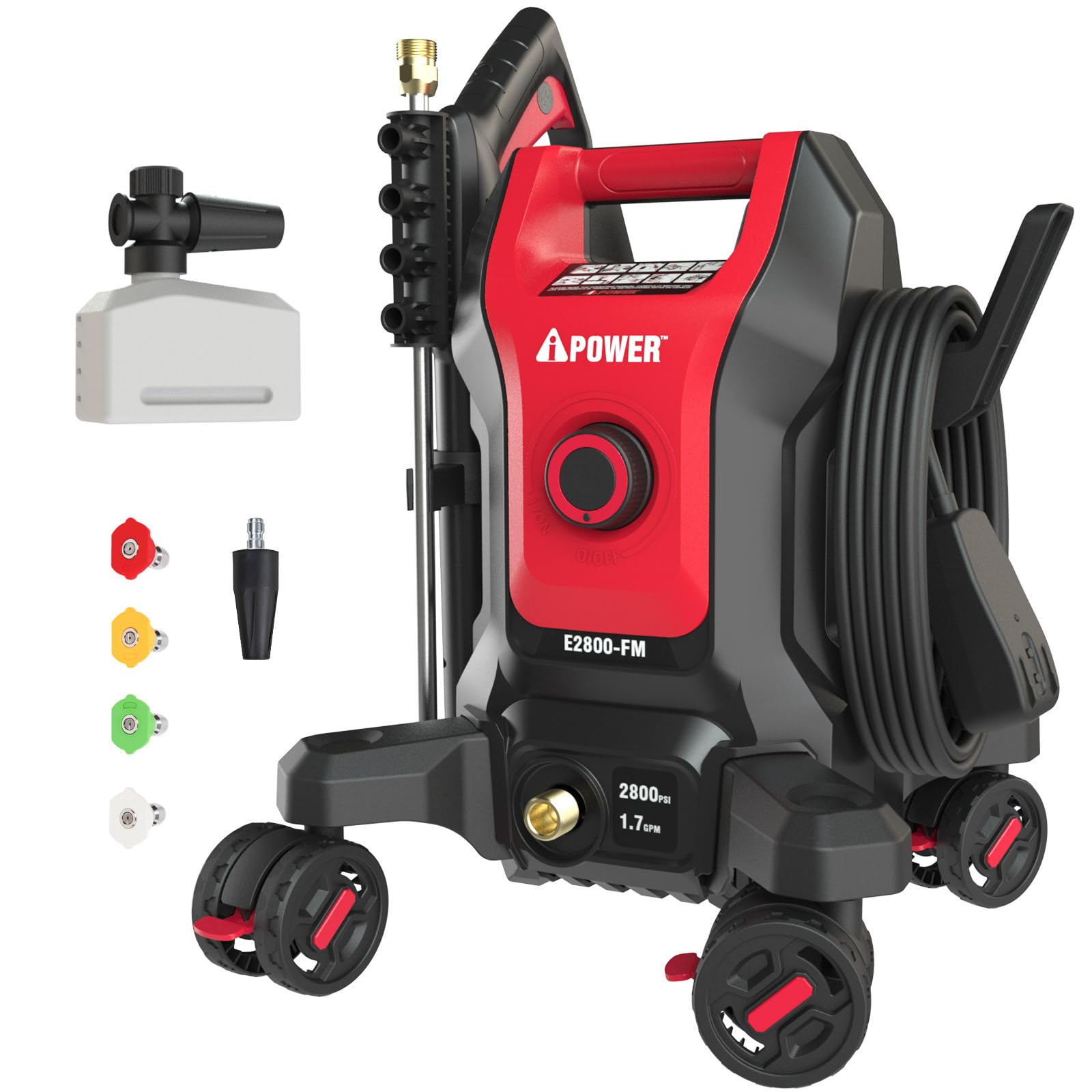
Forget the gas can—this electric unit brings 2800 PSI to your driveway.
If raw cleaning power is your priority, the A-iPower E2800-FM leads the pack with a 2800 max PSI (2000 rated PSI) and a 1.7 max GPM flow. This is the machine that strips concrete stains and old grime off driveways, yet its 25-foot hose and 35-foot power cord let you follow the dirt without constantly relocating the unit. The 4 quick-lock wheels offer 360° steering, and the low center of gravity is engineered to prevent tipping.
This unit directly beats the Westinghouse ePX3500 on peak pressure—2800 PSI vs 2500 PSI—making it the stronger choice for heavy-duty surface cleaning. It comes with 5 nozzles (0°, 15°, 25°, 40°, and turbo), giving you the full range from paint-safe wide sprays to concentrated jet blasts. The TSS system automatically stops the pump when the trigger is released, extending the motor’s life.
Owners praise its reliability and surprisingly quiet operation, with one person noting it “gets the vinyl siding clean in one pass.” The “Follow Me” design is the standout feature here, with buyers reporting excellent stability on uneven ground. It weighs 18.2 pounds, so it’s easy to steer, though some wish the frame was a little taller to avoid bending over. A 2-year manufacturer warranty backs it up.
Maximum Muscle
- Highest max PSI in the lineup at 2800 for stubborn grime
- 35-foot power cord plus 25-foot hose means fewer extension cord hassles
- Anti-tipping design steers smoothly around obstacles
Minor Quirks
- Some shorter users wish the frame was taller
- Durability gets a few negative notes in the reviews, so treat it with care
Grab This If: You split your time between washing cars and blasting driveways, and you want max pressure without gas.
skip it if: You rarely clean concrete—a lower-PSI unit with more flow would rinse a car faster.
5. Westinghouse WPX2300e
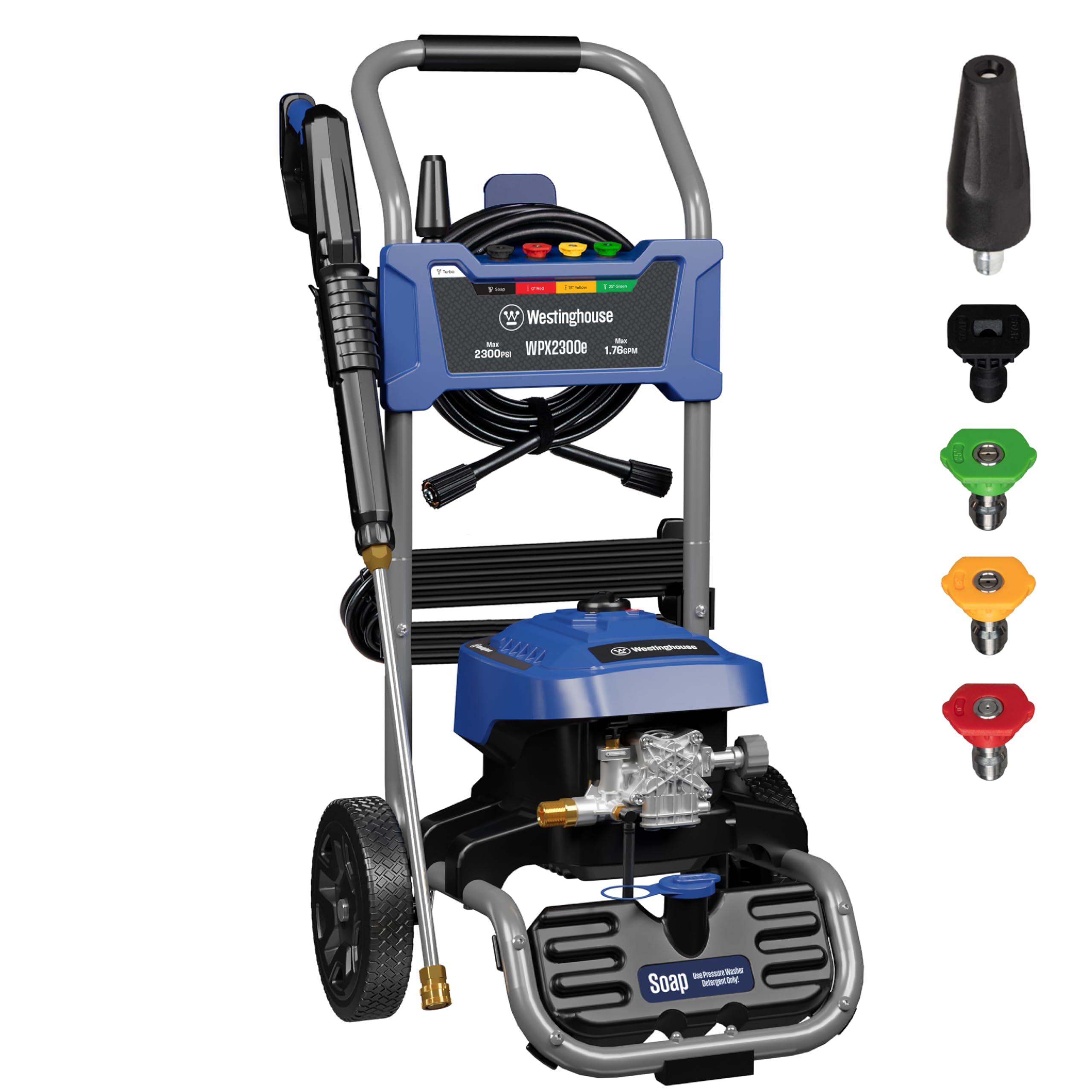
A durable induction motor and steel frame built for years of reliable service.
This Westinghouse model is the heavyweight sibling in the lineup, trading compact size for rugged durability. It delivers 2300 max PSI and 1.76 max GPM (1900 rated PSI, 1.2 rated GPM), powered by a heavy-duty AC 120V induction motor and a maintenance-free axial 3-piston auto-stop pump. The tough steel frame rides on high-profile 8″ never-flat wheels, making it easy to haul over curbs and rough terrain.
Owners describe the assembly as a 10-minute affair, and the performance is consistently praised for home cleaning projects. It cleans vinyl siding mold and carports with ease. The 25-foot abrasion-resistant super-flex hose pairs with a metal spray gun and 5 quick-connect nozzles (0°, 15°, 25°, soap, and turbo), plus a.42-gallon soap tank integrated into the frame.
The main trade-off is weight. At 27.5 pounds, it’s significantly heavier than the ePX3500, so it’s less about carrying and more about rolling. Buyers love the M22 fittings, which make it compatible with aftermarket surface cleaners and foam cannons. However, one recurring note is that the soap dispenser lacks an on/off switch, meaning soap flows until the tank is empty. It’s a minor annoyance on an otherwise excellent, sturdy machine backed by a 3-year limited warranty.
Built To Last: The induction motor and 8-inch wheels make this the most durable-feeling unit in the mid-range.
Worth Knowing: The soap tank design forces you to plan your rinse cycle, since you can’t shut the detergent off mid-stream.
6. Sun Joe SPX3000
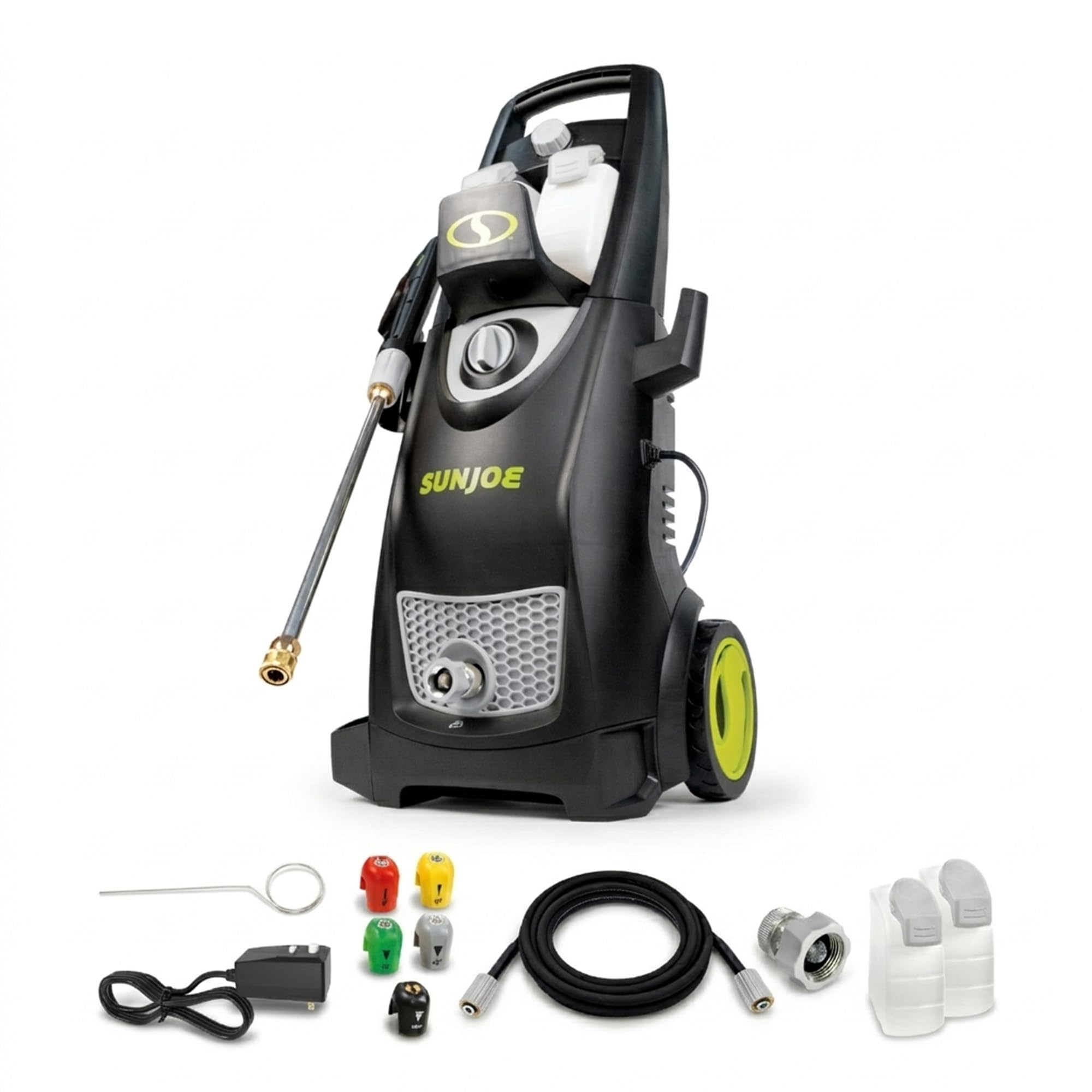
The mega-popular classic with a dual-tank system that detailers swear by.
With tens of thousands of owners, the Sun Joe SPX3000 is the most proven electric washer on this list. It delivers 2030 PSI working pressure and 1.2 GPM water flow, which is enough for cars, driveways, and patios. The 34-inch stainless steel lance with brass fittings feels premium, and the 20-foot high-pressure hose supports deep cleaning without tangling.
Its defining feature is the dual detergent tank system—two onboard 0.9L tanks let you store two different cleaning solutions and switch between them instantly. This is a genuine advantage for car care: use one tank for a pre-wash citrus degreaser on wheels and the other for a pH-neutral car shampoo. The five quick-connect tips (0°, 15°, 25°, 40°, and soap) cover every scenario from gentle rinses to concrete blasting.
The feedback is overwhelmingly positive, with one long-term owner reporting it still works after 7 years. A key tip from the community: remove the nozzles after each use, as a clogged tip can cause the unit to shut down. The GFCI plug is huge, so you’ll need a heavy-duty extension cord. It’s not the most powerful or the lightest, but the reliability and the dual-tank feature make it an easy recommendation for the dedicated car enthusiast.
The All-Rounder
- Dual 0.9L soap tanks for switching between cleaners on the fly
- Proven track record of lasting 5-7 years with basic care
- Stainless steel lance with brass fittings resists wear
The Catch
- The hose is stiff and hard to roll up for storage
- The plastic inlet fitting is a known weak point—use a quick-release connector
Pick This For: The best combination of proven reliability and a smart dual-soap system for varying wash duties.
Think Twice If: You want maximum water flow—at 1.2 GPM, it rinses slower than the 2.0 GPM premium units.
7. CAT Electric Pressure Washer

A patented 5-piston pump that delivers pro-level flow for faster rinsing.
This CAT unit redefines what an 1800 PSI machine can do. The patented aluminum 5-piston pump boosts power by 30%, cleaning efficiency by 20%, and cuts vibration by 30% compared to standard 3-piston pumps. While the peak pressure is a modest 1800 PSI, the standout spec is the 2.0 GPM water flow, producing an impressive 3600 cleaning units of output for rapid rinse-downs.
For car washing, this high-flow, moderate-pressure combo is arguably the safest and most effective setup. The volume of water flushes away dirt and foam quickly, while the pressure remains gentle on clear coats. The included 600ml detergent foam blaster adds a layer of pre-wash cleaning, and the metal lance and gun feel substantial in hand. The 20-foot real rubber hose (M22-15mm) resists kinking.
Owners note it’s lighter and more portable than comparable Greenworks models, and after 2 years of use, it remains reliable for vehicles and light-duty tasks. The main caveats: the GFCI plug needs to be reset each use, and the soap drains fast. The 35-foot power cord with GFCI provides good reach. It’s a quality starter-to-intermediate unit for the home detailer who values flow over brute force.
The Flow Master: At 2.0 GPM, this rinses a car faster than any 1.1–1.2 GPM unit in this guide.
One Honest Note: Don’t expect it to strip paint or heavy stains—that’s what a gas model is for.
8. Active 2.0 Electric Pressure Washer

A compact detailing machine engineered to be gentle on paint and tough on grime.
The Active 2.0 was built with car enthusiasts in mind. It sets an industry benchmark 2.0 GPM cleaning power to blast away dirt in less time, while the 1800 peak PSI output is intentionally moderate to keep your vehicle’s finish safe. The provided nozzles help rinse all panels effectively, preventing paint damage and ensuring swirl-free washing that protects your clear coat.
Its patented 5-piston pump and premium internals are designed for years of reliable performance, not just a single season. The small footprint (16″L x 9″W x 8″H) makes it wall-mount friendly for garage storage, and at 24 pounds it’s easy to move around your driveway. The universal threading (3/4″ GHA for the garden hose and M22-14mm for the pressure hose) makes it upgrade-ready for aftermarket guns, hoses, and foam cannons.
Users report it runs quietly and handles a 5-hour straight session on a slate deck without tripping a breaker. The biggest tip from owners is to use a steel-braided hose instead of flexible ones to avoid pressure surges. The included foam cannon drains fast, so a quality aftermarket cannon is a worthwhile upgrade. It comes with a 2-year residential warranty, making it a solid long-term investment for the serious home detailer.
Paint-Safe Power
- 2.0 GPM high-flow with moderate PSI is the ideal combo for clear coats
- Compact, wall-mount-friendly frame saves garage space
- Upgrade-ready threading for a growing arsenal of detailing tools
Keep In Mind
- The bundled foam cannon empties quickly—plan for a replacement
- Value for money gets mixed reviews, so it suits buyers who will use it often
Perfect For: The weekend detailer who wants a dedicated, gentle washing machine that won’t damage a wrapped or ceramic-coated car.
Consider Otherwise: If you mostly clean concrete and siding, a higher-PSI unit will serve you better than this flow-focused design.
9. Greenworks 3000 PSI Brushless Electric Pressure Washer

The closest an electric unit gets to gas-power, with a brushless motor and verified specs.
This is the flagship of the group, delivering a verified 3000 PSI and 2.0 GPM max—the highest pressure and flow combination here. Every spec is independently lab-tested, so the numbers you see are the numbers you get. The JETFLOW technology delivers up to 50% more flow, making it easier to reach high areas like second-story siding or the roof of an RV.
A painting contractor reports this “is by far the best electric pressure washer on the market,” using it on most jobs, especially for cleaning stucco. It runs for 1.5 hours non-stop without feeling warm, proof of the efficient brushless motor. The included 25-foot Uberflex kink-resistant hose, rugged metal gun, and 5 nozzles (15°, 25°, 40°, soap, and turbo) make it a complete package for heavy-duty home use.
The one thing to know: this machine draws serious power. It needs a dedicated outlet and a 12-gauge extension cord at minimum; a thinner cord can cause house lights to flicker or trip a 20A GFCI breaker (a safety switch that cuts power on overload). The durability gets mixed feedback, with some owners noting a short lifespan, so it’s best for those who will use it regularly rather than once a season. It comes with a 1-gallon onboard tank and requires a bit more care, but the cleaning power is class-leading in the electric category.
Maximum Output
- 3000 PSI and 2.0 GPM is the top-tier combo in this lineup
- Independent lab verification means honest specs
- Turbo nozzle excels at concrete and moss removal
The Heavy Lifting
- Demands a dedicated 15-amp circuit and thick 12-gauge extension cord
- Mixed durability reports—treat the pump gently and store it properly
Choose This For: The ultimate electric alternative to a gas washer, ideal for large homes, long driveways, and heavy grime.
pass on it if: Your wash day is just a quick car rinse—this machine is overkill and needs more electrical care than smaller units.
Understanding the Specs
PSI vs GPM
PSI (pounds per square inch) measures the force of the water jet, which is great for blasting caked-on mud. GPM (gallons per minute) measures the water volume, which is what actually rinses dirt and soap away. For car paint, a higher GPM with moderate PSI is safer and faster than a high-PSI, low-GPM unit that can etch clear coat if held too close.
Pump Types and Longevity
A 5-piston pump with an induction motor outlasts a standard axial pump, so check the pump type before buying. Axial pumps are common in consumer units and are fine for occasional use. A 5-piston pump, like those in the CAT and Active models, provides smoother operation and longer life. An induction motor (as found in the WPX2300e) runs cooler and quieter than a universal motor, which tends to be louder and wears faster.
FAQ
Is higher PSI always better for washing a car?
What is the difference between 1.2 GPM and 2.0 GPM for car washing?
Can I use a foam cannon with any of these pressure washers?
How long does an electric pressure washer typically last?
What does the Total Stop System (TSS) do?
Which nozzle should I use to wash my car safely?
Is an electric pressure washer quieter than a gas one?
Do I need a special extension cord for an electric pressure washer?
Final Thoughts: The Verdict
Across the board, the best automotive pressure washer is the Westinghouse ePX3500 because it perfectly balances high flow (1.76 GPM), strong pressure (2500 PSI), and a compact anti-tipping frame at a mid-range price. If you want a dedicated detailing machine that’s exceptionally gentle on paint, the Active 2.0 with its 2.0 GPM flow and upgrade-ready threading is the specialist’s pick. And for those with heavy concrete and siding duty, the Greenworks 3000 PSI brings gas-level power to an electric outlet—just make sure your wiring can handle it.
How We Picked
We do not accept paid placement. Every pick is matched to a real buyer and a real use-case; we do not hands-on test units.
Sources & Methodology
Specifications: manufacturer listings and product documentation. Review insights: verified customer reviews, as of August 2026. Pricing: not shown on this page (it changes often); check the current price via the retailer link.
As an Amazon Associate, Gadgets Feed earns from qualifying purchases. This does not affect which products we feature.