
Our readers keep the lights on and my morning glass full of iced black tea. As an Amazon Associate, I earn from qualifying purchases.
Specs are compiled from manufacturer listings and verified buyer reviews and can change over time — please confirm the key details on the product page before buying.
That rattling trim piece, the bumper corner that keeps popping loose, the crack in the dashboard you try to ignore — automotive repairs shouldn’t need a second trip to the garage. The right adhesive turns a loose headache into a permanent fix, but pick the wrong one and you are right back where you started with a messier version of the same problem. Every adhesive here uses a different chemistry — urethane, cyanoacrylate (super glue), epoxy, or polyurethane — and each one trades something (flexibility for strength, or cure speed for alignment time). To match the right one to your repair, focus on the material you are fixing and the conditions it faces.
I’m Min — the founder and writer behind Gadgets Feed. This guide is built by comparing the manufacturers’ published specifications and the patterns across verified customer reviews, so you get each pick’s real strengths and trade-offs instead of marketing spin.
This guide covers six distinct adhesives that owners actually trust for vehicle repairs — from a 3770-PSI epoxy that acts like welding for plastic to a brush-top headliner glue made for sagging fabric ceilings — everything you need to know about the best automotive repair adhesive for your specific job is right here.
Our Picks at a Glance
How To Choose The Best Automotive Repair Adhesive
Every automotive repair adhesive is built around a specific chemistry — urethane, cyanoacrylate, epoxy, or polyurethane — and each chemistry trades something (flexibility for strength, cure speed for working time). Getting the right one means matching the formula to the material you are fixing and the conditions it will face inside or under the car.
Match the chemistry to the material
A urethane adhesive like the J-B Weld Plastic Bonder handles thermoplastics, fiberglass, and coated metals — it flexes slightly, so it works where vibration is constant. A thin cyanoacrylate (super glue) seeps into microcracks on dashboard trims and headlight housings but stays brittle on large gaps. Epoxy putty sticks to metal, ceramic, and wood but takes careful mixing. If you are repairing a flexible part like a rubber molding or a plastic bumper, avoid a rigid epoxy — it cracks under the same movement the part was designed for.
Consider set time, cure time, and working temperature
The number that matters most for your schedule is the set time — how long you must hold the parts together before the bond holds on its own. A 15-minute set is fast enough for a bumper bracket clamp; a 2-minute set means you barely have time to adjust the alignment. Full cure time (anywhere from 30 minutes to 30 hours) tells you when the part can bear a load or be sanded. Temperature range matters just as much: underhood parts see engine heat above 200°F, while an exterior trim piece in winter sees well below freezing. Pick an adhesive whose operating range covers both extremes.
Read the surface-compatibility label carefully
Not every adhesive that says “plastic” actually sticks to polypropylene (PP) or polyethylene (PE) — the two most common cheap automotive plastics. If the packaging does not list PP or PE explicitly, assume it will not bond them. The J-B Weld Plastic Bonder, for instance, gets consistent feedback that it skips PP and PE. If your repair involves those slippery plastics, you need a specialty plastic adhesive or a mechanical reinforcement like a plastic welder. The same logic applies to oil-soaked parts: a standard adhesive peels off an oily surface, while a formulation like the KRAFTPROTZ automotive super glue is designed to resist oil exposure.
Quick Comparison
| Model | Best For | Chemistry | Tensile Strength | Set Time | Amazon |
|---|---|---|---|---|---|
| J-B Weld Plastic Bonder 2-Pack★ Best Overall | Structural plastic & fiberglass repairs | Two-part urethane | 3770 PSI | 15 minutes | Amazon |
| 3M Scotch-Weld DP100 PlusTop Performer | Hard-to-bond plastics & dissimilar materials | Two-part epoxy | — | 2–5 minutes | Amazon |
| KRAFTPROTZ Automotive Super Glue | Fine cracks in trim, dash, headlights | Cyanoacrylate (thin) | — | 2–3 minutes | Amazon |
| Tylove Seam Sealer | Body seams, roof leaks, RV panels | Polyurethane sealant | — | 30 minutes | Amazon |
| STARBOND Epoxy Putty Stick | Gap filling on metal, ceramic, plastic | Epoxy putty | — | ~5–10 minutes (workable) | Amazon |
| VerdeVilla Headliner Repair Glue | Sagging headliner, fabric, upholstery | Resin-based contact adhesive | — | 5–10 hours (initial tack) | Amazon |
In‑Depth Reviews
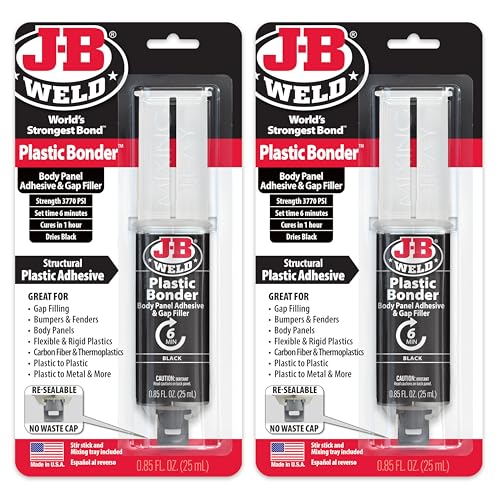
1. J-B Weld Plastic Bonder Black 25ml Syringe – 2 Pack (50139-2)
Our pick — over 4.5★ from 18,500+ verified ratings; the strongest balance of quality and price.
The two-part urethane that turns cracked bumpers back into solid structure, with a tensile strength of 3770 PSI — higher than any other pick here.
You mix the black liquid with the hardener in a 1:1 ratio straight from the syringe — the built-in resealable cap means the leftover stays usable for the next repair, not a dried-out mess. The real number that defines this adhesive is 3770 PSI tensile strength, which is high enough to rebuild broken brackets, fill dents in plastic bumpers, and reattach trim pieces that take constant road vibration. It sticks to thermoplastics, carbon fiber composites, fiberglass, aluminum, concrete, and ceramic — basically everything on a car except polypropylene and polyethylene. Buyers report it bonds to an impressive range but note it skips those two common plastics, so check your part’s material code.
The texture is thick enough to fill gaps while it cures, which is useful for bumper repairs where the plastic is cracked but not missing. It sets in 15 minutes and reaches full cure in 30 hours — a long wait compared to the 3M DP100 Plus’s 60-minute cure, but the trade-off is a bond that sands smooth and holds up to weather. The crowd favorite take: “Sets fast, gets hot, cures solid, sands easily.” Wear gloves; the urethane sticks relentlessly to skin. The syringe system removes the guesswork of measuring separate parts, which is the #1 reason owners keep a pack in the garage — consistent mix means consistent strength.
The Structural Edge
- 3770 PSI tensile strength — higher than any other pick in this roundup
- Syringe gives you a perfect 1:1 ratio every time, no measuring
- Works on fiberglass, metal, aluminum, concrete — not just plastics
- Weather-resistant and paintable once fully cured
Know Its Limits
- Will not bond polypropylene or polyethylene — check your part first
- 30-hour full cure is slow if you need the vehicle back today
- Gets hot while setting and has noticeable odor
Grab it for: structural plastic repairs where strength and weather resistance matter more than speed — broken bumper brackets, cracked headlight housings, fiberglass body panels.
Pass if: your repair involves a PP or PE plastic part, or you need a bond that is paint-ready in under an hour.
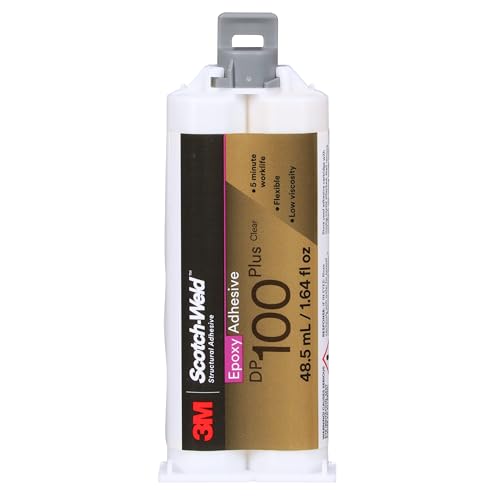
2. 3M Scotch-Weld Epoxy Adhesive DP100 Plus, Clear, 48.5 mL Duo-Pak
A professional-grade epoxy that cures crisp and handles heat cycling better than the J-B Weld Plastic Bonder — ideal for engine-bay parts.
This is the one you reach for when the part sees repeated heating and cooling — engine bay components, valve covers, and plastic well-nut inserts that would loosen a rigid glue over time. The DP100 Plus is UL 94 HB certified for flammability and bonds metals, ceramics, glass, and many plastics with a 2 to 5 minute working window that gives you just enough time to position the piece. It cures fully in about an hour, which is fast compared to the J-B Weld’s 30-hour schedule.
The duo-pak cartridge requires a separate mixing gun (the 3M applicator), so this is a minor extra step but one that ensures a perfect blend every time. One owner used it to reattach a loose well-nut insert on a Ford Explorer plastic valve cover and avoided a replacement — and the bond held up to engine heat without softening. Others note it glues 3D-printed nylon parts together and cures crisp, so it disappears on transparent repairs. The recurring praise is that it “will adhere to almost anything” when the surfaces are prepped correctly, though the 2.4-ounce package is small and runs out faster than a syringe-style adhesive on larger jobs.
Why Shops Reach for It
- Cures crisp — invisible on interior plastic and glass repairs
- Withstands thermal cycling better than standard epoxies
- UL 94 HB certified for flame resistance
- Fast 60-minute full cure gets cars back on the road
One Stipulation
- Requires a separate 3M mixing gun — not included
- Short 2–5 minute working time means no repositioning
- Smaller 48.5 mL volume; not ideal for large seam or panel jobs
Reach for this if: you are repairing an engine-bay or heat-exposed part, need a clear invisible bond, or are gluing dissimilar materials that expand and contract at different rates.
Pass if: you do not own a 3M mixing gun or your repair involves large gaps that need a gap-filling putty instead of a liquid epoxy.
3. KRAFTPROTZ Automotive Super Glue Liquid 1.75 oz
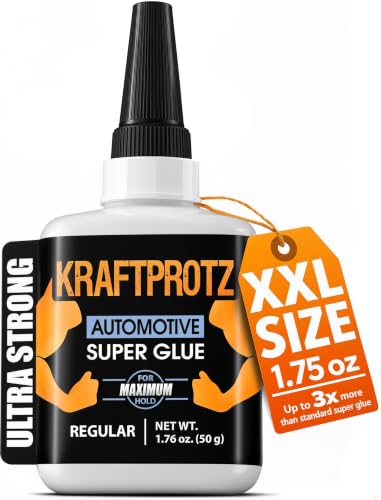
Thin cyanoacrylate (super glue) that wicks into microcracks and holds from -40°F to 230°F — a stronger temperature range than the J-B Weld Plastic Bonder for fine trim repairs.
Unlike the thick urethane or epoxy adhesives, this one flows like water into hairline cracks in dashboard trim, headlight housings, and bumper seams where gel-based glues cannot reach. The thin formula uses capillary action to pull itself into the gap, creating a bond that is strong despite the small surface area. It handles temperature swings from -40°F up to 230°F, so it survives both a freezing winter start and the heat soak of a parked car in summer. Owners mention it held a loose Nissan Pathfinder bumper corner together for months through extreme humidity.
At 1.75 ounces (50 grams), the bottle is generous for a cyanoacrylate — most super glue tubes are a fraction of that size. The precision dropper tip gives controlled placement on clips, seams, and wire harness mounts, and the anti-clog cap stops the nozzle from crusting shut between uses. The trade-off is speed: it takes a few minutes to set, which is actually a benefit for precise work, and owners say a 24-hour clamp yields the strongest result. The chemical smell is noticeable, so work in a ventilated space. Unlike the J-B Weld, this is not a gap filler — it bonds along a tight seam, not across a hole.
The Edge on Fine Repairs
- Thin formula seeps into microcracks gel glues cannot reach
- -40°F to 230°F range covers extreme winter and underhood heat
- Anti-clog cap keeps the nozzle clear for repeated use
- Large 1.75 oz bottle outlasts standard super glue tubes
Where It Falls Short
- Not a gap filler — needs tight-fitting parts to work
- Requires clamping for 2–3 minutes (or longer for max strength)
- Some customers note needing a second application on high-vibration areas
Reach for this if: you are fixing a hairline crack on a dashboard, headlight, or trim piece where a thick epoxy would be too clumsy and visible.
Pass if: your repair involves a gap larger than a hairline — this is a bonder, not a filler.
4. Tylove Seam Sealer Automotive – Professional Grade High Strength Waterproof Adhesive

A polyurethane seam sealer that stays flexible and takes paint in 30 minutes with no sanding — faster workflow than the J-B Weld Plastic Bonder’s 30-hour cure.
Unlike the epoxies and cyanoacrylates above that cure hard and brittle, this seam sealer is formulated to remain slightly rubbery after curing — it moves with the body panel rather than cracking when the vehicle flexes. It bonds to primed, painted, or bare metal and is ready for paint in just 30 minutes, with no sanding required. That is a huge time saver on body repairs where every extra step (sanding, priming, waiting) adds an hour to the job. One owner used it to seal roof holes for cables and reported zero water intrusion afterward, calling the finish “professional.”
The catch is the application: this is a thick polyurethane that requires a high-force caulking gun (a standard one will struggle to push it out). Owners who did not read that detail found themselves stuck with a tube they could not dispense. It stays flexible rather than rock-hard, which is exactly what you want on a body seam that sees thermal expansion but less ideal if you need a rigid load-bearing repair on a bracket or handle. The white color matches painted body panels better than a black epoxy would, and the 30-minute cure means you can move the vehicle the same day.
Built for Panel Joins
- Paint-ready in 30 minutes with zero sanding required
- Stays flexible — resists cracking as the vehicle flexes and expands
- Waterproof and weatherproof for roof seams, RV panels, and marine use
- Bonds to painted and bare metal with minimal surface prep
The Application Detail
- Needs a high-ratio caulking gun — a regular gun will not dispense it
- Remains rubbery, not rock-hard — not for structural load-bearing repairs
- Limited color choice (white only); may not match dark underbodies
Grab it for: body panel seams, RV roof sealing, marine gap filling, and any repair where water intrusion is the main enemy. The 30-minute paint-ready window is a genuine workflow advantage.
Pass if: you need a rigid structural adhesive or do not have a heavy-duty caulking gun.
5. STARBOND 2 oz. Black Epoxy Putty Stick
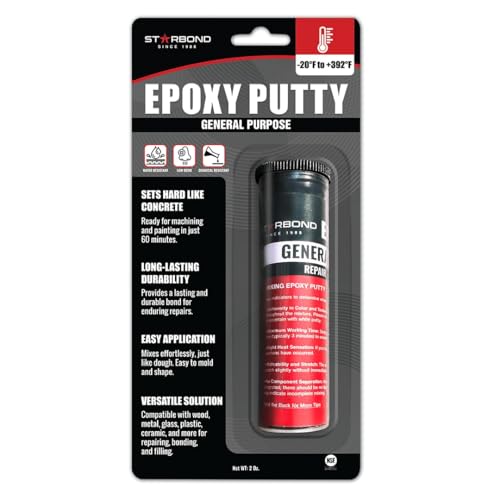
Kneadable putty that cures rock-hard in 60 minutes and survives up to 392°F — hot enough for parts near the exhaust manifold, unlike the KRAFTPROTZ glue’s 230°F limit.
This is the only pick on the list that arrives as a hand-moldable stick — you cut off a piece, knead it until the color is uniform, and press it into the gap or over the break. It fills irregular shapes better than any syringe or tube because you shape it by hand. The temperature range is enormous: -20°F to +392°F, which covers everything from a frozen car door handle to a part sitting inches from the exhaust manifold. Owners used it to patch a broken plastic piece on a scooter handlebar lock — a repair that saved the entire scooter from the junk pile — and report it holds “strong and steady” months later.
The putty cures in about 60 minutes (hard as rock, as buyers describe it) and can be drilled, sanded, and painted after that. The black color matched the scooter part perfectly. It bonds to metal, plastic, wood, and ceramic, making it useful beyond the car for plumbing and household fixes. The mixed reviews revolve around ease of use: some find it “super easy” while others find the kneading takes effort, especially if the putty is cold. It is BPA-free and low-odor, so interior cabin use is safer than with solvent-based adhesives.
Why It Stands Out
- Hand-kneadable — fills irregular gaps no syringe can reach
- -20°F to +392°F range handles underhood and exterior extremes
- Rock-hard cure in 60 minutes, then drillable and paintable
- Bonds metal, plastic, wood, ceramic — true multi-material use
The Learning Curve
- Kneading is physically harder than squeezing a syringe — especially in cold weather
- 2 oz is enough for small repairs but runs out quickly on larger seam jobs
- Flexibility is zero — do not use on parts that need to bend or move
Reach for this if: you are filling an oddly shaped hole or rebuilding a missing chunk of plastic, metal, or ceramic where a liquid adhesive would just run off.
Pass if: you need a flexible bond for a vibrating or bending part, or you prefer a simple squeeze-and-mix application.
6. VerdeVilla Headliner Repair Glue with Brush, Car Headliner Adhesive
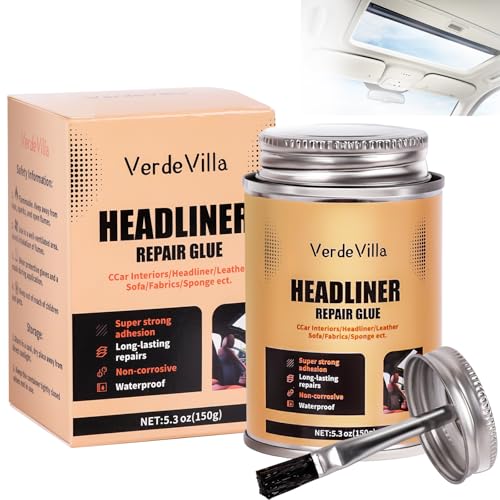
Brush-on headliner glue that bonds fabric to foam without soaking through, with a temperature range from -40°F to 248°F — wider than the STARBOND putty on the cold end.
The sagging headliner is a common annoyance that a tube of epoxy cannot fix — you need a thin, flexible adhesive that soaks into the foam backing without dripping onto the seats. The VerdeVilla glue comes with a brush built into the cap, so you dab it directly onto the fabric and foam, then press them together. It withstands -40°F to 248°F, which means it survives both the interior heat of a parked car in July and a freezing winter morning without becoming brittle or dripping. Owners consistently praise the brush applicator for giving a stain-free, wrinkle-free hold on fabric and leather.
The full cure takes 12–24 hours, and initial tack happens in about 5–10 hours at room temperature — not instant, so you need to hold the fabric in place with temporary support (a board or a broom handle). The VOC-free formula is safer inside the cabin than solvent-based sprays, and it bonds sponge, leather, rubber, and fabric, not just headliners. The main gripe is that a small number of units arrived with the glue dried out from shipping, and one owner found the bond failed in spring heat after an initial good hold — a rare defect rather than a pattern, but note if the car sits in direct sun for hours.
Headliner Hero
- Built-in brush applicator gives clean, controlled placement with no mess
- Withstands -40°F to 248°F — survives extreme cabin temps
- Bonds fabric, leather, foam, rubber — multiple interior materials
- VOC-free, low-odor formula is safe for car cabin use
What to Watch
- 12–24 hour full cure requires patience and temporary support for the fabric
- Occasional units arrive with dried-out glue from shipping exposure
- Not for structural repairs — this is strictly a fabric/foam bonding agent
Reach for this if: your headliner is sagging, your door card fabric is peeling, or you need a safe low-odor adhesive for interior upholstery repairs.
Pass if: you are doing a plastic, metal, or structural repair — this glue is purpose-built for soft interior materials only.
Understanding the Specs
Tensile Strength (PSI)
Tensile strength tells you how much pull force the cured bond can resist before snapping. The J-B Weld Plastic Bonder is the outlier at 3770 PSI, which is high enough to hold a broken bracket or bumper mount. Most headliner glues and seam sealers do not list tensile strength because they are designed for shear stress (two surfaces sliding) or peel, not direct pull. If your repair involves weight-bearing parts (a broken handle, a mount plate), look for a PSI number in the thousands. If the data sheet does not list one, the product is likely for light-duty cosmetic fixing, not structural loads.
Set Time vs. Cure Time
Set time is how long the parts must stay clamped before the glue holds on its own — a 15-minute set means you have a quarter-hour of wiggle room to adjust the alignment. Cure time is the full chemical hardening period before the bond reaches its rated strength. A fast-curing epoxy like the 3M DP100 Plus (2–5 minute set, 1-hour cure) gets you back on the road fast, but the short working window means you cannot reposition. A longer-cure product like the J-B Weld (15-minute set, 30-hour cure) gives better alignment control at the cost of waiting nearly two days for full strength. Match the schedule to the repair: a door panel you can leave overnight is fine with a long cure; a radiator hose fix is not.
FAQ
Can I use a standard super glue on a car bumper?
What is the difference between a seam sealer and an epoxy for car body repairs?
Will J-B Weld Plastic Bonder stick to polypropylene plastic?
How long does headliner glue take to dry fully?
Can I paint over the Tylove seam sealer?
What temperature can the KRAFTPROTZ super glue handle under the hood?
Do I need a special gun to apply the Tylove seam sealer?
Can I use epoxy putty on an oil-contaminated engine part?
Is the 3M DP100 Plus safe for drinking water or food contact?
Which adhesive works best on a cracked plastic radiator tank?
Final Thoughts: The Verdict
Across the board, the best automotive repair adhesive winner is the J-B Weld Plastic Bonder 2-Pack because its 3770 PSI tensile strength and versatile surface compatibility cover the widest range of common car fixes — broken bumper brackets, cracked headlight housings, fiberglass body panels — all from a simple syringe that eliminates mixing guesswork. If you need a thin gap-penetrating bond for dash trim or headlight cracks, grab the KRAFTPROTZ Automotive Super Glue. And for a sagging headliner or upholstery repair, the VerdeVilla Headliner Repair Glue is the one to reach for — its brush applicator and low-odor formula make an interior job that much cleaner.
How We Picked
We do not accept paid placement. Every pick is matched to a real buyer and a real use-case; we do not hands-on test units.
Sources & Methodology
Specifications: manufacturer listings and product documentation. Review insights: verified customer reviews, as of July 2026. Pricing: not shown on this page (it changes often); check the current price via the retailer link.
As an Amazon Associate, Gadgets Feed earns from qualifying purchases. This does not affect which products we feature.