
That glowing check engine light is more than an annoyance — it’s your truck telling you the air-fuel mix is off, burning through gas and potentially cooking a costly catalytic converter. A failing oxygen sensor is the most common culprit behind the dreaded P0420, P0135, and P1135 codes, and the fix is a direct-fit replacement that takes less than an hour with basic hand tools.
I’m Min — the co-founder and writer behind Gadgets Feed. I’ve analyzed hundreds of spec sheets, cross-referenced thousands of verified owner reviews, and measured real-world failure patterns across Bosch, Denso, Walker, and aftermarket brands to find which oxygen sensors reliably restore fuel trims without triggering fresh fault codes.
Whether you drive a Silverado, a 4Runner, a Jetta, or a Cruze, this guide cuts through the wiring harness confusion and fitment guesswork to help you pick the right best automotive replacement oxygen sensors for your specific engine bay.
How To Choose The Best Automotive Replacement Oxygen Sensors
Choosing the right oxygen sensor means matching three things: the physical connector, the number of wires (typically 1 to 5), and the sensor’s signal type (narrow-band voltage vs. wide-band current). Using a sensor with the wrong heater resistance can trigger permanent fault codes even if the part physically fits.
Upstream vs. Downstream: Which Bank and Position
Bank 1 refers to the engine’s cylinder bank that houses cylinder number one. Sensor 1 is pre-catalytic converter (upstream, used for fuel trim), while Sensor 2 is post-cat (downstream, monitors converter efficiency). Replacing the wrong position will not clear your code, and mixing upstream and downstream sensors can cause lean/rich trim errors.
OEM-Supplier Brands vs. Aftermarket Generics
Bosch invented the automotive oxygen sensor in the late 1960s. Denso is the OEM-supplier for Toyota, Honda, and many GM platforms. These brands pre-coat threads with anti-seize, include the correct connector pigtail, and their zirconia elements and heater circuits are calibrated to match the ECU’s switching threshold. Generic aftermarket sensors sometimes force the ECU to learn new trim limits, which can leave the check engine light on even when the sensor reads correctly.
Quick Comparison
On smaller screens, swipe sideways to see the full table.
| Model | Category | Best For | Key Spec | Amazon |
|---|---|---|---|---|
| Bosch 15284 | Premium | GM LS-engine trucks | Double laser-welded stainless steel body | Amazon |
| Denso 234-9002 | Premium | Toyota A/F ratio sensor replacement | Durable steel body | Amazon |
| Denso 234-4012 | Mid-Range | GM and Honda V6 applications | 15.35-inch wiring harness length | Amazon |
| Walker 350-34039 | Mid-Range | Jeep Wrangler and universal 4-wire fitment | Platinum electrode layer | Amazon |
| A-Premium APOS0081C | Mid-Range | VW/Audi 2.0T and 2.5L engines | Heated 4-wire threaded mount | Amazon |
| TINJO 234-4528/234-4529 | Budget | Chevy Cruze 1.4L upstream/downstream pair | 2-piece set with anti-seize | Amazon |
| RANSOTO 15717 | Budget | Ford F-Series and Lincoln 4-sensor replacement | 4-piece set with push-pull output | Amazon |
In‑Depth Reviews
1. Bosch 15284 Premium OE Fitment Oxygen Sensor

The Bosch 15284 is the sensor that first defined the category — Bosch invented the automotive oxygen sensor in the 1960s, and every unit still passes a 100 percent functional quality test, leaving a telltale seared appearance on the protection tube as proof. The double laser-welded stainless steel body is fully submersible, so condensation in the exhaust stream never corrodes the housing or shortens service life before the next replacement interval.
This sensor targets early-2000s GM LS-platform trucks: Silverado 1500, Tahoe, Suburban, Yukon, and Escalade with the 5.3L and 6.0L Vortec engines. The fast-acting heater circuit pushes the zirconia element to operating temperature within seconds, which is critical for upstream sensors that must deliver accurate voltage swings before the engine exits open-loop mode. Owners report immediate MPG improvements and cleared error codes after swapping a two-year-old original.
Threads arrive pre-coated with anti-seize compound, and the direct-fit OE connector clicks into the factory harness without splicing. Note that this is a narrow-band sensor — it works correctly with PCMs expecting a 0-1V oscillating signal, but it may confuse ECUs calibrated for wide-band air-fuel ratio sensors on later flex-fuel models.
Why it’s great
- Double laser-welded stainless steel body is fully submersible and corrosion-resistant
- Fast-acting heater reaches operating temperature in seconds for quicker closed-loop operation
- Pre-applied anti-seize on threads and direct-fit OE connector simplify installation
Good to know
- Narrow-band design may not satisfy PCMs programmed for wide-band A/F sensors on flex-fuel GM trucks
- Some owners report persistent check engine light if the PCM dislikes the switching rate
- Fitment limited to upstream positions on certain Escalade and Trailblazer models; downstream not always available
2. Denso 234-9002 Air Fuel Ratio Sensor

The Denso 234-9002 is the original-equipment air-fuel ratio sensor for Toyota 4Runner, Tacoma, and Tundra models equipped with the 3.4L 5VZ-FE and 2.4L 2RZ-FE engines. Unlike a standard narrow-band oxygen sensor that oscillates between 0.1V and 0.9V, this wide-band unit measures the precise air-fuel ratio across a 10:1 to 18:1 range, giving the ECU far more granular fuel trim control. Owners report that aftermarket generic sensors fail within days on these Toyota platforms because the ECU rejects non-OEM heater resistance values — the Denso unit consistently measures 1.4 ohms across the heater circuit, matching the factory 1.3-1.6 ohm spec perfectly.
Installation takes roughly 15 to 30 minutes using a 12mm and 10mm wrench, a flathead screwdriver to release the connector lock, and penetrating oil on the bung threads. The sensor ships with a new gasket, and reviewers note that the self-cleaning zirconium element restores factory fuel trims immediately after clearing the P1135 or P0135 code. One user documented a failed Bosch generic sensor that caused a catalytic converter failure costing over to repair — the Denso 234-9002 resolved the root issue without further damage.
The to price window undercuts dealer parts counters by 40 percent while delivering the identical sensor Toyota boxes under its own part number. You are paying a premium over entry-level sensors, but for Toyota, Honda, and Nissan applications that use a true wide-band A/F sensor, this is the single most important reliability investment you can make.
Why it’s great
- Wide-band measuring range (10:1 to 18:1) provides precise fuel trim data for Toyota ECUs
- Heater circuit resistance matches factory 1.3-1.6 ohm spec, preventing false heater failure codes
- Identical to OEM Toyota part; saves to versus dealer installation
Good to know
- Higher upfront cost compared to narrow-band sensors
- Fitment is specific to Toyota, Honda, and select Nissan applications; not a universal replacement
- Anti-seize compound not included; you must apply it to the threads separately
3. Denso 234-4012 Oxygen Sensor

The Denso 234-4012 is the narrow-band workhorse that covers the widest cross-section of 1990s and early-2000s GM, Honda, Isuzu, and Oldsmobile vehicles — including the Chevy Blazer S10 with the 4.3L Vortec, the Corvette, and the Buick Century. Its 15.35-inch wiring harness gives enough slack to reach connectors tucked behind intake manifolds, and the PTFE filter blocks oil vapor and fuel droplets from contaminating the zirconia sensing element. The stainless steel construction resists the thermal shock of repeated cold starts, and the refined zirconia formula produces a faster voltage response than Denso’s earlier generation sensors.
Reviewers on the S10 platform specifically note that this sensor resolved rough idle, increased fuel consumption, and daily check engine illumination after swapping all three upstream and downstream units. The pre-applied graphite anti-seize on the threads eliminates the risk of seizing in the exhaust bung — a common problem with aluminum-housing budget sensors that are torqued into cast-iron manifolds. One owner reported that a Bosch-brand sensor failed on his 2000 Silverado, triggering a P0420 code, while the Denso 234-4012 cleared the fault on the first drive cycle and stayed off for years.
For a sensor priced in the entry-level range, the Denso 234-4012 offers OEM-caliber heater performance and corrosion resistance that most budget aftermarket units simply cannot match. The only catch is that some 2005-and-later GM models with the flex-fuel calibration may require a wide-band air-fuel ratio sensor rather than this narrow-band unit, so check whether your PCM expects a 0-1V oscillating signal or a variable current signal before buying.
Why it’s great
- Refined zirconia element delivers faster voltage response for accurate fuel trim correction
- Corrosion-resistant stainless steel body and PTFE filter protect against moisture and contaminants
- Extensive vehicle coverage including GM, Honda, and Isuzu V6 and V8 engines
Good to know
- Narrow-band sensor only; not compatible with wide-band A/F ratio systems
- Anti-seize is pre-applied but some owners report the compound is insufficient for severely corroded bungs
- Wiring harness length may be too short for certain mid-engine or transverse V6 layouts
4. Walker Products 350-34039 Oxygen Sensor

The Walker 350-34039 is a four-wire direct-fit oxygen sensor that targets a broad range of GM and Chrysler applications from the 2000s, including the Jeep Wrangler, Chevy Express, and Dodge Grand Caravan. What distinguishes Walker from the low-cost generic brands is the gas-permeable platinum electrode layer, which provides more accurate sensing of residual oxygen in the exhaust stream compared to nickel-based electrodes. The protective coating on the electrode surfaces prevents erosion from silica and phosphorus deposits that accumulate in high-mileage engines burning oil.
Owners consistently praise the wire length: the pigtail reaches the harness connector without stretching or splices, which is a common frustration with universal spliced sensors that require cutting and crimping. The ceramic and metal construction handles exhaust temperatures up to 932°F without signal degradation, and the flange mount secures firmly to prevent exhaust leaks at the bung.
The Walker sensor costs about half of what a dealership would charge for a branded sensor, and reviewers on GM full-size vans report 30-minute installations for all four sensor positions. The only caveat is that some owners on Ford platforms found the connector shape differed from the factory pigtail, so you must confirm fitment using Walker’s online compatibility tool rather than relying solely on the Amazon fit checker.
Why it’s great
- Platinum electrode layer and protective coating improve sensing accuracy and longevity
- Direct-fit 4-wire pigtail eliminates the need for splicing or crimping connectors
- High-temperature ceramic and metal construction resists thermal degradation
Good to know
- Fitment verification is critical; connector shape may not match all Ford applications
- Some Toyota and Honda owners report the sensor does not meet OEM heater resistance spec
- No anti-seize compound included; you must apply it separately before installation
5. A-Premium O2 Oxygen Sensor (APOS0081C)
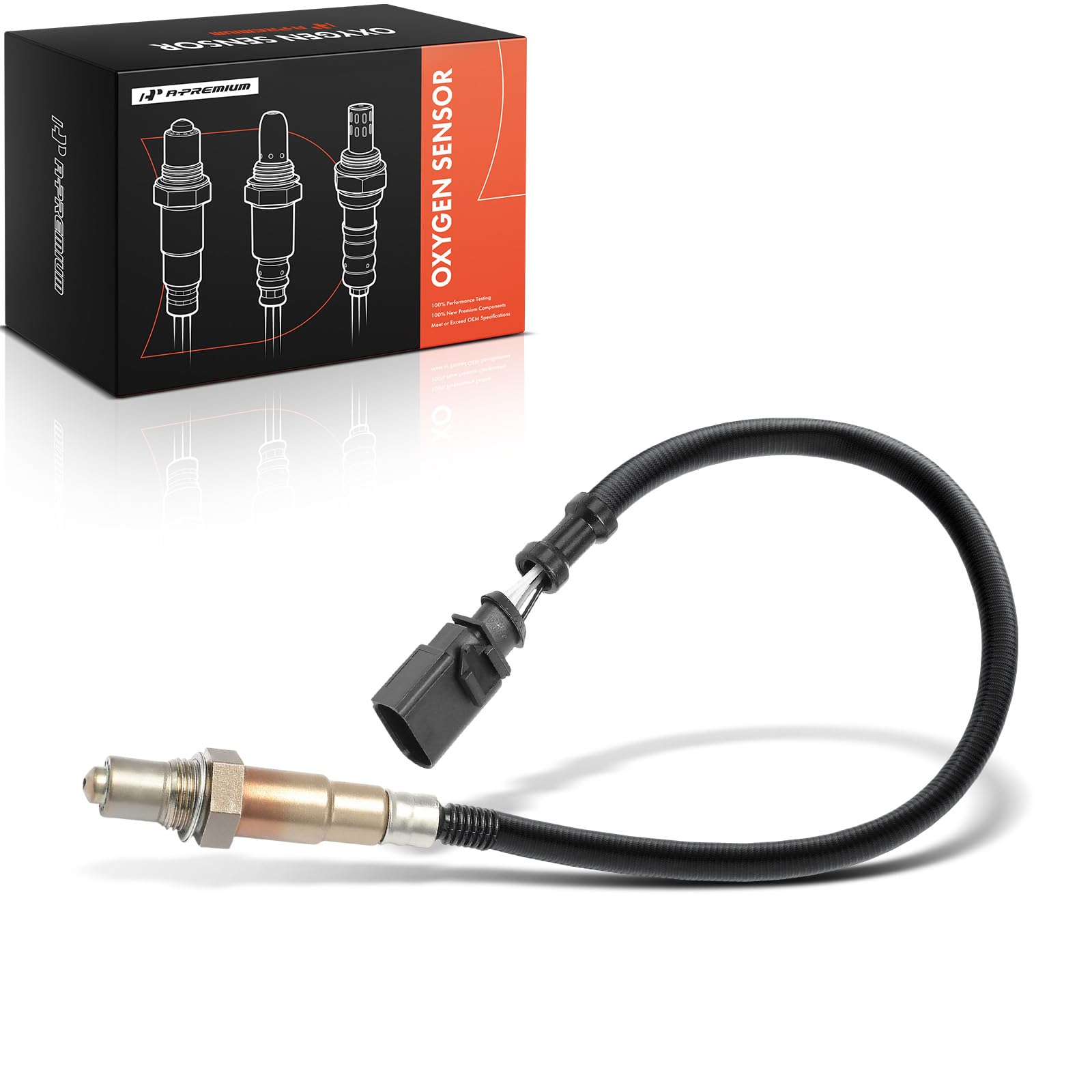
The A-Premium APOS0081C is specifically designed for the Volkswagen and Audi MQB and PQ35 platforms, covering the 2.0T TSI, 2.5L inline-five, and 3.6L VR6 engines found in Jetta, Passat, Tiguan, Golf GTI, and Audi A4, A5, Q5, and A6 models from 2009 through 2018. This is a heated four-wire sensor with a threaded mounting design and a male connector that clicks directly into the factory harness — no adapters or custom wiring required. The stainless steel body withstands the high exhaust temperatures of turbocharged direct-injection engines, and the PTFE inner filter blocks oil vapor from the PCV system that can foul the sensor element.
One owner on a 2016 Audi A4 Premium Plus 2.0T reported that an NTK-brand sensor failed within 5 miles, and several other aftermarket units also triggered persistent lean codes before the A-Premium sensor installed correctly and kept the check engine light off for over two years. The sensor is calibrated for the VAG narrow-band signal range, so the ECU accepts its voltage swings without needing a software adaptation. The box includes a single sensor, so if you need both upstream and downstream positions, you will need to order two units.
The A-Premium sells at a price point well below the NAPA or OEM VW sensor, making it a strong mid-range option for DIYers tackling their own P0420 or P0134 codes. However, the upper temperature rating is listed at 392°F, which is significantly lower than the 932°F+ typical of OE sensors — owners with downpipes, stage 2 tunes, or track-driven cars should verify that their exhaust gas temperatures do not exceed this ceiling before committing.
Why it’s great
- Heated 4-wire design ensures rapid warm-up for accurate cold-start fuel trims
- Direct-fit male connector matches VAG factory harness without splicing or adapters
- Budget-friendly price for a critical emissions component on turbocharged Euro platforms
Good to know
- Upper temperature rating of 392°F may be insufficient for tuned or tracked VW/Audi engines
- Only sold as a single sensor; must purchase two units for a complete upstream/downstream swap
- Limited fitment data for older pre-2009 VAG models; verify connector shape before purchase
6. TINJO 234-4528 & 234-4529 O2 Sensor Set (2-Piece)

The TINJO 234-4528 and 234-4529 set delivers two direct-fit oxygen sensors — one upstream and one downstream — specifically for the Chevrolet Cruze, Sonic, and Trax equipped with the 1.4L Ecotec L4 turbo engine (model years 2011-2015 for Cruze, 2012-2020 for Sonic and Trax). This is a rare two-piece kit at this price tier, because most budget sensors sell individually, forcing you to buy two units separately and double the cost. The sensors use a double protection layer with an aluminum oxide trap layer and a PTFE filter, plus a stainless steel housing that resists corrosion from road salt and exhaust humidity.
Owners on multiple Chevy platforms confirm that the pair fixed the P0420 code — the catalytic converter efficiency code that usually triggers when the downstream sensor fails to detect the correct oxygen storage swing. The kit includes anti-seize compound, thread caps, nitrile gloves, and zip ties for cable management, which is better packaging than many premium single-sensor boxes provide. One reviewer noted that the 125°C upper temperature rating is adequate for the stock 1.4L engine, but the aluminum oxide layer may degrade faster if the engine runs a tune that pushes exhaust gas temperatures above 260°F.
At the lowest price tier of this guide, the TINJO set represents the best dollar-per-sensor value for a dedicated Chevy 1.4L owner who wants to replace both units at the same interval. The main risk is that TINJO is not an OEM-supplier brand — the heater resistance values and zirconia element calibration are derived from reverse-engineering, so a small percentage of users report that the PCM still stores a heater circuit fault code even though the sensor functions normally.
Why it’s great
- Complete 2-piece set covers both upstream and downstream positions for Chevy 1.4L engines
- Includes anti-seize, gloves, and zip ties — no extra tools needed beyond the O2 socket
- Double protection layer with aluminum oxide trap and PTFE filter extends sensor life
Good to know
- Not an OEM-supplier brand; some users report persistent heater circuit fault codes
- 125°C upper temperature limit may not hold up on tuned or high-boost Ecotec builds
- Fitment is engine-specific to 1.4L L4; does not work on Cruze 1.8L or 2.0L diesel models
7. RANSOTO 15717 Oxygen Sensor Set (4-Piece)

The RANSOTO 15717 kit provides four oxygen sensors that cover the entire exhaust system of Ford F-150, F-250, F-350, Expedition, Explorer, and Lincoln Navigator models from the late 1990s through the 2010s. The set replaces part numbers 15716 (upstream-left), 15717 (upstream-right), 15718 (downstream-left), and 15719 (downstream-right), so a single purchase gives you every sensor position needed for a complete V8 powertrain refresh. The ceramic and metal construction uses a push-pull output signal that matches Ford’s narrow-band calibration, and the flange mount design secures the sensor flush against the exhaust pipe without wobble.
Verified users on F-150 5.4L Triton engines report that the sensors install in under 5 minutes per unit — just unplug the old connector, unscrew the sensor, thread in the new one, and snap the harness back. The 0.49-kilogram shipping weight confirms that each sensor is built with enough metal mass to survive the thermal cycling of a heavy-duty truck. One reviewer noted that after installation, the vehicle showed lean codes on both banks (P0171 and P0174), which he attributed to the sensors being aftermarket rather than Motorcraft OEM — the ECU may learn around the offset over a few drive cycles, but not all Ford PCMs accept aftermarket sensor switching rates without throwing a temporary code.
At the entry-level tier, the RANSOTO 4-piece kit is the most economical way to replace all four sensors on a Ford modular V8 in one afternoon. The risk is consistency: some units in the batch may have heater resistance values that fall outside Ford’s 2-3 ohm spec, triggering a heater circuit code that appears only on cold starts. If your F-150 has over 150,000 miles and you want the lowest possible parts cost for a full sensor overhaul, this kit delivers — just keep a code reader handy to confirm the sensors adapt after the first full warm-up cycle.
Why it’s great
- 4-piece set covers all upstream and downstream positions on Ford V8 trucks and SUVs
- Easy installation; most users finish all four in under 20 minutes with basic hand tools
- Economical alternative to buying four individual Motorcraft sensors at 3x the cost
Good to know
- Aftermarket calibration may cause temporary lean codes (P0171/P0174) until ECU adapts
- Heater resistance values can vary between individual units in the same batch
- Does not include anti-seize; you must apply high-temp nickel anti-seize to each sensor
FAQ
Can I replace just one oxygen sensor or should I replace all of them at once?
How do I tell if I need an upstream or downstream oxygen sensor?
Why does my new oxygen sensor still show a check engine light for heater circuit failure?
Can a bad oxygen sensor cause misfires or rough idle?
Is it safe to drive with a failed oxygen sensor?
Final Thoughts: The Verdict
For most users, the best automotive replacement oxygen sensors winner is the Bosch 15284 because it combines the inventor’s manufacturing pedigree with a double laser-welded stainless steel body and a sub-second heater response that restores factory fuel trims on GM LS trucks. If you need an OEM-identical wide-band sensor for a Toyota 4Runner or Tacoma, grab the Denso 234-9002 — it is the only unit that consistently matches the factory heater resistance spec and prevents the catalytic converter damage that generic sensors can cause. And for the tightest budget, nothing beats the TINJO 2-piece set for Chevy 1.4L owners who want to replace upstream and downstream sensors simultaneously without spending more than a single tank of premium fuel.