
That orange-brown bloom creeping along your frame, undercarriage, or rocker panels isn’t just an eyesore — it’s a structural threat that, left unchecked, turns solid metal into brittle flakes. An Automotive Rust Neutralizer chemically converts iron oxide into a stable, paintable surface, stopping the decay at the molecular level so you don’t have to cut and weld.
I’m Rikta — the co-founder and writer behind Gadgets Feed. I’ve studied hundreds of hours of salt-spray test data, peel-test adhesion reports, and real-world winter-road corrosion patterns to separate the converters that truly bond from those that just sit on top. (And Homer 🐱 supervised the entire deep-dive from his perch on a rusty fender, giving a slow blink of approval to anything that smelled chemically effective).
Below, I break down the top-performing formulas across every price tier, from waxy aerosols that seal cavity interiors to water-based converters that prime in one step, so you can pick the right automotive rust neutralizer for your project without guessing at the chemistry.
How To Choose The Best Automotive Rust Neutralizer
Not every rust treatment is a true converter. Some coat the surface with a waxy barrier that delays oxidation, while others chemically react with iron oxide to form a stable black layer. Knowing the difference — and matching it to your specific metal surface — is the single most important decision you will make.
Chemical Converter vs. Barrier Coating
A true converter, such as a tannic-acid or phosphoric-acid based formula, reacts with the rust itself to create an inert, water-insoluble layer. These products can be painted over directly without a primer. Barrier coatings, like waxy aerosols or encapsulating paints, seal out moisture but do not neutralize the rust chemically. If you have heavy scale, a converter is the better foundation; for light surface flash or prevention, a barrier alone is often enough.
Dry Time, Cure Time, and Recoat Windows
Water-based converters typically dry to the touch in 1–4 hours and accept topcoats after 24 hours. Solvent-based encapsulators may require a full 24-hour cure before any topcoat. Spray-on waxy films can feel dry in 15–30 minutes but remain flexible underneath. Rushing the cure is the fastest way to trap moisture and restart the corrosion cycle.
Application Method and Reach
Aerosol cans with extension tubes are ideal for box sections, frame rails, and cavity interiors. Brush-on liquid formulas work better for accessible panels, railings, and underbody patches where you need controlled thickness. Thinner sprays penetrate seam crevices better, while thicker brush-on coatings build film more quickly on open surfaces.
Indoor vs. Outdoor Use and Temperature Range
Some water-based converters are intended for interior use only and will fail in UV light or constant wetness. Premium encapsulators rated for exterior application can handle salt spray and high-humidity environments. Check the specified temperature range — many converters lose adhesion below 40°F or above 90°F.
Quick Comparison
On smaller screens, swipe sideways to see the full table.
| Model | Category | Best For | Key Spec | Amazon |
|---|---|---|---|---|
| Eastwood Rust Encapsulator Platinum | Premium Encapsulator | High-salt outdoor panels | 1500+ hour salt spray resistance | Amazon |
| CRC 06026 Heavy Duty Corrosion Inhibitor | Waxy Inhibitor | Long-term vehicle undercoating | 10 fl oz aerosol, flexible wax film | Amazon |
| Eastwood Internal Frame Coating | Cavity Spray | Frame rails & box sections | 360-degree spray extension wand | Amazon |
| Meuvcol 2 in 1 Rust Converter & Primer | Brush-On Converter | Large flat panels & underbody | 35 oz, one-step primer/conversion | Amazon |
| CorrosionX Rust Inhibitor | Penetrating Inhibitor | Electrical terminals & fasteners | Dielectric barrier over 39kV | Amazon |
| RUSTINS RUSC250 Rust Converter | Water-Based Converter | Indoor tubs & appliances | 250ml, dries in 4 hours | Amazon |
| JENOLITE Waxoil Rust Prevention | Waxy Spray | Cavities & hidden box sections | 500ml aerosol, self-sealing film | Amazon |
In‑Depth Reviews
1. Eastwood Rust Encapsulator Platinum Premium Rust Preventive Coating

This is the closest thing to a permanent chemical weld for rusted metal. The high-tech formulation penetrates deep into the surface porosity before curing into a hard, aluminum-pigmented barrier that has passed over 1,500 hours of salt spray testing. Unlike waxy coatings that remain tacky, this encapsulator dries to a metallic finish that can be topcoated with any quality paint system, and it bonds to both bare steel and existing corrosion with equal tenacity.
Application is flexible — brush, roller, or spray — and the low-temperature tolerance down to 40°F makes it a viable winter project solution for outdoor garage work. The UV-resistant silver finish also means it holds up on exposed underbody components that see sunlight, not just hidden cavities. Users report excellent results on classic car floorpans, truck frames, and trailer rails after only minimal surface prep.
The can design requires deliberate opening, and a few buyers noted the coating is thinner than expected, so multiple passes may be needed to achieve full hide on heavy scale. Still, the adhesion and durability data place this formula ahead of nearly every consumer-grade competitor for long-term corrosion protection on outdoor-steel projects.
Why it’s great
- Proven 1500+ hour salt spray resistance for extreme environments
- UV-resistant metallic finish accepts any topcoat
- Applies at temperatures as low as 40°F
Good to know
- Viscosity is thinner than some users expect
- Can lid can be difficult to open and reseal
2. CRC 06026 Heavy Duty Corrosion Inhibitor, 10 Wt Oz – 4 PACK

CRC’s industrial wax formula behaves like a modern version of classic Waxoyl or Cosmoline, but with better wetting characteristics and a self-leveling flow. The yellow liquid dries to a clear, flexible waxy film that remains active for roughly two years in normal service, making it a strong choice for seasonal undercoating on daily drivers in the snow belt. The 4-pack covers a full-size truck underbody with some left over for suspension components.
Its primary strength is the ability to self-heal after minor scratches or stone chips, resealing the metal underneath without manual touch-up. Users who combine it with a harder chip-resistant coating on lower rocker panels report excellent multi-season results. The formula also displaces moisture on contact, so it can be applied over lightly surface-rusted areas without extensive blasting.
The strong solvent odor demands a respirator and excellent ventilation. A few cans in the 4-pack have been reported to leak from the nozzle, and the waxy film remains slightly tacky, which can collect dust if applied in dirty environments. It is not paintable, so any areas requiring a topcoat need a different product.
Why it’s great
- Self-healing waxy film reseals after minor scratches
- 4-pack provides excellent coverage for a full vehicle
- Lasts approximately 2 years in real-world winter service
Good to know
- Strong solvent odor requires a respirator
- Not paintable; remains slightly tacky
3. Eastwood Internal Frame Coating Aerosol

This aerosol is engineered specifically for the problem every rust-fighter knows: the inside of a frame rail or box section that you cannot see, let alone brush. The 360-degree spray wand delivers a black, gloss finish coating that both destroys existing rust and prevents new formation, making it a dual-action product that saves a step over using a converter followed by a separate sealant.
The key spec here is the 24-hour dry-to-touch time — this is a thick formula designed to stay in place without sagging on vertical internal surfaces. Users report that a single can covers the interior of a Jeep JKU frame or a pickup truck rail section when applied with the included extension tube. The wand allows you to reach into bolt holes and open cavities without drilling access ports, which preserves structural integrity.
Fumes are potent, so this product absolutely requires open-air application or a supplied-air respirator. The flexible tube lacks internal support, so some users tape a stiff wire to it to control placement. If you are coating a large frame, consider buying a gallon version rather than multiple aerosols to avoid nozzle waste.
Why it’s great
- 360-degree wand coats unseen internal surfaces thoroughly
- Combines rust destruction and prevention in one spray
- Dries to a durable gloss finish that resists moisture
Good to know
- Extremely potent fumes demand strong ventilation
- Flexible wand can be hard to control without reinforcement
4. Meuvcol 2 in 1 Rust Converter & Metal Primer, 35 oz
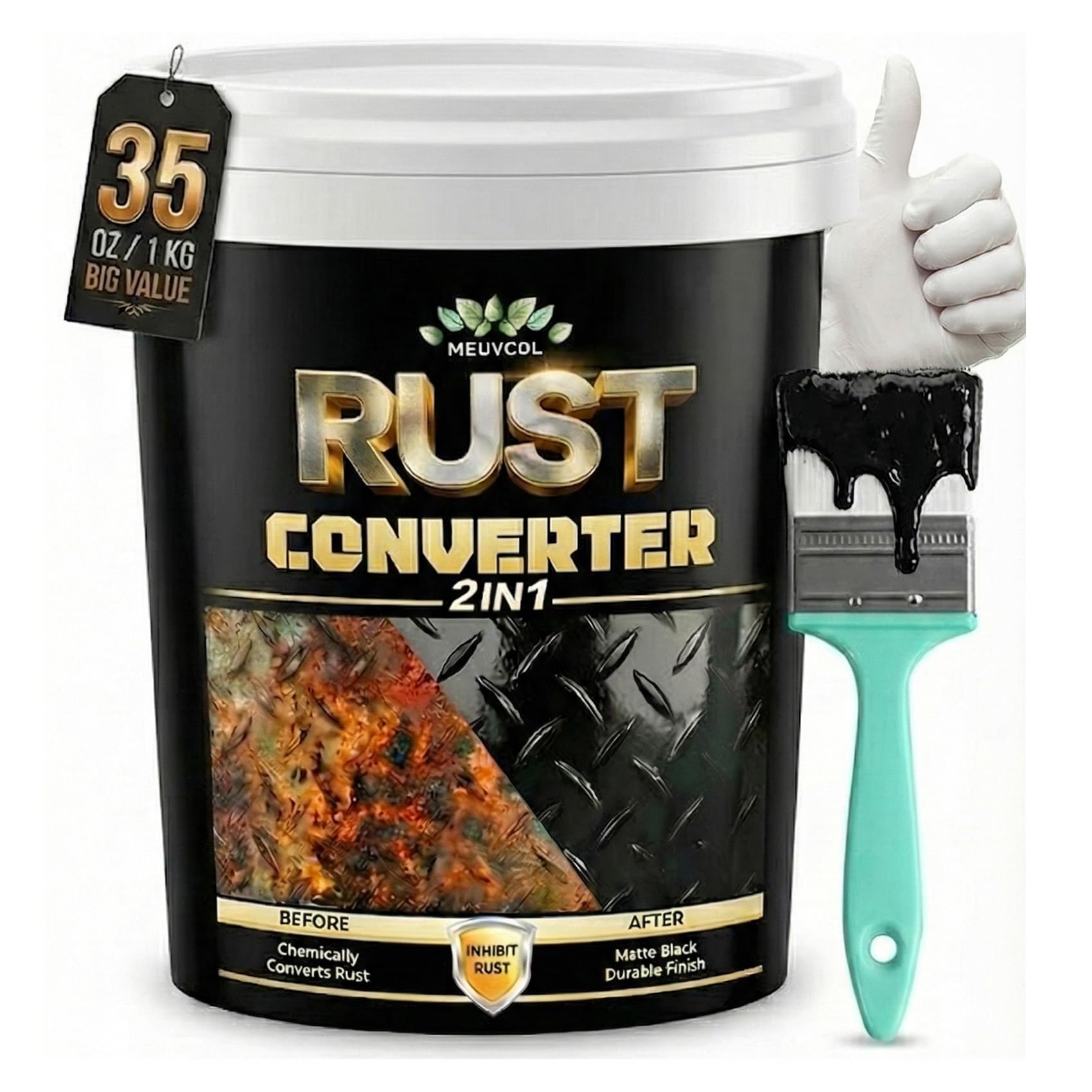
This is a true two-in-one: the phosphoric-acid based formula chemically converts iron oxide into a stable black layer while simultaneously laying down a matte primer that accepts paint after 24 hours. The 35-ounce can is one of the largest ready-to-use volumes in this category, making it ideal for big projects like a full truck frame, trailer deck, or farm implement without needing multiple containers.
Brush application is straightforward and the coating self-levels reasonably well, turning ugly brown scale into a uniform flat black finish. It includes a brush and gloves in the package, which is a thoughtful touch for first-time users. The waterproof barrier locks out oxygen and moisture effectively, and users report excellent adhesion on previously rusted railings, underbody pans, and suspension components.
The chemical smell is strong and requires a well-ventilated workspace. A small number of users have noted that the finish may chip if applied in a single heavy coat rather than the recommended thin layers, so follow the 2-coat minimum and full 24-hour cure before any mechanical contact.
Why it’s great
- Large 35 oz volume covers extensive projects
- Chemically converts rust while applying a primer in one step
- Self-leveling brush-on formula with included applicator kit
Good to know
- Strong odor requires good ventilation
- Thick coats may chip; thin layers cure better
5. CorrosionX Rust Inhibitor, Industrial-Strength Dielectric Corrosion Prevention
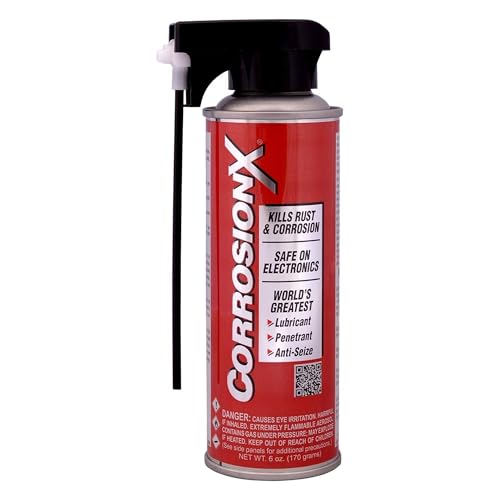
CorrosionX is a penetrating inhibitor first and a rust neutralizer second. Its unique value lies in the dielectric film it leaves behind — rated at over 39,000 volts — which makes it safe for battery terminals, electronic sensors, circuit boards, and marine electrical connections. The formula molecularly bonds to metal surfaces and subsurface layers, providing protection in environments where paint or wax alone would fail.
The product is qualified by the U.S. Navy under the Advanced Corrosion Preventive Compound specification, giving it a pedigree few consumer-grade products can match. Users report it effectively frees seized bolts, cleans corroded alternator terminals, and protects audio equipment connections without leaving conductive residue. It also displaces moisture instantly, making it a go-to for wet-storage engine components.
The aerosol nozzle is widely criticized — it delivers large splatters rather than a fine mist, which wastes product on precise jobs. The liquid form is quite thin and runs off vertical surfaces quickly, so multiple passes are needed. It also has a strong petroleum smell that lingers, though less offensive than some penetrating oils.
Why it’s great
- Dielectric barrier protects sensitive electronics safely
- Qualified by the U.S. Navy for marine corrosion control
- Penetrates and frees seized fasteners effectively
Good to know
- Nozzle produces coarse spray that wastes product
- Thin film runs off vertical surfaces easily
6. RUSTINS RUSC250 Rust Converter Water-Based Renovator for Metal 250ml

This water-based converter from Rustins does exactly what the name says — it converts rust into a stable black compound and seals the surface without requiring a separate primer. The 250ml tube is compact but punches above its weight for small-scale repairs: bathtub edges, appliance panels, tool surfaces, and localized car-body spots. It dries to a matte finish that can be overpainted with any standard coating.
The chemical reaction happens quickly; users report that a thin coat neutralizes surface rust within an hour, and the surface is ready for paint in 4 hours. Unlike many converters that leave a rubbery or gummy layer, this one dries to a hard, sandable surface. It is waterproof once fully cured, making it suitable for moist indoor environments like laundry rooms and basements.
The 250ml volume is limiting — it will not cover a frame or underbody. If applied too thickly, the finish can be difficult to sand smooth. It is also labeled for indoor use, so exposure to continuous UV or road salt may degrade it faster than dedicated automotive encapsulators.
Why it’s great
- Water-based formula with low odor for indoor work
- Dries to a hard, sandable, paint-ready surface in 4 hours
- Effectively neutralizes rust on appliances and tubs
Good to know
- Small 250ml volume limited to spot repairs
- Primarily an indoor product; less durable outdoors
7. JENOLITE Waxoil Rust Prevention Aerosol, 500ml

JENOLITE Waxoil is a traditional waxy rust inhibitor that excels in the application areas hardest to reach: door internals, sills, box sections, wheel arches, and chassis cavities. The aerosol sprays a thick, waxy fluid that drives out moisture on contact and leaves behind a self-sealing film that bridges small scratches and punctures without losing its protective properties.
Users in the salt-belt states report excellent results on truck suspension parts, camper slide rails, and frame sections that could not be painted. Unlike lanolin-based products that remain oily and attract dirt, this wax dries to a paint-like touch that stays clean and does not produce black smudges on clothing. It is also paintable, though adhesion of topcoats can be inconsistent over the waxy layer.
The aerosol stream can be difficult to control in tight spaces, and the waxy build-up can clog the nozzle if not cleaned immediately after use. Coverage is moderate — one 500ml can treats a single vehicle’s front suspension and underbody but will not cover a full truck frame. For large projects, budget multiple cans.
Why it’s great
- Self-sealing wax film repairs minor scratches automatically
- Dries to a non-smudge, paint-like touch
- Ideal for door cavities, sills, and box sections
Good to know
- Aerosol nozzle can clog with waxy residue
- One can is insufficient for a full truck frame
FAQ
What is the difference between a rust converter and a rust encapsulator?
Can I paint over a waxy rust inhibitor like Waxoil or CRC?
Final Thoughts: The Verdict
For most users, the automotive rust neutralizer winner is the Eastwood Rust Encapsulator Platinum because its proven 1,500-hour salt spray resistance and UV-stable metallic finish offer the longest service life for outdoor panels and frames. If you need to protect internal cavities and box sections, grab the Eastwood Internal Frame Coating for its 360-degree spray wand. And for budget-conscious undercoating with self-healing properties, nothing beats the value of the CRC 06026 4-Pack.