
That single click instead of a roar from the engine is the most frustrating sound for any vehicle owner. It’s the sound of a starter solenoid begging for more amperage, and if you hear it repeatedly, you are staring at a dead starter relay or a low-current trigger that needs a booster. An automotive starter relay is the unsung switch that takes a tiny ignition signal and flips a massive current gate to the starter motor — when it fails, nothing turns.
I’m Min — the co-founder and writer behind Gadgets Feed. I have spent hundreds of hours cross-referencing technical datasheets, real-user stress tests, and compatibility matrices to sort through this narrow category and identify which relays actually fix the common click-click failure without cooking your wiring.
This guide shows you exactly how to select the best replacement based on current ratings, terminal design, and duty-cycle demands, so you can find the optimal automotive starter relay for your specific application — weed out the cheap fakes and land on a unit that will crank reliably season after season.
How To Choose The Best Automotive Starter Relay
Selecting the right relay requires matching the electrical demand of your starter motor with the relay’s continuous and inrush current ratings. A mismatch leads to fried contacts, voltage drop, or the relay itself becoming the weak link that leaves you stranded.
Current Rating: Continuous vs. Inrush Peak
The most critical spec is the relay’s continuous duty current — usually 80A to 125A for most automotive starters. However, the real strain is the inrush peak (the 300ms surge when the solenoid engages), which can exceed 200A to 500A. A relay with a high peak rating survives the initial slam; one rated only for continuous 80A may weld its contacts after a few hot starts.
Terminal Configuration and Mounting Style
Three-terminal SPST relays are standard for starter solenoid replacement: one large terminal to battery, one large to starter, and a small trigger terminal. Four-terminal versions add a second small terminal for grounding or auxiliary functions. Check your OEM bracket hole spacing (5/16 x 19/32 with 2-13/64 on center is typical) and ensure the mounting foot fits your firewall or starter-mount bracket without bending.
Contact Material and Environmental Sealing
Silver-alloy or copper-silver contacts offer the lowest resistance and resist arc pitting better than plain copper. For exposed engine-bay installs, look for a sealed case or at least an environmental plating (zinc or nickel) to prevent rust from locking the plunger. Unsealed relays in wet applications need periodic inspection or a silicone bead around the case seam.
Quick Comparison
On smaller screens, swipe sideways to see the full table.
| Model | Category | Best For | Key Spec | Amazon |
|---|---|---|---|---|
| HD Switch LED Kit | Starter Relay | Mower click-click fix | 3-terminal plug-in | Amazon |
| APIELE 125A Continuous | Solenoid Relay | Golf cart / marine | 125A continuous / 300A peak | Amazon |
| Stylemafia 200A Trombetta | Heavy Duty | Winch / high-draw loads | 200A peak / 100A continuous | Amazon |
| MaySpare 300A Peak | Upgraded Solenoid | Motorcycle / tractor | 300A inrush / 150A cont. | Amazon |
| MaySpare 80A Isolator | Battery Isolator | Dual-battery / RV | 80A cont. / 500A surge | Amazon |
| Hamolar 200A 4-Pin | Accessory Relay | Split-charge / light bars | 200A continuous (rated) | Amazon |
| Ronybuy Waterproof 4-Pin | General Relay | Lights / horns / fans | 40/30A / 12 AWG wires | Amazon |
In‑Depth Reviews
1. HD Switch Starter Relay w/LED Kit
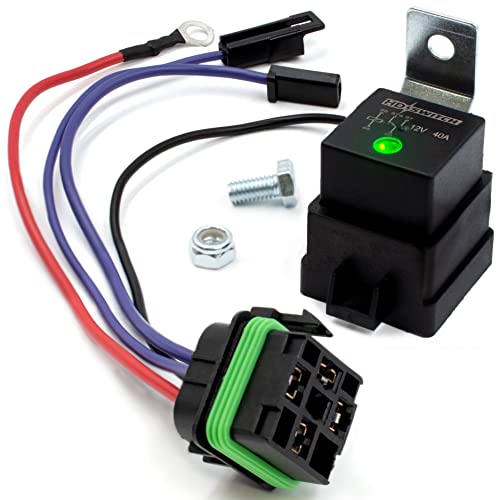
The HD Switch relay is the most effective direct fix for the dreaded click-click-click on John Deere, Bad Boy, Snapper Pro, and other Kawasaki/Kohler-equipped machines. It is a 3-terminal plug-in design with an integrated LED that gives visual confirmation of trigger voltage — a feature that saves hours of troubleshooting when the safety switch chain is suspect. Multiple verified owners on 2024 Badboy Revolts and 1988 AMT600s report that a 15-minute install resolved intermittent starting after new batteries and cleaned connections failed.
Unlike generic solenoids that require manual grounding or wire splicing, this relay is designed to replace the stock AM107421 / AM106304 part exactly. The package includes mounting hardware and a clear wiring diagram. The LED stays lit when the ignition key is turned to start, letting you immediately know if the safety switches on the seat or brake pedal are passing voltage. One installer found that tapping this relay gave his existing starter solenoid the extra amperage it needed to engage cleanly — saving a starter replacement.
It is critical to note that this unit is explicitly NOT compatible with Briggs & Stratton engines or remote-mounted solenoids — it only fits applications where the solenoid mounts directly to the starter housing. The silver-alloy contacts and sealed harness are built for outdoor power equipment vibration and moisture, but the plastic plug-in housing is less robust than a full metal-shell relay. For tractor and zero-turn mowers with persistent click issues, this is the simplest and most proven solution.
Why it’s great
- Built-in LED gives instant visual diagnostic of trigger signal
- Plug-in harness eliminates guesswork on a direct OEM swap
- Verified fix for Kawasaki/Kohler engines suffering click-click failure
Good to know
- Not for Briggs & Stratton engines or remote-mounted solenoids
- Plastic housing less durable than all-metal alternatives
- Primarily designed for specific lawn-tractor models, not universal cars
2. MaySpare 300A Peak Instant Current Solenoid

The MaySpare XR-2061 is a 300A inrush-rated solenoid with 14Ω coil resistance and 10.2W power draw, making it a strong upgrade for motorcycles (Honda VTX1800), older tractors (Dynahoe), and golf carts. Owners replacing OEM solenoids on VTX1800 motorcycles report that this unit cranks faster than generic Amazon parts because it actually delivers the rated in-rush current without sagging. The 150A continuous recommendation means it can handle sustained loads from heavy winching or high-compression starters during hot restart cycles.
The nickel-plated cover and 180°C copper wire coil are the key differentiators here — the plating resists rust in high-humidity engine bays, and the copper winding dissipates heat faster than aluminum-wound competitors. Bracket mounting holes match the standard 5/16 x 19/32 pattern with 2-13/64 on-center spacing, which fits most Ford, GM, and compact equipment starter brackets without drilling. The included copper contact points are large enough to avoid pitting even when the engine is cranking hard on a low battery.
A major quirk is the grounding requirement: one of the two small terminals must be grounded for the solenoid to energize, which is opposite of some OEM designs that are internally grounded. This catches many first-time installers off guard. The manufacturer also recommends a 5-minute cool-down between start cycles and warns against applying more than 5N of force to the plastic internal parts. For high-amperage applications like an old Dynahoe loader, verified buyers say it handles the draw without hesitation.
Why it’s great
- 300A peak handles high compression and inrush loads reliably
- Nickel-plated shell resists corrosion in wet environments
- Faster cranking speed than many generic solenoids on large displacement engines
Good to know
- Second small terminal must be manually grounded; not internally grounded
- Requires 5-minute cool-down between starts as per manufacturer
- Plastic internal parts are delicate if over-torqued during install
3. APIELE 125A Continuous Solenoid Relay 12V DC
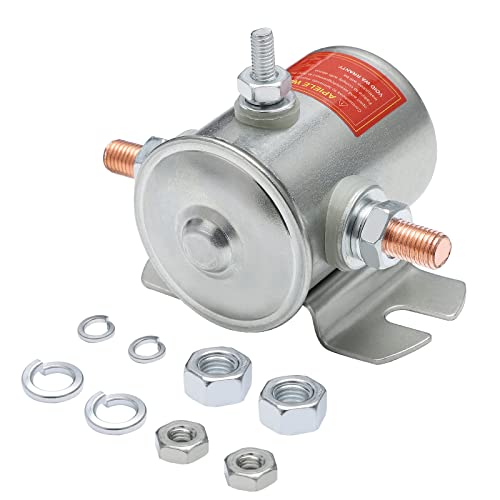
The APIELE relay is rated for 125A continuous duty, with a maximum 300A inrush that lasts up to 60 seconds — a specification that makes it a strong fit for golf carts, trolling motors, and winch applications where the relay stays energized for extended cycles. The coil is wound with 180°C copper wire, and the zinc-plated shell passes through salt-spray resistance tests that cheaper painted housings fail. Users have installed this on mowers, RV campers, and marine battery isolators and confirm it runs cooler than the box-store equivalent.
Terminal layout is the classic three-stud SPST: two large 5/16-inch studs for battery and starter, and one small screw terminal for the ignition trigger. The 14Ω coil resistance and 10.2W consumption mean it won’t tax a weak key switch. Replacements parts numbers include 1114240, 1114241, 1114538, and a dozen other cross-references, which covers many Ford, Club Car, and Yamaha OEM units. The bracket is flat steel with holes spaced for the standard 2-13/64 on-center pattern — most buyers say the bolt pattern matches their original exactly.
Some users note that while the relay is technically continuous duty, the fine print warns against extended operation above 125A to avoid fire risk. A handful of installers on RVs use it only for 4-5 cycles per year and found it perfectly adequate, but those running it near the limit for long periods should consider a higher-rated unit. For the entry-level price point, the silver alloy contacts and copper coil construction deliver reliable performance for intermittent starter and isolator use.
Why it’s great
- 125A continuous rating suits most starter, marine, and winch applications
- 180°C copper wire handles heat soak better than aluminum windings
- Zinc-plated housing prevents rust in exposed engine compartments
Good to know
- Not designed for long-duration high-load without cool-down
- Mixed feedback on sustained use near 125A for more than 60 seconds
- Compatibility with vehicles with remote-mounted solenoids is limited
4. Stylemafia 200A Continuous Solenoid Relay

The Stylemafia 200A relay is built to survive fire-apparatus primer pumps, marine winch circuits, and heavy farm equipment where a standard solenoid would weld its contacts after a few cycles. The internal contactor uses 180°C copper wire and flat copper points rather than the smaller round pins found on budget relays. One verified buyer used this as a direct replacement on a fire truck primer pump motor and confirmed it handles the inrush without burning up the motor’s internal brushes.
This is a 3-terminal normally open SPST design with a flat metal base case and 10-32 studs. The bracket is galvanized steel with the standard 5/16 x 19/32 holes spaced 2-13/64 on-centers. The manufacturer recommends a 5A fuse on the trigger circuit if using 16-18 AWG wire, or a 30A circuit breaker if running 10 AWG to the load. The sealed unit is plated to prevent corrosion, but the case seam is not fully potted, so marine users may want to run a bead of silicone around the crimp line for total waterproofing.
Some users noted the relay lacks the copper bus bar that hospital-grade solenoids have, meaning you must use 4/0 welding cable and eye rings to connect the high-amp side. Once wired correctly, it acts as a rugged, maintenance-free switch that one four-season Jeep owner described as “heavy duty enough to trust for auxiliary battery management.” For those needing to replace a Trombetta 24106 or any 3-terminal 200A-class relay, this is a cost-effective drop-in.
Why it’s great
- 200A peak rating handles heavy winch and pump loads without contact welding
- Galvanized steel bracket with standard bolt pattern simplifies installation
- 180°C copper winding handles heat soak in continuous-duty scenarios
Good to know
- No integrated copper bus bar; requires 4/0 cable for full current flow
- Case seam not fully potted — add silicone for marine/off-road use
- Best suited for low-cycle heavy loads, not frequent daily starting
5. MaySpare 80-Amp Continuous Duty Battery Isolator Relay

The MaySpare 80A relay is a 4-terminal white-bodied SPST designed primarily as a battery isolator for dual-battery setups in RVs and off-road vehicles. It uses copper contacts with silver pins and claims a 500A surge max at 5ms, with a mechanical cycle life of 100,000 engagements. The kit includes four large 100A ring terminals and four smaller signal terminals, plus insulated red caps, making it a complete package for a secondary battery install.
This relay cross-references with White-Rodgers 120-105751 and Cummins 3916301/3916302 parts, commonly used in school buses and heavy-duty truck auxiliary systems. The 18Ω coil draws only about 0.8A at 12V, which is gentle on the trigger circuit. Users running it for split-charge between starter and house batteries report consistent cut-in and cut-out without the constant clicking that cheaper isolators produce. The compact white plastic enclosure is flame-retardant and fits into standard relay panel cutouts.
The real limitation is the 80A continuous rating — anyone trying to pass sustained 100A+ through this relay will cause it to overheat quickly. A verified Jeep owner tried using it at 100A continuous and reported the unit became too hot to touch and emitted a burning smell. For its intended role (isolating a secondary battery charging at 30-60A), it works flawlessly. For direct starter duty or high-output alternator feeds, you should step up to a 125A or 200A class relay.
Why it’s great
- 500A surge rating protects against inrush during battery connection
- Includes complete wiring hardware — terminals and insulating caps
- 100,000 mechanical life cycle exceeds typical automotive solenoids
Good to know
- 80A continuous rating is too low for direct starter or high-amp winch use
- Plastic housing not as durable as all-metal solenoids under vibration
- Some units reported overheating when used near 100A continuous
6. Hamolar 2-Pack 200A Continuous Duty Relay
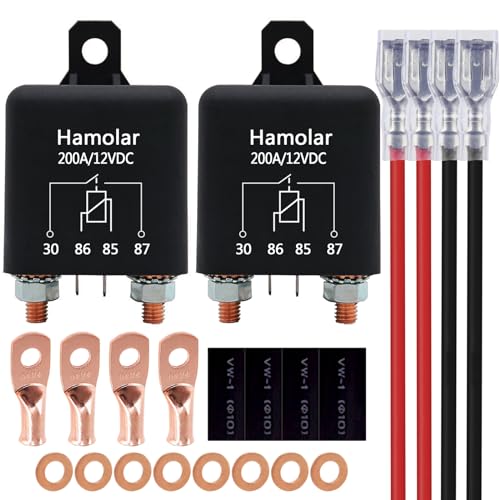
The Hamolar 200A relay comes as a 2-pack, each unit a 4-terminal SPST with silver-plated internal contacts and flame-retardant housing. One of the most popular applications is as a master kill switch or split-charge relay for 12V accessory systems — jeeps, ATVs, boat consoles, and light bars. A Jeep owner used one for 1.5 years to handle 60A continuous feed to wipers, heater, stereo, and ignition, concluding it saved the OEM ignition switch from burning out.
Each relay measures about 1.5 x 1.5 x 1.5 inches and uses standard 6.3mm spade terminals on the coil side and 10mm studs on the main contacts. The package includes terminal gaskets for extra sealing. Users on ATV winch applications found the relay prevents parasitic battery drain from wireless remote receivers because it disconnects the load completely when the ignition is off. Several buyers recommended applying clear silicone around the case seam before mounting in wet environments, as the unit is not IP-rated for submersion.
The major caveat is that the 200A rating is theoretical peak — real-world testing by a verified ATV owner showed the relay became hot at 100A continuous, and the screws/brass eyelets are lower quality than industrial-grade terminals. For dedicated starter solenoid duty, a single 3-terminal unit with thicker copper is the safer bet.
Why it’s great
- Two relays per package — great value for accessory wiring projects
- Silver-plated contacts resist pitting in moderate-current applications
- Prevents battery drain from remote electronics in ATV/off-road use
Good to know
- 200A rating is optimistic; runs hot at sustained current above 100A
- Not sealed — silicone bead required for wet or dusty environments
- Brass eyelets and terminal quality is functional but not industrial-grade
7. Ronybuy 4-PIN 12V Waterproof Relay with Harness (5-Pack)
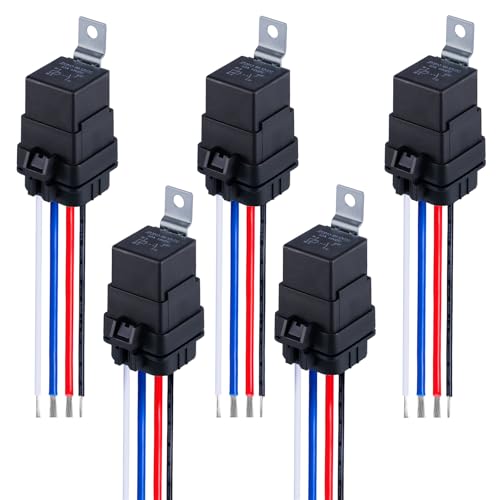
The Ronybuy 5-pack consists of standard 40/30A 4-pin automotive relays with pre-wired IP65 waterproof harnesses, making them the ideal solution for add-on circuits like horns, fog lights, cooling fans, and electric radiator fans. Each relay comes with a color-coded harness: pin 87 (Blue) and pin 30 (Red) use 12 AWG wire, while pin 85 (Black) and pin 86 (White) use 16 AWG control wires. The tinned copper wires resist oxidation in salt-prone environments, and the rubber cap seals the terminals against hose-down pressure washing.
These are NOT starter solenoids — they are general-purpose SPST relays designed to let a small trigger current (from a switch or ECU) switch a higher load circuit (up to 40A). The wiring diagram printed on the housing makes installation straightforward for DIYers. A truck owner used one to wire a Motohorn in the engine bay where moisture exposure was inevitable, and the IP65 seal kept the contacts dry through repeated rain events. The multi-pack also includes five identical harnesses, providing spares for future projects or for wiring multiple circuits simultaneously.
The obvious trade-off is current limitation: 40A is far too low for starter motor or winch direct control — anyone trying to use this for a starter relay will burn the contacts in one cycle. Also, the 40/30A rating means the normally open contact (pin 87) is rated 40A, but the normally closed contact (87A) is only 30A. For simple on/off accessory circuits where the load stays under 35A, this kit offers unbeatable convenience and value. For actual starter duty, stick with the 3-terminal continuous-duty units above.
Why it’s great
- IP65 waterproof rating keeps contacts dry in harsh engine-bay conditions
- Pre-wired harness with 12 AWG load wires simplifies installation
- Five units per pack — perfect for multiple accessory circuits or spares
Good to know
- 40A rating is strictly for low-draw accessories, not starter motor duty
- Normally closed contact limited to 30A — check your circuit type
- Not recommended for continuous loads above 35A to avoid voltage drop
FAQ
Can I use a 4-pin general-purpose relay for a starter solenoid replacement?
What does “click-click” mean when I turn the key and the starter doesn’t engage?
How do I know if my starter relay is “continuous duty” or “intermittent duty”?
Final Thoughts: The Verdict
For most users, the automotive starter relay winner is the HD Switch Starter Relay w/LED Kit because its plug-in design and built-in LED solve the click-click failure with zero guesswork on Kawasaki or Kohler mowers. If you need a 300A inrush-capable relay for high-compression tractors or motorcycles, grab the MaySpare 300A Peak Solenoid. And for heavy winch or fire-suppression loads where continuous ruggedness is non-negotiable, nothing beats the Stylemafia 200A Trombetta Relay.